

Microsoft is developing an AI-powered Data Loss Prevention Policy Optimizer for the web-based Microsoft Purview portal. Preview is planned for August 2026, followed by general availability in September 2026. Administrators should treat its prioritized recommendations as review inputs—not automatic instructions—and validate any proposed policy change in simulation or an equivalent non-enforcing test workflow before applying it to production enforcement.
The central question is therefore not whether AI can find possible cleanup opportunities. It is whether the optimizer can provide enough evidence for administrators, security teams, compliance owners, and change boards to decide safely what—if anything—should change.
Enterprise DLP rarely remains simple. A deployment may begin with a narrow business objective: identify regulated records, restrict sensitive transfers, warn users about risky sharing, or escalate activity for investigation. Complexity develops as new departments, data types, applications, regulatory obligations, exceptions, acquisitions, and collaboration patterns are added.
A policy may be adjusted after a legitimate workflow is interrupted. Another rule may be introduced for a newly recognized risk. An old condition may remain because nobody can confidently demonstrate that removing it will preserve coverage. Eventually, the configuration reflects not only current requirements but also years of incidents, audit findings, emergency changes, user complaints, and organizational history.
The result can resemble an archaeological site. Administrators can inspect the current rules, but the reason for each layer may be distributed across tickets, approvals, internal documentation, and the memories of former policy owners.
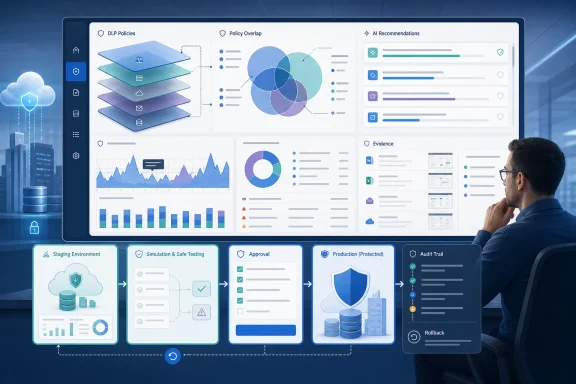
Policy Optimizer is designed to help analyze that accumulated complexity. According to the roadmap description, it will examine policy structure and activity signals, identify optimization opportunities that may be difficult to detect manually, and present prioritized recommendations supported by evidence and suggested actions.
That is more consequential than producing a plain-language summary of a selected policy. A summary explains what configuration is visible. An optimizer must identify a possible problem, show why it matters, and suggest a change without obscuring the trade-offs involved.
The roadmap names four categories of findings:
The optimizer’s promised output is as important as the categories it will examine. Microsoft is not describing only a health score or a generic warning that a policy needs attention. The roadmap calls for prioritization, evidence, and suggested actions.
Each element serves a different administrative need:
That is why the optimizer should initially be approached as a decision-support system. The roadmap describes recommendations, not a transfer of policy authority from administrators to AI.
A mature DLP estate may contain:
Microsoft’s decision to mention both policy structure and activity signals is therefore significant. It suggests that the optimizer will not be limited to checking whether configuration fields are present or syntactically valid.
The roadmap does not explain exactly how those two information sources will be combined. Administrators should not assume, before preview testing, that the optimizer understands business intent, regulatory purpose, policy ownership, or the historical reason for an exception.
Instead, preview testing should ask:
The configuration view asks what policies, rules, conditions, exceptions, scopes, and actions exist. The operational view asks what those controls are detecting and what administrative workload or business impact follows.
Looking at only one view can produce misleading conclusions. Configuration analysis may reveal that two rules are similar without showing whether they generate meaningful activity. Operational analysis may show high event volume without identifying which part of a rule is responsible.
Policy Optimizer is notable because Microsoft says it will analyze policy structure and activity signals. In principle, connecting those views can help administrators move from a general complaint—such as excessive noise—to a specific policy element that deserves investigation.
The key phrase is deserves investigation. A high-volume rule is not automatically defective. It may be accurately identifying a recurring risk. A rarely triggered rule is not automatically unnecessary. It may protect an infrequent but highly sensitive process.
The roadmap does not state how the optimizer will weigh frequency, sensitivity, severity, business impact, or policy intent. It also does not specify whether administrators will be able to adjust the basis of prioritization.
That uncertainty makes the promised supporting evidence essential. A recommendation such as “review this rule” is useful only if the administrator can determine why it was selected and what would be affected by the suggested action.
A useful recommendation would ideally make it possible to answer questions such as:
Those details will determine whether Policy Optimizer becomes an operational tool or remains primarily a discovery aid.
September 2026 — General availability planned: Microsoft plans to begin broader production availability for the same platform and cloud instance.
Roadmap dates are plans rather than guarantees, and no specific release day is included in the supplied facts. Administrators should confirm availability in their own tenants before scheduling testing or production changes.
A mature policy estate will almost always contain something that appears untidy. The meaningful test is whether Policy Optimizer can distinguish harmless complexity from a configuration issue that creates operational cost or weakens policy clarity.
Preview testers should determine whether the interface explains the basis of each ranking. If it does not, administrators will need to avoid treating the top recommendation as automatically the most important security issue.
Teams should test whether evidence can be traced back to identifiable policy elements and whether another reviewer can reproduce the reasoning. A recommendation that cannot be independently examined will be difficult to defend during governance, audit, or change-control review.
The roadmap does not specify what evidence will be available. Preview testers should ask whether it includes sufficient context to understand the finding without relying solely on an AI-generated explanation.
Administrators should create test cases that include intentional overlap and documented exceptions. The goal is to determine whether the optimizer merely detects similarity or provides enough context for a human to decide whether that similarity represents a real problem.
The roadmap does not state what activity window the optimizer will analyze or whether customers can select that window. Testers should determine whether recommendations disclose the relevant period and whether limited activity is clearly identified as a source of uncertainty.
A recommendation based on a narrow observation period should not be given the same administrative weight as one supported by consistent activity across a representative interval.
Preview testers should determine whether suggested actions explain those trade-offs or merely present simplification as an unqualified improvement.
The safest evaluation question is not, “Will this recommendation reduce noise?” It is, “What will this recommendation change, and which expected protection scenarios must still work afterward?”
The roadmap does not promise confidence levels, uncertainty indicators, or deterministic validation. Administrators should examine whether the product distinguishes strong findings from tentative ones and whether its language encourages verification.
The roadmap does not promise feedback learning, suppression controls, recommendation exceptions, decision history, or an approval workflow. These should be treated as preview questions:
The optimizer’s evidence should answer the first question:
Simulation is presented here as an operational safeguard, not as a claim about Microsoft’s documented deployment guidance or about any behavior promised by Policy Optimizer. If the available Purview environment does not support the exact test workflow an organization requires, the team should use an equivalent controlled validation process appropriate to its policies and change procedures.
Broad bundles of changes should be avoided where practical. If several rules, conditions, scopes, and exceptions are modified simultaneously, it becomes difficult to identify which adjustment produced an improvement or introduced a gap.
Incremental implementation may take longer, but it creates clearer evidence. It also supports rollback because the organization can reverse a specific change rather than reconstructing a large policy revision after an unexpected result.
They do not establish that the feature will understand every organization’s intent. They do not promise automatic remediation, cross-policy governance, feedback learning, confidence indicators, projected outcomes, or an audit-ready approval workflow.
They also do not establish how deeply AI will participate in the policy-editing experience. Administrators should avoid assuming that Policy Optimizer is embedded in a particular DLP editor, acts on a selected policy in a particular way, or duplicates capabilities associated with another Microsoft security assistant unless Microsoft documents those details.
The more useful comparison is conceptual. A descriptive assistant tells an administrator what a configuration appears to do. An optimization system evaluates whether something may deserve improvement. Policy Optimizer is being presented in the second category, but its practical value will depend on how clearly it connects each recommendation to inspectable configuration and activity evidence.
Fluent explanations will not be enough. Compliance and security teams need findings that can be reviewed, challenged, tested, approved, and recorded. If two reviewers cannot identify the same underlying rules and signals behind a recommendation, the output may be useful for exploration but not sufficient for policy change.
That standard is especially important because DLP changes can affect both protection and business activity. An overly broad control may interrupt legitimate work. An overly narrow control may miss sensitive information. Optimization must therefore be evaluated against the organization’s actual control objectives, not against neatness or reduced volume alone.
Teams should also compare the optimizer’s output with existing pain points. If analysts already know which policies consume disproportionate review time, does the optimizer identify them? If it does, does its evidence point to the same causes? If it does not, is the difference explained by a missing activity signal, a limited observation period, or a different definition of priority?
Disagreement should not automatically be treated as product failure. The optimizer may expose an overlooked relationship, while the human team may possess business context that is not represented in the data. The value of preview testing lies in investigating those disagreements rather than assuming that either side is automatically correct.
Organizations should document:
Prioritized recommendations could help direct scarce specialist attention. Supporting evidence could improve conversations among administrators, compliance owners, legal teams, business stakeholders, and change boards. Suggested actions could reduce the effort required to move from diagnosis to a testable proposal.
The roadmap, however, promises assistance rather than authority. It does not remove the need for policy ownership, business context, controlled testing, approval, monitoring, or rollback.
The concise verdict: Policy Optimizer could become a valuable DLP maintenance and discovery tool when preview begins in August 2026, but administrators should use its recommendations as evidence-backed review inputs, validate every proposed change before enforcement, and retain final policy authority with accountable human owners.
The feature is intended to identify overlapping rules, redundant conditions, misconfigurations, and excessive noise by examining DLP policy structure and related activity signals. Microsoft’s roadmap promises prioritized recommendations, supporting evidence, and suggested actions. That combination could make Policy Optimizer useful to organizations whose DLP environments have become difficult to maintain, but the roadmap does not promise autonomous remediation or automatic policy rewriting.Policy Optimizer fact box
- Roadmap ID: 564616
- Status: In development
- Product: Microsoft Purview
- Platform: Web
- Cloud: Worldwide Standard Multi-Tenant
- Preview: August 2026
- General availability: September 2026
The central question is therefore not whether AI can find possible cleanup opportunities. It is whether the optimizer can provide enough evidence for administrators, security teams, compliance owners, and change boards to decide safely what—if anything—should change.
 Microsoft Is Aiming AI at DLP’s Maintenance Problem
Enterprise DLP rarely remains simple. A deployment may begin with a narrow business objective: identify regulated records, restrict sensitive transfers, warn users about risky sharing, or escalate activity for investigation. Complexity develops as new departments, data types, applications, regulatory obligations, exceptions, acquisitions, and collaboration patterns are added.A policy may be adjusted after a legitimate workflow is interrupted. Another rule may be introduced for a newly recognized risk. An old condition may remain because nobody can confidently demonstrate that removing it will preserve coverage. Eventually, the configuration reflects not only current requirements but also years of incidents, audit findings, emergency changes, user complaints, and organizational history.
The result can resemble an archaeological site. Administrators can inspect the current rules, but the reason for each layer may be distributed across tickets, approvals, internal documentation, and the memories of former policy owners.
Policy Optimizer is designed to help analyze that accumulated complexity. According to the roadmap description, it will examine policy structure and activity signals, identify optimization opportunities that may be difficult to detect manually, and present prioritized recommendations supported by evidence and suggested actions.
That is more consequential than producing a plain-language summary of a selected policy. A summary explains what configuration is visible. An optimizer must identify a possible problem, show why it matters, and suggest a change without obscuring the trade-offs involved.
The roadmap names four categories of findings:
- Overlapping rules
- Redundant conditions
- Misconfigurations
- Sources of excessive noise
The optimizer’s promised output is as important as the categories it will examine. Microsoft is not describing only a health score or a generic warning that a policy needs attention. The roadmap calls for prioritization, evidence, and suggested actions.
Each element serves a different administrative need:
- Prioritization can help teams decide where to begin.
- Supporting evidence can help reviewers understand why an issue was raised.
- Suggested actions can provide a starting point for remediation.
That is why the optimizer should initially be approached as a decision-support system. The roadmap describes recommendations, not a transfer of policy authority from administrators to AI.
Policy Sprawl Is the Real Enemy
Policy sprawl is not simply a large number of policies. An organization can have many well-owned, clearly separated controls and still operate them effectively. The harder problem is accumulated complexity without reliable context.A mature DLP estate may contain:
- Policies created by different teams at different times
- Similar rules with different scopes or business owners
- Exceptions introduced for temporary operational reasons
- Conditions whose original rationale is no longer documented
- Controls that appear duplicative but support separate obligations
- Rules that generate more investigation work than their owners expected
- Configuration inherited through reorganizations or acquisitions
Microsoft’s decision to mention both policy structure and activity signals is therefore significant. It suggests that the optimizer will not be limited to checking whether configuration fields are present or syntactically valid.
The roadmap does not explain exactly how those two information sources will be combined. Administrators should not assume, before preview testing, that the optimizer understands business intent, regulatory purpose, policy ownership, or the historical reason for an exception.
Instead, preview testing should ask:
- Does the optimizer distinguish structural similarity from meaningful operational overlap?
- Does it explain which policy elements contributed to a finding?
- Does prioritization reflect activity volume, apparent risk, configuration severity, or another factor?
- How does it handle policies with little recent activity?
- Can administrators identify the activity period behind a recommendation?
- Does the product recognize when similar rules have different scopes, actions, owners, or governance purposes?
- Can intentional duplication be documented, deferred, or excluded from recurring recommendations?
Microsoft Is Connecting Configuration to Consequence
DLP administration often involves two related views.The configuration view asks what policies, rules, conditions, exceptions, scopes, and actions exist. The operational view asks what those controls are detecting and what administrative workload or business impact follows.
Looking at only one view can produce misleading conclusions. Configuration analysis may reveal that two rules are similar without showing whether they generate meaningful activity. Operational analysis may show high event volume without identifying which part of a rule is responsible.
Policy Optimizer is notable because Microsoft says it will analyze policy structure and activity signals. In principle, connecting those views can help administrators move from a general complaint—such as excessive noise—to a specific policy element that deserves investigation.
The key phrase is deserves investigation. A high-volume rule is not automatically defective. It may be accurately identifying a recurring risk. A rarely triggered rule is not automatically unnecessary. It may protect an infrequent but highly sensitive process.
The roadmap does not state how the optimizer will weigh frequency, sensitivity, severity, business impact, or policy intent. It also does not specify whether administrators will be able to adjust the basis of prioritization.
That uncertainty makes the promised supporting evidence essential. A recommendation such as “review this rule” is useful only if the administrator can determine why it was selected and what would be affected by the suggested action.
A useful recommendation would ideally make it possible to answer questions such as:
- Which policies, rules, or conditions are involved?
- What configuration relationship triggered the finding?
- What activity signals support the conclusion?
- Over what period were those signals evaluated?
- Is the issue primarily structural, operational, or both?
- What does the suggested action change?
- Which users, locations, workloads, or data scenarios might be affected?
- What assumptions must remain true for the recommendation to be safe?
Those details will determine whether Policy Optimizer becomes an operational tool or remains primarily a discovery aid.
Release Timeline
The Policy Optimizer is listed as in development for Microsoft Purview on the web. Its planned availability is limited, in the roadmap facts currently supplied, to the Worldwide Standard Multi-Tenant cloud.| Release ring | Planned availability | Product | Platform | Cloud instance |
|---|---|---|---|---|
| Preview | August 2026 | Microsoft Purview | Web | Worldwide Standard Multi-Tenant |
| General availability | September 2026 | Microsoft Purview | Web | Worldwide Standard Multi-Tenant |
Timeline
August 2026 — Preview planned: Eligible organizations should begin evaluating recommendation quality, evidence quality, prioritization, and workflow safety.September 2026 — General availability planned: Microsoft plans to begin broader production availability for the same platform and cloud instance.
Roadmap dates are plans rather than guarantees, and no specific release day is included in the supplied facts. Administrators should confirm availability in their own tenants before scheduling testing or production changes.
Action checklist for admins
- Inventory existing DLP policies, policy owners, business purposes, scopes, exceptions, dependencies, and approval requirements before preview begins.
- Identify policies already associated with recurring complaints, investigation workload, confusing ownership, or suspected duplication.
- Document known intentional overlap so the optimizer can be tested against scenarios where similar controls must remain separate.
- Establish a baseline for relevant operational measures, such as event volume, analyst review effort, user-reported friction, overrides, and escalations.
- Treat every optimizer recommendation as a review input rather than a production change instruction.
- Require reviewers to inspect the supporting evidence and identify the affected policies, rules, conditions, scopes, and business processes.
- Assign an accountable policy owner to approve, modify, defer, or reject each recommendation.
- Define the expected result of a proposed change before testing it.
- Validate proposed revisions in simulation or another non-enforcing test workflow before modifying production enforcement.
- Confirm that expected sensitive-data scenarios remain detectable after the proposed revision.
- Change one meaningful policy element at a time when practical so that outcomes can be attributed to a specific adjustment.
- Record why recommendations were accepted, modified, deferred, or rejected.
- Prepare a rollback plan for every production change.
- Do not treat lower alert or event volume as proof of improved protection.
What Admins Must Validate in Preview
Preview testing should focus less on whether the optimizer can produce recommendations and more on whether those recommendations survive structured human review.A mature policy estate will almost always contain something that appears untidy. The meaningful test is whether Policy Optimizer can distinguish harmless complexity from a configuration issue that creates operational cost or weakens policy clarity.
1. What does “priority” mean?
The roadmap promises prioritized recommendations, but priority can represent several different things:- The frequency of related activity
- The apparent severity of a configuration issue
- The estimated administrative workload
- The system’s confidence in the finding
- The expected ease of remediation
- A possible effect on policy coverage
Preview testers should determine whether the interface explains the basis of each ranking. If it does not, administrators will need to avoid treating the top recommendation as automatically the most important security issue.
2. Is the evidence inspectable?
Evidence must do more than repeat the recommendation in longer language. “This rule is noisy” is a conclusion. Administrators need to see the configuration and activity basis for that conclusion.Teams should test whether evidence can be traced back to identifiable policy elements and whether another reviewer can reproduce the reasoning. A recommendation that cannot be independently examined will be difficult to defend during governance, audit, or change-control review.
The roadmap does not specify what evidence will be available. Preview testers should ask whether it includes sufficient context to understand the finding without relying solely on an AI-generated explanation.
3. Does the finding preserve business context?
Similar rules may be intentional. Different policies can inspect related information while applying to different users, locations, business processes, or obligations. Even when two controls appear structurally similar, consolidating them may change ownership, reporting, investigation context, or approval boundaries.Administrators should create test cases that include intentional overlap and documented exceptions. The goal is to determine whether the optimizer merely detects similarity or provides enough context for a human to decide whether that similarity represents a real problem.
4. How does it handle limited or seasonal activity?
Recent activity may not represent the full value of a policy. Some workflows occur only during annual reporting, quarterly processing, tax preparation, litigation, benefits enrollment, mergers, or other intermittent events.The roadmap does not state what activity window the optimizer will analyze or whether customers can select that window. Testers should determine whether recommendations disclose the relevant period and whether limited activity is clearly identified as a source of uncertainty.
A recommendation based on a narrow observation period should not be given the same administrative weight as one supported by consistent activity across a representative interval.
5. Are trade-offs visible?
Policy optimization is not simply a search for fewer events. A change can reduce repetition while also removing useful distinctions. It can simplify conditions while broadening or narrowing what the policy detects. It can make administration easier while changing a business workflow.Preview testers should determine whether suggested actions explain those trade-offs or merely present simplification as an unqualified improvement.
The safest evaluation question is not, “Will this recommendation reduce noise?” It is, “What will this recommendation change, and which expected protection scenarios must still work afterward?”
6. How is uncertainty represented?
AI-assisted analysis should be precise about uncertainty. A finding based on incomplete activity or ambiguous policy relationships should not look identical to an obvious configuration issue.The roadmap does not promise confidence levels, uncertainty indicators, or deterministic validation. Administrators should examine whether the product distinguishes strong findings from tentative ones and whether its language encourages verification.
7. Can decisions be governed over time?
An optimizer may become frustrating if it repeatedly raises intentional overlap after administrators have already reviewed and rejected the recommendation. It may also create governance problems if accepted and rejected suggestions cannot be connected to policy owners and change records.The roadmap does not promise feedback learning, suppression controls, recommendation exceptions, decision history, or an approval workflow. These should be treated as preview questions:
- Can a recommendation be deferred or dismissed with a reason?
- Can an intentional configuration be documented?
- Will the same rejected finding return?
- Can administrators see who reviewed a recommendation?
- Can the evidence and decision be retained with the associated change record?
- Can a recommendation be reassigned to the appropriate policy owner?
Recommendations Must Remain Separate from Implementation
Policy Optimizer can identify a possible issue, but finding an issue and validating a correction are different tasks.The optimizer’s evidence should answer the first question:
A non-enforcing test should answer the second:Why does this policy element deserve review?
Administrators should preserve that separation. They should first assess whether the finding is relevant, then prepare a specific revision, establish expected results, test the revision, compare outcomes with a baseline, and obtain approval before production enforcement is changed.Does the proposed change behave as intended?
Simulation is presented here as an operational safeguard, not as a claim about Microsoft’s documented deployment guidance or about any behavior promised by Policy Optimizer. If the available Purview environment does not support the exact test workflow an organization requires, the team should use an equivalent controlled validation process appropriate to its policies and change procedures.
Broad bundles of changes should be avoided where practical. If several rules, conditions, scopes, and exceptions are modified simultaneously, it becomes difficult to identify which adjustment produced an improvement or introduced a gap.
Incremental implementation may take longer, but it creates clearer evidence. It also supports rollback because the organization can reverse a specific change rather than reconstructing a large policy revision after an unexpected result.
This Is an Optimization Engine, Not a Policy Owner
The roadmap facts support a clear description of Policy Optimizer: it is planned to analyze DLP policy structure and activity signals, detect specified categories of optimization opportunity, and provide prioritized recommendations with evidence and suggested actions.They do not establish that the feature will understand every organization’s intent. They do not promise automatic remediation, cross-policy governance, feedback learning, confidence indicators, projected outcomes, or an audit-ready approval workflow.
They also do not establish how deeply AI will participate in the policy-editing experience. Administrators should avoid assuming that Policy Optimizer is embedded in a particular DLP editor, acts on a selected policy in a particular way, or duplicates capabilities associated with another Microsoft security assistant unless Microsoft documents those details.
The more useful comparison is conceptual. A descriptive assistant tells an administrator what a configuration appears to do. An optimization system evaluates whether something may deserve improvement. Policy Optimizer is being presented in the second category, but its practical value will depend on how clearly it connects each recommendation to inspectable configuration and activity evidence.
Fluent explanations will not be enough. Compliance and security teams need findings that can be reviewed, challenged, tested, approved, and recorded. If two reviewers cannot identify the same underlying rules and signals behind a recommendation, the output may be useful for exploration but not sufficient for policy change.
That standard is especially important because DLP changes can affect both protection and business activity. An overly broad control may interrupt legitimate work. An overly narrow control may miss sensitive information. Optimization must therefore be evaluated against the organization’s actual control objectives, not against neatness or reduced volume alone.
The Preview Should Be Treated as a Controlled Evaluation
Early adopters should begin with configurations whose purpose is already known. Useful test cases may include:- A documented case of intentional overlap
- A suspected redundant condition
- A known policy ownership problem
- A rule associated with recurring review workload
- A low-volume control protecting an important process
- A temporary exception that may have outlived its original purpose
- Two similar controls that apply to different populations or business units
Teams should also compare the optimizer’s output with existing pain points. If analysts already know which policies consume disproportionate review time, does the optimizer identify them? If it does, does its evidence point to the same causes? If it does not, is the difference explained by a missing activity signal, a limited observation period, or a different definition of priority?
Disagreement should not automatically be treated as product failure. The optimizer may expose an overlooked relationship, while the human team may possess business context that is not represented in the data. The value of preview testing lies in investigating those disagreements rather than assuming that either side is automatically correct.
Organizations should document:
- The original recommendation
- The evidence displayed
- The administrator’s interpretation
- The relevant business context
- The proposed action
- The expected outcome
- The test results
- The approval decision
- The production result, if implemented
- The rollback result, if reversal becomes necessary
A Promising Tool with a Deliberately Limited Mandate
Policy Optimizer addresses a real operational problem. DLP environments accumulate rules, exceptions, overlapping responsibilities, and unexplained historical decisions. Comparing that structure with activity signals can be time-consuming, particularly for organizations without dedicated policy-engineering teams.Prioritized recommendations could help direct scarce specialist attention. Supporting evidence could improve conversations among administrators, compliance owners, legal teams, business stakeholders, and change boards. Suggested actions could reduce the effort required to move from diagnosis to a testable proposal.
The roadmap, however, promises assistance rather than authority. It does not remove the need for policy ownership, business context, controlled testing, approval, monitoring, or rollback.
The concise verdict: Policy Optimizer could become a valuable DLP maintenance and discovery tool when preview begins in August 2026, but administrators should use its recommendations as evidence-backed review inputs, validate every proposed change before enforcement, and retain final policy authority with accountable human owners.
References
- Primary source: Microsoft 365 Roadmap
Published: 2026-07-10T21:58:35.1674832Z
Loading…
www.microsoft.com - Official source: learn.microsoft.com
Loading…
learn.microsoft.com - Official source: wwps.microsoft.com
- Official source: cdn-dynmedia-1.microsoft.com
- Official source: marketingassets.microsoft.com
Slide 1: Data security as a foundation for secure AI adoption
PDF documentmarketingassets.microsoft.com
- Official source: info.microsoft.com
Loading…
info.microsoft.com
- Official source: techcommunity.microsoft.com
Loading…
techcommunity.microsoft.com