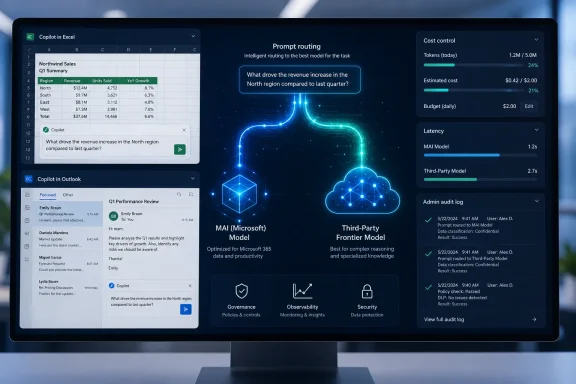
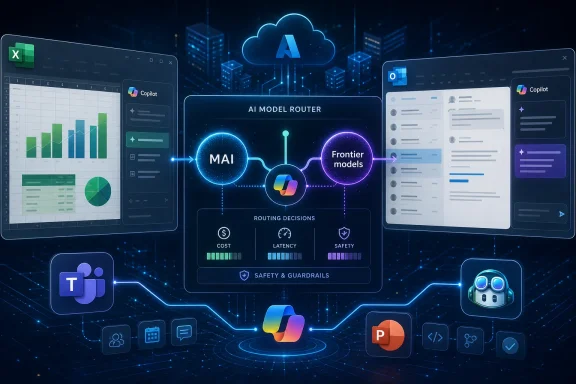
Microsoft has begun routing tens of thousands of weekly AI prompts from Excel and Outlook through its own MAI models, Bloomberg reported on July 7, 2026, marking the first disclosed production-scale shift of Microsoft 365 Copilot traffic away from OpenAI and Anthropic systems. The move is not a divorce from OpenAI, nor even a dramatic re-platforming of Copilot overnight. It is something more interesting: Microsoft has started treating frontier AI models as replaceable infrastructure.
That is the real story behind what sounds, at first, like a narrow backend routing change. Microsoft spent the first phase of the generative AI boom proving that OpenAI could be embedded everywhere Windows, Office, GitHub, and Azure customers already worked. The next phase is about proving that Microsoft does not have to pay someone else every time those customers ask a spreadsheet to summarize a table or an inbox to draft a reply.
For most of the Copilot era, Microsoft’s advantage was access. It had early, privileged, and deeply integrated access to OpenAI’s models at a moment when every other enterprise software company was scrambling to bolt chatbots onto existing products. That access let Microsoft move faster than Google in productivity software, faster than Amazon in enterprise AI packaging, and faster than most SaaS vendors in turning demos into paid SKUs.
But access is not the same thing as control. Once AI features become ordinary, the economics start to matter more than the novelty. A Copilot feature that looks magical in a launch demo becomes a recurring cost center when it runs across Outlook, Excel, Word, Teams, SharePoint, GitHub, Windows, and Azure every day.
Bloomberg’s report, later summarized by TechCrunch, says Microsoft is now using its in-house MAI models for a portion of prompts in workplace apps such as Excel and Outlook. The important phrase is not “tens of thousands,” impressive though that sounds. The important phrase is a portion, because model routing is how AI platforms quietly become markets.
A company does not need to replace GPT or Claude everywhere to change the leverage in a supplier relationship. It only needs enough credible substitution to say: this prompt does not require your most expensive model, this workflow can run on ours, and this category of traffic is no longer automatically yours.
An Outlook prompt to summarize a thread, rewrite a message, or extract action items does not necessarily need the most powerful reasoning model in the world. An Excel prompt to explain a formula, classify rows, generate a pivot suggestion, or summarize a table may need domain tuning and tight integration more than a benchmark-topping general model. That makes these apps ideal proving grounds for first-party models that are “good enough” in the most commercially important sense: good enough at scale, inside the workflow, at a lower marginal cost.
This is where Microsoft’s position differs from OpenAI’s. OpenAI sells intelligence as the product. Microsoft sells productivity, identity, cloud infrastructure, compliance, device management, collaboration, developer tooling, and now intelligence as a layer inside all of it.
That means Microsoft can optimize for the total system. If a smaller MAI model handles a common Copilot request cheaply and fast, while a frontier OpenAI or Anthropic model is reserved for more demanding reasoning, the user may never know which model answered. The CFO will.
That sentence matters because it punctures the marketing fog around “model choice.” Customers hear model choice and imagine flexibility, innovation, and a buffet of best-in-class tools. Platform owners hear model choice and imagine procurement leverage.
Microsoft has every reason to keep OpenAI and Anthropic in the tent. OpenAI remains strategically central to Copilot, Azure AI, and Microsoft’s broader AI credibility. Anthropic gives Microsoft a high-end alternative, particularly for customers and developers who prefer Claude for coding, writing, or agentic workflows. But multi-model architecture also prevents any one outside lab from becoming the tollbooth for Microsoft’s future.
This is not merely about saving a few cents on a prompt. It is about avoiding a structural dependency in which every successful AI feature increases Microsoft’s reliance on someone else’s compute, pricing, release cadence, safety policy, and enterprise roadmap.
The lineup reportedly included MAI-Thinking-1 for reasoning, MAI-Code-1-Flash for software development, MAI-Image-2.5, MAI-Voice-2, and MAI-Transcribe-1.5. Microsoft’s public pitch emphasized efficiency as much as capability. That is exactly what one would expect from a company trying to embed AI into hundreds of millions of paid seats without letting inference costs eat the business model.
The distinction between launch and deployment is crucial. Tech companies announce models all the time. They publish benchmark charts, put a model in preview, offer it to a small set of developers, and declare strategic independence. Real independence begins when production traffic moves.
That is why the Bloomberg detail about Excel and Outlook lands differently from the Build stagecraft. GitHub Copilot support shows developer availability. Model cards and benchmark claims show technical ambition. But weekly production prompts in Microsoft 365 show that MAI is being trusted inside the company’s most valuable software estate.
A router does not have to make a philosophical argument about whether GPT, Claude, Gemini, or MAI is “better.” It has to decide which model is suitable for this user, this tenant, this data boundary, this latency budget, this compliance regime, this feature, and this price point. That decision can happen invisibly, hundreds of millions of times, inside the apps where work already happens.
For WindowsForum readers, this is the enterprise version of a familiar PC-era lesson. The component with the highest benchmark is not always the component that wins the platform. The winning component is often the one that ships everywhere, is integrated cleanly, meets the practical requirements, and lets the platform owner manage cost and compatibility.
Microsoft learned that lesson with Windows drivers, Office file formats, Active Directory, Exchange, Azure, and now Copilot. The company does not need MAI to beat every frontier model in every public leaderboard. It needs MAI to be strong enough that Microsoft can reserve the most expensive external models for the jobs that truly need them.
The 2025 renegotiation of the OpenAI arrangement reportedly gave Microsoft more freedom to build competing models while preserving access to OpenAI technology through 2032. It also loosened OpenAI’s own constraints, allowing the AI lab to sell through other cloud and platform partners. That cut both ways, and it likely made the next phase inevitable.
Microsoft could live with OpenAI as a critical partner. It could not live with OpenAI as the only plausible brain behind Copilot. Satya Nadella’s reported fear that Microsoft might become “the next IBM” if it leaned too hard on a single AI partner captures the strategic anxiety perfectly. IBM did not fail because it lacked technology; it lost control of the layers that mattered most.
In AI, the model layer is one of those layers. So is the application layer. So is the cloud layer. Microsoft wants all three, or at least enough of all three that no supplier can dictate the terms.
But every external model creates a new line item. If Anthropic usage grows inside Microsoft products, Microsoft pays. If Claude becomes the default for certain workloads, Anthropic gains pricing power. If enterprise customers ask for Claude by name, Microsoft’s model router becomes less flexible.
Suleyman’s comment about reducing Anthropic costs should be read in that light. It is not an emotional preference for Microsoft-made models. It is procurement strategy expressed as technical architecture.
The same will apply to OpenAI over time, even with discounts and partnership terms. Discounted access is still access on negotiated terms, and negotiated terms expire, change, or become less favorable as the market shifts. Microsoft is preparing for a future in which external frontier models are valuable suppliers, not the foundation beneath every AI feature it sells.
A user in Outlook may experience a single Copilot button. Behind it, Microsoft can decide whether the request is handled by MAI, GPT, Claude, a smaller task-specific model, a retrieval pipeline, a deterministic workflow, or some combination. The branding remains stable even as the engine changes.
That has benefits. It lets Microsoft improve cost and latency without retraining users. It lets administrators buy Copilot as a managed enterprise service rather than adjudicating every model vendor directly. It lets Microsoft keep sensitive workflows inside its compliance and identity framework, even when the model decision changes behind the scenes.
It also creates opacity. If customers are not told which model handled which task, they may have questions about auditability, data handling, reproducibility, and performance variance. Enterprise IT will not necessarily object to model routing, but it will want controls, logs, and contractual clarity.
That is the deployment challenge. Microsoft can absorb some variation in consumer AI chat, where expectations remain fuzzy and experimentation is tolerated. It has less room for error inside work products that generate customer emails, financial analysis, executive summaries, legal drafts, and operational decisions.
Excel in particular is a dangerous place for merely plausible AI. A model that writes confident but incorrect formulas, misreads tables, or invents statistical meaning can create expensive mistakes. Outlook has a different risk profile: tone, confidentiality, missing context, and accidental disclosure.
This is why Microsoft is likely to move cautiously. The reported prompt volume sounds large, but in Microsoft 365 terms it is still a controlled slice. The company can route narrower classes of requests first, compare outcomes, measure user acceptance, and reserve higher-risk or more complex prompts for external frontier systems.
Enterprises will want to know which models are used for which workloads, where inference occurs, how data is retained, whether prompts cross tenant boundaries, what audit logs exist, and whether admins can pin, exclude, or prefer certain model families. Microsoft’s answer will likely be shaped by the same playbook it used for cloud services: abstract the complexity, promise compliance, then gradually expose controls as enterprise pressure builds.
That may be acceptable for many organizations. A mid-sized company already standardized on Microsoft 365 may prefer Microsoft to manage the model marketplace rather than negotiating separately with OpenAI, Anthropic, Google, and others. A regulated bank or government agency may be less comfortable with invisible routing unless the policy surface is explicit.
The more Microsoft makes Copilot a multi-model platform, the more administrators will need model provenance as part of normal governance. In the old Office world, admins worried about macros, add-ins, DLP, retention, and identity. In the Copilot world, they will also worry about which model reasoned over which business data.
It is also a more complicated sell than the original “OpenAI on Azure” message. Early Azure OpenAI adoption benefited from simplicity: use the models everyone is talking about, but through Microsoft’s enterprise cloud. A multi-model Azure AI world requires customers to think about routing, evaluation, cost controls, fallback behavior, latency, safety filters, and vendor mix.
That complexity is not a bug for Microsoft. It is how platforms justify their existence. If the model market fragments, customers need orchestration. If prices vary dramatically, customers need optimization. If governance varies by model, customers need policy enforcement.
MAI gives Microsoft a house brand inside that marketplace. It can be the default option for cost-sensitive workloads, a Microsoft-optimized choice for Copilot-style integration, and a negotiating counterweight to external labs. Even if customers keep using GPT and Claude, the presence of MAI changes the conversation.
Still, the pattern matters. Microsoft is not claiming, at least in the most credible version of its pitch, that MAI will dominate every leaderboard. It is claiming that specific models can be tuned for specific work and deliver acceptable or superior results at much lower cost.
That is exactly how enterprise AI is likely to mature. The first wave was intoxicated by generality: one big model, any task, astonishing demos. The second wave is about specialization: smaller models, cheaper inference, known workloads, measurable acceptance, and tight integration with business systems.
If Microsoft can make a McKinsey-tuned model cheaper for consulting workflows, it can make an Excel-tuned model cheaper for spreadsheet assistance, an Outlook-tuned model cheaper for email triage, and a Teams-tuned transcription model cheaper for meetings. Multiply that across the Microsoft estate and the strategic value becomes obvious.
But Microsoft’s move shows how application owners can squeeze model vendors over time. If a model provider does not own the workflow, it must continually prove that its model is worth the premium. If a platform can silently substitute a cheaper model for routine tasks, the premium model gets reserved for exceptional tasks.
That does not destroy the frontier model business. It changes its shape. OpenAI and Anthropic may become the high-end engines for difficult reasoning, agentic work, creative generation, and specialized enterprise use cases, while platform-owned or open-weight models handle the bulk of routine traffic.
The cloud companies understand this. Google has Gemini and Workspace. Amazon has Bedrock, its own models, and Anthropic exposure. Microsoft has OpenAI, Anthropic, MAI, GitHub, Azure, Windows, and Office. The fight is no longer just over who has the smartest model; it is over who controls the traffic.
That means most users will not get a clean story about “which AI” they are using. They will use Copilot. Copilot will use whatever Microsoft decides is best for that moment. If it works, nobody asks. If it fails, the hidden supply chain becomes visible.
A bad answer in Excel may not be blamed on MAI, GPT, or Claude by the average user. It will be blamed on Copilot, and therefore on Microsoft. That gives Microsoft a powerful incentive to be conservative about where it routes traffic. It also gives Microsoft a reason to own more of the stack, because accountability without control is a bad business.
This is the paradox of Microsoft’s AI moment. The company wants model optionality, but the customer buys a Microsoft experience. Every model behind Copilot becomes part of Microsoft’s reputation, whether Microsoft built it or not.
Yet incrementalism is how Microsoft usually wins. Windows did not become central to enterprise computing in one release. Azure did not overtake skepticism in one quarter. Teams did not replace a decade of collaboration habits instantly. Microsoft compounds distribution, licensing, integration, admin control, and default placement until a “small” change becomes the architecture.
MAI’s move into Excel and Outlook is that kind of change. It says Microsoft’s in-house models are no longer just research artifacts, Build demos, or GitHub Copilot options. They are now part of the production machinery of Microsoft 365.
That is the real story behind what sounds, at first, like a narrow backend routing change. Microsoft spent the first phase of the generative AI boom proving that OpenAI could be embedded everywhere Windows, Office, GitHub, and Azure customers already worked. The next phase is about proving that Microsoft does not have to pay someone else every time those customers ask a spreadsheet to summarize a table or an inbox to draft a reply.
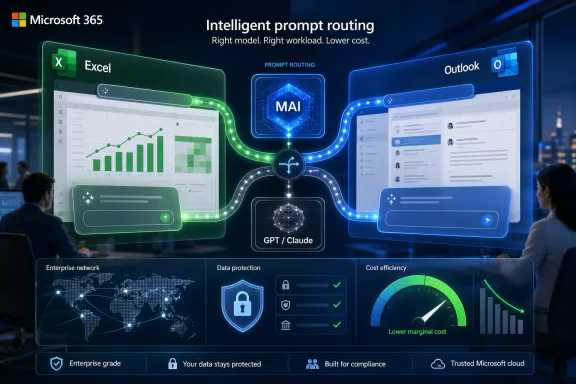 Microsoft’s AI Strategy Has Moved From Access to Margin
For most of the Copilot era, Microsoft’s advantage was access. It had early, privileged, and deeply integrated access to OpenAI’s models at a moment when every other enterprise software company was scrambling to bolt chatbots onto existing products. That access let Microsoft move faster than Google in productivity software, faster than Amazon in enterprise AI packaging, and faster than most SaaS vendors in turning demos into paid SKUs.But access is not the same thing as control. Once AI features become ordinary, the economics start to matter more than the novelty. A Copilot feature that looks magical in a launch demo becomes a recurring cost center when it runs across Outlook, Excel, Word, Teams, SharePoint, GitHub, Windows, and Azure every day.
Bloomberg’s report, later summarized by TechCrunch, says Microsoft is now using its in-house MAI models for a portion of prompts in workplace apps such as Excel and Outlook. The important phrase is not “tens of thousands,” impressive though that sounds. The important phrase is a portion, because model routing is how AI platforms quietly become markets.
A company does not need to replace GPT or Claude everywhere to change the leverage in a supplier relationship. It only needs enough credible substitution to say: this prompt does not require your most expensive model, this workflow can run on ours, and this category of traffic is no longer automatically yours.
The Spreadsheet and the Inbox Are the Perfect Places to Start
Excel and Outlook are not random test beds. They are two of Microsoft’s most durable monopolies of workplace attention, and they generate the kind of AI requests that often reward reliability, latency, privacy boundaries, and cost discipline more than raw model charisma.An Outlook prompt to summarize a thread, rewrite a message, or extract action items does not necessarily need the most powerful reasoning model in the world. An Excel prompt to explain a formula, classify rows, generate a pivot suggestion, or summarize a table may need domain tuning and tight integration more than a benchmark-topping general model. That makes these apps ideal proving grounds for first-party models that are “good enough” in the most commercially important sense: good enough at scale, inside the workflow, at a lower marginal cost.
This is where Microsoft’s position differs from OpenAI’s. OpenAI sells intelligence as the product. Microsoft sells productivity, identity, cloud infrastructure, compliance, device management, collaboration, developer tooling, and now intelligence as a layer inside all of it.
That means Microsoft can optimize for the total system. If a smaller MAI model handles a common Copilot request cheaply and fast, while a frontier OpenAI or Anthropic model is reserved for more demanding reasoning, the user may never know which model answered. The CFO will.
Mustafa Suleyman Said the Quiet Part Out Loud
The cost motive is not speculative. Mustafa Suleyman, Microsoft’s AI chief, said in June that Microsoft wanted to reduce what it spends on Anthropic by routing more work to MAI models. Bloomberg’s reporting quoted him saying Microsoft pays a lot of money to Anthropic and wants to reduce, ultimately even eliminate, that cost.That sentence matters because it punctures the marketing fog around “model choice.” Customers hear model choice and imagine flexibility, innovation, and a buffet of best-in-class tools. Platform owners hear model choice and imagine procurement leverage.
Microsoft has every reason to keep OpenAI and Anthropic in the tent. OpenAI remains strategically central to Copilot, Azure AI, and Microsoft’s broader AI credibility. Anthropic gives Microsoft a high-end alternative, particularly for customers and developers who prefer Claude for coding, writing, or agentic workflows. But multi-model architecture also prevents any one outside lab from becoming the tollbooth for Microsoft’s future.
This is not merely about saving a few cents on a prompt. It is about avoiding a structural dependency in which every successful AI feature increases Microsoft’s reliance on someone else’s compute, pricing, release cadence, safety policy, and enterprise roadmap.
Build 2026 Was the Coming-Out Party; Production Routing Is the Proof
At Build 2026 in June, Microsoft unveiled seven MAI models across reasoning, coding, image generation, speech, and transcription. Coverage from Axios, Windows Central, TechRadar, and others framed the announcement as Microsoft’s attempt to show that it is more than an OpenAI distributor.The lineup reportedly included MAI-Thinking-1 for reasoning, MAI-Code-1-Flash for software development, MAI-Image-2.5, MAI-Voice-2, and MAI-Transcribe-1.5. Microsoft’s public pitch emphasized efficiency as much as capability. That is exactly what one would expect from a company trying to embed AI into hundreds of millions of paid seats without letting inference costs eat the business model.
The distinction between launch and deployment is crucial. Tech companies announce models all the time. They publish benchmark charts, put a model in preview, offer it to a small set of developers, and declare strategic independence. Real independence begins when production traffic moves.
That is why the Bloomberg detail about Excel and Outlook lands differently from the Build stagecraft. GitHub Copilot support shows developer availability. Model cards and benchmark claims show technical ambition. But weekly production prompts in Microsoft 365 show that MAI is being trusted inside the company’s most valuable software estate.
Microsoft Does Not Need the Best Model; It Needs the Best Router
The AI industry still talks as if there will be a single winner: the best model, the smartest agent, the one system to rule every prompt. Microsoft is betting on something more mundane and probably more durable. It wants to own the router.A router does not have to make a philosophical argument about whether GPT, Claude, Gemini, or MAI is “better.” It has to decide which model is suitable for this user, this tenant, this data boundary, this latency budget, this compliance regime, this feature, and this price point. That decision can happen invisibly, hundreds of millions of times, inside the apps where work already happens.
For WindowsForum readers, this is the enterprise version of a familiar PC-era lesson. The component with the highest benchmark is not always the component that wins the platform. The winning component is often the one that ships everywhere, is integrated cleanly, meets the practical requirements, and lets the platform owner manage cost and compatibility.
Microsoft learned that lesson with Windows drivers, Office file formats, Active Directory, Exchange, Azure, and now Copilot. The company does not need MAI to beat every frontier model in every public leaderboard. It needs MAI to be strong enough that Microsoft can reserve the most expensive external models for the jobs that truly need them.
The OpenAI Partnership Is Becoming Less Exclusive by Design
Microsoft’s OpenAI relationship has always been both an asset and a source of tension. Microsoft invested billions, gained a privileged commercial position, and integrated OpenAI technology across its stack. But the more successful that strategy became, the more obvious the long-term risk became: Microsoft could end up building the future of Office, Azure, GitHub, and Windows on a model layer it did not fully control.The 2025 renegotiation of the OpenAI arrangement reportedly gave Microsoft more freedom to build competing models while preserving access to OpenAI technology through 2032. It also loosened OpenAI’s own constraints, allowing the AI lab to sell through other cloud and platform partners. That cut both ways, and it likely made the next phase inevitable.
Microsoft could live with OpenAI as a critical partner. It could not live with OpenAI as the only plausible brain behind Copilot. Satya Nadella’s reported fear that Microsoft might become “the next IBM” if it leaned too hard on a single AI partner captures the strategic anxiety perfectly. IBM did not fail because it lacked technology; it lost control of the layers that mattered most.
In AI, the model layer is one of those layers. So is the application layer. So is the cloud layer. Microsoft wants all three, or at least enough of all three that no supplier can dictate the terms.
The Anthropic Angle Shows Why Model Choice Is Also a Negotiating Weapon
The presence of Anthropic in this story is just as important as OpenAI’s. Microsoft added Anthropic models to parts of its AI ecosystem because customers wanted them, developers liked them, and Claude became a serious enterprise option. In a world where some users prefer Claude for long-context work, coding, or writing style, excluding Anthropic would make Microsoft’s platform less attractive.But every external model creates a new line item. If Anthropic usage grows inside Microsoft products, Microsoft pays. If Claude becomes the default for certain workloads, Anthropic gains pricing power. If enterprise customers ask for Claude by name, Microsoft’s model router becomes less flexible.
Suleyman’s comment about reducing Anthropic costs should be read in that light. It is not an emotional preference for Microsoft-made models. It is procurement strategy expressed as technical architecture.
The same will apply to OpenAI over time, even with discounts and partnership terms. Discounted access is still access on negotiated terms, and negotiated terms expire, change, or become less favorable as the market shifts. Microsoft is preparing for a future in which external frontier models are valuable suppliers, not the foundation beneath every AI feature it sells.
The Copilot Brand Becomes a Shell Around Many Brains
For users, Copilot increasingly looks like one product. For Microsoft, it is becoming a branded control plane over many models, tools, permissions, indexes, agents, connectors, and policy layers. That divergence will define the next few years of Microsoft AI.A user in Outlook may experience a single Copilot button. Behind it, Microsoft can decide whether the request is handled by MAI, GPT, Claude, a smaller task-specific model, a retrieval pipeline, a deterministic workflow, or some combination. The branding remains stable even as the engine changes.
That has benefits. It lets Microsoft improve cost and latency without retraining users. It lets administrators buy Copilot as a managed enterprise service rather than adjudicating every model vendor directly. It lets Microsoft keep sensitive workflows inside its compliance and identity framework, even when the model decision changes behind the scenes.
It also creates opacity. If customers are not told which model handled which task, they may have questions about auditability, data handling, reproducibility, and performance variance. Enterprise IT will not necessarily object to model routing, but it will want controls, logs, and contractual clarity.
Windows and Office Users May Feel the Shift Before They See It
Most end users will not notice the exact moment an Excel or Outlook prompt moves from an OpenAI model to an MAI model. They may notice if responses get faster, cheaper, more consistent, or more tightly tuned to Microsoft 365 semantics. They will definitely notice if quality drops.That is the deployment challenge. Microsoft can absorb some variation in consumer AI chat, where expectations remain fuzzy and experimentation is tolerated. It has less room for error inside work products that generate customer emails, financial analysis, executive summaries, legal drafts, and operational decisions.
Excel in particular is a dangerous place for merely plausible AI. A model that writes confident but incorrect formulas, misreads tables, or invents statistical meaning can create expensive mistakes. Outlook has a different risk profile: tone, confidentiality, missing context, and accidental disclosure.
This is why Microsoft is likely to move cautiously. The reported prompt volume sounds large, but in Microsoft 365 terms it is still a controlled slice. The company can route narrower classes of requests first, compare outcomes, measure user acceptance, and reserve higher-risk or more complex prompts for external frontier systems.
The Admin Console Will Become the Real Battleground
For IT pros, the most important question is not whether MAI models exist. It is whether Microsoft exposes enough governance to make model routing trustworthy in regulated environments.Enterprises will want to know which models are used for which workloads, where inference occurs, how data is retained, whether prompts cross tenant boundaries, what audit logs exist, and whether admins can pin, exclude, or prefer certain model families. Microsoft’s answer will likely be shaped by the same playbook it used for cloud services: abstract the complexity, promise compliance, then gradually expose controls as enterprise pressure builds.
That may be acceptable for many organizations. A mid-sized company already standardized on Microsoft 365 may prefer Microsoft to manage the model marketplace rather than negotiating separately with OpenAI, Anthropic, Google, and others. A regulated bank or government agency may be less comfortable with invisible routing unless the policy surface is explicit.
The more Microsoft makes Copilot a multi-model platform, the more administrators will need model provenance as part of normal governance. In the old Office world, admins worried about macros, add-ins, DLP, retention, and identity. In the Copilot world, they will also worry about which model reasoned over which business data.
Azure AI Gets a Stronger Story, but Also a More Complicated One
The same economics apply to Azure AI. Microsoft wants Azure customers to see its cloud as the place where they can use OpenAI, Anthropic, MAI, open models, fine-tuned models, and specialized task models under one enterprise umbrella. That is a strong platform pitch.It is also a more complicated sell than the original “OpenAI on Azure” message. Early Azure OpenAI adoption benefited from simplicity: use the models everyone is talking about, but through Microsoft’s enterprise cloud. A multi-model Azure AI world requires customers to think about routing, evaluation, cost controls, fallback behavior, latency, safety filters, and vendor mix.
That complexity is not a bug for Microsoft. It is how platforms justify their existence. If the model market fragments, customers need orchestration. If prices vary dramatically, customers need optimization. If governance varies by model, customers need policy enforcement.
MAI gives Microsoft a house brand inside that marketplace. It can be the default option for cost-sensitive workloads, a Microsoft-optimized choice for Copilot-style integration, and a negotiating counterweight to external labs. Even if customers keep using GPT and Claude, the presence of MAI changes the conversation.
The McKinsey Benchmark Is Less Important Than the Pattern
The source material notes that one MAI model tuned for McKinsey reportedly beat OpenAI’s GPT-5.5 on cost efficiency by a factor of ten, and that Microsoft has said one of its coding models can match Anthropic’s Opus 4.6 programming capabilities at lower cost. Those claims should be treated carefully, because vendor-tuned benchmarks and customer-specific workloads rarely translate cleanly into universal truth.Still, the pattern matters. Microsoft is not claiming, at least in the most credible version of its pitch, that MAI will dominate every leaderboard. It is claiming that specific models can be tuned for specific work and deliver acceptable or superior results at much lower cost.
That is exactly how enterprise AI is likely to mature. The first wave was intoxicated by generality: one big model, any task, astonishing demos. The second wave is about specialization: smaller models, cheaper inference, known workloads, measurable acceptance, and tight integration with business systems.
If Microsoft can make a McKinsey-tuned model cheaper for consulting workflows, it can make an Excel-tuned model cheaper for spreadsheet assistance, an Outlook-tuned model cheaper for email triage, and a Teams-tuned transcription model cheaper for meetings. Multiply that across the Microsoft estate and the strategic value becomes obvious.
The Competitive Pressure Moves Down the Stack
OpenAI and Anthropic are not helpless in this shift. They still build models that define the frontier and attract developers. They still have brand pull with users who ask for GPT or Claude by name. They still set much of the pace for reasoning, coding, agents, safety, and multimodal capabilities.But Microsoft’s move shows how application owners can squeeze model vendors over time. If a model provider does not own the workflow, it must continually prove that its model is worth the premium. If a platform can silently substitute a cheaper model for routine tasks, the premium model gets reserved for exceptional tasks.
That does not destroy the frontier model business. It changes its shape. OpenAI and Anthropic may become the high-end engines for difficult reasoning, agentic work, creative generation, and specialized enterprise use cases, while platform-owned or open-weight models handle the bulk of routine traffic.
The cloud companies understand this. Google has Gemini and Workspace. Amazon has Bedrock, its own models, and Anthropic exposure. Microsoft has OpenAI, Anthropic, MAI, GitHub, Azure, Windows, and Office. The fight is no longer just over who has the smartest model; it is over who controls the traffic.
The User Experience Will Hide the Supply Chain Until Something Breaks
There is an uncomfortable analogy here to web search, ad auctions, and cloud regions. Users see a simple interface. Behind it sits an enormous supply chain of ranking systems, bidding systems, caching layers, policy checks, data centers, and vendor contracts. AI in Office is headed the same way.That means most users will not get a clean story about “which AI” they are using. They will use Copilot. Copilot will use whatever Microsoft decides is best for that moment. If it works, nobody asks. If it fails, the hidden supply chain becomes visible.
A bad answer in Excel may not be blamed on MAI, GPT, or Claude by the average user. It will be blamed on Copilot, and therefore on Microsoft. That gives Microsoft a powerful incentive to be conservative about where it routes traffic. It also gives Microsoft a reason to own more of the stack, because accountability without control is a bad business.
This is the paradox of Microsoft’s AI moment. The company wants model optionality, but the customer buys a Microsoft experience. Every model behind Copilot becomes part of Microsoft’s reputation, whether Microsoft built it or not.
The First Real MAI Deployment Is a Cost Story With Platform Consequences
This routing change is easy to understate because it is incremental. OpenAI and Anthropic still handle most Copilot traffic, according to the reports. Microsoft is not ripping out its partners. The weekly prompt volume is meaningful, but not yet a wholesale migration.Yet incrementalism is how Microsoft usually wins. Windows did not become central to enterprise computing in one release. Azure did not overtake skepticism in one quarter. Teams did not replace a decade of collaboration habits instantly. Microsoft compounds distribution, licensing, integration, admin control, and default placement until a “small” change becomes the architecture.
MAI’s move into Excel and Outlook is that kind of change. It says Microsoft’s in-house models are no longer just research artifacts, Build demos, or GitHub Copilot options. They are now part of the production machinery of Microsoft 365.
The Office AI Bill Is Now a Strategic Lever
The practical readout is narrow enough for administrators and broad enough for the industry:- Microsoft has reportedly started using MAI models for tens of thousands of weekly prompts in Excel and Outlook, making this a real production deployment rather than a laboratory milestone.
- OpenAI and Anthropic remain central to Copilot, but Microsoft is building enough first-party capacity to reduce dependency and improve bargaining power.
- Cost is the explicit driver, because routine workplace prompts do not always justify the most expensive frontier model available.
- Enterprise customers should expect Copilot to become increasingly multi-model, even when the user interface continues to present one Microsoft-branded assistant.
- IT administrators will need clearer governance around model routing, auditability, data handling, and policy controls as these systems spread across Microsoft 365.
- The long-term competitive battle is shifting from who has the best model in isolation to who controls model selection inside the workflows people already use.
References
- Primary source: Technobezz
Published: 2026-07-07T20:21:07.809467
Microsoft Starts Routing Excel and Outlook AI Prompts to Its Own MAI Models | Technobezz
Microsoft shifts thousands of Excel and Outlook AI prompts to its own MAI models to cut costs and reduce reliance on OpenAI and Anthropic.www.technobezz.com - Related coverage: techtimes.com
Microsoft Build 2026: MAI-Thinking-1 Is First In-House Reasoning Model, Trained Without OpenAI Data
Microsoft Build 2026 launched MAI-Thinking-1, the company’s first in-house reasoning model, trained without OpenAI data. MAI-Code-1-Flash rolls out to all GitHub Copilot plans today. Independentwww.techtimes.com - Related coverage: techcrunch.com
Microsoft joins AI cost-cutting trend by relying more on its own models | TechCrunch
Microsoft is the latest Silicon Valley giant to cut back on its AI spending.techcrunch.com - Related coverage: santageai.com
Microsoft Launches Its Own AI Models at Build 2026, Cutting the OpenAI Cord | Santage
Microsoft unveiled seven in-house MAI models at Build 2026, headlined by MAI-Thinking-1 and MAI-Code-1-Flash. Project Polaris will replace GPT-4 Turbo in GitHub Copilot starting August 2026.santageai.com - Related coverage: thetechportal.com
Microsoft begins replacing OpenAI, Anthropic models with in-house MAI AI across key products: Report - The Tech Portal
Microsoft has reportedly begun deploying its own AI models across some of its most widely used productivity applications. Instead of thetechportal.com
- Related coverage: mcp.directory
Microsoft MAI Coding Models Explained — MCP.Directory
Microsoft unveiled MAI-Code-1-Flash and MAI-Thinking-1 at Build 2026 — its first in-house coding and reasoning models, now landing in GitHub Copilot.mcp.directory
- Related coverage: evermx.com
- Related coverage: digitalapplied.com
Microsoft's MAI Models at Build 2026: First-Party AI Bet
Microsoft launched 7 in-house MAI models at Build 2026, ending its OpenAI-reseller posture. Inside MAI-Thinking-1 benchmarks and the new Azure model choice.www.digitalapplied.com - Related coverage: ai-revolution.co.jp
Microsoft MAI-Thinking-1とは|35Bパラメータ・OpenAI不使用・AIME97%・MAI-Code-1-Flash・Build 2026自社AI7モデル完全解説 | AI革命株式会社
MicrosoftがBuild 2026で発表した自社製推論AIモデル「MAI-Thinking-1」の仕様・ベンチマーク・料金・利用方法を徹底解説。MAI-Code-1-Flash(GitHub Copilot統合)や残り5モデルの概要、「OpenAI不使用」主張の実態、競合モデル比較まで、2026年6月時点の最新情報をまとめます。ai-revolution.co.jp - Related coverage: resultsense.com
Microsoft unveils MAI models to cut OpenAI reliance
At Build, Microsoft launched its own MAI-Code-1-Flash and MAI-Thinking-1 models, pitching lower token costs and reduced dependence on OpenAI.www.resultsense.com
- Related coverage: therouter.ai
MAI-Thinking-1: Microsoft's First Proprietary Reasoning Model — Azure Foundry Routing, OpenRouter, and Team Decisions (2026) — TheRouter.ai | TheRouter.ai
MAI-Thinking-1 is Microsoft's first proprietary 35B MoE reasoning model — distillation-free, matches Claude Opus on SWE-Bench, on Azure Foundry. MAI-Code-1-Flash powers Copilot auto-routing with 60% fewer tokens. A routing guide for teams on Claude or GPT-4o.therouter.ai - Related coverage: windowscentral.com
Microsoft launches seven in‑house AI models to cut developer costs and reduce reliance on OpenAI | Windows Central
Microsoft’s new MAI model family includes a flagship reasoning model, zero distillation, and lower developer costs.www.windowscentral.com - Related coverage: axios.com
Microsoft debuts Scout agent, homegrown reasoning model
Microsoft is seeking to show it is a serious player in AI.www.axios.com
- Related coverage: techradar.com
From Quantum to Containers - 4 big things you might have missed at Microsoft Build 2026 | TechRadar
We round up some of the other major news from Microsoft Build 2026www.techradar.com - Related coverage: tomsguide.com
Biggest Microsoft Build 2026 announcements — agentic AI, RTX Spark Dev Box, GitHub Copilot app, new MAI models, and more | Tom's Guide
All the big news from Microsoft's AI-focused eventwww.tomsguide.com - Official source: microsoft.ai