

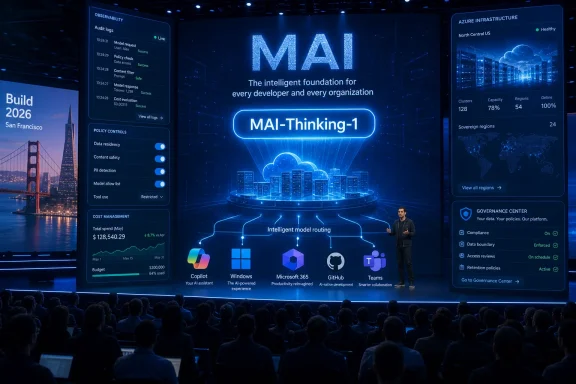
Microsoft used Build 2026 in San Francisco on June 2 to unveil seven internally developed MAI artificial intelligence models, including its first dedicated reasoning model, MAI-Thinking-1, as the company moves to reduce dependence on OpenAI while still selling OpenAI models through Azure. The announcement does not end the Microsoft-OpenAI relationship, but it changes its center of gravity. Microsoft is no longer merely the cloud landlord and enterprise packager for someone else’s frontier work. It is now trying to become a model lab in its own right, and that makes the old alliance look less like a marriage than a supply contract with an expiration date.
For most of the generative AI boom, Microsoft’s advantage was that it did not need to beat OpenAI. It needed to host it, fund it, productize it, and place it in front of hundreds of millions of enterprise users before Google, Amazon, or Salesforce could respond. That strategy worked well enough to turn Copilot from a branding exercise into the spine of Microsoft’s software roadmap.
But it also left Microsoft with an uncomfortable dependency at the exact layer where the industry believes the most value may accumulate. If the model is the product, Microsoft was leasing the product. If the model is infrastructure, Microsoft was paying another company for a strategic input it could not fully control.
The seven MAI models announced at Build are therefore less interesting as a leaderboard event than as a governance event. Microsoft is telling customers, investors, and rivals that it intends to own enough of the stack to make OpenAI optional. Optional is not the same as irrelevant, but in platform economics it is often the first step toward leverage.
That is why MAI-Thinking-1 matters even if it does not immediately dethrone OpenAI, Anthropic, or Google DeepMind. A mid-sized reasoning model with a large context window, trained for cost efficiency and integration into Microsoft’s products, is exactly the sort of thing an enterprise platform vendor would build if it wanted control rather than trophies. Microsoft does not need every Copilot prompt to hit the most expensive frontier model on the market. It needs the right model, at the right cost, inside the workflow where the customer already pays Microsoft.
The problem is that success compressed the distance between them. OpenAI became not just a supplier but a platform company with its own enterprise customers, developer ecosystem, consumer brand, and ambitions beyond Azure. Microsoft became not just a distributor but a product company whose AI margins depend on minimizing external tolls.
That makes the late-April restructuring of the relationship the real hinge point. Once Microsoft had more freedom to train larger models of its own and OpenAI had more room to pursue broader distribution, the partnership stopped being exclusive in the strategic sense even if commercial ties remained. The two companies can still cooperate, but they can no longer pretend their incentives are neatly aligned.
For WindowsForum readers, the analogy is familiar. Microsoft has spent decades bundling, abstracting, and eventually internalizing layers that once belonged to partners. The browser became part of the operating system. Security became part of Windows. Device management became part of Microsoft 365. AI is now moving through the same cycle, only faster and with vastly higher capital requirements.
The awkwardness is that Microsoft still benefits when OpenAI succeeds. Azure revenue, model availability, and enterprise demand all depend in part on OpenAI’s continued relevance. But every Copilot workload that can be served by MAI instead of GPT is also a workload Microsoft can optimize, price, and roadmap without waiting for an outside lab.
MAI-Thinking-1 is the headline because reasoning models have become the industry’s proxy for seriousness. Coding models matter because GitHub Copilot and Visual Studio Code are where Microsoft can influence developers before applications are even born. Voice and transcription models matter because Teams, Windows, accessibility tools, call centers, and productivity apps all need cheaper, faster speech systems that do not require a premium frontier model for every interaction.
This is where Microsoft’s platform instincts show. A standalone AI lab wants the most capable general model it can sell across the widest number of channels. Microsoft wants a portfolio of models that can be embedded into existing products, routed through Azure AI Foundry, and priced as part of a larger software relationship. The difference sounds subtle until procurement gets involved.
If Microsoft can run a coding assistant, meeting summarizer, image tool, and enterprise workflow agent on its own models at a lower internal cost, it has more room to bundle AI into licenses customers already understand. That is not glamorous, but it is how Microsoft wins markets. The company’s deepest skill is not invention in isolation; it is turning technologies into defaults.
The insistence that the new MAI models were trained from scratch, using commercially licensed data and without distillation from third-party systems, is also aimed at enterprise buyers. The legal and compliance overhang around AI training data has not gone away. Microsoft is trying to make its model supply chain sound auditable, defensible, and boring in the best possible enterprise sense.
That distinction explains why Microsoft is positioning MAI-Thinking-1 as a mid-sized model rather than pretending it is simply the biggest hammer in the drawer. Reasoning workloads are expensive because they often involve longer context, multi-step inference, tool use, code execution, and retries. If every enterprise agent burns premium tokens for routine work, the spreadsheet breaks.
Microsoft’s opportunity is to route tasks intelligently across a portfolio. A simple transcription does not need a frontier reasoning model. A code refactor might need a specialized coding model. A legal document review may need long context, careful retrieval, and auditability more than flashy benchmark performance. The platform that can choose among these models automatically has a cost advantage over a platform that treats the frontier model as the answer to everything.
That is also why Windows and Microsoft 365 matter so much. Microsoft sees more context than almost anyone: documents, calendars, meetings, chats, code repositories, identity graphs, device states, security signals, and business workflows. If it can apply smaller specialized models against that context safely, it can create AI features that feel native rather than bolted on.
The danger is equally obvious. The more AI becomes embedded into productivity and operating-system surfaces, the harder it becomes for administrators to know which model is handling which data, under what retention policy, and with what failure mode. Microsoft’s model independence may reduce supplier risk, but it increases the burden on Microsoft to explain its own stack clearly.
That is not a betrayal of Microsoft. It is what happens when a supplier becomes a platform. OpenAI’s API business, ChatGPT enterprise push, consumer subscription revenue, and developer ecosystem all benefit from being cloud-neutral. Every exclusive dependency becomes a negotiation point investors will question.
The economics are brutal. Frontier model development requires vast spending on compute, talent, data, infrastructure, safety systems, and deployment capacity. Revenue growth can be spectacular and still fail to cover the cost of serving increasingly capable models. If reported margin figures are directionally correct, the industry’s most famous AI company is still proving that demand is not the same as durable profit.
OpenAI therefore needs scale across every channel it can access. Microsoft, meanwhile, needs to prevent that scale from turning into permanent dependency. Both positions are rational. They are also structurally incompatible.
This is why the breakup framing can be misleading. Microsoft and OpenAI do not need to stop working together for the relationship to become competitive. They only need to start optimizing for different futures. That has already happened.
This is not new behavior for cloud platforms. AWS sells databases while hosting database companies. Microsoft sells security tools while integrating third-party security vendors. Google sells AI infrastructure while competing with AI startups. Platform owners routinely monetize ecosystems that include their rivals.
But AI raises the stakes because model choice may define product behavior more directly than earlier infrastructure choices. If an enterprise builds a customer service agent around one model family, switching later may affect tone, latency, accuracy, compliance review, and application logic. Model routing is not as interchangeable as swapping a virtual machine size.
Microsoft’s strongest pitch is that customers should not have to choose one model religion. They should be able to select, test, route, and replace models as needs change. That is a compelling argument, especially for enterprises that have learned not to hard-code their future into a single vendor’s roadmap.
The counterargument is that Microsoft’s own incentives will inevitably shape defaults. If MAI models are cheaper for Microsoft to operate, more tightly integrated with Copilot, and tuned for Microsoft data structures, they will become the path of least resistance. In enterprise software, the path of least resistance often becomes the standard.
That is the part administrators should watch. AI in Windows is no longer just a consumer assistant or a web-connected sidebar. It is becoming a control plane for actions: finding settings, summarizing content, generating code, automating workflows, interpreting screenshots, and eventually coordinating across local and cloud resources.
A Microsoft-owned model layer gives Redmond more room to optimize these experiences for Windows rather than for a generic API customer. It also gives the company more ability to decide what runs locally, what runs in Azure, and what gets escalated to a larger third-party model. That could improve performance and privacy in some cases. It could also make policy management more complicated if Microsoft does not expose enough controls.
Enterprise IT will care less about whether MAI-Thinking-1 beats Claude or GPT on a benchmark than whether it can be governed. Which tenant data is used? Which prompts are logged? Can model families be restricted? Can regulated departments force workloads to approved models? Can admins audit model routing after the fact?
Those are not side issues. They are the difference between AI as a demo and AI as infrastructure.
Mustafa Suleyman’s arrival changed the narrative, but personnel alone does not create a lab culture. OpenAI, Anthropic, and Google DeepMind have spent years building research organizations around model training, evaluation, alignment, and rapid iteration. Microsoft must prove that a giant platform company can move with enough focus to compete at that level.
The good news for Microsoft is that it does not need to win every research race to win commercially. Windows did not become dominant because it was always the most elegant operating system. Office did not win because every application was individually best in class at every moment. Microsoft wins when it turns “good enough and everywhere” into a distribution advantage that competitors cannot economically match.
The bad news is that AI failures are more visible and more consequential. A spreadsheet bug is one thing; an AI agent taking the wrong action across email, files, code, or identity systems is another. As Microsoft pushes models deeper into the productivity fabric, quality, safety, and administrative transparency become product features rather than compliance footnotes.
That is where the MAI project will be judged. Not on whether it can produce a dazzling keynote answer, but on whether it can operate at Microsoft scale without turning every enterprise tenant into a beta test.
Microsoft has an advantage because it can spread AI costs across Azure, Microsoft 365, GitHub, Windows, Dynamics, security, gaming, and developer tools. OpenAI has enormous demand, but it must convert that demand into a business model that can satisfy investors without losing the developer goodwill that made it central in the first place.
Anthropic faces a similar pressure as it grows from admired model lab into enterprise platform. Google has its own cloud, chips, search business, Android footprint, and DeepMind research engine. Amazon has AWS and a strong incentive to keep model choice fragmented rather than let any one lab dominate.
In that environment, Microsoft’s seven-model launch is best understood as a defensive escalation. It protects margins, strengthens Azure, gives Copilot a proprietary engine room, and reduces the risk that OpenAI’s strategic independence becomes Microsoft’s strategic vulnerability.
The irony is that Microsoft helped create the company it now needs to hedge against. That is not failure; it is platform capitalism working exactly as designed. The investor funds the insurgent, the insurgent becomes too important to depend on, and the investor builds an internal alternative before the dependency becomes a liability.
For years, Microsoft told customers they did not need to assemble the AI stack themselves. Copilot would bring the model to the workflow. Azure would bring the model catalog to the developer. Microsoft 365 would bring the security and compliance wrapper. The new message is that Microsoft, too, no longer wants to merely consume the frontier through someone else’s API.
That changes the meaning of Copilot. It becomes less a single product and more a packaging layer for whatever model strategy Microsoft wants to pursue underneath. Today that may include OpenAI. Tomorrow it may include MAI for most tasks, Anthropic for some, open-weight models for others, and specialized systems for regulated industries.
For developers, the practical effect is more choice and more ambiguity. More models mean more ways to optimize for cost, latency, context, and quality. They also mean more evaluation work, more vendor risk analysis, and more pressure to avoid building applications that depend too heavily on one model’s quirks.
For admins, the effect is a familiar Microsoft bargain. The company will offer integration, identity, policy, and procurement simplicity. In exchange, it will ask customers to trust that the black box under the Copilot label is being routed in their interest.
 Microsoft Stops Renting the Future
For most of the generative AI boom, Microsoft’s advantage was that it did not need to beat OpenAI. It needed to host it, fund it, productize it, and place it in front of hundreds of millions of enterprise users before Google, Amazon, or Salesforce could respond. That strategy worked well enough to turn Copilot from a branding exercise into the spine of Microsoft’s software roadmap.But it also left Microsoft with an uncomfortable dependency at the exact layer where the industry believes the most value may accumulate. If the model is the product, Microsoft was leasing the product. If the model is infrastructure, Microsoft was paying another company for a strategic input it could not fully control.
The seven MAI models announced at Build are therefore less interesting as a leaderboard event than as a governance event. Microsoft is telling customers, investors, and rivals that it intends to own enough of the stack to make OpenAI optional. Optional is not the same as irrelevant, but in platform economics it is often the first step toward leverage.
That is why MAI-Thinking-1 matters even if it does not immediately dethrone OpenAI, Anthropic, or Google DeepMind. A mid-sized reasoning model with a large context window, trained for cost efficiency and integration into Microsoft’s products, is exactly the sort of thing an enterprise platform vendor would build if it wanted control rather than trophies. Microsoft does not need every Copilot prompt to hit the most expensive frontier model on the market. It needs the right model, at the right cost, inside the workflow where the customer already pays Microsoft.
The OpenAI Alliance Becomes a Channel Conflict
The Microsoft-OpenAI partnership was elegant when the companies wanted different things. OpenAI needed capital and compute; Microsoft needed frontier AI credibility. Azure gave OpenAI industrial-scale infrastructure, while OpenAI gave Microsoft a dramatic answer to the question of what came after Windows, Office, and cloud subscriptions.The problem is that success compressed the distance between them. OpenAI became not just a supplier but a platform company with its own enterprise customers, developer ecosystem, consumer brand, and ambitions beyond Azure. Microsoft became not just a distributor but a product company whose AI margins depend on minimizing external tolls.
That makes the late-April restructuring of the relationship the real hinge point. Once Microsoft had more freedom to train larger models of its own and OpenAI had more room to pursue broader distribution, the partnership stopped being exclusive in the strategic sense even if commercial ties remained. The two companies can still cooperate, but they can no longer pretend their incentives are neatly aligned.
For WindowsForum readers, the analogy is familiar. Microsoft has spent decades bundling, abstracting, and eventually internalizing layers that once belonged to partners. The browser became part of the operating system. Security became part of Windows. Device management became part of Microsoft 365. AI is now moving through the same cycle, only faster and with vastly higher capital requirements.
The awkwardness is that Microsoft still benefits when OpenAI succeeds. Azure revenue, model availability, and enterprise demand all depend in part on OpenAI’s continued relevance. But every Copilot workload that can be served by MAI instead of GPT is also a workload Microsoft can optimize, price, and roadmap without waiting for an outside lab.
Seven Models Are a Strategy, Not a Product Sheet
The Build lineup was deliberately broad: reasoning, coding, image generation, image understanding, voice, and transcription. That breadth matters because Microsoft is not trying to build a single chatbot competitor. It is trying to populate the Microsoft stack with models tuned for the mundane, expensive, high-volume jobs that make or break AI economics.MAI-Thinking-1 is the headline because reasoning models have become the industry’s proxy for seriousness. Coding models matter because GitHub Copilot and Visual Studio Code are where Microsoft can influence developers before applications are even born. Voice and transcription models matter because Teams, Windows, accessibility tools, call centers, and productivity apps all need cheaper, faster speech systems that do not require a premium frontier model for every interaction.
This is where Microsoft’s platform instincts show. A standalone AI lab wants the most capable general model it can sell across the widest number of channels. Microsoft wants a portfolio of models that can be embedded into existing products, routed through Azure AI Foundry, and priced as part of a larger software relationship. The difference sounds subtle until procurement gets involved.
If Microsoft can run a coding assistant, meeting summarizer, image tool, and enterprise workflow agent on its own models at a lower internal cost, it has more room to bundle AI into licenses customers already understand. That is not glamorous, but it is how Microsoft wins markets. The company’s deepest skill is not invention in isolation; it is turning technologies into defaults.
The insistence that the new MAI models were trained from scratch, using commercially licensed data and without distillation from third-party systems, is also aimed at enterprise buyers. The legal and compliance overhang around AI training data has not gone away. Microsoft is trying to make its model supply chain sound auditable, defensible, and boring in the best possible enterprise sense.
Reasoning Models Move From Lab Demo to Cost Center
The first wave of AI marketing rewarded awe. The next wave will reward accounting. A reasoning model that can solve harder tasks is useful, but a reasoning model that can solve enough tasks at a predictable cost is what enterprises will actually deploy.That distinction explains why Microsoft is positioning MAI-Thinking-1 as a mid-sized model rather than pretending it is simply the biggest hammer in the drawer. Reasoning workloads are expensive because they often involve longer context, multi-step inference, tool use, code execution, and retries. If every enterprise agent burns premium tokens for routine work, the spreadsheet breaks.
Microsoft’s opportunity is to route tasks intelligently across a portfolio. A simple transcription does not need a frontier reasoning model. A code refactor might need a specialized coding model. A legal document review may need long context, careful retrieval, and auditability more than flashy benchmark performance. The platform that can choose among these models automatically has a cost advantage over a platform that treats the frontier model as the answer to everything.
That is also why Windows and Microsoft 365 matter so much. Microsoft sees more context than almost anyone: documents, calendars, meetings, chats, code repositories, identity graphs, device states, security signals, and business workflows. If it can apply smaller specialized models against that context safely, it can create AI features that feel native rather than bolted on.
The danger is equally obvious. The more AI becomes embedded into productivity and operating-system surfaces, the harder it becomes for administrators to know which model is handling which data, under what retention policy, and with what failure mode. Microsoft’s model independence may reduce supplier risk, but it increases the burden on Microsoft to explain its own stack clearly.
OpenAI Needs Distribution More Than Exclusivity
OpenAI’s incentive now points in the opposite direction. A company preparing for public-market scrutiny cannot afford to look like a captive research arm for Microsoft. It needs a platform story that reaches AWS customers, Google Cloud customers, startups, governments, and enterprises that do not want their AI strategy mediated through Redmond.That is not a betrayal of Microsoft. It is what happens when a supplier becomes a platform. OpenAI’s API business, ChatGPT enterprise push, consumer subscription revenue, and developer ecosystem all benefit from being cloud-neutral. Every exclusive dependency becomes a negotiation point investors will question.
The economics are brutal. Frontier model development requires vast spending on compute, talent, data, infrastructure, safety systems, and deployment capacity. Revenue growth can be spectacular and still fail to cover the cost of serving increasingly capable models. If reported margin figures are directionally correct, the industry’s most famous AI company is still proving that demand is not the same as durable profit.
OpenAI therefore needs scale across every channel it can access. Microsoft, meanwhile, needs to prevent that scale from turning into permanent dependency. Both positions are rational. They are also structurally incompatible.
This is why the breakup framing can be misleading. Microsoft and OpenAI do not need to stop working together for the relationship to become competitive. They only need to start optimizing for different futures. That has already happened.
Azure Wants to Be Switzerland and the Arsenal
Microsoft’s answer to the channel conflict is optionality. Azure can host OpenAI models, Anthropic models, open-weight models, Microsoft’s own MAI models, and a long tail of specialized systems. To customers, that sounds like neutrality. To competitors, it sounds like a marketplace where Microsoft owns the mall, the checkout system, and now some of the stores.This is not new behavior for cloud platforms. AWS sells databases while hosting database companies. Microsoft sells security tools while integrating third-party security vendors. Google sells AI infrastructure while competing with AI startups. Platform owners routinely monetize ecosystems that include their rivals.
But AI raises the stakes because model choice may define product behavior more directly than earlier infrastructure choices. If an enterprise builds a customer service agent around one model family, switching later may affect tone, latency, accuracy, compliance review, and application logic. Model routing is not as interchangeable as swapping a virtual machine size.
Microsoft’s strongest pitch is that customers should not have to choose one model religion. They should be able to select, test, route, and replace models as needs change. That is a compelling argument, especially for enterprises that have learned not to hard-code their future into a single vendor’s roadmap.
The counterargument is that Microsoft’s own incentives will inevitably shape defaults. If MAI models are cheaper for Microsoft to operate, more tightly integrated with Copilot, and tuned for Microsoft data structures, they will become the path of least resistance. In enterprise software, the path of least resistance often becomes the standard.
The Windows Angle Is Bigger Than a Chatbot
For Windows users, this shift will not arrive as a splashy “Microsoft replaces OpenAI” banner. It will show up as Copilot features that respond faster, cost less to serve, work offline or near the edge in limited cases, and become more deeply tied to Windows settings, files, apps, and developer tools.That is the part administrators should watch. AI in Windows is no longer just a consumer assistant or a web-connected sidebar. It is becoming a control plane for actions: finding settings, summarizing content, generating code, automating workflows, interpreting screenshots, and eventually coordinating across local and cloud resources.
A Microsoft-owned model layer gives Redmond more room to optimize these experiences for Windows rather than for a generic API customer. It also gives the company more ability to decide what runs locally, what runs in Azure, and what gets escalated to a larger third-party model. That could improve performance and privacy in some cases. It could also make policy management more complicated if Microsoft does not expose enough controls.
Enterprise IT will care less about whether MAI-Thinking-1 beats Claude or GPT on a benchmark than whether it can be governed. Which tenant data is used? Which prompts are logged? Can model families be restricted? Can regulated departments force workloads to approved models? Can admins audit model routing after the fact?
Those are not side issues. They are the difference between AI as a demo and AI as infrastructure.
Microsoft’s Hardest Competitor May Be Its Own History
Skepticism is warranted because Microsoft has not traditionally been viewed as a frontier AI model lab. The company has world-class research depth, but its consumer AI history includes false starts, abandoned assistants, awkward branding, and products that felt more imposed than loved. Cortana’s slow fade is still fresh enough to make any grand AI promise sound familiar.Mustafa Suleyman’s arrival changed the narrative, but personnel alone does not create a lab culture. OpenAI, Anthropic, and Google DeepMind have spent years building research organizations around model training, evaluation, alignment, and rapid iteration. Microsoft must prove that a giant platform company can move with enough focus to compete at that level.
The good news for Microsoft is that it does not need to win every research race to win commercially. Windows did not become dominant because it was always the most elegant operating system. Office did not win because every application was individually best in class at every moment. Microsoft wins when it turns “good enough and everywhere” into a distribution advantage that competitors cannot economically match.
The bad news is that AI failures are more visible and more consequential. A spreadsheet bug is one thing; an AI agent taking the wrong action across email, files, code, or identity systems is another. As Microsoft pushes models deeper into the productivity fabric, quality, safety, and administrative transparency become product features rather than compliance footnotes.
That is where the MAI project will be judged. Not on whether it can produce a dazzling keynote answer, but on whether it can operate at Microsoft scale without turning every enterprise tenant into a beta test.
The AI Arms Race Is Becoming a Margin War
The industry has spent the past three years talking about intelligence. The next three may be dominated by depreciation schedules. Data centers, accelerators, power contracts, networking gear, and model-training runs are now strategic weapons, and only a handful of companies can afford to fire them continuously.Microsoft has an advantage because it can spread AI costs across Azure, Microsoft 365, GitHub, Windows, Dynamics, security, gaming, and developer tools. OpenAI has enormous demand, but it must convert that demand into a business model that can satisfy investors without losing the developer goodwill that made it central in the first place.
Anthropic faces a similar pressure as it grows from admired model lab into enterprise platform. Google has its own cloud, chips, search business, Android footprint, and DeepMind research engine. Amazon has AWS and a strong incentive to keep model choice fragmented rather than let any one lab dominate.
In that environment, Microsoft’s seven-model launch is best understood as a defensive escalation. It protects margins, strengthens Azure, gives Copilot a proprietary engine room, and reduces the risk that OpenAI’s strategic independence becomes Microsoft’s strategic vulnerability.
The irony is that Microsoft helped create the company it now needs to hedge against. That is not failure; it is platform capitalism working exactly as designed. The investor funds the insurgent, the insurgent becomes too important to depend on, and the investor builds an internal alternative before the dependency becomes a liability.
The Build Message Hidden in Plain Sight
The most important sentence out of Build was not that Microsoft has a reasoning model. It was the broader claim that companies should move from consuming frontier models to participating at the frontier. That is Microsoft speaking to itself as much as to developers.For years, Microsoft told customers they did not need to assemble the AI stack themselves. Copilot would bring the model to the workflow. Azure would bring the model catalog to the developer. Microsoft 365 would bring the security and compliance wrapper. The new message is that Microsoft, too, no longer wants to merely consume the frontier through someone else’s API.
That changes the meaning of Copilot. It becomes less a single product and more a packaging layer for whatever model strategy Microsoft wants to pursue underneath. Today that may include OpenAI. Tomorrow it may include MAI for most tasks, Anthropic for some, open-weight models for others, and specialized systems for regulated industries.
For developers, the practical effect is more choice and more ambiguity. More models mean more ways to optimize for cost, latency, context, and quality. They also mean more evaluation work, more vendor risk analysis, and more pressure to avoid building applications that depend too heavily on one model’s quirks.
For admins, the effect is a familiar Microsoft bargain. The company will offer integration, identity, policy, and procurement simplicity. In exchange, it will ask customers to trust that the black box under the Copilot label is being routed in their interest.
Redmond’s New AI Bargain Comes With Fine Print
The concrete lesson from Build is not that OpenAI has been replaced. It is that Microsoft is building the leverage to make replacement possible wherever it makes economic or strategic sense.- Microsoft’s seven MAI models mark a shift from dependence on OpenAI toward a mixed strategy of buying, hosting, and building AI models.
- MAI-Thinking-1 is important because it gives Microsoft its own reasoning model to tune for cost, integration, and enterprise workloads.
- OpenAI and Microsoft can remain partners while increasingly competing for developers, enterprise customers, and platform control.
- Azure’s model catalog gives customers flexibility, but Microsoft’s own models are likely to become increasingly favored inside Copilot and Microsoft 365 experiences.
- Windows and Microsoft 365 administrators should watch governance, auditability, model-routing controls, and data-handling promises more closely than benchmark claims.
- The AI race is becoming less about who can demo the smartest model and more about who can deliver useful intelligence at sustainable cost.
References
- Primary source: Technobezz
Published: 2026-06-03T21:03:14.847977
Microsoft Launches Seven AI Models to Cut Its Reliance on OpenAI | Technobezz
Microsoft and OpenAI split as Microsoft launches its own AI models, directly competing against its former $13 billion investment.www.technobezz.com - Related coverage: axios.com
Microsoft debuts Scout agent, homegrown reasoning model
Microsoft is seeking to show it is a serious player in AI.www.axios.com
- Related coverage: tomsguide.com
Biggest Microsoft Build 2026 announcements — agentic AI, RTX Spark Dev Box, GitHub Copilot app, new MAI models, and more | Tom's Guide
All the big news from Microsoft's AI-focused eventwww.tomsguide.com - Related coverage: techradar.com
From code-first to intent-first: Microsoft Build 2026 could be the end of programming as we know it | TechRadar
Redefining what it means to be a developer with agentic AIwww.techradar.com - Official source: microsoft.ai
- Related coverage: ai-tldr.dev
Microsoft Launches Seven New MAI Models at Build… | AI/TLDR
Microsoft AI's biggest first-party launch yet: a reasoner, a coding flash model, image + voice updates, and a speech-to-text engine claimed to be 5x fas…ai-tldr.dev

- Related coverage: techcrunch.com
Microsoft takes on AI rivals with three new foundational models | TechCrunch
MAI released models that can transcribe voice into text as well as generate audio and images after the group's formation six months ago.techcrunch.com - Related coverage: ca.finance.yahoo.com
Microsoft debuts in-house AI models as it looks to ease reliance on OpenAI
Microsoft launched slew of AI models as it looks to ease dependence on OpenAI.ca.finance.yahoo.com - Related coverage: euronews.com
Microsoft launches its own AI models to take on OpenAI and Anthropic | Euronews
Seven in-house models unveiled at Build 2026 signal Microsoft's push to cut costs and compete directly on the AI frontier as its biggest investees plan to launch record-breaking IPOs.www.euronews.com - Related coverage: sekbernews.id
Microsoft Debuts MAI-Thinking-1 Reasoning Model at Build 2026
Microsoft introduced its first advanced reasoning AI model alongside six other in-house models during the Build 2026 conference.www.sekbernews.id - Related coverage: numerama.com
La guerre des IA repart de plus belle : Microsoft dévoile ses propres modèles MAI - Numerama
À l’occasion de sa conférence Build 2026, Microsoft a dévoilé une famille de sept nouveaux modèles d'IA développés en interne. Cette nouvelle gamme s'étend notamment de la génération d'images à la gestion de la voix. La guerre de l'intelligence artificielle générative monte... www.numerama.com
- Related coverage: cryptobriefing.com
Microsoft unveils seven new MAI models as in house AI push accelerates
Microsoft launched seven new MAI models at Build, covering reasoning, coding, and image editing, in its largest in-house AI expansion under CEO Mustafacryptobriefing.com - Related coverage: windowscentral.com
The Microsoft/OpenAI breakup: What does it actually mean for Copilot and other AI apps on your Windows 11 PC? | Windows Central
Copilot in Windows 11 doesn't feel as exclusive after Microsoft and OpenAI's new non-exclusive deal.www.windowscentral.com - Related coverage: omni.se
Microsoft lanserar sju nya modeller i AI-offensiv
Microsoft presenterade sju nya AI-modeller i samband med den årliga utvecklarkonferensen Build i San Francisco på tisdagen. Det rapporterar flera medier.omni.se
- Related coverage: ashgabattimes.com
