

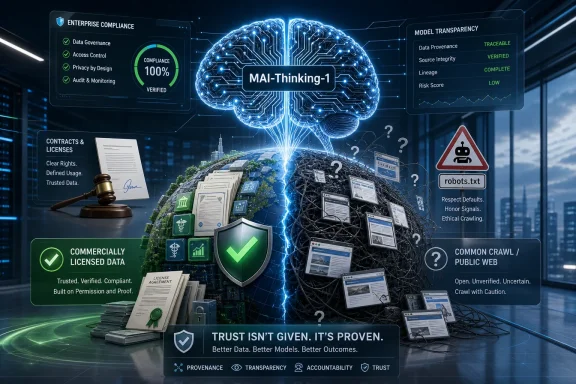
Microsoft Sold MAI as a Provenance Story, Not Just a Model Launch
Microsoft did not introduce MAI-Thinking-1 as another benchmark trophy. The company framed it as a strategic turn toward self-sufficiency: a Microsoft-built reasoning model, trained from scratch, with no distillation from third-party models and a cleaner data lineage than the murky web-scale practices that have haunted the AI industry since ChatGPT made training data a boardroom issue.
That positioning matters because enterprises do not buy models the way hobbyists try models. A consumer may care whether a model writes better code or answers faster. A bank, hospital, insurer, defense contractor, or software vendor also wants to know whether using the model creates downstream legal, contractual, or reputational exposure.
Microsoft understood that audience. Its MAI messaging leaned heavily on phrases such as “enterprise grade,” “clean,” “commercially licensed,” and “appropriately licensed.” Those words are not decorative in 2026. They are procurement language, risk language, and litigation-avoidance language.
The problem is that the training details appear to complicate the slogan. MAI materials reportedly reference public-web data and Common Crawl, a massive archive of crawled webpages that can include copyrighted pages, publisher content, forum posts, documentation, blogs, and material made public on the web without necessarily being licensed for AI training.
That does not automatically prove wrongdoing. It does, however, puncture the simplicity of the pitch. Microsoft is no longer merely saying, “Trust us, this is clean.” It is now facing the harder question: clean by whose definition, under what license theory, and with what exclusions?
Common Crawl Turns a Marketing Claim Into a Permission Test
Common Crawl is not obscure inside the AI world. It has long been one of the basic feedstocks for large language model development, precisely because it offers an enormous snapshot of the public web at a scale no ordinary company could manually assemble from scratch.
That convenience is also the issue. Common Crawl is a crawl, not a clearinghouse. It can preserve and index public pages, but the fact that a page was reachable by a crawler is not the same thing as the page being commercially licensed for model training.
This distinction is obvious to publishers but often blurred in AI marketing. A website can be publicly accessible and still copyrighted. A blog post can be readable without becoming free raw material for a commercial model. A forum thread can be indexed by search engines without granting a perpetual license to train reasoning systems that compete for attention, traffic, or paid work.
Microsoft’s technical materials, according to the reporting that surfaced the dispute, describe a training process that included Common Crawl after filtering, deduplication, merging, and further exact-URL and fuzzy-deduplication passes. Independent developer and technical commentator Simon Willison highlighted the tension because the numbers were not trivial; the Common Crawl portion was described as tens of billions of pages after processing.
The scale matters. A few licensed public-domain collections, carefully documented, would be one thing. A vast slice of the public web, passed through a cleaning pipeline, is something else entirely. Cleaning data for quality, duplication, toxicity, or model performance does not necessarily clean up the rights question.
Microsoft may have a legal theory. It may have excluded protected sources, honored opt-outs, licensed broad categories of web data, or applied filters more sophisticated than the public reporting can see. But if that is the case, the company needs to say so plainly, because the materials now in circulation invite the opposite inference.
Robots.txt Is a Boundary Marker, Not a Contract
One of the most important distinctions in this dispute is between crawler compliance and negotiated permission. Microsoft says its crawler respects robots.txt and related web controls, including meta tags and HTML-level signals. That is useful, and site operators should prefer a crawler that honors those signals over one that ignores them.
But robots.txt was never designed to function as a universal licensing framework for generative AI. It is a technical instruction file, born in the web-crawling era, that tells automated agents where they should not go. It is closer to a traffic sign than a publishing contract.
For search engines, that system became part of an uneasy bargain. Publishers allowed crawlers because search indexing sent users back to the source. The crawler created a copy or index, but the economic logic still pointed toward referral traffic, discovery, and attribution.
Generative AI strained that bargain. A model trained on crawled text does not necessarily send users back to the page. It can absorb patterns, facts, style, and structure, then answer directly inside another company’s product. Even when the output is not infringing in any obvious one-to-one way, the business model has changed.
That is why publisher controls have become more aggressive. Cloudflare and others have moved to give site owners tools to block or challenge AI crawlers. The rise of those controls is itself evidence that the old web-crawler etiquette no longer satisfies many publishers.
Microsoft’s crawler-respect posture may reduce one kind of bad behavior. It does not answer whether the company had affirmative commercial licenses for all or most public-web material used in MAI training. In enterprise compliance terms, “we honored opt-outs” and “we licensed the data” are different claims.
The Real Ambiguity Is Hiding in the Word “Appropriate”
Microsoft’s wording deserves close attention because it appears to shift between strong and flexible formulations. “Commercially licensed” sounds like a concrete assurance. “Appropriately licensed” leaves more room for interpretation.
That room is where the controversy lives. A company might argue that some public-web data is available under permissive licenses, some is public domain, some is covered by direct agreements, some is used under fair-use theories, and some is excluded through opt-out mechanisms. Under that mixed model, the company may view the resulting corpus as appropriately sourced.
But enterprise buyers hear a different music. To a compliance officer, “commercially licensed” suggests affirmative rights. It implies that someone can show a contract, license grant, dataset terms, or other documentary basis for commercial use. It sounds less like a fair-use argument and more like a procurement artifact.
That is why Microsoft’s phrasing now matters as much as the data itself. If “clean and commercially licensed” means “every meaningful copyrighted source was licensed,” then public-web and Common Crawl references demand explanation. If it means “we used a combination of licensed data, public data, opt-out-respecting crawls, and legal theories we believe are defensible,” then Microsoft should not let the shorter phrase do more work than it can bear.
This is not mere pedantry. AI vendors have learned that enterprises want legal comfort, and legal comfort has become a feature. Indemnities, data-residency guarantees, security certifications, privacy boundaries, and model provenance are now part of the competitive surface.
Microsoft has historically been good at selling that kind of comfort. Azure, Microsoft 365, Purview, Defender, Entra, and GitHub all rest on the premise that Microsoft can translate complex technical systems into manageable enterprise risk. MAI-Thinking-1 now tests whether Microsoft can do the same for foundation-model training data.
The Model Itself Makes the Provenance Fight Harder to Ignore
MAI-Thinking-1 is not a toy model tucked away in a research repo. Microsoft describes it as a 35-billion-active-parameter sparse mixture-of-experts model with roughly a trillion total parameters and a 256K-token context window. In plain English, it is designed to be efficient at inference while still offering enough capacity for serious reasoning, software engineering, and long-document work.
That technical profile is exactly why the data question matters. A capable reasoning model with a long context window is not limited to summarizing short prompts. It can inspect codebases, reason over corporate documents, call tools, follow layered instructions, and operate inside agentic workflows.
Microsoft is also positioning MAI inside Foundry and eventually the MAI Playground. Foundry is not a casual sandbox brand; it is part of Microsoft’s enterprise AI platform. The implication is obvious: this model is meant to be evaluated, adopted, embedded, and governed inside customer environments.
Once a model moves into that lane, provenance becomes part of deployment architecture. Security teams will ask what data the model was trained on. Legal teams will ask what rights attach to it. Procurement teams will ask whether vendor statements are precise enough to survive audit. Risk teams will ask whether outputs could create copyright, confidentiality, or reputational concerns.
Performance does not cancel those questions. In fact, performance intensifies them. The more useful the model is, the more likely it becomes part of production workflows, and the more important its training lineage becomes.
Microsoft’s own pitch recognizes this. The company is not saying, “Use MAI because nobody cares where the data came from.” It is saying the opposite: use MAI because how it was built matters. That is why the Common Crawl disclosure lands with force.
The OpenAI Shadow Still Hangs Over Microsoft’s Independence Push
MAI-Thinking-1 also arrives in the broader context of Microsoft’s evolving relationship with OpenAI. For years, Microsoft’s AI story was tightly coupled to OpenAI models exposed through Azure, Copilot, and developer tools. That partnership gave Microsoft a commanding early position in enterprise generative AI, but it also left the company dependent on another lab’s model roadmap, economics, and governance decisions.
The MAI family is Microsoft’s answer to that dependency. By building in-house models across reasoning, coding, voice, transcription, and image generation, Microsoft can diversify its AI supply chain. It can tune models to its own products, optimize for its own hardware, and present customers with a multi-model platform rather than a single-vendor wrapper.
That strategy is sensible. It is also expensive, risky, and deeply exposed to trust questions. Microsoft cannot simply inherit OpenAI’s prestige while claiming independence. If it builds its own models, it owns its own training choices.
The company’s no-distillation claim is part of this independence narrative. Distillation from third-party models has become controversial because it can blur competitive and legal boundaries. Microsoft wants MAI to stand as a model that learned from Microsoft’s own pipeline rather than borrowing another lab’s outputs.
Yet removing third-party distillation from the story raises the importance of the remaining data pipeline. If MAI was not taught by other frontier models, then the human-generated and web-derived corpus becomes even more central to its capabilities. That makes the public-web question less peripheral, not more.
The irony is sharp. Microsoft’s attempt to tell a cleaner story than the rest of the industry has made every inconsistency more visible. When a vendor promises less opacity, customers reasonably examine the glass.
Copyright Law Is Not Settled Enough to Carry the Marketing
The legal backdrop remains unsettled. AI training cases continue to move through courts, regulators, and policy bodies, and different jurisdictions are likely to treat data mining, fair use, opt-outs, and licensing markets differently. No serious enterprise should pretend the whole issue has been resolved.
In the United States, the fair-use debate around model training remains fact-specific. Courts may treat different datasets, acquisition methods, outputs, market effects, and product uses differently. A model trained on licensed code, public-domain books, permissively licensed documents, and opt-out-respecting crawls may receive a different legal analysis from one trained on pirated books or scraped subscription content.
That uncertainty creates room for vendors to make legal arguments. It does not create room for sloppy marketing. If Microsoft’s claim rests partly on fair use, crawler compliance, or public availability, then saying “commercially licensed” without qualification risks overpromising.
The Copyright Office’s posture has also pushed the industry toward licensing markets rather than a blanket rule that all training is either forbidden or freely allowed. That direction is inconvenient for model builders because licensing is slower and more expensive than crawling. It is also attractive to rights holders because it recognizes that public availability and commercial reuse are not the same thing.
Microsoft has been on both sides of this economy. It sells software protected by copyright, defends intellectual property, operates platforms that ingest massive user and public data, and now builds frontier models. The company understands better than most that licensing language has consequences.
This is why enterprises will not be satisfied with a philosophical defense alone. They need operational clarity. What was licensed? What was crawled? What was excluded? What opt-outs were honored? What indemnities apply? What happens if a rights holder later challenges a dataset category?
Enterprise Buyers Will Translate the Dispute Into Contract Language
For IT departments, the practical question is not whether Common Crawl is morally good or bad. It is whether Microsoft’s assurances are specific enough to put MAI-Thinking-1 into production under the organization’s own risk standards.
That answer will vary by industry. A startup building internal developer tools may accept Microsoft’s platform assurances and move quickly. A regulated financial institution may demand stronger representations, documented controls, and indemnity language. A media company may view the presence of public-web training data as a direct strategic concern.
The procurement workflow will be familiar. Legal teams will compare public marketing claims against contractual commitments. Security teams will review model cards, documentation, and compliance attestations. Data-governance teams will ask whether outputs can be monitored, logged, filtered, retained, or blocked. Developers will ask whether the model is good enough to justify the friction.
Microsoft’s advantage is that it already has enterprise channels built for this. Customers know how to negotiate Azure terms. They know how to use Microsoft compliance documentation. They know where to place vendor risk questionnaires.
Its disadvantage is that the AI training stack is still poorly standardized. There is no universally accepted software bill of materials equivalent for foundation-model pretraining data. Model cards and technical reports vary widely. Dataset disclosures often summarize categories rather than listing sources. Even when vendors are more transparent than competitors, they may still leave gaps that matter to compliance teams.
MAI-Thinking-1’s private-preview status gives Microsoft a chance to close those gaps before public preview expands the audience. That is the charitable reading. The less charitable reading is that Microsoft made a strong marketing claim before its own training disclosures were ready to support it cleanly.
Publishers Hear a Familiar Silicon Valley Bargain
For publishers, the dispute sounds painfully familiar. The tech industry has repeatedly built large systems on publicly available content, then argued after the fact that the public nature of the web made the practice legitimate, inevitable, or socially beneficial.
Search indexing was the original compromise. Social media embedding became another. News aggregation, snippet generation, answer engines, voice assistants, and now generative AI have each stretched the boundary between visibility and appropriation.
The AI era changes the stakes because the product is not just sending readers elsewhere. It can compete with the original source’s informational function. A model trained on years of articles may answer users directly, summarize the news, generate explainers, or help a competing outlet produce derivative analysis at speed.
Microsoft is not alone here. The entire industry has relied on web-scale data in one form or another. But Microsoft’s brand promise is different from that of a scrappy model lab or an open-source research collective. Microsoft sells governance.
That makes the company’s burden higher. If it wants to be the enterprise-safe AI vendor, it must be prepared for enterprise-safe scrutiny. Publishers, developers, and customers will not separate the product claim from the data supply chain.
There is also a strategic risk. If Microsoft’s clean-data language is perceived as elastic, then every future claim about model provenance becomes harder to trust. The company may win the narrow legal argument and still lose some of the confidence it was trying to build.
The Technical Paper Did What Transparency Is Supposed to Do
There is a more generous way to view this episode: the system worked. Microsoft published enough technical detail for outsiders to notice a tension, and independent readers did exactly what transparency is meant to enable. They inspected the claim, compared it with the data description, and asked for clarification.
That does not absolve Microsoft. But it does distinguish this episode from the pure black-box behavior common elsewhere in the AI industry. A less transparent vendor might simply have omitted the Common Crawl reference and left customers with a polished one-line provenance claim.
The lesson is not that companies should disclose less. It is that disclosure and marketing must be aligned. If the technical paper says one thing and the launch copy implies another, the paper will eventually win, because serious customers read appendices, model cards, and reports.
Microsoft should treat the criticism as a preview of enterprise due diligence. The public debate is doing a rough version of what sophisticated customers will do privately: reconcile the keynote, blog post, model card, technical paper, legal terms, and security documentation.
That reconciliation should not require Kremlinology. A customer should not have to infer from a phrase like “we process Common Crawl with the same pipeline” whether the underlying pages were licensed, filtered by license metadata, crawled under opt-out assumptions, or included under a fair-use analysis.
A better disclosure would divide the training corpus into clearer rights categories. It would explain the basis for inclusion, the exclusion rules, the opt-out handling, and the post-collection filtering. It would also distinguish quality cleaning from licensing status, because those are often conflated in AI documentation.
Clean Data Is Becoming a Product Feature With Audit Burden
The MAI controversy points to a larger shift in the AI market. Model vendors can no longer treat data provenance as backstage engineering. It is now a product feature, and product features invite verification.
“Clean data” sounds simple, but it can mean several different things. It can mean free of malware, spam, synthetic slop, personally identifiable information, duplicated text, toxic content, copyrighted material, unlicensed material, or low-quality boilerplate. A model can be clean under one definition and messy under another.
That semantic overload benefits marketers and frustrates customers. If “clean” means “filtered for quality and safety,” then it should not be mistaken for “commercially licensed.” If “appropriately licensed” includes fair-use determinations, then it should not be presented as if every page came with a signed agreement.
The enterprise AI market will eventually demand sharper labels. We may see provenance tiers, dataset audits, rights-category summaries, third-party attestations, or contractual schedules describing training inputs at a level vendors currently resist. The software industry went through similar maturity curves with security, privacy, and supply-chain management.
Security is the best analogy. Years ago, vendors could wave at “best practices.” Today, large customers ask for SOC reports, penetration-test summaries, SBOMs, vulnerability disclosure policies, incident notification commitments, and cloud security controls. AI training data is moving in the same direction.
Microsoft can help define that standard if it chooses. Or it can preserve maximum ambiguity and let courts, regulators, competitors, and customers define it more painfully.
The Customer Risk Is Not Theoretical, Even If the Lawsuits Are Unfinished
Some defenders of AI training argue that no customer has yet been meaningfully harmed by using a model trained on disputed public-web data. That may be true in many cases, but it is not the whole risk picture.
Enterprise risk is often about uncertainty itself. A vendor claim that later proves narrower than expected can trigger internal review, delay deployment, complicate audits, or force a customer to switch models after integration work has begun. In heavily regulated environments, uncertainty can be enough to slow adoption.
There is also output risk. Even if training is lawful, a model can generate text that resembles protected material, reveal memorized snippets, or produce responses that create attribution and compliance concerns. The probability may be low for any single prompt, but enterprises think in volume.
Then there is reputational risk. A company that builds a customer-facing product on a model later criticized for unlicensed data may face questions from users, partners, or rights holders. The legal merits may be complicated; the headline will not be.
Microsoft’s brand reduces some of that anxiety because customers expect the company to stand behind its products. But that expectation cuts both ways. If Microsoft wants customers to rely on its shield, the shield has to be described in enforceable terms rather than inspirational ones.
This is where Foundry matters. If MAI-Thinking-1 is available through Microsoft’s enterprise stack, customers will reasonably ask what protections flow through that channel. Is Microsoft offering indemnity for model use? Does it cover training-data claims? Are there exclusions? Does private-preview use differ from public-preview or general availability?
The Public Preview Is Microsoft’s Next Trust Checkpoint
The immediate pressure point is the planned public preview on MAI Playground. Private preview can be managed through selective access, direct customer conversations, and controlled documentation. Public preview invites a broader class of users, critics, competitors, lawyers, and researchers.
Microsoft does not need to publish a complete list of every training URL to improve its position. In fact, full URL disclosure may be impractical, privacy-sensitive, or competitively unrealistic. But the company can clarify the rights model without exposing the entire corpus.
It can state whether Common Crawl pages were included only when license metadata permitted commercial reuse. It can state whether crawler-accessible pages were treated as usable absent opt-out. It can state whether public-web data rests on fair-use analysis rather than negotiated license. It can state whether rights-holder removals or future opt-outs affect model training sets or only future crawling.
Most importantly, it can stop letting the phrase “commercially licensed” carry meanings that different audiences will interpret differently. If Microsoft’s actual framework is broader than licensing alone, the company should say so and defend it. If it is narrower, it should explain how the Common Crawl references fit.
The preview window is also a chance to publish customer-facing guidance. Enterprises do not need a law-school seminar. They need a deployment memo: what the model was trained on at category level, what Microsoft represents, what it does not represent, what customer data is or is not used for training, and what legal protections attach.
That kind of document would not silence every critic. It would, however, give serious buyers something firmer than a keynote phrase.
The MAI Promise Now Has to Survive Its Own Fine Print
The dispute around MAI-Thinking-1 is not that Microsoft used public-web data and therefore the model is disqualified. The modern AI industry is far too entangled with web-scale corpora for such a simple verdict. The dispute is that Microsoft marketed the model with trust language that appears cleaner than the disclosed data story.
For WindowsForum readers, the practical lesson is to read AI model announcements the way seasoned admins read patch notes. The headline tells you what the vendor wants you to notice. The technical report tells you where the implementation gets interesting.
A few concrete points should shape how teams evaluate MAI-Thinking-1 before wider rollout:
- Microsoft introduced MAI-Thinking-1 on June 2, 2026, as a private-preview reasoning model built in-house and positioned for enterprise use through Microsoft Foundry.
- The model is described as a sparse mixture-of-experts system with 35 billion active parameters, roughly one trillion total parameters, and a 256K-token context window.
- Microsoft’s launch language emphasized clean, enterprise-grade, commercially or appropriately licensed data, while subsequent scrutiny focused on references to public-web and Common Crawl inputs.
- Respecting robots.txt and related crawler controls is not the same as holding negotiated licenses for every publisher page used in training.
- Enterprise teams evaluating MAI should ask Microsoft for contractual clarity on training-data representations, indemnity scope, opt-out handling, and the rights basis for public-web material.
- Microsoft still has an opportunity to resolve the ambiguity before public preview, but the burden is now on the company to reconcile its trust pitch with its technical disclosures.
Microsoft’s opportunity is still large because enterprises want capable models that come with governance, not just raw intelligence. But the MAI-Thinking-1 episode shows that the next phase of AI competition will be fought as much in procurement rooms as on benchmark charts. If Microsoft can turn this controversy into clearer disclosure, stronger customer terms, and a more precise definition of clean data, it may strengthen the very trust story now under pressure; if it cannot, its new in-house model line will carry the same unresolved web-data baggage it was supposed to rise above.
References
- Training Details For Microsoft New In-House AI Models Put Clean-Data Promise in Doubt WinBuzzer · 2026-06-05T18:42:06.975048