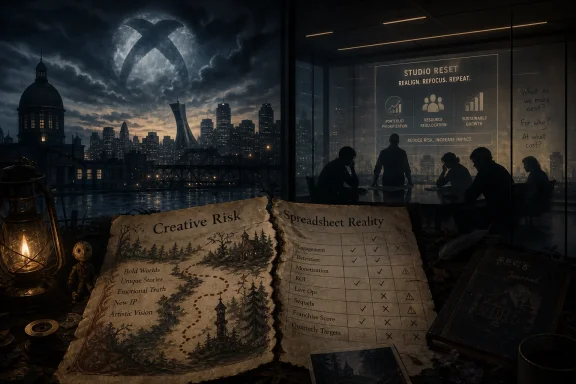
Microsoft’s Xbox division is reportedly preparing to close Montreal-based Compulsion Games, the studio behind South of Midnight, after warning employees in June 2026 that the gaming business had become overextended and would refocus resources around fewer priorities. The move is not merely another line item in a familiar layoff cycle. It is a test of whether Xbox’s public language about creative risk, new intellectual property, and award-winning storytelling still means anything when the spreadsheet turns hostile. If the reports hold, Compulsion will become the latest casualty in a Microsoft gaming strategy that keeps praising distinctiveness while rewarding scale.
The alleged Compulsion closure lands with unusual sting because the studio was not an obvious embarrassment case. South of Midnight was not a live-service disaster, a years-late reboot, or a public technical fiasco. It was a highly stylized, story-driven action-adventure game with a clear identity, a Southern Gothic folktale aesthetic, and the kind of authorship Xbox has spent years insisting it wanted more of.
That is what makes the timing so brutal. Earlier this year, Xbox leadership publicly celebrated the game’s critical recognition, including a Peabody Award, and held it up as an example of games’ ability to tell meaningful stories. In the normal grammar of platform-holder messaging, that is the sort of praise used to suggest strategic commitment: this is why we bought studios, this is why Game Pass needs variety, this is why first-party portfolios should not be reduced to sequels and shooters.
But the reported shutdown suggests a different internal grammar. Awards may validate a creative thesis, but they do not necessarily validate a business unit. In Microsoft’s current gaming calculus, a studio can produce respected work, enhance the brand’s cultural credibility, and still be judged insufficiently central to the next phase of Xbox.
That does not make Xbox uniquely cruel. It makes Xbox emblematic. The industry spent the post-pandemic years pretending that subscription growth, consolidation, and platform expansion could absorb almost any amount of creative experimentation. Now the same companies are discovering that creative diversity is easy to celebrate in interviews and much harder to defend in budget meetings.
When Microsoft acquired Compulsion in 2018, the deal fit the logic of the era. Xbox needed more first-party content, Game Pass needed a constant flow of differentiated releases, and Microsoft wanted to prove it could be a better patron of mid-sized creativity than the traditional publisher model. The acquisition spree that also brought in studios such as Ninja Theory, Playground Games, Undead Labs, and others was sold as both an industrial expansion and a cultural correction.
Compulsion was not acquired to become a Call of Duty support shop. It was acquired because Xbox needed studios that could make games no one else would greenlight at scale. That was the pitch, implicitly if not always explicitly: Microsoft’s money could protect eccentricity from the harshest pressures of the commercial market.
The reported closure shows the danger in that bargain. When a studio’s independence is converted into a platform asset, its survival depends less on whether it makes good work than on whether the platform still needs the category it represents. Compulsion’s fate, if sealed, would say less about whether South of Midnight was worthy and more about whether Xbox still believes boutique first-party games are strategically necessary.
That is corporate language, but it is not empty language. It says Xbox built for a future in which Game Pass, cloud gaming, console hardware, PC, mobile, and multi-platform publishing all reinforced one another more cleanly than they actually did. It also says the company now sees that content pipeline not as an unquestioned advantage but as a cost base demanding discipline.
This is the reversal that matters. For years, Xbox’s problem was framed as scarcity: not enough exclusives, not enough cadence, not enough must-play first-party output. The answer was to buy studios, buy publishers, and create a giant internal machine capable of feeding the ecosystem. Now the problem is being framed as excess: too many teams, too many bets, too many projects that do not map neatly onto the revised business.
That is why Compulsion is such a revealing case. A small-to-mid-sized award-winning studio should be an easy thing to defend if the old thesis still holds. If even that kind of team is vulnerable, the reset is not about trimming obvious redundancies. It is about changing what Xbox considers valuable.
That flexibility once looked like a blessing for unusual games. A title like South of Midnight did not need to behave like a blockbuster if it strengthened the service’s breadth. It could be part of the long tail, a reason for subscribers to feel that Game Pass offered discovery rather than just access to familiar franchises.
The problem is that flexible value can become invisible value. If a game’s contribution cannot be cleanly separated from the broader subscription bundle, then its defending argument becomes softer during cuts. A franchise that sells tens of millions of copies, drives in-game spending, or anchors an annual marketing beat has numbers that announce themselves. A distinctive narrative game has a harder case to make unless leadership is ideologically committed to protecting that lane.
This is the Game Pass paradox for studios like Compulsion. The service helped justify their existence inside Xbox, but it may also have blurred the direct commercial evidence needed to protect them. Microsoft can point to engagement, reach, and portfolio breadth when launching a game; when restructuring arrives, the conversation can quickly narrow to cost, headcount, and forecastable return.
The problem is that prestige only matters when a company chooses to account for it. Film studios understand this unevenly but explicitly: some releases exist to win awards, strengthen relationships with talent, and keep a studio in serious cultural conversation. Games companies often want the same benefits without admitting that prestige requires subsidy, patience, and protection from quarterly logic.
Xbox has repeatedly spoken as if it understands that. Its leadership has praised storytelling, new intellectual property, and the need for places where unusual ideas can come to life. Compulsion’s reported closure makes those statements look less like policy and more like mood music.
That distinction matters to developers watching from inside and outside Microsoft. If the lesson is that an acclaimed original game can still leave its studio exposed within a year, then the rational response is not to pitch bolder ideas. It is to pitch safer ones, attach them to existing brands, and avoid becoming the beautiful anomaly that executives celebrate right up until they cut it.
Compulsion now risks becoming the sequel to that reputational debacle. The details differ, and reported negotiations may yet alter the outcome, but the pattern is familiar enough to be damaging. A distinctive studio ships a well-regarded original game. Executives praise the work. A restructuring arrives. The studio’s future becomes precarious.
For players, this creates a sense of whiplash. For developers, it creates something colder: precedent. The question is no longer whether Xbox can fund creative games. Clearly it can. The question is whether Xbox can sustain the teams that make them when those games are not instant tentpoles.
That is a harder question because it cuts into Microsoft’s identity as the industry’s deep-pocketed stabilizer. The pitch of acquisition was not just money; it was security. If acquired studios conclude that Microsoft offers scale without safety, then Xbox’s ability to attract and retain creative leadership becomes more complicated.
That shift is not irrational. Console growth has been uneven, development costs have exploded, and Microsoft’s acquisition of Activision Blizzard gave it a massive engine of recurring revenue and global reach. In that world, it is easy to see why leadership would prioritize major franchises, proven engagement loops, and properties that can travel across devices and storefronts.
But there is a trade-off. The more Xbox becomes a portfolio manager, the less it can plausibly sell itself as a haven for studios with singular voices. Portfolio logic favors assets that are legible, scalable, and strategically reusable. Compulsion’s value was almost the opposite: specific, authored, and difficult to replicate without the people who made it.
That does not mean every small studio is doomed. It does mean every small studio inside Xbox now has to answer a harsher question: why should Microsoft own this capability rather than simply license, partner, or buy timed access to similar games from the outside? Once that question becomes central, internal creative teams lose the moral protection that first-party status used to imply.
That contrast fuels much of the anger around Xbox restructuring. Players are not confused about capitalism. They understand that companies cut costs. What they reject is the mismatch between Microsoft’s vast resources and the fragility of the creative teams it absorbed.
There is also a credibility cost. Microsoft spent years arguing that consolidation would not reduce creative output, that bringing studios under its umbrella would enable more games, more access, and more stability. Each closure makes that argument harder to sustain, especially when the targets are studios whose games visibly broadened Xbox’s identity.
The counterargument is straightforward: no company, however rich, should fund every team forever if the business case has collapsed. But that argument does not erase the prior sales pitch. If Microsoft wanted to be judged only as a ruthless allocator of capital, it should not have spent years presenting itself as a curator of creative ecosystems.
For workers, the ambiguity can be punishing. A reported closure that has not been officially acknowledged leaves employees navigating personal grief, professional uncertainty, and public speculation at the same time. For colleagues across the industry, those “open to work” posts function as both warning flare and mutual aid network.
The delay also shapes public trust. When companies do not speak quickly, the vacuum is filled by reporters, employees, leakers, and anxious fans. Sometimes early reports are incomplete. Sometimes negotiations continue behind the scenes. But silence rarely helps the people most affected.
If Compulsion’s fate is still subject to negotiation, Microsoft should say so plainly. If the decision is made, it should own it plainly. The industry has had enough of layoffs laundered through passive verbs.
Compulsion’s games were PC games as much as Xbox games. South of Midnight reached players through the Windows ecosystem, and its existence strengthened Microsoft’s argument that Game Pass on PC could be more than a back catalog and blockbuster rental service. Losing studios like Compulsion narrows the range of first-party PC experiences Microsoft can offer.
The practical consequence is not that PC players will suddenly lack games. The PC market is overflowing with independent and third-party releases. The consequence is that Microsoft’s own catalog risks becoming more predictable at the top and more dependent on external partners for variety underneath.
That matters because Game Pass for PC competes not only on price but on identity. If Microsoft’s service becomes a rotation of giant franchises, licensed third-party deals, and fewer internally produced oddities, it may still be commercially viable. It will simply be less interesting.
If Compulsion closes after South of Midnight, the message to mid-sized studios is not subtle. Critical acclaim is useful, awards are pleasant, and platform-holder praise is temporary. The safest work is attached to franchises, technology mandates, service revenue, or production pipelines too essential to cut.
That message may be rational for individual careers and disastrous for the medium. Games need weird middle spaces between tiny indie projects and enormous franchise machines. They need studios with enough resources to build rich worlds but not so much overhead that every release must become a global event.
Microsoft once seemed positioned to protect that middle. It had the money, the platform, and the subscription model to make room for games that did not need to dominate retail charts. The reported Compulsion closure suggests that room is shrinking.
Compulsion lived in that middle. It was not a garage team, and it was not a 1,000-person blockbuster factory. It made the kind of authored, polished, finite game that critics often champion and platform presentations often use to add texture between tentpoles.
That category is culturally important because it keeps the medium from flattening into two extremes: hobbyist experimentation and corporate mega-production. Mid-sized studios are where craft, risk, and professional production can meet. When they disappear, the industry loses not just jobs but a development format.
Microsoft’s dilemma is that the middle is expensive to own. If a mid-sized studio takes five or six years to ship a game that performs modestly, the numbers become difficult fast. But if the largest companies abandon that space, they should stop pretending their ecosystems are designed to nurture the full range of game creation.
That does not mean every decision is wrong. Xbox probably was overextended. The division’s studio count, hardware challenges, subscription ambitions, Activision integration, and multi-platform turn created a structure that may have been impossible to manage coherently. A reset was likely coming no matter who sat in the top job.
The issue is what kind of reset this becomes. A disciplined Xbox could still fund smaller original games, protect unusual teams, and use Microsoft’s scale to create a healthier portfolio than the old console-war model allowed. A frightened Xbox will retreat toward the biggest franchises, the safest metrics, and the least surprising bets.
Compulsion is a measure of which path Microsoft is choosing. If a Peabody-winning studio praised by leadership in April can be marked for closure in June, the burden of proof shifts. Xbox now has to demonstrate through actions, not interviews, that “great games” means more than games that are already too big to fail.
But focus becomes destructive when it treats distinct studios as expendable decorations. The point of owning a broad studio portfolio is not merely to feed content slots; it is to preserve capabilities that would be hard to rebuild later. Once a team like Compulsion is scattered, Microsoft cannot simply summon another South of Midnight by commissioning a pitch deck.
The games industry often talks about intellectual property as if the property is the asset. In practice, the people are the asset. The style, judgment, taste, and accumulated trust inside a studio are what make unusual projects possible. Close the studio, and the IP may remain on a shelf, but the creative organism is gone.
That is why the reported closure feels bigger than its headcount. It is a small event in Microsoft’s financial universe and a large event in Xbox’s cultural one. It tells every other team what kind of value survives the reset.
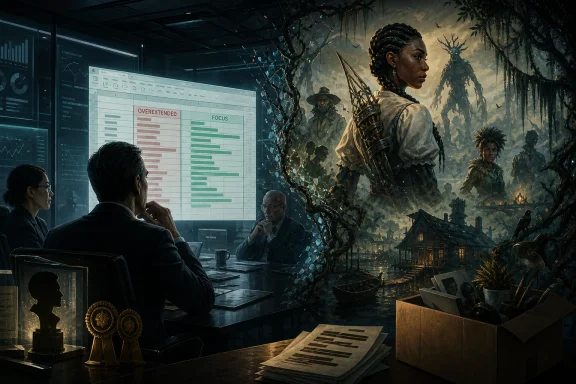 Xbox’s New Math Makes Prestige Feel Disposable
The alleged Compulsion closure lands with unusual sting because the studio was not an obvious embarrassment case. South of Midnight was not a live-service disaster, a years-late reboot, or a public technical fiasco. It was a highly stylized, story-driven action-adventure game with a clear identity, a Southern Gothic folktale aesthetic, and the kind of authorship Xbox has spent years insisting it wanted more of.That is what makes the timing so brutal. Earlier this year, Xbox leadership publicly celebrated the game’s critical recognition, including a Peabody Award, and held it up as an example of games’ ability to tell meaningful stories. In the normal grammar of platform-holder messaging, that is the sort of praise used to suggest strategic commitment: this is why we bought studios, this is why Game Pass needs variety, this is why first-party portfolios should not be reduced to sequels and shooters.
But the reported shutdown suggests a different internal grammar. Awards may validate a creative thesis, but they do not necessarily validate a business unit. In Microsoft’s current gaming calculus, a studio can produce respected work, enhance the brand’s cultural credibility, and still be judged insufficiently central to the next phase of Xbox.
That does not make Xbox uniquely cruel. It makes Xbox emblematic. The industry spent the post-pandemic years pretending that subscription growth, consolidation, and platform expansion could absorb almost any amount of creative experimentation. Now the same companies are discovering that creative diversity is easy to celebrate in interviews and much harder to defend in budget meetings.
Compulsion Was Exactly the Kind of Studio Xbox Said It Wanted
Compulsion Games always occupied a particular lane in Microsoft’s studio system. Founded in 2009, the Montreal developer built its reputation on games that looked and felt unlike the rest of the market. Contrast was a shadow-play puzzle platformer with cabaret flair. We Happy Few was messy, ambitious, and unmistakably strange. South of Midnight refined that impulse into something more coherent: a third-person adventure whose texture mattered as much as its mechanics.When Microsoft acquired Compulsion in 2018, the deal fit the logic of the era. Xbox needed more first-party content, Game Pass needed a constant flow of differentiated releases, and Microsoft wanted to prove it could be a better patron of mid-sized creativity than the traditional publisher model. The acquisition spree that also brought in studios such as Ninja Theory, Playground Games, Undead Labs, and others was sold as both an industrial expansion and a cultural correction.
Compulsion was not acquired to become a Call of Duty support shop. It was acquired because Xbox needed studios that could make games no one else would greenlight at scale. That was the pitch, implicitly if not always explicitly: Microsoft’s money could protect eccentricity from the harshest pressures of the commercial market.
The reported closure shows the danger in that bargain. When a studio’s independence is converted into a platform asset, its survival depends less on whether it makes good work than on whether the platform still needs the category it represents. Compulsion’s fate, if sealed, would say less about whether South of Midnight was worthy and more about whether Xbox still believes boutique first-party games are strategically necessary.
The “Overextended” Memo Was the Real Announcement
The most important Xbox story of the week was not the first reported studio closure. It was the leadership memo that made such closures feel almost inevitable. Xbox’s new leadership reportedly told employees that the division had expanded its studio system to support multiple strategies across subscription, streaming, devices, and content, only to find itself stretched too thin as those strategies changed.That is corporate language, but it is not empty language. It says Xbox built for a future in which Game Pass, cloud gaming, console hardware, PC, mobile, and multi-platform publishing all reinforced one another more cleanly than they actually did. It also says the company now sees that content pipeline not as an unquestioned advantage but as a cost base demanding discipline.
This is the reversal that matters. For years, Xbox’s problem was framed as scarcity: not enough exclusives, not enough cadence, not enough must-play first-party output. The answer was to buy studios, buy publishers, and create a giant internal machine capable of feeding the ecosystem. Now the problem is being framed as excess: too many teams, too many bets, too many projects that do not map neatly onto the revised business.
That is why Compulsion is such a revealing case. A small-to-mid-sized award-winning studio should be an easy thing to defend if the old thesis still holds. If even that kind of team is vulnerable, the reset is not about trimming obvious redundancies. It is about changing what Xbox considers valuable.
Game Pass Changed the Measurement, Then the Measurement Changed the Studios
The subscription model did not invent the tension between art and commerce, but it did make the tension harder to see. A game sold at retail either met expectations or did not. A Game Pass release, by contrast, can be valuable in several overlapping ways: attracting new subscribers, retaining existing ones, filling a release calendar, generating social conversation, improving brand perception, or later selling on other platforms.That flexibility once looked like a blessing for unusual games. A title like South of Midnight did not need to behave like a blockbuster if it strengthened the service’s breadth. It could be part of the long tail, a reason for subscribers to feel that Game Pass offered discovery rather than just access to familiar franchises.
The problem is that flexible value can become invisible value. If a game’s contribution cannot be cleanly separated from the broader subscription bundle, then its defending argument becomes softer during cuts. A franchise that sells tens of millions of copies, drives in-game spending, or anchors an annual marketing beat has numbers that announce themselves. A distinctive narrative game has a harder case to make unless leadership is ideologically committed to protecting that lane.
This is the Game Pass paradox for studios like Compulsion. The service helped justify their existence inside Xbox, but it may also have blurred the direct commercial evidence needed to protect them. Microsoft can point to engagement, reach, and portfolio breadth when launching a game; when restructuring arrives, the conversation can quickly narrow to cost, headcount, and forecastable return.
Awards Are Not a Business Model, but They Are Not Nothing
There is a temptation, especially among the industry’s most cynical observers, to dismiss awards as irrelevant decoration. That is too easy. Awards do not pay salaries by themselves, but they do confer meaning, brand value, recruitment power, and cultural durability. They are part of why platform holders fund prestige projects in the first place.The problem is that prestige only matters when a company chooses to account for it. Film studios understand this unevenly but explicitly: some releases exist to win awards, strengthen relationships with talent, and keep a studio in serious cultural conversation. Games companies often want the same benefits without admitting that prestige requires subsidy, patience, and protection from quarterly logic.
Xbox has repeatedly spoken as if it understands that. Its leadership has praised storytelling, new intellectual property, and the need for places where unusual ideas can come to life. Compulsion’s reported closure makes those statements look less like policy and more like mood music.
That distinction matters to developers watching from inside and outside Microsoft. If the lesson is that an acclaimed original game can still leave its studio exposed within a year, then the rational response is not to pitch bolder ideas. It is to pitch safer ones, attach them to existing brands, and avoid becoming the beautiful anomaly that executives celebrate right up until they cut it.
The Hi-Fi Rush Shadow Still Hangs Over Xbox
It is impossible to discuss Compulsion without remembering Tango Gameworks. Microsoft’s 2024 closure of the studio behind Hi-Fi Rush became an industry shorthand for Xbox’s credibility problem: a company can ask for smaller, creative, critically beloved games and then shut down the team that delivered one. Even after Tango’s revival outside Microsoft, the damage to Xbox’s messaging lingered.Compulsion now risks becoming the sequel to that reputational debacle. The details differ, and reported negotiations may yet alter the outcome, but the pattern is familiar enough to be damaging. A distinctive studio ships a well-regarded original game. Executives praise the work. A restructuring arrives. The studio’s future becomes precarious.
For players, this creates a sense of whiplash. For developers, it creates something colder: precedent. The question is no longer whether Xbox can fund creative games. Clearly it can. The question is whether Xbox can sustain the teams that make them when those games are not instant tentpoles.
That is a harder question because it cuts into Microsoft’s identity as the industry’s deep-pocketed stabilizer. The pitch of acquisition was not just money; it was security. If acquired studios conclude that Microsoft offers scale without safety, then Xbox’s ability to attract and retain creative leadership becomes more complicated.
The New Xbox Looks Less Like a Console Company and More Like a Portfolio Manager
The reported Compulsion move also fits a broader strategic turn. Xbox is no longer behaving like a traditional console platform holder trying to wall off a stable of exclusives. It is increasingly acting like a gaming portfolio manager with hardware, subscriptions, PC distribution, cloud infrastructure, and multi-platform publishing all competing for capital.That shift is not irrational. Console growth has been uneven, development costs have exploded, and Microsoft’s acquisition of Activision Blizzard gave it a massive engine of recurring revenue and global reach. In that world, it is easy to see why leadership would prioritize major franchises, proven engagement loops, and properties that can travel across devices and storefronts.
But there is a trade-off. The more Xbox becomes a portfolio manager, the less it can plausibly sell itself as a haven for studios with singular voices. Portfolio logic favors assets that are legible, scalable, and strategically reusable. Compulsion’s value was almost the opposite: specific, authored, and difficult to replicate without the people who made it.
That does not mean every small studio is doomed. It does mean every small studio inside Xbox now has to answer a harsher question: why should Microsoft own this capability rather than simply license, partner, or buy timed access to similar games from the outside? Once that question becomes central, internal creative teams lose the moral protection that first-party status used to imply.
Microsoft’s Scale Makes Every Closure Feel Like a Choice
Layoffs are never painless, but Microsoft’s size gives Xbox cuts a particular optics problem. This is one of the most valuable companies in the world, a firm with cloud profits, enterprise dominance, and the ability to spend tens of billions on acquisitions. When it closes a studio of fewer than 100 people, the savings may be meaningful to a divisional budget but look almost microscopic against the parent company’s balance sheet.That contrast fuels much of the anger around Xbox restructuring. Players are not confused about capitalism. They understand that companies cut costs. What they reject is the mismatch between Microsoft’s vast resources and the fragility of the creative teams it absorbed.
There is also a credibility cost. Microsoft spent years arguing that consolidation would not reduce creative output, that bringing studios under its umbrella would enable more games, more access, and more stability. Each closure makes that argument harder to sustain, especially when the targets are studios whose games visibly broadened Xbox’s identity.
The counterargument is straightforward: no company, however rich, should fund every team forever if the business case has collapsed. But that argument does not erase the prior sales pitch. If Microsoft wanted to be judged only as a ruthless allocator of capital, it should not have spent years presenting itself as a curator of creative ecosystems.
The Human Signal Arrives Before the Corporate Statement
One reason this story spread quickly is that employees reportedly began signaling on LinkedIn and social platforms that they were looking for work before any official Microsoft or Compulsion statement. That pattern has become grimly familiar across the games industry. The human news arrives first; the corporate confirmation comes later, often polished into phrases about alignment, focus, and strategic priorities.For workers, the ambiguity can be punishing. A reported closure that has not been officially acknowledged leaves employees navigating personal grief, professional uncertainty, and public speculation at the same time. For colleagues across the industry, those “open to work” posts function as both warning flare and mutual aid network.
The delay also shapes public trust. When companies do not speak quickly, the vacuum is filled by reporters, employees, leakers, and anxious fans. Sometimes early reports are incomplete. Sometimes negotiations continue behind the scenes. But silence rarely helps the people most affected.
If Compulsion’s fate is still subject to negotiation, Microsoft should say so plainly. If the decision is made, it should own it plainly. The industry has had enough of layoffs laundered through passive verbs.
Where Windows and PC Players Fit Into the Fallout
For WindowsForum readers, this may look at first like console-industry drama. It is not. Xbox is now one of the most important PC publishers in the world, and its first-party strategy directly shapes what appears on Windows, Steam, the Microsoft Store, Game Pass for PC, and eventually competing consoles.Compulsion’s games were PC games as much as Xbox games. South of Midnight reached players through the Windows ecosystem, and its existence strengthened Microsoft’s argument that Game Pass on PC could be more than a back catalog and blockbuster rental service. Losing studios like Compulsion narrows the range of first-party PC experiences Microsoft can offer.
The practical consequence is not that PC players will suddenly lack games. The PC market is overflowing with independent and third-party releases. The consequence is that Microsoft’s own catalog risks becoming more predictable at the top and more dependent on external partners for variety underneath.
That matters because Game Pass for PC competes not only on price but on identity. If Microsoft’s service becomes a rotation of giant franchises, licensed third-party deals, and fewer internally produced oddities, it may still be commercially viable. It will simply be less interesting.
Developers Will Hear the Message Louder Than Players
Players tend to experience studio closures as loss: a sequel that will not happen, a creative voice that disappears, a favorite team scattered across the industry. Developers experience them as market intelligence. They read the pattern and adjust their ambitions accordingly.If Compulsion closes after South of Midnight, the message to mid-sized studios is not subtle. Critical acclaim is useful, awards are pleasant, and platform-holder praise is temporary. The safest work is attached to franchises, technology mandates, service revenue, or production pipelines too essential to cut.
That message may be rational for individual careers and disastrous for the medium. Games need weird middle spaces between tiny indie projects and enormous franchise machines. They need studios with enough resources to build rich worlds but not so much overhead that every release must become a global event.
Microsoft once seemed positioned to protect that middle. It had the money, the platform, and the subscription model to make room for games that did not need to dominate retail charts. The reported Compulsion closure suggests that room is shrinking.
The Industry’s Middle Class Keeps Getting Erased
The broader games business has been hollowing out its middle for years. Development costs rise, marketing costs rise, player attention concentrates around fewer live-service giants, and subscription economics remain difficult to parse from the outside. The result is an industry that can support solo indies, small breakout teams, and mega-franchises, but struggles to sustain studios in the middle.Compulsion lived in that middle. It was not a garage team, and it was not a 1,000-person blockbuster factory. It made the kind of authored, polished, finite game that critics often champion and platform presentations often use to add texture between tentpoles.
That category is culturally important because it keeps the medium from flattening into two extremes: hobbyist experimentation and corporate mega-production. Mid-sized studios are where craft, risk, and professional production can meet. When they disappear, the industry loses not just jobs but a development format.
Microsoft’s dilemma is that the middle is expensive to own. If a mid-sized studio takes five or six years to ship a game that performs modestly, the numbers become difficult fast. But if the largest companies abandon that space, they should stop pretending their ecosystems are designed to nurture the full range of game creation.
The Lesson Hidden Inside Compulsion’s Reported Exit
The Compulsion story is still developing, and the precise outcome may change if reported negotiations produce a reprieve, sale, spinout, or restructuring short of closure. But the larger lesson is already visible: Xbox’s new leadership is moving from expansion to triage, and creative acclaim alone will not protect teams that no longer fit the revised map.That does not mean every decision is wrong. Xbox probably was overextended. The division’s studio count, hardware challenges, subscription ambitions, Activision integration, and multi-platform turn created a structure that may have been impossible to manage coherently. A reset was likely coming no matter who sat in the top job.
The issue is what kind of reset this becomes. A disciplined Xbox could still fund smaller original games, protect unusual teams, and use Microsoft’s scale to create a healthier portfolio than the old console-war model allowed. A frightened Xbox will retreat toward the biggest franchises, the safest metrics, and the least surprising bets.
Compulsion is a measure of which path Microsoft is choosing. If a Peabody-winning studio praised by leadership in April can be marked for closure in June, the burden of proof shifts. Xbox now has to demonstrate through actions, not interviews, that “great games” means more than games that are already too big to fail.
A Smaller Xbox Could Still Be a Better Xbox, but Not This Way
There is a version of Xbox’s reset that makes sense. Microsoft could reduce duplication, clarify publishing priorities, give studios more realistic budgets, and stop pretending every initiative must serve console, cloud, subscription, PC, and multi-platform strategy at once. Focus is not inherently anti-creative.But focus becomes destructive when it treats distinct studios as expendable decorations. The point of owning a broad studio portfolio is not merely to feed content slots; it is to preserve capabilities that would be hard to rebuild later. Once a team like Compulsion is scattered, Microsoft cannot simply summon another South of Midnight by commissioning a pitch deck.
The games industry often talks about intellectual property as if the property is the asset. In practice, the people are the asset. The style, judgment, taste, and accumulated trust inside a studio are what make unusual projects possible. Close the studio, and the IP may remain on a shelf, but the creative organism is gone.
That is why the reported closure feels bigger than its headcount. It is a small event in Microsoft’s financial universe and a large event in Xbox’s cultural one. It tells every other team what kind of value survives the reset.
The Signal Xbox Sends After the Applause
The most concrete facts remain narrow, but they are enough to frame the stakes.- Microsoft’s gaming division reportedly warned employees in June 2026 that Xbox had become overextended after years of expansion across studios, subscriptions, streaming, devices, and content.
- Compulsion Games is reportedly being targeted for closure after releasing South of Midnight, a critically praised original game that won major recognition for storytelling and impact.
- Xbox leadership praised Compulsion’s work earlier in 2026, making the reported closure a sharp contrast between public celebration and internal prioritization.
- The move would reinforce industry fears that mid-sized creative studios are becoming harder to sustain inside large platform companies.
- PC players should care because Xbox’s studio strategy increasingly shapes the future of Game Pass for PC, Windows releases, and Microsoft’s broader publishing identity.
- The unresolved question is whether Xbox’s reset will create a more coherent creative strategy or simply narrow the company around its safest and largest franchises.
References
- Primary source: PC Gamer
Published: Mon, 15 Jun 2026 18:18:15 GMT

Xbox is reportedly closing South of Midnight studio Compulsion Games after bragging about its award-winning developers earlier this year | PC Gamer
The shutdown comes just a few days after a report claiming that major layoffs at Xbox were on the way.www.pcgamer.com - Related coverage: windowscentral.com

Xbox admits it’s “over‑extended” as leadership signals a major rethink of its studio strategy | Windows Central
Xbox leadership admits the company became overextended and says major changes are needed to strengthen its biggest franchises.www.windowscentral.com - Related coverage: gamesradar.com
Major Xbox layoffs reportedly on the way as CEO Asha Sharma admits Microsoft's gaming division is "over extended" | GamesRadar+
Going forward, this cannot continuewww.gamesradar.com - Related coverage: gamespot.com
Xbox Closing We Happy Few, South Of Midnight Developer Compulsion Games - Report - GameSpot
Xbox CEO Asha Sharma recently discussed "hard truths."www.gamespot.com - Related coverage: gematsu.com
Bloomberg: Several Xbox studios in negotiations to avoid closure - Gematsu
Several studios within Xbox are in active negotiations to spin off from the company in order to avoid closure, including Compulsion Games…www.gematsu.com - Related coverage: tweaktown.com

Xbox first-party studio closures target Compulsion Games, Double Fine and more, studios negotiating for independence
Microsoft is planning to shut down first-party Xbox Games Studios groups, but these developers are negotiating in a bid to secure independence from Xbox. www.tweaktown.com
- Related coverage: videogameschronicle.com

Xbox is reportedly shutting down South of Midnight studio Compulsion Games | VGC
The Xbox studio behind We Happy Few and Contrast looks set to close…www.videogameschronicle.com - Related coverage: insider-gaming.com

Xbox Likely To Close South of Midnight Developer Compulsion Games - Insider Gaming
Insider Gaming can confirm that Xbox is planning to shut down Compulsion Games, the award-winning studio behind South of Midnight.insider-gaming.com - Related coverage: gamedeveloper.com

Report: Multiple Xbox game studios negotiating to avoid closure
Xbox's strategic reset appears to involve shutting down or divesting from South of Midnight developer Compulsion Games.www.gamedeveloper.com - Related coverage: altchar.com

Xbox is reportedly shutting down South of Midnight studio Compulsion Games, with Arkane Lyon also said to be at risk | AltChar
The South of Midnight developer is being shut down according to reports, and separate info suggest Deathloop studio Arkane Lyon may not be safe either. www.altchar.com
- Related coverage: gamersegames.com.br
Xbox pode encerrar a Compulsion Games, estúdio de South of Midnight
Relato aponta para o fechamento do estúdio adquirido em 2018, em plena fase de cortes e “reset” do negócio Xbox.www.gamersegames.com.br - Related coverage: nintendoeverything.com

Xbox reportedly shutting down South of Midnight dev Compulsion Games
According to a report from Kotaku, Xbox will be shutting down Compulsion Games. An official announcement has not been made, but that could be changing very soon. Compulsion Games previously made South of Midnight, which came to Nintendo Switch 2 a little while back. The studio was also behind We... nintendoeverything.com
- Related coverage: engadget.com

Xbox Is Reportedly Closing Ninja Theory, Double Fine And Compulsion Games
Some well-known first-party Xbox studios are reportedly at risk of being closed down.www.engadget.com - Related coverage: techradar.com

Xbox leaders lay out new priorities for the company's future, and promise 'flexible pricing' and a focus on 'daily active players' by prioritizing 'hardware, content, experience, and services' | TechRadar
Xbox CEO Asha Sharma and Xbox Chief Content Officer Matt Booty have shared a detailed plan for the company's future, which includes a focus on player engagement and another name change.www.techradar.com