

Microsoft has quietly begun paying you—in Microsoft Rewards points—to stay on Microsoft Edge when you search for Google Chrome in Bing, a tactic that combines in‑product advertising, loyalty incentives, and UX nudging to keep Windows 11 users inside Microsoft’s ecosystem.
Microsoft’s recent marketing experiments on Bing and in Microsoft Edge are the latest escalation in a long-running contest between browsers and search engines. Over the past two years Microsoft has repeatedly tested prominent, system‑level prompts designed to persuade Windows users to use Edge and Bing instead of rival browsers and search engines. Those experiments have included UI mimicry, full‑screen promotional cards, comparison “scoreboards,” and now rewards‑backed offers that promise Microsoft Rewards points for trying Edge. Independent reporting and community reproductions show these units appear at the precise moment a user seeks to download or look up Chrome, surfacing above official download links and sometimes adding friction to finding the competitor’s page. This campaign is not an isolated stunt: it fits into a broader strategy in which Microsoft uses Windows, Edge, and Bing as mutually reinforcing distribution channels. The tactics have triggered pushback from privacy and competition critics, regulatory scrutiny in several jurisdictions, and fresh complaints from rival browser vendors. At the same time, they leverage legitimate product differentiators—AI features, integrated services, and a loyalty program (Microsoft Rewards)—to frame retention as user benefit rather than rent‑seeking.
For users, the practical takeaway is simple: the ad units can be bypassed with a direct URL or by setting a preferred default browser; Microsoft Rewards are redeemable but not cash, and point values vary by region; Edge Secure Network is useful for privacy but is not a full VPN replacement. For regulators and competitors, the campaign is one more data point in a larger debate about how far integrated platforms should go to keep users inside their own ecosystems before they cross the line from helpful marketing to anti‑competitive exclusion.
Ultimately, whether these tactics are persuasive or pernicious depends on perspective—and on whether regulators, enterprises, and the public insist that choice at the OS and browser level remains clear, discoverable, and fair.
Source: Windows Latest Download “Chrome” using Bing? Microsoft ‘bribes’ you to use Windows 11's Edge with gift cards
 Background
Microsoft’s recent marketing experiments on Bing and in Microsoft Edge are the latest escalation in a long-running contest between browsers and search engines. Over the past two years Microsoft has repeatedly tested prominent, system‑level prompts designed to persuade Windows users to use Edge and Bing instead of rival browsers and search engines. Those experiments have included UI mimicry, full‑screen promotional cards, comparison “scoreboards,” and now rewards‑backed offers that promise Microsoft Rewards points for trying Edge. Independent reporting and community reproductions show these units appear at the precise moment a user seeks to download or look up Chrome, surfacing above official download links and sometimes adding friction to finding the competitor’s page. This campaign is not an isolated stunt: it fits into a broader strategy in which Microsoft uses Windows, Edge, and Bing as mutually reinforcing distribution channels. The tactics have triggered pushback from privacy and competition critics, regulatory scrutiny in several jurisdictions, and fresh complaints from rival browser vendors. At the same time, they leverage legitimate product differentiators—AI features, integrated services, and a loyalty program (Microsoft Rewards)—to frame retention as user benefit rather than rent‑seeking. What the Bing ad does, in practice
The mechanics of the “don’t download Chrome” card
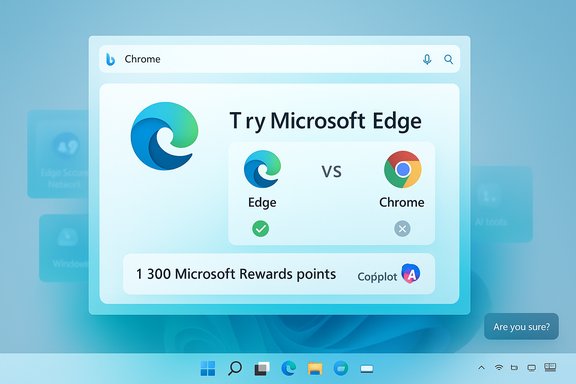
When a user running Microsoft Edge on Windows 11 searches for “Chrome” or “download Chrome” in Bing, a large promotional card can appear above the normal search results. Variations of the card include:- A side‑by‑side comparison that visually “scores” Edge against Chrome (Edge gets ticks; Chrome gets muted marks).
- A prominent call‑to‑action to “Try Microsoft Edge” or “Discover more features.”
- A note promising Microsoft Rewards points—WindowsLatest reported an instance advertising 1,300 Microsoft Rewards points for trying Edge. The card also highlights features like AI personalization and a built‑in “secure network” or VPN‑like option.
The Rewards hook
Microsoft’s ad does not promise cash. Instead, it states you can earn Microsoft Rewards points (the example figure reported by WindowsLatest was 1,300 points) by trying Edge, and points can be redeemed for gift cards, subscriptions, and charitable donations. Microsoft itself documents that Rewards points can be exchanged for third‑party gift cards (Amazon, Spotify, etc. or donated to nonprofits—options the ad explicitly highlights. The Rewards program is an established loyalty system that awards points for Bing searches, Edge usage, and other activities. Caveat: the specific amount (1,300 points) and the exact redemption options shown in an ad unit appear to be regional and experiment‑dependent. At the time of reporting that figure was documented by WindowsLatest and reproduced in forum screenshots, but it does not appear to be a universally advertised global offer. Treat the exact points figure as situational and likely A/B tested.Verifying the technical and product claims
Microsoft Rewards: what points buy and how they work
Microsoft Rewards points cannot be converted to cash, but they can be redeemed for real‑world benefits: gift cards (Microsoft Store, Amazon, Spotify, Roblox and others), Xbox content, Microsoft Store credit, and donations to charities. Microsoft’s Rewards portal lists redemption options and notes that availability and point costs vary by market and membership level. Independent community trackers and user reports confirm that redemption rates change over time and by region—so a set number of points will map to different gift card values depending on where you are and when you redeem. This means a 1,300‑point incentive is modest in monetary terms and unlikely to buy much outright without additional points saved. Key verification points:- Microsoft documents how Rewards redemptions work and shows gift card options in the Rewards catalog.
- Community data and forum reports show point‑to‑value conversions vary and have changed historically (users report shifts in points required for popular gift cards). Treat conversion rates as fluid.
Edge’s “built‑in VPN” — what it really is
The ad lists a “VPN” or “Cloudflare‑based secure network” as an Edge differentiator. That claim is grounded in fact: Microsoft ships Edge Secure Network, a privacy proxy feature powered by Cloudflare’s Privacy Proxy technology. Cloudflare’s press materials and Microsoft documentation both describe Edge Secure Network as a privacy‑enhancing proxy that routes browser traffic through Cloudflare to mask your IP and encrypt browser connections. However, technical disclosures and Cloudflare’s own blog clarify this is not the same as a full, location‑selectable VPN service: it functions as a browser‑level privacy proxy with usage caps in many markets (for example, free tiers provide a limited data allotment) and does not generally let users pick arbitrary egress locations like conventional commercial VPNs do. That means marketing language that calls the feature a VPN is technically imprecise; it’s a Cloudflare‑backed privacy proxy integrated into Edge. What we verified:- Cloudflare publicly announced its role powering Edge Secure Network and described the Privacy Proxy architecture; Microsoft’s Edge pages describe the feature as well. The technical documentation explicitly frames it as a privacy proxy/tunnel rather than a full VPN replacement. Availability, caps, and geo‑behavior vary by market.
AI personalization and “Microsoft‑recommended” labels
Edge’s integration with Microsoft’s Copilot and other AI services is real: Edge includes contextual AI tools for summarization, chat, and content generation. Microsoft’s marketing flagging “AI personalization” is therefore verifiable as product capability. The “Microsoft‑recommended” badge, however, is a marketing designation—not an objective third‑party certification—and should be read as a Microsoft compatibility/marketing label rather than an independent trustmark.Context: why Microsoft is pushing Edge so aggressively
- Browsers are strategic gateways to search, advertising revenue, and aggregated user signals used to improve AI models. Chrome dominates global browser market share, and even small shifts in user behavior can produce substantial changes in daily active users and data collection. Microsoft’s integrated approach—bundling Edge with Windows 11 and using Bing as the default search—creates distribution leverage. The recent ads aim to turn that leverage into measurable retention.
- Regulatory pressure has forced Microsoft to change some behaviors in specific regions (notably the EEA under the Digital Markets Act). In the EEA Microsoft has implemented mechanisms to respect user defaults more politely, but outside those markets Microsoft still has leeway to surface targeted promotions from within Windows and Edge. That regulatory patchwork explains why experiments can look aggressive in some geographies and toned down in others.
- The company is testing server‑side and in‑product experiments at scale: A/B testing copy, reward amounts, and card placement lets Microsoft see what moves behavior with minimal engineering rollout. The result is quick iteration but also inconsistent experiences across users. Community reproductions show the behavior appears in particular account and region configurations, which is characteristic of server‑side experimentation.
Critical analysis — strengths, benefits and business rationale
What Microsoft does well (and why some users might like it)
- Integrated features and convenience: Edge offers tightly integrated features—sync across devices, reading tools, vertical tabs, Copilot and AI helpers—that are genuinely useful for productivity users and those invested in Microsoft services. The “everything in one place” narrative has some merit.
- Loyalty incentives can reward habitual behavior: Microsoft Rewards gives tangible benefits (gift cards, subscriptions, donations). For some users those points are a nice bonus for actions they would take anyway—searching and using a browser—so the Rewards hook can feel like a win.
- Privacy proxy for casual use: Edge Secure Network, backed by Cloudflare, provides an accessible privacy enhancement for users who want to avoid leaking their IP on public Wi‑Fi or when visiting unknown sites. For many users a simple toggle with a modest free data allotment is a practical tradeoff.
Why the approach is risky and where it fails users
- Dark‑pattern risk: Placing promotional cards above the object of a user’s intent (downloading Chrome) and using visual emphasis to de‑emphasize alternatives crosses into the territory of dark patterns—UX choices that manipulate decisions. Repeated use of such patterns can erode trust even if the action is not strictly illegal. Several reporting and community examples show users describing the experience as manipulative.
- Regulatory and competitive exposure: Packaging system‑level prompts with rewards and comparison scoreboards invites antitrust scrutiny. Regulators and rival browser vendors are already monitoring these behaviors and in some cases filing complaints. Microsoft’s local compliance with the DMA in the EEA shows regulators can shape how these features behave at scale; similar pressure in other regions could force wider changes.
- Reward economics are weak: Microsoft Rewards is a loyalty mechanic, not a salary. Reported reward amounts (e.g., 1,300 points) are typically low relative to the friction of switching and often insufficient to purchase meaningful gift cards without additional points. Community evidence shows point valuations and redemption costs fluctuate, so the incentive is inconsistent and often symbolic rather than substantial. Presenting rewards as “money” can mislead casual users who equate gift cards with cash.
- The “VPN” framing is ambiguous: Marketing language that frames Edge Secure Network as a “VPN” can mislead users about the feature’s capabilities. The Cloudflare integration is a privacy proxy with limitations and (in many markets) data caps; it’s not a substitute for a full, configurable VPN service. Users seeking geo‑location control or unlimited tunneling should not treat Edge Secure Network as a direct replacement for dedicated VPN services.
Practical guidance for Windows users and administrators
For everyday users
- If you want to bypass Bing promotions: type the direct URL (e.g., google.com/chrome) into the address bar rather than searching via Bing. That avoids some of the promotional units and gets you straight to the official download.
- If you prefer Chrome or another browser as default: use Settings → Apps → Default apps and set Chrome (or your preferred browser) for the key web file associations (.htm, .html, HTTP, HTTPS) to minimize prompts. In the EEA Microsoft’s changes have made this process more straightforward; outside the EEA you may still encounter promotional nags.
- Be realistic about Rewards: treat Microsoft Rewards as a small loyalty program, not a replacement for cash. Points redeem for gift cards and donations; conversion rates change by region. If you plan to pursue a reward, check the Rewards catalog before chasing a short‑lived ad.
For power users and IT admins
- Enforce defaults via policy: Enterprises should use Group Policy or MDM to enforce default browser and search engine settings to remove user confusion and prevent OS‑level promotional experiments from altering user workflows.
- Document and train: Add clear KB steps for installing alternatives and setting defaults as part of onboarding to avoid user support churn from promotional cards.
- Audit UI experiments: Monitor telemetry and user feedback for unexpected UI prompts that can confuse end users or generate compliance risk.
- Consider formal complaints where competitors are materially harmed: If a vendor believes Microsoft’s server‑side experiments are anti‑competitive and cause measurable harm, regulatory routes exist and competitors have used them in multiple regions.
Where verification is thin — flagged claims
- The specific “1,300 Microsoft Rewards points” figure appears prominently in screenshots and in WindowsLatest reporting but has not been widely corroborated across multiple major outlets at the moment of writing. The number may be a localized or experiment‑dependent reward amount; readers should not assume it’s a guaranteed global rebate. Until Microsoft publishes a formal promotional page confirming the figure, treat it as experimentally observed, not universally guaranteed.
- The ad’s precise redemption options (e.g., which gift cards are offered for 1,300 points) will vary by market and over time. Microsoft changes the Rewards catalog and point costs periodically; community trackers document frequent adjustments. Verify the current catalog in your Rewards dashboard before assuming a specific point total will net a particular gift card.
Wider implications: competition, UX, and the browser market
Microsoft’s push reinforces a pattern seen across major platform owners: using integrated system surface area to promote first‑party services. Historically that behavior invites two outcomes:- Short term: Success at incrementally retaining non‑technical users who follow the path of least resistance. Promotional nudges combined with small financial incentives can convert a fraction of users—enough to matter at scale because of the sheer size of Windows’ installed base.
- Long term: Regulatory scrutiny and reputational cost. Repeated use of prominent nudges and UI patterns that obscure choices elevates the risk of antitrust complaints and public backlash. Competitors and consumer groups are more likely to document patterns and seek remedies when behavior is systemic rather than occasional. Microsoft’s EEA concessions demonstrate regulators can force substantive changes when market power is implicated.
Conclusion
Microsoft’s use of Bing to offer Microsoft Rewards points—reportedly 1,300 points in a reproduced ad—to try to keep users on Edge is a telling example of modern platform marketing: it blends product claims (AI, privacy proxy features), loyalty mechanics (Microsoft Rewards), and UX design to shape user decisions at the moment of intent. The features Microsoft highlights—Edge Secure Network, Copilot integration, Rewards—are real and have verifiable technical grounding. However, the presentation and placement of those promotions raise legitimate concerns about dark patterns, operability across regions, and transparency of incentives.For users, the practical takeaway is simple: the ad units can be bypassed with a direct URL or by setting a preferred default browser; Microsoft Rewards are redeemable but not cash, and point values vary by region; Edge Secure Network is useful for privacy but is not a full VPN replacement. For regulators and competitors, the campaign is one more data point in a larger debate about how far integrated platforms should go to keep users inside their own ecosystems before they cross the line from helpful marketing to anti‑competitive exclusion.
Ultimately, whether these tactics are persuasive or pernicious depends on perspective—and on whether regulators, enterprises, and the public insist that choice at the OS and browser level remains clear, discoverable, and fair.
Source: Windows Latest Download “Chrome” using Bing? Microsoft ‘bribes’ you to use Windows 11's Edge with gift cards
