

Microsoft Rewards is heading into another period of upheaval, and this time the controversy is not just about a few shaved-off points or a temporary promotion change. The bigger story is that Microsoft appears to be rethinking the whole shape of the program, with region-specific rollouts, tiered status changes, and a tighter grip on how users earn value. For a service that has long been sold as a simple loyalty perk, the direction of travel feels more like a recalibration of the exchange rate between user activity and Microsoft’s ecosystem benefits. That is why the backlash is so immediate: people do not merely see fewer points, they see a different contract.
Microsoft Rewards has always been more than a points program, even when it looked modest on the surface. Microsoft’s current public materials still describe it as a way to earn rewards by searching, browsing, shopping, playing, and completing dashboard activities, with redemptions ranging from gift cards to donations and sweepstakes entries. The appeal has always been that the user feels like they are being paid for normal behavior, while Microsoft quietly shapes that behavior toward Bing, Edge, Xbox, and the Microsoft Store. That combination made the service sticky. It also made any reduction in earning power feel personal.
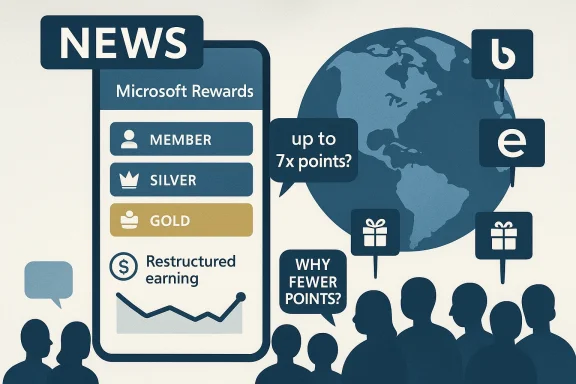
Historically, the program has changed frequently enough that long-time users have learned to expect movement, but not necessarily to accept it. Microsoft still documents a classic two-level structure in many markets, with Level 1 and Level 2 tied to monthly accumulation and Level 2 unlocking better Bing earning rates and discounts on Microsoft-branded redemptions. Yet community reports in 2025 and 2026 suggest that some regions are being moved into a newer three-tier model with Member, Silver, and Gold status, a structure that is not reflected in the older public support pages but is being discussed widely by users in rollout regions. That gap between official documentation and lived experience is one reason the situation has become so contentious.
The tension is not just about labels. Loyalty programs usually succeed when the path to value feels clear, predictable, and fair. Microsoft Rewards has increasingly drifted toward something more dynamic and more segmented, where the earning math changes by region and by account type. Microsoft’s own support pages emphasize that availability varies by market, that point limits apply, and that users should check region-specific rules before assuming a universal experience. That flexibility is practical for Microsoft, but it can create a fragmented customer experience where two users on different continents are effectively playing different games.
The current backlash also reflects the changing role of Rewards inside Microsoft’s broader ecosystem strategy. The company is no longer using the program primarily as a light acquisition hook. It is using it as an engagement engine across search, shopping, gaming, and subscriptions. In that context, every cut to the daily grind, every shift in redemption pricing, and every new status rule is really a decision about how much user behavior Microsoft wants to subsidize. The more mature the program becomes, the more aggressively Microsoft can try to tune that subsidy downward without technically breaking its promises.
Microsoft’s current support language still presents Rewards as a broad ecosystem that spans search, browsing, shopping, gaming, and personalized dashboard tasks. It also makes clear that point limits apply and that rewards vary by market. That legal and operational flexibility gives Microsoft the room to change the earning model without treating every shift like a major product launch. But users do not experience the program as legal language. They experience it as a daily trade: time and attention in exchange for redeemable value.
The new reported tier system appears designed to formalize a newer version of that trade. Under the older two-tier model, Level 2 was the prize for steady monthly participation, and the reward was straightforward: earn 500 points, unlock better rates, and keep going. Under the reported Member/Silver/Gold setup, the hierarchy becomes more granular, with a premium tier that promises larger multipliers while the base daily earning cap appears lower in practice. That is a classic loyalty-program tactic: compress the default and make the premium path look exciting. It can work, but only if the premium path feels real.
The rollout pattern also matters because early adopters tend to become the loudest critics. If a new model lands in one region and users there decide it is worse, Microsoft inherits that sentiment before the change has even reached the rest of its markets. The result is an update that arrives with a reputational handicap. Once a loyalty program is seen as being devalued, recovery is hard.
What makes the new model controversial is the apparent mismatch between the promise and the experience. In the reported rollout, daily earning caps are dramatically lower at the baseline than users were accustomed to, while the higher tier is presented as a way to recover some of that value. That can feel less like a promotion and more like a restructuring of an existing benefit. Microsoft may say users can earn more in total through new methods, but if the day-to-day route feels thinner, the sentiment will still be negative.
That is where Microsoft’s messaging may struggle. Any promise of up to 7x points is likely to be interpreted by users as a broad uplift, even if the real-world gain depends on very specific actions or markets. The phrase “up to” is doing a lot of work there. It is a classic corporate hedge, and consumers know it. The more the headline sounds promotional, the more carefully users will inspect the fine print.
That psychological reality is why small cuts matter so much. A daily set reduced from 10 points to 5 points may not look dramatic in isolation, but over time it changes the cost-benefit calculation for anyone who built a routine around accumulation. Once the user feels that the routine has been devalued, the entire loyalty proposition starts to look weaker. Microsoft does not have to remove value entirely for the emotional effect to be negative.
The tradeoff is obvious. Efficient systems often feel colder. If users begin to believe Rewards is primarily a device for pushing product usage rather than a sincere loyalty benefit, the emotional tone of the program changes. That tone is difficult to repair once it shifts.
A staged rollout is sensible from an engineering and product-management standpoint. It lets Microsoft measure reaction, tune thresholds, and compare behavior across cohorts. But it also means that the user experience becomes increasingly uneven. Some people will feel like they are being tested on, while others will feel like they are seeing the “normal” version of the program. The end result is a fragmented loyalty experience that is hard to describe in a single sentence.
It is one thing for a company to evolve a loyalty program. It is another for the documentation, the dashboard, and the user community to all tell slightly different stories. When that happens, users assume the company is hiding the ball, even if the truth is merely that rollout and documentation are out of sync.
The immediate consumer risk is simple: the program becomes less worth the time. If users must jump through more hoops for the same or lower return, many will scale back participation. That may not matter to Microsoft if casual engagement remains high enough, but it does matter if the program relies on habit to keep people inside the ecosystem. Habit is fragile. Once users skip a few days, they often skip more.
The gaming audience also tends to be exceptionally good at comparing value across systems. Once the reward math looks worse, they move on quickly. Microsoft can afford a lot of experimentation, but it cannot assume the gaming audience will remain patient simply because the program is part of the broader Xbox ecosystem. Gamers are generous only until the value stops feeling transparent.
For enterprise buyers, the direct effect is limited. Microsoft Rewards is not an IT deployment issue in the way Windows Update or Microsoft 365 licensing is. But it still matters as a signal. The company is increasingly comfortable using segmented incentives, regional variation, and behavioral nudges to steer users. That philosophy often spills into other product areas, especially where Microsoft wants to increase stickiness without resorting to hard locks.
This is the same tension Microsoft faces in many other products: how to improve monetization and engagement without making the product feel more extractive. Rewards is just a more visible version of that problem because the exchange rate is easy to understand. When value is this legible, users notice when the math changes.
The reason messaging matters so much here is that loyalty programs depend on trust, not just on arithmetic. If users believe the redesign is better, they will adapt. If they believe it is a downgrade dressed up as a feature, they will resist. Microsoft’s challenge is not to prove that the new system can technically produce value. It is to make users feel that value without needing a spreadsheet.
The company’s best defense would be transparency that is more specific than “more opportunities” and more honest than “up to” language alone. Users want concrete examples, visible dashboards, and an honest explanation of what changed. Anything less feels like spin.
The upside is not imaginary. Microsoft has a massive ecosystem, and a better-structured Rewards program could tie search, shopping, gaming, and subscription behavior together more coherently. The key is whether the company can preserve the sense of fairness that made the program popular in the first place.
There is also the risk of fragmentation. If different regions receive different versions of the program with different caps, bonuses, and tier behavior, comparison becomes difficult and resentment becomes easier. The more opaque the rollout, the more likely users are to assume the worst.
The real question is not whether Microsoft can technically justify the changes. It can. The question is whether users will continue to feel that the time they invest is worth the return they receive. That is where loyalty programs win or lose. And once that feeling changes, it usually takes more than a status tier to bring it back.
Source: GameRant Microsoft Rewards is Getting Some Controversial Changes in May
 Background
Microsoft Rewards has always been more than a points program, even when it looked modest on the surface. Microsoft’s current public materials still describe it as a way to earn rewards by searching, browsing, shopping, playing, and completing dashboard activities, with redemptions ranging from gift cards to donations and sweepstakes entries. The appeal has always been that the user feels like they are being paid for normal behavior, while Microsoft quietly shapes that behavior toward Bing, Edge, Xbox, and the Microsoft Store. That combination made the service sticky. It also made any reduction in earning power feel personal.Historically, the program has changed frequently enough that long-time users have learned to expect movement, but not necessarily to accept it. Microsoft still documents a classic two-level structure in many markets, with Level 1 and Level 2 tied to monthly accumulation and Level 2 unlocking better Bing earning rates and discounts on Microsoft-branded redemptions. Yet community reports in 2025 and 2026 suggest that some regions are being moved into a newer three-tier model with Member, Silver, and Gold status, a structure that is not reflected in the older public support pages but is being discussed widely by users in rollout regions. That gap between official documentation and lived experience is one reason the situation has become so contentious.
The tension is not just about labels. Loyalty programs usually succeed when the path to value feels clear, predictable, and fair. Microsoft Rewards has increasingly drifted toward something more dynamic and more segmented, where the earning math changes by region and by account type. Microsoft’s own support pages emphasize that availability varies by market, that point limits apply, and that users should check region-specific rules before assuming a universal experience. That flexibility is practical for Microsoft, but it can create a fragmented customer experience where two users on different continents are effectively playing different games.
The current backlash also reflects the changing role of Rewards inside Microsoft’s broader ecosystem strategy. The company is no longer using the program primarily as a light acquisition hook. It is using it as an engagement engine across search, shopping, gaming, and subscriptions. In that context, every cut to the daily grind, every shift in redemption pricing, and every new status rule is really a decision about how much user behavior Microsoft wants to subsidize. The more mature the program becomes, the more aggressively Microsoft can try to tune that subsidy downward without technically breaking its promises.
What makes this moment different
The key difference now is that users are not reacting to a single isolated tweak. They are reacting to a pattern. Point values have been adjusted, daily set values have been reduced in some regions, and users in multiple countries have reported a revised tier structure with lower apparent daily caps and more complicated bonus logic. That kind of change feels less like a refresh and more like a redefinition. That distinction matters more than the branding does.- Microsoft Rewards is still framed as a loyalty benefit.
- Users increasingly experience it as a variable economy.
- Regional rollout makes the program feel inconsistent.
- Long-time earners notice reductions faster than casual users.
- A more complex system can easily feel less generous.
Overview
The controversial May changes should be understood as part of a much longer Microsoft pattern: simplify the promise, complicate the mechanics, and shift the economics gradually enough that many users only realize what changed after they have already built habits around the old system. That is not unique to Microsoft, but it is especially visible in Rewards because the program touches daily routines. People check in, search, click, and redeem on autopilot. When the rules move, the routine breaks.Microsoft’s current support language still presents Rewards as a broad ecosystem that spans search, browsing, shopping, gaming, and personalized dashboard tasks. It also makes clear that point limits apply and that rewards vary by market. That legal and operational flexibility gives Microsoft the room to change the earning model without treating every shift like a major product launch. But users do not experience the program as legal language. They experience it as a daily trade: time and attention in exchange for redeemable value.
The new reported tier system appears designed to formalize a newer version of that trade. Under the older two-tier model, Level 2 was the prize for steady monthly participation, and the reward was straightforward: earn 500 points, unlock better rates, and keep going. Under the reported Member/Silver/Gold setup, the hierarchy becomes more granular, with a premium tier that promises larger multipliers while the base daily earning cap appears lower in practice. That is a classic loyalty-program tactic: compress the default and make the premium path look exciting. It can work, but only if the premium path feels real.
Why users are upset
The biggest complaint is not merely that Microsoft is changing the rules. It is that the changes appear to reduce the baseline value for the majority of users while reserving the most attractive earning rates for a narrower group. If the ordinary daily ceiling falls, then casual participation becomes less rewarding, and the user who once felt like a smart optimizer begins to feel like a player being nudged into a different lane. That is a subtle but powerful form of dissatisfaction.- Daily points are easy to compare across time.
- Reduced ceilings are easy to notice.
- Bonus-heavy systems feel less transparent.
- Users dislike rewards that require new mental accounting.
- Perceived fairness often matters more than raw totals.
The regional fragmentation problem
Microsoft’s Rewards ecosystem is increasingly market-specific, which means the same program can feel generous in one country and stingier in another. Support pages openly acknowledge that availability and earning rules vary by region. That is understandable from a business perspective, but it also means Microsoft is effectively running multiple versions of Rewards at once. In practice, that creates confusion, comparison shopping, and frustration among users who are reading Reddit threads and trying to reconcile different screenshots with their own dashboards.The rollout pattern also matters because early adopters tend to become the loudest critics. If a new model lands in one region and users there decide it is worse, Microsoft inherits that sentiment before the change has even reached the rest of its markets. The result is an update that arrives with a reputational handicap. Once a loyalty program is seen as being devalued, recovery is hard.
The New Tier Logic
The reported Member, Silver, and Gold structure is the clearest sign that Microsoft is rethinking the psychology of Rewards. A three-tier ladder gives the company more room to segment users and more levers to pull when it wants to reward deeper engagement. It also lets Microsoft market the top tier as aspirational rather than merely practical. That matters because people respond more strongly to visible status ladders than to invisible math.What makes the new model controversial is the apparent mismatch between the promise and the experience. In the reported rollout, daily earning caps are dramatically lower at the baseline than users were accustomed to, while the higher tier is presented as a way to recover some of that value. That can feel less like a promotion and more like a restructuring of an existing benefit. Microsoft may say users can earn more in total through new methods, but if the day-to-day route feels thinner, the sentiment will still be negative.
Why status changes are so sensitive
Status systems work best when the improvement feels earned rather than imposed. Microsoft has long used Level 2 to encourage monthly consistency, and that model was easy to understand because the reward was based on a simple threshold: 500 points per month. The new structure appears more conditional and more segmented. That may improve Microsoft’s ability to tune rewards, but it also makes the program harder to explain to ordinary users.- Simple thresholds create confidence.
- Multi-tier ladders create more questions.
- Higher status only helps if the benefits are obvious.
- “Up to” claims often hide wide variability.
- Users want clarity before they want gamification.
The Gold problem
The reported Gold tier is especially important because it seems to be Microsoft’s attempt to create a premium identity inside a loyalty system that was once largely about consistency. Gold sounds valuable. It sounds exclusive. It sounds like a win. But if users have to work harder overall to reach the point where Gold feels worthwhile, the brand halo will not save the program from criticism.That is where Microsoft’s messaging may struggle. Any promise of up to 7x points is likely to be interpreted by users as a broad uplift, even if the real-world gain depends on very specific actions or markets. The phrase “up to” is doing a lot of work there. It is a classic corporate hedge, and consumers know it. The more the headline sounds promotional, the more carefully users will inspect the fine print.
The Economics of Points
Microsoft Rewards is a closed economy, and that means Microsoft can change the rules without ever calling it a price hike. The company’s own documentation is careful to say that points do not have cash value, that offers vary, and that earning limits apply. That legal framing protects Microsoft, but it does not protect goodwill. If the points become harder to earn or less valuable to redeem, users experience the change as a loss even if no cash ever changed hands.That psychological reality is why small cuts matter so much. A daily set reduced from 10 points to 5 points may not look dramatic in isolation, but over time it changes the cost-benefit calculation for anyone who built a routine around accumulation. Once the user feels that the routine has been devalued, the entire loyalty proposition starts to look weaker. Microsoft does not have to remove value entirely for the emotional effect to be negative.
Why redemption users care most
The most sensitive users are the ones who actually redeem regularly, especially for Xbox gift cards, Microsoft Store credit, or similar recurring purchases. They tend to track point value with almost financial discipline. If the earning rate drops and the redemption thresholds stay high, those users notice immediately. The program stops feeling like a perk and starts feeling like a grind.- Redeemers pay attention to thresholds.
- Power users notice every daily reduction.
- Gift card buyers compare old and new effort.
- Casual users often see the damage later.
- Trust erodes fastest among heavy participants.
Why Microsoft can still argue this is rational
From Microsoft’s perspective, a tighter point economy can make sense. The company wants Rewards to drive engagement, not to become a generous quasi-cashback program. By reducing the base rate and emphasizing status-based bonuses, Microsoft can reserve better economics for users who are more valuable across Bing, Edge, Xbox, and Store behavior. That is efficient business design, even if it is unpopular design.The tradeoff is obvious. Efficient systems often feel colder. If users begin to believe Rewards is primarily a device for pushing product usage rather than a sincere loyalty benefit, the emotional tone of the program changes. That tone is difficult to repair once it shifts.
Regional Rollout and Testing
One of the most important details in the current controversy is that the changes do not appear to be landing everywhere at once. Reports and user discussions suggest the new structure has been tested or rolled out in places including New Zealand, Colombia, India, Canada, and various European markets, with additional chatter about Germany, France, Italy, and the UK seeing changes more recently. Microsoft’s official support pages, meanwhile, continue to stress that Rewards availability and rules vary by region. That combination strongly suggests a staged global deployment.A staged rollout is sensible from an engineering and product-management standpoint. It lets Microsoft measure reaction, tune thresholds, and compare behavior across cohorts. But it also means that the user experience becomes increasingly uneven. Some people will feel like they are being tested on, while others will feel like they are seeing the “normal” version of the program. The end result is a fragmented loyalty experience that is hard to describe in a single sentence.
Why rollout timing changes perception
Timing shapes interpretation more than Microsoft may want to admit. A user who wakes up to a new dashboard with slightly different rewards may view it as a product refresh. A user who has watched point values decline over several months will read the same change as a cut. That difference is crucial. In loyalty programs, perception is part of the product.- Early adopters often become the harshest critics.
- Region-by-region rollouts multiply confusion.
- Comparisons across countries create frustration.
- Support teams inherit the inconsistency.
- Users rarely separate policy from experience.
The support-doc problem
Microsoft’s official pages still describe a much cleaner universe than the one users are describing in communities and forums. The support documentation emphasizes Level 1 and Level 2, monthly qualification, and clear earning paths. But if the live product has already evolved into a Member/Silver/Gold model in some markets, then the documentation is effectively lagging the reality. That mismatch can be poisonous because it makes the program feel less trustworthy.It is one thing for a company to evolve a loyalty program. It is another for the documentation, the dashboard, and the user community to all tell slightly different stories. When that happens, users assume the company is hiding the ball, even if the truth is merely that rollout and documentation are out of sync.
Consumer Impact
For consumers, Microsoft Rewards is supposed to feel like free upside for using Microsoft’s services. The more ordinary the action, the better the reward feels. That is why search-based points and daily dashboard tasks have always been so central to the program’s appeal. They require little effort, they become habitual, and they give the user a sense of steady progress. When Microsoft changes the formulas, that emotional rhythm changes too.The immediate consumer risk is simple: the program becomes less worth the time. If users must jump through more hoops for the same or lower return, many will scale back participation. That may not matter to Microsoft if casual engagement remains high enough, but it does matter if the program relies on habit to keep people inside the ecosystem. Habit is fragile. Once users skip a few days, they often skip more.
Casual users versus power users
Casual users may not notice the impact immediately, especially if they only check Rewards occasionally or redeem infrequently. Power users, by contrast, live in the margins. They know exactly how many points each action used to deliver, and they tend to notice when the numbers change. That makes them the first alarm bell for any loyalty redesign.- Casual users tolerate ambiguity longer.
- Power users notice value compression quickly.
- Habit builders are vulnerable to streak fatigue.
- Occasional redeemers are less sensitive at first.
- Heavy users amplify backlash in public forums.
Why this hits Xbox users especially hard
Xbox-oriented users are likely to feel the change more sharply than the average browser user. Xbox gift cards and related redemptions have always been a major draw, and Microsoft has historically used Rewards to reinforce gaming engagement. If the earning path becomes slower or more structured, the friction lands directly on people who were using Rewards to offset entertainment spending. That is where the dissatisfaction can become especially loud.The gaming audience also tends to be exceptionally good at comparing value across systems. Once the reward math looks worse, they move on quickly. Microsoft can afford a lot of experimentation, but it cannot assume the gaming audience will remain patient simply because the program is part of the broader Xbox ecosystem. Gamers are generous only until the value stops feeling transparent.
Enterprise and Ecosystem Implications
Microsoft Rewards is a consumer loyalty program, but its design says a lot about Microsoft’s broader platform strategy. The same company that uses Rewards to encourage Bing search and Edge browsing is also shaping how people move through Xbox, Microsoft Store, and related services. That means the program is part of Microsoft’s ecosystem engineering, not just a standalone perk. When the program changes, it tells us how Microsoft thinks about engagement across the stack.For enterprise buyers, the direct effect is limited. Microsoft Rewards is not an IT deployment issue in the way Windows Update or Microsoft 365 licensing is. But it still matters as a signal. The company is increasingly comfortable using segmented incentives, regional variation, and behavioral nudges to steer users. That philosophy often spills into other product areas, especially where Microsoft wants to increase stickiness without resorting to hard locks.
Why the pattern matters to Microsoft’s business model
Rewards is one of the least expensive ways for Microsoft to keep users inside its ecosystem. It makes everyday interaction feel productive while gathering data and reinforcing product preference. That is efficient, and it scales well. It also makes the company less reliant on blunt advertising and more reliant on subtle habit formation. In a world where consumer attention is scarce, that is a strategically attractive approach.- Rewards reinforces Bing and Edge usage.
- It encourages shopping inside Microsoft services.
- It creates soft loyalty around gaming and subscriptions.
- It helps Microsoft segment its most engaged users.
- It turns behavior into a measurable business asset.
The risk of over-optimization
The danger is that Microsoft may optimize the program so far that it no longer feels like a reward. Once a loyalty system starts feeling like a performance ladder, users stop seeing it as generosity and start seeing it as a behavioral tax. That is a bad emotional transition. It can still be profitable in the short term, but it can erode the goodwill that made the system effective in the first place.This is the same tension Microsoft faces in many other products: how to improve monetization and engagement without making the product feel more extractive. Rewards is just a more visible version of that problem because the exchange rate is easy to understand. When value is this legible, users notice when the math changes.
Microsoft’s Messaging Problem
Microsoft may be able to argue that the new Rewards structure offers more ways to earn and more granular progression. On paper, that is believable. In practice, the company seems to be fighting a perception problem more than a documentation problem. The program is being experienced as more complicated, less generous, and harder to navigate. That perception is the real story.The reason messaging matters so much here is that loyalty programs depend on trust, not just on arithmetic. If users believe the redesign is better, they will adapt. If they believe it is a downgrade dressed up as a feature, they will resist. Microsoft’s challenge is not to prove that the new system can technically produce value. It is to make users feel that value without needing a spreadsheet.
Why “more ways to earn” is a dangerous phrase
That phrase is almost always intended to sound positive, but users have learned to read it skeptically. In many loyalty programs, “more ways to earn” means the old path got thinner while the new paths became more conditional. It can be true that the total menu is larger while the straightforward base reward is smaller. That is exactly the kind of tradeoff people dislike.- More ways to earn can mean more friction.
- New bonus systems can hide lower base rates.
- Status tiers can obscure reduced default value.
- Users prefer obvious gains to theoretical gains.
- Complexity can be read as a warning sign.
The trust test
Microsoft will ultimately be judged by what users can actually do with the program in daily life. If the new system makes it easier for Gold users to accumulate meaningful rewards while preserving a decent baseline for everyone else, the backlash may fade. If not, the complaints will harden into a lasting narrative that Microsoft Rewards has become harder to love and easier to ignore. That narrative is already visible in user discussions, and narratives are sticky.The company’s best defense would be transparency that is more specific than “more opportunities” and more honest than “up to” language alone. Users want concrete examples, visible dashboards, and an honest explanation of what changed. Anything less feels like spin.
Strengths and Opportunities
Despite the criticism, Microsoft has real opportunities if it handles the transition well. A tiered Rewards system can reward the most engaged users more intelligently, create clearer progression for regular participants, and give Microsoft more flexibility to adapt the program by market. If the company can make the math obvious and the benefits tangible, it may still turn the redesign into a stronger retention engine.The upside is not imaginary. Microsoft has a massive ecosystem, and a better-structured Rewards program could tie search, shopping, gaming, and subscription behavior together more coherently. The key is whether the company can preserve the sense of fairness that made the program popular in the first place.
- Clearer segmentation could improve personalization.
- Gold-style status can motivate deeper participation.
- Regional tuning may help Microsoft optimize costs.
- More reward paths can increase engagement if they are easy to understand.
- Better dashboards could reduce confusion.
- Cross-product incentives may strengthen ecosystem loyalty.
- Transparent thresholds would help restore trust.
Risks and Concerns
The biggest risk is that Microsoft may be underestimating how fast users will react to anything that looks like devaluation. Loyalty programs depend on a sense of earned progress, and once the daily math feels worse, the emotional reaction can be immediate and durable. Microsoft may be able to justify the change internally, but users will judge it externally.There is also the risk of fragmentation. If different regions receive different versions of the program with different caps, bonuses, and tier behavior, comparison becomes difficult and resentment becomes easier. The more opaque the rollout, the more likely users are to assume the worst.
- Reduced daily value can alienate long-time earners.
- Opaque rollout timing may increase mistrust.
- Regional inconsistency can make support harder.
- Complex tier logic may discourage casual users.
- Overpromised bonuses can lead to disappointment.
- Community backlash can spread faster than clarification.
- The program may feel less like a reward and more like a chore.
Looking Ahead
The next several months will tell us whether Microsoft Rewards is being refined into a more sustainable loyalty program or quietly recast into something less generous and more segmented. Much depends on whether Microsoft expands the new structure with clear explanations, consistent regional treatment, and visible value for ordinary users. If it does, the controversy may soften into a familiar kind of product grumbling. If it does not, the new system could become a permanent example of how to damage goodwill with a well-packaged redesign.The real question is not whether Microsoft can technically justify the changes. It can. The question is whether users will continue to feel that the time they invest is worth the return they receive. That is where loyalty programs win or lose. And once that feeling changes, it usually takes more than a status tier to bring it back.
- Watch for clearer official documentation.
- Watch for whether U.S. users receive the same model.
- Watch for whether daily earning caps continue to shrink.
- Watch for whether Gold delivers meaningful repeat value.
- Watch for whether support pages catch up to the live experience.
Source: GameRant Microsoft Rewards is Getting Some Controversial Changes in May
