

Microsoft’s long-running DXGKRNL effort for Linux has resurfaced with a fresh round of updates after years of relative quiet, and the timing is notable. What began as an ambitious attempt to bring Windows-style GPU virtualization into the Linux kernel for WSL2 and related Hyper-V scenarios is once again being actively reworked, suggesting Microsoft still sees strategic value in deep graphics integration across its platforms. The new patch series is being discussed as a major refresh after roughly four years of incremental stasis, which makes it more than just another maintenance drop; it is a signal that Microsoft is still trying to reconcile Linux kernel expectations with its own graphics stack ambitions.
The original dxgkrnl concept dates back to Microsoft’s 2020 push to add GPU acceleration to WSL2, where the Linux guest would talk to a Windows host through a paravirtualized graphics path. In Microsoft’s own framing at the time, the driver exposed a
But the idea also ran into immediate resistance from upstream kernel developers, who objected to the driver’s dependence on closed user-space pieces and its overall fit with Linux kernel norms. The controversy was not just philosophical; it was practical. A driver intended for mainline inclusion has to meet expectations around maintainability, interfaces, licensing clarity, and long-term support, and the first versions of Microsoft’s approach did not satisfy those goals cleanly. That is why this latest refresh is being watched so closely: it is not just about features, but about whether Microsoft has finally addressed the structural objections that made the earlier proposal dead on arrival.
The broader context is Microsoft’s steadily widening involvement with Linux over the last several years. By 2024 and 2025, Microsoft was no longer just maintaining WSL and Azure Linux; it was also open-sourcing more of its tooling, expanding kernel work, and publishing more code that sits at the boundary between Windows and Linux ecosystems. Phoronix’s own archive shows that Microsoft’s Linux footprint now spans WSL, Hyper-V, Azure Linux, the DirectX Shader Compiler, and even Mesa work. In that sense, DXGKRNL is part of a larger pattern rather than an isolated experiment. (phoronix.com)
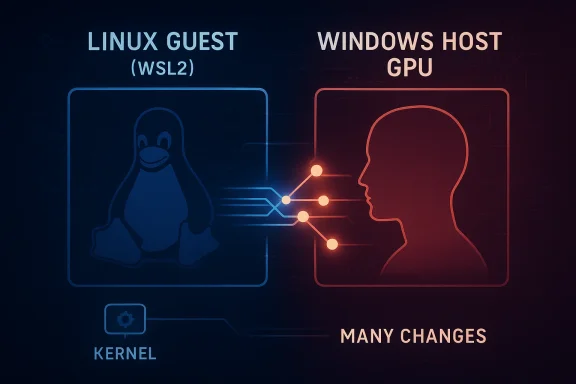
What makes this update especially interesting is the gap it closes. After years of little public movement, the driver is back with “many changes,” which hints at a substantial internal redesign rather than a simple cleanup. That kind of rewrite usually means one of two things: either the original implementation was too tightly coupled to a private architecture, or Microsoft decided that upstreaming required rethinking the contract between guest Linux, host Windows, and the graphics subsystem. In either case, the patch series is more revealing than any single feature list could be. The fact that it took years to get here is itself the story.
This solves a real problem for WSL2, where Linux binaries run in a lightweight VM on top of Windows. If the Linux side cannot access the GPU efficiently, everything from machine learning to graphics-heavy development workflows becomes less attractive. Microsoft has therefore treated GPU access as a strategic feature, not a luxury, especially as WSL has matured from a novelty into a core developer platform. The same logic applies to Windows Subsystem for Android, which also relied on the broader push to make GPU-backed workloads work inside Windows-hosted Linux guests.
The tension here is important. Microsoft is not trying to make Linux graphics more generic; it is trying to make Linux graphics work inside Microsoft’s virtualization framework. That means the technical success criteria and the upstream acceptance criteria are not the same. A solution can be useful, well-engineered, and still fail to gain broad kernel support if it is too environment-specific. That is the recurring challenge DXGKRNL has never escaped.
That matters because the Linux kernel has evolved significantly since the early WSL2 GPU work first appeared. The graphics, memory-management, and virtualization subsystems have all moved forward, and Microsoft itself has shifted the WSL kernel onto a newer LTS base in recent years. A driver designed in the 5.4/5.10 era, or even one tailored to the older WSL fork, may no longer be a clean fit for Linux 6.x expectations. In other words, the kernel moved, and the driver had to chase it.
The new series may also be a sign that Microsoft wants a more maintainable long-term path for GPU acceleration in Linux guests. Maintaining a private fork forever is expensive, especially when kernel APIs and internal graphics interfaces continue to evolve. A more upstream-friendly driver would reduce rebase pain, lower security risk, and make the feature less dependent on Microsoft’s in-house kernel branch. That is the kind of pragmatism that usually drives multi-year rewrites.
The upstream issue is not simply ideological. Kernel maintainers have to think about long-term supportability, interface stability, and who bears the cost when things break. If the Linux guest driver is only useful when paired with a proprietary Windows-side stack, then upstream reviewers will ask whether the code belongs in the kernel at all or should live as an out-of-tree component maintained by Microsoft. That question is central, because the mainline kernel is not a convenience layer for vendor-specific experiments.
There is also a cultural issue. The Linux kernel is not hostile to Microsoft in the abstract; it is hostile to poorly scoped, hard-to-maintain code. Microsoft has made progress in many areas of Linux-facing development, but graphics and virtualization remain especially sensitive because they sit close to performance, security, and platform control. That makes the bar higher, not lower.
The significance grows when you consider the modern developer stack. A lot of contemporary tooling expects CUDA, DirectML, Vulkan, or OpenGL translation layers to work reasonably well inside VMs or containers. Microsoft has already been trying to bridge those gaps through WSLg, DirectX work, and related graphics plumbing. In that context, DXGKRNL is best understood as infrastructure for making Windows a more credible host for Linux-native development scenarios.
This is also where Microsoft’s strategy is quite shrewd. By improving the Linux experience on Windows, it reduces the incentive for power users to leave Windows altogether. That does not mean Linux becomes a captive workload; it means Microsoft makes Windows a more attractive endpoint for people who still need Linux toolchains. That is an important distinction.
That puts pressure on other platforms in subtle ways. Bare-metal Linux still wins on openness, control, and simplicity, but it has to work harder to match the convenience of a polished Windows host with deep Linux compatibility layers. Meanwhile, cloud providers and virtualization vendors that offer Linux guests may watch Microsoft’s work closely because GPU virtualization is increasingly a prerequisite for AI and graphics workloads. (phoronix.com)
There is also an ecosystem effect. Microsoft’s repeated work around DirectX, Mesa interoperability, and Linux graphics tells vendors that Windows and Linux are no longer cleanly separated domains. The two stacks are increasingly interdependent, especially at the boundaries of virtualization and GPU compute. That is uncomfortable for purists, but strategically important for Microsoft. (phoronix.com)
The maintenance issue is just as important as the security issue. Microsoft has already learned, through WSL kernel updates and Azure Linux maintenance, that shipping a forked Linux stack means constantly reconciling upstream changes with product needs. The longer a codebase stays out of tree, the more likely it is to accumulate hidden incompatibilities, especially in fast-moving subsystems like memory management, virtualization, and graphics. (phoronix.com)
That said, Microsoft has made security a more visible part of its Linux story in recent years, including its work on Azure Linux, WSL vulnerabilities, and open-source infrastructure. That does not eliminate the DXGKRNL risk, but it does suggest the company understands that credibility in Linux space depends on treating security as a first-class concern, not an afterthought. The industry will expect the same discipline here. (phoronix.com)
This is why the current update matters beyond graphics. It is a test case for whether Microsoft’s open-source posture can extend to controversial infrastructure that matters to its product strategy. If the company can present DXGKRNL in a form that Linux maintainers can actually engage with, that would be a meaningful signal. If not, it will reinforce the notion that Microsoft can open-source selectively while still keeping the most strategic pieces in-house.
It is worth stressing that Microsoft has already demonstrated it can maintain Linux-facing software at scale. The harder question is whether it can do so in a way that aligns with community expectations around ownership and upstream governance. DXGKRNL is not a branding exercise; it is a governance exercise. (phoronix.com)
For consumers and enthusiasts, the value is more mixed but still meaningful. Power users who run WSL2 for local AI experiments, graphics development, or Linux-native tools will benefit from smoother acceleration and fewer incompatibilities. Still, consumer interest tends to be more sensitive to whether the feature feels invisible and reliable, rather than whether the patch series is elegant from a kernel perspective.
At the same time, Microsoft has to be careful not to overfit the driver to only one segment. If the solution is too tied to a narrow WSL use case, enterprises may like it but the broader Linux community will remain unconvinced. If it is too generic, Microsoft may lose some of the control that makes the architecture attractive in the first place. That trade-off is the heart of the whole effort.
It will also be important to watch whether Microsoft pairs this work with more visible Linux graphics cooperation elsewhere, especially in Mesa and related compute paths. The company has already shown that it can contribute to the broader open-source stack when there is a strategic payoff. The question now is whether DXGKRNL is part of a broader normalization of Microsoft-Linux graphics collaboration, or just a long-delayed cleanup of one stubborn subsystem.
Source: Phoronix Microsoft's DXGKRNL Driver Updated For Linux - Many Changes After Four Years - Phoronix
 Overview
The original dxgkrnl concept dates back to Microsoft’s 2020 push to add GPU acceleration to WSL2, where the Linux guest would talk to a Windows host through a paravirtualized graphics path. In Microsoft’s own framing at the time, the driver exposed a /dev/dxg device and a set of IOCTLs that mirrored parts of the Windows graphics kernel interface, letting Linux workloads reach host GPU capabilities without pretending the Linux guest had native hardware control. That architecture mattered because it offered a route to DirectX-compatible compute in a Linux environment while still keeping the actual driver logic on the Windows side.But the idea also ran into immediate resistance from upstream kernel developers, who objected to the driver’s dependence on closed user-space pieces and its overall fit with Linux kernel norms. The controversy was not just philosophical; it was practical. A driver intended for mainline inclusion has to meet expectations around maintainability, interfaces, licensing clarity, and long-term support, and the first versions of Microsoft’s approach did not satisfy those goals cleanly. That is why this latest refresh is being watched so closely: it is not just about features, but about whether Microsoft has finally addressed the structural objections that made the earlier proposal dead on arrival.
The broader context is Microsoft’s steadily widening involvement with Linux over the last several years. By 2024 and 2025, Microsoft was no longer just maintaining WSL and Azure Linux; it was also open-sourcing more of its tooling, expanding kernel work, and publishing more code that sits at the boundary between Windows and Linux ecosystems. Phoronix’s own archive shows that Microsoft’s Linux footprint now spans WSL, Hyper-V, Azure Linux, the DirectX Shader Compiler, and even Mesa work. In that sense, DXGKRNL is part of a larger pattern rather than an isolated experiment. (phoronix.com)
What makes this update especially interesting is the gap it closes. After years of little public movement, the driver is back with “many changes,” which hints at a substantial internal redesign rather than a simple cleanup. That kind of rewrite usually means one of two things: either the original implementation was too tightly coupled to a private architecture, or Microsoft decided that upstreaming required rethinking the contract between guest Linux, host Windows, and the graphics subsystem. In either case, the patch series is more revealing than any single feature list could be. The fact that it took years to get here is itself the story.
What DXGKRNL Is Trying to Solve
At its core, DXGKRNL exists to let Linux workloads inside a Microsoft-managed virtualization environment access GPU acceleration without relying on a conventional emulated GPU. That distinction matters because modern graphics and compute workloads are far too demanding for naive emulation. Instead, Microsoft’s design uses paravirtualization so the guest can make requests that are then serviced by the host’s Windows graphics stack, which is far more efficient and tightly integrated with vendor drivers.This solves a real problem for WSL2, where Linux binaries run in a lightweight VM on top of Windows. If the Linux side cannot access the GPU efficiently, everything from machine learning to graphics-heavy development workflows becomes less attractive. Microsoft has therefore treated GPU access as a strategic feature, not a luxury, especially as WSL has matured from a novelty into a core developer platform. The same logic applies to Windows Subsystem for Android, which also relied on the broader push to make GPU-backed workloads work inside Windows-hosted Linux guests.
The architectural bet
The driver’s architectural bet is that Linux can remain a guest while still receiving “native enough” graphics semantics through a specialized bridge. That is appealing to Microsoft because it preserves control of the host graphics stack and avoids forcing Windows users to install or manage a separate Linux GPU driver model. It is less appealing to upstream Linux maintainers because it creates a special-purpose layer that exists primarily for Microsoft’s virtualization environment, with all the maintenance and policy headaches that implies.The tension here is important. Microsoft is not trying to make Linux graphics more generic; it is trying to make Linux graphics work inside Microsoft’s virtualization framework. That means the technical success criteria and the upstream acceptance criteria are not the same. A solution can be useful, well-engineered, and still fail to gain broad kernel support if it is too environment-specific. That is the recurring challenge DXGKRNL has never escaped.
- It reduces the need for full GPU emulation.
- It lets the host retain control of vendor-specific graphics logic.
- It enables GPU-accelerated Linux workloads in WSL2-style environments.
- It creates a tightly coupled Microsoft-only plumbing layer.
- It raises upstream acceptance questions immediately.
Why the New Patch Series Matters
The phrase “many changes after four years” is more than clickbait shorthand. In kernel development, a long gap between visible revisions often means the maintainers have rewritten assumptions, not just fixed bugs. If Microsoft is returning to this code after such a delay, it suggests the company believes the prior shape of the driver was not fit for the current Linux kernel, or not fit for the review path required to ever land upstream.That matters because the Linux kernel has evolved significantly since the early WSL2 GPU work first appeared. The graphics, memory-management, and virtualization subsystems have all moved forward, and Microsoft itself has shifted the WSL kernel onto a newer LTS base in recent years. A driver designed in the 5.4/5.10 era, or even one tailored to the older WSL fork, may no longer be a clean fit for Linux 6.x expectations. In other words, the kernel moved, and the driver had to chase it.
What changed in the background
Another important factor is that Microsoft’s Linux posture has matured. WSL went open source in 2025, Azure Linux has continued to receive regular updates, and Microsoft has been increasingly comfortable publishing Linux-facing work in public. That does not guarantee DXGKRNL will be accepted upstream, but it does mean the company is operating in a more open ecosystem than it was when the driver first appeared. The political environment around Microsoft’s kernel work is different now, even if the technical objections remain. (phoronix.com)The new series may also be a sign that Microsoft wants a more maintainable long-term path for GPU acceleration in Linux guests. Maintaining a private fork forever is expensive, especially when kernel APIs and internal graphics interfaces continue to evolve. A more upstream-friendly driver would reduce rebase pain, lower security risk, and make the feature less dependent on Microsoft’s in-house kernel branch. That is the kind of pragmatism that usually drives multi-year rewrites.
- It likely reflects an architectural cleanup, not just a bug-fix release.
- It aligns with Microsoft’s broader open-source strategy.
- It may be responding to kernel API and subsystem changes.
- It could reduce the cost of maintaining a private WSL graphics fork.
- It may be aimed at improving reviewability, not only functionality.
The Upstream Problem
The Linux kernel community has always been skeptical of drivers that feel too tailored to one vendor’s ecosystem. That skepticism is especially strong when the code depends on private interfaces, external user-mode pieces, or a host-side implementation that the Linux side cannot meaningfully control. Microsoft’s earlier DXGKRNL proposal ran directly into that wall, and there is no reason to assume the new version avoids all of the same issues.The upstream issue is not simply ideological. Kernel maintainers have to think about long-term supportability, interface stability, and who bears the cost when things break. If the Linux guest driver is only useful when paired with a proprietary Windows-side stack, then upstream reviewers will ask whether the code belongs in the kernel at all or should live as an out-of-tree component maintained by Microsoft. That question is central, because the mainline kernel is not a convenience layer for vendor-specific experiments.
Why the dependency problem is hard
A Linux kernel driver that depends on closed user-space components can still be useful in practice, but it becomes much harder to justify upstream. The kernel community prefers architectures where the kernel portion stands on its own, interfaces are documented, and the user-space pieces can evolve independently without forcing hidden assumptions into the kernel. Microsoft’s challenge is to prove that DXGKRNL is not a dead-end wrapper around Windows-only behavior.There is also a cultural issue. The Linux kernel is not hostile to Microsoft in the abstract; it is hostile to poorly scoped, hard-to-maintain code. Microsoft has made progress in many areas of Linux-facing development, but graphics and virtualization remain especially sensitive because they sit close to performance, security, and platform control. That makes the bar higher, not lower.
- Upstream maintainers care about long-term interface stability.
- Closed user-space dependencies are a red flag.
- Environment-specific code is harder to justify in mainline Linux.
- Performance alone does not solve maintainability concerns.
- Microsoft must show the driver is more than a Windows-only bridge.
WSL2 and the Developer Experience
For Windows developers who live in WSL2, GPU acceleration is one of those quality-of-life features that quietly changes how useful the platform feels. Python ML stacks, compute-heavy research tools, graphics APIs, and even some desktop workflows become much more practical when the guest Linux environment can see the GPU without awkward pass-through hacks. DXGKRNL is therefore part of WSL’s value proposition, not an optional extra.The significance grows when you consider the modern developer stack. A lot of contemporary tooling expects CUDA, DirectML, Vulkan, or OpenGL translation layers to work reasonably well inside VMs or containers. Microsoft has already been trying to bridge those gaps through WSLg, DirectX work, and related graphics plumbing. In that context, DXGKRNL is best understood as infrastructure for making Windows a more credible host for Linux-native development scenarios.
Consumer and developer benefits
For consumers, the benefit is mostly indirect. Better GPU acceleration in WSL improves the performance and reliability of tools people use for development, content creation, and local AI experimentation. For developers, the benefit is more obvious: fewer platform compromises, less need to dual-boot, and better access to hardware-accelerated workflows within a familiar Windows desktop.This is also where Microsoft’s strategy is quite shrewd. By improving the Linux experience on Windows, it reduces the incentive for power users to leave Windows altogether. That does not mean Linux becomes a captive workload; it means Microsoft makes Windows a more attractive endpoint for people who still need Linux toolchains. That is an important distinction.
Implications for enterprise
In enterprise settings, WSL2 GPU support can matter even more than it does for hobbyists. Teams can standardize on Windows laptops while still giving engineers access to Linux-based workflows for testing, data science, and cloud-native development. A robust DXGKRNL path helps Microsoft sell Windows not as a barrier to Linux, but as a platform that can host it efficiently. (phoronix.com)- Improves hardware acceleration for WSL2 workloads.
- Reduces the need for dual-boot or separate Linux machines.
- Supports ML, graphics, and compute-heavy development.
- Helps enterprises keep Windows-managed endpoints.
- Strengthens Microsoft’s “Windows as a Linux host” pitch.
Competitive Implications
The competitive implications extend well beyond one driver. Microsoft is effectively trying to make its virtualization stack the most convenient place to run Linux workloads on a Windows machine, and GPU access is a critical differentiator. If successful, that gives Microsoft a stronger argument against native Linux on the desktop for certain classes of users, especially developers who need both ecosystems in one box.That puts pressure on other platforms in subtle ways. Bare-metal Linux still wins on openness, control, and simplicity, but it has to work harder to match the convenience of a polished Windows host with deep Linux compatibility layers. Meanwhile, cloud providers and virtualization vendors that offer Linux guests may watch Microsoft’s work closely because GPU virtualization is increasingly a prerequisite for AI and graphics workloads. (phoronix.com)
What rivals should notice
The key competitive point is not that Microsoft has invented GPU virtualization, but that it is integrating it into a platform with enormous distribution reach. If DXGKRNL matures, Microsoft can make WSL2 feel less like a compatibility layer and more like a first-class development surface. That is a potent message in a market where developer convenience often outweighs abstract architectural purity.There is also an ecosystem effect. Microsoft’s repeated work around DirectX, Mesa interoperability, and Linux graphics tells vendors that Windows and Linux are no longer cleanly separated domains. The two stacks are increasingly interdependent, especially at the boundaries of virtualization and GPU compute. That is uncomfortable for purists, but strategically important for Microsoft. (phoronix.com)
- It strengthens Windows as a development host.
- It reduces friction for mixed Windows/Linux workflows.
- It pressures virtualization vendors to improve GPU paths.
- It blurs the line between Windows-native and Linux-native tooling.
- It makes Microsoft’s platform story more competitive for developers.
Security and Maintenance Questions
Whenever a graphics virtualization path reaches deep into host and guest cooperation, security concerns follow. A driver like DXGKRNL sits in a sensitive part of the stack because it mediates privileged requests, translates interface calls, and depends on cross-boundary assumptions that can be hard to audit. Even if the code is correct today, the maintenance burden is substantial because any mismatch between host and guest behavior can create instability or exploitable bugs.The maintenance issue is just as important as the security issue. Microsoft has already learned, through WSL kernel updates and Azure Linux maintenance, that shipping a forked Linux stack means constantly reconciling upstream changes with product needs. The longer a codebase stays out of tree, the more likely it is to accumulate hidden incompatibilities, especially in fast-moving subsystems like memory management, virtualization, and graphics. (phoronix.com)
Why kernel developers worry
Kernel developers worry about drivers that are hard to reason about independently. If the Linux side merely forwards requests to a Windows host, then the real security boundary may live elsewhere, and that complicates threat modeling. In practice, this can create a situation where the guest driver looks small but still exposes a broad attack surface because it acts as a bridge to a much larger proprietary subsystem.That said, Microsoft has made security a more visible part of its Linux story in recent years, including its work on Azure Linux, WSL vulnerabilities, and open-source infrastructure. That does not eliminate the DXGKRNL risk, but it does suggest the company understands that credibility in Linux space depends on treating security as a first-class concern, not an afterthought. The industry will expect the same discipline here. (phoronix.com)
- Cross-boundary graphics code expands the attack surface.
- Host/guest mismatches can create hard-to-diagnose bugs.
- Out-of-tree maintenance raises long-term risk.
- Security review is harder when behavior spans two OS stacks.
- Microsoft’s recent Linux work raises expectations for rigor.
The Open-Source Credibility Test
Microsoft’s Linux credibility has improved markedly, but that credibility remains conditional. The company has open-sourced WSL, continued to publish Azure Linux updates, contributed to Mesa, and kept a fairly active Linux-facing engineering cadence. Those moves have earned attention, but they also create expectations that Microsoft’s future kernel work will be more transparent and more upstream-friendly than the first DXGKRNL attempts were. (phoronix.com)This is why the current update matters beyond graphics. It is a test case for whether Microsoft’s open-source posture can extend to controversial infrastructure that matters to its product strategy. If the company can present DXGKRNL in a form that Linux maintainers can actually engage with, that would be a meaningful signal. If not, it will reinforce the notion that Microsoft can open-source selectively while still keeping the most strategic pieces in-house.
What success would look like
Success would not necessarily mean immediate mainline inclusion. It would mean a driver that is understandable, maintainable, and less dependent on opaque host-side assumptions, even if it remains out of tree for some time. It would also mean the patch series is structured in a way that invites technical review rather than triggering immediate rejection. That is a very different bar from “it works on my machine.”It is worth stressing that Microsoft has already demonstrated it can maintain Linux-facing software at scale. The harder question is whether it can do so in a way that aligns with community expectations around ownership and upstream governance. DXGKRNL is not a branding exercise; it is a governance exercise. (phoronix.com)
- Microsoft’s Linux credibility has improved, but not universally.
- Open-source releases raise the bar for transparency.
- Mainline acceptance requires more than functionality.
- Reviewability is almost as important as performance.
- DXGKRNL will test Microsoft’s upstream maturity.
Enterprise vs Consumer Impact
For enterprise users, the impact of a better DXGKRNL stack is potentially significant because it improves the case for Windows-managed developer fleets. Organizations that standardize on Windows endpoints but rely on Linux tooling can reduce friction by giving developers access to GPU-accelerated Linux workloads without introducing separate hardware or complex remote setups. That can simplify support, imaging, and security policy enforcement.For consumers and enthusiasts, the value is more mixed but still meaningful. Power users who run WSL2 for local AI experiments, graphics development, or Linux-native tools will benefit from smoother acceleration and fewer incompatibilities. Still, consumer interest tends to be more sensitive to whether the feature feels invisible and reliable, rather than whether the patch series is elegant from a kernel perspective.
Different stakes, same plumbing
Enterprise buyers care about manageability, compliance, and endpoint consolidation. Consumers care about convenience, performance, and whether their tools simply work. DXGKRNL sits underneath both constituencies, which means Microsoft has a rare chance to satisfy two very different audiences with the same investment. That is why even an obscure kernel patch series can matter commercially. (phoronix.com)At the same time, Microsoft has to be careful not to overfit the driver to only one segment. If the solution is too tied to a narrow WSL use case, enterprises may like it but the broader Linux community will remain unconvinced. If it is too generic, Microsoft may lose some of the control that makes the architecture attractive in the first place. That trade-off is the heart of the whole effort.
- Enterprises gain easier Windows-hosted Linux development.
- Consumers gain smoother local GPU acceleration in WSL2.
- IT teams benefit from fewer special-purpose machines.
- The feature is most valuable when it is invisible and stable.
- Over-specialization could limit broader Linux acceptance.
Strengths and Opportunities
DXGKRNL’s biggest strength is that it targets a genuine pain point: getting high-performance GPU access inside a Linux guest on Windows without cumbersome passthrough complexity. Microsoft also has the platform reach to make the feature matter immediately to millions of developers, which is something most virtualization projects cannot claim. The current rewrite effort may finally be closing the gap between a clever idea and a maintainable implementation.- GPU acceleration in WSL2 remains a valuable differentiator.
- Microsoft controls both the host ecosystem and the developer distribution channel.
- The work aligns with broader WSL and Azure Linux investment.
- A cleaner architecture could reduce private fork maintenance.
- Better Linux graphics integration strengthens Windows as a developer workstation.
- Microsoft’s open-source momentum gives the project more credibility than it had in 2020.
- If reviewed well, the driver could influence how others think about guest GPU plumbing.
Risks and Concerns
The biggest risk is that DXGKRNL remains too Microsoft-specific to ever feel truly upstream-worthy. That would leave Microsoft with a useful but isolated codebase that still needs continuous internal maintenance. There is also the security risk that any guest-host graphics bridge introduces a broad attack surface that is hard to audit thoroughly.- Upstream rejection remains a real possibility.
- Closed host dependencies could keep the driver out of mainline Linux.
- Security review is complicated by cross-OS behavior.
- Long-term maintenance can become expensive if the driver stays out of tree.
- User expectations may outpace actual stability and polish.
- The architecture may be too specialized to appeal beyond WSL.
- Any regression could damage trust in Microsoft’s Linux efforts.
Looking Ahead
The next phase will be about review, not marketing. If Microsoft wants DXGKRNL to matter beyond WSL lore, it needs to show that the driver is evolving toward kernel standards rather than around them. That means cleaner code, clearer abstractions, and a stronger story for why this work belongs anywhere near the Linux kernel conversation.It will also be important to watch whether Microsoft pairs this work with more visible Linux graphics cooperation elsewhere, especially in Mesa and related compute paths. The company has already shown that it can contribute to the broader open-source stack when there is a strategic payoff. The question now is whether DXGKRNL is part of a broader normalization of Microsoft-Linux graphics collaboration, or just a long-delayed cleanup of one stubborn subsystem.
- Watch for a new patch series cadence and reviewer response.
- Watch whether the driver’s dependencies become more clearly documented.
- Watch for any signs of reduced coupling to proprietary host behavior.
- Watch whether Microsoft ties this work to WSL or broader Hyper-V scenarios.
- Watch for downstream adoption pressure from developers and OEMs.
Source: Phoronix Microsoft's DXGKRNL Driver Updated For Linux - Many Changes After Four Years - Phoronix
Last edited:
