

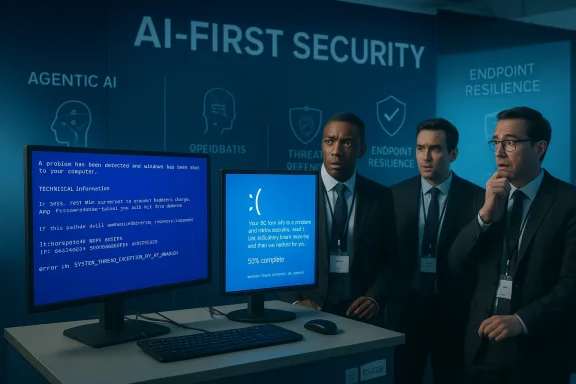
Microsoft’s RSAC 2026 presence was supposed to showcase AI-first security, not trigger a fresh round of nostalgic panic over the Blue Screen of Death. Yet that is exactly what happened when an eagle-eyed attendee spotted two suspiciously period-correct BSOD-style displays at the company’s security stand, one looking like something from the Windows 98 era and another resembling a Windows 8-style crash screen. Microsoft’s own RSAC materials emphasize modern threat defense, agentic AI, and endpoint resilience, which makes the sight of crash screens on its booth especially awkward.
What made the moment so comic was the ambiguity. The screens may have been deliberate props, old test images, a support-scam mockup, or simply a presentation artifact that looked far worse in person than it did in the designer’s head. But in a week when Microsoft is trying to sell the future of security, a pair of blue crash screens is a reminder that Windows’ most famous failure mode still carries emotional baggage. That baggage is not just technical; it is cultural, because the BSOD remains one of the most recognizable symbols in personal computing.
The episode also lands at a sensitive moment for Microsoft’s broader Windows reputation. The company has spent the past year and a half talking up resilience, recovery, and AI-assisted security while still fielding very public complaints about blue screens, black screens, and update-related breakage in Windows 11 24H2 and related builds. In that context, even a harmless booth display can look like an uninvited joke at the company’s expense.
To understand why a few blue screens can cause such a stir, you have to remember what the BSOD represents. It is not just an error message; it is a shorthand for system failure, driver instability, hardware trouble, and in some cases the unreliability of an entire platform. For decades, Windows users learned to fear the blue screen because it meant an abrupt stop, lost work, and a reboot that might or might not solve the problem. The symbol became so iconic that even people who rarely use Windows know exactly what it means.
Microsoft has spent years trying to reduce the frequency and severity of those moments. Its own recent messaging around the Windows Resiliency Initiative talks explicitly about recovery, reliability, and reducing user disruption after crashes. That is a meaningful shift from the old era, when the BSOD was simply accepted as part of life with a PC. The company is now trying to frame reliability as a feature, not a consolation prize.
The irony is that the public memory of Windows failures remains unusually sticky. Even when the root cause is a third-party driver or a bad firmware interaction, the brand damage tends to land on Microsoft first. That became painfully clear after widespread Windows disruption in 2024, and it has continued to surface in 2025 and 2026 through community reports of blue screens, black screens, and boot problems across different hardware configurations. The lesson is simple: perception can outlive the technical explanation.
RSAC is also an especially loaded place to stage any kind of Windows-crash imagery. Microsoft uses the conference to show off identity, cloud, endpoint, and AI security capabilities, and it has leaned into polished demos and high-level messaging about protecting AI-powered environments. A crash screen in that setting does not read like a random prop; it reads like an accidental comment on the product’s own history.
That symbolic force is exactly why scams often imitate it. A fake blue screen can be used to frighten less technical users into calling bogus support lines or surrendering control of a machine. Microsoft has long had to contend not only with real BSODs but with BSOD theater: the convincing imitation of failure for profit.
A blue screen, even one that is fake or historic, pulls the audience backward. It evokes the era when Windows instability was part of the mainstream narrative, which is precisely the story Microsoft is trying to retire. In that sense, the display was either an unforced error or a remarkably on-brand reminder that the past is never entirely gone.
The contrast with the observed crash screens is what makes the anecdote newsworthy. A conference demo area is supposed to reinforce control: controlled scenarios, controlled outcomes, controlled storytelling. A BSOD image, even if inert, punctures that sense of control and invites the audience to ask whether the company’s security narrative is more fragile than it looks.
This is a smart market strategy. Buyers increasingly want fewer disconnected tools and more operational coherence, especially when AI systems are introduced into everyday workflows. Microsoft’s pitch is that security should follow the same integrated logic as its broader cloud and productivity ecosystem.
That is why the apparent BSOD screens became such a point of interest. They were not just funny; they were a visual contradiction. On a stand selling control and resilience, a crash screen looks like a glitch in the brand story.
That recognition cuts both ways. On one hand, Microsoft has benefited from the BSOD becoming an instantly understood emblem of serious troubleshooting. On the other hand, it has spent years paying the reputational cost of being the company most associated with that emblem.
That is why the imagery still lands in 2026. Even when Microsoft is talking about agentic AI, the mind of the average IT professional can still jump to “what happens when this breaks?” The old symbols remain potent because they expose the human side of system failure.
That ambiguity is part of the problem. A real crash, a mockup, and a scam screen can all look similar to non-specialists. Microsoft’s security staff would know that, which is why a display like this feels either oddly careless or intentionally provocative.
The result is a classic security-industry paradox: the more attention you try to draw to resilience, the more a single failure image can dominate the conversation. That is not because the image is inherently dangerous. It is because it is so easy to understand.
In recent months and years, public reports have continued to describe blue screens, black screens, and boot failures on Windows 11 systems, especially around version 24H2 and other update cycles. Microsoft’s own community forums and support pages show that even when the issues are eventually diagnosed as driver, firmware, or hardware compatibility problems, users still experience them as “Windows being unstable.”
That event changed expectations. Enterprises no longer think only about patching; they think about blast radius, recovery, and how quickly a fleet can be brought back. When a company like Microsoft appears next to crash imagery, the old wound gets reopened whether or not the image was intentional.
Microsoft’s RSAC messaging is clearly aimed at the enterprise market, which is why the optics matter so much. Enterprise buyers want proof that the company understands failure modes, not just AI ambition. A blue screen prop can therefore be read as either a confidence-building acknowledgment of history or a painful reminder of unresolved trust issues.
And that burden is why security conferences are such delicate theater. The audience is full of admins, CISOs, engineers, and partners who know exactly where the bodies are buried. They may admire Microsoft’s progress, but they are also the first to spot a visual that feels uncomfortably like the old days.
That makes the BSOD imagery especially interesting. If it was deliberate, it would fit within a larger strategy of dramatic storytelling: a nod to the chaos defenders are trying to prevent. If it was accidental, it shows how easily security messaging can be derailed by one poorly chosen visual. Either way, the line between demonstration and embarrassment was thin.
That is why such imagery should be used sparingly, and ideally with obvious framing. Without context, the display can become the entire story.
If the joke is missed, the brand takes the hit. A security company can survive a little self-awareness, but not confusion about whether its showcase booth is displaying a real crash or a metaphorical one.
That said, the absence of a public explanation leaves room for interpretation. In public-relations terms, silence rarely helps when the audience is already laughing.
The company’s recent public materials show a strong effort to present itself as the vendor of resilience. Its RSAC 2026 page and related security content emphasize platform integration and AI-first defense. That is a far cry from the era when Microsoft’s brand could be summed up by a generic crash screen and a reboot prompt.
But it also means the company gets judged across a wider surface area. A visual joke about Windows reliability can now bleed into a broader evaluation of Microsoft’s enterprise credibility.
That collective memory is hard to erase. Microsoft can modernize the stack, but it cannot reboot the audience’s memory.
So even if the booth display was just a mockup, it sat very close to a category of imagery that security professionals are trained to distrust. That is another reason the sight was so instantly shareable.
More broadly, this episode is a reminder that Microsoft’s security ambitions are now large enough to be judged not only by architecture and telemetry, but by the smallest details of presentation. The company can talk about agentic AI and end-to-end defense all day, yet one blue screen can still hijack the conversation because it touches a nerve that decades of computing have not erased.
Source: theregister.com To BSOD or not to BSOD? Only Microsoft knows the answer
What made the moment so comic was the ambiguity. The screens may have been deliberate props, old test images, a support-scam mockup, or simply a presentation artifact that looked far worse in person than it did in the designer’s head. But in a week when Microsoft is trying to sell the future of security, a pair of blue crash screens is a reminder that Windows’ most famous failure mode still carries emotional baggage. That baggage is not just technical; it is cultural, because the BSOD remains one of the most recognizable symbols in personal computing.
The episode also lands at a sensitive moment for Microsoft’s broader Windows reputation. The company has spent the past year and a half talking up resilience, recovery, and AI-assisted security while still fielding very public complaints about blue screens, black screens, and update-related breakage in Windows 11 24H2 and related builds. In that context, even a harmless booth display can look like an uninvited joke at the company’s expense.
 Background
To understand why a few blue screens can cause such a stir, you have to remember what the BSOD represents. It is not just an error message; it is a shorthand for system failure, driver instability, hardware trouble, and in some cases the unreliability of an entire platform. For decades, Windows users learned to fear the blue screen because it meant an abrupt stop, lost work, and a reboot that might or might not solve the problem. The symbol became so iconic that even people who rarely use Windows know exactly what it means.Microsoft has spent years trying to reduce the frequency and severity of those moments. Its own recent messaging around the Windows Resiliency Initiative talks explicitly about recovery, reliability, and reducing user disruption after crashes. That is a meaningful shift from the old era, when the BSOD was simply accepted as part of life with a PC. The company is now trying to frame reliability as a feature, not a consolation prize.
The irony is that the public memory of Windows failures remains unusually sticky. Even when the root cause is a third-party driver or a bad firmware interaction, the brand damage tends to land on Microsoft first. That became painfully clear after widespread Windows disruption in 2024, and it has continued to surface in 2025 and 2026 through community reports of blue screens, black screens, and boot problems across different hardware configurations. The lesson is simple: perception can outlive the technical explanation.
RSAC is also an especially loaded place to stage any kind of Windows-crash imagery. Microsoft uses the conference to show off identity, cloud, endpoint, and AI security capabilities, and it has leaned into polished demos and high-level messaging about protecting AI-powered environments. A crash screen in that setting does not read like a random prop; it reads like an accidental comment on the product’s own history.
Why the BSOD Still Matters
The BSOD has survived because it is both technical and symbolic. On the technical side, it signals a kernel-level failure or other serious problem that ordinary app-level recovery cannot solve. On the symbolic side, it has become a kind of shared language for digital breakdown, used in jokes, memes, tutorials, and even counterfeit scam screens.That symbolic force is exactly why scams often imitate it. A fake blue screen can be used to frighten less technical users into calling bogus support lines or surrendering control of a machine. Microsoft has long had to contend not only with real BSODs but with BSOD theater: the convincing imitation of failure for profit.
Why This RSAC Moment Landed Hard
At a security conference, the optics matter as much as the engineering. Microsoft’s booth messaging at RSAC 2026 centers on AI-ready security, adaptive agents, and end-to-end protection for cloud and endpoint environments. That is a forward-looking pitch, and it is meant to reassure buyers that the company’s platform is getting more robust, not less.A blue screen, even one that is fake or historic, pulls the audience backward. It evokes the era when Windows instability was part of the mainstream narrative, which is precisely the story Microsoft is trying to retire. In that sense, the display was either an unforced error or a remarkably on-brand reminder that the past is never entirely gone.
- The BSOD is still instantly recognizable.
- Security audiences are highly sensitive to reliability cues.
- Old error imagery can easily be misread as a live incident.
- Microsoft’s current message depends on trust and resilience.
What Microsoft Is Trying to Sell at RSAC 2026
Microsoft’s official RSAC 2026 materials are all about a platform story. The company is pitching an integrated security stack for the AI era, with messaging around agentic workflows, threat protection, identity, cloud, and data security. The booth experience is designed to be interactive, modern, and confidence-building.The contrast with the observed crash screens is what makes the anecdote newsworthy. A conference demo area is supposed to reinforce control: controlled scenarios, controlled outcomes, controlled storytelling. A BSOD image, even if inert, punctures that sense of control and invites the audience to ask whether the company’s security narrative is more fragile than it looks.
The Security-Platform Message
Microsoft’s RSAC 2026 guide emphasizes how the company wants customers to protect every layer of the AI stack. The emphasis is on securing AI-powered environments, not simply selling point products. That means the company is trying to position itself as the connective tissue between identity, data, endpoint, and operations.This is a smart market strategy. Buyers increasingly want fewer disconnected tools and more operational coherence, especially when AI systems are introduced into everyday workflows. Microsoft’s pitch is that security should follow the same integrated logic as its broader cloud and productivity ecosystem.
Why Booth Design Matters
A booth is not just a venue; it is a stage set. Every visual cue tells visitors something about maturity, discipline, and trustworthiness. When Microsoft chooses to make a show of security, it is not merely informing the crowd; it is reassuring them.That is why the apparent BSOD screens became such a point of interest. They were not just funny; they were a visual contradiction. On a stand selling control and resilience, a crash screen looks like a glitch in the brand story.
- Microsoft is selling integrated AI-era security.
- The booth experience is designed around confidence and interactivity.
- Visual props can either reinforce or undermine trust.
- A crash screen is a high-risk visual in a security setting.
The Strange Power of the Blue Screen
The BSOD is one of those rare UI artifacts that escaped its original function and became part of pop culture. It is a failure message, but it also operates like a logo: compact, distinctive, and emotionally charged. The fact that people can identify a Windows crash from across a room says a lot about the long history of Windows reliability problems.That recognition cuts both ways. On one hand, Microsoft has benefited from the BSOD becoming an instantly understood emblem of serious troubleshooting. On the other hand, it has spent years paying the reputational cost of being the company most associated with that emblem.
From Error Message to Cultural Icon
The earliest blue-screen imagery was purely functional, but the public turned it into something bigger. Users photographed it, companies mocked it, and hardware support desks built entire workflows around it. In time, the BSOD became shorthand not just for Windows failure, but for the anxiety of depending on software you do not fully control.That is why the imagery still lands in 2026. Even when Microsoft is talking about agentic AI, the mind of the average IT professional can still jump to “what happens when this breaks?” The old symbols remain potent because they expose the human side of system failure.
Fake BSODs and Scam Culture
There is another reason a blue screen can look suspicious even when it is not real: scammers love it. Fake BSOD pages and support-scam lock screens have been used for years to frighten users into making unnecessary calls or granting remote access. In that context, a BSOD-like image at a conference can easily be mistaken for a fake rather than a real system event.That ambiguity is part of the problem. A real crash, a mockup, and a scam screen can all look similar to non-specialists. Microsoft’s security staff would know that, which is why a display like this feels either oddly careless or intentionally provocative.
- The BSOD is more than a technical error.
- It is a piece of digital pop culture.
- Fake crash screens are common in scams.
- Visual ambiguity can create confusion fast.
Why Old-Looking Screens Raise Eyebrows
The Register’s description noted that one screen seemed to come from the Windows 98 era and another from the Windows 8 era. That matters because design language changes over time, and people in tech notice those shifts. If a modern vendor puts up a visual that looks years out of date, people instinctively start asking whether it is a joke, a relic, or a mistake.The result is a classic security-industry paradox: the more attention you try to draw to resilience, the more a single failure image can dominate the conversation. That is not because the image is inherently dangerous. It is because it is so easy to understand.
Microsoft’s Reliability Problem Is Bigger Than One Booth
This incident would probably have remained a throwaway anecdote if not for the larger reliability conversation surrounding Windows. Microsoft has made real progress in modernizing its platform narrative, but it still has to live with a long memory of update mishaps, driver instability, and highly visible crashes. One odd booth image can therefore plug into a much bigger reservoir of skepticism.In recent months and years, public reports have continued to describe blue screens, black screens, and boot failures on Windows 11 systems, especially around version 24H2 and other update cycles. Microsoft’s own community forums and support pages show that even when the issues are eventually diagnosed as driver, firmware, or hardware compatibility problems, users still experience them as “Windows being unstable.”
The 2024–2025 Shadow
The CrowdStrike-linked outage of 2024 remains a major reference point for anyone talking about Windows reliability. It was not Microsoft’s patch in the narrow sense, but it still produced widespread blue screens and boot loops on Windows devices and left a lasting mark on how enterprises talk about endpoint resilience. Microsoft’s own reporting and support ecosystem had to absorb the fallout.That event changed expectations. Enterprises no longer think only about patching; they think about blast radius, recovery, and how quickly a fleet can be brought back. When a company like Microsoft appears next to crash imagery, the old wound gets reopened whether or not the image was intentional.
Consumer vs Enterprise Lens
Consumers see a blue screen as disruption and inconvenience. Enterprises see it as cost, downtime, and possible compliance trouble. The same visual lands differently depending on whether one laptop is frozen at home or five thousand endpoints are affected in an organization.Microsoft’s RSAC messaging is clearly aimed at the enterprise market, which is why the optics matter so much. Enterprise buyers want proof that the company understands failure modes, not just AI ambition. A blue screen prop can therefore be read as either a confidence-building acknowledgment of history or a painful reminder of unresolved trust issues.
- Consumer trust is emotional and immediate.
- Enterprise trust is operational and financial.
- Large outages amplify small visual mistakes.
- Reliability messaging must be extremely consistent.
Why This Is Still a Microsoft Story
Windows remains the desktop operating system most closely associated with mainstream business computing, which means Microsoft can never fully escape responsibility for the failure narratives around it. Even when the root cause is elsewhere, the platform owner gets the branding consequences. That is the burden of being the dominant ecosystem vendor.And that burden is why security conferences are such delicate theater. The audience is full of admins, CISOs, engineers, and partners who know exactly where the bodies are buried. They may admire Microsoft’s progress, but they are also the first to spot a visual that feels uncomfortably like the old days.
Security Theater, Literally and Figuratively
The RSAC 2026 booth was built to be interactive, and that means Microsoft clearly understands the power of staging. The company’s official description of booth activities includes theater sessions, demo stations, and gamified scenarios meant to simulate real-world security work. In other words, Microsoft is already using performance as part of its pitch.That makes the BSOD imagery especially interesting. If it was deliberate, it would fit within a larger strategy of dramatic storytelling: a nod to the chaos defenders are trying to prevent. If it was accidental, it shows how easily security messaging can be derailed by one poorly chosen visual. Either way, the line between demonstration and embarrassment was thin.
When a Prop Becomes a Problem
A good conference prop should be legible. It should quickly tell the audience what the company wants them to feel. But a BSOD is a high-voltage symbol; it does too much too quickly. Instead of “security awareness,” people may see “instability,” “support scam,” or “someone forgot to check the slide deck.”That is why such imagery should be used sparingly, and ideally with obvious framing. Without context, the display can become the entire story.
The Risk of Irony in Brand Messaging
Microsoft’s current security story depends heavily on competence. It wants to persuade buyers that its platform can secure AI workloads, simplify operations, and reduce the fragmentation that plagues modern enterprises. Irony is risky in that context because irony depends on the audience decoding the joke correctly.If the joke is missed, the brand takes the hit. A security company can survive a little self-awareness, but not confusion about whether its showcase booth is displaying a real crash or a metaphorical one.
What the Booth Probably Was Not
It probably was not a live outage. That would have been far more visible, and the company would have had to react publicly. The Register’s own account suggests the screens were removed or no longer visible when a reporter returned later, which points more toward a temporary setup, a visual mistake, or a quickly corrected display issue than an actual meltdown.That said, the absence of a public explanation leaves room for interpretation. In public-relations terms, silence rarely helps when the audience is already laughing.
- Security demos are a form of theater.
- Ambiguous visuals can dominate the narrative.
- Irony is dangerous when trust is fragile.
- Silence after a weird incident invites speculation.
Historical Context: Microsoft Has Been Here Before
This is not the first time Microsoft has had to deal with unwanted attention around reliability, support messaging, or conference optics. In many ways, the company has been living with the legacy of Windows error culture for as long as Windows has existed. The difference in 2026 is that Microsoft now has more to lose because it is also selling cloud, identity, and AI security at the highest enterprise levels.The company’s recent public materials show a strong effort to present itself as the vendor of resilience. Its RSAC 2026 page and related security content emphasize platform integration and AI-first defense. That is a far cry from the era when Microsoft’s brand could be summed up by a generic crash screen and a reboot prompt.
The Shift From OS Vendor to Security Platform
Microsoft is no longer just the Windows company. It is trying to be the security fabric across endpoints, clouds, identities, and AI systems. That expansion has been strategically smart, because security is one of the few enterprise domains where platform vendors can still consolidate spend.But it also means the company gets judged across a wider surface area. A visual joke about Windows reliability can now bleed into a broader evaluation of Microsoft’s enterprise credibility.
Why Old Windows Jokes Still Work
Part of the reason old Windows humor still lands is that it is built on shared memory. Millions of users have seen some version of a blue screen, frozen boot, or forced restart. Even younger IT professionals who never used Windows 98 have inherited the joke through meme culture and inherited workplace folklore.That collective memory is hard to erase. Microsoft can modernize the stack, but it cannot reboot the audience’s memory.
The Support-Scam Angle
The Register’s suggestion that the screen may have resembled a technical-support scam screen is also revealing. Support scams exploit fear and urgency, which are exactly the emotions a blue screen provokes. That makes the BSOD one of the most socially useful fake interfaces in cybercrime, because it borrows the authority of a real system failure.So even if the booth display was just a mockup, it sat very close to a category of imagery that security professionals are trained to distrust. That is another reason the sight was so instantly shareable.
Strengths and Opportunities
Microsoft actually has a chance to turn this kind of awkwardness into a strength, if it leans into clarity and uses the moment to reinforce its reliability story. The company’s current security messaging is broad, ambitious, and well-timed for the AI era, so a little self-awareness could help humanize it rather than weaken it. The key is to show that it understands both the history of Windows and the expectations of modern security buyers.- Brand recognition remains one of Microsoft’s biggest assets.
- AI-era security integration is a compelling enterprise message.
- RSAC visibility gives Microsoft a premium platform to shape perception.
- Reliability storytelling can differentiate the company from point-solution rivals.
- Historical candor can make the brand feel more credible.
- Security theater done well can be memorable rather than embarrassing.
- Cross-platform security is a strategic opportunity if the message stays coherent.
Risks and Concerns
The downside is that Microsoft’s own history makes it unusually vulnerable to visual gags about failure. If people think the company is joking about crashes while customers are still dealing with reliability issues, the brand can look tone-deaf rather than self-aware. The problem is not the blue screen itself; it is the mismatch between the image and the message.- Mixed signals can undermine an otherwise polished booth experience.
- Reliability skepticism remains high among enterprise buyers.
- Public ambiguity invites rumor and ridicule.
- Support-scam associations can create unwanted implications.
- Old Windows memories can overwhelm newer security narratives.
- Silence from Microsoft can make a harmless display look like a mistake.
- Any appearance of instability can hurt trust faster than a product pitch can repair it.
Looking Ahead
The immediate question is whether Microsoft will acknowledge the screens or simply let the story fade. In most cases, silence is enough if the incident is harmless and fleeting, but the company’s public posture at RSAC 2026 suggests it would benefit from being more explicit about what attendees were seeing. Clarity is cheap, and ambiguity is expensive.More broadly, this episode is a reminder that Microsoft’s security ambitions are now large enough to be judged not only by architecture and telemetry, but by the smallest details of presentation. The company can talk about agentic AI and end-to-end defense all day, yet one blue screen can still hijack the conversation because it touches a nerve that decades of computing have not erased.
What to Watch Next
- Whether Microsoft explains the booth visuals publicly.
- Whether the imagery shows up in other RSAC-related materials.
- Whether competitors use the incident as a contrast point.
- Whether Microsoft sharpens its reliability messaging in future events.
- Whether the story feeds broader discussion about Windows trust and recovery.
Source: theregister.com To BSOD or not to BSOD? Only Microsoft knows the answer
