

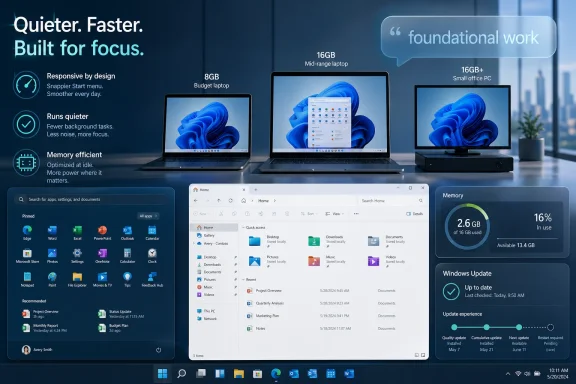
Microsoft CEO Satya Nadella told investors on April 29, 2026, that Microsoft is doing “foundational work” to win back fans across its consumer businesses, including Windows performance improvements for lower-memory devices and a more streamlined Windows Update experience. That is not a product launch so much as a confession. After years of insisting that Windows 11 was the modern, secure, AI-ready future of the PC, Microsoft is now acknowledging that the operating system’s most important feature may be the oldest one: staying out of the user’s way. The company’s challenge is that performance is not a toggle, and trust is not recovered by promising that tomorrow’s Windows will finally respect yesterday’s PC.
For years, Windows users have complained about the same thing in different dialects: the Start menu lags, File Explorer stutters, updates arrive at inconvenient moments, background services multiply, and the system seems to treat available RAM as an invitation rather than a constraint. Nadella’s earnings-call language matters because it moves those complaints from forum folklore into executive messaging. Microsoft is no longer merely saying Windows 11 is improving; it is saying the company has to win people back.
The phrasing is telling. You do not “win back” users who are delighted. You win back users who have stayed because switching is hard, because their games run on Windows, because their employer standardizes on Microsoft 365, or because decades of muscle memory have more staying power than brand affection.
That distinction is crucial. Windows remains enormous by any rational measure, reportedly running on more than 1.6 billion monthly active devices. But scale can hide dissatisfaction. A platform can be dominant and still feel unloved, especially when the people most likely to notice its rough edges are also the people most likely to influence purchasing decisions, IT policy, and family tech support.
The consumer PC market is not the same world Microsoft ruled in the Windows 7 era. Apple has normalized silent updates, instant wake, long battery life, and a base level of responsiveness that makes many cheap Windows laptops feel worse than their specifications suggest. Chromebooks carved out an expectation that a low-cost machine should still boot cleanly and manage itself. SteamOS has reminded gamers that Windows’ compatibility advantage is not the same as performance elegance.
On an 8GB laptop, the difference between “the system is intelligently caching” and “the system is crowding my browser, Teams call, and antivirus scan” is not philosophical. It is the difference between smooth multitasking and a fan ramping up while the cursor hesitates. Budget machines are where Windows’ ambitions meet the user’s patience, and lately the user’s patience has been losing.
That is why Nadella’s reference to lower-memory devices lands harder than a generic performance promise. Microsoft is implicitly acknowledging that Windows’ baseline footprint has become part of the product experience. If the operating system consumes too much headroom at idle, then every app looks worse, every driver hiccup feels sharper, and every update becomes another tax on hardware the user already paid for.
The low-memory issue is also politically awkward for Microsoft. Windows 11’s official minimum memory requirement remains modest by modern standards, but the actual experience many people expect from a 2026 PC involves browser tabs, background sync, collaboration apps, game launchers, widgets, search indexing, security scanning, cloud storage, phone integration, and now AI-related services. The paper requirement and the practical requirement have drifted apart.
That sequencing matters. A new feature feels exciting when the foundation is solid. It feels presumptuous when the foundation creaks. Microsoft spent the last several years telling users that Windows is the front door to an AI PC future, while many users were still asking for the old right-click menu to behave predictably and the Start menu to stop acting like a billboard.
The company now appears to understand the optics. Recent reporting around Microsoft’s internal Windows repair effort, widely described as a renewed focus on fundamentals, points to performance, reliability, update behavior, memory footprint, and user interface responsiveness as priorities. That is the correct list. It is also a list that reads like a backlog of grievances that should never have needed a branding exercise.
There is a larger strategic tension here. Microsoft’s investor story is cloud and AI; Windows’ user story is reliability and control. Those stories can coexist, but they are not the same story. Nadella can tout AI revenue and agentic computing to Wall Street, but the person opening a lid on a $599 laptop wants the machine to wake instantly, connect to Wi-Fi, preserve battery, and launch the browser without drama.
For IT pros, Windows Update is not a mere consumer annoyance. It is an operational risk surface. Every cumulative update carries the possibility of printer failures, VPN weirdness, BitLocker surprises, driver regressions, or support tickets that cannot be solved by telling users that security is important. Microsoft has improved servicing dramatically since the chaotic Windows 10 feature-update years, but the cultural memory remains.
A streamlined update process therefore has to mean more than prettier settings. It has to mean fewer disruptive restarts, better rollback behavior, clearer communication, more predictable driver handling, and stronger separation between security necessities and feature experiments. The ideal Windows update is not one users admire. It is one they barely notice.
This is where Microsoft’s consumer and enterprise audiences overlap. The everyday user wants fewer interruptions. The sysadmin wants fewer unknowns. The enthusiast wants fewer “known issues” that look obvious the week after Patch Tuesday. If Microsoft can make updates boring again, it will have solved a problem that sits directly between perception and reality.
That complexity is real. It is also not a complete defense. Users do not experience architectural excuses; they experience latency. If the Start menu hesitates on a new machine, they do not care whether the problem lives in a UI framework, a shell extension, a background indexer, a graphics driver, or a vendor preload. They blame Windows because Windows is the thing in front of them.
OEM behavior complicates the picture further. A clean Windows installation on decent hardware is often better than the average retail laptop experience, where trialware, vendor dashboards, update agents, telemetry tools, and bundled security products stack themselves on top of Microsoft’s own services. But Microsoft owns the Windows brand, and the brand absorbs the consequences of the ecosystem it enables.
That means the “less RAM” promise cannot stop at Microsoft’s code. It has to influence certification, OEM preload expectations, driver quality, app startup behavior, and default background activity. Windows will not feel lighter if Microsoft saves 300MB while the average laptop ships with a parade of vendor utilities fighting over the notification area.
The taskbar lost flexibility. Context menus gained an extra click. The Start menu felt less like a command center and more like a constrained panel with recommendation real estate. Settings improved but did not fully replace the old Control Panel. Legacy and modern interfaces continued to sit side by side, creating the uncanny feeling that Windows had been renovated room by room by teams that did not always share a blueprint.
Performance complaints are especially damaging in this context because they make aesthetic modernization look like vanity. If a new interface is faster, users forgive change. If it is slower, every rounded corner becomes evidence for the prosecution. Windows 11’s design debt is not merely that Microsoft changed things; it is that some changes felt less capable than what they replaced.
That is why reports of renewed attention to File Explorer, shell responsiveness, WinUI performance, taskbar flexibility, and memory overhead are encouraging. They target the parts of Windows that users touch constantly. The operating system does not need another inspirational keynote as much as it needs hundreds of small interactions to feel immediate again.
A modern Windows can have AI features. It can have cloud integration. It can have stronger security defaults, richer settings, Android phone handoff, better accessibility, and gaming optimizations. But those things have to feel optional where possible, quiet where necessary, and efficient everywhere. The great sin is not ambition; it is making ambition feel like overhead.
This is particularly important for mainstream users who do not customize their systems. Enthusiasts can disable startup apps, swap launchers, tweak services, reinstall clean builds, and complain with precision. Everyday users simply conclude that their computer is slow. That conclusion shapes whether they buy another Windows laptop, keep an old machine limping along, or look at a MacBook, iPad, Chromebook, or handheld console instead.
Winning back everyday users therefore means designing for the person who never opens Task Manager. If Microsoft’s improvements only satisfy benchmarkers and Insider build watchers, they will not change the platform’s reputation. The test is whether a normal user on normal hardware feels fewer pauses, sees fewer interruptions, and has fewer reasons to think about the operating system at all.
Windows remains deeply entrenched in business for reasons that are not going away: identity, manageability, application compatibility, security tooling, Group Policy inheritance, Intune, Microsoft 365 integration, and decades of operational knowledge. But entrenched does not mean frictionless. Every percentage point of avoidable overhead becomes expensive when multiplied across thousands of endpoints.
Lower memory usage is especially relevant in fleets that are not refreshed aggressively. Many organizations still operate devices with 8GB or 16GB of RAM, and they are simultaneously asking those devices to run endpoint detection, collaboration suites, browser-heavy workflows, virtualization components, and management agents. If Windows itself becomes leaner and more predictable, IT gets breathing room without immediately buying new hardware.
There is also a sustainability angle, though Microsoft should be careful not to overplay it. Extending the useful life of PCs by improving performance on existing hardware is better than telling everyone to upgrade. But the company’s Windows 11 hardware requirements and the approaching end of Windows 10 support have already made many users skeptical of green messaging. Performance improvements can help, but they cannot erase the tension between security baselines, product strategy, and e-waste.
That makes the renewed attention to Windows more interesting, not less. Microsoft does not need Windows to be the old profit monarch for Windows to remain strategically vital. It is still the default work surface for hundreds of millions of people. It is still the place where Microsoft 365, Edge, Teams, Copilot, Xbox services, developer tools, and enterprise management intersect. It is still the platform that defines how many users encounter Microsoft every morning.
If that surface feels sluggish, intrusive, or indifferent, it damages more than Windows. It damages Microsoft’s broader consumer credibility. A user who resents the operating system is less receptive to the services layered on top of it. A user who trusts the operating system may be more willing to try the next thing Microsoft wants to sell.
That is why “win back fans” is not a sentimental phrase. It is a platform strategy. Microsoft’s AI ambitions need a trusted client. Its gaming ambitions need a performant client. Its productivity ambitions need a stable client. The cloud may be where the margin lives, but the PC is still where much of the relationship begins.
The harder question is whether it can maintain discipline after the immediate backlash fades. Windows tends to accumulate. Teams want entry points. Services want engagement. Search wants promotion. Widgets want content. Copilot wants visibility. OEMs want differentiation. Security wants background scanning. The Store wants relevance. Each addition has an internal rationale; together they become the very weight Microsoft now says it wants to reduce.
A leaner Windows requires saying no inside the company. It requires treating RAM, CPU wakeups, startup impact, notification surfaces, update disruption, and shell latency as product features with owners and consequences. It requires deciding that not every Microsoft service deserves a default foothold in the user’s day.
This is why the most important phrase in Nadella’s statement may be “foundational work.” Foundation work is unglamorous. It does not demo well. It often means removing, consolidating, delaying, refactoring, and measuring things users only notice when they go wrong. But it is exactly the work Windows needs if Microsoft wants performance to become a reputation rather than a release note.
If Windows improves only on the newest AI PCs, the trust campaign will fail. The people Microsoft needs to win back are often sitting on hardware that is capable but not luxurious. They need the OS to stop treating 8GB as an inconvenience and 16GB as a blank check.
This is where performance work becomes democratic. A lighter idle footprint helps budget laptops first, but it also helps gaming handhelds, virtual machines, developer boxes, remote workers, and high-end desktops under load. Responsiveness is one of the few improvements that scales both downward and upward. Everyone notices when the machine stops hesitating.
Microsoft should also resist the temptation to bury every improvement inside vague “quality” language. Users have heard that before. If the company is serious, it should publish clearer metrics: idle memory targets, shell latency improvements, Explorer launch times, update restart reductions, driver crash-rate goals, and before-and-after data across common hardware classes. Trust grows when promises become measurable.
That sounds modest, but it would be radical by the standards of modern platform incentives. Software companies are built to add. Product teams are rewarded for shipping. Engagement surfaces are easier to measure than absence. It takes institutional maturity to recognize that the best feature in a mature operating system may be the one that removes a daily irritation for a billion people.
Windows has always been a compromise between compatibility and progress. That compromise will never be as tidy as Apple’s vertical stack or as minimal as ChromeOS. But Windows does not need to become those platforms. It needs to become a better version of itself: broad, capable, backward-compatible, hardware-diverse, and fast enough that users stop thinking about the tax of choosing it.
For enthusiasts, that means Microsoft should treat power-user complaints as an early warning system rather than a niche annoyance. For everyday users, it means the PC should feel less like a system that must be managed and more like a tool that is ready. For enterprises, it means quality has to show up in operational numbers, not just executive quotes.
Source: PC Guide Microsoft CEO admits Windows should use less RAM as the company aims to "win back" everyday users
 Microsoft Finally Says the Quiet Part About Windows Out Loud
For years, Windows users have complained about the same thing in different dialects: the Start menu lags, File Explorer stutters, updates arrive at inconvenient moments, background services multiply, and the system seems to treat available RAM as an invitation rather than a constraint. Nadella’s earnings-call language matters because it moves those complaints from forum folklore into executive messaging. Microsoft is no longer merely saying Windows 11 is improving; it is saying the company has to win people back.The phrasing is telling. You do not “win back” users who are delighted. You win back users who have stayed because switching is hard, because their games run on Windows, because their employer standardizes on Microsoft 365, or because decades of muscle memory have more staying power than brand affection.
That distinction is crucial. Windows remains enormous by any rational measure, reportedly running on more than 1.6 billion monthly active devices. But scale can hide dissatisfaction. A platform can be dominant and still feel unloved, especially when the people most likely to notice its rough edges are also the people most likely to influence purchasing decisions, IT policy, and family tech support.
The consumer PC market is not the same world Microsoft ruled in the Windows 7 era. Apple has normalized silent updates, instant wake, long battery life, and a base level of responsiveness that makes many cheap Windows laptops feel worse than their specifications suggest. Chromebooks carved out an expectation that a low-cost machine should still boot cleanly and manage itself. SteamOS has reminded gamers that Windows’ compatibility advantage is not the same as performance elegance.
RAM Became the Symbol of a Larger Malaise
The complaint that Windows uses too much RAM is both technically messy and emotionally accurate. Modern operating systems cache aggressively, preload components, and keep services ready so that common tasks feel faster later. Unused RAM is not automatically wasted RAM. But that explanation has worn thin because users are not reacting to a memory graph in isolation; they are reacting to the lived experience of a PC that feels busy before they have done anything.On an 8GB laptop, the difference between “the system is intelligently caching” and “the system is crowding my browser, Teams call, and antivirus scan” is not philosophical. It is the difference between smooth multitasking and a fan ramping up while the cursor hesitates. Budget machines are where Windows’ ambitions meet the user’s patience, and lately the user’s patience has been losing.
That is why Nadella’s reference to lower-memory devices lands harder than a generic performance promise. Microsoft is implicitly acknowledging that Windows’ baseline footprint has become part of the product experience. If the operating system consumes too much headroom at idle, then every app looks worse, every driver hiccup feels sharper, and every update becomes another tax on hardware the user already paid for.
The low-memory issue is also politically awkward for Microsoft. Windows 11’s official minimum memory requirement remains modest by modern standards, but the actual experience many people expect from a 2026 PC involves browser tabs, background sync, collaboration apps, game launchers, widgets, search indexing, security scanning, cloud storage, phone integration, and now AI-related services. The paper requirement and the practical requirement have drifted apart.
The AI Push Made the Basics Feel Neglected
Microsoft’s problem is not simply that it added AI to Windows. The problem is that it added AI at a moment when many users felt the existing shell still needed basic repair. Copilot buttons, recall-like concepts, cloud-connected suggestions, Start menu recommendations, and Microsoft account nudges all arrived into an atmosphere where File Explorer performance, Settings fragmentation, taskbar regressions, and update fatigue were already sore points.That sequencing matters. A new feature feels exciting when the foundation is solid. It feels presumptuous when the foundation creaks. Microsoft spent the last several years telling users that Windows is the front door to an AI PC future, while many users were still asking for the old right-click menu to behave predictably and the Start menu to stop acting like a billboard.
The company now appears to understand the optics. Recent reporting around Microsoft’s internal Windows repair effort, widely described as a renewed focus on fundamentals, points to performance, reliability, update behavior, memory footprint, and user interface responsiveness as priorities. That is the correct list. It is also a list that reads like a backlog of grievances that should never have needed a branding exercise.
There is a larger strategic tension here. Microsoft’s investor story is cloud and AI; Windows’ user story is reliability and control. Those stories can coexist, but they are not the same story. Nadella can tout AI revenue and agentic computing to Wall Street, but the person opening a lid on a $599 laptop wants the machine to wake instantly, connect to Wi-Fi, preserve battery, and launch the browser without drama.
Windows Update Is Where Trust Goes to Be Tested
Nadella also cited a streamlined Windows Update experience, which is smart because updates are where Microsoft’s platform bargain becomes most visible. Users accept that Windows must be patched. They do not accept feeling ambushed by restarts, driver changes, unexplained failures, or post-update slowdowns that turn a routine patch cycle into a troubleshooting session.For IT pros, Windows Update is not a mere consumer annoyance. It is an operational risk surface. Every cumulative update carries the possibility of printer failures, VPN weirdness, BitLocker surprises, driver regressions, or support tickets that cannot be solved by telling users that security is important. Microsoft has improved servicing dramatically since the chaotic Windows 10 feature-update years, but the cultural memory remains.
A streamlined update process therefore has to mean more than prettier settings. It has to mean fewer disruptive restarts, better rollback behavior, clearer communication, more predictable driver handling, and stronger separation between security necessities and feature experiments. The ideal Windows update is not one users admire. It is one they barely notice.
This is where Microsoft’s consumer and enterprise audiences overlap. The everyday user wants fewer interruptions. The sysadmin wants fewer unknowns. The enthusiast wants fewer “known issues” that look obvious the week after Patch Tuesday. If Microsoft can make updates boring again, it will have solved a problem that sits directly between perception and reality.
The PC Ecosystem Makes Microsoft’s Job Harder Than Apple’s
It is tempting to compare Windows unfavorably with macOS and leave it there, but that undersells the difficulty of Microsoft’s job. Windows runs across a wild ecosystem of CPUs, GPUs, storage controllers, docks, printers, webcams, firmware implementations, RGB utilities, corporate agents, anti-cheat systems, accessibility tools, and ancient line-of-business applications. Apple optimizes a garden; Microsoft maintains a continent.That complexity is real. It is also not a complete defense. Users do not experience architectural excuses; they experience latency. If the Start menu hesitates on a new machine, they do not care whether the problem lives in a UI framework, a shell extension, a background indexer, a graphics driver, or a vendor preload. They blame Windows because Windows is the thing in front of them.
OEM behavior complicates the picture further. A clean Windows installation on decent hardware is often better than the average retail laptop experience, where trialware, vendor dashboards, update agents, telemetry tools, and bundled security products stack themselves on top of Microsoft’s own services. But Microsoft owns the Windows brand, and the brand absorbs the consequences of the ecosystem it enables.
That means the “less RAM” promise cannot stop at Microsoft’s code. It has to influence certification, OEM preload expectations, driver quality, app startup behavior, and default background activity. Windows will not feel lighter if Microsoft saves 300MB while the average laptop ships with a parade of vendor utilities fighting over the notification area.
The Windows 11 Design Debt Is Still Coming Due
Windows 11 was presented as a cleaner, calmer, more modern Windows. In some places, it is. The visual language is more coherent than late Windows 10, the settings migration has continued, and modern hardware often handles it comfortably. But Windows 11 also shipped with conspicuous regressions that trained users to distrust the redesign.The taskbar lost flexibility. Context menus gained an extra click. The Start menu felt less like a command center and more like a constrained panel with recommendation real estate. Settings improved but did not fully replace the old Control Panel. Legacy and modern interfaces continued to sit side by side, creating the uncanny feeling that Windows had been renovated room by room by teams that did not always share a blueprint.
Performance complaints are especially damaging in this context because they make aesthetic modernization look like vanity. If a new interface is faster, users forgive change. If it is slower, every rounded corner becomes evidence for the prosecution. Windows 11’s design debt is not merely that Microsoft changed things; it is that some changes felt less capable than what they replaced.
That is why reports of renewed attention to File Explorer, shell responsiveness, WinUI performance, taskbar flexibility, and memory overhead are encouraging. They target the parts of Windows that users touch constantly. The operating system does not need another inspirational keynote as much as it needs hundreds of small interactions to feel immediate again.
Everyday Users Are Not Asking for Nostalgia
There is a risk in framing this as a demand to return to Windows 7 or Windows 10. That is not quite right. Users are not asking Microsoft to freeze time. They are asking it to preserve the virtues that made Windows feel powerful while removing the cruft that makes it feel distracted.A modern Windows can have AI features. It can have cloud integration. It can have stronger security defaults, richer settings, Android phone handoff, better accessibility, and gaming optimizations. But those things have to feel optional where possible, quiet where necessary, and efficient everywhere. The great sin is not ambition; it is making ambition feel like overhead.
This is particularly important for mainstream users who do not customize their systems. Enthusiasts can disable startup apps, swap launchers, tweak services, reinstall clean builds, and complain with precision. Everyday users simply conclude that their computer is slow. That conclusion shapes whether they buy another Windows laptop, keep an old machine limping along, or look at a MacBook, iPad, Chromebook, or handheld console instead.
Winning back everyday users therefore means designing for the person who never opens Task Manager. If Microsoft’s improvements only satisfy benchmarkers and Insider build watchers, they will not change the platform’s reputation. The test is whether a normal user on normal hardware feels fewer pauses, sees fewer interruptions, and has fewer reasons to think about the operating system at all.
Enterprises Will Welcome the Pivot, but They Will Measure It Coldly
Corporate IT departments are likely to approve of Microsoft’s renewed focus on fundamentals, but they will not grade it on vibes. They will look at help desk volume, update deferrals, endpoint performance, boot times, Teams and browser responsiveness, crash rates, VPN reliability, device compliance, and the number of times an executive’s laptop behaves badly during a meeting.Windows remains deeply entrenched in business for reasons that are not going away: identity, manageability, application compatibility, security tooling, Group Policy inheritance, Intune, Microsoft 365 integration, and decades of operational knowledge. But entrenched does not mean frictionless. Every percentage point of avoidable overhead becomes expensive when multiplied across thousands of endpoints.
Lower memory usage is especially relevant in fleets that are not refreshed aggressively. Many organizations still operate devices with 8GB or 16GB of RAM, and they are simultaneously asking those devices to run endpoint detection, collaboration suites, browser-heavy workflows, virtualization components, and management agents. If Windows itself becomes leaner and more predictable, IT gets breathing room without immediately buying new hardware.
There is also a sustainability angle, though Microsoft should be careful not to overplay it. Extending the useful life of PCs by improving performance on existing hardware is better than telling everyone to upgrade. But the company’s Windows 11 hardware requirements and the approaching end of Windows 10 support have already made many users skeptical of green messaging. Performance improvements can help, but they cannot erase the tension between security baselines, product strategy, and e-waste.
Microsoft’s Earnings Call Shows the Real Power Center
The irony of Nadella’s comments is that Windows is no longer the financial center of Microsoft’s universe. The company’s latest earnings story is dominated by cloud and AI growth, with Azure and Microsoft Cloud doing the heavy lifting. Windows OEM and device revenue is comparatively modest and, in the reported quarter, not the growth engine investors are cheering.That makes the renewed attention to Windows more interesting, not less. Microsoft does not need Windows to be the old profit monarch for Windows to remain strategically vital. It is still the default work surface for hundreds of millions of people. It is still the place where Microsoft 365, Edge, Teams, Copilot, Xbox services, developer tools, and enterprise management intersect. It is still the platform that defines how many users encounter Microsoft every morning.
If that surface feels sluggish, intrusive, or indifferent, it damages more than Windows. It damages Microsoft’s broader consumer credibility. A user who resents the operating system is less receptive to the services layered on top of it. A user who trusts the operating system may be more willing to try the next thing Microsoft wants to sell.
That is why “win back fans” is not a sentimental phrase. It is a platform strategy. Microsoft’s AI ambitions need a trusted client. Its gaming ambitions need a performant client. Its productivity ambitions need a stable client. The cloud may be where the margin lives, but the PC is still where much of the relationship begins.
The Promise Is Easy; the Discipline Is Hard
Microsoft has made “back to basics” promises before. Windows history is full of course corrections: the post-Vista polish of Windows 7, the retreat from Windows 8’s tablet-first overreach, the servicing changes after Windows 10’s update turbulence, and the periodic vows to make Windows simpler, faster, and more coherent. The company is often capable of fixing its own excesses once the evidence becomes impossible to ignore.The harder question is whether it can maintain discipline after the immediate backlash fades. Windows tends to accumulate. Teams want entry points. Services want engagement. Search wants promotion. Widgets want content. Copilot wants visibility. OEMs want differentiation. Security wants background scanning. The Store wants relevance. Each addition has an internal rationale; together they become the very weight Microsoft now says it wants to reduce.
A leaner Windows requires saying no inside the company. It requires treating RAM, CPU wakeups, startup impact, notification surfaces, update disruption, and shell latency as product features with owners and consequences. It requires deciding that not every Microsoft service deserves a default foothold in the user’s day.
This is why the most important phrase in Nadella’s statement may be “foundational work.” Foundation work is unglamorous. It does not demo well. It often means removing, consolidating, delaying, refactoring, and measuring things users only notice when they go wrong. But it is exactly the work Windows needs if Microsoft wants performance to become a reputation rather than a release note.
The Repair Job Has to Reach the Machines People Actually Own
The most encouraging part of Microsoft’s message is the emphasis on lower-memory devices. Too much of the PC industry optimizes its story around premium hardware and then acts surprised when mainstream buyers judge the platform on budget machines. The average user’s Windows experience is often not a halo laptop with 32GB of RAM and a fast NVMe drive. It is a discounted notebook, a school laptop, a family desktop, or a work-issued machine loaded with management software.If Windows improves only on the newest AI PCs, the trust campaign will fail. The people Microsoft needs to win back are often sitting on hardware that is capable but not luxurious. They need the OS to stop treating 8GB as an inconvenience and 16GB as a blank check.
This is where performance work becomes democratic. A lighter idle footprint helps budget laptops first, but it also helps gaming handhelds, virtual machines, developer boxes, remote workers, and high-end desktops under load. Responsiveness is one of the few improvements that scales both downward and upward. Everyone notices when the machine stops hesitating.
Microsoft should also resist the temptation to bury every improvement inside vague “quality” language. Users have heard that before. If the company is serious, it should publish clearer metrics: idle memory targets, shell latency improvements, Explorer launch times, update restart reductions, driver crash-rate goals, and before-and-after data across common hardware classes. Trust grows when promises become measurable.
A Leaner Windows Would Be a Different Kind of Innovation
The PC industry often treats innovation as visible novelty: new panels, new AI keys, new silicon, new assistants, new app surfaces. But the next meaningful Windows innovation may be subtractive. Less idle memory. Fewer forced surfaces. Fewer surprise restarts. Less duplicated UI. Fewer background tasks. Less time spent waiting for the operating system to remember that the user is in charge.That sounds modest, but it would be radical by the standards of modern platform incentives. Software companies are built to add. Product teams are rewarded for shipping. Engagement surfaces are easier to measure than absence. It takes institutional maturity to recognize that the best feature in a mature operating system may be the one that removes a daily irritation for a billion people.
Windows has always been a compromise between compatibility and progress. That compromise will never be as tidy as Apple’s vertical stack or as minimal as ChromeOS. But Windows does not need to become those platforms. It needs to become a better version of itself: broad, capable, backward-compatible, hardware-diverse, and fast enough that users stop thinking about the tax of choosing it.
For enthusiasts, that means Microsoft should treat power-user complaints as an early warning system rather than a niche annoyance. For everyday users, it means the PC should feel less like a system that must be managed and more like a tool that is ready. For enterprises, it means quality has to show up in operational numbers, not just executive quotes.
The New Windows Bargain Is Simple Enough to Measure
Microsoft’s latest message is significant because it reframes Windows improvement around fundamentals rather than spectacle. The company has not earned a victory lap; it has merely identified the right exam.- Microsoft is now publicly tying Windows’ future to performance on lower-memory devices, not just new AI PC features.
- Nadella’s “win back fans” language signals that user trust has become a business problem, not just an enthusiast complaint.
- Lower RAM usage will matter only if it is paired with faster shell responsiveness, quieter background behavior, and fewer update disruptions.
- The Windows ecosystem’s hardware diversity makes optimization harder, but it also makes Microsoft’s responsibility broader.
- The clearest proof will be ordinary PCs feeling better after ordinary updates, without users needing to tweak, debloat, or reinstall.
Source: PC Guide Microsoft CEO admits Windows should use less RAM as the company aims to "win back" everyday users
