

Microsoft CEO Satya Nadella used Microsoft’s April 29, 2026 earnings call to tell investors the company is trying to “win back fans” of Windows and Xbox, pledging renewed focus on quality, performance, updates, and core user needs after months of AI-driven backlash. That is not a small rhetorical shift. It is Microsoft admitting, in the language of Wall Street, that the Windows relationship has become politically fragile.
For years, Windows users have complained about the same things: intrusive prompts, inconsistent UI, unreliable updates, unwanted cloud nudges, and the creeping sense that the operating system is being used as a delivery vehicle for Microsoft’s strategic priorities rather than their own work. Nadella’s remarks do not reverse Microsoft’s AI strategy. But they do suggest Redmond has finally recognized that an operating system cannot be treated like a growth hack without eventually angering the people who live inside it.
Nadella did not make his comments in a developer keynote, a Windows Insider blog post, or a community AMA. He made them on an earnings call, surrounded by the usual language of cloud revenue, AI run rates, margins, and engagement. That matters because it elevates Windows user discontent from a support nuisance to a business concern.
The line that will get clipped is simple enough: Microsoft is doing the “foundational work required to win back fans.” The more revealing phrase came immediately after it. Nadella said the company is focused on “fundamentals,” “quality,” and “serving our core users better.” For Windows veterans, that sounds less like a product vision than a confession.
Microsoft has spent the last two years asking users to imagine Windows as the front door to Copilot, cloud intelligence, passkeys, Microsoft accounts, Edge, Bing, Recall-like experiences, and eventually agentic computing. The problem is that many users were still waiting for Windows 11 to feel as coherent, predictable, and respectful as the operating system they thought they were upgrading from. When the pitch became “AI agents everywhere,” the reaction was not wonder. It was exhaustion.
The danger for Microsoft is not that Windows users reject AI outright. The danger is that they reject Microsoft’s right to keep adding layers of ambition while old annoyances remain unfixed. A user who has just watched Windows Update restart at the wrong time is not primed to celebrate a multimodal assistant that can reason across files and apps. They are primed to ask why the Start menu still feels like a policy experiment.
That disconnect is the real story. Microsoft sees AI as the next abstraction layer for computing. Many Windows users see it as the next excuse to add bloat, telemetry, account dependencies, and UI churn. Both sides can be partly right, which is why the argument has been so bitter.
For enterprise IT, the phrase “agentic OS” also lands differently than it does in a product demo. Agents imply delegation. Delegation implies permissions. Permissions imply audit trails, policy boundaries, identity controls, data classification, rollback, and liability. The moment an AI feature stops answering questions and starts taking action, Windows is no longer merely a desktop environment; it becomes an automation surface with security consequences.
Microsoft knows this, of course. The company has spent years selling identity, compliance, endpoint management, and security tooling to the very customers that will be asked to trust AI deeper inside the client OS. But trust is cumulative. If Windows feels pushy in consumer scenarios, IT departments will assume the enterprise version needs aggressive governance before it is allowed anywhere near production workflows.
That is precisely why they matter. Windows does not need to impress users every morning. It needs to disappear until summoned. The highest compliment most professionals can pay an operating system is that it did not interrupt them, slow them down, move their settings, advertise at them, or change defaults they had already chosen.
This is where Microsoft’s consumer and enterprise incentives collide. The company wants Windows to be a strategic surface for services. Users want Windows to be a stable substrate for their own priorities. Every notification, upsell, Copilot button, account prompt, search redirect, and default-app scuffle reminds users that Microsoft’s definition of “engagement” may not match theirs.
A reset toward fundamentals would therefore require more than fixing bugs. It would require restraint. It would mean shipping fewer half-integrated features, retiring more experiments, and accepting that some of the most valuable Windows improvements are the ones that never produce a flashy demo.
That scale is both Microsoft’s shield and its trap. Windows can disappoint users for a very long time before they leave, because switching operating systems is painful. But that same inertia breeds resentment. People do not love a platform simply because they cannot easily escape it.
Windows 11’s reputation has also been shaped by a peculiar imbalance. The operating system has improved substantially since launch in areas like window management, security baselines, app modernization, HDR support, and ARM viability. Yet many of its most visible changes have involved surfaces users did not ask for: widgets, search promotions, recommended content, Copilot placement, Microsoft account pressure, and Edge persistence.
That is why “quality” is not just a bug count. It is a product posture. A technically stable OS can still feel low-quality if it behaves as though user intent is negotiable.
From a shareholder perspective, the AI strategy is working. Azure demand is strong, Copilot is becoming a commercial packaging layer, and Microsoft is trying to turn every major product category into a distribution channel for intelligence. Windows, with its enormous installed base and daily user attention, is too important to leave out.
But from a user perspective, that creates a conflict of interest. If Microsoft’s fastest-growing business depends on AI usage, and Windows is one of the best places to stimulate that usage, then users are right to scrutinize every “helpful” integration. Is it there because it solves a real problem, or because it creates another opportunity to route behavior through Microsoft’s AI stack?
That does not mean AI has no place in Windows. Quite the opposite. Local and cloud-assisted intelligence could make search better, settings easier, accessibility more powerful, troubleshooting less miserable, and automation more approachable. But Microsoft has to earn the right to put those features close to the operating system’s nervous system.
There is a good version of Copilot on Windows. It is contextual but not nosy, powerful but permissioned, visible when wanted and absent when dismissed. It helps explain errors, automate repetitive tasks, summarize local context with consent, and bridge the gap between human intent and system complexity.
There is also a bad version. It is a persistent brand surface. It nags. It consumes resources. It duplicates existing workflows poorly. It suggests actions before understanding consequences. It treats the desktop as a funnel.
The difference between those futures will not be settled by slogans like “agentic OS.” It will be settled by defaults, controls, auditability, performance, and whether “no” really means no.
For home users, Windows Update frustration often appears as surprise reboots, confusing timing, or patches that seem to arrive with little visible benefit. For IT departments, the stakes are broader: compatibility, phased deployment, rollback planning, driver stability, and help desk volume. Every bad update story reinforces the belief that Microsoft’s control plane is stronger than the user’s.
Microsoft has made real progress over the years with servicing models, active hours, rollback capabilities, and enterprise management controls. Yet the lived experience remains uneven, especially on consumer and unmanaged devices. A “streamlined” update experience must therefore mean more than fewer clicks. It must mean clearer communication, better timing, fewer regressions, and less post-update surprise.
The paradox is that users want Windows patched aggressively against modern threats, but they want those patches to feel almost invisible. That is an engineering problem, a UX problem, and a trust problem all at once. If Microsoft wants to win back fans, this is one of the places where rhetoric can be measured quickly.
These users are not opposed to change. Many of them adopted SSDs early, switched to high-refresh displays, embraced WSL, built workflows around PowerToys, manage fleets with Intune, and test Insider builds. What they resent is change that appears to serve Microsoft’s metrics more than their needs.
A developer complaining about Windows is often not asking for nostalgia. They are asking for consistency, speed, keyboard-driven workflows, reliable terminals, sane defaults, and fewer interruptions. A gamer is not asking for an OS frozen in 2015; they want low overhead, stable drivers, predictable updates, and no background feature deciding now is a good time to index, sync, scan, or suggest.
This is why Microsoft’s renewed language around fundamentals is powerful if taken seriously. It reframes the Windows audience not as blockers to innovation, but as the people whose trust determines whether innovation can land at all.
Windows has a different business model, but the emotional pattern is similar. A beloved platform becomes a strategic distribution layer. The company optimizes for reach, services, subscriptions, and ecosystem leverage. The most loyal users begin to feel like the product is being redesigned around everyone except them.
The Xbox lesson is that fandom is not the same as usage. People may keep using a platform while becoming less likely to advocate for it. They may stay subscribed while becoming more cynical. They may buy the next device while telling everyone the magic is gone.
For Windows, that matters because the platform’s most influential users shape its reputation. Sysadmins, developers, PC builders, and enthusiasts are the informal sales force Microsoft never pays. When they sour, the damage is not always visible in monthly active device counts. It shows up in defaults changed during imaging, features disabled by policy, recommendations against upgrades, and a cultural drift toward “use Windows because you must.”
Microsoft has an advantage here because it already owns so much of the enterprise stack. Entra ID, Intune, Defender, Purview, Microsoft 365, Azure, and Windows give the company the components needed to build governable AI experiences. If any vendor can make agentic desktop computing administratively tolerable, Microsoft is on the short list.
But that advantage cuts both ways. Because Microsoft owns the stack, customers will expect integration to be clean. They will not be patient with consumer-grade ambiguity in enterprise controls. They will not want AI features that appear first and policy templates that arrive later.
The enterprise question is not whether AI will come to Windows. It is whether Microsoft can make AI in Windows feel like a managed capability rather than a consumer experiment smuggled into business machines. Fundamentals, in that context, include documentation, telemetry clarity, compliance boundaries, rollback, and the ability to say “not yet” without breaking the platform.
Apple has made battery life, hardware integration, and silence into selling points. Linux has become more viable for developers and even some gamers than it was a decade ago. ChromeOS owns a simplicity narrative Windows has never quite matched. None of these platforms is about to dethrone Windows broadly, but each gives users a language for what Windows lacks.
That is why quality has become a competitive feature. Not quality as in “passes automated tests,” but quality as in coherence. Does the system feel like one product? Do settings live where users expect? Do defaults respect intent? Do updates explain themselves? Do new features earn their place?
Microsoft’s challenge is unusually hard because Windows must serve cheap laptops, gaming rigs, enterprise fleets, kiosks, workstations, handhelds, virtual desktops, and experimental AI PCs. The platform’s breadth makes elegance difficult. But that is not an excuse users care about. It is the job.
The weaker moments come when Microsoft cannot resist turning Windows into a billboard for the next corporate priority. The browser wars left scars. The Microsoft account push left scars. Search and widgets left scars. Copilot risks joining that list if Microsoft confuses distribution with adoption.
Stopping itself does not mean abandoning AI. It means letting usefulness, not placement, drive adoption. It means letting users remove surfaces they do not want. It means treating performance regressions as product failures, not acceptable costs of strategic integration.
This is where Nadella’s comments either become meaningful or fade into earnings-call atmospherics. “Focused on fundamentals” is easy to say after backlash. It is harder to maintain when the next internal scorecard rewards Copilot engagement, Edge share, Bing queries, Microsoft account conversions, or cloud attachment.
The future of Windows is almost certainly more intelligent, more cloud-connected, and more agentic than the version many users would design for themselves. The question is whether Microsoft can make that future feel earned rather than imposed. Nadella has now said the quiet part out loud: before Windows can become the next great AI platform, it has to become a better Windows.
Source: IT Pro Satya Nadella woos Windows users with OS improvement pledges: 'We are focused on fundamentals, prioritizing quality, and serving our core users better'
For years, Windows users have complained about the same things: intrusive prompts, inconsistent UI, unreliable updates, unwanted cloud nudges, and the creeping sense that the operating system is being used as a delivery vehicle for Microsoft’s strategic priorities rather than their own work. Nadella’s remarks do not reverse Microsoft’s AI strategy. But they do suggest Redmond has finally recognized that an operating system cannot be treated like a growth hack without eventually angering the people who live inside it.
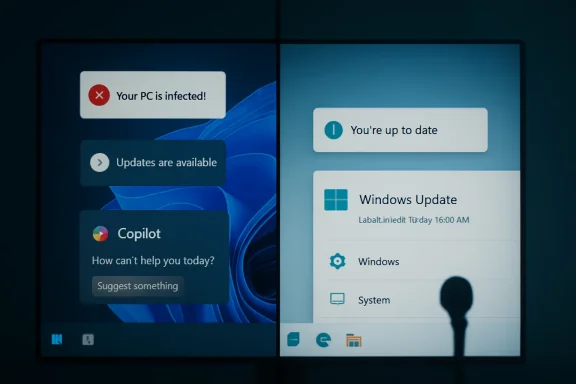 Microsoft’s Windows Problem Has Moved From Forums to Finance
Nadella did not make his comments in a developer keynote, a Windows Insider blog post, or a community AMA. He made them on an earnings call, surrounded by the usual language of cloud revenue, AI run rates, margins, and engagement. That matters because it elevates Windows user discontent from a support nuisance to a business concern.The line that will get clipped is simple enough: Microsoft is doing the “foundational work required to win back fans.” The more revealing phrase came immediately after it. Nadella said the company is focused on “fundamentals,” “quality,” and “serving our core users better.” For Windows veterans, that sounds less like a product vision than a confession.
Microsoft has spent the last two years asking users to imagine Windows as the front door to Copilot, cloud intelligence, passkeys, Microsoft accounts, Edge, Bing, Recall-like experiences, and eventually agentic computing. The problem is that many users were still waiting for Windows 11 to feel as coherent, predictable, and respectful as the operating system they thought they were upgrading from. When the pitch became “AI agents everywhere,” the reaction was not wonder. It was exhaustion.
The danger for Microsoft is not that Windows users reject AI outright. The danger is that they reject Microsoft’s right to keep adding layers of ambition while old annoyances remain unfixed. A user who has just watched Windows Update restart at the wrong time is not primed to celebrate a multimodal assistant that can reason across files and apps. They are primed to ask why the Start menu still feels like a policy experiment.
The “Agentic OS” Backlash Was a Symptom, Not the Disease
The flashpoint came when Windows chief Pavan Davuluri described Windows as evolving into an “agentic OS,” a phrase that landed with the subtlety of a mandatory Teams migration. In Microsoft’s internal vocabulary, the term probably sounds obvious: an operating system where AI agents can perceive context, act across apps, and help users accomplish complex tasks. In public, it sounded like an operating system that would watch more, infer more, and intervene more.That disconnect is the real story. Microsoft sees AI as the next abstraction layer for computing. Many Windows users see it as the next excuse to add bloat, telemetry, account dependencies, and UI churn. Both sides can be partly right, which is why the argument has been so bitter.
For enterprise IT, the phrase “agentic OS” also lands differently than it does in a product demo. Agents imply delegation. Delegation implies permissions. Permissions imply audit trails, policy boundaries, identity controls, data classification, rollback, and liability. The moment an AI feature stops answering questions and starts taking action, Windows is no longer merely a desktop environment; it becomes an automation surface with security consequences.
Microsoft knows this, of course. The company has spent years selling identity, compliance, endpoint management, and security tooling to the very customers that will be asked to trust AI deeper inside the client OS. But trust is cumulative. If Windows feels pushy in consumer scenarios, IT departments will assume the enterprise version needs aggressive governance before it is allowed anywhere near production workflows.
Nadella’s Olive Branch Is Really a Product Management Reset
The most interesting part of Nadella’s statement is not the apology-adjacent tone. It is the specific examples he chose. He pointed to performance improvements for lower-memory devices, a streamlined Windows Update experience, and a renewed focus on “core features and fundamentals.” Those are not moonshots. They are maintenance promises.That is precisely why they matter. Windows does not need to impress users every morning. It needs to disappear until summoned. The highest compliment most professionals can pay an operating system is that it did not interrupt them, slow them down, move their settings, advertise at them, or change defaults they had already chosen.
This is where Microsoft’s consumer and enterprise incentives collide. The company wants Windows to be a strategic surface for services. Users want Windows to be a stable substrate for their own priorities. Every notification, upsell, Copilot button, account prompt, search redirect, and default-app scuffle reminds users that Microsoft’s definition of “engagement” may not match theirs.
A reset toward fundamentals would therefore require more than fixing bugs. It would require restraint. It would mean shipping fewer half-integrated features, retiring more experiments, and accepting that some of the most valuable Windows improvements are the ones that never produce a flashy demo.
Windows 11’s Adoption Story Is Better Than Its Reputation
Nadella also said monthly active Windows devices have surpassed 1.6 billion, a reminder that Windows remains one of the largest computing platforms on earth even when its loudest users are furious. Windows 11, after a slow start, has continued gaining ground, helped by Windows 10’s approaching end of support and the natural replacement cycle for PCs. The installed base is massive, sticky, and commercially indispensable.That scale is both Microsoft’s shield and its trap. Windows can disappoint users for a very long time before they leave, because switching operating systems is painful. But that same inertia breeds resentment. People do not love a platform simply because they cannot easily escape it.
Windows 11’s reputation has also been shaped by a peculiar imbalance. The operating system has improved substantially since launch in areas like window management, security baselines, app modernization, HDR support, and ARM viability. Yet many of its most visible changes have involved surfaces users did not ask for: widgets, search promotions, recommended content, Copilot placement, Microsoft account pressure, and Edge persistence.
That is why “quality” is not just a bug count. It is a product posture. A technically stable OS can still feel low-quality if it behaves as though user intent is negotiable.
The AI Business Is Booming, Which Makes Restraint Harder
The awkward backdrop to Nadella’s Windows comments is that Microsoft’s AI business is exploding. The company said its AI business surpassed a $37 billion annual revenue run rate, up 123 percent year over year. Microsoft Cloud revenue exceeded $54 billion in the quarter. These numbers explain why the company is not going to stop pushing AI into its products.From a shareholder perspective, the AI strategy is working. Azure demand is strong, Copilot is becoming a commercial packaging layer, and Microsoft is trying to turn every major product category into a distribution channel for intelligence. Windows, with its enormous installed base and daily user attention, is too important to leave out.
But from a user perspective, that creates a conflict of interest. If Microsoft’s fastest-growing business depends on AI usage, and Windows is one of the best places to stimulate that usage, then users are right to scrutinize every “helpful” integration. Is it there because it solves a real problem, or because it creates another opportunity to route behavior through Microsoft’s AI stack?
That does not mean AI has no place in Windows. Quite the opposite. Local and cloud-assisted intelligence could make search better, settings easier, accessibility more powerful, troubleshooting less miserable, and automation more approachable. But Microsoft has to earn the right to put those features close to the operating system’s nervous system.
Copilot Needs Fewer Doorways and Better Reasons to Exist
Davuluri’s later promise to reduce unnecessary Copilot entry points was a tacit admission that Microsoft’s first instinct had been saturation. Copilot appeared in places where the user benefit was not always obvious, and that made it feel less like a tool than a campaign. The issue was not merely that Microsoft promoted Copilot; it was that Windows seemed to be reorganizing itself around a feature many users had not yet invited into their workflow.There is a good version of Copilot on Windows. It is contextual but not nosy, powerful but permissioned, visible when wanted and absent when dismissed. It helps explain errors, automate repetitive tasks, summarize local context with consent, and bridge the gap between human intent and system complexity.
There is also a bad version. It is a persistent brand surface. It nags. It consumes resources. It duplicates existing workflows poorly. It suggests actions before understanding consequences. It treats the desktop as a funnel.
The difference between those futures will not be settled by slogans like “agentic OS.” It will be settled by defaults, controls, auditability, performance, and whether “no” really means no.
The Windows Update Promise Cuts to the Core of Trust
Nadella’s mention of a streamlined Windows Update experience may sound like a minor housekeeping item, but it goes straight to the heart of Windows trust. Updates are where Microsoft’s platform responsibilities collide with user autonomy. Security requires urgency. Productivity requires predictability.For home users, Windows Update frustration often appears as surprise reboots, confusing timing, or patches that seem to arrive with little visible benefit. For IT departments, the stakes are broader: compatibility, phased deployment, rollback planning, driver stability, and help desk volume. Every bad update story reinforces the belief that Microsoft’s control plane is stronger than the user’s.
Microsoft has made real progress over the years with servicing models, active hours, rollback capabilities, and enterprise management controls. Yet the lived experience remains uneven, especially on consumer and unmanaged devices. A “streamlined” update experience must therefore mean more than fewer clicks. It must mean clearer communication, better timing, fewer regressions, and less post-update surprise.
The paradox is that users want Windows patched aggressively against modern threats, but they want those patches to feel almost invisible. That is an engineering problem, a UX problem, and a trust problem all at once. If Microsoft wants to win back fans, this is one of the places where rhetoric can be measured quickly.
Core Users Are Not Just Nostalgists
When Microsoft talks about “core users,” it risks sounding as though it means a cranky minority of power users who want Control Panel preserved in amber. That would be a mistake. The core Windows audience includes developers, gamers, sysadmins, creators, small business owners, and ordinary people who simply know when their computer is getting in the way.These users are not opposed to change. Many of them adopted SSDs early, switched to high-refresh displays, embraced WSL, built workflows around PowerToys, manage fleets with Intune, and test Insider builds. What they resent is change that appears to serve Microsoft’s metrics more than their needs.
A developer complaining about Windows is often not asking for nostalgia. They are asking for consistency, speed, keyboard-driven workflows, reliable terminals, sane defaults, and fewer interruptions. A gamer is not asking for an OS frozen in 2015; they want low overhead, stable drivers, predictable updates, and no background feature deciding now is a good time to index, sync, scan, or suggest.
This is why Microsoft’s renewed language around fundamentals is powerful if taken seriously. It reframes the Windows audience not as blockers to innovation, but as the people whose trust determines whether innovation can land at all.
Xbox Is the Warning Windows Should Study
Nadella paired Windows and Xbox in the same consumer-business thought, and that pairing was not accidental. Xbox has spent years testing the limits of fan patience through platform ambiguity, pricing changes, studio closures, exclusivity confusion, and a Game Pass strategy that sometimes seems clearer to accountants than to players. The phrase “win back fans” fits Xbox almost too neatly.Windows has a different business model, but the emotional pattern is similar. A beloved platform becomes a strategic distribution layer. The company optimizes for reach, services, subscriptions, and ecosystem leverage. The most loyal users begin to feel like the product is being redesigned around everyone except them.
The Xbox lesson is that fandom is not the same as usage. People may keep using a platform while becoming less likely to advocate for it. They may stay subscribed while becoming more cynical. They may buy the next device while telling everyone the magic is gone.
For Windows, that matters because the platform’s most influential users shape its reputation. Sysadmins, developers, PC builders, and enthusiasts are the informal sales force Microsoft never pays. When they sour, the damage is not always visible in monthly active device counts. It shows up in defaults changed during imaging, features disabled by policy, recommendations against upgrades, and a cultural drift toward “use Windows because you must.”
The Enterprise Version of This Debate Is Colder and More Important
Consumer backlash is loud. Enterprise skepticism is quieter, slower, and more consequential. IT departments do not usually rage-post about “agentic OS” branding. They ask what data the agent can see, where prompts are processed, how actions are logged, how least privilege is enforced, and whether the feature can be disabled globally before legal notices arrive.Microsoft has an advantage here because it already owns so much of the enterprise stack. Entra ID, Intune, Defender, Purview, Microsoft 365, Azure, and Windows give the company the components needed to build governable AI experiences. If any vendor can make agentic desktop computing administratively tolerable, Microsoft is on the short list.
But that advantage cuts both ways. Because Microsoft owns the stack, customers will expect integration to be clean. They will not be patient with consumer-grade ambiguity in enterprise controls. They will not want AI features that appear first and policy templates that arrive later.
The enterprise question is not whether AI will come to Windows. It is whether Microsoft can make AI in Windows feel like a managed capability rather than a consumer experiment smuggled into business machines. Fundamentals, in that context, include documentation, telemetry clarity, compliance boundaries, rollback, and the ability to say “not yet” without breaking the platform.
Quality Is Now a Competitive Feature
For most of Windows history, Microsoft’s primary desktop advantage was compatibility. If the app, peripheral, workflow, or game mattered, Windows was where it lived. That remains true in many markets, but it is less absolute than it once was.Apple has made battery life, hardware integration, and silence into selling points. Linux has become more viable for developers and even some gamers than it was a decade ago. ChromeOS owns a simplicity narrative Windows has never quite matched. None of these platforms is about to dethrone Windows broadly, but each gives users a language for what Windows lacks.
That is why quality has become a competitive feature. Not quality as in “passes automated tests,” but quality as in coherence. Does the system feel like one product? Do settings live where users expect? Do defaults respect intent? Do updates explain themselves? Do new features earn their place?
Microsoft’s challenge is unusually hard because Windows must serve cheap laptops, gaming rigs, enterprise fleets, kiosks, workstations, handhelds, virtual desktops, and experimental AI PCs. The platform’s breadth makes elegance difficult. But that is not an excuse users care about. It is the job.
Microsoft’s Real Test Is Whether It Can Stop Itself
The company’s best Windows moments often come when it exercises discipline. Windows 7 worked because it cleaned up the Vista hangover. Windows 10 succeeded early because it felt like a pragmatic correction to Windows 8. PowerToys has earned affection because it solves real problems without trying to become the center of the universe.The weaker moments come when Microsoft cannot resist turning Windows into a billboard for the next corporate priority. The browser wars left scars. The Microsoft account push left scars. Search and widgets left scars. Copilot risks joining that list if Microsoft confuses distribution with adoption.
Stopping itself does not mean abandoning AI. It means letting usefulness, not placement, drive adoption. It means letting users remove surfaces they do not want. It means treating performance regressions as product failures, not acceptable costs of strategic integration.
This is where Nadella’s comments either become meaningful or fade into earnings-call atmospherics. “Focused on fundamentals” is easy to say after backlash. It is harder to maintain when the next internal scorecard rewards Copilot engagement, Edge share, Bing queries, Microsoft account conversions, or cloud attachment.
The Repair Job Has a Short List
Microsoft does not need a grand apology tour to improve the Windows relationship. It needs visible, boring, user-centered changes that prove the operating system is being run for the people at the keyboard as much as for the services behind it. The company’s own language has now created a testable standard.- Microsoft should make Windows Update more predictable, more transparent, and less likely to surprise users after they have already expressed timing preferences.
- Microsoft should reduce Copilot’s passive presence in Windows and make its strongest features discoverable through user intent rather than persistent promotion.
- Microsoft should treat low-memory and lower-cost devices as first-class Windows machines, not as edge cases that absorb the cost of platform expansion.
- Microsoft should give power users and IT administrators durable controls that survive feature updates, policy changes, and new monetization experiments.
- Microsoft should measure Windows quality not only by crash rates and engagement, but by interruption, latency, consistency, and user reversal of defaults.
- Microsoft should explain what an agentic Windows can and cannot do before asking users to trust agents with files, apps, settings, and work context.
The future of Windows is almost certainly more intelligent, more cloud-connected, and more agentic than the version many users would design for themselves. The question is whether Microsoft can make that future feel earned rather than imposed. Nadella has now said the quiet part out loud: before Windows can become the next great AI platform, it has to become a better Windows.
Source: IT Pro Satya Nadella woos Windows users with OS improvement pledges: 'We are focused on fundamentals, prioritizing quality, and serving our core users better'
