

Microsoft CEO Satya Nadella told investors on April 29, 2026, that Microsoft is doing the work required to “win back fans” across consumer businesses including Windows and Xbox, after a quarter in which the company reported strong cloud-driven financial results but faced visible user frustration. That sentence matters because it was not aimed at hobbyists on a forum; it was delivered inside the ritual theater of an earnings call. Microsoft is not suddenly poor, weak, or cornered. It is something more awkward: hugely successful, and yet increasingly distrusted by many of the people who used to defend it for free.
The strangest thing about Microsoft’s current consumer trust problem is that it arrives amid spectacular financial strength. The company’s fiscal third quarter was not a distress signal. Revenue rose to $82.9 billion, operating income climbed, net income expanded, and the Microsoft Cloud kept doing the heavy lifting that investors have come to expect.
That is precisely why Nadella’s “win back fans” line lands differently from the usual executive throat-clearing. This is not a CEO trying to distract from a busted quarter. It is a CEO acknowledging that the balance sheet and the brand are now telling different stories.
For Wall Street, Microsoft is a cloud-and-AI compounder with an enterprise moat, a deep relationship with OpenAI, and a seemingly endless ability to turn software dependency into recurring revenue. For many Windows users, it is the company that keeps moving buttons, inserting prompts, renaming settings, breaking workflows, and asking everyone to be excited about whatever Copilot integration appeared this month.
Those two Microsofts can coexist for a while. They already have. But they cannot coexist forever without consequence, because Windows is not merely another consumer app with churn and reactivation curves. It is the surface on which millions of people encounter the company every workday, often unwillingly, and it is where every rough edge becomes a referendum on whether Microsoft still respects the PC.
Nadella did not need to use the language of fandom. Microsoft could have said it was improving engagement, strengthening customer satisfaction, or optimizing consumer experiences. Instead, the company reached for a more emotional word, one that admits the existence of attachment and, by implication, disappointment.
That matters because Microsoft has spent years treating Windows loyalty as a default condition. Enthusiasts grumbled, administrators cursed Patch Tuesday, gamers complained about overlays and account requirements, and privacy advocates warned about telemetry and Recall-like features. But Windows still shipped on PCs, Microsoft 365 still renewed, Azure still grew, and the company could read inertia as consent.
Now the company appears to understand that inertia is not affection. Users may stay because their employer mandates Windows, because their games run there, because their peripherals behave there, because their muscle memory lives there, or because switching remains tedious. None of that means they are fans. It means the cost of exit remains higher than the cost of complaint.
But “service” quietly acquired a second meaning. Windows became not only serviced but monetized in motion. The Start menu became a recommendation surface. Settings became an onboarding channel. Edge became harder to ignore. Microsoft accounts became harder to avoid. Copilot became the new gravitational center before many users had agreed that they wanted an AI assistant embedded in the operating system at all.
This is the root of the backlash. It is not that Windows users hate change. Windows enthusiasts have survived the ribbon, Metro, live tiles, charms, forced restarts, the Control Panel–Settings split, and more taskbar experiments than anyone should have to remember. What they resent is the sense that change is no longer primarily in service of the user.
That suspicion turns every glitch into evidence. A File Explorer stall becomes proof of architectural neglect. A driver failure becomes proof that quality gates have weakened. A Copilot button becomes proof that AI priorities outrank basic polish. A nag screen becomes proof that the operating system is no longer a neutral tool but a conversion funnel.
That was not a small rhetorical shift. Microsoft had been talking about Windows as the stage for agentic computing, Copilot+ PCs, and edge intelligence. Davuluri’s memo sounded more like a product leader who had spent time reading angry comments and realized that the faithful were not asking for a manifesto. They were asking for the OS to stop getting in their way.
The promise to make Copilot less intrusive was especially telling. For the past two years, AI was treated inside Microsoft almost as a universal solvent: add it to the product, invoke productivity, declare transformation, repeat. But Windows is different from a chatbot tab or an enterprise workflow assistant. It is intimate infrastructure. When AI appears there too aggressively, users do not see innovation; they see occupation.
Nadella’s earnings-call comment effectively elevated Davuluri’s reset from Windows-team messaging to corporate strategy. That is the part worth watching. A Windows boss can promise polish. A CEO has to decide whether the company’s incentives will actually reward it.
Microsoft knows this. The company has spent decades building tooling, rings, telemetry, servicing channels, and deployment controls for precisely the customers who cannot afford romantic software. Yet many IT pros still approach Windows updates with the defensive posture of bomb disposal technicians. The issue is not that software sometimes breaks. The issue is that Windows’ scale turns every quality slip into a national weather system.
That is why “highest quality” cannot remain an investor-call phrase. In Windows, quality is not an abstract product virtue. It is whether a hospital workstation boots. It is whether a small business owner can print invoices. It is whether a school lab survives an update cycle. It is whether a sysadmin gets a weekend back.
Microsoft’s challenge is compounded by the ecosystem it governs but does not fully control. Drivers, OEM utilities, security software, peripherals, firmware, legacy apps, and enterprise customizations all collide on the same platform. Windows is messy because the PC world is messy. But Microsoft benefits enormously from that ecosystem, so it cannot invoke complexity only when things break.
That created a brutal perception problem: Microsoft seemed to have endless energy for adding AI surfaces but less urgency for fixing daily irritants. Whether that perception is entirely fair hardly matters. In consumer trust, perception becomes operational reality.
The phrase “AI slop” has become crude shorthand for this frustration, and its popularity should worry Redmond. It suggests that users are not merely skeptical of particular implementations. They are developing an allergic reaction to AI features that appear without clear consent, clear usefulness, or clear performance discipline.
This does not mean AI has no place in Windows. It almost certainly does. Local semantic search, accessibility assistance, natural-language settings, device troubleshooting, creative workflows, and security analysis could all become genuinely useful. But usefulness has to lead. If AI arrives as branding first and utility second, Windows users will continue to treat it like adware with a graduate degree.
The reported decision by HashiCorp co-founder Mitchell Hashimoto to move a project away from GitHub over stability concerns was symbolically potent because GitHub is supposed to be one of Microsoft’s great trust wins. The 2018 acquisition could have gone badly; instead, for years, Microsoft largely persuaded developers that it would not smother the platform. GitHub became proof that modern Microsoft could steward a beloved tool without turning it into SharePoint with pull requests.
That goodwill is not indestructible. Developer trust is unusually sensitive because developers can leave, loudly, and then automate the path for others. A Windows user may be stuck for practical reasons. A maintainer with enough motivation can move repositories, change workflows, and write the migration guide.
The connection to Windows is cultural rather than technical. In both cases, Microsoft is being asked to prove that it values reliability as much as expansion. A platform company can survive isolated outages and bugs. It has a harder time surviving the belief that quality is being subordinated to strategic theater.
The parallel with Windows is striking. In both markets, Microsoft has tried to reframe a beloved product around a broader platform strategy. Windows becomes the edge of AI and cloud intelligence. Xbox becomes a content, services, and Game Pass ecosystem that stretches beyond a box under the television. Strategically, both moves make sense in a spreadsheet.
Emotionally, they are harder. Fans attach to products, rituals, and identities. They do not wake up eager to be migrated into a more efficient total addressable market. When Microsoft speaks in platform abstractions, users hear the soft prelude to losing something concrete.
This is not nostalgia masquerading as analysis. Consumer tech loyalty is built on continuity as much as novelty. Apple understands this almost too well, sometimes preserving interaction patterns long after critics would prefer a reset. Microsoft, by contrast, often behaves as though installed-base patience is a renewable resource.
For consumers, those alternatives are more credible than they used to be. macOS owns the premium laptop mindshare Microsoft once hoped Surface might contest more aggressively. ChromeOS remains strong in education and lightweight computing. Linux is no longer a punchline for gaming in quite the way it once was, thanks in part to Proton, Steam Deck, and the broader maturation of open-source desktop tooling. Mobile devices have eaten many casual PC tasks entirely.
For businesses, the lock-in remains deeper. Legacy Win32 applications, Active Directory inheritance, endpoint management, compliance processes, procurement habits, and user training all keep Windows entrenched. But enterprise dominance is not the same as cultural energy. Nobody wants to become the platform people use only because the migration plan is worse.
That is Microsoft’s real risk. Windows does not have to collapse to lose stature. It only has to become a grudging default: present everywhere, loved nowhere, defended by procurement logic rather than enthusiasm.
Trust returns when users can predict a company’s behavior. Right now, many Windows users cannot. They do not know whether a setting will remain where it is, whether an app will gain an AI panel, whether a local workflow will be nudged toward the cloud, whether an update will introduce a new nag, or whether Microsoft will respect the difference between “available” and “pushed.”
For IT pros, predictability is even more important than affection. A stable Microsoft is one whose servicing cadence, deprecation plans, policy controls, and feature rollouts can be modeled. A surprising Microsoft is expensive. It creates documentation churn, helpdesk load, executive escalations, and the kind of institutional resentment that no keynote can soothe.
This is why the company’s internal incentives matter. If Windows teams are rewarded for engagement, Copilot exposure, account conversion, cloud attachment, and AI usage, then quality rhetoric will eventually lose to dashboards. If they are rewarded for fewer disruptions, faster responsiveness, lower resource usage, clearer controls, and measurable reliability, users may begin to believe the reset is real.
That history gives Microsoft a reason for confidence. It knows how to pivot when the market shouts loudly enough. It has engineering depth, telemetry at planetary scale, distribution power, and a vast ecosystem of partners that still need Windows to succeed.
But the same history also makes users cynical. They have heard the comeback speech before. They remember when Microsoft promised that Windows 10 was the last version of Windows. They remember unwanted app reinstallations, Start menu experiments, account nudges, privacy defaults, and the slow drift from operating system to services billboard.
The company therefore has less room for theatrical reinvention. The next Windows trust campaign cannot be built around a new slogan. It has to be built around the unfamiliar sensation of Microsoft choosing restraint.
This is where enthusiasts and enterprise admins unexpectedly align. The enthusiast wants Windows to feel sharp again. The admin wants it to be boring again. Both are asking for the same philosophical shift: make the operating system serve the task rather than making the task serve Microsoft’s roadmap.
Microsoft should be careful not to confuse feedback channels with trust. Users do not want merely to submit complaints more efficiently. They want evidence that the complaints change outcomes. Feedback Hub can become a useful civic institution, or it can remain a suggestion box in a building whose architects have already moved on.
The same goes for Insider builds. The Windows Insider Program was once a symbol of participatory development. Over time, many users came to see it as a telemetry farm where rough ideas were floated, defended, renamed, or shipped anyway. If Microsoft wants the Insider community to matter again, it must be willing to kill features publicly because Insiders said no.
The Windows fan is not always representative of the average Windows customer, and Microsoft is right not to design exclusively for forum regulars. But enthusiasts are early-warning systems. When they become bitter, the broader user base often follows later in quieter forms: lower satisfaction, slower adoption, more support friction, less willingness to try the next Microsoft thing.
This is especially important for Copilot+ PCs and whatever Microsoft imagines the next AI-native generation of Windows hardware will become. The company needs credible advocates to explain why local NPUs matter, why new devices are worth buying, and why AI features are more than bundled demos. If the people most capable of making that argument instead spend their time disabling features, Microsoft has a marketing problem no ad campaign can solve.
The company’s great consumer successes have usually paired broad accessibility with enthusiast legitimacy. Xbox had it in its strongest eras. Windows had it when PC builders, gamers, students, developers, and office workers all felt the platform was expanding their choices. The current complaint is that Microsoft is narrowing choices while calling it modernization.
A serious repair effort would be visible in small decisions. It would mean fewer forced defaults, fewer promotional surfaces, fewer mystery regressions, clearer release notes, stronger rollback paths, and a sharper distinction between consumer experimentation and enterprise stability. It would mean Copilot appears where it solves a problem, not where a quarterly metric needs oxygen.
It would also mean accepting that some users do not want AI in every corner of their PC. That is not Luddism. It is a preference for agency. A personal computer that constantly explains Microsoft’s preferred future is less personal than one that lets the owner choose how much future to install.
For WindowsForum readers, the test is not whether Nadella said the right thing. He did, more or less. The test is whether Windows starts behaving as though the company heard the part users have been saying for years: stop treating the desktop as conquered territory.
Source: theregister.com Microsoft boss says company is working to 'win back fans'
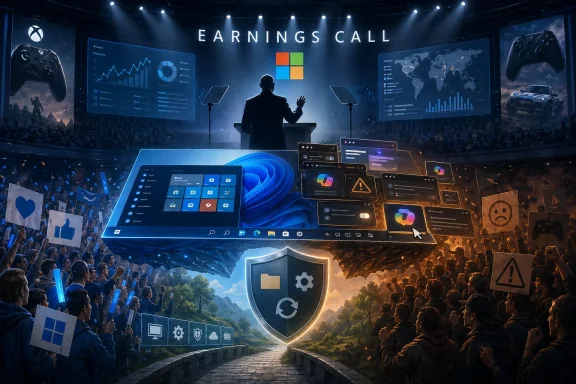 Microsoft’s Richest Problem Is That Its Users No Longer Clap on Cue
The strangest thing about Microsoft’s current consumer trust problem is that it arrives amid spectacular financial strength. The company’s fiscal third quarter was not a distress signal. Revenue rose to $82.9 billion, operating income climbed, net income expanded, and the Microsoft Cloud kept doing the heavy lifting that investors have come to expect.That is precisely why Nadella’s “win back fans” line lands differently from the usual executive throat-clearing. This is not a CEO trying to distract from a busted quarter. It is a CEO acknowledging that the balance sheet and the brand are now telling different stories.
For Wall Street, Microsoft is a cloud-and-AI compounder with an enterprise moat, a deep relationship with OpenAI, and a seemingly endless ability to turn software dependency into recurring revenue. For many Windows users, it is the company that keeps moving buttons, inserting prompts, renaming settings, breaking workflows, and asking everyone to be excited about whatever Copilot integration appeared this month.
Those two Microsofts can coexist for a while. They already have. But they cannot coexist forever without consequence, because Windows is not merely another consumer app with churn and reactivation curves. It is the surface on which millions of people encounter the company every workday, often unwillingly, and it is where every rough edge becomes a referendum on whether Microsoft still respects the PC.
The Earnings Call Became a Confessional Booth
Earnings calls are not designed for humility. They are scripted arenas where executives translate complexity into growth narratives, where “headwinds” are temporary, “investments” are disciplined, and every awkward product transition is framed as durable opportunity. In that setting, a phrase like “win back fans” is unusually revealing.Nadella did not need to use the language of fandom. Microsoft could have said it was improving engagement, strengthening customer satisfaction, or optimizing consumer experiences. Instead, the company reached for a more emotional word, one that admits the existence of attachment and, by implication, disappointment.
That matters because Microsoft has spent years treating Windows loyalty as a default condition. Enthusiasts grumbled, administrators cursed Patch Tuesday, gamers complained about overlays and account requirements, and privacy advocates warned about telemetry and Recall-like features. But Windows still shipped on PCs, Microsoft 365 still renewed, Azure still grew, and the company could read inertia as consent.
Now the company appears to understand that inertia is not affection. Users may stay because their employer mandates Windows, because their games run there, because their peripherals behave there, because their muscle memory lives there, or because switching remains tedious. None of that means they are fans. It means the cost of exit remains higher than the cost of complaint.
Windows Became a Service, Then Started Acting Like a Sales Floor
The modern Windows bargain was supposed to be simple: fewer big-bang upgrades, more continuous improvement. Windows as a service would keep devices secure, current, and incrementally better. It sounded sane after the bruising cycles of boxed releases, driver chaos, and enterprise migration projects that stretched across years.But “service” quietly acquired a second meaning. Windows became not only serviced but monetized in motion. The Start menu became a recommendation surface. Settings became an onboarding channel. Edge became harder to ignore. Microsoft accounts became harder to avoid. Copilot became the new gravitational center before many users had agreed that they wanted an AI assistant embedded in the operating system at all.
This is the root of the backlash. It is not that Windows users hate change. Windows enthusiasts have survived the ribbon, Metro, live tiles, charms, forced restarts, the Control Panel–Settings split, and more taskbar experiments than anyone should have to remember. What they resent is the sense that change is no longer primarily in service of the user.
That suspicion turns every glitch into evidence. A File Explorer stall becomes proof of architectural neglect. A driver failure becomes proof that quality gates have weakened. A Copilot button becomes proof that AI priorities outrank basic polish. A nag screen becomes proof that the operating system is no longer a neutral tool but a conversion funnel.
Davuluri’s Reset Was the Setup; Nadella’s Line Was the Admission
Earlier this year, Windows chief Pavan Davuluri tried to reset the tone. His message to the Windows community was notably different from the recent drumbeat of AI triumphalism. It emphasized reliability, performance, stability, user feedback, and a reduction of unnecessary Copilot entry points.That was not a small rhetorical shift. Microsoft had been talking about Windows as the stage for agentic computing, Copilot+ PCs, and edge intelligence. Davuluri’s memo sounded more like a product leader who had spent time reading angry comments and realized that the faithful were not asking for a manifesto. They were asking for the OS to stop getting in their way.
The promise to make Copilot less intrusive was especially telling. For the past two years, AI was treated inside Microsoft almost as a universal solvent: add it to the product, invoke productivity, declare transformation, repeat. But Windows is different from a chatbot tab or an enterprise workflow assistant. It is intimate infrastructure. When AI appears there too aggressively, users do not see innovation; they see occupation.
Nadella’s earnings-call comment effectively elevated Davuluri’s reset from Windows-team messaging to corporate strategy. That is the part worth watching. A Windows boss can promise polish. A CEO has to decide whether the company’s incentives will actually reward it.
The Quality Problem Is Bigger Than One Bad Update
Administrators do not judge Microsoft by vibes. They judge it by tickets, failed deployments, rollback windows, broken VPN clients, printer weirdness, BitLocker surprises, remote desktop regressions, blue screens, and the grim arithmetic of how many endpoints must be touched because a cumulative update behaved badly.Microsoft knows this. The company has spent decades building tooling, rings, telemetry, servicing channels, and deployment controls for precisely the customers who cannot afford romantic software. Yet many IT pros still approach Windows updates with the defensive posture of bomb disposal technicians. The issue is not that software sometimes breaks. The issue is that Windows’ scale turns every quality slip into a national weather system.
That is why “highest quality” cannot remain an investor-call phrase. In Windows, quality is not an abstract product virtue. It is whether a hospital workstation boots. It is whether a small business owner can print invoices. It is whether a school lab survives an update cycle. It is whether a sysadmin gets a weekend back.
Microsoft’s challenge is compounded by the ecosystem it governs but does not fully control. Drivers, OEM utilities, security software, peripherals, firmware, legacy apps, and enterprise customizations all collide on the same platform. Windows is messy because the PC world is messy. But Microsoft benefits enormously from that ecosystem, so it cannot invoke complexity only when things break.
AI Became the Visible Symbol of Misplaced Priorities
The backlash against Copilot in Windows is not really about one button. It is about sequencing. Users looked at an operating system with performance complaints, inconsistent interfaces, update anxiety, and lingering control-panel archaeology, then watched Microsoft prioritize AI affordances with missionary zeal.That created a brutal perception problem: Microsoft seemed to have endless energy for adding AI surfaces but less urgency for fixing daily irritants. Whether that perception is entirely fair hardly matters. In consumer trust, perception becomes operational reality.
The phrase “AI slop” has become crude shorthand for this frustration, and its popularity should worry Redmond. It suggests that users are not merely skeptical of particular implementations. They are developing an allergic reaction to AI features that appear without clear consent, clear usefulness, or clear performance discipline.
This does not mean AI has no place in Windows. It almost certainly does. Local semantic search, accessibility assistance, natural-language settings, device troubleshooting, creative workflows, and security analysis could all become genuinely useful. But usefulness has to lead. If AI arrives as branding first and utility second, Windows users will continue to treat it like adware with a graduate degree.
GitHub Shows the Trust Problem Is Not Confined to Windows
The user’s patience problem is not limited to the desktop. GitHub’s recent reliability complaints are a reminder that Microsoft’s developer-facing credibility also depends on boring excellence. Developers do not want inspirational language from their code host when pushes, actions, package flows, or availability wobble. They want the platform to behave like oxygen.The reported decision by HashiCorp co-founder Mitchell Hashimoto to move a project away from GitHub over stability concerns was symbolically potent because GitHub is supposed to be one of Microsoft’s great trust wins. The 2018 acquisition could have gone badly; instead, for years, Microsoft largely persuaded developers that it would not smother the platform. GitHub became proof that modern Microsoft could steward a beloved tool without turning it into SharePoint with pull requests.
That goodwill is not indestructible. Developer trust is unusually sensitive because developers can leave, loudly, and then automate the path for others. A Windows user may be stuck for practical reasons. A maintainer with enough motivation can move repositories, change workflows, and write the migration guide.
The connection to Windows is cultural rather than technical. In both cases, Microsoft is being asked to prove that it values reliability as much as expansion. A platform company can survive isolated outages and bugs. It has a harder time surviving the belief that quality is being subordinated to strategic theater.
Xbox Makes the Same Mistake in a Different Accent
Nadella’s mention of Xbox alongside Windows was not accidental. Xbox has its own trust deficit, shaped by studio closures, pricing changes, subscription ambiguity, cross-platform strategy shifts, hardware uncertainty, and the feeling among some longtime fans that Microsoft wants the Xbox audience without necessarily wanting the Xbox console business as they understood it.The parallel with Windows is striking. In both markets, Microsoft has tried to reframe a beloved product around a broader platform strategy. Windows becomes the edge of AI and cloud intelligence. Xbox becomes a content, services, and Game Pass ecosystem that stretches beyond a box under the television. Strategically, both moves make sense in a spreadsheet.
Emotionally, they are harder. Fans attach to products, rituals, and identities. They do not wake up eager to be migrated into a more efficient total addressable market. When Microsoft speaks in platform abstractions, users hear the soft prelude to losing something concrete.
This is not nostalgia masquerading as analysis. Consumer tech loyalty is built on continuity as much as novelty. Apple understands this almost too well, sometimes preserving interaction patterns long after critics would prefer a reset. Microsoft, by contrast, often behaves as though installed-base patience is a renewable resource.
The Windows Installed Base Is Huge, but Hugeness Can Hide Decay
More than 1.6 billion monthly active Windows devices is an extraordinary figure. It is also a dangerous one if Microsoft mistakes it for devotion. Dominance can conceal dissatisfaction until the alternatives become just good enough.For consumers, those alternatives are more credible than they used to be. macOS owns the premium laptop mindshare Microsoft once hoped Surface might contest more aggressively. ChromeOS remains strong in education and lightweight computing. Linux is no longer a punchline for gaming in quite the way it once was, thanks in part to Proton, Steam Deck, and the broader maturation of open-source desktop tooling. Mobile devices have eaten many casual PC tasks entirely.
For businesses, the lock-in remains deeper. Legacy Win32 applications, Active Directory inheritance, endpoint management, compliance processes, procurement habits, and user training all keep Windows entrenched. But enterprise dominance is not the same as cultural energy. Nobody wants to become the platform people use only because the migration plan is worse.
That is Microsoft’s real risk. Windows does not have to collapse to lose stature. It only has to become a grudging default: present everywhere, loved nowhere, defended by procurement logic rather than enthusiasm.
Trust Is a Product Feature, Not a Communications Plan
The easiest version of Microsoft’s “win back fans” campaign would be cosmetic. Fewer Copilot buttons. A nicer Feedback Hub. A few beloved taskbar options restored. Some performance charts. A blog series about listening. Those things may help, but they will not be enough.Trust returns when users can predict a company’s behavior. Right now, many Windows users cannot. They do not know whether a setting will remain where it is, whether an app will gain an AI panel, whether a local workflow will be nudged toward the cloud, whether an update will introduce a new nag, or whether Microsoft will respect the difference between “available” and “pushed.”
For IT pros, predictability is even more important than affection. A stable Microsoft is one whose servicing cadence, deprecation plans, policy controls, and feature rollouts can be modeled. A surprising Microsoft is expensive. It creates documentation churn, helpdesk load, executive escalations, and the kind of institutional resentment that no keynote can soothe.
This is why the company’s internal incentives matter. If Windows teams are rewarded for engagement, Copilot exposure, account conversion, cloud attachment, and AI usage, then quality rhetoric will eventually lose to dashboards. If they are rewarded for fewer disruptions, faster responsiveness, lower resource usage, clearer controls, and measurable reliability, users may begin to believe the reset is real.
The Company Has Done This Before, Which Cuts Both Ways
Microsoft has recovered from consumer misfires before. Windows 7 repaired much of the reputational damage from Vista. Windows 10 was framed as a course correction after Windows 8’s tablet-first overreach. The company’s developer relations improved dramatically under Nadella after years of hostility toward open source. Even Edge, after its Chromium rebasing, became a technically credible browser despite the company’s often counterproductive attempts to force it on users.That history gives Microsoft a reason for confidence. It knows how to pivot when the market shouts loudly enough. It has engineering depth, telemetry at planetary scale, distribution power, and a vast ecosystem of partners that still need Windows to succeed.
But the same history also makes users cynical. They have heard the comeback speech before. They remember when Microsoft promised that Windows 10 was the last version of Windows. They remember unwanted app reinstallations, Start menu experiments, account nudges, privacy defaults, and the slow drift from operating system to services billboard.
The company therefore has less room for theatrical reinvention. The next Windows trust campaign cannot be built around a new slogan. It has to be built around the unfamiliar sensation of Microsoft choosing restraint.
The Repair Job Starts Where the Annoyance Starts
The most important Windows improvements in 2026 may not be spectacular. They may be the kind that do not demo well: a faster Explorer, fewer shell hangs, less memory pressure, cleaner update rollback behavior, better driver coordination, quieter widgets, clearer privacy controls, and fewer moments where the OS interrupts the user to satisfy a Microsoft business objective.This is where enthusiasts and enterprise admins unexpectedly align. The enthusiast wants Windows to feel sharp again. The admin wants it to be boring again. Both are asking for the same philosophical shift: make the operating system serve the task rather than making the task serve Microsoft’s roadmap.
Microsoft should be careful not to confuse feedback channels with trust. Users do not want merely to submit complaints more efficiently. They want evidence that the complaints change outcomes. Feedback Hub can become a useful civic institution, or it can remain a suggestion box in a building whose architects have already moved on.
The same goes for Insider builds. The Windows Insider Program was once a symbol of participatory development. Over time, many users came to see it as a telemetry farm where rough ideas were floated, defended, renamed, or shipped anyway. If Microsoft wants the Insider community to matter again, it must be willing to kill features publicly because Insiders said no.
The Fan Base Microsoft Wants Is Not the One It Has Been Designing For
There is an irony in Microsoft trying to win back fans while optimizing so many experiences for passive users. Fans are not passive. They customize, test, complain, benchmark, document, script, image, deploy, break, repair, and evangelize. They notice when power-user affordances disappear. They notice when local control is traded for cloud convenience. They notice when telemetry explanations sound lawyered into uselessness.The Windows fan is not always representative of the average Windows customer, and Microsoft is right not to design exclusively for forum regulars. But enthusiasts are early-warning systems. When they become bitter, the broader user base often follows later in quieter forms: lower satisfaction, slower adoption, more support friction, less willingness to try the next Microsoft thing.
This is especially important for Copilot+ PCs and whatever Microsoft imagines the next AI-native generation of Windows hardware will become. The company needs credible advocates to explain why local NPUs matter, why new devices are worth buying, and why AI features are more than bundled demos. If the people most capable of making that argument instead spend their time disabling features, Microsoft has a marketing problem no ad campaign can solve.
The company’s great consumer successes have usually paired broad accessibility with enthusiast legitimacy. Xbox had it in its strongest eras. Windows had it when PC builders, gamers, students, developers, and office workers all felt the platform was expanding their choices. The current complaint is that Microsoft is narrowing choices while calling it modernization.
Redmond’s Apology Tour Has to Ship Code
The encouraging part of Nadella’s comment is that it names the problem in human terms. The discouraging part is that Microsoft has often been better at diagnosing trust erosion than preventing the next act of self-sabotage. Windows users have become experts at waiting for the other shoe to drop.A serious repair effort would be visible in small decisions. It would mean fewer forced defaults, fewer promotional surfaces, fewer mystery regressions, clearer release notes, stronger rollback paths, and a sharper distinction between consumer experimentation and enterprise stability. It would mean Copilot appears where it solves a problem, not where a quarterly metric needs oxygen.
It would also mean accepting that some users do not want AI in every corner of their PC. That is not Luddism. It is a preference for agency. A personal computer that constantly explains Microsoft’s preferred future is less personal than one that lets the owner choose how much future to install.
For WindowsForum readers, the test is not whether Nadella said the right thing. He did, more or less. The test is whether Windows starts behaving as though the company heard the part users have been saying for years: stop treating the desktop as conquered territory.
The Next Six Months Will Tell Us Whether “Fans” Means Anything
The practical markers are easy to state and harder to fake. Microsoft does not need to solve every Windows complaint before the end of 2026, but it does need to demonstrate a different operating rhythm. The company has promised tangible progress; now the receipts have to arrive in builds, servicing behavior, and product restraint.- Microsoft has publicly acknowledged that consumer trust has eroded across Windows and Xbox, which changes the issue from community grumbling into an executive-level priority.
- Windows quality will be judged less by new features than by fewer crashes, smoother updates, faster core experiences, and less friction in everyday workflows.
- Copilot’s future on Windows depends on Microsoft proving usefulness before ubiquity, especially for users who never asked for AI to become part of the shell.
- Enterprise administrators will measure the reset through deployment predictability, policy control, and support burden rather than through marketing language.
- Enthusiasts will return only if Microsoft restores a sense of agency, because fandom cannot be rebuilt around a product that keeps overriding user intent.
Source: theregister.com Microsoft boss says company is working to 'win back fans'
