

Microsoft will ship more than 60,000 of NVIDIA’s advanced AI accelerators — including GB300 “Blackwell” class GPUs — to data centers in the United Arab Emirates under U.S. Commerce Department export licenses granted with what Microsoft calls “stringent safeguards,” a move tied to a broader $15.2 billion Microsoft investment in the UAE and a sweeping $1.4 trillion U.S.-focused investment pledge from Emirati entities.
The headline — Microsoft’s plan to move tens of thousands of frontier AI chips into the UAE — sits at the intersection of three trends: hyperscaler infrastructure scale‑up, evolving U.S. export-control policy for AI hardware, and aggressive Gulf-region state investment in AI ecosystems. The Commerce Department approvals reportedly issued in September allow Microsoft to ship the equivalent of more than 60,000 A100-class chips — where the real hardware being deployed includes NVIDIA’s GB300 Grace Blackwell GPUs — to Microsoft‑managed facilities in the UAE. This hardware will feed Azure’s regional AI capacity and be used to host models from OpenAI, Anthropic, Microsoft, and open‑source providers, while also supporting product initiatives such as in‑country Microsoft 365 Copilot processing for qualified UAE organizations. Microsoft frames this as part of a seven‑year, $15.2 billion program of capital and operating expenditures in the UAE, including earlier investments such as a $1.5 billion equity stake in G42.
First, it shows how commercial deals and state-level investment commitments can reshape export‑control outcomes; strategic economic ties (such as a $1.4 trillion pledge) can unlock access to frontier hardware when accompanied by governance promises. Second, the arrival of GB300‑class racks in new regions lowers the latency and logistical friction for running advanced models nearer to end users, accelerating localized AI adoption and productization. For businesses and developers, that opens new opportunities — but only if governance and transparency keep pace.
Third, the deal crystallizes a broader industry tradeoff: capability versus control. Hyperscalers can build AI capacity faster by co‑engineering with chip vendors and sovereign partners, but the proliferation of that capacity raises legitimate security, governance, and ethical questions that require sustained, auditable oversight.
The Microsoft announcement is technically and commercially consequential. It expands the global topology of frontier AI compute and institutionalizes new arrangements between hyperscalers and national partners. The long‑term outcome — whether it becomes a template for secure, auditable export of advanced technology or a cautionary tale about opaque safeguards — will depend on the depth and transparency of the assurances that were given alongside the chips.
Microsoft’s shipments mark a new chapter in the global AI infrastructure race: one where advanced hardware, large‑scale investment, export policy, and national strategic interests collide. The immediate technical benefits are real for UAE developers and customers, but the policy and governance questions raised by this expansion are as consequential as the chips themselves — and they demand continuous public scrutiny, auditable controls, and international cooperation if the promise of safe, beneficial AI is to be realized.
Source: Tech in Asia https://www.techinasia.com/news/microsoft-to-ship-60000-nvidia-ai-chips-to-uae/amp/
 Background and overview
The headline — Microsoft’s plan to move tens of thousands of frontier AI chips into the UAE — sits at the intersection of three trends: hyperscaler infrastructure scale‑up, evolving U.S. export-control policy for AI hardware, and aggressive Gulf-region state investment in AI ecosystems. The Commerce Department approvals reportedly issued in September allow Microsoft to ship the equivalent of more than 60,000 A100-class chips — where the real hardware being deployed includes NVIDIA’s GB300 Grace Blackwell GPUs — to Microsoft‑managed facilities in the UAE. This hardware will feed Azure’s regional AI capacity and be used to host models from OpenAI, Anthropic, Microsoft, and open‑source providers, while also supporting product initiatives such as in‑country Microsoft 365 Copilot processing for qualified UAE organizations. Microsoft frames this as part of a seven‑year, $15.2 billion program of capital and operating expenditures in the UAE, including earlier investments such as a $1.5 billion equity stake in G42. Why the GB300 (Blackwell) chips matter
What GB300 brings to the table
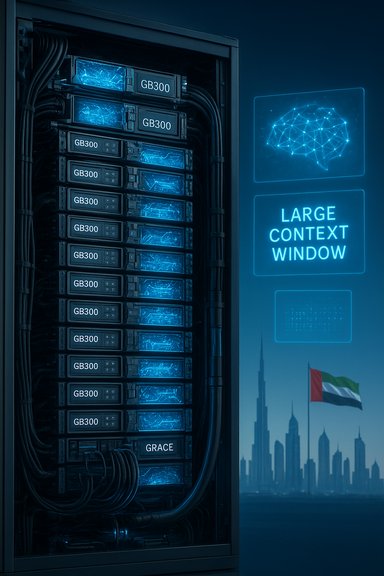
- GB300 (Blackwell Ultra) GPUs are engineered for reasoning‑class workloads — inference and low‑latency, high‑memory applications where large context windows and key‑value caches matter.
- The rack‑scale GB300 NVL72 design couples 72 Blackwell GPUs with 36 Grace CPUs and presents pooled “fast memory” measured in the tens of terabytes per rack, with dense NVLink/NVSwitch fabrics inside the rack and high‑speed InfiniBand for pod‑level stitching. These engineering choices reduce cross‑host synchronization and make very large model inference more practical.
Practical impact for cloud AI workloads
For enterprise and ISV engineers, GB300 racks mean:- Larger memory-per‑logical‑accelerator for longer contexts and bigger KV caches.
- Lower inference latency for agentic and multi‑step reasoning tasks.
- A different cost and orchestration model: topology awareness (rack affinity), liquid cooling, and power provisioning become first‑order concerns.
The deal: licenses, safeguards, and the timeline
Microsoft says the export licenses enabling the shipments were approved in September and were issued with stringent safeguards governing how the chips and resulting compute capacity can be used and by whom. The company told reporters the chips had not yet been delivered but would arrive in the coming months as Microsoft deploys additional regional capacity. Key public facts reported so far:- Quantity: Over 60,000 NVIDIA chips (coverage equates the compute capability to ~60,400 A100 equivalents in some Microsoft statements).
- Hardware mix: Includes GB300 Grace Blackwell GPUs and other advanced NVIDIA parts cited in Microsoft briefings.
- Investment context: The shipments are part of Microsoft’s $15.2 billion UAE investment program and coordinated public‑private measures, including an Intergovernmental Assurance Agreement with partner entities.
Geopolitical context and policy friction
The Trump administration’s public stance vs. licensing reality
President Donald Trump has publicly stated he would not permit U.S. exports of the “most advanced” NVIDIA Blackwell chips to foreign buyers — a stance he reiterated on national television — creating a visible tension between public rhetoric and the Commerce Department’s case‑by‑case license decisions. The Microsoft‑UAE licenses were reportedly issued under the Trump administration with special assurances and security controls, illustrating the nuance in how export controls can be operationalized: blanket political statements do not always equate to universal denials when strategic safeguards and allied‑nation frameworks are negotiated.The UAE bargaining chip: $1.4 trillion pledge
The chemistry that made the approvals politically and economically feasible includes an unprecedented UAE pledge — a reported 10‑year, $1.4 trillion investment framework in the U.S. focused on energy, AI infrastructure, semiconductors, and industrial projects. That pledge, announced publicly by U.S. officials earlier this year, reshaped strategic calculations and tightened economic interdependence between the two countries. The combination of that pledge and on‑the‑ground safeguards formed the backdrop to Commerce’s licensing decisions.Past scrutiny: G42 and transfer concerns
Microsoft’s prior $1.5 billion equity investment in Abu Dhabi‑based G42 and the resulting commercial ties have been scrutinized in Washington because of G42’s historical Chinese partnerships. Those concerns drove part of the compliance architecture around new deals, including the Intergovernmental Assurance Agreement and conditions on physical access and personnel. Public reporting has emphasized these governance guardrails as essential parts of the export approval calculus.What this means for the UAE AI ecosystem and the region
- Rapid capacity expansion: Hosting tens of thousands more high‑end GPUs will materially raise the UAE’s available frontier compute, reducing latency for local customers and enabling more models and services to be run in‑region.
- Sovereign cloud and regulated AI: Microsoft’s steps to provide in‑country processing for Microsoft 365 Copilot and other controlled services respond to customer demands for data residency, auditability, and sovereign controls, and they directly benefit government and regulated enterprises in the UAE.
- Talent and commercialization: Microsoft’s announced skilling commitments and local engineering centers — part of the $15.2 billion program — aim to seed local AI R&D, upskill government employees and students, and attract international AI workloads to the UAE’s data centers.
Risks, unanswered questions, and governance gaps
1) Export‑control transparency and enforceability
Public reporting describes “stringent safeguards,” but the operational detail — who is allowed access, how access is logged, what technical controls protect plaintext model inputs and outputs, and the audit regimes that ensure compliance — remains opaque in public filings. Export licenses are often accompanied by classified annexes or agency oversight whose contents are not public. That creates a verification gap: independent auditors and congressional oversight bodies will need access to the compliance evidence to validate the claims. This gap should caution observers about overconfidence in “gold‑standard” assurances without publicly auditable proofs.2) Concentration risk and vendor lock‑in
Hyperscaler-scale GB300 deployments deepen reliance on NVIDIA’s hardware family and its supply chain. This concentration creates systemic risk: supply disruptions at NVIDIA, or a shift in U.S. policy, could materially impair regional compute availability. Additionally, rack‑scale designs with NVLink, Grace CPUs, and heavy co‑engineering produce high migration friction for customers who want portability between clouds or on‑premises. These lock‑in dynamics are intentional for performance, but costly if strategic rebalancing is needed.3) Sovereignty vs. operational dependency
Deploying advanced AI infrastructure in foreign jurisdictions requires balancing data residency and sovereign control with dependence on U.S. vendor platforms and American software stacks. Even when compute sits physically in Abu Dhabi or Dubai, critical software, telemetry, and updates often originate in the U.S., raising questions about operational autonomy and the mechanisms that guarantee the UAE full, auditable control where required. Microsoft’s in‑country Copilot pledge is a step in the right direction, but day‑one feature coverage and contractual exceptions (e.g., telemetry or emergency support that crosses borders) will determine how robust that promise is.4) Dual‑use and proliferation concerns
High‑end AI accelerators are dual‑use: they power civilian innovation and can accelerate military or surveillance capabilities. The very factors that make GB300 desirable for large‑scale inference — low latency, huge KV caches, and massive aggregate throughput — also make them attractive for applications with national‑security sensitivity. The Commerce Department’s licensing approach attempts to thread a needle, but the long tail of software and models running on that hardware remains hard to control once compute capacity is live. That risk profile argues for sustained inspection, independent auditing, and rigorous contractual prohibitions on illicit uses.Operational implications for IT decision‑makers and WindowsForum readers
Short term (0–12 months)
- Expect more cloud capacity options in the Middle East with new high‑end NDv6 GB300 SKUs and rack‑scale instances appearing in Azure region catalogs.
- Validate whether your target services or models require GB300‑class features (large KV caches, extended context windows) or if lower‑tier GPU families will meet needs at much lower cost.
- Demand topology‑aware SLAs and placement controls, because performance and cost depend heavily on rack affinity and intra‑pod fabric locality.
Medium term (1–3 years)
- Revisit hybrid strategies: for regulated workloads, design for local Copilot / Copilot-like inference running in‑country with tested fallbacks to other VM classes.
- Negotiate audit rights and independent attestations into contracts where national security or regulatory compliance is material.
- Plan for energy, cooling and TCO: GB300 NVL72 racks are liquid‑cooled and power‑dense, and the operational cost profile differs substantially from general‑purpose servers.
Strengths and opportunities
- Massive regional compute will accelerate research, experimentation and production-grade LLM deployments in the Gulf and adjacent markets.
- Sovereign processing options (Copilot in‑country) reduce procurement friction for regulated customers and governments.
- Economic and skills investment from Microsoft can build a local talent pipeline, R&D clusters, and cross‑border commercialization that lifts the region’s AI competitiveness.
Recommendations for policy makers and corporate security teams
- Require independent third‑party audits and publish executive summaries of those audits for public reassurance where national‑security sensitivities allow.
- Establish strict contractual and technical controls around who can run models on in‑country GB300 capacity; tie access to KYC, identity vetting, and continuous monitoring.
- Encourage portability and export‑safe model packaging so enterprise customers are not locked into a single vendor’s rack topology for core business services.
- Maintain congressional or parliamentary oversight committees with classified briefings where export license decisions are sensitive but consequential.
Final analysis — why this matters for the AI industry
The Microsoft‑UAE chip shipments signal the normalization of ultra‑high‑end AI compute outside the contiguous U.S. under controlled, allied‑nation frameworks. That shift matters for three reasons.First, it shows how commercial deals and state-level investment commitments can reshape export‑control outcomes; strategic economic ties (such as a $1.4 trillion pledge) can unlock access to frontier hardware when accompanied by governance promises. Second, the arrival of GB300‑class racks in new regions lowers the latency and logistical friction for running advanced models nearer to end users, accelerating localized AI adoption and productization. For businesses and developers, that opens new opportunities — but only if governance and transparency keep pace.
Third, the deal crystallizes a broader industry tradeoff: capability versus control. Hyperscalers can build AI capacity faster by co‑engineering with chip vendors and sovereign partners, but the proliferation of that capacity raises legitimate security, governance, and ethical questions that require sustained, auditable oversight.
The Microsoft announcement is technically and commercially consequential. It expands the global topology of frontier AI compute and institutionalizes new arrangements between hyperscalers and national partners. The long‑term outcome — whether it becomes a template for secure, auditable export of advanced technology or a cautionary tale about opaque safeguards — will depend on the depth and transparency of the assurances that were given alongside the chips.
Microsoft’s shipments mark a new chapter in the global AI infrastructure race: one where advanced hardware, large‑scale investment, export policy, and national strategic interests collide. The immediate technical benefits are real for UAE developers and customers, but the policy and governance questions raised by this expansion are as consequential as the chips themselves — and they demand continuous public scrutiny, auditable controls, and international cooperation if the promise of safe, beneficial AI is to be realized.
Source: Tech in Asia https://www.techinasia.com/news/microsoft-to-ship-60000-nvidia-ai-chips-to-uae/amp/
