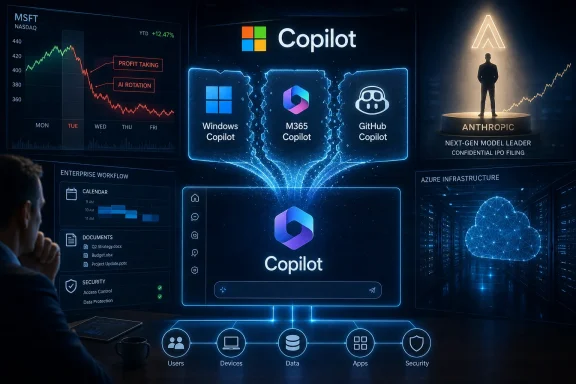
Microsoft shares fell on Tuesday, June 2, 2026, as investors weighed Anthropic’s confidential IPO filing, Microsoft’s sprawling Copilot strategy, and the larger question of whether the next stage of AI growth will reward platform owners, model builders, or infrastructure suppliers. The move was not a simple verdict against Microsoft. It was a reminder that the market’s AI trade has become more selective, more impatient, and less willing to treat every Copilot announcement as proof of inevitable profit. For Windows users and IT departments, the stock wobble matters because it reflects a deeper pressure inside Microsoft: the company must turn AI from a spectacular demo layer into dependable, governable, budgetable software.
The Microsoft story on Tuesday was not that one of the world’s most valuable companies suddenly lost its AI advantage. It was that investors are increasingly asking a harder question: where, exactly, does the next dollar of AI profit come from?
For much of the generative AI boom, Microsoft enjoyed the cleanest narrative in Big Tech. It had the OpenAI partnership, Azure demand, GitHub Copilot, Microsoft 365 Copilot, Windows integration, and a CEO who could plausibly argue that AI would be woven through every layer of the company’s stack. That story was powerful because it was simple: Microsoft owned the enterprise channel, OpenAI owned the breakthrough model brand, and Azure sold the shovels.
But the next phase is messier. Anthropic’s confidential filing for a potential IPO introduces another high-profile frontier AI company into the public-market imagination. The Claude maker is not merely another model vendor; it is one of the few firms investors can plausibly imagine as a giant public AI pure play. If public-market capital begins treating Anthropic as a trillion-dollar-style growth story, Microsoft’s position becomes more complicated.
That is not because Anthropic is purely a threat. Microsoft has embraced a multi-model future, and Claude’s deeper presence in enterprise tools could help Microsoft pitch Copilot as less dependent on any single model family. The pressure comes from the other side of the same argument: if customers want model choice, then Microsoft must prove that its durable value lies in orchestration, governance, identity, data access, and workflow control — not merely in having been early to OpenAI.
The market’s impatience is therefore rational. AI is no longer an abstract transformation story. It is a capital-intensive operating model with real infrastructure costs, real licensing friction, real compliance risk, and real competitors. Microsoft can still be one of the biggest winners, but the easy part of the narrative is over.
That is a subtle but important shift. Private AI companies can be discussed in sweeping terms because their economics are largely opaque. Public companies, by contrast, eventually have to show revenue concentration, gross margins, compute commitments, customer retention, and risk factors in black and white. If Anthropic goes public, the AI software market gets a new measuring stick.
For Microsoft, that could cut both ways. A successful Anthropic listing would validate enterprise demand for advanced AI systems and reinforce the idea that the market is large enough for multiple foundation-model providers. It could also make Microsoft’s multi-model strategy look prescient, especially if Claude becomes a common choice for regulated or safety-conscious workflows.
But a public Anthropic would also sharpen comparison. Investors would ask why Microsoft, despite its distribution advantage, should capture more of the AI value chain than the model labs creating the core intelligence. They would ask whether Copilot is a high-margin software product, a cloud-consumption accelerator, or a costly bundling exercise meant to defend Microsoft 365 from insurgents. They would ask whether Azure’s AI growth is durable customer demand or a compute arms race with thin near-term payoff.
That is the problem with having a strong position across the whole stack. Microsoft can claim optionality, but it also inherits scrutiny from every layer of the market. When model companies are hot, Microsoft must explain its dependence. When chip companies are hot, Microsoft must explain its spending. When enterprise software adoption slows, Microsoft must explain the gap between demos and daily use.
There is GitHub Copilot, Microsoft 365 Copilot, Copilot Chat, Copilot Studio, Security Copilot, Windows Copilot experiences, role-based copilots, app-embedded copilots, and agent-building tools that increasingly blur the line between assistant, workflow engine, chatbot, and automation platform. The branding has done its job too well. Copilot is now less a product than a weather system.
That sprawl is why reports of a unified “One Copilot” platform make strategic sense. Microsoft needs a cleaner AI front door. A single experience that can span GitHub Copilot, Copilot Chat, Microsoft 365 Copilot, and agent-based workflows would reduce confusion for customers who are currently forced to decode licensing tiers, app surfaces, admin controls, and model capabilities.
The danger is that unification can become another abstraction layer over unresolved complexity. Enterprise buyers do not merely want one Copilot icon. They want to know which data is used, which permissions apply, which model answered, which connector ran, which workflow changed a document, which tenant setting governs the action, and which invoice will reflect the usage. A unified interface is useful only if the underlying controls are equally coherent.
That is where Microsoft’s Windows and Microsoft 365 heritage cuts both ways. The company knows how to package complexity for enterprises better than almost anyone. But it also has a long history of turning product families into licensing mazes. AI agents raise the stakes because confusion is not just annoying; it can become a security, compliance, and cost-management problem.
This is Microsoft’s natural terrain. Entra ID, Microsoft Graph, Purview, Intune, Defender, Teams, SharePoint, Exchange, and Windows give Redmond a level of organizational context that pure AI startups cannot easily replicate. A Copilot that understands permissions, document history, meetings, email, source code, tickets, policies, and workflows can be far more valuable than a standalone chatbot with a slightly better answer on a benchmark.
But trust is not automatic. If Copilot summarizes the wrong material, surfaces sensitive data too broadly, or performs an agentic action without sufficient auditability, the problem lands on the CIO’s desk. The more Microsoft pushes Copilot from chat into action, the more it must prove that agentic software can behave like enterprise software: logged, bounded, testable, reversible, and administrable.
That is also why Anthropic matters beyond Wall Street. Claude’s reputation has often been tied to safety, reasoning, and enterprise-friendly positioning. If Microsoft can offer Anthropic models inside its own governed environments, it can tell customers that model choice does not require platform fragmentation. But if customers begin to see the model provider as the source of trust and Microsoft merely as the delivery channel, Redmond’s strategic leverage weakens.
The winning move for Microsoft is not to insist that Copilot is one thing. It is to make Copilot the control plane through which many AI systems can safely operate. That sounds less glamorous than a frontier model announcement, but it is probably where the durable enterprise money is.
Now the same spending is being examined with a colder eye. AI infrastructure is expensive, depreciation is real, power availability is constrained, and model training and inference costs do not magically disappear because a feature is called Copilot. The question is not whether AI demand exists. It plainly does. The question is whether Microsoft can turn that demand into returns that justify the scale and speed of its buildout.
Azure is central to this debate. If Copilot adoption drives meaningful Azure consumption, Microsoft gets paid twice: once through software subscriptions and again through cloud infrastructure. If AI workloads move unevenly, customers optimize usage aggressively, or competitors undercut pricing, the economics become less straightforward.
There is also a timing mismatch. Microsoft must spend ahead of demand because enterprise AI capacity cannot be conjured overnight. Investors, however, can reprice a stock in a single session if they suspect the payoff timeline is stretching. Tuesday’s decline looked like part of that broader reassessment rather than a rejection of Microsoft’s long-term position.
For IT buyers, the spending debate has a practical echo. If Microsoft’s AI economics depend on consumption, metering, premium agents, and add-on licenses, customers should expect pricing models to keep evolving. Copilot will not remain a single neat SKU forever. The more capable it becomes, the more finance teams will demand visibility into who is using it, what they are invoking, and whether productivity gains justify the bill.
This is an area where Microsoft has structural advantages. It already understands government compliance regimes, classified and sovereign cloud requirements, identity management, endpoint control, and procurement cycles. Its pitch is not simply that Copilot can draft a memo. It is that Microsoft can provide AI inside environments that agencies already trust, monitor, and regulate.
But government AI also magnifies the risks. Public-sector deployments will be judged not only by productivity gains but by transparency, accountability, bias controls, data handling, and resilience. A consumer chatbot can be forgiven for weirdness; an AI system embedded in a benefits office, military workflow, or cyber defense operation cannot be treated so casually.
This is where Microsoft’s unified Copilot push could become strategically important. Fragmented AI tools are hard enough for corporations to govern. For government customers, fragmentation can be disqualifying. A single administrative and compliance framework for Copilot-style tools would give Microsoft a stronger story against both startup AI vendors and hyperscaler rivals.
The catch is that government customers move slowly, and public-sector wins often take time to appear in revenue. Investors looking for immediate AI acceleration may not give Microsoft full credit for long-cycle opportunities. Administrators, however, should pay attention. The same controls built for government-grade AI often become the baseline for regulated industries and, eventually, mainstream enterprise deployments.
Microsoft’s challenge is to make AI useful in Windows without turning the OS into a billboard for unfinished services. Users have already shown limited patience for features that feel bolted on, especially when they raise privacy questions or require cloud round-trips for basic tasks. The bar for Windows AI is higher than the bar for a web chatbot because the operating system is where people manage files, credentials, applications, screenshots, local search, and device settings.
The most promising Windows AI features are likely to be quiet. Better search, local summarization, accessibility improvements, smarter troubleshooting, device-aware automation, and app actions that respect user intent could all make Windows feel more modern without forcing every workflow through a chat box. The least promising features are the ones that treat the desktop as an acquisition funnel.
This is why the “One Copilot” idea must be handled carefully. A unified Copilot across Microsoft’s ecosystem could reduce confusion, but Windows users will resist if unification means more prompts, more cloud dependency, or more ambiguity about what is happening on-device. Local AI, clear permissions, and visible controls will matter as much as model quality.
Microsoft’s enterprise customers will ask a parallel set of questions. Can admins disable or scope features by role? Can they audit prompts and outputs where appropriate? Can they prevent sensitive data from flowing into the wrong context? Can they distinguish between consumer Copilot experiences and tenant-governed work experiences? If the answer is yes, Windows becomes a powerful AI endpoint. If the answer is murky, Copilot becomes another policy headache.
That is a very Microsoft argument. It is the argument that made Office durable, that made Azure credible, that made Teams unavoidable, and that made Windows Server and Active Directory foundational for decades of enterprise computing. Microsoft rarely needs to invent the final category shape to dominate it. It needs to integrate, distribute, administer, and persist.
But AI is not simply another software category. It is probabilistic, compute-hungry, fast-moving, and culturally destabilizing inside organizations. A word processor feature can be wrong in obvious ways; an AI agent can be wrong in ways that look plausible, propagate quickly, and touch systems beyond the document where it began. That changes the burden of proof.
Microsoft’s next task is therefore not to announce more Copilots. It is to make Copilot feel less like a collection of experiments and more like infrastructure. That means clearer product boundaries, clearer licensing, clearer logs, clearer model routing, clearer admin controls, and clearer evidence that the software saves time without creating invisible risk.
If Microsoft can do that, Anthropic’s rise becomes less threatening. Model competition would strengthen Microsoft’s platform by giving customers choice inside a trusted shell. If Microsoft cannot do that, model competition becomes a wedge that lets customers bypass Copilot and assemble their own AI stacks from foundation-model APIs, workflow tools, and vertical applications.
A modest or even sharp one-day move in Microsoft shares should not be overread. This is still a company with enormous cloud scale, unmatched enterprise distribution, deep developer reach, and one of the most aggressive AI roadmaps in the industry. But the stock reaction is useful because it reveals what investors are beginning to penalize: complexity, uncertain payback periods, and the possibility that AI value may be captured by different players than originally assumed.
Anthropic’s IPO path is part of that repricing. So is the reported One Copilot effort. So are concerns about AI spending, government opportunity, agent governance, and the real-world adoption curve for Microsoft 365 Copilot. These are not separate stories. They are all pieces of the same question: can Microsoft convert AI from a strategic posture into a disciplined business system?
That question matters more to WindowsForum readers than the daily ticker would suggest. If Microsoft feels pressure to prove AI monetization quickly, users may see more aggressive Copilot placement, more bundled features, more licensing changes, and faster movement from optional assistant to default workflow layer. If Microsoft instead proves that governance and usability drive adoption, customers may get a more mature AI platform rather than another wave of half-integrated branding.
 Wall Street Is No Longer Buying AI by the Pound
The Microsoft story on Tuesday was not that one of the world’s most valuable companies suddenly lost its AI advantage. It was that investors are increasingly asking a harder question: where, exactly, does the next dollar of AI profit come from?For much of the generative AI boom, Microsoft enjoyed the cleanest narrative in Big Tech. It had the OpenAI partnership, Azure demand, GitHub Copilot, Microsoft 365 Copilot, Windows integration, and a CEO who could plausibly argue that AI would be woven through every layer of the company’s stack. That story was powerful because it was simple: Microsoft owned the enterprise channel, OpenAI owned the breakthrough model brand, and Azure sold the shovels.
But the next phase is messier. Anthropic’s confidential filing for a potential IPO introduces another high-profile frontier AI company into the public-market imagination. The Claude maker is not merely another model vendor; it is one of the few firms investors can plausibly imagine as a giant public AI pure play. If public-market capital begins treating Anthropic as a trillion-dollar-style growth story, Microsoft’s position becomes more complicated.
That is not because Anthropic is purely a threat. Microsoft has embraced a multi-model future, and Claude’s deeper presence in enterprise tools could help Microsoft pitch Copilot as less dependent on any single model family. The pressure comes from the other side of the same argument: if customers want model choice, then Microsoft must prove that its durable value lies in orchestration, governance, identity, data access, and workflow control — not merely in having been early to OpenAI.
The market’s impatience is therefore rational. AI is no longer an abstract transformation story. It is a capital-intensive operating model with real infrastructure costs, real licensing friction, real compliance risk, and real competitors. Microsoft can still be one of the biggest winners, but the easy part of the narrative is over.
Anthropic’s IPO Filing Changes the Center of Gravity
Anthropic’s confidential draft IPO paperwork is not an IPO in the retail-investor sense. There is no public S-1 to dissect, no share count, no offering price, and no guaranteed listing date. But the filing matters because it begins the machinery that can turn Claude from a privately funded rival into a publicly valued benchmark.That is a subtle but important shift. Private AI companies can be discussed in sweeping terms because their economics are largely opaque. Public companies, by contrast, eventually have to show revenue concentration, gross margins, compute commitments, customer retention, and risk factors in black and white. If Anthropic goes public, the AI software market gets a new measuring stick.
For Microsoft, that could cut both ways. A successful Anthropic listing would validate enterprise demand for advanced AI systems and reinforce the idea that the market is large enough for multiple foundation-model providers. It could also make Microsoft’s multi-model strategy look prescient, especially if Claude becomes a common choice for regulated or safety-conscious workflows.
But a public Anthropic would also sharpen comparison. Investors would ask why Microsoft, despite its distribution advantage, should capture more of the AI value chain than the model labs creating the core intelligence. They would ask whether Copilot is a high-margin software product, a cloud-consumption accelerator, or a costly bundling exercise meant to defend Microsoft 365 from insurgents. They would ask whether Azure’s AI growth is durable customer demand or a compute arms race with thin near-term payoff.
That is the problem with having a strong position across the whole stack. Microsoft can claim optionality, but it also inherits scrutiny from every layer of the market. When model companies are hot, Microsoft must explain its dependence. When chip companies are hot, Microsoft must explain its spending. When enterprise software adoption slows, Microsoft must explain the gap between demos and daily use.
Copilot Has Become Microsoft’s Brand and Its Burden
Copilot began as an elegant label. It suggested augmentation rather than replacement, assistance rather than automation, and it gave Microsoft a way to package generative AI for developers, office workers, security teams, and consumers. Then the name spread everywhere.There is GitHub Copilot, Microsoft 365 Copilot, Copilot Chat, Copilot Studio, Security Copilot, Windows Copilot experiences, role-based copilots, app-embedded copilots, and agent-building tools that increasingly blur the line between assistant, workflow engine, chatbot, and automation platform. The branding has done its job too well. Copilot is now less a product than a weather system.
That sprawl is why reports of a unified “One Copilot” platform make strategic sense. Microsoft needs a cleaner AI front door. A single experience that can span GitHub Copilot, Copilot Chat, Microsoft 365 Copilot, and agent-based workflows would reduce confusion for customers who are currently forced to decode licensing tiers, app surfaces, admin controls, and model capabilities.
The danger is that unification can become another abstraction layer over unresolved complexity. Enterprise buyers do not merely want one Copilot icon. They want to know which data is used, which permissions apply, which model answered, which connector ran, which workflow changed a document, which tenant setting governs the action, and which invoice will reflect the usage. A unified interface is useful only if the underlying controls are equally coherent.
That is where Microsoft’s Windows and Microsoft 365 heritage cuts both ways. The company knows how to package complexity for enterprises better than almost anyone. But it also has a long history of turning product families into licensing mazes. AI agents raise the stakes because confusion is not just annoying; it can become a security, compliance, and cost-management problem.
The Real Copilot Battle Is Over Trust, Not Chat
Microsoft’s AI challenge is often framed as a battle over the best model. That misses the enterprise reality. Most organizations will not choose their AI stack on leaderboard performance alone; they will choose it based on trust, integration, governance, and cost predictability.This is Microsoft’s natural terrain. Entra ID, Microsoft Graph, Purview, Intune, Defender, Teams, SharePoint, Exchange, and Windows give Redmond a level of organizational context that pure AI startups cannot easily replicate. A Copilot that understands permissions, document history, meetings, email, source code, tickets, policies, and workflows can be far more valuable than a standalone chatbot with a slightly better answer on a benchmark.
But trust is not automatic. If Copilot summarizes the wrong material, surfaces sensitive data too broadly, or performs an agentic action without sufficient auditability, the problem lands on the CIO’s desk. The more Microsoft pushes Copilot from chat into action, the more it must prove that agentic software can behave like enterprise software: logged, bounded, testable, reversible, and administrable.
That is also why Anthropic matters beyond Wall Street. Claude’s reputation has often been tied to safety, reasoning, and enterprise-friendly positioning. If Microsoft can offer Anthropic models inside its own governed environments, it can tell customers that model choice does not require platform fragmentation. But if customers begin to see the model provider as the source of trust and Microsoft merely as the delivery channel, Redmond’s strategic leverage weakens.
The winning move for Microsoft is not to insist that Copilot is one thing. It is to make Copilot the control plane through which many AI systems can safely operate. That sounds less glamorous than a frontier model announcement, but it is probably where the durable enterprise money is.
AI Spending Has Turned From Signal to Suspicion
For the last two years, massive AI capital expenditure was treated as proof of seriousness. If a company was buying GPUs, building data centers, and expanding cloud regions, investors assumed demand would arrive. Microsoft benefited enormously from that logic.Now the same spending is being examined with a colder eye. AI infrastructure is expensive, depreciation is real, power availability is constrained, and model training and inference costs do not magically disappear because a feature is called Copilot. The question is not whether AI demand exists. It plainly does. The question is whether Microsoft can turn that demand into returns that justify the scale and speed of its buildout.
Azure is central to this debate. If Copilot adoption drives meaningful Azure consumption, Microsoft gets paid twice: once through software subscriptions and again through cloud infrastructure. If AI workloads move unevenly, customers optimize usage aggressively, or competitors undercut pricing, the economics become less straightforward.
There is also a timing mismatch. Microsoft must spend ahead of demand because enterprise AI capacity cannot be conjured overnight. Investors, however, can reprice a stock in a single session if they suspect the payoff timeline is stretching. Tuesday’s decline looked like part of that broader reassessment rather than a rejection of Microsoft’s long-term position.
For IT buyers, the spending debate has a practical echo. If Microsoft’s AI economics depend on consumption, metering, premium agents, and add-on licenses, customers should expect pricing models to keep evolving. Copilot will not remain a single neat SKU forever. The more capable it becomes, the more finance teams will demand visibility into who is using it, what they are invoking, and whether productivity gains justify the bill.
The Government Angle Is Bigger Than Procurement
Microsoft’s AI ambitions are not limited to commercial productivity software. Government opportunities are becoming a larger part of the story, especially as agencies modernize cloud infrastructure, automate administrative work, and evaluate AI for defense, intelligence, cybersecurity, and public services.This is an area where Microsoft has structural advantages. It already understands government compliance regimes, classified and sovereign cloud requirements, identity management, endpoint control, and procurement cycles. Its pitch is not simply that Copilot can draft a memo. It is that Microsoft can provide AI inside environments that agencies already trust, monitor, and regulate.
But government AI also magnifies the risks. Public-sector deployments will be judged not only by productivity gains but by transparency, accountability, bias controls, data handling, and resilience. A consumer chatbot can be forgiven for weirdness; an AI system embedded in a benefits office, military workflow, or cyber defense operation cannot be treated so casually.
This is where Microsoft’s unified Copilot push could become strategically important. Fragmented AI tools are hard enough for corporations to govern. For government customers, fragmentation can be disqualifying. A single administrative and compliance framework for Copilot-style tools would give Microsoft a stronger story against both startup AI vendors and hyperscaler rivals.
The catch is that government customers move slowly, and public-sector wins often take time to appear in revenue. Investors looking for immediate AI acceleration may not give Microsoft full credit for long-cycle opportunities. Administrators, however, should pay attention. The same controls built for government-grade AI often become the baseline for regulated industries and, eventually, mainstream enterprise deployments.
Windows Is the Quiet Front in the AI War
For Windows enthusiasts, the Microsoft stock story can seem distant from the desktop. It is not. The fight over Copilot eventually lands in the operating system, because Windows remains Microsoft’s largest daily surface for users who do not think of themselves as “AI customers.”Microsoft’s challenge is to make AI useful in Windows without turning the OS into a billboard for unfinished services. Users have already shown limited patience for features that feel bolted on, especially when they raise privacy questions or require cloud round-trips for basic tasks. The bar for Windows AI is higher than the bar for a web chatbot because the operating system is where people manage files, credentials, applications, screenshots, local search, and device settings.
The most promising Windows AI features are likely to be quiet. Better search, local summarization, accessibility improvements, smarter troubleshooting, device-aware automation, and app actions that respect user intent could all make Windows feel more modern without forcing every workflow through a chat box. The least promising features are the ones that treat the desktop as an acquisition funnel.
This is why the “One Copilot” idea must be handled carefully. A unified Copilot across Microsoft’s ecosystem could reduce confusion, but Windows users will resist if unification means more prompts, more cloud dependency, or more ambiguity about what is happening on-device. Local AI, clear permissions, and visible controls will matter as much as model quality.
Microsoft’s enterprise customers will ask a parallel set of questions. Can admins disable or scope features by role? Can they audit prompts and outputs where appropriate? Can they prevent sensitive data from flowing into the wrong context? Can they distinguish between consumer Copilot experiences and tenant-governed work experiences? If the answer is yes, Windows becomes a powerful AI endpoint. If the answer is murky, Copilot becomes another policy headache.
Microsoft’s Best Argument Is Also Its Hardest One to Prove
The strongest bullish case for Microsoft is that AI will not be won by the company with the flashiest model. It will be won by the company that embeds AI into the work people already do, behind the permissions they already use, connected to the data they already manage, and billed through contracts they already understand.That is a very Microsoft argument. It is the argument that made Office durable, that made Azure credible, that made Teams unavoidable, and that made Windows Server and Active Directory foundational for decades of enterprise computing. Microsoft rarely needs to invent the final category shape to dominate it. It needs to integrate, distribute, administer, and persist.
But AI is not simply another software category. It is probabilistic, compute-hungry, fast-moving, and culturally destabilizing inside organizations. A word processor feature can be wrong in obvious ways; an AI agent can be wrong in ways that look plausible, propagate quickly, and touch systems beyond the document where it began. That changes the burden of proof.
Microsoft’s next task is therefore not to announce more Copilots. It is to make Copilot feel less like a collection of experiments and more like infrastructure. That means clearer product boundaries, clearer licensing, clearer logs, clearer model routing, clearer admin controls, and clearer evidence that the software saves time without creating invisible risk.
If Microsoft can do that, Anthropic’s rise becomes less threatening. Model competition would strengthen Microsoft’s platform by giving customers choice inside a trusted shell. If Microsoft cannot do that, model competition becomes a wedge that lets customers bypass Copilot and assemble their own AI stacks from foundation-model APIs, workflow tools, and vertical applications.
The Tuesday Sell-Off Was a Warning, Not a Verdict
The market did not discover on Tuesday that Microsoft has competitors. It discovered, or at least remembered, that the AI boom is entering a phase where product clarity and financial proof matter more than narrative momentum.A modest or even sharp one-day move in Microsoft shares should not be overread. This is still a company with enormous cloud scale, unmatched enterprise distribution, deep developer reach, and one of the most aggressive AI roadmaps in the industry. But the stock reaction is useful because it reveals what investors are beginning to penalize: complexity, uncertain payback periods, and the possibility that AI value may be captured by different players than originally assumed.
Anthropic’s IPO path is part of that repricing. So is the reported One Copilot effort. So are concerns about AI spending, government opportunity, agent governance, and the real-world adoption curve for Microsoft 365 Copilot. These are not separate stories. They are all pieces of the same question: can Microsoft convert AI from a strategic posture into a disciplined business system?
That question matters more to WindowsForum readers than the daily ticker would suggest. If Microsoft feels pressure to prove AI monetization quickly, users may see more aggressive Copilot placement, more bundled features, more licensing changes, and faster movement from optional assistant to default workflow layer. If Microsoft instead proves that governance and usability drive adoption, customers may get a more mature AI platform rather than another wave of half-integrated branding.
The Copilot Era Now Has Receipts to Produce
Microsoft’s Tuesday problem can be reduced to a few concrete realities that matter for investors, admins, developers, and Windows users alike.- Microsoft’s share-price decline reflected a broader reassessment of where AI profits will accrue, not a sudden collapse in the company’s competitive position.
- Anthropic’s confidential IPO filing gives investors another potential pure-play AI benchmark and increases pressure on Microsoft to explain how much value belongs to platforms versus model makers.
- A unified “One Copilot” strategy could reduce customer confusion, but only if Microsoft also simplifies governance, licensing, model routing, and administrative controls.
- Enterprise adoption will depend less on chatbot novelty than on whether Copilot can act safely across Microsoft 365, GitHub, Windows, Azure, and third-party systems.
- Microsoft’s AI spending remains both a strategic advantage and a margin concern, because infrastructure must be built before returns are fully visible.
- Windows users should expect AI features to become more deeply embedded, but the success of that push will depend on privacy, local capability, and admin control rather than branding.
References
- Primary source: Dailyhunt
Published: 2026-06-03T03:12:16.319218
What Is Going On With Microsoft On Tuesday? | Dailyhunt
Microsoft Corp(NASDAQ:MSFT) traded lower on Tuesday as investors took profits and rotated within the large-cap technology sector, even as broader tech stocks mom.dailyhunt.in - Related coverage: techradar.com
From code-first to intent-first: Microsoft Build 2026 could be the end of programming as we know it | TechRadar
Redefining what it means to be a developer with agentic AIwww.techradar.com - Official source: support.microsoft.com
Get started with Workflows in Microsoft 365 Copilot | Microsoft Support
Learn how you can automate tasks with Workflows--building, testing, monitoring, and managing your flows with Microsoft 365 Copilot.support.microsoft.com - Official source: learn.microsoft.com
Microsoft 365 Copilot Agent Usage Report - Microsoft 365 admin | Microsoft Learn
The Microsoft 365 Copilot Agent usage report helps admins track agent adoption and activity. Discover trends and optimize agent deployment in your organization.learn.microsoft.com - Official source: developer.microsoft.com
Microsoft 365 Copilot | Extend and Customize Copilot
Extend, enrich, and customize Microsoft Microsoft 365 Copilot. Explore Copilot extensibility options such as agents, API plugins, and Copilot connectors to expand AI-powered productivity, skills, and creativity.developer.microsoft.com - Official source: microsoft.com
AI in the Enterprise: How People Use M365 Copilot Chat - Microsoft Research
M365 Copilot is used every week by millions of people across more than a million companies around the world as part of their workflows. Uniquely positioned in the AI landscape given its near-exclusive use for work purposes, M365 Copilot can offer a clear picture of how people use AI for work and...www.microsoft.com
- Official source: devblogs.microsoft.com
Announcing the public preview of the Microsoft 365 Copilot Agent Evaluations tool - Microsoft 365 Developer Blog
The Microsoft 365 Copilot Agent Evaluations tool helps developers measure and improve the quality of agents they build for Microsoft 365 Copilot.devblogs.microsoft.com - Related coverage: windowscentral.com
Microsoft 365 Copilot Chat summarized confidential emails | Windows Central
Microsoft confirms a Copilot bug that exposed and summarized confidential emails, bypassing security policies.www.windowscentral.com - Official source: microsoft.github.io

FastTrack for Microsoft 365 Copilot
Open-source tools, agent templates, analytics dashboards, and strategic guidance from Microsoft FastTrack to accelerate your Microsoft 365 Copilot journey.
microsoft.github.io
- Related coverage: tomshardware.com
Expert maps out more than 80 different Microsoft Copilot products, but there may be more than 100 — 'What happens when you name everything Copilot,' an AI consultant mapped out the myriad products | Tom's Hardware
An artificial intelligence aficionado has unearthed and charted 80 Copilot products that Microsoft has developed and marketed.www.tomshardware.com - Related coverage: itpro.com
Satya Nadella says “our multi-model approach goes beyond choice’ as Microsoft adds Claude AI models to 365 Copilot | IT Pro
Users can choose between both OpenAI and Anthropic models in Microsoft 365 Copilotwww.itpro.com - Official source: cdn-dynmedia-1.microsoft.com
- Official source: techcommunity.microsoft.com
- Related coverage: benzinga.com
What Is Going On With Microsoft On Tuesday? - Microsoft (NASDAQ:MSFT) - Benzinga
Microsoft stock slips 3.66% to $443.66 on profit-taking as core partner Anthropic files for a confidential trillion-dollar IPO.www.benzinga.com - Related coverage: gurufocus.com
Microsoft Stock Sinks After Rare Stifel 'Downgrade' Cites AI Mar
Microsoft (MSFT) shares slid about 5% Thursday after Stifel downgraded the software giant to Hold from Buy, citing cloud supply constraints, rising investment nwww.gurufocus.com - Related coverage: in.investing.com
Stifel issues rare Microsoft downgrade on cloud and AI concerns By Investing.com
Stifel issues rare Microsoft downgrade on cloud and AI concernsin.investing.com - Related coverage: tradersunion.com
Surge in Microsoft AI spending and Azure slowdown — Microsoft stock drops 1.61%
Microsoft trades at $423.24 today, down 1.61%. Persistent selling pressure puts the stock below key averages and resistance.tradersunion.com - Related coverage: insiderfinance.io
Microsoft Stock Downgrade Tests AI Lead | InsiderFinance
Microsoft stock downgrade by Stifel cited Azure supply limits, elevated capex and AI competition, prompting traders to reassess re-rating risk.www.insiderfinance.io