

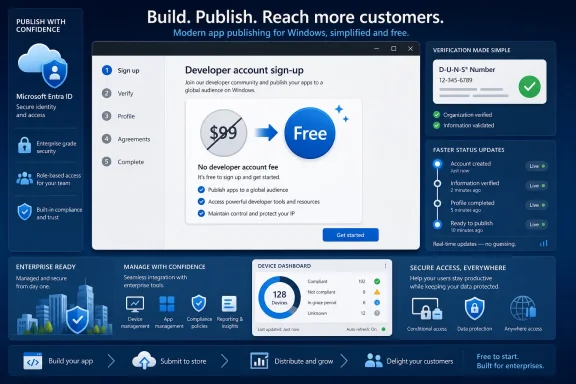
Microsoft announced on May 7, 2026, that company developer accounts for the Microsoft Store are now free in supported onboarding flows, removing the previous $99 registration fee while adding Microsoft Entra ID sign-up and a faster verification process for organizations publishing Windows apps. The move sounds administrative, but it is really about Microsoft lowering the cost of legitimacy for Windows software distribution. Redmond is trying to make the Store feel less like a consumer app mall and more like a credible publishing rail for desktop software, internal tooling, and enterprise-managed deployment. The question is not whether $99 was bankrupting software companies; it is why Microsoft waited this long to remove a symbolic obstacle from a Store that still needs developer trust more than developer money.
For years, the Microsoft Store occupied an odd place in the Windows ecosystem. It was preinstalled, heavily promoted, and increasingly capable, but it never became the default place where many Windows users expected to find serious desktop software. Windows trained generations of users to download installers from vendor websites, GitHub releases, package managers, or corporate portals, and that habit has been difficult to unwind.
The newly free company account is therefore less about direct savings than about friction. A one-time $99 fee is not a major expense for a software vendor, an ISV, or an enterprise IT department, but it is an approval step, a procurement line item, and a reason for a developer or product manager to postpone the experiment. Microsoft is removing one of the small bureaucratic excuses that kept organizations from trying the Store in the first place.
That matters because Microsoft has spent the last several years repositioning the Store away from its Windows 8-era identity. The Store is no longer just a place for UWP apps or lightweight consumer downloads. Microsoft now wants it to be a distribution surface for Win32 apps, .NET WPF and WinForms applications, PWAs, Electron apps, .NET MAUI projects, UWP packages, and software that does not need to be rewritten to participate.
The free registration announcement fits that broader rehabilitation campaign. Microsoft is not asking organizations to adopt a new app model first and publish later. It is saying: bring the software you already have, verify your business, and let the Store become another channel.
Developer programs send signals. Apple’s annual developer fee signals a tightly controlled, commercially mature marketplace. Google’s one-time Play registration fee signals broad access with some identity friction. Microsoft’s old model sat awkwardly between them: cheaper than Apple, but still charging companies to help populate a store that Microsoft very much needed to populate.
That asymmetry was hard to ignore. If Microsoft wants the Store to compete with direct downloads and package managers, it has to make the Store feel easier, not merely safer. A vendor can already publish an MSI or EXE from its own website. A developer can already ship through GitHub. An enterprise can already deploy with Intune, winget, Configuration Manager, or any number of software distribution tools. The Store has to justify itself by reducing hassle, not adding another portal with another fee.
Removing the fee also aligns company accounts with Microsoft’s earlier move to make individual developer registration free. That earlier change lowered the barrier for solo developers and hobbyists; this one closes the obvious gap for organizations. Microsoft can now tell a cleaner story: publishing to the Microsoft Store does not begin with a charge.
The result is not a revolution, but it is a better opening argument. Microsoft is effectively saying that the Store’s value should be proven through reach, trust, distribution, and management integration, not extracted at the door.
Anyone who has administered cloud tenants, app registrations, certificates, developer portals, or vendor dashboards knows the pattern. A well-meaning engineer creates an account with a personal Microsoft account or a shared mailbox, publishes something important, and moves on. Months or years later, IT is trying to determine who owns the asset, how access is controlled, and why recovery depends on a person who no longer works there.
By letting organizations use work accounts during sign-up, Microsoft is pulling Store onboarding into the same identity plane that already governs much of Microsoft 365, Azure, Intune, and enterprise access control. That is not glamorous, but it is exactly the sort of plumbing that makes a platform more acceptable to serious IT departments.
It also changes how companies can think about Store publishing. A company developer account can become part of the organization’s governed estate, rather than a side-channel created by a product team. The closer it sits to Entra ID, the easier it becomes to imagine policy, access reviews, conditional access, lifecycle management, and audit expectations surrounding Store operations.
Microsoft’s challenge is that identity integration alone does not guarantee clean governance. Entra ID can help anchor the account, but organizations still need internal ownership, role hygiene, and operational discipline. Still, the direction is right: Store publishing should not feel like a consumer account flow with a corporate logo attached.
That is the part developers will actually feel. A fee is annoying once. Bad verification is annoying for days.
Microsoft is recommending that companies have their D-U-N-S Number ready before starting, which tells us where the company wants the process to go. If Microsoft can use a business identifier to retrieve and validate company information quickly, onboarding becomes less dependent on manual document review. If a company does not have a D-U-N-S Number or cannot use one cleanly, it can upload business documents instead, but Microsoft warns that manual review can take longer.
This is a reasonable tradeoff, but it also reveals the tension in any marketplace that wants both openness and trust. Microsoft wants more apps in the Store, but it does not want the Store flooded with impersonators, malware operators, or fake companies publishing under plausible names. Verification is the toll booth that remains after the monetary toll disappears.
The details matter for smaller firms, international companies, and internal development teams that may not have all corporate documentation at hand. A startup may move quickly, but its registry documents, domain ownership records, tax filings, and corporate contact details may not line up neatly. A large enterprise may have the documents, but the person creating the account may not know where to get them. Microsoft’s improved flow can reduce confusion, but it cannot eliminate the administrative reality of proving a business exists.
The modern app store debate has been dominated by commissions, payment control, anti-steering rules, and regulatory fights. Apple and Google built enormously profitable mobile ecosystems around store payment flows and developer fees. Microsoft, by contrast, has less leverage on Windows because Windows software distribution never became store-exclusive. That weakness gives Microsoft room to be generous.
For non-game Windows apps, the Store can function more like a trusted catalog, update channel, and acquisition surface than a mandatory cash register. That is a meaningful distinction for developers selling subscriptions, professional tools, productivity software, or enterprise apps. They can meet users in the Store without necessarily surrendering their billing relationship.
This is also where Microsoft’s competitive posture becomes interesting. The company is not simply copying the mobile app store model. It is using the openness of Windows as a selling point while trying to borrow some of the trust and convenience users associate with centralized stores. The pitch is: keep your commerce, keep your app architecture, gain discoverability and distribution.
That pitch is strongest for vendors who already have a Windows business but have ignored the Store because it seemed unnecessary. If Microsoft can make publishing cheap, identity-aware, and operationally cleaner, the Store becomes easier to justify as an additional channel. It does not have to replace direct downloads to become useful.
That history still matters because developers remember platform dead ends. They remember Silverlight, Windows Phone, UWP confusion, packaging requirements, and shifting guidance around what “modern” Windows apps were supposed to be. Even when Microsoft improves the Store, it has to fight the suspicion that this is another distribution strategy that might change direction later.
The current Store is much more pragmatic. Support for classic desktop app types acknowledges the reality that Windows remains a Win32-first software universe in many places. Enterprise support through Intune acknowledges that business software distribution is as much about management as discovery. Free signing, hosted distribution, and automatic updates are practical benefits that map to real operational work.
But trust is cumulative. Developers will not judge Microsoft only by this announcement; they will judge the Store by submission reliability, review consistency, analytics quality, update speed, policy clarity, customer support, and whether users actually install apps from it. Removing the company fee is useful, but it is one brick in a much larger reconstruction project.
The Store’s support for enterprise distribution through Intune gives organizations a way to think about app availability beyond public consumer discovery. A company can publish, manage, and distribute software in ways that align with modern endpoint management. That does not replace every existing deployment pipeline, but it adds a Microsoft-native path that may appeal to organizations standardizing around Intune and Entra ID.
This is where the Store can become less of a storefront and more of a supply-chain component. Software distribution is increasingly a security problem: who built the app, who signed it, where did it come from, how is it updated, and can the organization verify the chain of custody? Microsoft wants the Store to answer some of those questions for Windows apps.
The pitch lands differently in enterprises than it does with consumers. A consumer may care that an app is easy to find and install. An admin cares whether it updates cleanly, avoids ad hoc download sources, integrates with device management, and reduces the number of untrusted installers floating around the fleet. If Store publishing becomes easier for vendors, it may eventually make Store-based deployment more realistic for IT.
There is still a cultural obstacle. Many admins have spent years disabling, restricting, or ignoring the Microsoft Store in managed Windows environments because the consumer-facing Store was seen as a distraction or risk. Microsoft has to persuade those admins that the Store is not merely a shopping app but part of a controlled software delivery strategy.
That will be a hard balance. If onboarding is too strict, developers complain that the process is opaque and slow. If it is too loose, users encounter clones, abandoned listings, misleading publishers, and low-quality software. Microsoft needs volume, but it needs credible volume.
The company’s emphasis on business-domain email addresses is a small but telling detail. Microsoft is trying to reduce ambiguity early in the process. If the account contact uses an address tied to the company’s domain, verification has one less mismatch to resolve. If the developer signs up with a generic or unrelated domain, Microsoft may need more proof that the person actually represents the organization.
This is mundane identity hygiene, but it is also marketplace hygiene. The Store’s reputation depends on users believing that publisher names mean something. If a listing says it comes from a known company, Microsoft has to make sure that claim is true. Free registration cannot become free impersonation.
The risk is that developers will still judge the system by edge cases. If a legitimate company gets stuck because its legal name differs from its brand name, or because its D-U-N-S data is stale, or because a regional business registry does not match Microsoft’s expectations, the “faster onboarding” promise will feel hollow. Microsoft’s support process will matter as much as its automation.
This is the Store’s central problem. Microsoft can make publishing easy, but it still has to make the Store a habit. On mobile platforms, the store is the default route because the operating system makes it so. On Windows, the browser remains the default route for software discovery, and enterprise users often receive software through managed channels without visiting a storefront at all.
For developers, that means the Store should be evaluated as one channel among several. It may improve trust for users wary of random downloads. It may simplify updating. It may help with discoverability for certain categories. It may support enterprise deployment. But it will not automatically deliver the kind of app-store economics that mobile developers expect.
Microsoft knows this, which is why its pitch has shifted toward low-friction participation. If developers do not have to rewrite their app, surrender their commerce system, or pay an account fee, then the hurdle becomes smaller. Publishing to the Store can be treated as a relatively low-risk addition to an existing distribution strategy.
That is sensible. It also means Microsoft’s success metric should not be whether every Windows developer abandons direct downloads. The better question is whether more reputable Windows software becomes available through a Microsoft-verified, update-capable channel. If the answer becomes yes, the Store gets more useful even without becoming the only path.
That comparison is fair up to a point. Windows remains the most open mainstream desktop operating system by distribution norms, and Microsoft’s Store policies for non-game apps are more permissive than the mobile app store model that regulators have spent years scrutinizing. Developers who want to keep their payment systems have a strong reason to appreciate that flexibility.
But Microsoft’s openness is also a function of weaker control. Apple can charge more and impose more because iOS distribution is structurally centralized. Microsoft cannot plausibly force all Windows software through the Store without breaking decades of ecosystem expectations and provoking enterprise revolt. Its generosity is partly strategic virtue and partly market necessity.
That does not make it meaningless. Users and developers benefit when a platform chooses a lighter-touch model, whatever the reason. But it should temper the applause. Microsoft is not dismantling a toll booth at the center of Windows software distribution; it is trying to persuade more traffic to take a road many drivers still bypass.
The most credible version of Microsoft’s argument is not that the Store is morally superior to mobile app stores. It is that Windows can offer a store without becoming a walled garden. That is a better story for the PC, and one Microsoft should have leaned into earlier.
Microsoft has made progress on developer tooling around the Store, including command-line capabilities and improved operational features. Those matter because professional developers and IT teams do not want to live inside a web portal for every task. The more Store publishing can be automated, integrated, and monitored, the more viable it becomes for serious workflows.
There is also a support burden. If Microsoft wants companies to treat Store publishing as part of their distribution strategy, the company needs support channels that understand business urgency. A blocked verification or stalled update is not just an inconvenience when it affects a production app or a release campaign. The Store cannot be both enterprise-relevant and consumer-support casual.
The best version of this future is a Store where developers can publish conventional Windows apps with minimal ceremony, organizations can govern access through Entra ID, admins can deploy through Intune, and users can trust that a publisher is who it claims to be. That is not flashy. It is plumbing. But Windows has always won by having good plumbing beneath messy freedom.
The company now has to keep those promises in practice. A trusted Store cannot be merely free to enter. It has to be reliable, well-policed, transparent, and worth using.
That is especially important as Windows software supply-chain concerns become more visible. Users are increasingly trained to distrust random downloads, unsigned installers, fake ads, spoofed domains, and search-engine traps. A well-run Store can help, but only if the Store itself avoids becoming another cluttered marketplace where legitimacy is hard to distinguish from imitation.
Microsoft has an advantage here because it controls Windows, Defender reputation systems, signing infrastructure, identity platforms, and management tooling. It can connect dots that third-party download sites cannot. The company’s problem is not capability; it is consistency.
If Microsoft wants the Store to become the safer default for Windows software, it must make the safe path the easy path. This announcement removes one small obstacle from that path. Many more remain.
Source: Neowin Microsoft makes company developer accounts free for the Microsoft Store
 Microsoft Finally Stops Charging Companies for the Privilege of Showing Up
For years, the Microsoft Store occupied an odd place in the Windows ecosystem. It was preinstalled, heavily promoted, and increasingly capable, but it never became the default place where many Windows users expected to find serious desktop software. Windows trained generations of users to download installers from vendor websites, GitHub releases, package managers, or corporate portals, and that habit has been difficult to unwind.The newly free company account is therefore less about direct savings than about friction. A one-time $99 fee is not a major expense for a software vendor, an ISV, or an enterprise IT department, but it is an approval step, a procurement line item, and a reason for a developer or product manager to postpone the experiment. Microsoft is removing one of the small bureaucratic excuses that kept organizations from trying the Store in the first place.
That matters because Microsoft has spent the last several years repositioning the Store away from its Windows 8-era identity. The Store is no longer just a place for UWP apps or lightweight consumer downloads. Microsoft now wants it to be a distribution surface for Win32 apps, .NET WPF and WinForms applications, PWAs, Electron apps, .NET MAUI projects, UWP packages, and software that does not need to be rewritten to participate.
The free registration announcement fits that broader rehabilitation campaign. Microsoft is not asking organizations to adopt a new app model first and publish later. It is saying: bring the software you already have, verify your business, and let the Store become another channel.
The Fee Was Small, but the Signal Was Large
It is tempting to dismiss this as a minor pricing change. Company developer accounts previously carried a one-time fee, not a recurring subscription, and $99 is a rounding error for most commercial software shops. But platform economics are rarely only about the invoice.Developer programs send signals. Apple’s annual developer fee signals a tightly controlled, commercially mature marketplace. Google’s one-time Play registration fee signals broad access with some identity friction. Microsoft’s old model sat awkwardly between them: cheaper than Apple, but still charging companies to help populate a store that Microsoft very much needed to populate.
That asymmetry was hard to ignore. If Microsoft wants the Store to compete with direct downloads and package managers, it has to make the Store feel easier, not merely safer. A vendor can already publish an MSI or EXE from its own website. A developer can already ship through GitHub. An enterprise can already deploy with Intune, winget, Configuration Manager, or any number of software distribution tools. The Store has to justify itself by reducing hassle, not adding another portal with another fee.
Removing the fee also aligns company accounts with Microsoft’s earlier move to make individual developer registration free. That earlier change lowered the barrier for solo developers and hobbyists; this one closes the obvious gap for organizations. Microsoft can now tell a cleaner story: publishing to the Microsoft Store does not begin with a charge.
The result is not a revolution, but it is a better opening argument. Microsoft is effectively saying that the Store’s value should be proven through reach, trust, distribution, and management integration, not extracted at the door.
Entra ID Turns Store Publishing Into an IT-Governed Workflow
The more consequential part of the announcement may be Microsoft Entra ID support during sign-up. For organizations, identity is not a convenience feature. It is the difference between a developer account that belongs to the company and one that becomes an orphaned asset when an employee leaves.Anyone who has administered cloud tenants, app registrations, certificates, developer portals, or vendor dashboards knows the pattern. A well-meaning engineer creates an account with a personal Microsoft account or a shared mailbox, publishes something important, and moves on. Months or years later, IT is trying to determine who owns the asset, how access is controlled, and why recovery depends on a person who no longer works there.
By letting organizations use work accounts during sign-up, Microsoft is pulling Store onboarding into the same identity plane that already governs much of Microsoft 365, Azure, Intune, and enterprise access control. That is not glamorous, but it is exactly the sort of plumbing that makes a platform more acceptable to serious IT departments.
It also changes how companies can think about Store publishing. A company developer account can become part of the organization’s governed estate, rather than a side-channel created by a product team. The closer it sits to Entra ID, the easier it becomes to imagine policy, access reviews, conditional access, lifecycle management, and audit expectations surrounding Store operations.
Microsoft’s challenge is that identity integration alone does not guarantee clean governance. Entra ID can help anchor the account, but organizations still need internal ownership, role hygiene, and operational discipline. Still, the direction is right: Store publishing should not feel like a consumer account flow with a corporate logo attached.
Verification Is the Real Price of Admission
Free does not mean frictionless. Microsoft is still asking organizations to prove they are real organizations, and that is where the new onboarding flow becomes important. The company says the redesigned process includes clearer requirements, upfront validation, real-time status updates, email notifications, and more automated verification checks.That is the part developers will actually feel. A fee is annoying once. Bad verification is annoying for days.
Microsoft is recommending that companies have their D-U-N-S Number ready before starting, which tells us where the company wants the process to go. If Microsoft can use a business identifier to retrieve and validate company information quickly, onboarding becomes less dependent on manual document review. If a company does not have a D-U-N-S Number or cannot use one cleanly, it can upload business documents instead, but Microsoft warns that manual review can take longer.
This is a reasonable tradeoff, but it also reveals the tension in any marketplace that wants both openness and trust. Microsoft wants more apps in the Store, but it does not want the Store flooded with impersonators, malware operators, or fake companies publishing under plausible names. Verification is the toll booth that remains after the monetary toll disappears.
The details matter for smaller firms, international companies, and internal development teams that may not have all corporate documentation at hand. A startup may move quickly, but its registry documents, domain ownership records, tax filings, and corporate contact details may not line up neatly. A large enterprise may have the documents, but the person creating the account may not know where to get them. Microsoft’s improved flow can reduce confusion, but it cannot eliminate the administrative reality of proving a business exists.
The Store’s Business Model Is Quietly Its Strongest Pitch
Microsoft also continues to emphasize a point that deserves more attention: non-game app developers can use their own in-app commerce systems and keep 100 percent of the revenue generated through those systems. In the platform world, that is not a footnote. It is a strategic wedge.The modern app store debate has been dominated by commissions, payment control, anti-steering rules, and regulatory fights. Apple and Google built enormously profitable mobile ecosystems around store payment flows and developer fees. Microsoft, by contrast, has less leverage on Windows because Windows software distribution never became store-exclusive. That weakness gives Microsoft room to be generous.
For non-game Windows apps, the Store can function more like a trusted catalog, update channel, and acquisition surface than a mandatory cash register. That is a meaningful distinction for developers selling subscriptions, professional tools, productivity software, or enterprise apps. They can meet users in the Store without necessarily surrendering their billing relationship.
This is also where Microsoft’s competitive posture becomes interesting. The company is not simply copying the mobile app store model. It is using the openness of Windows as a selling point while trying to borrow some of the trust and convenience users associate with centralized stores. The pitch is: keep your commerce, keep your app architecture, gain discoverability and distribution.
That pitch is strongest for vendors who already have a Windows business but have ignored the Store because it seemed unnecessary. If Microsoft can make publishing cheap, identity-aware, and operationally cleaner, the Store becomes easier to justify as an additional channel. It does not have to replace direct downloads to become useful.
Microsoft Is Still Paying Down the Windows Store’s Original Sin
The Microsoft Store’s credibility problem did not appear overnight. The original Windows Store arrived in the Windows 8 era with a heavy emphasis on a new app model that many desktop developers never embraced. It felt less like a natural extension of Windows and more like an attempt to import a mobile-style ecosystem onto the PC.That history still matters because developers remember platform dead ends. They remember Silverlight, Windows Phone, UWP confusion, packaging requirements, and shifting guidance around what “modern” Windows apps were supposed to be. Even when Microsoft improves the Store, it has to fight the suspicion that this is another distribution strategy that might change direction later.
The current Store is much more pragmatic. Support for classic desktop app types acknowledges the reality that Windows remains a Win32-first software universe in many places. Enterprise support through Intune acknowledges that business software distribution is as much about management as discovery. Free signing, hosted distribution, and automatic updates are practical benefits that map to real operational work.
But trust is cumulative. Developers will not judge Microsoft only by this announcement; they will judge the Store by submission reliability, review consistency, analytics quality, update speed, policy clarity, customer support, and whether users actually install apps from it. Removing the company fee is useful, but it is one brick in a much larger reconstruction project.
The Enterprise Angle Is Bigger Than the Consumer Storefront
For WindowsForum readers, the most interesting part may not be consumer discovery at all. It may be the way Microsoft is stitching Store publishing into enterprise deployment and management.The Store’s support for enterprise distribution through Intune gives organizations a way to think about app availability beyond public consumer discovery. A company can publish, manage, and distribute software in ways that align with modern endpoint management. That does not replace every existing deployment pipeline, but it adds a Microsoft-native path that may appeal to organizations standardizing around Intune and Entra ID.
This is where the Store can become less of a storefront and more of a supply-chain component. Software distribution is increasingly a security problem: who built the app, who signed it, where did it come from, how is it updated, and can the organization verify the chain of custody? Microsoft wants the Store to answer some of those questions for Windows apps.
The pitch lands differently in enterprises than it does with consumers. A consumer may care that an app is easy to find and install. An admin cares whether it updates cleanly, avoids ad hoc download sources, integrates with device management, and reduces the number of untrusted installers floating around the fleet. If Store publishing becomes easier for vendors, it may eventually make Store-based deployment more realistic for IT.
There is still a cultural obstacle. Many admins have spent years disabling, restricting, or ignoring the Microsoft Store in managed Windows environments because the consumer-facing Store was seen as a distraction or risk. Microsoft has to persuade those admins that the Store is not merely a shopping app but part of a controlled software delivery strategy.
Free Onboarding Will Invite More Apps, and More Noise
Lowering barriers always has two effects. It attracts useful participants, and it attracts marginal ones. Microsoft is betting that business verification, automated checks, and Store policies can keep the second group from overwhelming the first.That will be a hard balance. If onboarding is too strict, developers complain that the process is opaque and slow. If it is too loose, users encounter clones, abandoned listings, misleading publishers, and low-quality software. Microsoft needs volume, but it needs credible volume.
The company’s emphasis on business-domain email addresses is a small but telling detail. Microsoft is trying to reduce ambiguity early in the process. If the account contact uses an address tied to the company’s domain, verification has one less mismatch to resolve. If the developer signs up with a generic or unrelated domain, Microsoft may need more proof that the person actually represents the organization.
This is mundane identity hygiene, but it is also marketplace hygiene. The Store’s reputation depends on users believing that publisher names mean something. If a listing says it comes from a known company, Microsoft has to make sure that claim is true. Free registration cannot become free impersonation.
The risk is that developers will still judge the system by edge cases. If a legitimate company gets stuck because its legal name differs from its brand name, or because its D-U-N-S data is stale, or because a regional business registry does not match Microsoft’s expectations, the “faster onboarding” promise will feel hollow. Microsoft’s support process will matter as much as its automation.
Developers Get a Cleaner Doorway, Not a Guaranteed Audience
The Microsoft Store reportedly reaches more than 250 million monthly users on Windows, a number large enough to make any distribution team pay attention. But reach is not the same as conversion. A user who has the Store on their PC is not necessarily a user who starts software searches there.This is the Store’s central problem. Microsoft can make publishing easy, but it still has to make the Store a habit. On mobile platforms, the store is the default route because the operating system makes it so. On Windows, the browser remains the default route for software discovery, and enterprise users often receive software through managed channels without visiting a storefront at all.
For developers, that means the Store should be evaluated as one channel among several. It may improve trust for users wary of random downloads. It may simplify updating. It may help with discoverability for certain categories. It may support enterprise deployment. But it will not automatically deliver the kind of app-store economics that mobile developers expect.
Microsoft knows this, which is why its pitch has shifted toward low-friction participation. If developers do not have to rewrite their app, surrender their commerce system, or pay an account fee, then the hurdle becomes smaller. Publishing to the Store can be treated as a relatively low-risk addition to an existing distribution strategy.
That is sensible. It also means Microsoft’s success metric should not be whether every Windows developer abandons direct downloads. The better question is whether more reputable Windows software becomes available through a Microsoft-verified, update-capable channel. If the answer becomes yes, the Store gets more useful even without becoming the only path.
The Competitive Comparison Cuts Both Ways
Microsoft’s contrast with Apple and Google is obvious, and Microsoft is happy to invite it. Apple still operates a much more restrictive App Store model with annual developer fees and tight payment rules. Google Play remains more open than Apple’s ecosystem in some respects, but it still has its own registration fee and billing policies. Microsoft can present itself as the developer-friendly alternative.That comparison is fair up to a point. Windows remains the most open mainstream desktop operating system by distribution norms, and Microsoft’s Store policies for non-game apps are more permissive than the mobile app store model that regulators have spent years scrutinizing. Developers who want to keep their payment systems have a strong reason to appreciate that flexibility.
But Microsoft’s openness is also a function of weaker control. Apple can charge more and impose more because iOS distribution is structurally centralized. Microsoft cannot plausibly force all Windows software through the Store without breaking decades of ecosystem expectations and provoking enterprise revolt. Its generosity is partly strategic virtue and partly market necessity.
That does not make it meaningless. Users and developers benefit when a platform chooses a lighter-touch model, whatever the reason. But it should temper the applause. Microsoft is not dismantling a toll booth at the center of Windows software distribution; it is trying to persuade more traffic to take a road many drivers still bypass.
The most credible version of Microsoft’s argument is not that the Store is morally superior to mobile app stores. It is that Windows can offer a store without becoming a walled garden. That is a better story for the PC, and one Microsoft should have leaned into earlier.
The Real Test Comes After the Account Is Approved
The onboarding changes will be judged quickly by developers creating new company accounts, but the deeper test comes later. Once an organization is verified, how smooth is the first submission? How predictable are policy reviews? How quickly do updates propagate? How useful are analytics and crash signals? How well does the Store handle apps that already have mature installers, licensing systems, and update mechanisms?Microsoft has made progress on developer tooling around the Store, including command-line capabilities and improved operational features. Those matter because professional developers and IT teams do not want to live inside a web portal for every task. The more Store publishing can be automated, integrated, and monitored, the more viable it becomes for serious workflows.
There is also a support burden. If Microsoft wants companies to treat Store publishing as part of their distribution strategy, the company needs support channels that understand business urgency. A blocked verification or stalled update is not just an inconvenience when it affects a production app or a release campaign. The Store cannot be both enterprise-relevant and consumer-support casual.
The best version of this future is a Store where developers can publish conventional Windows apps with minimal ceremony, organizations can govern access through Entra ID, admins can deploy through Intune, and users can trust that a publisher is who it claims to be. That is not flashy. It is plumbing. But Windows has always won by having good plumbing beneath messy freedom.
The Store’s Next Argument Has to Be Trust
Microsoft’s latest announcement is best understood as a trust maneuver. Free registration builds trust with developers by removing a needless charge. Entra ID builds trust with organizations by connecting publishing to corporate identity. Verification builds trust with users by making publisher claims more meaningful. Intune integration builds trust with admins by making distribution manageable.The company now has to keep those promises in practice. A trusted Store cannot be merely free to enter. It has to be reliable, well-policed, transparent, and worth using.
That is especially important as Windows software supply-chain concerns become more visible. Users are increasingly trained to distrust random downloads, unsigned installers, fake ads, spoofed domains, and search-engine traps. A well-run Store can help, but only if the Store itself avoids becoming another cluttered marketplace where legitimacy is hard to distinguish from imitation.
Microsoft has an advantage here because it controls Windows, Defender reputation systems, signing infrastructure, identity platforms, and management tooling. It can connect dots that third-party download sites cannot. The company’s problem is not capability; it is consistency.
If Microsoft wants the Store to become the safer default for Windows software, it must make the safe path the easy path. This announcement removes one small obstacle from that path. Many more remain.
The $99 Wall Is Gone, but the Work Begins Now
Microsoft’s company-account change is concrete enough to matter, but modest enough to keep expectations grounded. The important lessons are practical rather than dramatic.- Companies can now create Microsoft Store developer accounts without paying the previous $99 registration fee in the new onboarding flow.
- Organizations can use Microsoft Entra ID during sign-up, making Store publishing easier to connect to corporate identity and access management.
- Microsoft is pushing developers toward faster verification through D-U-N-S Numbers, while still allowing supporting business documents when automated checks are not enough.
- Business-domain email addresses are more than a nicety, because mismatched contact domains can trigger additional verification work.
- Non-game app developers still have one of the Store’s strongest economic advantages: they can use their own in-app commerce systems and keep the revenue.
- The real value for IT may come from combining Store publishing with Intune distribution, verified identity, signing, updates, and cleaner software supply-chain practices.
Source: Neowin Microsoft makes company developer accounts free for the Microsoft Store
