
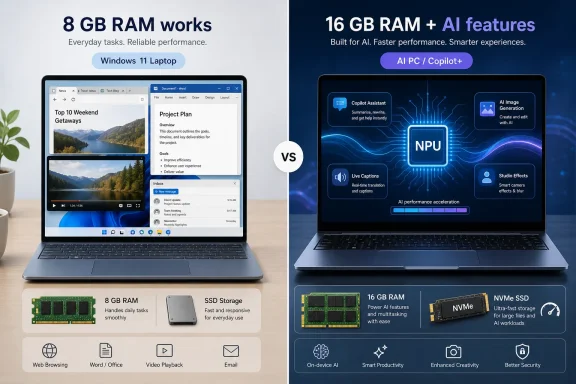
Microsoft’s latest Surface buying guidance separates ordinary Windows 11 use from Copilot+ PC ambitions, telling shoppers that 8 GB of RAM is sufficient for browsing, video, reading, and office work, while keeping 16 GB of RAM and 256 GB of SSD storage as the floor for its AI-branded PCs. That is less a technical revolution than a marketing retreat. After years of nudging buyers toward the idea that 16 GB was the new respectable baseline, Microsoft has rediscovered the awkward truth sitting in its own product catalog: millions of Windows PCs, including current Surface models, still ship with 8 GB. The real story is not that Windows 11 suddenly got lighter; it is that Microsoft’s AI-era hardware story has become too expensive to pretend it applies to everyone.
For most users, Windows memory advice has always lived in the gap between what the operating system can technically run on and what a sane person would want to buy. Microsoft’s official Windows 11 minimum remains far below the level enthusiasts recommend. The company can say Windows 11 requires only a modest amount of memory while also knowing that Chrome, Teams, OneDrive, security tools, and a half-dozen background services can turn that minimum into a patience test.
The new Surface framing matters because it draws a cleaner line than Microsoft’s broader AI messaging has often allowed. A Windows 11 PC is one category. A Copilot+ PC is another. The former can be an everyday productivity machine with 8 GB of RAM; the latter is a hardware badge for devices expected to run local AI features, and that badge still demands 16 GB of RAM, a qualifying neural processing unit, and modern storage.
That distinction should have been obvious from the beginning, but Microsoft’s public language has frequently treated the future of Windows as if it were synonymous with the future of Copilot. The result was predictable confusion. If Copilot+ PCs are the future of Windows, and Copilot+ PCs require 16 GB, then buyers reasonably inferred that 8 GB machines were yesterday’s news.
Microsoft is now backing away from that implication without fully saying it was wrong. The company is not declaring 8 GB luxurious, future-proof, or ideal for heavy multitasking. It is saying something narrower and more defensible: for basic daily workloads, 8 GB remains enough.
This is why the “Microsoft changes its mind” framing lands with such force. A company cannot credibly tell customers that 16 GB is the modern baseline while also selling 8 GB Surface PCs as viable products. It can sell them as compromises. It can sell them as affordable configurations. But it cannot market them as current Windows machines and simultaneously imply they are already inadequate.
The Surface lineup makes the contradiction visible because Microsoft is not merely a software vendor here. It is the platform owner, the operating system developer, the AI evangelist, and the PC manufacturer. When Dell, Lenovo, or HP ships an 8 GB Windows laptop, Microsoft can shrug and point to OEM choice. When Surface does it, Microsoft owns the message.
The economics are not subtle. Memory prices and overall component costs have pressured laptop makers, and the Copilot+ PC push arrived at exactly the moment when making 16 GB universal became more expensive. If Microsoft wants lower starting prices for Surface devices, 8 GB configurations are the easiest lever to pull. The company’s guidance is therefore not only a technical clarification; it is product-positioning cover.
That makes sense at one level. Local AI features need memory headroom, fast storage, and dedicated acceleration. Features such as on-device semantic search, image generation, live translation, and recall-style activity indexing are not equivalent to opening Word and checking email. They are persistent, background-heavy, and potentially demanding in ways that traditional Windows tasks are not.
But the branding problem is that Microsoft sold Copilot+ PCs as the vanguard of the Windows experience. When a platform holder says the most exciting Windows features require a higher hardware tier, ordinary customers hear a simpler message: your current PC is falling behind. That is a dangerous message to send when Windows 10 support deadlines are already pushing people toward replacement hardware.
Microsoft now appears to be narrowing the promise. Copilot+ is not Windows 11. Copilot+ is a premium capability layer on top of Windows 11. That distinction may not thrill the marketing department, but it is the only way to keep the Windows ecosystem from looking artificially obsolete.
Enthusiasts know the nuance. A 32 GB gaming desktop in 2026 is not absurd, especially for AAA titles, mods, streaming, Discord, browsers, capture software, and background launchers. The problem is that Microsoft’s messaging collapsed too many audiences into one. A gamer, a student, a call-center worker, a government employee, and a parent buying a low-cost laptop do not have the same memory needs.
When Microsoft removed the article, it did not erase the underlying issue. It confirmed that the company understands how combustible hardware recommendations have become. In an inflation-sensitive PC market, a sentence about “recommended” RAM can read like a corporate demand that users pay more to remain respectable.
The 8 GB clarification is therefore a course correction after a messaging overreach. It acknowledges that “modern PC” cannot mean the same thing in every context. That sounds simple, but it cuts against the whole thrust of AI PC marketing, which wants a clean before-and-after moment.
This is where the debate becomes less about Microsoft and more about modern software culture. Browsers are application platforms. Teams and Slack are web apps wearing desktop clothing. Security agents inspect more. Cloud clients sync more. OEM utilities phone home, update firmware, optimize displays, and ask users to sign into services they did not request.
On a clean 8 GB Windows 11 laptop, basic work can feel perfectly acceptable. Add a dozen browser tabs, a video call, a PDF, a spreadsheet, OneDrive sync, and an antivirus scan, and the machine may begin leaning heavily on the SSD. Modern NVMe storage can hide some of that pain, but it does not turn swap into RAM. The user experiences the gap as pauses, reloads, fan noise, and small irritations that accumulate.
That is why “8 GB is sufficient” should not be read as “8 GB is ideal.” It is sufficient for a defined set of ordinary tasks, particularly when the device is well-configured and the user’s workload is modest. It is not a blank check for heavy multitasking, gaming, development, virtualization, creative work, or AI features.
Enterprise buyers tend to think in refresh cycles, not shopping moments. A laptop bought in 2026 may need to remain useful until 2029 or 2030. The question is not whether 8 GB is enough for today’s email, browser, and Office workload. It is whether it will be enough after three years of security agents, Teams updates, browser bloat, management tooling, and whatever Copilot features the organization decides to enable.
There is also a support-cost dimension that rarely appears in marketing copy. A cheaper 8 GB fleet can become expensive if users complain about slow machines, help desks spend time triaging performance issues, and departments develop shadow workarounds. Memory that looks optional on a quote sheet can become labor cost later.
Still, not every enterprise workload requires 16 GB. Kiosk devices, frontline-worker laptops, shared machines, single-purpose endpoints, and thin-client-like deployments can make sense with 8 GB. Microsoft’s clearer split between Windows 11 and Copilot+ may actually help IT shops justify more segmented purchasing instead of applying one spec across every role.
That matters because Windows is a global platform, not a premium laptop club. If Microsoft lets Copilot+ hardware requirements become confused with Windows 11 expectations, it risks sending a hostile signal to markets where 16 GB machines remain meaningfully more expensive. The company wants AI adoption everywhere, but it cannot price the basic Windows experience as if every buyer is shopping in the same segment.
There is a political economy to system requirements. When Microsoft tightened Windows 11 compatibility around TPM, CPU generation, and security baselines, it accepted a wave of criticism because it could argue that the requirements served security and reliability goals. RAM is more personal. Users understand memory as money. Telling them they need more of it feels less like a security upgrade and more like a tax.
By saying 8 GB is enough for everyday use, Microsoft gives retailers, OEMs, and customers in price-sensitive markets a more usable story. Windows 11 remains within reach. Copilot+ remains aspirational. That may be less glamorous than “the year of the AI PC,” but it is much closer to how people actually buy computers.
The 8 GB clarification complicates that story. If everyday Windows 11 remains fine on cheaper hardware, then Copilot+ has to win on feature value rather than implied necessity. That is healthier for customers but harder for marketing. It forces Microsoft to show why local AI is worth paying for instead of relying on anxiety that non-AI PCs are already obsolete.
So far, that case remains uneven. Some AI features are genuinely useful in the right workflow. Others feel like demos in search of habits. Recall, semantic search, live captions, image generation, and local assistant features may eventually become expected parts of the Windows experience, but they have not yet displaced the basic buying priorities of battery life, display quality, keyboard comfort, repairability, price, and memory.
This is the central tension in the Windows ecosystem now. Microsoft wants a future-facing hardware baseline. The market still wants affordable machines that run the present well. The company’s revised guidance is an admission that the present cannot be wished away.
The trouble begins when the device is non-upgradable. Many modern laptops solder memory to the motherboard, turning the purchase decision into a permanent ceiling. An 8 GB machine that looks adequate on day one may become cramped before the battery wears out. In that case, the lower upfront price deserves more scrutiny.
For WindowsForum readers, the more useful distinction is not “8 GB versus 16 GB” in the abstract. It is “replaceable versus soldered,” “single-channel versus dual-channel,” “slow storage versus fast storage,” and “basic workload versus expanding workload.” Memory capacity is one spec inside a system, but it is the spec most likely to punish optimism.
If the machine is cheap, the workload is light, and the buyer understands the trade-off, 8 GB is not a scandal. If the machine is expensive, sealed, and marketed as ready for the next era of Windows, 8 GB deserves skepticism. Microsoft’s own product line now contains both realities.
That split may be technically honest, but it carries risk. Windows has historically benefited from being one broad platform, even when hardware capabilities varied widely. If AI features become too central to Microsoft’s roadmap, non-Copilot+ PCs may begin to feel like second-class citizens despite being officially supported.
The company will need to manage that boundary carefully. If Copilot+ remains a premium enhancement, the ecosystem can absorb it. If ordinary Windows becomes a waiting room for features that only AI PCs receive, then the 8 GB reassurance will age badly. Users do not mind optional extras; they resent being told their perfectly functional machines are strategically inconvenient.
The better path is to make Windows 11 leaner, more predictable, and less background-hungry across all devices, while letting AI PCs prove themselves on top. That would make 8 GB machines better and 16 GB machines better still. It would also show that Microsoft learned the right lesson from the backlash: users want capability, not coercion.
 Microsoft Rebuilds the Wall It Blurred
For most users, Windows memory advice has always lived in the gap between what the operating system can technically run on and what a sane person would want to buy. Microsoft’s official Windows 11 minimum remains far below the level enthusiasts recommend. The company can say Windows 11 requires only a modest amount of memory while also knowing that Chrome, Teams, OneDrive, security tools, and a half-dozen background services can turn that minimum into a patience test.The new Surface framing matters because it draws a cleaner line than Microsoft’s broader AI messaging has often allowed. A Windows 11 PC is one category. A Copilot+ PC is another. The former can be an everyday productivity machine with 8 GB of RAM; the latter is a hardware badge for devices expected to run local AI features, and that badge still demands 16 GB of RAM, a qualifying neural processing unit, and modern storage.
That distinction should have been obvious from the beginning, but Microsoft’s public language has frequently treated the future of Windows as if it were synonymous with the future of Copilot. The result was predictable confusion. If Copilot+ PCs are the future of Windows, and Copilot+ PCs require 16 GB, then buyers reasonably inferred that 8 GB machines were yesterday’s news.
Microsoft is now backing away from that implication without fully saying it was wrong. The company is not declaring 8 GB luxurious, future-proof, or ideal for heavy multitasking. It is saying something narrower and more defensible: for basic daily workloads, 8 GB remains enough.
The 8 GB Laptop Never Actually Left the Market
The loudest part of this story is not the recommendation; it is the inventory. Microsoft continues to sell Surface hardware with 8 GB of RAM, and the wider Windows laptop market is packed with similar configurations. That includes entry-level consumer notebooks, education devices, commercial fleet machines, and budget models sold in markets where price sensitivity matters far more than AI branding.This is why the “Microsoft changes its mind” framing lands with such force. A company cannot credibly tell customers that 16 GB is the modern baseline while also selling 8 GB Surface PCs as viable products. It can sell them as compromises. It can sell them as affordable configurations. But it cannot market them as current Windows machines and simultaneously imply they are already inadequate.
The Surface lineup makes the contradiction visible because Microsoft is not merely a software vendor here. It is the platform owner, the operating system developer, the AI evangelist, and the PC manufacturer. When Dell, Lenovo, or HP ships an 8 GB Windows laptop, Microsoft can shrug and point to OEM choice. When Surface does it, Microsoft owns the message.
The economics are not subtle. Memory prices and overall component costs have pressured laptop makers, and the Copilot+ PC push arrived at exactly the moment when making 16 GB universal became more expensive. If Microsoft wants lower starting prices for Surface devices, 8 GB configurations are the easiest lever to pull. The company’s guidance is therefore not only a technical clarification; it is product-positioning cover.
Copilot+ PCs Made RAM a Branding Problem
The Copilot+ PC label changed the politics of memory because it turned RAM from a spec-sheet detail into an eligibility requirement. Before that, 8 GB versus 16 GB was mostly a buyer’s judgment call. With Copilot+ PCs, Microsoft made 16 GB part of a new class identity.That makes sense at one level. Local AI features need memory headroom, fast storage, and dedicated acceleration. Features such as on-device semantic search, image generation, live translation, and recall-style activity indexing are not equivalent to opening Word and checking email. They are persistent, background-heavy, and potentially demanding in ways that traditional Windows tasks are not.
But the branding problem is that Microsoft sold Copilot+ PCs as the vanguard of the Windows experience. When a platform holder says the most exciting Windows features require a higher hardware tier, ordinary customers hear a simpler message: your current PC is falling behind. That is a dangerous message to send when Windows 10 support deadlines are already pushing people toward replacement hardware.
Microsoft now appears to be narrowing the promise. Copilot+ is not Windows 11. Copilot+ is a premium capability layer on top of Windows 11. That distinction may not thrill the marketing department, but it is the only way to keep the Windows ecosystem from looking artificially obsolete.
The Deleted Gaming Advice Became a Warning Shot
The memory debate did not start with the Surface guide. It was sharpened by Microsoft’s earlier messaging around gaming PCs, where a now-removed support-style article reportedly described 16 GB as a baseline and 32 GB as the worry-free zone for modern gaming. The backlash was not because 32 GB is bad advice for many serious gamers. It was because the advice sounded like another attempt to normalize more expensive hardware under the Windows 11 banner.Enthusiasts know the nuance. A 32 GB gaming desktop in 2026 is not absurd, especially for AAA titles, mods, streaming, Discord, browsers, capture software, and background launchers. The problem is that Microsoft’s messaging collapsed too many audiences into one. A gamer, a student, a call-center worker, a government employee, and a parent buying a low-cost laptop do not have the same memory needs.
When Microsoft removed the article, it did not erase the underlying issue. It confirmed that the company understands how combustible hardware recommendations have become. In an inflation-sensitive PC market, a sentence about “recommended” RAM can read like a corporate demand that users pay more to remain respectable.
The 8 GB clarification is therefore a course correction after a messaging overreach. It acknowledges that “modern PC” cannot mean the same thing in every context. That sounds simple, but it cuts against the whole thrust of AI PC marketing, which wants a clean before-and-after moment.
Windows 11 Is Not the Only Thing Eating Memory
The practical question for readers is not whether 8 GB can run Windows 11. It can. The practical question is what kind of Windows 11 life you get after the operating system, browser, collaboration apps, cloud sync, endpoint security, and vendor utilities all take their share.This is where the debate becomes less about Microsoft and more about modern software culture. Browsers are application platforms. Teams and Slack are web apps wearing desktop clothing. Security agents inspect more. Cloud clients sync more. OEM utilities phone home, update firmware, optimize displays, and ask users to sign into services they did not request.
On a clean 8 GB Windows 11 laptop, basic work can feel perfectly acceptable. Add a dozen browser tabs, a video call, a PDF, a spreadsheet, OneDrive sync, and an antivirus scan, and the machine may begin leaning heavily on the SSD. Modern NVMe storage can hide some of that pain, but it does not turn swap into RAM. The user experiences the gap as pauses, reloads, fan noise, and small irritations that accumulate.
That is why “8 GB is sufficient” should not be read as “8 GB is ideal.” It is sufficient for a defined set of ordinary tasks, particularly when the device is well-configured and the user’s workload is modest. It is not a blank check for heavy multitasking, gaming, development, virtualization, creative work, or AI features.
Enterprise IT Hears a Different Message Than Consumers Do
For home users, Microsoft’s revised guidance may offer reassurance. For IT departments, it creates a procurement dilemma. Buying 8 GB machines can reduce near-term costs, but those devices may age poorly as Windows, browsers, endpoint tools, and AI-adjacent features continue to expand.Enterprise buyers tend to think in refresh cycles, not shopping moments. A laptop bought in 2026 may need to remain useful until 2029 or 2030. The question is not whether 8 GB is enough for today’s email, browser, and Office workload. It is whether it will be enough after three years of security agents, Teams updates, browser bloat, management tooling, and whatever Copilot features the organization decides to enable.
There is also a support-cost dimension that rarely appears in marketing copy. A cheaper 8 GB fleet can become expensive if users complain about slow machines, help desks spend time triaging performance issues, and departments develop shadow workarounds. Memory that looks optional on a quote sheet can become labor cost later.
Still, not every enterprise workload requires 16 GB. Kiosk devices, frontline-worker laptops, shared machines, single-purpose endpoints, and thin-client-like deployments can make sense with 8 GB. Microsoft’s clearer split between Windows 11 and Copilot+ may actually help IT shops justify more segmented purchasing instead of applying one spec across every role.
Emerging Markets Were Never Going to Standardize on 16 GB Overnight
The Uzbekistan angle in the submitted report is not incidental. In many markets, 8 GB laptops are not a fringe category; they are the mainstream. Retail shelves are often shaped by affordability, import pricing, currency pressure, and the practical reality that users need a working computer before they need an AI showcase.That matters because Windows is a global platform, not a premium laptop club. If Microsoft lets Copilot+ hardware requirements become confused with Windows 11 expectations, it risks sending a hostile signal to markets where 16 GB machines remain meaningfully more expensive. The company wants AI adoption everywhere, but it cannot price the basic Windows experience as if every buyer is shopping in the same segment.
There is a political economy to system requirements. When Microsoft tightened Windows 11 compatibility around TPM, CPU generation, and security baselines, it accepted a wave of criticism because it could argue that the requirements served security and reliability goals. RAM is more personal. Users understand memory as money. Telling them they need more of it feels less like a security upgrade and more like a tax.
By saying 8 GB is enough for everyday use, Microsoft gives retailers, OEMs, and customers in price-sensitive markets a more usable story. Windows 11 remains within reach. Copilot+ remains aspirational. That may be less glamorous than “the year of the AI PC,” but it is much closer to how people actually buy computers.
The AI PC Year Runs Into the Budget PC Reality
Microsoft has been eager to frame 2026 as a major year for AI PCs. The company wants developers to build for local AI acceleration, OEMs to ship machines with NPUs, and customers to see Copilot+ features as a reason to refresh hardware. That strategy depends on momentum, and momentum depends on the feeling that the new class of PCs is not merely premium but inevitable.The 8 GB clarification complicates that story. If everyday Windows 11 remains fine on cheaper hardware, then Copilot+ has to win on feature value rather than implied necessity. That is healthier for customers but harder for marketing. It forces Microsoft to show why local AI is worth paying for instead of relying on anxiety that non-AI PCs are already obsolete.
So far, that case remains uneven. Some AI features are genuinely useful in the right workflow. Others feel like demos in search of habits. Recall, semantic search, live captions, image generation, and local assistant features may eventually become expected parts of the Windows experience, but they have not yet displaced the basic buying priorities of battery life, display quality, keyboard comfort, repairability, price, and memory.
This is the central tension in the Windows ecosystem now. Microsoft wants a future-facing hardware baseline. The market still wants affordable machines that run the present well. The company’s revised guidance is an admission that the present cannot be wished away.
Buyers Should Treat 8 GB as a Floor, Not a Promise
For individual buyers, the cleanest advice is also the least exciting: 8 GB is acceptable only if the workload is predictable and modest. A student writing papers, streaming video, browsing with a reasonable number of tabs, and using web-based productivity apps can make it work. So can a home user who needs email, banking, documents, and media.The trouble begins when the device is non-upgradable. Many modern laptops solder memory to the motherboard, turning the purchase decision into a permanent ceiling. An 8 GB machine that looks adequate on day one may become cramped before the battery wears out. In that case, the lower upfront price deserves more scrutiny.
For WindowsForum readers, the more useful distinction is not “8 GB versus 16 GB” in the abstract. It is “replaceable versus soldered,” “single-channel versus dual-channel,” “slow storage versus fast storage,” and “basic workload versus expanding workload.” Memory capacity is one spec inside a system, but it is the spec most likely to punish optimism.
If the machine is cheap, the workload is light, and the buyer understands the trade-off, 8 GB is not a scandal. If the machine is expensive, sealed, and marketed as ready for the next era of Windows, 8 GB deserves skepticism. Microsoft’s own product line now contains both realities.
The New Rule Is That There Are Two Windows Futures
Microsoft’s revised memory stance points toward a bifurcated Windows future. One track is ordinary Windows 11: familiar apps, cloud services, browser work, Office, media, and the incremental improvements users expect from the platform. The other track is Copilot+ Windows: local AI features, NPU acceleration, higher memory requirements, and a stronger claim on the next hardware refresh.That split may be technically honest, but it carries risk. Windows has historically benefited from being one broad platform, even when hardware capabilities varied widely. If AI features become too central to Microsoft’s roadmap, non-Copilot+ PCs may begin to feel like second-class citizens despite being officially supported.
The company will need to manage that boundary carefully. If Copilot+ remains a premium enhancement, the ecosystem can absorb it. If ordinary Windows becomes a waiting room for features that only AI PCs receive, then the 8 GB reassurance will age badly. Users do not mind optional extras; they resent being told their perfectly functional machines are strategically inconvenient.
The better path is to make Windows 11 leaner, more predictable, and less background-hungry across all devices, while letting AI PCs prove themselves on top. That would make 8 GB machines better and 16 GB machines better still. It would also show that Microsoft learned the right lesson from the backlash: users want capability, not coercion.
The Memory Line Microsoft Can No Longer Blur
The practical readout from this episode is narrower than the headlines but more important than the spec-sheet argument. Microsoft is not saying 8 GB is the new enthusiast recommendation. It is saying Windows 11 and Copilot+ PCs are not the same purchasing category, and that distinction should guide buyers.- Windows 11 remains usable on 8 GB of RAM for basic browsing, video, reading, and office productivity.
- Copilot+ PC features still require a higher hardware tier, including 16 GB of RAM and suitable AI acceleration.
- Buyers should be more cautious about 8 GB laptops when the memory is soldered and cannot be upgraded later.
- IT departments should match memory configurations to job roles instead of treating one Microsoft marketing baseline as universal.
- Microsoft’s own Surface lineup makes it impossible for the company to imply that every serious Windows 11 PC must start at 16 GB.
- The real upgrade pressure will come later if AI features become central to Windows rather than optional additions.
References
- Primary source: zamin.uz
Published: 2026-06-25T12:24:52.075261
Loading…
zamin.uz - Related coverage: windowscentral.com
Microsoft accidentally made a better Surface by failing its own AI requirements | Windows Central
The new budget-friendly 8GB Surface Pro and Surface Laptop aren't Copilot+ PCs, and that might be a blessing in disguise.www.windowscentral.com - Official source: microsoft.com
Loading…
www.microsoft.com - Official source: support.microsoft.com
Requisitos del sistema de Windows 11 - Soporte técnico de Microsoft
Obtén información sobre Windows 11 requisitos mínimos del sistema y cómo evaluar la idoneidad para la actualización.support.microsoft.com - Related coverage: windowslatest.com
Microsoft admits 8GB RAM is fine for Windows 11, after years of pushing 16GB as the baseline
Microsoft now tells that 8GB RAM is great for everyday use on Surface devices, after years of insisting 16GB was the minimum for Windows 11. www.windowslatest.com
- Related coverage: dir.md
Windows 11 Requirements Explained: Is Your PC Ready?
Learn minimum specs, TPM rules, and compatibility tips to safely upgrade to Windows 11. dir.md
- Related coverage: techradar.com
Loading…
www.techradar.com - Related coverage: pcgamer.com
Microsoft plans to launch a cheaper 8 GB Surface laptop later this year which won't meet the requirements of a Copilot+ PC | PC Gamer
How far we have fallen.www.pcgamer.com - Official source: download.microsoft.com
