

Microsoft’s recent suspension of developer accounts tied to VeraCrypt, WireGuard, and Windscribe has become a cautionary tale about what happens when automated enforcement collides with trusted infrastructure. What initially looked like a sweeping crackdown on privacy and security projects now appears to have been triggered by a missed compliance step in the Windows Hardware Program. Even so, the fallout was real: driver signing was interrupted, update pipelines were threatened, and developers were left chasing support channels that seemed to go nowhere.
The episode matters because it reaches far beyond a few angry posts on social media. It touches the trust model behind Windows driver signing, the resilience of Microsoft’s partner systems, and the fragility of open-source projects that depend on a small number of people to keep their publishing credentials alive. It also raises a bigger question: when a platform vendor tightens security controls, how much friction is acceptable before protection starts to look like self-inflicted damage?
The immediate controversy began with reports that Microsoft had terminated or suspended accounts associated with three recognizable security and privacy projects: VeraCrypt, WireGuard, and Windscribe. In practical terms, the impact was severe because those accounts were used for publishing, identity validation, and, in the case of Windows drivers, signing workflows that are central to shipping updates safely on the platform.
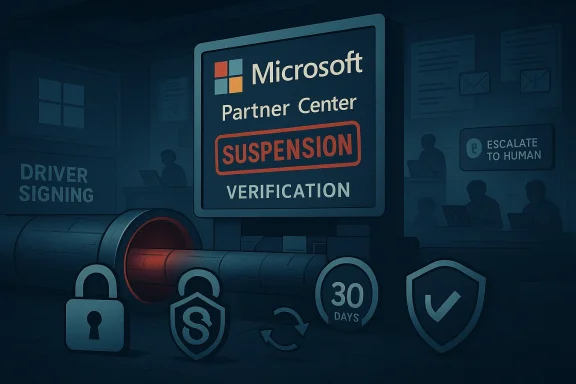
Microsoft later indicated that this was not a targeted takedown of those projects, but rather the result of a broader verification requirement that had gone into effect in the Windows Hardware Program. According to Microsoft’s own guidance, partners who had not completed account verification since April 2024 were required to go through a mandatory verification process beginning October 16, 2025, and they had 30 days to complete it or face rejection and suspension from the hardware program. That same guidance states that the name on the government-issued ID must match the Partner Center primary contact, and that failure to complete verification within the deadline results in suspension.
That detail matters because the enforcement story is not really about security software being singled out. It is about how Microsoft Partner Center, Hardware Dev Center, and related verification systems have become gatekeepers for the Windows driver ecosystem. For years, Microsoft has tightened the rules around kernel-mode code, signing pathways, and partner identity, largely in the name of reducing malware risk and improving ecosystem trust. The logic is easy to understand: if you can reliably verify the people who submit drivers, you reduce the odds that a malicious actor can masquerade as a legitimate publisher.
But the policy logic and the operational experience are not the same thing. Developers who spoke out said they encountered automated responses, unhelpful support loops, and opaque suspension behavior. That is where the controversy took off, because the projects involved are not random hobby apps; they are widely used tools with deep relevance to security-conscious Windows users. When a company like Microsoft creates a dependency and then appears to break it without warning, the backlash is predictable.
There is also a historical context to this kind of problem. Microsoft has spent years balancing two competing goals: making Windows more secure and making the ecosystem easier for legitimate developers to operate in. Those goals often align in theory, but in practice they can clash. A stronger identity-verification gate may stop abuse, but it can also ensnare real developers whose documentation, email routing, or contact data has gone stale since the last renewal cycle.
That tension is especially sharp in open source. Projects such as WireGuard and VeraCrypt often depend on a small number of maintainers, some of whom are volunteers or part-time contributors rather than dedicated compliance staff. In that environment, a single missed email or mismatched identity field can become a platform-wide outage for end users who depend on timely updates.
That process is not arbitrary from Microsoft’s point of view. The company has long treated Windows driver signing as a privileged channel that should be reserved for verified publishers, especially after years of abuse involving rootkits, unsigned kernel components, and drivers used to disable security software. The modern Windows ecosystem increasingly treats driver signing as a trust pipeline, not a convenience. That means the compliance burden is real, and Microsoft has every incentive to keep it strict.
The problem is that strictness creates failure modes, and those failure modes are often worst for small teams. A large OEM can absorb a missed verification email, route it to a compliance group, or escalate internally. An open-source maintainer may not even see the request, or may see it too late. When support replies are automated and appeals are difficult, the process starts to feel less like a safeguard and more like a trapdoor.
The reaction from the community made that feeling visible. WireGuard creator Jason Donenfeld said the account problem blocked driver signing and therefore blocked Windows updates for WireGuard. VeraCrypt maintainer Mounir Idrassi publicly complained that he could not get a human response through Microsoft’s support channels. Windscribe likewise reported that its Microsoft developer account had been suspended and that the company was struggling to get traction with support.
Then came the public-relations rescue effort. Microsoft executive Pavan Davuluri said the company was working to resolve the issue and that the suspended accounts would be reinstated. Microsoft employee Scott Hanselman also chimed in on social media, framing the situation as a case where people should check their emails and complete verification rather than assume malicious intent. That response may have calmed some of the speculation, but it also highlighted how easily a compliance workflow can become a reputational event.
That sounds straightforward on paper, and in many enterprise contexts it probably is. But the specifics matter because compliance systems often break at the edges: stale contact records, name mismatches, shared inboxes, or staff turnover can all derail a verification workflow. For a large commercial vendor, those are annoying administrative problems. For a one- or two-person open-source project, they are existential.
A missed notice can lead to suspension even when the underlying publisher is legitimate. That makes the system efficient, but not necessarily forgiving.
But the friction is not trivial. The more rigid the identity gate becomes, the more likely it is that legitimate publishers will be blocked by process rather than policy. In the end, good security can still fail if it is not usable by the people it is meant to protect.
That is why the story escalated so quickly. If Microsoft had suspended an obscure internal test account, few people would have noticed. But suspending or disabling the publishing path for widely respected privacy tools made the situation feel alarming and, to many, disproportionate.
That creates a hidden dependency stack:
That makes the issue more than a bureaucratic annoyance. It becomes a supply-chain problem. The longer the block lasts, the longer users stay on older builds that may contain bugs or security weaknesses. In security software, that is the opposite of what a platform provider wants.
Microsoft did eventually acknowledge the situation and say it was working to resolve the problem. But by that point, the story had already become a referendum on whether Microsoft’s support systems are fit for purpose when trusted developers need immediate help.
A system that can suspend a developer should also be able to rapidly route that developer to a human who can verify context. Without that escape hatch, the platform vendor risks enforcing the letter of the policy while undermining the spirit of trust.
The problem is that security policy in the driver ecosystem is a chain, and a chain is only as reliable as its weakest human process. If identity verification is brittle, the system can end up blocking trustworthy developers while still leaving room for attackers who understand how to game paperwork or create disposable identities.
This shift has three consequences:
For a giant OEM, verification is a checklist. For an open-source maintainer, it may be a distraction that consumes days. The result is an ecosystem that technically protects everyone but feels designed for the biggest players first.
That matters because privacy tools are often used by people who are especially sensitive to risk. When those users see their trusted projects blocked by a platform vendor, they may conclude that the platform itself is unreliable or indifferent to their needs.
So when Microsoft appears to impede those tools, even temporarily, it creates an emotional response beyond ordinary software frustration. The platform is not merely inconveniencing a developer; it is interrupting a user’s trust strategy.
That makes the consumer impact indirect but serious. Even if Microsoft reinstates the accounts quickly, the temporary disruption can still shake confidence in the update chain.
The key issue is not whether Microsoft has the right to verify identities. It does. The issue is whether those controls are operationally mature enough to support real-world business continuity.
That means the right question is not “Are we compliant today?” It is “Can we recover quickly if a partner platform decides we are not?” That distinction matters enormously.
Microsoft’s response suggested the company believed the issue stemmed from missed verification rather than malicious enforcement. It also signaled that the situation had become embarrassing enough to warrant direct executive attention. That alone is revealing. If the process were robust, the affected developers likely would have resolved the issue without becoming public examples.
That is not a sign of healthy operations. It means the formal channel failed to provide a timely answer.
If Microsoft wants to preserve the breadth of the Windows ecosystem, it needs to remember that friction is not distributed equally.
Another question is whether this episode changes how developers approach Microsoft’s trust systems. If the lesson becomes “watch your email more carefully,” that may be true but insufficient. If the lesson becomes “Microsoft needs a real human escalation path for trusted security projects,” then the company may actually emerge stronger in the long run.
What to watch next:
In the end, this episode is less about a few accounts being suspended than it is about what kind of ecosystem Windows wants to be. If Microsoft wants security-conscious developers to keep trusting the platform, it has to make sure its defenses do not look like indifference in disguise.
Source: Windows Central Microsoft cut off accounts tied to VeraCrypt, WireGuard, and Windscribe
The episode matters because it reaches far beyond a few angry posts on social media. It touches the trust model behind Windows driver signing, the resilience of Microsoft’s partner systems, and the fragility of open-source projects that depend on a small number of people to keep their publishing credentials alive. It also raises a bigger question: when a platform vendor tightens security controls, how much friction is acceptable before protection starts to look like self-inflicted damage?
 Background
The immediate controversy began with reports that Microsoft had terminated or suspended accounts associated with three recognizable security and privacy projects: VeraCrypt, WireGuard, and Windscribe. In practical terms, the impact was severe because those accounts were used for publishing, identity validation, and, in the case of Windows drivers, signing workflows that are central to shipping updates safely on the platform.Microsoft later indicated that this was not a targeted takedown of those projects, but rather the result of a broader verification requirement that had gone into effect in the Windows Hardware Program. According to Microsoft’s own guidance, partners who had not completed account verification since April 2024 were required to go through a mandatory verification process beginning October 16, 2025, and they had 30 days to complete it or face rejection and suspension from the hardware program. That same guidance states that the name on the government-issued ID must match the Partner Center primary contact, and that failure to complete verification within the deadline results in suspension.
That detail matters because the enforcement story is not really about security software being singled out. It is about how Microsoft Partner Center, Hardware Dev Center, and related verification systems have become gatekeepers for the Windows driver ecosystem. For years, Microsoft has tightened the rules around kernel-mode code, signing pathways, and partner identity, largely in the name of reducing malware risk and improving ecosystem trust. The logic is easy to understand: if you can reliably verify the people who submit drivers, you reduce the odds that a malicious actor can masquerade as a legitimate publisher.
But the policy logic and the operational experience are not the same thing. Developers who spoke out said they encountered automated responses, unhelpful support loops, and opaque suspension behavior. That is where the controversy took off, because the projects involved are not random hobby apps; they are widely used tools with deep relevance to security-conscious Windows users. When a company like Microsoft creates a dependency and then appears to break it without warning, the backlash is predictable.
There is also a historical context to this kind of problem. Microsoft has spent years balancing two competing goals: making Windows more secure and making the ecosystem easier for legitimate developers to operate in. Those goals often align in theory, but in practice they can clash. A stronger identity-verification gate may stop abuse, but it can also ensnare real developers whose documentation, email routing, or contact data has gone stale since the last renewal cycle.
That tension is especially sharp in open source. Projects such as WireGuard and VeraCrypt often depend on a small number of maintainers, some of whom are volunteers or part-time contributors rather than dedicated compliance staff. In that environment, a single missed email or mismatched identity field can become a platform-wide outage for end users who depend on timely updates.
Overview
Microsoft’s own public guidance shows that the company had been laying the groundwork for stricter verification well before the incident became news. The October 2025 hardware-program announcement says partners must monitor their verification status in Partner Center, keep legal information current, and ensure that the primary contact email is a monitored work account rather than a generic mailbox. The notice also says identity verification must be completed within 30 days of the request, and that rejected accounts may be suspended from the Windows Hardware Program.That process is not arbitrary from Microsoft’s point of view. The company has long treated Windows driver signing as a privileged channel that should be reserved for verified publishers, especially after years of abuse involving rootkits, unsigned kernel components, and drivers used to disable security software. The modern Windows ecosystem increasingly treats driver signing as a trust pipeline, not a convenience. That means the compliance burden is real, and Microsoft has every incentive to keep it strict.
The problem is that strictness creates failure modes, and those failure modes are often worst for small teams. A large OEM can absorb a missed verification email, route it to a compliance group, or escalate internally. An open-source maintainer may not even see the request, or may see it too late. When support replies are automated and appeals are difficult, the process starts to feel less like a safeguard and more like a trapdoor.
The reaction from the community made that feeling visible. WireGuard creator Jason Donenfeld said the account problem blocked driver signing and therefore blocked Windows updates for WireGuard. VeraCrypt maintainer Mounir Idrassi publicly complained that he could not get a human response through Microsoft’s support channels. Windscribe likewise reported that its Microsoft developer account had been suspended and that the company was struggling to get traction with support.
Then came the public-relations rescue effort. Microsoft executive Pavan Davuluri said the company was working to resolve the issue and that the suspended accounts would be reinstated. Microsoft employee Scott Hanselman also chimed in on social media, framing the situation as a case where people should check their emails and complete verification rather than assume malicious intent. That response may have calmed some of the speculation, but it also highlighted how easily a compliance workflow can become a reputational event.
Why This Became a Big Story
The story spread because it touched three groups at once: security users, open-source developers, and Windows ecosystem watchers. Each of those communities has a reason to care, but their concerns are not identical.- Security users worry about update delays and broken trust chains.
- Developers worry about opaque enforcement and support dead ends.
- Enterprise admins worry about whether partner compliance processes are robust enough for mission-critical workflows.
- Microsoft watchers worry about whether the company is becoming too automated and too hard to reach.
The Verification Policy Behind the Suspensions
The crucial piece of the puzzle is Microsoft’s mandatory account verification rule for the Windows Hardware Program. The company stated that partners who had not completed account verification since April 2024 would need to complete the process after October 16, 2025, and that failing to do so within 30 days would lead to rejection and suspension. Microsoft also said the primary contact must use a monitored work email and that the government-issued ID must match the Partner Center contact details.That sounds straightforward on paper, and in many enterprise contexts it probably is. But the specifics matter because compliance systems often break at the edges: stale contact records, name mismatches, shared inboxes, or staff turnover can all derail a verification workflow. For a large commercial vendor, those are annoying administrative problems. For a one- or two-person open-source project, they are existential.
The 30-Day Clock
The 30-day deadline is one of the most consequential parts of the policy. It gives Microsoft a clean rule to enforce, but it also leaves little room for ambiguity, missed notifications, or personal circumstances.A missed notice can lead to suspension even when the underlying publisher is legitimate. That makes the system efficient, but not necessarily forgiving.
- A verification email sent to an old inbox can be fatal.
- A generic mailbox can fail the policy even if it reaches the team.
- A name mismatch can stop verification even if the company is real.
- A slow support cycle can turn a temporary hiccup into an outage.
- A small project may not have someone watching Partner Center daily.
Security Rationale Versus Real-World Friction
Microsoft’s rationale is easy to defend in the abstract. A stricter identity check should reduce impersonation, fraud, and abuse in the driver ecosystem. That is especially important because Windows kernel access is powerful and dangerous; a malicious driver can undermine the operating system’s defenses in ways that ordinary apps cannot.But the friction is not trivial. The more rigid the identity gate becomes, the more likely it is that legitimate publishers will be blocked by process rather than policy. In the end, good security can still fail if it is not usable by the people it is meant to protect.
Why VeraCrypt, WireGuard, and Windscribe Matter
These were not random names plucked from obscurity. VeraCrypt is one of the best-known open-source encryption tools on Windows, WireGuard is a major VPN protocol and implementation with a strong reputation for speed and simplicity, and Windscribe is a well-known privacy-focused VPN provider with a substantial user base. When a platform issue touches those projects, it immediately resonates with users who depend on them for everyday privacy and security.That is why the story escalated so quickly. If Microsoft had suspended an obscure internal test account, few people would have noticed. But suspending or disabling the publishing path for widely respected privacy tools made the situation feel alarming and, to many, disproportionate.
Open Source Dependencies Are Fragile
Open-source projects often have a public image of resilience because their code is visible and their communities are distributed. In reality, many of them still rely on a few maintainers to sign releases, manage packaging, and handle platform-specific distribution chores.That creates a hidden dependency stack:
- one maintainer may hold the publishing credentials,
- one account may gate driver signing,
- one verified identity may be required for release access,
- one support ticket may be the only path to restore service.
Driver Signing Is Not Just Paperwork
WireGuard’s case is especially important because it involves driver signing, not just app publishing. On Windows, driver signing is the bridge between a maintainer’s code and a user’s machine. If that bridge is blocked, updates cannot safely ship.That makes the issue more than a bureaucratic annoyance. It becomes a supply-chain problem. The longer the block lasts, the longer users stay on older builds that may contain bugs or security weaknesses. In security software, that is the opposite of what a platform provider wants.
Microsoft’s Message Control Problem
One of the most damaging aspects of the episode was not the suspension itself but the communications vacuum around it. According to the affected developers, they were met with automated replies, bot-like responses, and little meaningful escalation. That left social media as the de facto support channel, which is rarely where a high-trust enterprise issue should be resolved.Microsoft did eventually acknowledge the situation and say it was working to resolve the problem. But by that point, the story had already become a referendum on whether Microsoft’s support systems are fit for purpose when trusted developers need immediate help.
The Human Layer Matters
Automated compliance is efficient. It can sort risk at scale, reduce manual workload, and standardize enforcement. But automation becomes dangerous when it replaces the human layer instead of supporting it.A system that can suspend a developer should also be able to rapidly route that developer to a human who can verify context. Without that escape hatch, the platform vendor risks enforcing the letter of the policy while undermining the spirit of trust.
Public Fallout Is a Signal
The fact that the issue reached people like Tim Sweeney and then reportedly got elevated inside Microsoft is telling. It suggests that direct escalation still matters more than formal channels when things go wrong. That is not a healthy sign for a platform company that wants to present itself as predictable and enterprise-ready.- Support responsiveness is a trust signal.
- Fast escalation is a reliability signal.
- Public acknowledgement is not the same as remediation.
- A clear appeal path reduces reputational damage.
- Transparency after the fact is better than silence, but not sufficient.
The Role of Windows Driver Security
Microsoft has spent years improving the trust model for Windows drivers, and for good reason. Kernel-mode code is high risk, and a single compromised driver can create security headaches for millions of users. In that sense, the company’s desire to tighten verification is aligned with best practice.The problem is that security policy in the driver ecosystem is a chain, and a chain is only as reliable as its weakest human process. If identity verification is brittle, the system can end up blocking trustworthy developers while still leaving room for attackers who understand how to game paperwork or create disposable identities.
From Convenience to Controlled Access
Historically, platform ecosystems often prioritized developer convenience. That is no longer true for Windows drivers. Microsoft has increasingly treated access as controlled, auditable, and revocable.This shift has three consequences:
- It lowers the risk of malicious kernel submissions.
- It increases administrative overhead for legitimate publishers.
- It makes support quality part of the security model.
The New Reality for Smaller Vendors
Large vendors can hire compliance teams. Small vendors cannot. That creates a structural asymmetry where the same rule has very different effects depending on company size.For a giant OEM, verification is a checklist. For an open-source maintainer, it may be a distraction that consumes days. The result is an ecosystem that technically protects everyone but feels designed for the biggest players first.
Consumer Impact: Privacy, Encryption, and Trust
For ordinary Windows users, the immediate concern is simple: will their tools still update on time? With projects like VeraCrypt and WireGuard, the answer directly affects access to encryption and networking software that people use to protect themselves. If updates are delayed, users may be left on older versions longer than intended.That matters because privacy tools are often used by people who are especially sensitive to risk. When those users see their trusted projects blocked by a platform vendor, they may conclude that the platform itself is unreliable or indifferent to their needs.
Why This Feels Personal to Users
Security tools occupy a special place in a user’s trust hierarchy. People do not install them casually. They install them because they want to make the system safer, more private, or more resilient.So when Microsoft appears to impede those tools, even temporarily, it creates an emotional response beyond ordinary software frustration. The platform is not merely inconveniencing a developer; it is interrupting a user’s trust strategy.
- Encryption tools are often seen as non-negotiable.
- VPN software is tied to privacy expectations.
- Delayed updates can raise risk exposure.
- Users may not distinguish between policy enforcement and censorship.
- Confidence can erode faster than technical damage accumulates.
Update Delays Are Security Issues
A blocked update is not just a missed feature release. In the security space, it can mean unresolved bugs, unpatched compatibility issues, and a longer window for exploitation if a vulnerability is later identified.That makes the consumer impact indirect but serious. Even if Microsoft reinstates the accounts quickly, the temporary disruption can still shake confidence in the update chain.
Enterprise Impact: Partner Compliance and Operational Risk
Enterprises should not assume this is only a story about niche privacy tools. It is also a warning about how Microsoft’s partner workflows behave when a compliance requirement collides with production operations. Any company that depends on Windows driver signing, Partner Center access, or identity-verification workflows should pay attention.The key issue is not whether Microsoft has the right to verify identities. It does. The issue is whether those controls are operationally mature enough to support real-world business continuity.
What Enterprises Should Take Away
Enterprises generally have more structure than open-source teams, but they are not immune to verification failures. A contact change, M&A event, reorganization, or stale inbox could cause a similar interruption.- Review Partner Center contact ownership now.
- Confirm that primary contacts are monitored daily.
- Verify that legal and identity data match exactly.
- Document an internal escalation path for suspension events.
- Test the appeal route before you need it.
The Business Continuity Lesson
A lot of enterprises treat platform compliance as a periodic chore rather than a continuity risk. This incident shows that can be a mistake. If a verification failure can block driver updates or publishing, then compliance status is effectively part of the production chain.That means the right question is not “Are we compliant today?” It is “Can we recover quickly if a partner platform decides we are not?” That distinction matters enormously.
The Public Backlash and Microsoft’s Response
Once the suspensions became public, the conversation shifted from technical policy to brand damage. Microsoft needed to show two things at once: that it had a legitimate security process, and that it would not leave respected developers stranded in a support maze. Those goals are compatible in theory, but the optics were rough.Microsoft’s response suggested the company believed the issue stemmed from missed verification rather than malicious enforcement. It also signaled that the situation had become embarrassing enough to warrant direct executive attention. That alone is revealing. If the process were robust, the affected developers likely would have resolved the issue without becoming public examples.
Social Media as an Escalation Ladder
One of the most striking details was that the issue reportedly gained traction after backlash online and intervention from high-profile figures. That is a familiar pattern in tech now: if support is insufficient, public pressure becomes the escalation mechanism.That is not a sign of healthy operations. It means the formal channel failed to provide a timely answer.
Why Microsoft Had to Move Fast
Microsoft had a strong incentive to de-escalate quickly because the names involved carry symbolic weight. VeraCrypt, WireGuard, and Windscribe are not fringe brands. They are associated with technical sophistication and user trust. A prolonged blockage would have turned a process problem into a governance crisis.Strengths and Opportunities
Microsoft still has an opportunity to turn this into a credibility win if it improves the process rather than simply restoring access. A stricter verification regime can coexist with a humane support experience, but only if Microsoft treats them as two parts of the same system. The broader Windows ecosystem would benefit from better communication, clearer deadlines, and faster human intervention when trusted developers get swept up in automated enforcement.- Stronger identity checks can reduce abuse in the Windows driver ecosystem.
- Clear deadlines make policy easier for legitimate partners to follow.
- Better communication would reduce confusion and public backlash.
- Faster human escalation could prevent short outages from becoming reputational crises.
- Improved Partner Center hygiene would help enterprise and open-source publishers alike.
- More transparent appeals would create confidence in enforcement fairness.
- Proactive reminders could catch small teams before deadlines pass.
A Chance to Improve Trust
The upside here is not theoretical. If Microsoft uses the episode to modernize its partner communications, it could make the entire hardware program more credible. A platform vendor that is strict and responsive tends to earn more trust than one that is only strict.Risks and Concerns
The biggest risk is that Microsoft treats this as a one-off PR problem rather than a systems problem. If the same class of suspension can happen again, the company will have simply postponed the next backlash. There is also a broader risk that smaller developers begin to see Windows publishing as too brittle, too opaque, or too dependent on luck.- False positives can keep blocking legitimate publishers.
- Support opacity may push developers toward public escalation.
- Small teams are disproportionately vulnerable to verification misses.
- Delayed updates can increase security exposure for users.
- Trust erosion can damage Microsoft’s developer ecosystem over time.
- Over-automation can undermine the platform’s human appeal.
- Compliance fatigue may discourage open-source participation on Windows.
The Hidden Cost of Friction
Every additional step in the verification process creates a small tax on developer attention. For large teams, that tax is manageable. For small teams and volunteers, it can become a barrier to participation.If Microsoft wants to preserve the breadth of the Windows ecosystem, it needs to remember that friction is not distributed equally.
Looking Ahead
The most important thing to watch now is whether Microsoft makes the fix procedural or structural. Procedural fixes will unblock the current accounts and maybe improve messaging. Structural fixes would mean redesigning how verification, escalation, and appeals work for critical developer accounts. The distinction is huge, because only the latter addresses the underlying fragility.Another question is whether this episode changes how developers approach Microsoft’s trust systems. If the lesson becomes “watch your email more carefully,” that may be true but insufficient. If the lesson becomes “Microsoft needs a real human escalation path for trusted security projects,” then the company may actually emerge stronger in the long run.
What to watch next:
- Whether Microsoft updates Partner Center guidance or alerting.
- Whether more open-source maintainers report similar suspensions.
- Whether Microsoft offers a faster appeal or reinstatement path.
- Whether the company publishes clearer verification timelines.
- Whether Windows driver publishers tighten their own compliance hygiene.
- Whether developers diversify publishing and signing dependencies.
In the end, this episode is less about a few accounts being suspended than it is about what kind of ecosystem Windows wants to be. If Microsoft wants security-conscious developers to keep trusting the platform, it has to make sure its defenses do not look like indifference in disguise.
Source: Windows Central Microsoft cut off accounts tied to VeraCrypt, WireGuard, and Windscribe
