

Microsoft’s latest reorganization puts Microsoft Teams under Ryan Roslansky, the executive already overseeing LinkedIn and Office, as Rajesh Jha’s Experiences and Devices empire is split among several leaders who will report directly to Satya Nadella after Jha exits on June 30, 2026. The move is not just another box-and-line shuffle inside Redmond. It is Microsoft admitting that the future of productivity is no longer an app suite, a collaboration tool, or a social graph, but a single workplace operating layer. Teams is being moved closer to the place where Microsoft thinks work itself is being redesigned.
For years, Microsoft Teams has occupied an awkward place in the company’s empire. It was born as a Slack competitor, grew into a pandemic-era lifeline, and then became the interface where meetings, chats, files, phone calls, apps, and Copilot all collided. It was both wildly successful and deeply resented, the kind of enterprise product that wins procurement battles while becoming shorthand for notification fatigue.
Putting Teams under Roslansky changes the emphasis. He is not merely the LinkedIn executive who got more responsibility. He now sits across three pillars of Microsoft’s workplace theory: the professional identity graph of LinkedIn, the document-and-email machinery of Office, and the collaboration fabric of Teams.
That combination is powerful because Microsoft’s AI ambitions depend on context. Copilot is only as useful as the data, permissions, relationships, documents, meetings, and workflows it can safely reason over. Teams contains the messy, real-time residue of office life: what was said, who was in the room, what got promised, which files were shared, and which decisions never made it into the official document.
The new Work Experiences Group, as reported, is therefore less about giving Teams a new manager than giving Microsoft’s workplace products a clearer gravitational center. The company has spent years insisting that Microsoft 365 is more than Office plus cloud storage. This reshuffle makes that claim organizationally real.
But the AI era is putting pressure on that structure. Microsoft is no longer trying merely to keep Windows, Office, Teams, and OneDrive moving in the same general direction. It is trying to turn all of them into surfaces for Copilot and agents, while preserving enterprise trust, satisfying regulators, and avoiding the UX chaos that comes from bolting AI buttons onto every toolbar in sight.
Jha’s old portfolio was too large to simply hand to one successor. Instead, Microsoft is spreading responsibility among leaders whose remits map more closely to the company’s new fault lines. Pavan Davuluri keeps Windows and devices. Charles Lamanna takes on Copilot, agents, platform, Microsoft 365 core services, Dynamics-related services, OneDrive, SharePoint, data platform work, and growth. Roslansky gets Teams alongside Office and LinkedIn.
That division tells us how Microsoft now sees the battlefield. Windows is the endpoint and device substrate. Lamanna’s world is the AI and platform engine. Roslansky’s world is the human work experience sitting on top of it.
Slack sold a vision of work organized around channels. Zoom made video meetings feel effortless. Teams did something more Microsoft-like: it absorbed everything. It became a meeting client, chat client, telephony platform, app launcher, file browser, webinar tool, classroom, help desk front end, and compliance-recorded workplace archive.
That sprawl is why users complain about it, and why CIOs keep buying it. Teams is not beloved in the consumer-product sense. It is embedded in the enterprise-infrastructure sense. It touches identity, calendars, Exchange, SharePoint, OneDrive, Entra, Purview, compliance retention, and the Microsoft Graph.
That makes Teams one of the richest possible homes for AI agents. A workplace agent that cannot see meetings, chats, files, calendars, tasks, and organizational context is basically a smarter chatbot with a nicer license. A workplace agent that can navigate those systems with permission-aware grounding becomes something closer to a new interface for office work.
Microsoft knows this. Its recent Copilot messaging has leaned hard into agents, “human-agent teams,” and business processes that span applications. Teams is the obvious venue for that ambition because it is where work already pretends to be conversational.
That matters because Microsoft’s AI pitch increasingly depends on understanding not just what a company knows, but who knows it. The enterprise productivity problem has shifted from “Where is the file?” to “Who has the context, what happened before, and what should happen next?” LinkedIn’s worldview is unusually relevant to that problem.
Microsoft has owned LinkedIn since 2016, but the integration has often been careful rather than maximalist. LinkedIn retained a distinct culture, product identity, and consumer-facing brand. That restraint was wise; few things would have been more Microsoft than smothering LinkedIn under Office licensing logic.
Now the logic may be reversing. Rather than stuffing LinkedIn into Office, Microsoft appears to be importing more LinkedIn-shaped thinking into the productivity estate. If the future workplace is organized around skills, relationships, reputation, and AI-mediated workflows, Roslansky is a more natural fit than he might have looked ten years ago.
This split between Lamanna and Roslansky is important. Lamanna is getting the systems that make agents possible. Roslansky is getting the experiences where workers will either adopt those agents or reject them.
Microsoft has a long history of confusing platform success with user affection. Developers, admins, and procurement teams may accept deep integration because it reduces friction, centralizes governance, and improves compliance. End users, however, judge the result by whether the product helps them get through Tuesday without drowning in panels, pings, prompts, and half-finished AI summaries.
That is the tension the new structure must solve. Lamanna can make Copilot and agents technically pervasive. Roslansky has to make them feel coherent inside the daily ritual of work.
That is why Teams matters so much. Word, Excel, PowerPoint, and Outlook are still iconic, but they are not where all work begins anymore. A project may start in a Teams chat, move into a Loop component, become a Planner task, produce a PowerPoint, generate an Excel model, and end as a Copilot summary in Outlook. The application boundaries are increasingly artificial.
Roslansky’s Work Experiences Group appears designed around that reality. Instead of treating Teams as a neighboring product that integrates with Office, Microsoft is treating it as part of the same experiential layer. That could reduce the fragmentation that has made Microsoft 365 feel, at times, like a federation of acquired habits rather than a single product.
But it also raises the stakes. If Microsoft wants users to accept Copilot as the connective tissue of work, the underlying apps need to stop feeling like rival kingdoms. A reorg cannot fix product incoherence by itself, but it can remove the excuses that product teams use when incoherence persists.
That makes this reshuffle delicate. On one hand, putting Teams closer to Office and LinkedIn makes product sense. On the other, regulators are not likely to ignore an organizational move that further aligns Teams with Microsoft’s dominant workplace suite.
Microsoft’s defense will be that integration is what customers want, especially in a world of AI agents that need context across meetings, documents, calendars, chats, and enterprise data. That argument is not frivolous. Fragmented workplace software really does create friction, and enterprise IT often prefers a governed stack over a patchwork of point solutions.
But the counterargument is just as obvious. When the same company controls the productivity suite, the collaboration layer, the identity system, the storage layer, the AI assistant, and the data graph, integration can start to look indistinguishable from enclosure. The more useful Copilot becomes inside Microsoft’s own stack, the harder it may be for rivals to compete on equal terms.
Yet the reorg also reinforces a deeper truth: Windows is no longer the organizing center of Microsoft’s productivity strategy. It is a crucial endpoint, but not the whole map. The center of gravity has moved to accounts, subscriptions, cloud services, Graph data, security boundaries, and AI experiences that follow the user across devices.
That shift has been underway for years, but AI accelerates it. An agent that summarizes meetings, drafts documents, updates records, and suggests next steps does not care much whether the user is on a Surface Laptop, a browser tab, an iPhone, or a virtual desktop. Microsoft still cares, of course, because Windows gives it distribution and control. But the productivity battle is increasingly fought above the operating system.
This is why the Teams move is more strategically revealing than any individual Windows assignment. The workplace OS Microsoft wants to build is not Windows 12 or Windows 11 with more Copilot buttons. It is Microsoft 365 as a cross-device, AI-mediated work layer.
Microsoft’s Windows and Office organizations are full of people who understand why things are the way they are. Some of that knowledge is priceless; some of it is inertia. A retirement program can clear space for new bets, but it can also remove the people who remember which architectural shortcuts were taken, which customer promises were made, and which enterprise edge cases can still wake up a support organization at 3 a.m.
This matters because Microsoft is trying to reinvent productivity while maintaining backward compatibility with the working lives of hundreds of millions of people. That is a harder task than launching a clean AI-native startup. Microsoft has to modernize without breaking the workflows that payroll departments, hospitals, schools, law firms, governments, and manufacturers have quietly depended on for decades.
The leadership changes therefore have a generational quality. Jha’s retirement symbolizes the end of one Microsoft productivity era. Roslansky and Lamanna represent the next one: less about shipping software suites, more about orchestrating intelligent systems around work.
Users have reason to be skeptical. Microsoft’s productivity portfolio already contains too many surfaces that appear to do similar things: Teams chats, channels, Outlook groups, Viva Engage communities, Loop workspaces, SharePoint pages, Planner tasks, To Do lists, OneNote notebooks, OneDrive files, Copilot pages, and whatever new agent canvas appears next quarter. The company’s answer is usually that each surface has a distinct purpose. The user’s answer is usually that work is already complicated enough.
AI can either fix that problem or make it worse. A well-designed Copilot layer could hide product seams and let people work by intent: summarize this, schedule that, turn this thread into a plan, find the owner, draft the update, file the decision. A poorly designed layer will add yet another place to check, another permission model to understand, and another stream of generated text to verify.
Roslansky’s challenge is not to make Teams more central. It is already central. His challenge is to make centrality feel like clarity rather than capture.
Source: The Verge Microsoft’s Office and LinkedIn chief now runs Teams in latest reshuffle
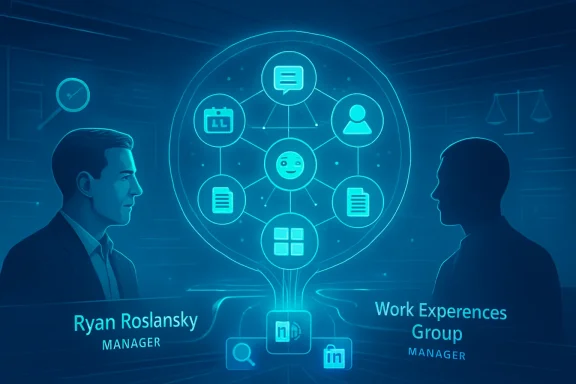 Microsoft Puts the Meeting Room Inside the Work Graph
For years, Microsoft Teams has occupied an awkward place in the company’s empire. It was born as a Slack competitor, grew into a pandemic-era lifeline, and then became the interface where meetings, chats, files, phone calls, apps, and Copilot all collided. It was both wildly successful and deeply resented, the kind of enterprise product that wins procurement battles while becoming shorthand for notification fatigue.Putting Teams under Roslansky changes the emphasis. He is not merely the LinkedIn executive who got more responsibility. He now sits across three pillars of Microsoft’s workplace theory: the professional identity graph of LinkedIn, the document-and-email machinery of Office, and the collaboration fabric of Teams.
That combination is powerful because Microsoft’s AI ambitions depend on context. Copilot is only as useful as the data, permissions, relationships, documents, meetings, and workflows it can safely reason over. Teams contains the messy, real-time residue of office life: what was said, who was in the room, what got promised, which files were shared, and which decisions never made it into the official document.
The new Work Experiences Group, as reported, is therefore less about giving Teams a new manager than giving Microsoft’s workplace products a clearer gravitational center. The company has spent years insisting that Microsoft 365 is more than Office plus cloud storage. This reshuffle makes that claim organizationally real.
Rajesh Jha’s Exit Forces Microsoft to Choose Its Next Operating Model
Rajesh Jha’s retirement after more than 35 years at Microsoft is the event that made this reshuffle unavoidable. Jha’s Experiences and Devices group had become a sprawling home for some of the company’s most strategically sensitive products: Windows, Office, Microsoft 365, Copilot, and more. That made sense when Microsoft needed a senior executive to coordinate the transition from boxed software to subscription services and cloud-connected productivity.But the AI era is putting pressure on that structure. Microsoft is no longer trying merely to keep Windows, Office, Teams, and OneDrive moving in the same general direction. It is trying to turn all of them into surfaces for Copilot and agents, while preserving enterprise trust, satisfying regulators, and avoiding the UX chaos that comes from bolting AI buttons onto every toolbar in sight.
Jha’s old portfolio was too large to simply hand to one successor. Instead, Microsoft is spreading responsibility among leaders whose remits map more closely to the company’s new fault lines. Pavan Davuluri keeps Windows and devices. Charles Lamanna takes on Copilot, agents, platform, Microsoft 365 core services, Dynamics-related services, OneDrive, SharePoint, data platform work, and growth. Roslansky gets Teams alongside Office and LinkedIn.
That division tells us how Microsoft now sees the battlefield. Windows is the endpoint and device substrate. Lamanna’s world is the AI and platform engine. Roslansky’s world is the human work experience sitting on top of it.
Teams Was Never Just a Chat App
The easy read is that Teams is being moved because it belongs near Office. That is true, but incomplete. Teams has always been more consequential than its category label suggested.Slack sold a vision of work organized around channels. Zoom made video meetings feel effortless. Teams did something more Microsoft-like: it absorbed everything. It became a meeting client, chat client, telephony platform, app launcher, file browser, webinar tool, classroom, help desk front end, and compliance-recorded workplace archive.
That sprawl is why users complain about it, and why CIOs keep buying it. Teams is not beloved in the consumer-product sense. It is embedded in the enterprise-infrastructure sense. It touches identity, calendars, Exchange, SharePoint, OneDrive, Entra, Purview, compliance retention, and the Microsoft Graph.
That makes Teams one of the richest possible homes for AI agents. A workplace agent that cannot see meetings, chats, files, calendars, tasks, and organizational context is basically a smarter chatbot with a nicer license. A workplace agent that can navigate those systems with permission-aware grounding becomes something closer to a new interface for office work.
Microsoft knows this. Its recent Copilot messaging has leaned hard into agents, “human-agent teams,” and business processes that span applications. Teams is the obvious venue for that ambition because it is where work already pretends to be conversational.
Roslansky’s LinkedIn Lens Matters More Than His Office Title
Roslansky’s expanded role is fascinating because LinkedIn gives him a different mental model from the classic Office executive. Office executives traditionally think in documents, workloads, collaboration, licensing, and enterprise deployment. LinkedIn executives think in networks, profiles, skills, jobs, feeds, identity, and labor-market signals.That matters because Microsoft’s AI pitch increasingly depends on understanding not just what a company knows, but who knows it. The enterprise productivity problem has shifted from “Where is the file?” to “Who has the context, what happened before, and what should happen next?” LinkedIn’s worldview is unusually relevant to that problem.
Microsoft has owned LinkedIn since 2016, but the integration has often been careful rather than maximalist. LinkedIn retained a distinct culture, product identity, and consumer-facing brand. That restraint was wise; few things would have been more Microsoft than smothering LinkedIn under Office licensing logic.
Now the logic may be reversing. Rather than stuffing LinkedIn into Office, Microsoft appears to be importing more LinkedIn-shaped thinking into the productivity estate. If the future workplace is organized around skills, relationships, reputation, and AI-mediated workflows, Roslansky is a more natural fit than he might have looked ten years ago.
Lamanna Gets the Machinery, Roslansky Gets the Stage
The other major winner in the reshuffle is Charles Lamanna, whose rise inside Microsoft has been one of the clearer signs of the company’s agentic turn. Lamanna’s new Copilot, Agents, and Platform group reportedly gathers key Microsoft 365 and Dynamics 365 services, BizChat, OneDrive and SharePoint, Microsoft 365 Core, and data platform work. That is not a small promotion; it is a mandate to rationalize the plumbing behind Microsoft’s AI business applications.This split between Lamanna and Roslansky is important. Lamanna is getting the systems that make agents possible. Roslansky is getting the experiences where workers will either adopt those agents or reject them.
Microsoft has a long history of confusing platform success with user affection. Developers, admins, and procurement teams may accept deep integration because it reduces friction, centralizes governance, and improves compliance. End users, however, judge the result by whether the product helps them get through Tuesday without drowning in panels, pings, prompts, and half-finished AI summaries.
That is the tension the new structure must solve. Lamanna can make Copilot and agents technically pervasive. Roslansky has to make them feel coherent inside the daily ritual of work.
The Office Brand Is Fading, but Its Power Is Not
Microsoft has spent years trying to move customers from “Office” to “Microsoft 365,” and then from Microsoft 365 to a Copilot-forward framing. The branding has often been clumsy, sometimes comically so. Yet underneath the naming churn, the strategic direction is consistent: Office is no longer a bundle of productivity apps; it is a subscription platform for work data and AI assistance.That is why Teams matters so much. Word, Excel, PowerPoint, and Outlook are still iconic, but they are not where all work begins anymore. A project may start in a Teams chat, move into a Loop component, become a Planner task, produce a PowerPoint, generate an Excel model, and end as a Copilot summary in Outlook. The application boundaries are increasingly artificial.
Roslansky’s Work Experiences Group appears designed around that reality. Instead of treating Teams as a neighboring product that integrates with Office, Microsoft is treating it as part of the same experiential layer. That could reduce the fragmentation that has made Microsoft 365 feel, at times, like a federation of acquired habits rather than a single product.
But it also raises the stakes. If Microsoft wants users to accept Copilot as the connective tissue of work, the underlying apps need to stop feeling like rival kingdoms. A reorg cannot fix product incoherence by itself, but it can remove the excuses that product teams use when incoherence persists.
Regulators Will Read the Org Chart Too
The Teams move also lands in the shadow of antitrust scrutiny. Microsoft has already faced European pressure over tying Teams to Office and Microsoft 365, following complaints from Slack and broader concern that the company used its productivity-suite dominance to advantage its collaboration app. Microsoft responded by unbundling Teams from certain Office and Microsoft 365 offerings, and the regulatory story is still part of the product’s baggage.That makes this reshuffle delicate. On one hand, putting Teams closer to Office and LinkedIn makes product sense. On the other, regulators are not likely to ignore an organizational move that further aligns Teams with Microsoft’s dominant workplace suite.
Microsoft’s defense will be that integration is what customers want, especially in a world of AI agents that need context across meetings, documents, calendars, chats, and enterprise data. That argument is not frivolous. Fragmented workplace software really does create friction, and enterprise IT often prefers a governed stack over a patchwork of point solutions.
But the counterargument is just as obvious. When the same company controls the productivity suite, the collaboration layer, the identity system, the storage layer, the AI assistant, and the data graph, integration can start to look indistinguishable from enclosure. The more useful Copilot becomes inside Microsoft’s own stack, the harder it may be for rivals to compete on equal terms.
Windows Is Still Central, but It Is No Longer the Center
Pavan Davuluri’s continued leadership of Windows and Devices is a reminder that Microsoft has not abandoned the client. Windows remains the place where much of Microsoft 365 is experienced, where enterprise management policies land, where Copilot ambitions meet user skepticism, and where hardware partnerships still matter.Yet the reorg also reinforces a deeper truth: Windows is no longer the organizing center of Microsoft’s productivity strategy. It is a crucial endpoint, but not the whole map. The center of gravity has moved to accounts, subscriptions, cloud services, Graph data, security boundaries, and AI experiences that follow the user across devices.
That shift has been underway for years, but AI accelerates it. An agent that summarizes meetings, drafts documents, updates records, and suggests next steps does not care much whether the user is on a Surface Laptop, a browser tab, an iPhone, or a virtual desktop. Microsoft still cares, of course, because Windows gives it distribution and control. But the productivity battle is increasingly fought above the operating system.
This is why the Teams move is more strategically revealing than any individual Windows assignment. The workplace OS Microsoft wants to build is not Windows 12 or Windows 11 with more Copilot buttons. It is Microsoft 365 as a cross-device, AI-mediated work layer.
The Voluntary Retirement Program Adds a Human Edge
The reshuffle is also arriving alongside Microsoft’s planned voluntary retirement offer for long-serving U.S. employees whose age plus years of service total 70 or more. That kind of program is easy to describe in sterile corporate language, but it can materially change how institutional knowledge moves through a company.Microsoft’s Windows and Office organizations are full of people who understand why things are the way they are. Some of that knowledge is priceless; some of it is inertia. A retirement program can clear space for new bets, but it can also remove the people who remember which architectural shortcuts were taken, which customer promises were made, and which enterprise edge cases can still wake up a support organization at 3 a.m.
This matters because Microsoft is trying to reinvent productivity while maintaining backward compatibility with the working lives of hundreds of millions of people. That is a harder task than launching a clean AI-native startup. Microsoft has to modernize without breaking the workflows that payroll departments, hospitals, schools, law firms, governments, and manufacturers have quietly depended on for decades.
The leadership changes therefore have a generational quality. Jha’s retirement symbolizes the end of one Microsoft productivity era. Roslansky and Lamanna represent the next one: less about shipping software suites, more about orchestrating intelligent systems around work.
The Risk Is Another Layer of Microsoft Sprawl
The optimistic reading is straightforward. Microsoft is aligning Teams, Office, LinkedIn, Copilot, agents, data, and platform services so that workplace AI becomes less fragmented and more useful. The pessimistic reading is equally straightforward. Microsoft is creating another grand internal abstraction that will produce more branding churn, more admin complexity, and more half-overlapping experiences.Users have reason to be skeptical. Microsoft’s productivity portfolio already contains too many surfaces that appear to do similar things: Teams chats, channels, Outlook groups, Viva Engage communities, Loop workspaces, SharePoint pages, Planner tasks, To Do lists, OneNote notebooks, OneDrive files, Copilot pages, and whatever new agent canvas appears next quarter. The company’s answer is usually that each surface has a distinct purpose. The user’s answer is usually that work is already complicated enough.
AI can either fix that problem or make it worse. A well-designed Copilot layer could hide product seams and let people work by intent: summarize this, schedule that, turn this thread into a plan, find the owner, draft the update, file the decision. A poorly designed layer will add yet another place to check, another permission model to understand, and another stream of generated text to verify.
Roslansky’s challenge is not to make Teams more central. It is already central. His challenge is to make centrality feel like clarity rather than capture.
The New Microsoft Org Chart Says the Quiet Part Out Loud
The most concrete lesson from this reshuffle is that Microsoft is organizing around the experience of work rather than the legacy boundaries of its apps. That is a rational move, but it carries consequences for customers, competitors, and regulators.- Microsoft Teams is moving under Ryan Roslansky, aligning it more closely with Office and LinkedIn inside a new Work Experiences Group.
- Rajesh Jha’s retirement is breaking up one of Microsoft’s most important product empires rather than producing a single direct replacement.
- Charles Lamanna’s expanded Copilot, Agents, and Platform role gives Microsoft a clearer owner for the AI infrastructure behind Microsoft 365 and Dynamics experiences.
- Pavan Davuluri’s Windows and Devices group remains important, but the reorg shows that Microsoft’s productivity strategy now lives above the operating system.
- The move makes product sense for Copilot and agents, but it will intensify scrutiny over how tightly Microsoft binds Teams, Office, identity, data, and AI together.
- The voluntary retirement program could accelerate Microsoft’s generational shift, while also testing how well the company preserves deep product and enterprise knowledge.
Source: The Verge Microsoft’s Office and LinkedIn chief now runs Teams in latest reshuffle
