

Microsoft is now set to face one of the most consequential cloud-pricing lawsuits ever brought in the UK, and the implications reach well beyond a single licensing dispute. A London tribunal has allowed a mass claim to proceed alleging that Microsoft overcharged British businesses for Windows Server when they ran it on competing clouds instead of Azure. The case could expose how pricing, licensing, and platform power intertwine in the modern cloud market, where software rules can shape competition as much as infrastructure does. It also adds fresh pressure to a company already under scrutiny in multiple jurisdictions for how it uses its scale to influence enterprise buying decisions. dispute sits at the intersection of three long-running trends: Microsoft’s dominance in enterprise software, the shift of workloads into public cloud, and rising regulatory concern about whether platform vendors can steer customers toward their own ecosystems through licensing design. In simple terms, the claim alleges that Microsoft made Windows Server more expensive to use on rival clouds than on Azure, a pricing structure that could make competing platforms less attractive even when the underlying cloud service itself is comparable. That kind of allegation matters because cloud competition is often decided not just by raw infrastructure performance, but by the total cost of ownership businesses actually face.
The plaintiff side argues that this is not a niche complaint. The claim reportedly covers nearly 60,000 UK businesses and could be worth as much as £2.1 billion, which makes it a test case for whether cloud licensing can be challenged at mass scale. If the alleged overcharging can be proven, the case may become a template for similar claims in other jurisdictions where enterprises rely on Microsoft software but host workloads on AWS, Google Cloud, Alibaba Cloud, or other alternatives.
The tribunal’s decision to let the case continue does not mean Microsoft has lost on the merits. It means the court was not persuaded, at this stage, that the damages theory was so unworkable that the case should be thrown out before trial. That distinction matters in competition litigation, where procedural victories can determine whether a claim lives long enough to force settlement pressure, disclosure, and a full economic examination of the market. In practice, surviving this phase often matters almost as much as winning later.
The broader backdrop is a cloud market under continuous regulatory stress. Microsoft’s licensing practices have already drawn criticism from the UK Competition and Markets Authority, which last year concluded that certain policies were harming competition and materially disadvantaging AWS and Google, according to Reuters as reflected in the user-provided material. That earlier regulatory finding did not resolve the market question, but it strengthened the idea that cloud licensing is not merely a commercial issue; it is a competition policy issue with real downstream effects.
Cloud economics are especially sensitive because the buying decision is rarely about one product alone. Enterprises evaluate infrastructure, operating system compatibility, supportability, migration risk, and the subtle costs that come from licensing architecture. When a supplier controls both software and cloud infrastructure, the pricing model itself can become a competitive weapon. That is why this lawsuit has drawn attention far beyond the UK legal community.
At the heart of the case is a straightforward but powerful allegation: Microsoft charged more for Windows Server when customers used it outside Azure, and those higher fees distorted competition. If true, that would mean the company did not merely compete on the quality of Azure, but used licensing as a lever to make rival clouds relatively more expensive. In competition terms, that can look like a form of foreclosure, especially if customers are locked into Windows-based workflows and cannot easily move away.
The legal significance is that the case frames licensing as part of the competitive landscape rather than as an isolated contract term. That framing makes the dispute more consequential because it invites the tribunal to look at market structure, customer dependency, and switching friction. In other words, the question is not simply whether Microsoft can price software differently in different contexts. It is whether those differences unduly protect its own cloud from rival pressure.
The issue also reflects a basic cloud reality: enterprises frequently move to the cloud in stages, and they often keep Microsoft software in place while changing the hosting layer. That means the customer may be buying compute from one provider and operating system rights from another part of the ecosystem. If the software licensor can increase prices outside its own cloud, it can influence the hosting decision without explicitly forbidding competition. That is why the allegation has attracted so much attention.
That type of argument is especially compelling in enterprise software markets where purchasing is done through layered procurement decisions. A buyer might never say, “We chose Azure because of one licensing rule,” but the combined effect of software costs, migration risk, and commercial incentives can still steer the outcome. This is precisely the kind of market influence competition authorities tend to care about.
The tribunal’s refusal to dismiss on that basis is important because it suggests the court believes the alleged harm is at least capable of being tested. That does not mean the claimants will ultimately prevail. It does mean the court is willing to let the economics be fought out in a fuller process rather than treating the damages issue as fatal from the start.
That is a credible defense in principle. Integration is not automatically anti-competitive. Many customers prefer a tightly managed ecosystem because it reduces operational complexity, improves support, and lowers the risk of incompatibilities. The problem for Microsoft is that regulators and claimants may see a different story if the integration also creates a pricing structure that pushes customers toward Azure at the expense of equally capable rivals.
That kind of finding tends to matter even when it is not a final enforcement action. It can influence how judges, claimants, and market participants think about the sector. Once a regulator has identified a plausible competitive harm, private litigants can build on that foundation and argue that the market already shows signs of distortion.
That is why regulators often focus on effective competition, not simply formal choice. A customer may technically be free to use AWS or Google Cloud, but if Windows Server costs substantially more there than on Azure, the freedom may be more theoretical than real. The market can still look competitive on paper while being tilted in practice.
That global scrutiny is important because it may encourage convergence in policy thinking. If one jurisdiction sees cloud licensing as a competition problem, others may follow. That does not guarantee coordinated enforcement, but it does increase the odds that Microsoft will face the same argument in multiple venues, in different legal forms, for years to come.
This is especially true in cloud markets where the same software policy can affect thousands of customers at once. If Microsoft used a uniform pricing rule across many enterprise accounts, the alleged harm may be broad enough to justify a collective proceeding. That in turn makes the case a potential bellwether for how far UK courts are willing to go in large-scale digital competition disputes.
That layered friction is what gives the claim its force. The issue is not whether rival clouds exist; they obviously do. The issue is whether Microsoft’s licensing model makes those rivals meaningfully less usable for customers who need Windows Server. That is a more subtle, but often more powerful, competitive concern.
That is why rivals care so much about this case. AWS, Google Cloud, and other providers do not need a court to redesign Microsoft’s commercial model. But they do need a legal process that tests whether the model crosses the line from legitimate differentiation into anti-competitive conduct. If claimants succeed, even partly, it could reshape how the whole sector thinks about software portability.
This dynamic matters because cloud platforms increasingly sell a whole operating environment rather than discrete servers. The more integrated the environment, the more likely licensing and technical compatibility become part of the product story. Microsoft knows this well, which is why rivals have long complained that the company can use its software dominance to reinforce its cloud position.
The impact can be even greater because many organizations are multi-cloud in practice. They may spread workloads across providers to reduce concentration risk, optimize pricing, or satisfy procurement rules. If Microsoft’s licensing makes one cloud economically cleaner than another, it can distort those balancing decisions and reduce real competition.
That creates a serious problem for customers who are trying to diversify their cloud spend. They may believe they are comparing equivalent offers, only to discover that Microsoft’s licensing structure changes the economics behind the scenes. The result can be vendor dependence that looks like rational procurement but behaves like enforced preference.
A lot of cloud lock-in happens at this level. Engineers may be ready to adopt a rival cloud for performance or resilience reasons, but procurement may conclude that the licensing burden makes the move uneconomic. The case is therefore about much more than one software line item. It is about who gets to set the terms of the enterprise cloud equation.
That is why the lawsuit has broader significance for enterprise buyers. Even if the final legal outcome is mixed, the process itself forces an uncomfortable question: are customers selecting Azure because it is genuinely best, or because Microsoft has made the alternatives structurally less attractive? That question is difficult for any platform vendor to answer cleanly.
The wider industry should also pay close attention because the lawsuit arrives at a moment when cloud, software, and AI distribution are becoming even more intertwined. If courts and regulators decide that licensing can be used to tilt the playing field too aggressively, then other platform vendors may find themselves under the same microscope. That would not end cloud competition; it would make the rules of competition far more visible, and far more contested, than they have been so far.
Source: PYMNTS.com Microsoft Must Face Mass Lawsuit in UK Over Cloud Software Pricing | PYMNTS.com
The plaintiff side argues that this is not a niche complaint. The claim reportedly covers nearly 60,000 UK businesses and could be worth as much as £2.1 billion, which makes it a test case for whether cloud licensing can be challenged at mass scale. If the alleged overcharging can be proven, the case may become a template for similar claims in other jurisdictions where enterprises rely on Microsoft software but host workloads on AWS, Google Cloud, Alibaba Cloud, or other alternatives.
The tribunal’s decision to let the case continue does not mean Microsoft has lost on the merits. It means the court was not persuaded, at this stage, that the damages theory was so unworkable that the case should be thrown out before trial. That distinction matters in competition litigation, where procedural victories can determine whether a claim lives long enough to force settlement pressure, disclosure, and a full economic examination of the market. In practice, surviving this phase often matters almost as much as winning later.
The broader backdrop is a cloud market under continuous regulatory stress. Microsoft’s licensing practices have already drawn criticism from the UK Competition and Markets Authority, which last year concluded that certain policies were harming competition and materially disadvantaging AWS and Google, according to Reuters as reflected in the user-provided material. That earlier regulatory finding did not resolve the market question, but it strengthened the idea that cloud licensing is not merely a commercial issue; it is a competition policy issue with real downstream effects.
Cloud economics are especially sensitive because the buying decision is rarely about one product alone. Enterprises evaluate infrastructure, operating system compatibility, supportability, migration risk, and the subtle costs that come from licensing architecture. When a supplier controls both software and cloud infrastructure, the pricing model itself can become a competitive weapon. That is why this lawsuit has drawn attention far beyond the UK legal community.
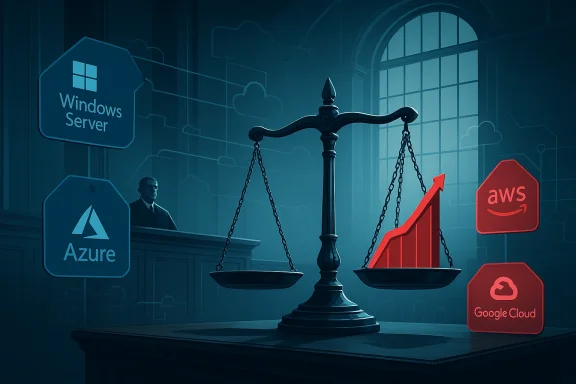 What the Lawsuit Alleges
At the heart of the case is a straightforward but powerful allegation: Microsoft charged more for Windows Server when customers used it outside Azure, and those higher fees distorted competition. If true, that would mean the company did not merely compete on the quality of Azure, but used licensing as a lever to make rival clouds relatively more expensive. In competition terms, that can look like a form of foreclosure, especially if customers are locked into Windows-based workflows and cannot easily move away.The theory of harm
The claimant theory is that Microsoft’s pricing difference was not just a benign product variation, but a market-shaping intervention. Windows Server is a core enterprise dependency, so even small changes in licensing can materially affect where businesses choose to run workloads. If Azure receives a cost advantage while competitors absorb a surcharge, the choice is no longer only about features or uptime. It becomes a question of effective pricing after licensing is added.The legal significance is that the case frames licensing as part of the competitive landscape rather than as an isolated contract term. That framing makes the dispute more consequential because it invites the tribunal to look at market structure, customer dependency, and switching friction. In other words, the question is not simply whether Microsoft can price software differently in different contexts. It is whether those differences unduly protect its own cloud from rival pressure.
Why Windows Server matters
Windows Server is not a marginal product. It is embedded in thousands of enterprise environments and often sits beneath mission-critical applications, identity systems, and legacy infrastructure. That makes it one of the most strategically important pieces of Microsoft’s commercial stack. When a vendor has that kind of installed base, even a subtle licensing change can ripple through procurement, budgeting, and migration planning.The issue also reflects a basic cloud reality: enterprises frequently move to the cloud in stages, and they often keep Microsoft software in place while changing the hosting layer. That means the customer may be buying compute from one provider and operating system rights from another part of the ecosystem. If the software licensor can increase prices outside its own cloud, it can influence the hosting decision without explicitly forbidding competition. That is why the allegation has attracted so much attention.
The claimants’ commercial logic
The claimants’ argument is not just that prices were higher, but that those higher prices were passed through to customers and altered cloud selection. That gives the case a broad economic footprint because the harm is not confined to direct license buyers. It extends to businesses that may have chosen Azure, or stayed with Azure longer than they otherwise would have, because the rival-cloud option became comparatively more expensive.That type of argument is especially compelling in enterprise software markets where purchasing is done through layered procurement decisions. A buyer might never say, “We chose Azure because of one licensing rule,” but the combined effect of software costs, migration risk, and commercial incentives can still steer the outcome. This is precisely the kind of market influence competition authorities tend to care about.
Microsoft’s Defense
Microsoft has pushed back by arguing that the lawsuit does not present a coherent method for calculating damages and should be dismissed. That defense is common in large competition cases, where defendants often try to block claims by challenging the economics before the merits are fully tested. If the court had accepted that argument, the case might have ended early without a full evidentiary record.The damages question
Microsoft’s position appears to be that the claimants cannot credibly separate lawful pricing from alleged overcharge, or translate the alleged conduct into a reliable class-wide damages model. That matters because large-scale competition claims depend on economic assumptions that can be attacked as too speculative, too individualized, or too dependent on counterfactual guesswork. In short, if damages cannot be modeled in a stable way, the lawsuit becomes much harder to prosecute.The tribunal’s refusal to dismiss on that basis is important because it suggests the court believes the alleged harm is at least capable of being tested. That does not mean the claimants will ultimately prevail. It does mean the court is willing to let the economics be fought out in a fuller process rather than treating the damages issue as fatal from the start.
Microsoft’s vertical-integration argument
Microsoft has also defended its business model on broader competition grounds, saying that its vertically integrated approach can promote competition. In that framing, the company is not using licensing to suppress rivals, but building a coherent stack in which Windows Server and Azure work together efficiently. Microsoft’s argument is that integration can lower friction, simplify deployment, and improve customer outcomes.That is a credible defense in principle. Integration is not automatically anti-competitive. Many customers prefer a tightly managed ecosystem because it reduces operational complexity, improves support, and lowers the risk of incompatibilities. The problem for Microsoft is that regulators and claimants may see a different story if the integration also creates a pricing structure that pushes customers toward Azure at the expense of equally capable rivals.
Why the tribunal’s ruling matters
The tribunal’s procedural ruling matters because it keeps both stories alive. Microsoft still gets to argue that the pricing structure is justified by commercial and technical realities, while claimants get the chance to prove it operated as a competitive distortion. That is the exact posture that makes major antitrust and competition cases so unpredictable. Once the evidence is live, the argument shifts from theory to proof.- Microsoft retains the chance to argue integration benefits customers.
- The claimants keep their chance to prove a market-distorting pricing effect.
- The court has signaled that damages can be assessed in a workable way.
- The case can now develop into a fuller test of cloud licensing power.
- Settlement leverage may increase simply because the case survived.
The UK Competition Context
This lawsuit does not arise in a vacuum. UK regulators have already spent significant time examining cloud competition, licensing practices, and the role of hyperscalers in enterprise markets. That matters because tribunals do not make these decisions in isolation; they operate in an environment where policy concerns, market studies, and earlier findings shape the interpretive backdrop.The CMA’s previous concerns
According to the Reuters-linked material provided by the user, a panel from the UK’s Competition and Markets Authority last July concluded that Microsoft’s licensing policies were harming competition by materially disadvantaging AWS and Google. That earlier conclusion is highly relevant because it suggests the dispute is not merely a private disagreement over contract language. It is part of a broader regulatory narrative in which cloud licensing may be functioning as a strategic barrier to rival adoption.That kind of finding tends to matter even when it is not a final enforcement action. It can influence how judges, claimants, and market participants think about the sector. Once a regulator has identified a plausible competitive harm, private litigants can build on that foundation and argue that the market already shows signs of distortion.
Why cloud licensing gets special scrutiny
Cloud licensing is difficult to regulate because it sits between software rights and infrastructure access. On one side, Microsoft is entitled to monetize its intellectual property and recover value from its products. On the other, cloud customers need portability and competitive choice if the market is to function properly. When the same vendor controls both layers, it can shape the market by adjusting terms rather than overtly blocking access.That is why regulators often focus on effective competition, not simply formal choice. A customer may technically be free to use AWS or Google Cloud, but if Windows Server costs substantially more there than on Azure, the freedom may be more theoretical than real. The market can still look competitive on paper while being tilted in practice.
The wider European and US backdrop
The case also arrives amid broader scrutiny of Microsoft’s cloud behavior in Europe and the United States. Across jurisdictions, competition authorities are increasingly alert to software vendors who bundle services, adjust pricing across environments, or use licensing to reinforce platform loyalty. Cloud is now central to digital infrastructure, which makes pricing power in this sector much more consequential than in a traditional software market.That global scrutiny is important because it may encourage convergence in policy thinking. If one jurisdiction sees cloud licensing as a competition problem, others may follow. That does not guarantee coordinated enforcement, but it does increase the odds that Microsoft will face the same argument in multiple venues, in different legal forms, for years to come.
- UK regulators have already signaled concern.
- European scrutiny reinforces the same basic theory of harm.
- US attention adds pressure even without identical legal standards.
- Cloud licensing is now viewed as a market-structure issue.
- The sector’s strategic importance raises the stakes of every case.
Why This Case Could Be Big
The scale of the claim is one reason it stands out. A case involving nearly 60,000 businesses and a potential value in the billions is not an ordinary licensing dispute. It is a direct challenge to how a dominant software vendor can monetize its installed base in a cloud world where customers expect portability and price transparency.A mass claim with platform implications
Mass claims are powerful because they turn a diffuse grievance into a single legal and economic event. If each business were to sue separately, many would never find it worthwhile to proceed. But when a competition lawyer aggregates a large number of affected entities, the litigation becomes capable of producing systemic change. The scale itself creates leverage.This is especially true in cloud markets where the same software policy can affect thousands of customers at once. If Microsoft used a uniform pricing rule across many enterprise accounts, the alleged harm may be broad enough to justify a collective proceeding. That in turn makes the case a potential bellwether for how far UK courts are willing to go in large-scale digital competition disputes.
The economics of switching
One reason this case matters is that cloud switching is rarely simple. Enterprises often stay with a provider because of compatibility, operational risk, staff familiarity, and migration cost. If licensing also penalizes them for leaving Azure, the economic friction compounds. The result is not a hard lock-in, but a system of layered incentives that can be just as effective.That layered friction is what gives the claim its force. The issue is not whether rival clouds exist; they obviously do. The issue is whether Microsoft’s licensing model makes those rivals meaningfully less usable for customers who need Windows Server. That is a more subtle, but often more powerful, competitive concern.
The strategic importance of licensing
For Microsoft, licensing is not a side business. It is a core monetization mechanism that shapes how enterprises consume its ecosystem. The company has enormous leverage because so many organizations depend on Windows Server, Microsoft 365, identity tools, and Azure in overlapping ways. If licensing changes can shift workload placement, they become a strategic instrument, not just an accounting detail.That is why rivals care so much about this case. AWS, Google Cloud, and other providers do not need a court to redesign Microsoft’s commercial model. But they do need a legal process that tests whether the model crosses the line from legitimate differentiation into anti-competitive conduct. If claimants succeed, even partly, it could reshape how the whole sector thinks about software portability.
Azure, AWS, and Google Cloud
The competitive implications are obvious. Azure competes directly with AWS and Google Cloud for enterprise workloads, and Windows Server licensing is one of the less visible but more powerful tools that can affect that rivalry. If Microsoft can make its own cloud economically easier to use for customers already invested in its software, the competitive field is never quite level.Platform economics, not just infrastructure
Cloud buying is often portrayed as a race over compute, storage, AI capability, and geographic reach. Those factors matter, but enterprise customers also respond to ecosystem economics. If running a Microsoft workload on AWS costs more because of licensing, then AWS must either absorb the difference indirectly or convince the customer to pay more for the same outcome. That can make the rival cloud look weaker even if its core service is excellent.This dynamic matters because cloud platforms increasingly sell a whole operating environment rather than discrete servers. The more integrated the environment, the more likely licensing and technical compatibility become part of the product story. Microsoft knows this well, which is why rivals have long complained that the company can use its software dominance to reinforce its cloud position.
Why AWS and Google are particularly exposed
AWS and Google Cloud both compete with Azure at scale, but they do so in slightly different ways. AWS emphasizes breadth, maturity, and operational depth. Google Cloud often leans on data, analytics, and AI differentiation. In both cases, a Microsoft licensing premium on Windows Server can still make it harder to win workloads that depend on Microsoft software. That is especially true in enterprises where Windows Server is not optional.The impact can be even greater because many organizations are multi-cloud in practice. They may spread workloads across providers to reduce concentration risk, optimize pricing, or satisfy procurement rules. If Microsoft’s licensing makes one cloud economically cleaner than another, it can distort those balancing decisions and reduce real competition.
The market-wide message
The broader market message is that cloud competition is no longer just about servers and regions. It is about the legal and commercial rules that govern how software is used across those servers and regions. That should worry every rival, because it means pricing power can travel with the software layer itself. A company does not have to win every contract on pure merit if it can reshape the economics of the choice set.- AWS faces direct pressure from licensing-linked economics.
- Google Cloud faces the same issue in enterprise Windows environments.
- Azure benefits if software costs tilt decisions in its favor.
- Multi-cloud strategies become harder to preserve.
- Rivals may need to lean more on procurement and regulatory pressure.
The Enterprise Customer Problem
For customers, especially large enterprises, the most important issue is not abstract antitrust theory. It is whether licensing makes it harder, more expensive, or riskier to place workloads where they want them. That is why this lawsuit resonates so strongly with procurement teams and CIOs. It speaks directly to how cloud budgets are actually managed.Total cost of ownership is everything
Enterprises rarely choose a cloud provider based on one sticker price. They model total cost of ownership, including licensing, migration labor, support, compliance, and long-term exit risk. If Windows Server costs materially more on a rival cloud, that cost can easily outweigh headline compute discounts. In effect, the operating system price becomes a hidden tax on competition.That creates a serious problem for customers who are trying to diversify their cloud spend. They may believe they are comparing equivalent offers, only to discover that Microsoft’s licensing structure changes the economics behind the scenes. The result can be vendor dependence that looks like rational procurement but behaves like enforced preference.
Procurement, not just engineering
This issue also affects procurement governance. Large enterprises want clear rules, predictable renewal terms, and defensible price comparisons. If licensing is variable by hosting platform, then procurement teams must factor in a moving commercial target. That increases the burden on legal, finance, and technical teams to understand the full licensing stack before making decisions.A lot of cloud lock-in happens at this level. Engineers may be ready to adopt a rival cloud for performance or resilience reasons, but procurement may conclude that the licensing burden makes the move uneconomic. The case is therefore about much more than one software line item. It is about who gets to set the terms of the enterprise cloud equation.
The risk of normalized dependence
Over time, a pricing structure like this can normalize dependence on a dominant vendor. Customers may start with one platform because it is cheaper, then optimize around that platform, then find the cost of leaving too high. At that point, the market is no longer behaving like a competitive choice architecture. It is behaving like a managed dependency.That is why the lawsuit has broader significance for enterprise buyers. Even if the final legal outcome is mixed, the process itself forces an uncomfortable question: are customers selecting Azure because it is genuinely best, or because Microsoft has made the alternatives structurally less attractive? That question is difficult for any platform vendor to answer cleanly.
Strengths and Opportunities
The case has several strengths from a claimant perspective, and it also reveals why the issue may matter for the broader market. The biggest opportunity is that it gives the tribunal a concrete way to examine how software licensing affects cloud choice in practice, not just in theory. That is valuable because it forces the market to confront the mechanics of platform power rather than debating slogans about competition.- The claim reportedly involves a very large group of affected businesses.
- Windows Server is a strategically important enterprise product.
- The alleged pricing difference maps cleanly onto cloud competition.
- The tribunal has allowed the case to proceed, preserving momentum.
- The issue aligns with prior UK regulatory concern.
- The case may encourage more transparent cloud procurement.
- Rivals may gain leverage if licensing scrutiny increases.
Risks and Concerns
Microsoft still has several strong defenses, and the case is far from won by the claimants. The company can argue that its pricing reflects legitimate commercial structure, that integration benefits customers, and that the claimants’ damages model is too speculative to support the sweeping relief they want. There is also a real risk that the case becomes so technically complex that the final outcome is narrower than the headline numbers suggest.- Damages may prove harder to quantify than claimants hope.
- Microsoft can argue integration creates customer value.
- Enterprise purchasing decisions are often multi-causal.
- The court may narrow the scope of any eventual remedy.
- Regulatory interest does not guarantee a plaintiff victory.
- Large collective claims can face proof and class-management challenges.
- The litigation could take years before any substantive resolution.
Looking Ahead
The next phase will likely focus on evidentiary detail: how Microsoft structured the pricing, how customers responded, and whether the alleged premium can be tied to identifiable competitive harm. That is where these cases usually become more revealing. The public narrative is about fairness and overcharging, but the legal outcome will depend on economics, documentation, and the credibility of the competing market models. If the claimants can show that Microsoft’s licensing materially shifted cloud decisions, the case will become much more dangerous for the company.The wider industry should also pay close attention because the lawsuit arrives at a moment when cloud, software, and AI distribution are becoming even more intertwined. If courts and regulators decide that licensing can be used to tilt the playing field too aggressively, then other platform vendors may find themselves under the same microscope. That would not end cloud competition; it would make the rules of competition far more visible, and far more contested, than they have been so far.
- The tribunal will eventually need to test the economic theory in depth.
- Microsoft will likely continue arguing integration and pricing freedom.
- Claimants must prove both harm and a workable damages framework.
- Regulators may watch the litigation closely for market-signaling value.
- Rivals will use the case to reinforce their own competition complaints.
- Enterprise buyers may become more alert to licensing-driven lock-in.
Source: PYMNTS.com Microsoft Must Face Mass Lawsuit in UK Over Cloud Software Pricing | PYMNTS.com
