

Microsoft unified its consumer and commercial Copilot efforts on March 17, 2026, putting Jacob Andreou in charge of a single Copilot experience across personal and workplace products and having him report directly to CEO Satya Nadella as part of a broader AI leadership reshuffle. The move is not just another org-chart shuffle in Redmond; it is Microsoft admitting that its AI assistant cannot win as a bag of disconnected buttons. The promise is seductive: one Copilot that understands work, Windows, Teams, Office, the web, and eventually the rest of your digital life. The danger is just as obvious: the more useful Copilot becomes, the more tightly users and IT departments are pulled into Microsoft’s cloud, identity, data, app, and AI stack.
For the last few years, “Copilot” has meant almost everything and therefore sometimes almost nothing. There was Microsoft 365 Copilot for business users, Copilot in Windows, Copilot in Edge, Copilot for consumers, Copilot Studio, GitHub Copilot, Security Copilot, and a growing family of agentic features scattered through Microsoft’s estate. The brand was unified, but the experience often was not.
That fragmentation mattered because AI assistants are not like traditional apps. A spreadsheet can live separately from an email client and still make sense. An assistant that is supposed to help you across contexts, remember preferences, understand documents, draft responses, summarize meetings, and take actions starts to look foolish when it forgets who you are every time you cross a product boundary.
Microsoft’s March 2026 reorganization is therefore best understood as a product correction. Nadella’s message was that Copilot needed one leader for the end-to-end experience, spanning consumer and commercial usage. Andreou’s remit across design, product, growth, and engineering suggests Microsoft wants fewer seams and fewer competing roadmaps.
That is the right diagnosis. If Copilot is to become the front door to Microsoft software, it cannot feel like a dozen separate assistants sharing a logo. It has to feel like a single system.
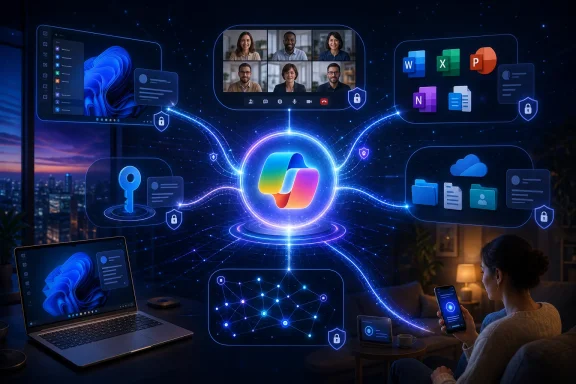
The enterprise version is more complicated. For businesses, Copilot is not just a chatbot. It is an interface layered on top of Microsoft Graph, Entra ID, SharePoint, Exchange, Teams, Office files, Purview controls, device management, and licensing. The value comes from proximity to the data and workflows employees already use.
That is why Microsoft’s “one Copilot” strategy is powerful. It turns Microsoft’s sprawl into an advantage. The same integration that makes Microsoft 365 messy to administer can make Copilot unusually context-rich compared with a third-party assistant dropped into the environment from the outside.
But that is also why the lock-in concern is not paranoia. If Copilot becomes the layer through which employees search, write, meet, automate, and retrieve institutional memory, switching costs rise dramatically. The old lock-in was file formats and app habits; the new lock-in is workflow memory.
That is exactly where Microsoft has leverage. Windows is already on the desktop, Office is already in the workflow, Teams is already the meeting room, Outlook is already the inbox, OneDrive and SharePoint are already the file layer, and Entra ID is already the corporate identity spine. Copilot does not need to knock on the door; in many organizations, it is already inside the building.
For IT leaders, this creates an uncomfortable trade. A unified Copilot could reduce tool sprawl, simplify training, and give administrators a clearer management surface. It could also make Microsoft’s defaults harder to resist, because the assistant becomes more valuable as more of the organization’s work remains inside Microsoft-controlled systems.
That is the classic platform bargain. Microsoft offers coherence, supportability, and integration. In exchange, customers surrender optionality a little at a time.
Microsoft’s retirement of Skype in 2025 and migration path toward Teams Free showed the logic of consolidation. Maintaining two communications products with overlapping features made little strategic sense. Yet Teams remained burdened by its enterprise identity, even when offered for personal use.
That history matters for Copilot because Microsoft is again trying to bridge work and life. The company wants Copilot to be equally natural in a corporate tenant and a personal Microsoft account. But consumers do not always adopt enterprise-shaped tools just because Microsoft places them nearby.
Copilot has a better chance than Teams because AI assistance is broader than chat and meetings. Still, Microsoft should not assume that “one platform” automatically means “one audience.” The needs of a compliance officer and a parent planning a school holiday may intersect technically, but they do not feel the same emotionally.
Today, the practical boundary between work Copilot and personal Copilot is the account boundary. Sign in with a work account, and enterprise rules apply. Sign in with a personal account, and the experience changes. This is inelegant, but it is legible.
A truly seamless assistant strains that model. Users want continuity: preferences, tone, calendar awareness, browser context, device state, and personal productivity habits. Organizations want separation: corporate data must not leak into personal prompts, personal content must not become part of regulated business workflows, and admin policy must be enforceable even when the experience looks unified.
Microsoft can solve much of this technically with tenant boundaries, permissions, labels, audit logs, and policy enforcement. But the user experience will remain delicate. If Copilot feels too divided, the “one assistant” promise weakens. If it feels too blended, security teams will panic.
This is the central tension of the strategy. Microsoft wants Copilot to feel personal without becoming personally dangerous to the enterprise.
That is a much harder governance problem. AI assistants blur categories that traditional IT policy kept separate. A generated meeting summary can become a business record. A prompt can reveal sensitive intent. A draft email can be wrong in ways that are legally or commercially meaningful. An agentic workflow can take action before a human fully understands the chain of reasoning.
The answer is not to ban the tool. In most Microsoft-heavy organizations, that will be impractical. The answer is to treat Copilot as a new operational layer that needs the same seriousness as identity, endpoint management, data loss prevention, and records retention.
The uncomfortable truth is that many companies are not ready. Their SharePoint permissions are messy, their retention policies are uneven, their data classification is aspirational, and their users already paste sensitive information into whatever tool helps them finish the task. Copilot does not create those weaknesses, but it can expose and accelerate them.
This matters because the platform story is stronger when Microsoft owns more layers. If it controls the app surface, identity system, data graph, admin plane, cloud infrastructure, and a growing share of the model layer, it can optimize Copilot in ways competitors cannot easily match. It can also tune cost, latency, safety behavior, and enterprise features more directly.
The OpenAI partnership is still strategically central, but Microsoft clearly does not want Copilot’s future to depend entirely on another company’s roadmap. That is rational. No platform company wants its most important interface controlled from the outside.
For customers, the implications cut both ways. More Microsoft-native models could mean better enterprise tuning, more predictable compliance commitments, and lower costs over time. It could also mean that Copilot becomes less a neutral AI interface and more an extension of Microsoft’s own infrastructure ambitions.
If employees grow accustomed to using independent assistants that sit above Microsoft 365, Google Workspace, Slack, Salesforce, ServiceNow, and internal systems, Microsoft risks losing the interface battle even while retaining the underlying productivity revenue. The company has seen that movie before. Windows remained important while the browser, the phone, and the cloud shifted where user attention lived.
Copilot is Microsoft’s attempt to prevent that from happening again. By embedding AI into the existing work surface, Microsoft is trying to make the assistant feel less like a destination and more like the operating fabric of productivity.
That is why the consumer-commercial unification matters. Microsoft does not just want Copilot to be the assistant employees use when forced by corporate licensing. It wants Copilot to become habitual. Habits formed at home reinforce habits at work, and habits formed at work normalize the tool at home.
That does not mean every Copilot integration in Windows will be loved. Microsoft has already learned that shoving AI-branded buttons into the shell can generate backlash if the feature feels more like promotion than utility. Windows users are unusually sensitive to anything that appears to clutter the desktop, alter defaults, or blur the line between local control and cloud service.
But Windows remains Microsoft’s most valuable consumer-enterprise bridge. A work laptop is also a personal browser, a home device may connect to a school account, and a personal Microsoft account often sits one login away from business identity. If one Copilot is going to cross the boundary between life and work, Windows is where many users will feel that crossing first.
The operating system also gives Microsoft a path toward agentic actions that go beyond document generation. An assistant that can adjust settings, find files, manage windows, triage notifications, and coordinate across apps becomes more than a sidebar. It becomes a control surface.
Enterprises will need clarity on what the unified strategy changes and what it does not. A single product leader does not automatically mean a single SKU, a single admin model, or a single entitlement. Microsoft has strong incentives to package advanced capabilities in ways that preserve premium revenue.
This is where IT procurement and technical governance intersect. If Copilot becomes more central to daily work, licensing decisions become architecture decisions. Choosing who gets access, which agents are enabled, and which connectors are allowed will shape not only cost but also organizational behavior.
The risk is that Copilot adoption grows sideways. Departments may buy different tiers, power users may build agents without consistent oversight, and business units may assume that anything branded Copilot has the same data handling model. Microsoft needs to make the commercial map as coherent as the product vision, or administrators will inherit the confusion.
But “managed” does not mean “safe by default.” Copilot respects permissions, which is useful only if permissions are correct. It can surface information quickly, which is productive unless the information should never have been broadly accessible. It can generate confident text, which is helpful unless users stop checking its work.
The security problem is therefore socio-technical. Microsoft can provide controls, but customers must clean up their data estates, rationalize access, train users, define acceptable use, and monitor outcomes. The assistant’s intelligence does not compensate for weak governance; it amplifies whatever governance already exists.
This is why the unified Copilot strategy should make security teams more involved, not less. If Copilot is no longer a discrete enterprise feature but a cross-context assistant, the security review cannot be a one-time licensing gate. It has to become an ongoing operational discipline.
In that environment, Microsoft’s pitch is brutally effective: stop stitching together random AI tools and use the assistant already integrated into your productivity suite. The company can make this sound responsible, not merely convenient. Standardize on Copilot, apply Microsoft’s controls, and reduce the chaos.
There is truth in that pitch. Fragmented AI adoption is risky. Shadow AI is already the new shadow IT. A sanctioned platform with admin visibility is preferable to employees improvising with consumer tools and sensitive data.
But the cure has its own side effects. Standardizing too early on one vendor’s assistant may narrow future options just as the AI market is still evolving. The best model, interface, agent framework, or governance architecture of 2028 may not be the one bundled most neatly into Microsoft 365 in 2026.
That is a different problem from enterprise distribution. Microsoft can sell Copilot into organizations through licensing, bundling, executive relationships, and security assurances. It cannot force users to trust the assistant with their attention. If Copilot is slow, generic, intrusive, or inconsistently useful, employees will route around it.
Consumer expectations are even less forgiving. People tolerate clunky enterprise software because work requires it. They abandon personal tools quickly when they feel awkward or uncool. If Microsoft wants one Copilot to span both worlds, it has to escape the gravitational pull of enterprise software design.
That may be why Andreou’s background in consumer product and growth matters. Copilot needs admin credibility, but it also needs everyday appeal. The assistant must become useful in small repeated moments, not just impressive in stage demos.
Microsoft will likely keep emphasizing trust, integration, and openness. Customers should listen, but they should also demand specificity. How are personal and work contexts separated? Which admin policies follow users across devices? What happens when employees use personal accounts on managed hardware? How are agent actions logged, reviewed, and constrained? Which models process which data under which contractual terms?
Those questions are not hostile. They are the price of taking Microsoft’s vision seriously. If Copilot is going to become the everyday interface for work and life, it deserves the same scrutiny as the operating system, the identity provider, and the productivity suite.
 Microsoft Stops Pretending Copilot Is a Product Line
For the last few years, “Copilot” has meant almost everything and therefore sometimes almost nothing. There was Microsoft 365 Copilot for business users, Copilot in Windows, Copilot in Edge, Copilot for consumers, Copilot Studio, GitHub Copilot, Security Copilot, and a growing family of agentic features scattered through Microsoft’s estate. The brand was unified, but the experience often was not.That fragmentation mattered because AI assistants are not like traditional apps. A spreadsheet can live separately from an email client and still make sense. An assistant that is supposed to help you across contexts, remember preferences, understand documents, draft responses, summarize meetings, and take actions starts to look foolish when it forgets who you are every time you cross a product boundary.
Microsoft’s March 2026 reorganization is therefore best understood as a product correction. Nadella’s message was that Copilot needed one leader for the end-to-end experience, spanning consumer and commercial usage. Andreou’s remit across design, product, growth, and engineering suggests Microsoft wants fewer seams and fewer competing roadmaps.
That is the right diagnosis. If Copilot is to become the front door to Microsoft software, it cannot feel like a dozen separate assistants sharing a logo. It has to feel like a single system.
The Unified Assistant Is Really a Unified Business Model
The consumer-friendly version of this story is simple: one AI companion follows you from work to life. It helps you write a quarterly review in Word, summarize a Teams meeting, find a file in OneDrive, draft a dinner invitation, plan a trip, and maybe control parts of Windows without forcing you to think about which Copilot you are using.The enterprise version is more complicated. For businesses, Copilot is not just a chatbot. It is an interface layered on top of Microsoft Graph, Entra ID, SharePoint, Exchange, Teams, Office files, Purview controls, device management, and licensing. The value comes from proximity to the data and workflows employees already use.
That is why Microsoft’s “one Copilot” strategy is powerful. It turns Microsoft’s sprawl into an advantage. The same integration that makes Microsoft 365 messy to administer can make Copilot unusually context-rich compared with a third-party assistant dropped into the environment from the outside.
But that is also why the lock-in concern is not paranoia. If Copilot becomes the layer through which employees search, write, meet, automate, and retrieve institutional memory, switching costs rise dramatically. The old lock-in was file formats and app habits; the new lock-in is workflow memory.
The Golden Handcuffs Are Padded With Convenience
Microsoft is not wrong to argue that integration makes AI better. Most users do not want to configure model providers, connect data sources, evaluate retrieval pipelines, and decide which assistant should handle which task. They want the thing in front of them to work.That is exactly where Microsoft has leverage. Windows is already on the desktop, Office is already in the workflow, Teams is already the meeting room, Outlook is already the inbox, OneDrive and SharePoint are already the file layer, and Entra ID is already the corporate identity spine. Copilot does not need to knock on the door; in many organizations, it is already inside the building.
For IT leaders, this creates an uncomfortable trade. A unified Copilot could reduce tool sprawl, simplify training, and give administrators a clearer management surface. It could also make Microsoft’s defaults harder to resist, because the assistant becomes more valuable as more of the organization’s work remains inside Microsoft-controlled systems.
That is the classic platform bargain. Microsoft offers coherence, supportability, and integration. In exchange, customers surrender optionality a little at a time.
Teams Shows That One Platform Does Not Guarantee One Audience
Microsoft has tried this kind of convergence before, and the results are mixed. Skype was once a household name in consumer communications. Teams became the dominant collaboration product in many businesses, but it never inherited Skype’s cultural role as a casual, cross-platform consumer verb.Microsoft’s retirement of Skype in 2025 and migration path toward Teams Free showed the logic of consolidation. Maintaining two communications products with overlapping features made little strategic sense. Yet Teams remained burdened by its enterprise identity, even when offered for personal use.
That history matters for Copilot because Microsoft is again trying to bridge work and life. The company wants Copilot to be equally natural in a corporate tenant and a personal Microsoft account. But consumers do not always adopt enterprise-shaped tools just because Microsoft places them nearby.
Copilot has a better chance than Teams because AI assistance is broader than chat and meetings. Still, Microsoft should not assume that “one platform” automatically means “one audience.” The needs of a compliance officer and a parent planning a school holiday may intersect technically, but they do not feel the same emotionally.
Identity Is Where the Dream Gets Messy
The hardest part of one Copilot is not the model. It is identity.Today, the practical boundary between work Copilot and personal Copilot is the account boundary. Sign in with a work account, and enterprise rules apply. Sign in with a personal account, and the experience changes. This is inelegant, but it is legible.
A truly seamless assistant strains that model. Users want continuity: preferences, tone, calendar awareness, browser context, device state, and personal productivity habits. Organizations want separation: corporate data must not leak into personal prompts, personal content must not become part of regulated business workflows, and admin policy must be enforceable even when the experience looks unified.
Microsoft can solve much of this technically with tenant boundaries, permissions, labels, audit logs, and policy enforcement. But the user experience will remain delicate. If Copilot feels too divided, the “one assistant” promise weakens. If it feels too blended, security teams will panic.
This is the central tension of the strategy. Microsoft wants Copilot to feel personal without becoming personally dangerous to the enterprise.
The Governance Burden Moves From Feature Control to Behavior Control
Early Copilot administration has often focused on enablement: who gets a license, which apps expose the assistant, what data is indexed, and which controls apply. A unified Copilot changes the emphasis. The question becomes less “Is Copilot turned on?” and more “What is Copilot allowed to know, infer, generate, and do in each context?”That is a much harder governance problem. AI assistants blur categories that traditional IT policy kept separate. A generated meeting summary can become a business record. A prompt can reveal sensitive intent. A draft email can be wrong in ways that are legally or commercially meaningful. An agentic workflow can take action before a human fully understands the chain of reasoning.
The answer is not to ban the tool. In most Microsoft-heavy organizations, that will be impractical. The answer is to treat Copilot as a new operational layer that needs the same seriousness as identity, endpoint management, data loss prevention, and records retention.
The uncomfortable truth is that many companies are not ready. Their SharePoint permissions are messy, their retention policies are uneven, their data classification is aspirational, and their users already paste sensitive information into whatever tool helps them finish the task. Copilot does not create those weaknesses, but it can expose and accelerate them.
Microsoft’s Own Models Make the Strategy More Microsoft-Native
The Copilot consolidation also lands alongside Microsoft’s push to build more of its own AI models. The company’s MAI-branded work in transcription, voice, and image generation signals a desire to control more of the stack beneath Copilot, even while Microsoft continues to rely heavily on major model partners.This matters because the platform story is stronger when Microsoft owns more layers. If it controls the app surface, identity system, data graph, admin plane, cloud infrastructure, and a growing share of the model layer, it can optimize Copilot in ways competitors cannot easily match. It can also tune cost, latency, safety behavior, and enterprise features more directly.
The OpenAI partnership is still strategically central, but Microsoft clearly does not want Copilot’s future to depend entirely on another company’s roadmap. That is rational. No platform company wants its most important interface controlled from the outside.
For customers, the implications cut both ways. More Microsoft-native models could mean better enterprise tuning, more predictable compliance commitments, and lower costs over time. It could also mean that Copilot becomes less a neutral AI interface and more an extension of Microsoft’s own infrastructure ambitions.
The Real Competition Is Not Another Chatbot
It is tempting to frame unified Copilot as a fight against ChatGPT, Gemini, Claude, or whatever assistant happens to be leading consumer attention this quarter. That is only partly right. Microsoft’s more important competition is the possibility that AI becomes a cross-platform layer Microsoft does not control.If employees grow accustomed to using independent assistants that sit above Microsoft 365, Google Workspace, Slack, Salesforce, ServiceNow, and internal systems, Microsoft risks losing the interface battle even while retaining the underlying productivity revenue. The company has seen that movie before. Windows remained important while the browser, the phone, and the cloud shifted where user attention lived.
Copilot is Microsoft’s attempt to prevent that from happening again. By embedding AI into the existing work surface, Microsoft is trying to make the assistant feel less like a destination and more like the operating fabric of productivity.
That is why the consumer-commercial unification matters. Microsoft does not just want Copilot to be the assistant employees use when forced by corporate licensing. It wants Copilot to become habitual. Habits formed at home reinforce habits at work, and habits formed at work normalize the tool at home.
Windows Becomes the Most Strategic Surface Again
For WindowsForum readers, the Windows angle is especially important. Copilot’s future is not confined to Microsoft 365. Windows is the place where Microsoft can make AI feel ambient, persistent, and difficult to ignore.That does not mean every Copilot integration in Windows will be loved. Microsoft has already learned that shoving AI-branded buttons into the shell can generate backlash if the feature feels more like promotion than utility. Windows users are unusually sensitive to anything that appears to clutter the desktop, alter defaults, or blur the line between local control and cloud service.
But Windows remains Microsoft’s most valuable consumer-enterprise bridge. A work laptop is also a personal browser, a home device may connect to a school account, and a personal Microsoft account often sits one login away from business identity. If one Copilot is going to cross the boundary between life and work, Windows is where many users will feel that crossing first.
The operating system also gives Microsoft a path toward agentic actions that go beyond document generation. An assistant that can adjust settings, find files, manage windows, triage notifications, and coordinate across apps becomes more than a sidebar. It becomes a control surface.
Licensing Will Decide How Unified This Feels in Practice
Microsoft can talk about one Copilot, but licensing may still carve the experience into tiers. That is not a minor detail. If consumer Copilot, Microsoft 365 Copilot, Copilot Pro, Copilot Studio, Security Copilot, and specialized agents remain commercially fragmented, the user-facing brand may unify faster than the customer’s bill.Enterprises will need clarity on what the unified strategy changes and what it does not. A single product leader does not automatically mean a single SKU, a single admin model, or a single entitlement. Microsoft has strong incentives to package advanced capabilities in ways that preserve premium revenue.
This is where IT procurement and technical governance intersect. If Copilot becomes more central to daily work, licensing decisions become architecture decisions. Choosing who gets access, which agents are enabled, and which connectors are allowed will shape not only cost but also organizational behavior.
The risk is that Copilot adoption grows sideways. Departments may buy different tiers, power users may build agents without consistent oversight, and business units may assume that anything branded Copilot has the same data handling model. Microsoft needs to make the commercial map as coherent as the product vision, or administrators will inherit the confusion.
The Security Pitch Is Stronger Than the Security Reality
Microsoft’s strongest enterprise argument is that Copilot can be governed inside the Microsoft trust boundary. Compared with unsanctioned AI tools, a managed Copilot deployment offers administrators better identity integration, auditing, compliance hooks, and data controls. For many organizations, that is reason enough to prefer it.But “managed” does not mean “safe by default.” Copilot respects permissions, which is useful only if permissions are correct. It can surface information quickly, which is productive unless the information should never have been broadly accessible. It can generate confident text, which is helpful unless users stop checking its work.
The security problem is therefore socio-technical. Microsoft can provide controls, but customers must clean up their data estates, rationalize access, train users, define acceptable use, and monitor outcomes. The assistant’s intelligence does not compensate for weak governance; it amplifies whatever governance already exists.
This is why the unified Copilot strategy should make security teams more involved, not less. If Copilot is no longer a discrete enterprise feature but a cross-context assistant, the security review cannot be a one-time licensing gate. It has to become an ongoing operational discipline.
Microsoft Is Selling Simplicity to a Market Drowning in AI Choice
The broader market context helps explain why Microsoft is moving now. AI tools have proliferated faster than enterprise governance models can absorb them. Employees are experimenting, vendors are adding agents to everything, and CIOs are being asked to deliver productivity gains without creating a compliance bonfire.In that environment, Microsoft’s pitch is brutally effective: stop stitching together random AI tools and use the assistant already integrated into your productivity suite. The company can make this sound responsible, not merely convenient. Standardize on Copilot, apply Microsoft’s controls, and reduce the chaos.
There is truth in that pitch. Fragmented AI adoption is risky. Shadow AI is already the new shadow IT. A sanctioned platform with admin visibility is preferable to employees improvising with consumer tools and sensitive data.
But the cure has its own side effects. Standardizing too early on one vendor’s assistant may narrow future options just as the AI market is still evolving. The best model, interface, agent framework, or governance architecture of 2028 may not be the one bundled most neatly into Microsoft 365 in 2026.
The Andreou Era Has to Prove Copilot Can Be Loved, Not Just Deployed
Jacob Andreou’s challenge is not merely to organize engineering teams. It is to make Copilot feel coherent enough that users choose it when alternatives are one browser tab away.That is a different problem from enterprise distribution. Microsoft can sell Copilot into organizations through licensing, bundling, executive relationships, and security assurances. It cannot force users to trust the assistant with their attention. If Copilot is slow, generic, intrusive, or inconsistently useful, employees will route around it.
Consumer expectations are even less forgiving. People tolerate clunky enterprise software because work requires it. They abandon personal tools quickly when they feel awkward or uncool. If Microsoft wants one Copilot to span both worlds, it has to escape the gravitational pull of enterprise software design.
That may be why Andreou’s background in consumer product and growth matters. Copilot needs admin credibility, but it also needs everyday appeal. The assistant must become useful in small repeated moments, not just impressive in stage demos.
The Fine Print Redmond Cannot Afford to Mumble
The practical questions for IT leaders are now sharper than Microsoft’s marketing language. A unified Copilot strategy should trigger a review of data boundaries, identity assumptions, procurement plans, and employee training before adoption becomes culturally irreversible.Microsoft will likely keep emphasizing trust, integration, and openness. Customers should listen, but they should also demand specificity. How are personal and work contexts separated? Which admin policies follow users across devices? What happens when employees use personal accounts on managed hardware? How are agent actions logged, reviewed, and constrained? Which models process which data under which contractual terms?
Those questions are not hostile. They are the price of taking Microsoft’s vision seriously. If Copilot is going to become the everyday interface for work and life, it deserves the same scrutiny as the operating system, the identity provider, and the productivity suite.
The Copilot Merger Leaves IT With Fewer Excuses
Microsoft’s unification push does not require panic, but it does require preparation. The organizations that benefit most will be the ones that treat Copilot as a governed platform rather than a novelty feature.- Microsoft’s March 2026 Copilot reorganization makes clear that consumer and commercial AI experiences are now part of one strategic product bet.
- A unified Copilot could reduce fragmentation for users, but it may increase long-term dependency on Microsoft’s cloud, identity, app, and data ecosystem.
- The most important enterprise issue is not whether Copilot can generate useful text, but whether work and personal data boundaries remain clear and enforceable.
- Skype’s retirement and Teams’ uneven consumer identity show that Microsoft cannot assume enterprise success will translate into personal adoption.
- Microsoft’s growing investment in its own MAI models gives Copilot a more vertically integrated future, even as partner models remain important.
- IT leaders should review licensing, permissions, data classification, auditability, and employee training before Copilot becomes embedded in daily workflows.
References
- Primary source: Petri IT Knowledgebase
Published: 2026-06-11T11:42:08.741382
One Copilot: Microsoft's Unified AI Platform for Work & Life
Unifying Copilot under one umbrella is a forward-looking bet from Microsoft. But what does it mean for IT organizations? petri.com
- Official source: support.microsoft.com
Skype is retiring in May 2025: What you need to know | Microsoft Support
Skype is retiring in May 2025. Switch over to Teams Free to keep all your chats and contacts in one place, or export your data. Learn more in this FAQ.support.microsoft.com - Official source: blogs.microsoft.com
Announcing Copilot leadership update - The Official Microsoft Blog
Satya Nadella, Chairman and CEO, and Mustafa Suleyman, Executive Vice President and CEO of Microsoft AI, shared the below communications with Microsoft employees this morning. SATYA NADELLA MESSAGE I want to share two org changes we’re making to our Copilot org and superintelligence effort. It’s...blogs.microsoft.com - Related coverage: techcrunch.com
Microsoft takes on AI rivals with three new foundational models | TechCrunch
MAI released models that can transcribe voice into text as well as generate audio and images after the group's formation six months ago.techcrunch.com - Related coverage: pymnts.com
PYMNTS | Microsoft Combining Commercial and Consumer AI Efforts
Microsoft is reconfiguring the various teams working on its flagship artificial intelligence (AI) offering. www.pymnts.com
- Related coverage: theinformation.com
Microsoft Overhauls AI Leadership, Nadella to Take More Direct Oversight of Copilot — The Information
Microsoft is overhauling its executive ranks to give CEO Satya Nadella more direct oversight of engineering teams working on its Copilot chatbots, Nadella said in a memo to staff Tuesday. The reorganization will bring together engineering divisions working on the consumer version of Copilot...www.theinformation.com
- Related coverage: investing.com
Microsoft rejigs Copilot teams, freeing up AI chief for superintelligence push By Reuters
Microsoft rejigs Copilot teams, freeing up AI chief for superintelligence pushwww.investing.com - Related coverage: bloomberg.com
- Related coverage: guavanews.com
마이크로소프트, AI 비서 '코파일럿' 조직 통합…경쟁 심화 대응
마이크로소프트가 AI 비서 '코파일럿'의 법인 및 소비자 팀을 통합하며 조직 재편을 발표했다. 이는 경쟁사 AI 서비스에 대한 대응으로 보인다. guavanews.com
- Related coverage: mlq.ai
Microsoft Restructures Copilot Teams Under New Leader Jacob Andreou | MLQ News
Microsoft announced a major reorganization of its Copilot AI division, merging consumer and commercial product teams under Jacob Andreou, newly promoted to EVP…mlq.ai - Related coverage: ai-beat.github.io
Microsoft Starts Building Its Own · AI Beat
Microsoft released three foundational AI models through Azure AI Foundry on April 2: MAI-Transcribe-1 for speech, MAI-Voice-1 for synthesis, and MAI-Image-2 for generation. These are Microsoft's first internally built foundational models — a quiet but significant signal that the company wants... ai-beat.github.io
- Related coverage: geekwire.com
Microsoft revamps Copilot structure, elevating former Snap exec as Suleyman shifts to AI models – GeekWire
Microsoft is reorganizing its Copilot organization, unifying its consumer and commercial AI efforts under former Snap executive Jacob Andreou while narrowing the role of Microsoft AI leader Mustafa Suleyman to focus on superintelligence and frontier models.www.geekwire.com - Related coverage: techradar.com
Microsoft is mixing up its Copilot AI leadership, so Suleyman can 'build enterprise tuned lineages' | TechRadar
Microsoft brings consumer and enterprise Copilot into closer alignmentwww.techradar.com - Related coverage: windowscentral.com
Microsoft Copilot Changes: Moving Away From OpenAI? | Windows Central
Ex-SnapChat exec takes over Copilot AI experiences as Microsoft AI CEO doubles down on in-house modelswww.windowscentral.com - Related coverage: tomsguide.com
Microsoft debuts MAI-Image-1, its first in-house AI image generator | Tom's Guide
Microsoft has launched its first in-house image generation tool, and it's already landed a top spot in the LMArena.www.tomsguide.com - Related coverage: as.com
- Related coverage: nextepinvestimentos.com.br
Microsoft Offers Its First Ever Buyouts to Shape Workforce Around AI Push - WSJ
PDF documentnextepinvestimentos.com.br
- Official source: microsoft.com
</rdf:Alt> </dc:title> <dc:description> <rdf:Alt> <rdf:li xml:lang="x-default"/> </rdf:Alt> </dc:description> <dc:creator> <rdf:Seq> <rdf:li>Lukas V
</rdf:Alt> </dc:description> <dc:creator> <rdf:Seq> <rdf:li>Lukas Velushwww.microsoft.com
