

Microsoft is offering a one-time voluntary retirement package to roughly 8,750 eligible U.S. employees in May 2026, targeting longtime workers at level 67 and below whose age plus years of service total at least 70. The company is framing the program as a supported off-ramp, not a layoff. But the details make clear that this is also a cost-control instrument designed for a Microsoft that is spending aggressively on AI infrastructure while trying to reshape its workforce without another blunt-force reduction. The offer is generous enough to matter, narrow enough to be strategic, and revealing enough to show where Microsoft thinks the next phase of efficiency has to come from.
The most important thing about Microsoft’s voluntary retirement program is not that it exists. It is that it exists at Microsoft, a company still printing cash, still central to the AI boom, and still able to tell Wall Street a compelling growth story.
Voluntary retirement programs are familiar in industrial America. Airlines, automakers, telecom giants, and old-line manufacturers have long used them to reduce payroll without the reputational and legal mess of mass layoffs. In big tech, the pattern has usually been different: hire aggressively, reorganize abruptly, cut teams in waves, and describe the result as prioritization.
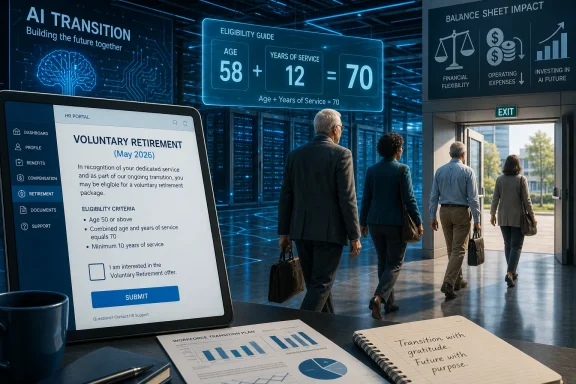
Microsoft is now borrowing from the older corporate playbook. The offer reportedly applies to U.S.-based employees at level 67 or below whose age plus tenure equals 70 or more, excluding some groups such as employees on sales incentive plans. That formula is not random. It selects for people who have spent enough years inside Microsoft to have accumulated institutional memory, compensation, stock, and healthcare expectations that make ordinary layoffs more complicated.
The package itself reinforces the point. Eligible employees who accept can reportedly receive between eight and 39 weeks of base pay, continued medical, dental, and vision access for up to five years, and accelerated stock vesting that can range from six months to as much as a year for certain long-serving workers. This is not a gold watch. It is a negotiated corporate nudge.
Microsoft can call it voluntary, and it appears to be voluntary. But a voluntary exit program during an efficiency push is never just an act of generosity. It is a signal that the company wants fewer people in certain cost bands, fewer long-tenured employees sitting in expensive roles, and more freedom to reshape teams around AI-era priorities.
That choice has weight because Microsoft has already been cutting. The company has gone through multiple rounds of layoffs in recent years, including large reductions tied to gaming, sales, recruiting, and broader organizational streamlining. At the same time, it has been pouring capital into data centers, GPUs, cloud capacity, and AI services at a pace that has changed the internal economics of the company.
The old Microsoft could afford to carry layers of veteran expertise because Windows, Office, Azure, and enterprise contracts generated durable margins. The new Microsoft still has those engines, but it is also making one of the largest infrastructure bets in corporate history. When AI compute becomes a strategic necessity, payroll becomes one of the places management looks for offsetting discipline.
That is why the reported $900 million charge matters. It sounds enormous until it is placed against Microsoft’s scale, but it is still real money. A company does not take that charge merely to honor loyal employees. It does so because it believes the long-term payroll, benefits, and organizational savings justify the near-term expense.
The softer nature of the program should not be dismissed. A voluntary offer can be more humane than a surprise layoff notice, especially for employees who were already considering retirement, consulting, a second career, or a slower pace. But soft is not the same as sentimental. This is a spreadsheet decision with a better human interface.
A 55-year-old with 15 years at Microsoft qualifies. A 50-year-old with 20 years qualifies. A 45-year-old with 25 years qualifies. The program is therefore not limited to people ready for traditional retirement, particularly in a tech labor market where many workers expect to remain employed well into their 60s.
That creates a tension Microsoft cannot fully smooth over with language about “next chapters.” For some eligible employees, the offer may be genuinely attractive. For others, it may feel like an early warning siren: take the package now, or risk facing less generous options later.
The reported exclusion of senior director-equivalent and below employees also tells a story. Microsoft is not offering a broad executive retirement window. It is reaching into the experienced professional and middle-management layers where large organizations often accumulate complexity. These are the people who know how systems actually work, who can unblock obscure processes, and who also represent significant compensation commitments.
That makes the program risky as well as efficient. Institutional memory is expensive, but so is losing it too quickly. Anyone who has watched a large enterprise system fail after “streamlining” knows that the people who look redundant in org charts are sometimes the people preventing outages, compliance mistakes, and doomed migrations.
Microsoft reportedly will extend access to medical, dental, and vision coverage for up to five years, with the first year fully covered by the company and employees paying the standard fee afterward. That can be meaningful for employees who are close to Medicare eligibility but not there yet. It can also be the difference between a theoretical retirement and a plausible one.
The catch is that healthcare continuation does not mean indefinite security. Employees who become Medicare-eligible at 65 reportedly lose access to Microsoft’s continuation at that point, even if their five-year window has not run its full course. For some workers, that may be perfectly sensible. For others, the arithmetic of age, dependents, local insurance markets, and ongoing medical needs will make the decision far more complicated than a headline suggests.
This is why voluntary retirement programs often produce uneven reactions inside companies. One employee sees a dignified exit with healthcare and stock. Another sees a package that is not enough to bridge a family’s real-world obligations. A third sees a warning that refusing the offer could leave them exposed to a future layoff with worse terms.
Microsoft’s managers will need to handle that ambiguity carefully. A retirement offer can be voluntary on paper while still feeling coercive if workers believe the company has already decided their cohort is too expensive. The difference between choice and pressure is often not in the document; it is in the surrounding climate.
By offering additional vesting, Microsoft is addressing the very thing that often keeps senior employees in place. A worker who might otherwise leave can be reluctant to walk away from months of scheduled vesting. A retirement package that accelerates stock reduces that friction and makes the exit more rational.
The reported structure appears designed to reward deeper tenure. Most participants would receive an additional six months of vesting, while employees with more than 24 years of service could receive up to a year. Certain long-serving employees may continue vesting under existing terms. That makes the package more attractive to the exact group Microsoft is trying to reach: people whose financial relationship with the company is long, layered, and tied to equity.
This is also where the “generous support” language becomes more complicated. Microsoft is not simply giving away value. It is purchasing certainty. The company is paying to convert an ongoing employment relationship into a managed departure, with fewer disputes, fewer morale shocks, and less visible damage than another layoff wave.
For employees, the calculation is intensely personal. If Microsoft stock continues to perform, leaving with accelerated vesting may look smart but not extraordinary. If future layoffs come with less favorable treatment, accepting now may look prescient. If an employee still wants to work, still has strong prospects, and can land elsewhere without reemployment restrictions, the package could become a launchpad rather than an ending.
Microsoft’s AI strategy is capital-hungry. Training, serving, integrating, and scaling AI features across Azure, Microsoft 365, GitHub, Windows, and security products requires enormous infrastructure spending. That spending has to be defended to investors not just with growth forecasts, but with evidence that the company can keep margins under control.
This is where headcount becomes symbolic as well as financial. A company can tell Wall Street it is investing for the future. But if operating expenses balloon while AI revenue remains hard to isolate, the questions get sharper. Voluntary retirement becomes one way to show discipline without admitting that the AI transition is forcing more painful choices.
The irony is that many of the eligible employees likely helped build the systems Microsoft is now using to fund its AI ambitions. Windows, Office, Exchange, SharePoint, SQL Server, Azure, Xbox, developer tools, identity platforms, and enterprise support all depended on long-haul expertise. The new AI stack does not float above that legacy. It sits on top of it.
That is why the company has to be careful not to confuse old with obsolete. The AI era needs new skills, but it also needs people who understand customers, uptime, security, regulatory promises, and the ugly edge cases of enterprise computing. Cutting cost is easy to model. Rebuilding trust after a knowledge drain is harder.
Large tech companies use compensation architecture to shape behavior. Levels define status, mobility, pay expectations, promotion ladders, and retention battles. When Microsoft simplifies levels, it is not merely cleaning up HR paperwork. It is changing the map employees use to understand their careers.
Greater flexibility in stock grants for longtime employees could soften some of the anxiety created by the retirement offer. It may give managers more room to retain high-value veterans who do not fit neatly into current performance frameworks. It may also help Microsoft avoid losing exactly the people it cannot easily replace.
But flexibility can cut both ways. A simpler structure can make compensation easier to manage, but it can also make distinctions less transparent. Employees who have learned to decode Microsoft’s levels over years may find the new system harder to predict. In a company famous for internal calibration and performance rituals, ambiguity around pay is never just an HR issue.
For IT pros watching from outside Microsoft, this is a useful reminder that tech workforce changes are rarely isolated events. A buyout, a compensation restructure, a return-to-office policy, and an AI spending surge may be announced separately. Inside the company, employees experience them as one continuous pressure system.
Windows is not a startup product. It is a living treaty among consumers, OEMs, enterprise administrators, developers, hardware vendors, security teams, accessibility requirements, backward compatibility promises, and regulatory constraints. The most valuable Windows knowledge often lives in people who remember why a strange behavior exists, which customer broke when it was changed, and what hidden dependency still expects it.
Microsoft has been trying to make Windows feel more modern, more cloud-connected, and more AI-infused. Copilot integration, Recall controversies, security baseline changes, ARM ambitions, and ongoing update reliability debates all show a company trying to move faster on a platform that punishes careless speed. In that context, the departure of experienced employees is not automatically bad, but it is not trivial.
Administrators understand this better than most. When a veteran engineer leaves a corporate IT team, the job description may be filled quickly. The accumulated map of fragile scripts, legacy applications, odd licensing arrangements, and executive exceptions is not. Microsoft faces a version of the same problem at planetary scale.
That does not mean the company should freeze its workforce in amber. Platforms need renewal. Younger engineers and product managers bring different assumptions, and some old processes deserve to die. The risk is not change. The risk is losing the people who know which changes are safe.
But the program also tells employees something blunt: Microsoft is not done optimizing. The company’s AI ambitions do not remove the need for expense discipline; they intensify it. Long tenure is no longer simply a badge of value. It is also a cost category management is willing to address directly.
That message will travel beyond the eligible pool. Employees who do not qualify will still read the signal. Managers will wonder which teams are next. Recruiters at rival firms will know that a wave of highly experienced Microsoft talent may be available. Customers will wonder whether support, product continuity, and account knowledge will shift as familiar faces exit.
The best outcome for Microsoft is that the program attracts people who were already close to leaving, reduces costs without hollowing out critical teams, and gives managers room to retain essential experts. The worst outcome is that it nudges out precisely the people who know how to keep complex systems stable, while leaving behind a more anxious workforce.
Most likely, the result will be mixed. Some employees will take a smart deal and thrive elsewhere. Some will retire gratefully. Some will stay and feel newly uncertain. Microsoft will declare the program orderly, investors will absorb the charge, and the real impact will show up later in execution, product quality, and customer confidence.
For longtime Microsoft employees, the decision is not merely financial. It is identity. People who joined during the Ballmer years, the Windows XP era, the rise of Azure, or the early Satya Nadella transformation have lived through multiple Microsofts. Leaving now means exiting as the company turns itself into an AI infrastructure and platform giant with a much more aggressive cost posture.
That timing matters. If AI becomes the next durable growth engine, some employees may regret leaving before the next phase fully matures. If AI spending forces further cuts and reorganizations, the voluntary package may look like the cleanest door Microsoft was ever going to offer.
The lack of reported reemployment restrictions, if accurate, also changes the calculus. An employee who can take the package and then work elsewhere may treat the offer as a subsidized transition rather than retirement. That could make the program attractive to experienced engineers, program managers, architects, and specialists who still have market value but no longer want to navigate Microsoft’s internal machinery.
For Microsoft, that is both good and dangerous. It helps the program succeed. It also means competitors, startups, cloud customers, consulting firms, and AI infrastructure vendors may get access to people who understand Microsoft’s systems from the inside.
Microsoft’s voluntary retirement offer is therefore best understood as a preview, not an exception: a high-margin, AI-obsessed platform company testing whether it can shrink gracefully while still moving faster. If the program works, expect other tech giants to study it closely; if it backfires, the cost will not be measured only in severance dollars, but in lost memory, weaker execution, and the quiet disappearance of people who knew why Microsoft’s most important systems worked in the first place.
Source: TechRepublic Microsoft’s Voluntary Retirement Offer: New Details Reveal Who Qualifies
 Microsoft Turns Retirement Into a Workforce Tool
The most important thing about Microsoft’s voluntary retirement program is not that it exists. It is that it exists at Microsoft, a company still printing cash, still central to the AI boom, and still able to tell Wall Street a compelling growth story.Voluntary retirement programs are familiar in industrial America. Airlines, automakers, telecom giants, and old-line manufacturers have long used them to reduce payroll without the reputational and legal mess of mass layoffs. In big tech, the pattern has usually been different: hire aggressively, reorganize abruptly, cut teams in waves, and describe the result as prioritization.
Microsoft is now borrowing from the older corporate playbook. The offer reportedly applies to U.S.-based employees at level 67 or below whose age plus tenure equals 70 or more, excluding some groups such as employees on sales incentive plans. That formula is not random. It selects for people who have spent enough years inside Microsoft to have accumulated institutional memory, compensation, stock, and healthcare expectations that make ordinary layoffs more complicated.
The package itself reinforces the point. Eligible employees who accept can reportedly receive between eight and 39 weeks of base pay, continued medical, dental, and vision access for up to five years, and accelerated stock vesting that can range from six months to as much as a year for certain long-serving workers. This is not a gold watch. It is a negotiated corporate nudge.
Microsoft can call it voluntary, and it appears to be voluntary. But a voluntary exit program during an efficiency push is never just an act of generosity. It is a signal that the company wants fewer people in certain cost bands, fewer long-tenured employees sitting in expensive roles, and more freedom to reshape teams around AI-era priorities.
The Buyout Is Softer Than a Layoff, but It Serves the Same Balance Sheet
A severance package gives a worker money after the decision has effectively been made for them. A voluntary retirement package gives the worker a choice, but the company still sets the frame. Microsoft is asking a specific slice of its workforce to look at the next few years and decide whether leaving now is better than staying through whatever comes next.That choice has weight because Microsoft has already been cutting. The company has gone through multiple rounds of layoffs in recent years, including large reductions tied to gaming, sales, recruiting, and broader organizational streamlining. At the same time, it has been pouring capital into data centers, GPUs, cloud capacity, and AI services at a pace that has changed the internal economics of the company.
The old Microsoft could afford to carry layers of veteran expertise because Windows, Office, Azure, and enterprise contracts generated durable margins. The new Microsoft still has those engines, but it is also making one of the largest infrastructure bets in corporate history. When AI compute becomes a strategic necessity, payroll becomes one of the places management looks for offsetting discipline.
That is why the reported $900 million charge matters. It sounds enormous until it is placed against Microsoft’s scale, but it is still real money. A company does not take that charge merely to honor loyal employees. It does so because it believes the long-term payroll, benefits, and organizational savings justify the near-term expense.
The softer nature of the program should not be dismissed. A voluntary offer can be more humane than a surprise layoff notice, especially for employees who were already considering retirement, consulting, a second career, or a slower pace. But soft is not the same as sentimental. This is a spreadsheet decision with a better human interface.
The Eligibility Formula Says More Than the Memo Does
The age-plus-service formula is the heart of the program. By setting the threshold at 70, Microsoft is not simply targeting older employees or longest-serving employees in isolation. It is targeting a blended profile: people whose careers are deeply intertwined with the company.A 55-year-old with 15 years at Microsoft qualifies. A 50-year-old with 20 years qualifies. A 45-year-old with 25 years qualifies. The program is therefore not limited to people ready for traditional retirement, particularly in a tech labor market where many workers expect to remain employed well into their 60s.
That creates a tension Microsoft cannot fully smooth over with language about “next chapters.” For some eligible employees, the offer may be genuinely attractive. For others, it may feel like an early warning siren: take the package now, or risk facing less generous options later.
The reported exclusion of senior director-equivalent and below employees also tells a story. Microsoft is not offering a broad executive retirement window. It is reaching into the experienced professional and middle-management layers where large organizations often accumulate complexity. These are the people who know how systems actually work, who can unblock obscure processes, and who also represent significant compensation commitments.
That makes the program risky as well as efficient. Institutional memory is expensive, but so is losing it too quickly. Anyone who has watched a large enterprise system fail after “streamlining” knows that the people who look redundant in org charts are sometimes the people preventing outages, compliance mistakes, and doomed migrations.
Healthcare Is the Hidden Lever
The healthcare portion of the package may be the most consequential part for many workers. Cash severance is easy to compare. Stock vesting is easy to model. Healthcare, especially in the United States, is emotional, practical, and deeply tied to timing.Microsoft reportedly will extend access to medical, dental, and vision coverage for up to five years, with the first year fully covered by the company and employees paying the standard fee afterward. That can be meaningful for employees who are close to Medicare eligibility but not there yet. It can also be the difference between a theoretical retirement and a plausible one.
The catch is that healthcare continuation does not mean indefinite security. Employees who become Medicare-eligible at 65 reportedly lose access to Microsoft’s continuation at that point, even if their five-year window has not run its full course. For some workers, that may be perfectly sensible. For others, the arithmetic of age, dependents, local insurance markets, and ongoing medical needs will make the decision far more complicated than a headline suggests.
This is why voluntary retirement programs often produce uneven reactions inside companies. One employee sees a dignified exit with healthcare and stock. Another sees a package that is not enough to bridge a family’s real-world obligations. A third sees a warning that refusing the offer could leave them exposed to a future layoff with worse terms.
Microsoft’s managers will need to handle that ambiguity carefully. A retirement offer can be voluntary on paper while still feeling coercive if workers believe the company has already decided their cohort is too expensive. The difference between choice and pressure is often not in the document; it is in the surrounding climate.
Stock Vesting Turns Loyalty Into a Negotiation
The accelerated stock vesting component is classic Microsoft. For many longtime employees, total compensation is not just salary. It is unvested equity, refresh grants, accumulated shares, and the timing of when those awards convert into actual wealth.By offering additional vesting, Microsoft is addressing the very thing that often keeps senior employees in place. A worker who might otherwise leave can be reluctant to walk away from months of scheduled vesting. A retirement package that accelerates stock reduces that friction and makes the exit more rational.
The reported structure appears designed to reward deeper tenure. Most participants would receive an additional six months of vesting, while employees with more than 24 years of service could receive up to a year. Certain long-serving employees may continue vesting under existing terms. That makes the package more attractive to the exact group Microsoft is trying to reach: people whose financial relationship with the company is long, layered, and tied to equity.
This is also where the “generous support” language becomes more complicated. Microsoft is not simply giving away value. It is purchasing certainty. The company is paying to convert an ongoing employment relationship into a managed departure, with fewer disputes, fewer morale shocks, and less visible damage than another layoff wave.
For employees, the calculation is intensely personal. If Microsoft stock continues to perform, leaving with accelerated vesting may look smart but not extraordinary. If future layoffs come with less favorable treatment, accepting now may look prescient. If an employee still wants to work, still has strong prospects, and can land elsewhere without reemployment restrictions, the package could become a launchpad rather than an ending.
The AI Boom Is Not Eliminating Work; It Is Repricing It
The lazy version of this story is that AI is replacing Microsoft employees. The sharper version is that AI is changing what Microsoft can justify paying people to do.Microsoft’s AI strategy is capital-hungry. Training, serving, integrating, and scaling AI features across Azure, Microsoft 365, GitHub, Windows, and security products requires enormous infrastructure spending. That spending has to be defended to investors not just with growth forecasts, but with evidence that the company can keep margins under control.
This is where headcount becomes symbolic as well as financial. A company can tell Wall Street it is investing for the future. But if operating expenses balloon while AI revenue remains hard to isolate, the questions get sharper. Voluntary retirement becomes one way to show discipline without admitting that the AI transition is forcing more painful choices.
The irony is that many of the eligible employees likely helped build the systems Microsoft is now using to fund its AI ambitions. Windows, Office, Exchange, SharePoint, SQL Server, Azure, Xbox, developer tools, identity platforms, and enterprise support all depended on long-haul expertise. The new AI stack does not float above that legacy. It sits on top of it.
That is why the company has to be careful not to confuse old with obsolete. The AI era needs new skills, but it also needs people who understand customers, uptime, security, regulatory promises, and the ugly edge cases of enterprise computing. Cutting cost is easy to model. Rebuilding trust after a knowledge drain is harder.
The Compensation Reset Is Part of the Same Story
The voluntary retirement offer is arriving alongside reported changes to Microsoft’s compensation structure, including a reduction in pay levels from nine to five and more manager flexibility around stock awards. That detail should not be treated as administrative background. It is part of the same rebalancing.Large tech companies use compensation architecture to shape behavior. Levels define status, mobility, pay expectations, promotion ladders, and retention battles. When Microsoft simplifies levels, it is not merely cleaning up HR paperwork. It is changing the map employees use to understand their careers.
Greater flexibility in stock grants for longtime employees could soften some of the anxiety created by the retirement offer. It may give managers more room to retain high-value veterans who do not fit neatly into current performance frameworks. It may also help Microsoft avoid losing exactly the people it cannot easily replace.
But flexibility can cut both ways. A simpler structure can make compensation easier to manage, but it can also make distinctions less transparent. Employees who have learned to decode Microsoft’s levels over years may find the new system harder to predict. In a company famous for internal calibration and performance rituals, ambiguity around pay is never just an HR issue.
For IT pros watching from outside Microsoft, this is a useful reminder that tech workforce changes are rarely isolated events. A buyout, a compensation restructure, a return-to-office policy, and an AI spending surge may be announced separately. Inside the company, employees experience them as one continuous pressure system.
Windows Veterans Will Read This Through a Different Lens
For the WindowsForum audience, the most interesting question is not whether Microsoft can afford the retirement package. It can. The question is what happens when a company built on decades of platform continuity accelerates turnover among people who understand the old layers.Windows is not a startup product. It is a living treaty among consumers, OEMs, enterprise administrators, developers, hardware vendors, security teams, accessibility requirements, backward compatibility promises, and regulatory constraints. The most valuable Windows knowledge often lives in people who remember why a strange behavior exists, which customer broke when it was changed, and what hidden dependency still expects it.
Microsoft has been trying to make Windows feel more modern, more cloud-connected, and more AI-infused. Copilot integration, Recall controversies, security baseline changes, ARM ambitions, and ongoing update reliability debates all show a company trying to move faster on a platform that punishes careless speed. In that context, the departure of experienced employees is not automatically bad, but it is not trivial.
Administrators understand this better than most. When a veteran engineer leaves a corporate IT team, the job description may be filled quickly. The accumulated map of fragile scripts, legacy applications, odd licensing arrangements, and executive exceptions is not. Microsoft faces a version of the same problem at planetary scale.
That does not mean the company should freeze its workforce in amber. Platforms need renewal. Younger engineers and product managers bring different assumptions, and some old processes deserve to die. The risk is not change. The risk is losing the people who know which changes are safe.
A Kinder Exit Can Still Be a Warning Shot
Microsoft deserves some credit for choosing a more orderly mechanism than surprise layoffs. A 30-day decision window, healthcare continuation, severance, and stock vesting are materially better than the cold efficiency that has characterized many tech cuts since 2022. If a company wants to reduce payroll, giving some employees a dignified option is better than pretending every cut is a performance issue.But the program also tells employees something blunt: Microsoft is not done optimizing. The company’s AI ambitions do not remove the need for expense discipline; they intensify it. Long tenure is no longer simply a badge of value. It is also a cost category management is willing to address directly.
That message will travel beyond the eligible pool. Employees who do not qualify will still read the signal. Managers will wonder which teams are next. Recruiters at rival firms will know that a wave of highly experienced Microsoft talent may be available. Customers will wonder whether support, product continuity, and account knowledge will shift as familiar faces exit.
The best outcome for Microsoft is that the program attracts people who were already close to leaving, reduces costs without hollowing out critical teams, and gives managers room to retain essential experts. The worst outcome is that it nudges out precisely the people who know how to keep complex systems stable, while leaving behind a more anxious workforce.
Most likely, the result will be mixed. Some employees will take a smart deal and thrive elsewhere. Some will retire gratefully. Some will stay and feel newly uncertain. Microsoft will declare the program orderly, investors will absorb the charge, and the real impact will show up later in execution, product quality, and customer confidence.
The Fine Print Is the Story Microsoft Employees Will Actually Live
The broad outline of the offer is now clear, but the lived reality will depend on the details each eligible employee sees. A week of pay can mean different things depending on level, vesting schedule, dependents, location, tax exposure, and job prospects. “Voluntary” can feel very different to someone with a manager encouraging them to consider it than to someone whose team is actively fighting to retain them.For longtime Microsoft employees, the decision is not merely financial. It is identity. People who joined during the Ballmer years, the Windows XP era, the rise of Azure, or the early Satya Nadella transformation have lived through multiple Microsofts. Leaving now means exiting as the company turns itself into an AI infrastructure and platform giant with a much more aggressive cost posture.
That timing matters. If AI becomes the next durable growth engine, some employees may regret leaving before the next phase fully matures. If AI spending forces further cuts and reorganizations, the voluntary package may look like the cleanest door Microsoft was ever going to offer.
The lack of reported reemployment restrictions, if accurate, also changes the calculus. An employee who can take the package and then work elsewhere may treat the offer as a subsidized transition rather than retirement. That could make the program attractive to experienced engineers, program managers, architects, and specialists who still have market value but no longer want to navigate Microsoft’s internal machinery.
For Microsoft, that is both good and dangerous. It helps the program succeed. It also means competitors, startups, cloud customers, consulting firms, and AI infrastructure vendors may get access to people who understand Microsoft’s systems from the inside.
The Real Numbers Behind Microsoft’s Polite Goodbye
The offer’s concrete terms make it easier to see what Microsoft is trying to do, and what employees must weigh before accepting. The headline is voluntary retirement, but the mechanics are a managed reduction of an expensive, experienced slice of the U.S. workforce.- The program reportedly applies to about 8,750 U.S. employees, or roughly 7% of Microsoft’s domestic workforce.
- Eligible workers are generally level 67 or below and must have age plus years of service totaling at least 70.
- The package reportedly includes between eight and 39 weeks of base pay, depending on level and tenure.
- Microsoft is offering healthcare continuation for up to five years, with the first year fully covered and later coverage subject to standard employee costs.
- Accelerated stock vesting appears to be one of the package’s strongest incentives, especially for employees with more than two decades at the company.
- The company expects a charge of about $900 million, which shows that this is not a symbolic gesture but a major restructuring expense.
Microsoft’s voluntary retirement offer is therefore best understood as a preview, not an exception: a high-margin, AI-obsessed platform company testing whether it can shrink gracefully while still moving faster. If the program works, expect other tech giants to study it closely; if it backfires, the cost will not be measured only in severance dollars, but in lost memory, weaker execution, and the quiet disappearance of people who knew why Microsoft’s most important systems worked in the first place.
Source: TechRepublic Microsoft’s Voluntary Retirement Offer: New Details Reveal Who Qualifies
