• Thread Author
Microsoft’s reported threat to sue OpenAI over the Amazon Web Services deal is not just another ugly corporate spat. It is the clearest sign yet that the partnership that helped ignite the generative AI boom has moved from strategic alignment to hard-nosed containment. What once looked like a model alliance between a cloud giant and a frontier lab is now starting to resemble a negotiated separation, with both sides testing how far their contract language can be stretched before lawyers are forced in. The stakes are enormous: control of distribution, access to enterprise customers, and the long-term economics of AI infrastructure.

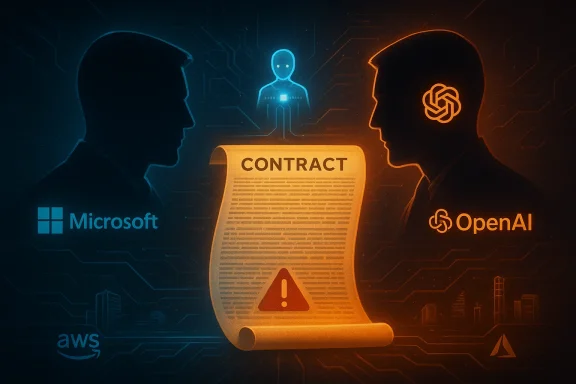
AI heads on a contract document with warning icon, featuring Microsoft, OpenAI, and AWS logos.Background​

The Microsoft–OpenAI relationship has always been unusual, even by Silicon Valley standards. Microsoft’s early bet on OpenAI gave the startup the capital and compute it needed to turn research ambition into commercial momentum, while Microsoft gained an inside track on the technology that would later power Copilot, Azure OpenAI Service, and a broader AI-led product reset. That initial partnership structure was widely described as a way to marry frontier model development with industrial-scale cloud delivery, and for a time it worked exactly that way. Microsoft’s own 2023 statement said Azure would power all OpenAI workloads across research, products, and API services.
The problem with high-functioning alliances is that they often conceal the moment when incentives begin to diverge. By 2024 and 2025, OpenAI no longer looked like a lab that simply needed a benefactor; it looked like a platform company building direct enterprise relationships, additional infrastructure options, and its own strategic leverage. Microsoft, meanwhile, had become more than a provider. It was a downstream commercial partner, a distribution channel, and in many cases a competitor that depended on OpenAI while also trying to reduce dependence on it. Microsoft’s October 2025 blog post said the new agreement extended key IP rights through 2032 and preserved Azure API exclusivity, while also refining provisions so each company could pursue new opportunities independently.
That duality is the real story. Partnership language remained warm, but the mechanics increasingly pointed toward separation. OpenAI expanded compute relationships beyond Microsoft, while Microsoft invested in its own model stack and began surfacing rival systems such as Anthropic’s Claude in Office 365. In parallel, OpenAI pursued Stargate-style infrastructure ambitions with other partners and deepened its own enterprise offering. The result is not a clean breakup, but a slow-motion uncoupling.
The latest flashpoint, according to reporting cited in the prompt and reflected in OpenAI’s own public statements, is Frontier, OpenAI’s enterprise platform for building and running AI agents. OpenAI and Amazon announced that AWS would serve as the exclusive third-party cloud distribution provider for Frontier, while OpenAI said Frontier products would continue to be hosted on Azure and that any stateless API calls stemming from third-party collaborations, including Amazon, would also be hosted on Azure. That wording matters because it suggests the deal is not a straightforward migration away from Microsoft infrastructure, but rather a fight over who gets to own the customer relationship and where value is recognized in the stack.

The Contractual Core of the Dispute​

At the center of the dispute is a very old business issue dressed in very modern language: who has the right to distribute what, and through whom. Microsoft’s reported position is that OpenAI cannot use AWS as a third-party distribution channel for Frontier without violating the spirit, if not the strict wording, of their relationship. OpenAI’s public statement, however, says the opposite in effect: that the new Amazon collaboration is compatible with the Microsoft partnership and that Azure remains the home for OpenAI’s first-party products and stateless APIs. That is a classic recipe for legal ambiguity.
The distinction between hosting and distribution is doing most of the work here. If Frontier runs on Azure but is sold or surfaced through AWS, then Microsoft still owns the infrastructure layer while Amazon captures part of the commercial surface area. For a company like Microsoft, which has spent years turning Azure into a strategic AI platform, that is not a minor distinction. It means the cloud provider that absorbs the capital burden may not be the one that fully controls the enterprise relationship or the sales motion.

Why the language matters​

The language of the 2025 agreement appears to have been designed to keep both sides talking while preserving room for maneuver. OpenAI’s own statement emphasizes that nothing in the Amazon announcement changes previously shared terms, and that collaborations with third-party cloud providers were always contemplated. Microsoft, by contrast, has framed the same period as one of reinforced exclusivity and durable IP rights. When both parties can plausibly cite the same agreement to support opposite narratives, litigation becomes less a possibility than an outcome waiting for a trigger.
A lawsuit threat is also a signaling device. It tells enterprise customers, investors, and rivals that Microsoft does not intend to be passively disintermediated inside the very market it helped create. It also tells OpenAI that the days of assuming Microsoft will absorb every strategic surprise are over. In that sense, the dispute is as much about leverage as law. The contract is the battlefield, but power is the prize.
  • Hosting and distribution are not the same thing.
  • Control of the enterprise customer relationship is the strategic issue.
  • Contract language can preserve partnership optics while reallocating power.
  • A lawsuit threat often functions as a negotiation tool before it becomes a filing.

From Marriage to Managed Rivalry​

For a while, Microsoft and OpenAI behaved like a deeply integrated joint venture without the formal labels. Microsoft had capital, cloud scale, and a vast enterprise base. OpenAI had the most visible frontier model brand in the world and the ability to attract developers, customers, and talent at astonishing speed. That combination worked because each party needed the other more than it feared the other. Once that asymmetry faded, the arrangement became harder to sustain.
The early warning signs were visible well before the current Amazon dispute. Microsoft’s 2023 rush to integrate GPT-4 into Bing, despite reported OpenAI objections, showed how quickly the platform company was willing to move when product opportunity beckoned. Then came the November 2023 OpenAI board crisis, when Sam Altman was briefly ousted without advance notice to Microsoft. Microsoft’s response was telling: it moved to hire Altman and his team if necessary. That episode made the relationship feel less like a shared mission and more like a fragile truce. Trust never really recovered from that week.

The strategic reset​

By 2024 and 2025, both companies started building insurance policies against one another. OpenAI signed compute commitments beyond Azure, while Microsoft deepened its own model strategy and broadened its supplier mix. Microsoft’s decision to work more visibly with Anthropic models inside Microsoft 365 was especially important because it showed customers and investors that Redmond was not willing to be locked into a single frontier partner forever. That is what mature platform companies do when they no longer believe exclusivity is strategically sustainable.
OpenAI’s side of the strategy was equally deliberate. It needed more compute, more distribution optionality, and more bargaining power against any single cloud provider. Its own statements now emphasize flexibility to commit additional compute elsewhere, including the Stargate effort. That is not how a dependent startup speaks. It is how a company speaks when it wants to become infrastructure-independent enough to negotiate from strength.
  • The partnership shifted from dependency to mutual hedging.
  • Both sides built alternatives before openly admitting it.
  • Each incremental diversification reduced the other party’s leverage.
  • The relationship now looks more like managed rivalry than shared destiny.

Why Frontier Became the Flashpoint​

Frontier matters because enterprise AI is where the money is heading. Consumer chat experiences generate buzz, but enterprise platforms determine whether AI becomes a durable software category or an expensive novelty. If Frontier is the surface through which companies build and run AI agents, then controlling how that platform is distributed is equivalent to controlling a potential gateway to recurring revenue, integration lock-in, and customer retention.
That explains why the Amazon deal caused such a strong reaction. AWS is not merely another cloud vendor in this context; it is the largest and most credible enterprise distribution network in cloud computing. If AWS becomes the preferred way for corporate customers to access a major OpenAI product, Microsoft loses a share of the commercial gravity it expected to keep. Even if Azure still hosts the underlying workloads, the loss of distribution primacy is a strategic setback. Infrastructure without customer ownership is only partial power.

Enterprise channel control​

Microsoft has spent years building a story around integrated AI adoption across the Microsoft stack, from Azure to Microsoft 365 to Dynamics and security products. Frontier, if routed through AWS in a meaningful commercial sense, introduces a rival channel into that story. That means AWS can position itself as the preferred enterprise on-ramp for a major OpenAI product, while Microsoft becomes the invisible backend. The optics alone are unfavorable, and the economics may be worse.
There is also a broader competitive concern. Enterprise buyers like optionality, but cloud vendors like control. When OpenAI distributes through AWS, it tells customers that the frontier model ecosystem is no longer a Microsoft-only path. That weakens one of the key arguments behind Azure’s AI push and may make large enterprises less likely to standardize around a single Microsoft-centric stack. For rivals, that is an opening. For Microsoft, it is a warning.
  • Frontier is strategically important because it sits at the enterprise adoption layer.
  • AWS distribution can redirect customer relationships away from Azure.
  • Microsoft risks becoming a backend utility rather than the primary commercial gateway.
  • The dispute is about platform power, not just server placement.

The Cloud Economics Behind the Drama​

Cloud partnerships are usually discussed as technology relationships, but they are really economics wrapped in product language. Training and serving frontier models requires enormous capital expenditure, long-term capacity planning, and very patient assumptions about utilization. Whoever pays for the infrastructure wants preferential access to the business generated by it. That is why cloud exclusivity matters so much, and why disputes about “who gets the customer” can become existential.
Microsoft has already made clear that Azure remains central to the OpenAI relationship. OpenAI’s own statement says Azure is the exclusive cloud provider for stateless OpenAI APIs and that first-party products, including Frontier, will continue to be hosted on Azure. That means Microsoft still has massive infrastructure relevance. But the presence of AWS in the sales and distribution chain dilutes the payoff from that infrastructure. It changes who captures the commercial surplus.

The value stack problem​

In cloud computing, value is distributed across layers: raw compute, orchestration, product packaging, and customer acquisition. Microsoft appears to believe it should own more of those layers because it funded the buildout and has the deeper contractual rights. OpenAI appears to believe it can expand into adjacent channels without surrendering its core obligations. The question is less whether both are technically right and more which reading a court, arbitrator, or negotiator would find more persuasive. That uncertainty is what makes the threat credible.
There is also a market-structure angle. If OpenAI can offer the same or similar frontier experience across multiple clouds, then cloud providers may compete on distribution, compliance, procurement convenience, and integration rather than pure exclusivity. That would be good for customers in some ways, but it would weaken Microsoft’s narrative that Azure is the singular home of OpenAI-powered enterprise AI. It would also empower Amazon as a platform broker.
  • Cloud economics are about margin capture, not just capacity.
  • Distribution rights can be worth as much as hosting rights.
  • Multi-cloud access increases customer choice but weakens exclusivity.
  • The fight is over the richest layer of the AI value stack.

The Legal and Governance Wild Card​

Microsoft’s threat to sue is notable because it suggests the company believes it has a plausible path to enforcement rather than merely a bargaining position. That said, the public record shows the two companies recently issued statements that preserve the core partnership and extend key rights. Microsoft’s October 2025 post said its IP rights were extended through 2032 and that OpenAI could provide API access to U.S. national security customers regardless of cloud provider, while OpenAI said collaborations with third-party cloud providers were contemplated under the agreements. Those details create a wide legal gray zone.
This is where governance becomes as important as contract law. A relationship of this scale depends not only on written terms but on shared norms about notice, consultation, and strategic restraint. The OpenAI board upheaval in 2023 already proved that governance shock can reshape the partnership. If the current dispute escalates, it may reveal that the more consequential problem is not the wording of the documents but the collapse of the norms that once made those documents workable.

What litigation would really test​

A court battle would likely test whether third-party distribution is barred in substance, not just in form. It could also force disclosure of how much control Microsoft thought it had over routing, product exclusivity, and enterprise go-to-market rights. That would be risky for both parties, which is why the more likely near-term outcome is continued negotiation. But the very fact that litigation is being discussed shows how far trust has eroded. Once partners start parsing “spirit” and “letter” separately, the relationship is already under strain.
The governance implication is equally significant for the AI market. Future model partnerships are likely to be written with more explicit carve-outs, more transparent termination rights, and more defined distribution rules. The Microsoft–OpenAI saga may become a template not for cooperation, but for the contract hardening that follows a high-profile alliance fracture.
  • The legal case likely turns on substance versus form.
  • Governance failures can be more damaging than the contract itself.
  • Litigation would expose how much control each party really believed it had.
  • The broader industry may respond with tighter, more explicit partnership terms.

Competitive Implications for Microsoft, OpenAI, and Amazon​

For Microsoft, the risk is not just losing a dispute; it is losing narrative control. The company has spent years presenting itself as the principal enterprise AI platform, with OpenAI as the flagship engine inside that story. If OpenAI now uses AWS to widen distribution, Microsoft must explain why its most important AI partner is helping a rival cloud provider win enterprise mindshare. That is a difficult message for sales teams and investors alike.
For OpenAI, the upside is leverage and resilience. It gains the ability to serve more customers through more channels, reduces overdependence on a single cloud provider, and signals that it can play the platform game on its own terms. But it also risks antagonizing the company that still has deep IP rights, a huge installed base, and a long contractual memory. OpenAI may want optionality, but optionality can look like betrayal to a former ally.

Amazon’s strategic gain​

Amazon is the quiet winner in the current drama. By becoming the exclusive third-party cloud distribution provider for Frontier, AWS inserts itself into the most valuable layer of enterprise AI adoption without having to invent the frontier model itself. That allows Amazon to monetize demand for AI agents while keeping OpenAI in the product spotlight. In effect, AWS gets to sell the highway while someone else drives the car.
That has broader competitive consequences. If AWS can reliably host the commercial front door to frontier-model products, then Amazon can challenge Microsoft’s claim to be the default enterprise AI distribution layer. It also pressures Google Cloud and other providers to seek similar arrangements or risk being left behind. The result could be a more fragmented, multi-cloud AI market where the main differentiator is not model ownership but distribution architecture.
  • Microsoft risks narrative dilution inside enterprise AI.
  • OpenAI gains leverage but also invites retaliation.
  • Amazon gains strategic relevance without bearing all model-development risk.
  • Rivals may follow with similar distribution-first strategies.

What It Means for Enterprise Customers​

Enterprise customers often prefer redundancy, and in that sense the broader trend is positive. More cloud options, more deployment pathways, and more bargaining competition can reduce lock-in. But the current fight also introduces uncertainty about roadmap stability, support consistency, and pricing predictability. When major partners are threatening lawsuits, buyers have to wonder how long the commercial rules will remain the same.
There is also a procurement issue. Many large organizations have standardized around Microsoft ecosystems, especially if they use Microsoft 365, security tooling, and Azure services. Frontier’s Amazon distribution may offer those buyers an easier way to procure OpenAI capabilities through an existing AWS relationship, but it may also split their AI strategy across vendors. That could be useful in the short run and messy in the long run. Convenience today can become complexity tomorrow.

Enterprise adoption realities​

The most sophisticated buyers will see this as a bargaining opportunity. They can compare Microsoft-hosted, OpenAI-direct, and AWS-mediated pathways and choose the one that best fits governance, security, and pricing needs. Smaller buyers, however, may simply face more confusion about where the “real” OpenAI experience lives. In enterprise software, clarity is often the most underrated feature.
That makes the stakes larger than a single launch. The dispute could influence how enterprises think about AI procurement for years: whether they buy from a model company, a cloud provider, or a stack vendor. Microsoft wants the answer to be “the stack vendor.” Amazon wants the answer to be “the cloud provider.” OpenAI wants the answer to be “the platform.”
  • Buyers may benefit from more choice and better pricing leverage.
  • Mixed-vendor AI stacks can create governance and support complexity.
  • Procurement teams will need clearer definitions of hosting versus distribution.
  • The dispute may shape enterprise expectations about platform independence.

The Bigger Industry Pattern​

This fight is not happening in a vacuum. The AI industry has already moved from a phase of exuberant dependency to a phase of strategic disentanglement. Early winners needed enormous capital and infrastructure, so they attached themselves to large cloud platforms. Once the products became commercially important, those same startups sought more independence, more partners, and more control over the value chain. That pattern is playing out across the sector.
Microsoft and OpenAI are simply the most visible example because their partnership has been so central to the public AI narrative. The alliance was always too important to stay purely friendly and too successful to remain politically simple. Once models became the foundation of enterprise software strategy, any single-cloud exclusivity agreement became a source of tension. That is why the current dispute feels bigger than the sum of its contractual clauses. It reflects a market in transition.

A template for future deals​

The most likely long-term lesson is that frontier AI partnerships will increasingly resemble telecom interconnect deals or media licensing agreements: complex, layered, and heavily negotiated around routing, access, and economics. The era of informal “we trust each other” arrangements is over. Future deals will likely specify exactly where models run, how they are distributed, who can resell them, and under what circumstances. That is less romantic but more realistic.
For the market, that is both good and bad. It may reduce surprise breakups and make alliance boundaries clearer. But it also signals that the industry’s most important partnerships are maturing into more defensive, less visionary structures. The AI boom is no longer just about building the future; it is about litigating who owns it.
  • AI partnerships are becoming more like infrastructure contracts.
  • Distribution rights are now as important as model quality.
  • The market is shifting from improvisation to formalized control.
  • The Microsoft–OpenAI dispute may become a reference case for the industry.

Strengths and Opportunities​

Despite the acrimony, the situation also reveals how valuable both companies remain to each other and to the broader AI ecosystem. Microsoft still has deep enterprise reach, massive cloud infrastructure, and a huge installed base of customers who want AI tools embedded in familiar products. OpenAI still has one of the strongest brands in AI, a powerful developer mindshare, and a product portfolio that attracts enterprise attention at scale. If they can reset expectations, the partnership could still produce enormous value.
The opportunity lies in clearer segmentation. Microsoft can focus on infrastructure, enterprise integration, and broad product distribution, while OpenAI can push model innovation and multi-channel adoption. A more explicit division of labor could reduce future surprise conflicts. It may even produce a more durable, if less intimate, alliance. Sometimes a better contract is a better partnership.
  • Microsoft retains unmatched enterprise reach.
  • OpenAI retains top-tier brand gravity and developer attention.
  • Clearer role separation could reduce strategic ambiguity.
  • Multi-cloud distribution may increase total market adoption.
  • Stronger contractual definitions could stabilize future launches.
  • Both companies can still monetize complementary strengths.
  • Customers may benefit from broader access and more resilient infrastructure.

Risks and Concerns​

The risks are considerable because the current situation combines legal uncertainty, strategic mistrust, and market symbolism. A lawsuit threat can harden positions quickly, making compromise more difficult even if both sides would benefit from it. There is also a danger that customers interpret the conflict as instability in the very AI stack they are being asked to trust with sensitive workflows. In enterprise technology, confidence is a product feature.
The more serious concern is that each company may conclude it is better off accelerating decoupling than preserving a strained alliance. If that happens, both could spend the next year optimizing against each other rather than for customers. That would be costly not only for them but for the broader AI market, which still depends on these leaders to provide clear, reliable guidance. Strategic breakup behavior rarely stays contained.
  • Litigation could freeze negotiations and damage trust further.
  • Customer confidence may fall if launch terms keep changing.
  • Decoupling could increase costs for both sides.
  • Rival clouds may exploit the uncertainty to win business.
  • Microsoft could lose channel control over key enterprise AI products.
  • OpenAI could face retaliation over IP, access, or pricing leverage.
  • The partnership’s instability may set a cautionary precedent for the industry.

Looking Ahead​

The next phase will likely be decided not in public statements, but in how aggressively each side enforces the boundaries it believes it owns. If Microsoft truly believes Frontier’s AWS distribution violates the partnership, it may press for remedies that stop short of open litigation but still reassert control. If OpenAI believes its public interpretation is sound, it will continue to broaden its distribution strategy while insisting that Azure remains the technical foundation. The gap between those positions is where the real negotiation lives.
The most important question now is whether the parties want a final resolution or just a more stable truce. A final resolution would likely mean a re-written relationship, clearer limits, and a more explicit division of commercial territory. A truce would preserve flexibility, but only if both sides can resist the temptation to test each other again. That is a hard ask in a market this lucrative.

What to watch​

  • Whether Microsoft files suit or uses the threat as leverage.
  • Whether OpenAI and Amazon expand the Frontier partnership further.
  • Whether Microsoft sharpens its own rival model and distribution strategy.
  • Whether additional cloud providers seek similar OpenAI arrangements.
  • Whether enterprise customers see the dispute as risk or opportunity.
  • Whether new partnership language becomes more explicit about third-party distribution.
The alliance that helped create the modern AI market has entered its most revealing phase. Whether it ends in a courtroom, a compromise, or a carefully worded redefinition of roles, the old story is already over. What comes next is not the collapse of AI cooperation, but the end of innocence about who controls its economics.

Source: Proactive Investors Microsoft's threat to sue OpenAI is the clearest sign yet that the most important partnership in tech is breaking down
 

Microsoft and OpenAI have just enough contractual history to make this latest cloud fight feel less like a surprise and more like an inevitable collision. A new deal that would make Amazon Web Services the exclusive third-party cloud provider for OpenAI’s enterprise platform Frontier has reportedly triggered a sharp warning from Microsoft, which says the arrangement could violate its exclusive cloud rights with OpenAI. The dispute matters because it cuts to the center of the modern AI stack: who hosts the models, who controls access, and who gets to shape the enterprise distribution layer for the next wave of AI agents. If the talks fail, this could become one of the most consequential partnership disputes in the AI industry.

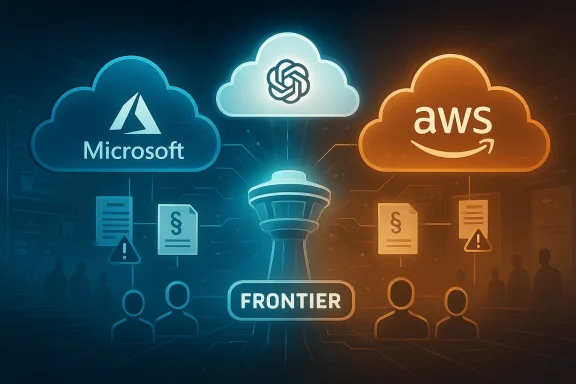
Neon cloud-computing illustration showing Microsoft on the left and AWS on the right with “FRONTIER” below.Background​

The Microsoft–OpenAI relationship has always been unusual, because it blends strategic investment, cloud dependence, IP access, and fierce competitive ambition in a single agreement. Microsoft has spent years positioning Azure as the backbone of OpenAI’s model development and commercialization, while OpenAI has relied on that infrastructure to scale rapidly and distribute its products. That arrangement made Microsoft more than a financier; it made the company a central gatekeeper in OpenAI’s operating model.
The latest round of tension comes after both companies issued a joint statement in late February 2026 clarifying that Microsoft retains its exclusive license and access to intellectual property for OpenAI models and that Azure remains the exclusive cloud provider for stateless OpenAI APIs and OpenAI’s first-party products, including Frontier. Microsoft also said that collaborations between OpenAI and other cloud providers were always contemplated under the agreement, while emphasizing that any stateless API calls resulting from such collaborations would still be hosted on Azure. That wording was designed to reassure the market, but it also created a very specific boundary around what third-party cloud deals can and cannot do.
The AWS partnership appears to test that boundary. OpenAI’s public announcement described AWS as the exclusive third-party cloud distribution provider for Frontier, which it framed as an enterprise platform for building, deploying, and managing AI agents. AWS and OpenAI also said they would co-create a stateful runtime environment and make it available through Amazon Bedrock, signaling something broader than a simple resale or hosting arrangement. In other words, this is not merely about spare compute capacity; it is about a distribution channel for enterprise AI workloads.
Microsoft’s concern is therefore easy to understand. If Azure is supposed to remain the exclusive cloud provider for access to OpenAI models and IP, then a deep AWS role in Frontier may look like an end-run around that exclusivity. Yet the same joint Microsoft–OpenAI statement also suggests the parties envisioned some degree of multi-cloud flexibility, especially as OpenAI scales and pursues additional compute elsewhere. That makes the dispute less about whether OpenAI can ever work with another cloud and more about which parts of the stack can move off Azure without crossing the contract line.

What Frontier Actually Changes​

Frontier is not just another product name in OpenAI’s enterprise catalog. OpenAI describes it as a platform for building, deploying, and managing AI coworkers or agents that can do real work across the enterprise. That positions Frontier as an operational layer, not simply a model endpoint, and that distinction is legally and commercially important. A platform for running agents can sit closer to customer workflows, data, and governance than a standard API service.
That matters because enterprise AI buyers increasingly want more than model access. They want orchestration, security controls, auditability, and the ability to connect AI systems to internal applications and data. If Frontier becomes the preferred way to package that experience, then the cloud provider attached to Frontier gains leverage well beyond raw compute. It becomes part of the go-to-market story, the procurement path, and the customer trust equation.

Why the enterprise layer matters​

The enterprise layer is where cloud strategy becomes business strategy. A hosting deal in consumer AI is important, but an enterprise platform can influence long-term customer retention, developer habits, and regulated-industry adoption. That is why AWS’s role is potentially so sensitive: it is not simply providing oxygen, it is sitting close to the lungs.
  • Frontier is framed as an AI agent platform, not just model hosting.
  • Enterprise workflows increase the value of the cloud provider relationship.
  • The platform layer can shape data governance and compliance expectations.
  • Control over deployment channels can affect how customers buy AI.
  • The closer the cloud provider is to the product, the harder exclusivity becomes to define.
There is also a practical reason to pay attention to Frontier. Enterprise AI platforms often blend first-party features, partner integrations, and infrastructure services in ways that are difficult to separate cleanly. That can make contract language do a lot of work, and when the language is vague, lawyers become product strategists by default.
The AWS–OpenAI announcement suggests OpenAI wants a broader footprint for its enterprise ambitions. Microsoft’s position suggests it still sees Azure as the privileged route for OpenAI model access and IP. The dispute is therefore not only about the future of Frontier, but also about whether OpenAI can distribute the same intelligence through multiple infrastructure partners without eroding Microsoft’s exclusivity.

Microsoft’s Legal Theory​

Microsoft’s reported threat to sue rests on a straightforward premise: if the contract says access to OpenAI models must go through Azure, then a deal that elevates AWS as an exclusive third-party cloud provider may be inconsistent with that promise. The argument is simple on the surface and complicated underneath, because the real question is what “access” means in a modular AI platform. Microsoft’s camp seems to believe the boundaries are narrow enough to enforce aggressively.
A person familiar with Microsoft’s position reportedly said the company would sue if the agreement is breached. That kind of public-private signaling usually serves two purposes: it warns the counterparties, and it tells investors that the company is prepared to defend the value of its contractual assets. In this case, those assets include exclusive cloud rights, IP access, and the economic leverage of being the default route for OpenAI workloads.

Where the contract language could bite​

The legal fight may turn on how the agreements distinguish between stateless APIs, first-party products, third-party integrations, and enterprise distribution. Microsoft has already stated that stateless OpenAI API calls resulting from collaborations with third parties would still be hosted on Azure, which suggests the company wants to preserve a broad interpretation of its cloud exclusivity. If Frontier’s AWS role goes beyond distribution and into actual access, Microsoft has a plausible basis for concern.
  • Access is the key word, and it may be broader than hosting.
  • A third-party distribution role may or may not be treated as a cloud exception.
  • First-party products and API products are not necessarily governed the same way.
  • Jointly developed products can create edge cases that contracts struggle to anticipate.
  • The sharper the product integration, the harder the legal boundary becomes.
Microsoft also has leverage from the broader partnership structure. In October 2025, the two companies updated their relationship, preserving Azure API exclusivity until AGI and extending Microsoft’s IP rights through 2032 with additional guardrails. OpenAI was also allowed to jointly develop some products with third parties, but API products developed with third parties were said to be exclusive to Azure, while non-API products could be served on any cloud provider. That split is precisely the sort of drafting that invites interpretive disputes when new product categories emerge.
The likely issue is not that OpenAI and AWS entered into a deal. It is that the deal may have landed in a gray zone between cloud capacity, distribution, and product access. In the AI era, those boundaries are increasingly arbitrary, and that is why the lawyers are being asked to define what the engineers already blurred.

OpenAI’s Multi-Cloud Strategy​

OpenAI’s pivot toward multiple cloud partners is not accidental. The company has been trying to widen its infrastructure base for some time, including a separate arrangement with Oracle for additional cloud capacity. That broader strategy reduces dependence on any one provider, increases bargaining leverage, and gives OpenAI more flexibility as its workloads explode. It also reflects the hard truth that frontier model companies are compute-hungry in a way that no single partner always wants to underwrite forever.
The AWS partnership fits that pattern. OpenAI said AWS would provide infrastructure to run and scale core AI workloads, and its announcement of Frontier emphasized enterprise deployment and management of AI agents. If OpenAI can spread model operations across Azure, AWS, and Oracle, it lowers concentration risk while keeping multiple partners invested in its growth. That is a classic platform play, even if it looks like a contractual headache to the incumbent cloud provider.

Why multi-cloud is attractive now​

The appeal of multi-cloud is no longer just redundancy. For OpenAI, it is also about strategic optionality, geographic reach, negotiation power, and the ability to tailor different workloads to different infrastructure strengths. The more OpenAI grows, the more it can behave like a cloud-agnostic AI platform rather than a single-provider tenant.
  • Multi-cloud reduces dependency on one hyperscaler.
  • It creates room for capacity planning across different demand cycles.
  • It gives OpenAI leverage in pricing and commercial negotiations.
  • It allows enterprise product design to match different customer environments.
  • It makes the company less vulnerable to any one partner’s constraints.
Still, multi-cloud is not free. It introduces operational complexity, governance overhead, and the possibility of fragmented customer experiences. A platform like Frontier may be easier to market if it can promise consistent access across clouds, but harder to manage if those clouds have different controls, billing structures, and performance profiles. The more OpenAI spreads out, the more it must prove that fragmentation will not hurt reliability or trust.
That is where the Microsoft dispute becomes more than a legal skirmish. It is a referendum on whether the next phase of frontier AI will be centralized around one partner or distributed across a federation of partners. OpenAI appears to prefer the latter. Microsoft appears determined to make sure that distribution does not hollow out the original deal.

AWS as a Strategic Counterweight​

For Amazon, the deal is strategically elegant. AWS has spent years trying to prove that it is not merely a general-purpose cloud, but a serious platform for enterprise AI workloads. A partnership with OpenAI gives AWS a marquee relationship that can attract customers, reassure developers, and signal that the company is fully in the race for frontier AI infrastructure. It is also a useful answer to rivals who argue that Microsoft owns the AI narrative through OpenAI.
The AWS announcement framed the partnership as a way to expand access to OpenAI’s most advanced enterprise platform and to help organizations build and manage teams of AI agents. That message is important because it inserts AWS into the highest-value layer of the AI stack: not just storing data, but enabling production-grade agent workflows. If successful, this could make AWS the preferred launchpad for some OpenAI enterprise deployments, even if Azure remains central to the broader relationship.

The competitive signal to the market​

AWS does not need to replace Azure in OpenAI’s world to benefit from the deal. It simply needs to show that OpenAI can work with Amazon at all, and that enterprise buyers can access leading AI tools through more than one hyperscaler. That changes procurement conversations in ways that are hard to reverse.
  • AWS gains validation as a serious AI hosting partner.
  • Enterprise customers get a new distribution path to OpenAI tools.
  • The deal chips away at the idea of a Microsoft-only OpenAI ecosystem.
  • Amazon gets to market itself as infrastructure-agnostic and enterprise-ready.
  • Rivals must now respond to a more fragmented but more competitive AI cloud market.
The AWS partnership also adds pressure on Microsoft’s broader cloud strategy. Microsoft has been positioning itself as the home for the “Frontier Firm” and has been pushing AI app distribution through Microsoft Marketplace and Azure-integrated services. If OpenAI’s frontier platforms can also live meaningfully inside AWS, Microsoft’s ability to frame Azure as the default enterprise AI destination becomes less absolute.
That does not mean AWS has won anything permanent. Instead, it has secured a very visible proof point that cloud exclusivity in AI is becoming more negotiable than many thought. And in hyperscale cloud competition, perception can be almost as valuable as workload migration.

The Enterprise AI Market Implications​

This dispute lands in a market that is already moving from model novelty to workflow utility. Enterprises are no longer impressed by benchmark claims alone; they want durable platforms that fit procurement rules, identity controls, and governance frameworks. Frontier appears designed to satisfy that demand by wrapping AI agents into a managed enterprise experience, and that makes its cloud relationships commercially sensitive.
The broader implication is that cloud providers may increasingly compete not just to host models, but to become the administrative layer through which enterprise AI is bought, secured, and observed. That could lead to a future where the same model family is accessible through multiple clouds, but each cloud fights to own the customer relationship around it. In that scenario, cloud exclusivity may matter less at the hardware level and more at the workflow level.

Enterprise buyers will notice​

Enterprise IT teams are likely to interpret this dispute as a signal that the AI vendor landscape is still in flux. They may welcome the competition because it can create better pricing, more flexibility, and less lock-in. At the same time, they may worry that contractual fights between major vendors could disrupt service continuity or complicate compliance obligations.
  • Buyers may gain more choice across cloud environments.
  • Procurement teams may need to evaluate dual- or multi-cloud AI architectures.
  • Legal uncertainty can slow enterprise adoption of new platforms.
  • Governance teams will care who actually controls the runtime.
  • Security teams will want clarity on data flow and model access.
There is also a subtle market lesson here: the most valuable AI deals are no longer just about model accuracy. They are about where the model lives, who can touch it, and which cloud provider gets to translate it into business outcomes. Frontier sits at that intersection, which is why the AWS deal is so much more explosive than a normal infrastructure partnership.
If Microsoft wins the argument, it will reinforce the idea that OpenAI’s commercial surface is still largely Azure-shaped. If OpenAI and AWS win, it will prove that AI distribution can be decoupled from the original cloud anchor, at least in part. Either outcome would reshape how other AI labs structure their own cloud agreements.

What This Means for Microsoft​

For Microsoft, the threat is partly legal and partly strategic. Legally, it wants to preserve the value of the exclusivity it negotiated over years of investment and partnership. Strategically, it does not want OpenAI becoming a cloud-agnostic product platform that can freely route around Azure when convenient. The company has invested too much in the OpenAI story to let the story move off its own infrastructure on anything resembling equal terms.
That said, Microsoft is not trying to sever the relationship. Quite the opposite: it has repeatedly described the partnership as intact, even as it reserves the right to defend its contract. This is a classic enterprise negotiation posture—support the collaboration publicly while setting a hard boundary privately. It allows Microsoft to look cooperative to customers and investors while still signaling that it will not waive away its rights.

Why Microsoft cares beyond revenue​

The financial stakes are obvious, but the strategic stakes may be even bigger. Microsoft has spent years embedding OpenAI capabilities into Copilot, Azure AI services, and a wider enterprise software stack. If OpenAI’s most important enterprise products can be delivered through AWS, then Microsoft risks losing part of the narrative control that makes those integrations persuasive.
  • Azure exclusivity protects Microsoft’s infrastructure moat.
  • IP access helps Microsoft differentiate its own AI offerings.
  • The OpenAI relationship supports Microsoft’s enterprise credibility.
  • A weaker exclusivity story could embolden competitors.
  • The company must defend both economics and market perception.
Microsoft also appears increasingly comfortable with a more diversified AI portfolio. Its embrace of Anthropic as an alternative partner suggests it is preparing for a world in which OpenAI is important but not singular. That diversification is sensible risk management, but it also weakens the idea that OpenAI can assume absolute dependence on Microsoft. In other words, Microsoft wants exclusivity where it matters, and optionality where it can get it.
If Microsoft ultimately settles rather than sues, it may be because the company decides the practical value of preserving the partnership exceeds the value of a legal win. But if it believes Frontier creates a precedent that could hollow out its Azure rights, it may choose to fight precisely to prevent future erosion.

What This Means for OpenAI​

For OpenAI, the AWS arrangement is both an expansion opportunity and a legal stress test. The company wants room to grow beyond a single-cloud dependency, especially as enterprise demand increases and infrastructure requirements become more complicated. At the same time, it cannot afford to alienate the partner that remains deeply embedded in its model access, IP rights, and commercial reach.
The challenge is not simply balancing those relationships. It is doing so while convincing customers that OpenAI’s platform strategy is stable, scalable, and not hostage to internal cloud politics. Enterprise buyers do not want to buy into a platform that may be disrupted by a contract fight six months later. So OpenAI has every incentive to resolve this quickly and quietly, if possible.

The balancing act​

OpenAI’s multi-cloud strategy makes business sense, but only if it can avoid signaling that its original cloud commitments are optional. It needs flexibility without appearing disloyal, and distribution without appearing to undercut the old anchor. That is an extremely difficult line to walk in public.
  • OpenAI wants more compute and more bargaining leverage.
  • It also needs to preserve trust with Microsoft.
  • Frontier depends on enterprise credibility.
  • AWS broadens distribution but adds legal exposure.
  • The company must keep innovation ahead of litigation.
OpenAI’s public messaging has tried to thread that needle by emphasizing that AWS’s role is part of a broader strategy and that Microsoft’s rights remain intact. But the fact that the companies are reportedly in talks to resolve the conflict suggests the issue is not purely theoretical. Someone, somewhere, believes the line was crossed or at least approached too closely for comfort.
If OpenAI can persuade Microsoft that Frontier fits within the allowed scope of third-party collaboration, it may preserve the multi-cloud model it wants. If not, it may have to redesign the arrangement or accept a more limited AWS role. Either way, the company is discovering that platform expansion is easier than contractual escape velocity.

Historical Context: From Co-Dependence to Controlled Diversification​

The Microsoft–OpenAI story has evolved from early cloud patronage to a far more complex strategic partnership. In the beginning, the relationship looked relatively simple: Microsoft provided capital and infrastructure, and OpenAI brought frontier-model prestige and product momentum. Over time, however, OpenAI became not just a tenant but a partner whose ambitions were large enough to justify new legal categories and commercial exceptions.
The 2023 extension made Azure the exclusive cloud provider for OpenAI workloads across research, products, and API services. That was a strong statement of dependence and control. But the 2025–2026 updates introduced more nuance, including room for jointly developed products with third parties, additional compute elsewhere, and a more explicit distinction between API and non-API products. Those refinements were necessary because the original framework could not fully anticipate how fast the enterprise AI market would change.

Why the contract keeps changing​

Contracts in frontier AI are becoming living documents, because the products keep mutating. What started as model hosting now includes agents, orchestration layers, partner integrations, and industry-specific deployments. That creates constant pressure to redefine what counts as access, what counts as distribution, and what counts as cloud service.
  • Early deals focused on model training and hosting.
  • Later deals added commercial API access and product distribution.
  • Enterprise demand introduced governance and workflow layers.
  • Third-party partnerships created new edge cases.
  • Multi-cloud strategies made exclusivity harder to police.
This is why the dispute matters far beyond Microsoft and OpenAI. The broader AI industry is moving from simple vendor relationships to layered partnership ecosystems, and those ecosystems require more precise legal architecture than many early agreements provided. As a result, every major alliance is now also a test of contract design.
The Microsoft–OpenAI relationship may ultimately survive this episode intact, but it will almost certainly emerge more carefully segmented. That is what mature platform wars look like: not the end of partnerships, but the rise of highly specific guardrails around how those partnerships can evolve.

Strengths and Opportunities​

The upside for all three companies is real if they can resolve the conflict without a public breakdown. A compromise could preserve Microsoft’s core rights, give OpenAI the multi-cloud flexibility it wants, and let AWS claim a meaningful enterprise foothold without forcing a courtroom showdown. That outcome would signal maturity in the market and reduce the risk of collateral damage to customers.
  • Microsoft can preserve Azure’s strategic primacy.
  • OpenAI can expand its enterprise reach without single-cloud dependence.
  • AWS can gain a high-profile AI workload and market validation.
  • Enterprise customers may get more deployment options.
  • The market could see clearer product-category boundaries.
  • A negotiated resolution would reduce uncertainty for partners and investors.
There is also an opportunity for better product definition. If the parties clarify what Frontier is, how it differs from stateless APIs, and where third-party clouds can participate, they could create a more durable template for future AI deals. That would be unsexy work, but it is exactly the kind of work that keeps fast-moving ecosystems from turning into litigation traps.

Risks and Concerns​

The biggest risk is that the conflict escalates into a public dispute that damages trust across the AI ecosystem. If Microsoft sues, the message to the market will be that even the strongest AI partnerships can fracture over infrastructure rights. That could chill future collaboration, slow enterprise adoption, and make other vendors more defensive in their own contract negotiations.
  • Litigation could delay Frontier’s rollout.
  • Public conflict may unsettle enterprise buyers.
  • Contract ambiguity could expose other AI partnerships to similar disputes.
  • Microsoft and OpenAI could both lose narrative control.
  • AWS may be pulled into a broader strategic fight with Microsoft.
  • Customers could face confusing hosting and access terms.
  • The dispute might harden cloud silos instead of opening them.
A second concern is that the legal theory may be genuinely messy. AI platforms do not fit old cloud categories cleanly, and the more the product stack blends hosting, inference, orchestration, and distribution, the harder it becomes to say where one provider’s rights end and another’s begin. In that sense, the parties may be fighting over a future that the original paperwork only partially understood.
There is also a reputational risk for OpenAI. The company has built a brand around acceleration and ambition, but enterprise customers also value predictability and governance. If OpenAI looks too willing to strain contractual boundaries, some buyers may worry about stability, especially in regulated industries where cloud provenance matters.

Looking Ahead​

The most likely near-term outcome is a negotiated fix, not an immediate courtroom battle. The Financial Times reporting that the parties are already in talks suggests all sides understand that a lawsuit would be costly, distracting, and possibly unnecessary if a narrower interpretation of Frontier can be agreed upon. In the AI world, nobody wants to spend the next quarter in discovery if a deal can be salvaged in private.
Still, the negotiation will almost certainly shape the next chapter of the Microsoft–OpenAI alliance. Even if the parties avoid litigation, they now have to live with the reality that multi-cloud AI distribution is on the table and that any future partnership expansion will be read through the lens of this dispute. That means the final wording could matter almost as much as the business substance.

What to watch next​

  • Whether Microsoft issues a more forceful public statement.
  • Whether OpenAI narrows or rephrases Frontier’s AWS role.
  • Whether the parties formalize a revised cloud-access carveout.
  • Whether enterprise customers see any launch delays.
  • Whether other AI labs copy the multi-cloud strategy.
  • Whether AWS expands similar partnerships with other model providers.
The broader lesson is simple: frontier AI is no longer just a race to build smarter models. It is a race to define the contractual, infrastructural, and commercial rails that determine how those models reach the market. Microsoft, OpenAI, and Amazon are now fighting over those rails, and whoever wins may shape not just this partnership, but the structure of enterprise AI distribution for years to come.

Source: Techzine Global Microsoft is considering legal action against OpenAI and Amazon
 

Microsoft’s reported willingness to sue OpenAI is more than a contract dispute; it is a signal that the foundational alliance of the generative AI era is no longer operating like a partnership at all. What once looked like a tightly coupled strategic marriage is now behaving more like a controlled separation, with both sides building leverage, hedging dependencies, and preparing for the possibility that the other side becomes an adversary. The immediate trigger is reportedly OpenAI’s deal with Amazon Web Services, but the deeper story is about control, distribution, and who gets to own the customer relationship in the next phase of AI.

Overview​

For years, the Microsoft-OpenAI relationship defined the commercial imagination of the AI boom. Microsoft provided the capital, the cloud, and the enterprise distribution muscle; OpenAI supplied the model breakthroughs that turned ChatGPT into a global product and then into a platform. In public, both companies described the relationship as deep, strategic, and long term, and Microsoft repeatedly emphasized that the partnership was still central even as OpenAI began broadening its infrastructure options. (blogs.microsoft.com)
But alliances built on extreme interdependence rarely stay serene once both parties become powerful enough to negotiate from strength. Microsoft’s latest joint statement with OpenAI, published on February 27, 2026, reaffirmed that Azure remains the exclusive cloud provider for stateless OpenAI APIs and that Microsoft’s IP access remains intact through the revised structure. It also said OpenAI could continue to add compute elsewhere, including through Stargate, which is the crucial caveat that made the deal look flexible even as it preserved Microsoft’s core claims. (blogs.microsoft.com)
The Amazon issue appears to have pushed that flexibility to its limit. OpenAI and Amazon recently disclosed a major expansion in their relationship, including Amazon Web Services serving as the exclusive third-party cloud distribution provider for Frontier, OpenAI’s enterprise platform for building and running AI agents. AP reported that the broader funding package includes $110 billion from Amazon, Nvidia, and SoftBank, with Amazon committing $50 billion, and that OpenAI said the new arrangements do not change its Microsoft relationship. (apnews.com)
That is exactly the kind of statement that usually means both sides are testing the boundaries in public while sharpening arguments in private. If Microsoft truly believes the Amazon-Frontier arrangement violates its rights, the case is not just about revenue. It is about whether OpenAI can use third-party clouds to rewire its commercial model without conceding the strategic centrality that made Microsoft indispensable in the first place. (blogs.microsoft.com)

The Partnership That Built the AI Boom​

The Microsoft-OpenAI pact was never a normal vendor contract. It was an industrial arrangement that fused capital, compute, software distribution, and frontier-model access into a single commercial engine. Microsoft’s early backing helped OpenAI scale from research lab to category-defining product company, while Azure became the core platform on which OpenAI’s workloads and enterprise products could be operationalized. (blogs.microsoft.com)
The scale of that bet is easy to forget because it has become so familiar. Microsoft’s Azure cloud business has since grown into a giant, with annual revenue surpassing $75 billion by mid-2025, a size that shows how central cloud and AI infrastructure have become to Microsoft’s modern identity. OpenAI, meanwhile, has ridden that infrastructure to extraordinary consumer and enterprise demand, with AP noting more than 900 million weekly active ChatGPT users and more than 50 million consumer subscribers in February 2026. (apnews.com)

From mutual dependency to mutual suspicion​

The relationship started as a classic case of aligned incentives. Microsoft wanted a way to make Azure indispensable in the AI stack, and OpenAI needed industrial-grade compute, enterprise sales reach, and a trusted channel into large organizations. For a time, the bargain worked almost perfectly, because each side got what it lacked most. (blogs.microsoft.com)
The trouble began when each partner started believing it could do more without the other. Microsoft began investing in its own model road map, including work under Mustafa Suleyman, while OpenAI began diversifying its compute footprint and commercial partnerships. Once both companies had alternatives, the partnership stopped being a moat and started becoming a constraint. (apnews.com)
  • Microsoft gained enterprise distribution and Azure demand.
  • OpenAI gained scale, reliability, and global cloud reach.
  • Both companies gained leverage, which eventually reduced trust.
  • The more successful the partnership became, the more each side feared dependency.
One of the key lessons here is that strategic success can create strategic fragility. In the early years, dependence looked efficient; later, it looked dangerous. That shift is why this story has so much significance beyond the two companies involved.

How the Terms Shifted Over Time​

The contractual history matters because the current dispute cannot be understood as a simple yes-or-no question about AWS. Microsoft and OpenAI’s relationship has already been renegotiated multiple times, and by January 2025 Microsoft publicly said it was no longer OpenAI’s exclusive cloud provider, replacing exclusivity with a right of first refusal on future compute capacity. That is a major change from the earlier arrangement, and it opened the door to multi-cloud sourcing. (bloomberg.com)
By September 2025, the companies issued another non-binding MOU for the next phase of the partnership. OpenAI said the parties were still finalizing definitive terms, while later Microsoft communications stressed that its exclusive license to OpenAI IP and Azure’s exclusivity for stateless APIs remained intact. In other words, the deal evolved from a singular cloud marriage into a more complex structure with multiple layers of exclusivity. (openai.com)

Why legal language now matters more than ever​

That layered structure is exactly why the Amazon issue is so combustible. If Microsoft’s rights are tied to model access, API routing, or revenue share, then the difference between “hosted on Azure” and “sold through AWS” may be economically meaningful even if the underlying models still run on Microsoft infrastructure. Lawyers will focus on the exact wording, but executives will focus on commercial reality. (blogs.microsoft.com)
The February 27 Microsoft statement is particularly important because it anticipates third-party collaborations. It says Azure remains exclusive for stateless OpenAI APIs, and that any stateless API calls resulting from a collaboration with Amazon would be hosted on Azure. That language suggests Microsoft already knew OpenAI wanted to widen its ecosystem, but it also suggests Microsoft was trying to keep the commercial funnel pinned to Azure. (blogs.microsoft.com)
  • The original exclusivity has already been softened.
  • Microsoft still retains key IP and API advantages.
  • OpenAI now has room to negotiate with other clouds.
  • The dispute is less about hosting than about monetization control.
This is not the kind of structure that produces clarity. It produces litigation-grade ambiguity, especially when a high-value enterprise product enters the picture.

What Frontier Changes​

Frontier is important because it is not just another OpenAI product. It is positioned as an enterprise platform for building and running AI agents, which means it sits closer to the value layer where cloud providers, enterprise buyers, and platform owners all want to capture margin. AP reported that AWS will serve as the exclusive third-party cloud distribution provider for Frontier, which is a serious commercial coup for Amazon even if Azure remains the hosting layer. (apnews.com)
That distinction matters because enterprise AI is increasingly about workflow ownership, not just model access. Whoever controls the route into the customer can shape billing, bundling, support, procurement, and long-term account relationships. If AWS becomes the broker for Frontier, Microsoft may see that as OpenAI handing Amazon a strategic role in the sales chain even while Microsoft still supplies the underlying infrastructure. (blogs.microsoft.com)

Distribution versus infrastructure​

This is the heart of the dispute. Infrastructure is valuable, but distribution is where recurring customer power lives. If OpenAI can place a premium enterprise product into AWS’s orbit, Amazon gains a new reason to pull workloads, developers, and procurement teams deeper into its ecosystem. (apnews.com)
Microsoft’s apparent objection, as described in reporting, is that OpenAI cannot offer Frontier through AWS without violating the terms of their partnership. Even if Microsoft ultimately wins a narrow reading of the agreement, the larger market lesson remains the same: OpenAI is trying to stop being a single-cloud company, and every major cloud player understands the strategic value of that shift. (tomshardware.com)
  • Frontier is an enterprise product, not a consumer chatbot.
  • AWS distribution could reshape buying and procurement patterns.
  • Microsoft may view the move as erosion of its commercial primacy.
  • Amazon gains credibility as an AI platform gatekeeper.
There is also a symbolic dimension here. Frontier suggests OpenAI wants to sell not just model tokens but an operating environment for agents. That moves the company closer to platform territory, where rival clouds are not just suppliers but strategic channels.

Microsoft’s Strategic Dilemma​

Microsoft’s position is awkward because it has already publicly acknowledged a more flexible partnership structure. It also has every incentive to preserve the value of the OpenAI relationship, since the alliance has powered Azure growth, Copilot differentiation, and a broader enterprise AI story that investors have rewarded. Yet if Microsoft allows OpenAI to redirect key enterprise distribution to AWS without consequence, it risks making its own exclusivity claims look porous. (blogs.microsoft.com)
At the same time, Microsoft is clearly preparing for a world in which OpenAI is not its sole frontier partner. The company has been moving to strengthen its own model stack and has even integrated Anthropic models into parts of its product ecosystem, a sign that it wants optionality rather than dependence. That is not what a company does when it expects a single marriage to remain pristine forever. (apnews.com)

The case for a hard line​

A lawsuit threat can be read as a negotiation tactic, but it can also be read as a warning shot to every other partner Microsoft may want to recruit. If Microsoft lets OpenAI stretch the contract publicly, then future partners may assume Microsoft’s terms are flexible whenever the economics become attractive enough. In platform businesses, that kind of precedent can be more damaging than one lost deal. (blogs.microsoft.com)
There is also shareholder logic behind a hard line. Microsoft’s AI story depends on the perception that the company owns durable strategic advantages, not just temporary access to someone else’s breakthrough. If OpenAI can freely route premium enterprise products through Amazon, then Microsoft’s role starts to look more like a toll collector than the architect of the AI stack. That is not the narrative Microsoft wants attached to a multibillion-dollar AI platform strategy. (apnews.com)
  • Microsoft wants to preserve contractual credibility.
  • It needs to protect Azure’s strategic status.
  • It cannot appear passive while a partner expands around it.
  • It must also avoid looking overly dependent on OpenAI.
This is the classic bind of a dominant platform partner: act too softly, and you lose leverage; act too aggressively, and you accelerate the breakup you were trying to avoid.

OpenAI’s Bid for Independence​

OpenAI’s strategy is easier to explain than Microsoft’s. The company has always wanted more freedom than a single-cloud relationship can provide, and it has spent the past two years methodically widening its options. Reuters and other outlets have reported partnerships with Oracle and Google Cloud, while the Stargate project has become a major pillar of OpenAI’s long-term infrastructure ambitions. (openai.com)
The Amazon deal is the clearest expression yet of that strategy. It gives OpenAI another large-scale infrastructure and distribution partner while also signaling to the market that the company no longer sees Microsoft as the only serious route to scale. That does not necessarily mean OpenAI wants a full divorce; it means OpenAI wants the bargaining power that comes with being able to leave. (apnews.com)

Diversification as leverage​

For a company like OpenAI, diversification is not just risk management. It is a negotiation strategy. Every extra cloud provider, chip supplier, or infrastructure partner reduces the chance that any one counterparty can dictate terms, slow growth, or constrain commercialization. (openai.com)
But diversification has a cost. The more OpenAI spreads across partners, the more it has to manage conflicting incentives, overlapping commitments, and legal ambiguity. It also creates the possibility that a former backer, like Microsoft, will treat expansion not as healthy maturation but as a breach of trust. That is the price of winning your independence while still depending on someone else’s infrastructure. (blogs.microsoft.com)
  • OpenAI wants multi-cloud resilience.
  • It wants bargaining power against all major vendors.
  • It wants freedom to structure new products independently.
  • It risks triggering disputes over the residual rights Microsoft still holds.
OpenAI’s challenge is that independence is never clean when a legacy partner still owns essential pieces of the stack. The more ambitious OpenAI becomes, the harder it is to keep everyone’s expectations aligned.

Amazon’s Entry Changes the Power Map​

Amazon’s role may be the most underrated part of the story. AWS is not merely buying into a hot AI company; it is positioning itself as the distribution layer for a major enterprise AI product at the exact moment cloud vendors are jockeying for control of the next generation of software spend. AP reported that Amazon will put up $50 billion as part of the broader funding package, and that Frontier will be distributed through AWS as the exclusive third-party cloud route. (apnews.com)
That is a highly strategic move because Amazon does not need to own OpenAI to benefit from OpenAI. It only needs to be the place where enterprises go to acquire the product. That creates ecosystem gravity, and ecosystem gravity is one of the most valuable assets in cloud computing. (apnews.com)

Why AWS wins even without exclusivity over the model​

If the models remain hosted on Azure but AWS controls third-party distribution, Amazon still gains commercial influence. It can bundle Frontier into broader AWS procurement relationships, deepen customer lock-in, and strengthen its AI relevance against Microsoft and Google. In cloud wars, where the money often comes from volume, adjacency is sometimes more valuable than direct ownership. (blogs.microsoft.com)
This is also a reminder that Amazon’s AI posture has matured. It is no longer just a compute seller trying to keep up with Microsoft’s OpenAI halo. It is now a broker, a distributor, and potentially a standards-setter for enterprise AI consumption. That is a very different strategic position. (apnews.com)
  • AWS gains a premium AI distribution channel.
  • Amazon strengthens enterprise stickiness.
  • It can compete more directly with Azure’s AI narrative.
  • It captures value without needing sole hosting rights.
Amazon’s arrival changes the optics too. Once a third cloud giant enters the relationship, the question stops being whether OpenAI and Microsoft can stay aligned and becomes whether any one cloud vendor can dominate the AI stack at all.

Enterprise Customers Are Caught in the Middle​

Enterprise buyers rarely care about the romance of strategic partnerships. They care about uptime, pricing, governance, data handling, and whether a vendor’s ecosystem will still exist in three years. From that perspective, a Microsoft-OpenAI dispute is both a warning and an opportunity, because it exposes how many AI offerings are still shaped by private contract fights rather than stable platform standards. (blogs.microsoft.com)
For many large customers, the practical implication is that procurement could become more complicated before it becomes simpler. If Frontier is sold through AWS while still running on Azure, enterprises may face more layered dependencies, more contract questions, and more uncertainty about where service obligations begin and end. That is not an ideal environment for risk-averse CIOs or compliance-heavy sectors. (blogs.microsoft.com)

The AI procurement headache​

The upside for enterprise customers is that competition may eventually improve pricing and flexibility. The downside is that the transition phase can produce confusion, especially if vendors dispute where a product is actually hosted, who owns support obligations, or whether a specific commercial route violates partner terms. In enterprise AI, ambiguity is not a feature; it is an invoice multiplier. (blogs.microsoft.com)
The more fragmented the stack becomes, the more buyers will need to ask uncomfortable questions about portability and continuity. If OpenAI’s products can move across clouds, then customers may gain bargaining power, but they also inherit more vendor complexity. That trade-off is likely to become a major theme in AI procurement over the next year. (openai.com)
  • Enterprises want stability, not partner drama.
  • Multi-cloud access can reduce lock-in.
  • Contract disputes create procurement uncertainty.
  • AI governance teams will demand clearer hosting disclosures.
The ironic outcome is that a fight between giants may encourage smaller customers to demand better terms. When the big players start arguing over the plumbing, everyone downstream becomes more aware of the plumbing.

Competitive Implications for the Cloud Market​

This dispute is also a cloud market story wearing an AI costume. Microsoft, Amazon, and Google all want to be the default substrate for generative AI workloads, and each new OpenAI deal shifts perceptions about who is winning. If Microsoft had been able to keep OpenAI tightly centered on Azure, it would have reinforced the idea that Azure is the natural home for frontier AI. The Amazon arrangement complicates that story. (apnews.com)
That matters because cloud markets are built on narrative as much as on raw capacity. AWS is still the incumbent leader in cloud infrastructure, but Azure has been leveraging AI as a growth engine and a perception engine. A public fight over whether OpenAI can distribute Frontier through AWS risks signaling that no single cloud has a permanent claim on the AI future. (fortune.com)

A bigger race than one contract​

The strategic competition here is not merely about this one product. It is about whether cloud vendors become interchangeable pipes or differentiated AI ecosystems. If OpenAI can play clouds against one another, then all three hyperscalers have to compete harder on price, latency, compliance, and enterprise integration. (apnews.com)
That should worry Microsoft and please Amazon in equal measure. It should also concern Google, which has been steadily trying to regain relevance in enterprise AI infrastructure. Every time OpenAI signs another large compute or distribution deal, it reduces the chance that one vendor can dictate the architecture of the AI economy alone. (openai.com)
  • Cloud competition is becoming AI-platform competition.
  • Distribution rights matter nearly as much as hosting rights.
  • OpenAI is now powerful enough to shape hyperscaler strategy.
  • Rival clouds benefit when no single partner owns the whole stack.
The broader market implication is simple: the age of one-vendor AI dependency is fading. The companies that adapt fastest to multi-cloud, multi-partner reality will likely control the next phase of enterprise AI.

Strengths and Opportunities​

The upside of this messy transition is that it may force the market into a more open and competitive structure. OpenAI gains flexibility, Microsoft is pushed to sharpen its own model strategy, and enterprises get more than one route into frontier AI. That sounds chaotic, but it can also be healthy if the legal and technical interfaces eventually become clearer.
  • More competition among cloud providers could lower prices and improve service.
  • Multi-cloud resilience reduces the risk of single-vendor failure.
  • Enterprise choice expands as model access becomes less tightly gated.
  • Microsoft’s internal model work may accelerate if OpenAI is no longer assumed to be the only answer.
  • Amazon gains strategic relevance in frontier AI distribution.
  • Customers may benefit from stronger bargaining power and less lock-in.
  • The sector could mature into clearer standards for AI hosting, routing, and distribution.

Risks and Concerns​

The danger is that the market gets the worst of both worlds: more fragmentation without enough clarity, and more competition without stable rules. If Microsoft and OpenAI end up in court, the process could expose sensitive contract terms, freeze product planning, and create uncertainty for enterprise buyers who simply want reliable access to AI tools.
  • Litigation risk could delay product launches or force commercial rewrites.
  • Contract ambiguity may spook enterprise customers and partners.
  • Public distrust between Microsoft and OpenAI could weaken cooperation on safety and deployment.
  • Cloud fragmentation may increase integration complexity for customers.
  • Precedent-setting disputes could destabilize future AI partnership deals.
  • Vendor lock-in fears may intensify if each company retaliates by tightening terms.
  • Strategic distraction could slow innovation at both firms.
A deeper concern is that this kind of conflict may become normal in frontier AI. If the biggest names in the industry cannot keep their alliances coherent, then smaller firms will have even less room to negotiate cleanly. The market may be learning that AI scale and AI stability do not always travel together.

Looking Ahead​

The next phase will hinge on whether the current dispute is resolved quietly or escalates into a formal legal confrontation. The most likely short-term outcome is still a negotiated settlement or revised commercial language, because all sides have too much to lose from a public rupture. But the fact that a lawsuit is reportedly on the table tells you how far the relationship has deteriorated behind the polished public statements. (blogs.microsoft.com)
In practical terms, the companies now have to answer three questions. First, can OpenAI keep diversifying without triggering breach claims? Second, can Microsoft preserve strategic control without appearing to strangle a partner it helped create? Third, can Amazon convert distribution rights into durable AI influence without becoming collateral damage in someone else’s contract war? Those are not easy questions, and none of the answers are likely to stay stable for long.
  • Whether Microsoft files suit or stands down.
  • Whether OpenAI revises Frontier’s commercial routing.
  • Whether AWS expands its role beyond distribution.
  • Whether Microsoft doubles down on in-house models and alternative partners.
  • Whether enterprise customers demand more explicit hosting and rights disclosures.
The larger story is that the AI industry is entering the phase where partnerships are no longer measured by launch-day enthusiasm but by whether they can survive once the money, scale, and ambition get too big for the original handshake. Microsoft and OpenAI may still insist they are in a strong, central partnership, but the facts on the ground now point to something else: a strategic relationship that has become too valuable, too contested, and too self-aware to remain simple. If it does not break outright, it will almost certainly be rebuilt into something colder, narrower, and far more transactional than the alliance that helped ignite the AI revolution.

Source: Proactive financial news Microsoft's threat to sue OpenAI is the clearest sign yet that the most important partnership in tech is breaking down
 

Back
Top