Microsoft’s reported threat to sue OpenAI over the Amazon Web Services deal is not just another ugly corporate spat. It is the clearest sign yet that the partnership that helped ignite the generative AI boom has moved from strategic alignment to hard-nosed containment. What once looked like a model alliance between a cloud giant and a frontier lab is now starting to resemble a negotiated separation, with both sides testing how far their contract language can be stretched before lawyers are forced in. The stakes are enormous: control of distribution, access to enterprise customers, and the long-term economics of AI infrastructure.
The Microsoft–OpenAI relationship has always been unusual, even by Silicon Valley standards. Microsoft’s early bet on OpenAI gave the startup the capital and compute it needed to turn research ambition into commercial momentum, while Microsoft gained an inside track on the technology that would later power Copilot, Azure OpenAI Service, and a broader AI-led product reset. That initial partnership structure was widely described as a way to marry frontier model development with industrial-scale cloud delivery, and for a time it worked exactly that way. Microsoft’s own 2023 statement said Azure would power all OpenAI workloads across research, products, and API services.
The problem with high-functioning alliances is that they often conceal the moment when incentives begin to diverge. By 2024 and 2025, OpenAI no longer looked like a lab that simply needed a benefactor; it looked like a platform company building direct enterprise relationships, additional infrastructure options, and its own strategic leverage. Microsoft, meanwhile, had become more than a provider. It was a downstream commercial partner, a distribution channel, and in many cases a competitor that depended on OpenAI while also trying to reduce dependence on it. Microsoft’s October 2025 blog post said the new agreement extended key IP rights through 2032 and preserved Azure API exclusivity, while also refining provisions so each company could pursue new opportunities independently.
That duality is the real story. Partnership language remained warm, but the mechanics increasingly pointed toward separation. OpenAI expanded compute relationships beyond Microsoft, while Microsoft invested in its own model stack and began surfacing rival systems such as Anthropic’s Claude in Office 365. In parallel, OpenAI pursued Stargate-style infrastructure ambitions with other partners and deepened its own enterprise offering. The result is not a clean breakup, but a slow-motion uncoupling.
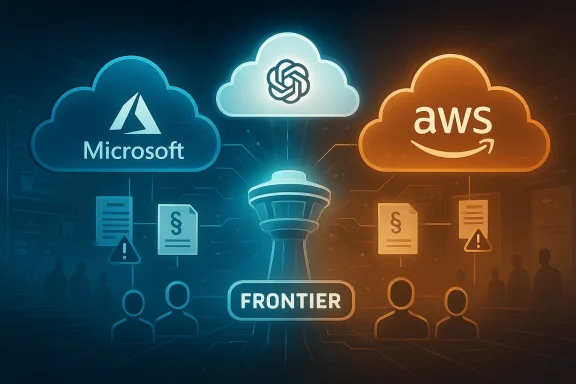
The latest flashpoint, according to reporting cited in the prompt and reflected in OpenAI’s own public statements, is Frontier, OpenAI’s enterprise platform for building and running AI agents. OpenAI and Amazon announced that AWS would serve as the exclusive third-party cloud distribution provider for Frontier, while OpenAI said Frontier products would continue to be hosted on Azure and that any stateless API calls stemming from third-party collaborations, including Amazon, would also be hosted on Azure. That wording matters because it suggests the deal is not a straightforward migration away from Microsoft infrastructure, but rather a fight over who gets to own the customer relationship and where value is recognized in the stack.
The distinction between hosting and distribution is doing most of the work here. If Frontier runs on Azure but is sold or surfaced through AWS, then Microsoft still owns the infrastructure layer while Amazon captures part of the commercial surface area. For a company like Microsoft, which has spent years turning Azure into a strategic AI platform, that is not a minor distinction. It means the cloud provider that absorbs the capital burden may not be the one that fully controls the enterprise relationship or the sales motion.
A lawsuit threat is also a signaling device. It tells enterprise customers, investors, and rivals that Microsoft does not intend to be passively disintermediated inside the very market it helped create. It also tells OpenAI that the days of assuming Microsoft will absorb every strategic surprise are over. In that sense, the dispute is as much about leverage as law. The contract is the battlefield, but power is the prize.
The early warning signs were visible well before the current Amazon dispute. Microsoft’s 2023 rush to integrate GPT-4 into Bing, despite reported OpenAI objections, showed how quickly the platform company was willing to move when product opportunity beckoned. Then came the November 2023 OpenAI board crisis, when Sam Altman was briefly ousted without advance notice to Microsoft. Microsoft’s response was telling: it moved to hire Altman and his team if necessary. That episode made the relationship feel less like a shared mission and more like a fragile truce. Trust never really recovered from that week.
OpenAI’s side of the strategy was equally deliberate. It needed more compute, more distribution optionality, and more bargaining power against any single cloud provider. Its own statements now emphasize flexibility to commit additional compute elsewhere, including the Stargate effort. That is not how a dependent startup speaks. It is how a company speaks when it wants to become infrastructure-independent enough to negotiate from strength.
That explains why the Amazon deal caused such a strong reaction. AWS is not merely another cloud vendor in this context; it is the largest and most credible enterprise distribution network in cloud computing. If AWS becomes the preferred way for corporate customers to access a major OpenAI product, Microsoft loses a share of the commercial gravity it expected to keep. Even if Azure still hosts the underlying workloads, the loss of distribution primacy is a strategic setback. Infrastructure without customer ownership is only partial power.
There is also a broader competitive concern. Enterprise buyers like optionality, but cloud vendors like control. When OpenAI distributes through AWS, it tells customers that the frontier model ecosystem is no longer a Microsoft-only path. That weakens one of the key arguments behind Azure’s AI push and may make large enterprises less likely to standardize around a single Microsoft-centric stack. For rivals, that is an opening. For Microsoft, it is a warning.
Microsoft has already made clear that Azure remains central to the OpenAI relationship. OpenAI’s own statement says Azure is the exclusive cloud provider for stateless OpenAI APIs and that first-party products, including Frontier, will continue to be hosted on Azure. That means Microsoft still has massive infrastructure relevance. But the presence of AWS in the sales and distribution chain dilutes the payoff from that infrastructure. It changes who captures the commercial surplus.
There is also a market-structure angle. If OpenAI can offer the same or similar frontier experience across multiple clouds, then cloud providers may compete on distribution, compliance, procurement convenience, and integration rather than pure exclusivity. That would be good for customers in some ways, but it would weaken Microsoft’s narrative that Azure is the singular home of OpenAI-powered enterprise AI. It would also empower Amazon as a platform broker.
This is where governance becomes as important as contract law. A relationship of this scale depends not only on written terms but on shared norms about notice, consultation, and strategic restraint. The OpenAI board upheaval in 2023 already proved that governance shock can reshape the partnership. If the current dispute escalates, it may reveal that the more consequential problem is not the wording of the documents but the collapse of the norms that once made those documents workable.
The governance implication is equally significant for the AI market. Future model partnerships are likely to be written with more explicit carve-outs, more transparent termination rights, and more defined distribution rules. The Microsoft–OpenAI saga may become a template not for cooperation, but for the contract hardening that follows a high-profile alliance fracture.
For OpenAI, the upside is leverage and resilience. It gains the ability to serve more customers through more channels, reduces overdependence on a single cloud provider, and signals that it can play the platform game on its own terms. But it also risks antagonizing the company that still has deep IP rights, a huge installed base, and a long contractual memory. OpenAI may want optionality, but optionality can look like betrayal to a former ally.
That has broader competitive consequences. If AWS can reliably host the commercial front door to frontier-model products, then Amazon can challenge Microsoft’s claim to be the default enterprise AI distribution layer. It also pressures Google Cloud and other providers to seek similar arrangements or risk being left behind. The result could be a more fragmented, multi-cloud AI market where the main differentiator is not model ownership but distribution architecture.
There is also a procurement issue. Many large organizations have standardized around Microsoft ecosystems, especially if they use Microsoft 365, security tooling, and Azure services. Frontier’s Amazon distribution may offer those buyers an easier way to procure OpenAI capabilities through an existing AWS relationship, but it may also split their AI strategy across vendors. That could be useful in the short run and messy in the long run. Convenience today can become complexity tomorrow.
That makes the stakes larger than a single launch. The dispute could influence how enterprises think about AI procurement for years: whether they buy from a model company, a cloud provider, or a stack vendor. Microsoft wants the answer to be “the stack vendor.” Amazon wants the answer to be “the cloud provider.” OpenAI wants the answer to be “the platform.”
Microsoft and OpenAI are simply the most visible example because their partnership has been so central to the public AI narrative. The alliance was always too important to stay purely friendly and too successful to remain politically simple. Once models became the foundation of enterprise software strategy, any single-cloud exclusivity agreement became a source of tension. That is why the current dispute feels bigger than the sum of its contractual clauses. It reflects a market in transition.
For the market, that is both good and bad. It may reduce surprise breakups and make alliance boundaries clearer. But it also signals that the industry’s most important partnerships are maturing into more defensive, less visionary structures. The AI boom is no longer just about building the future; it is about litigating who owns it.
The opportunity lies in clearer segmentation. Microsoft can focus on infrastructure, enterprise integration, and broad product distribution, while OpenAI can push model innovation and multi-channel adoption. A more explicit division of labor could reduce future surprise conflicts. It may even produce a more durable, if less intimate, alliance. Sometimes a better contract is a better partnership.
The more serious concern is that each company may conclude it is better off accelerating decoupling than preserving a strained alliance. If that happens, both could spend the next year optimizing against each other rather than for customers. That would be costly not only for them but for the broader AI market, which still depends on these leaders to provide clear, reliable guidance. Strategic breakup behavior rarely stays contained.
The most important question now is whether the parties want a final resolution or just a more stable truce. A final resolution would likely mean a re-written relationship, clearer limits, and a more explicit division of commercial territory. A truce would preserve flexibility, but only if both sides can resist the temptation to test each other again. That is a hard ask in a market this lucrative.
Source: Proactive Investors Microsoft's threat to sue OpenAI is the clearest sign yet that the most important partnership in tech is breaking down
 Background
The Microsoft–OpenAI relationship has always been unusual, even by Silicon Valley standards. Microsoft’s early bet on OpenAI gave the startup the capital and compute it needed to turn research ambition into commercial momentum, while Microsoft gained an inside track on the technology that would later power Copilot, Azure OpenAI Service, and a broader AI-led product reset. That initial partnership structure was widely described as a way to marry frontier model development with industrial-scale cloud delivery, and for a time it worked exactly that way. Microsoft’s own 2023 statement said Azure would power all OpenAI workloads across research, products, and API services.The problem with high-functioning alliances is that they often conceal the moment when incentives begin to diverge. By 2024 and 2025, OpenAI no longer looked like a lab that simply needed a benefactor; it looked like a platform company building direct enterprise relationships, additional infrastructure options, and its own strategic leverage. Microsoft, meanwhile, had become more than a provider. It was a downstream commercial partner, a distribution channel, and in many cases a competitor that depended on OpenAI while also trying to reduce dependence on it. Microsoft’s October 2025 blog post said the new agreement extended key IP rights through 2032 and preserved Azure API exclusivity, while also refining provisions so each company could pursue new opportunities independently.
That duality is the real story. Partnership language remained warm, but the mechanics increasingly pointed toward separation. OpenAI expanded compute relationships beyond Microsoft, while Microsoft invested in its own model stack and began surfacing rival systems such as Anthropic’s Claude in Office 365. In parallel, OpenAI pursued Stargate-style infrastructure ambitions with other partners and deepened its own enterprise offering. The result is not a clean breakup, but a slow-motion uncoupling.
The latest flashpoint, according to reporting cited in the prompt and reflected in OpenAI’s own public statements, is Frontier, OpenAI’s enterprise platform for building and running AI agents. OpenAI and Amazon announced that AWS would serve as the exclusive third-party cloud distribution provider for Frontier, while OpenAI said Frontier products would continue to be hosted on Azure and that any stateless API calls stemming from third-party collaborations, including Amazon, would also be hosted on Azure. That wording matters because it suggests the deal is not a straightforward migration away from Microsoft infrastructure, but rather a fight over who gets to own the customer relationship and where value is recognized in the stack.
The Contractual Core of the Dispute
At the center of the dispute is a very old business issue dressed in very modern language: who has the right to distribute what, and through whom. Microsoft’s reported position is that OpenAI cannot use AWS as a third-party distribution channel for Frontier without violating the spirit, if not the strict wording, of their relationship. OpenAI’s public statement, however, says the opposite in effect: that the new Amazon collaboration is compatible with the Microsoft partnership and that Azure remains the home for OpenAI’s first-party products and stateless APIs. That is a classic recipe for legal ambiguity.The distinction between hosting and distribution is doing most of the work here. If Frontier runs on Azure but is sold or surfaced through AWS, then Microsoft still owns the infrastructure layer while Amazon captures part of the commercial surface area. For a company like Microsoft, which has spent years turning Azure into a strategic AI platform, that is not a minor distinction. It means the cloud provider that absorbs the capital burden may not be the one that fully controls the enterprise relationship or the sales motion.
Why the language matters
The language of the 2025 agreement appears to have been designed to keep both sides talking while preserving room for maneuver. OpenAI’s own statement emphasizes that nothing in the Amazon announcement changes previously shared terms, and that collaborations with third-party cloud providers were always contemplated. Microsoft, by contrast, has framed the same period as one of reinforced exclusivity and durable IP rights. When both parties can plausibly cite the same agreement to support opposite narratives, litigation becomes less a possibility than an outcome waiting for a trigger.A lawsuit threat is also a signaling device. It tells enterprise customers, investors, and rivals that Microsoft does not intend to be passively disintermediated inside the very market it helped create. It also tells OpenAI that the days of assuming Microsoft will absorb every strategic surprise are over. In that sense, the dispute is as much about leverage as law. The contract is the battlefield, but power is the prize.
- Hosting and distribution are not the same thing.
- Control of the enterprise customer relationship is the strategic issue.
- Contract language can preserve partnership optics while reallocating power.
- A lawsuit threat often functions as a negotiation tool before it becomes a filing.
From Marriage to Managed Rivalry
For a while, Microsoft and OpenAI behaved like a deeply integrated joint venture without the formal labels. Microsoft had capital, cloud scale, and a vast enterprise base. OpenAI had the most visible frontier model brand in the world and the ability to attract developers, customers, and talent at astonishing speed. That combination worked because each party needed the other more than it feared the other. Once that asymmetry faded, the arrangement became harder to sustain.The early warning signs were visible well before the current Amazon dispute. Microsoft’s 2023 rush to integrate GPT-4 into Bing, despite reported OpenAI objections, showed how quickly the platform company was willing to move when product opportunity beckoned. Then came the November 2023 OpenAI board crisis, when Sam Altman was briefly ousted without advance notice to Microsoft. Microsoft’s response was telling: it moved to hire Altman and his team if necessary. That episode made the relationship feel less like a shared mission and more like a fragile truce. Trust never really recovered from that week.
The strategic reset
By 2024 and 2025, both companies started building insurance policies against one another. OpenAI signed compute commitments beyond Azure, while Microsoft deepened its own model strategy and broadened its supplier mix. Microsoft’s decision to work more visibly with Anthropic models inside Microsoft 365 was especially important because it showed customers and investors that Redmond was not willing to be locked into a single frontier partner forever. That is what mature platform companies do when they no longer believe exclusivity is strategically sustainable.OpenAI’s side of the strategy was equally deliberate. It needed more compute, more distribution optionality, and more bargaining power against any single cloud provider. Its own statements now emphasize flexibility to commit additional compute elsewhere, including the Stargate effort. That is not how a dependent startup speaks. It is how a company speaks when it wants to become infrastructure-independent enough to negotiate from strength.
- The partnership shifted from dependency to mutual hedging.
- Both sides built alternatives before openly admitting it.
- Each incremental diversification reduced the other party’s leverage.
- The relationship now looks more like managed rivalry than shared destiny.
Why Frontier Became the Flashpoint
Frontier matters because enterprise AI is where the money is heading. Consumer chat experiences generate buzz, but enterprise platforms determine whether AI becomes a durable software category or an expensive novelty. If Frontier is the surface through which companies build and run AI agents, then controlling how that platform is distributed is equivalent to controlling a potential gateway to recurring revenue, integration lock-in, and customer retention.That explains why the Amazon deal caused such a strong reaction. AWS is not merely another cloud vendor in this context; it is the largest and most credible enterprise distribution network in cloud computing. If AWS becomes the preferred way for corporate customers to access a major OpenAI product, Microsoft loses a share of the commercial gravity it expected to keep. Even if Azure still hosts the underlying workloads, the loss of distribution primacy is a strategic setback. Infrastructure without customer ownership is only partial power.
Enterprise channel control
Microsoft has spent years building a story around integrated AI adoption across the Microsoft stack, from Azure to Microsoft 365 to Dynamics and security products. Frontier, if routed through AWS in a meaningful commercial sense, introduces a rival channel into that story. That means AWS can position itself as the preferred enterprise on-ramp for a major OpenAI product, while Microsoft becomes the invisible backend. The optics alone are unfavorable, and the economics may be worse.There is also a broader competitive concern. Enterprise buyers like optionality, but cloud vendors like control. When OpenAI distributes through AWS, it tells customers that the frontier model ecosystem is no longer a Microsoft-only path. That weakens one of the key arguments behind Azure’s AI push and may make large enterprises less likely to standardize around a single Microsoft-centric stack. For rivals, that is an opening. For Microsoft, it is a warning.
- Frontier is strategically important because it sits at the enterprise adoption layer.
- AWS distribution can redirect customer relationships away from Azure.
- Microsoft risks becoming a backend utility rather than the primary commercial gateway.
- The dispute is about platform power, not just server placement.
The Cloud Economics Behind the Drama
Cloud partnerships are usually discussed as technology relationships, but they are really economics wrapped in product language. Training and serving frontier models requires enormous capital expenditure, long-term capacity planning, and very patient assumptions about utilization. Whoever pays for the infrastructure wants preferential access to the business generated by it. That is why cloud exclusivity matters so much, and why disputes about “who gets the customer” can become existential.Microsoft has already made clear that Azure remains central to the OpenAI relationship. OpenAI’s own statement says Azure is the exclusive cloud provider for stateless OpenAI APIs and that first-party products, including Frontier, will continue to be hosted on Azure. That means Microsoft still has massive infrastructure relevance. But the presence of AWS in the sales and distribution chain dilutes the payoff from that infrastructure. It changes who captures the commercial surplus.
The value stack problem
In cloud computing, value is distributed across layers: raw compute, orchestration, product packaging, and customer acquisition. Microsoft appears to believe it should own more of those layers because it funded the buildout and has the deeper contractual rights. OpenAI appears to believe it can expand into adjacent channels without surrendering its core obligations. The question is less whether both are technically right and more which reading a court, arbitrator, or negotiator would find more persuasive. That uncertainty is what makes the threat credible.There is also a market-structure angle. If OpenAI can offer the same or similar frontier experience across multiple clouds, then cloud providers may compete on distribution, compliance, procurement convenience, and integration rather than pure exclusivity. That would be good for customers in some ways, but it would weaken Microsoft’s narrative that Azure is the singular home of OpenAI-powered enterprise AI. It would also empower Amazon as a platform broker.
- Cloud economics are about margin capture, not just capacity.
- Distribution rights can be worth as much as hosting rights.
- Multi-cloud access increases customer choice but weakens exclusivity.
- The fight is over the richest layer of the AI value stack.
The Legal and Governance Wild Card
Microsoft’s threat to sue is notable because it suggests the company believes it has a plausible path to enforcement rather than merely a bargaining position. That said, the public record shows the two companies recently issued statements that preserve the core partnership and extend key rights. Microsoft’s October 2025 post said its IP rights were extended through 2032 and that OpenAI could provide API access to U.S. national security customers regardless of cloud provider, while OpenAI said collaborations with third-party cloud providers were contemplated under the agreements. Those details create a wide legal gray zone.This is where governance becomes as important as contract law. A relationship of this scale depends not only on written terms but on shared norms about notice, consultation, and strategic restraint. The OpenAI board upheaval in 2023 already proved that governance shock can reshape the partnership. If the current dispute escalates, it may reveal that the more consequential problem is not the wording of the documents but the collapse of the norms that once made those documents workable.
What litigation would really test
A court battle would likely test whether third-party distribution is barred in substance, not just in form. It could also force disclosure of how much control Microsoft thought it had over routing, product exclusivity, and enterprise go-to-market rights. That would be risky for both parties, which is why the more likely near-term outcome is continued negotiation. But the very fact that litigation is being discussed shows how far trust has eroded. Once partners start parsing “spirit” and “letter” separately, the relationship is already under strain.The governance implication is equally significant for the AI market. Future model partnerships are likely to be written with more explicit carve-outs, more transparent termination rights, and more defined distribution rules. The Microsoft–OpenAI saga may become a template not for cooperation, but for the contract hardening that follows a high-profile alliance fracture.
- The legal case likely turns on substance versus form.
- Governance failures can be more damaging than the contract itself.
- Litigation would expose how much control each party really believed it had.
- The broader industry may respond with tighter, more explicit partnership terms.
Competitive Implications for Microsoft, OpenAI, and Amazon
For Microsoft, the risk is not just losing a dispute; it is losing narrative control. The company has spent years presenting itself as the principal enterprise AI platform, with OpenAI as the flagship engine inside that story. If OpenAI now uses AWS to widen distribution, Microsoft must explain why its most important AI partner is helping a rival cloud provider win enterprise mindshare. That is a difficult message for sales teams and investors alike.For OpenAI, the upside is leverage and resilience. It gains the ability to serve more customers through more channels, reduces overdependence on a single cloud provider, and signals that it can play the platform game on its own terms. But it also risks antagonizing the company that still has deep IP rights, a huge installed base, and a long contractual memory. OpenAI may want optionality, but optionality can look like betrayal to a former ally.
Amazon’s strategic gain
Amazon is the quiet winner in the current drama. By becoming the exclusive third-party cloud distribution provider for Frontier, AWS inserts itself into the most valuable layer of enterprise AI adoption without having to invent the frontier model itself. That allows Amazon to monetize demand for AI agents while keeping OpenAI in the product spotlight. In effect, AWS gets to sell the highway while someone else drives the car.That has broader competitive consequences. If AWS can reliably host the commercial front door to frontier-model products, then Amazon can challenge Microsoft’s claim to be the default enterprise AI distribution layer. It also pressures Google Cloud and other providers to seek similar arrangements or risk being left behind. The result could be a more fragmented, multi-cloud AI market where the main differentiator is not model ownership but distribution architecture.
- Microsoft risks narrative dilution inside enterprise AI.
- OpenAI gains leverage but also invites retaliation.
- Amazon gains strategic relevance without bearing all model-development risk.
- Rivals may follow with similar distribution-first strategies.
What It Means for Enterprise Customers
Enterprise customers often prefer redundancy, and in that sense the broader trend is positive. More cloud options, more deployment pathways, and more bargaining competition can reduce lock-in. But the current fight also introduces uncertainty about roadmap stability, support consistency, and pricing predictability. When major partners are threatening lawsuits, buyers have to wonder how long the commercial rules will remain the same.There is also a procurement issue. Many large organizations have standardized around Microsoft ecosystems, especially if they use Microsoft 365, security tooling, and Azure services. Frontier’s Amazon distribution may offer those buyers an easier way to procure OpenAI capabilities through an existing AWS relationship, but it may also split their AI strategy across vendors. That could be useful in the short run and messy in the long run. Convenience today can become complexity tomorrow.
Enterprise adoption realities
The most sophisticated buyers will see this as a bargaining opportunity. They can compare Microsoft-hosted, OpenAI-direct, and AWS-mediated pathways and choose the one that best fits governance, security, and pricing needs. Smaller buyers, however, may simply face more confusion about where the “real” OpenAI experience lives. In enterprise software, clarity is often the most underrated feature.That makes the stakes larger than a single launch. The dispute could influence how enterprises think about AI procurement for years: whether they buy from a model company, a cloud provider, or a stack vendor. Microsoft wants the answer to be “the stack vendor.” Amazon wants the answer to be “the cloud provider.” OpenAI wants the answer to be “the platform.”
- Buyers may benefit from more choice and better pricing leverage.
- Mixed-vendor AI stacks can create governance and support complexity.
- Procurement teams will need clearer definitions of hosting versus distribution.
- The dispute may shape enterprise expectations about platform independence.
The Bigger Industry Pattern
This fight is not happening in a vacuum. The AI industry has already moved from a phase of exuberant dependency to a phase of strategic disentanglement. Early winners needed enormous capital and infrastructure, so they attached themselves to large cloud platforms. Once the products became commercially important, those same startups sought more independence, more partners, and more control over the value chain. That pattern is playing out across the sector.Microsoft and OpenAI are simply the most visible example because their partnership has been so central to the public AI narrative. The alliance was always too important to stay purely friendly and too successful to remain politically simple. Once models became the foundation of enterprise software strategy, any single-cloud exclusivity agreement became a source of tension. That is why the current dispute feels bigger than the sum of its contractual clauses. It reflects a market in transition.
A template for future deals
The most likely long-term lesson is that frontier AI partnerships will increasingly resemble telecom interconnect deals or media licensing agreements: complex, layered, and heavily negotiated around routing, access, and economics. The era of informal “we trust each other” arrangements is over. Future deals will likely specify exactly where models run, how they are distributed, who can resell them, and under what circumstances. That is less romantic but more realistic.For the market, that is both good and bad. It may reduce surprise breakups and make alliance boundaries clearer. But it also signals that the industry’s most important partnerships are maturing into more defensive, less visionary structures. The AI boom is no longer just about building the future; it is about litigating who owns it.
- AI partnerships are becoming more like infrastructure contracts.
- Distribution rights are now as important as model quality.
- The market is shifting from improvisation to formalized control.
- The Microsoft–OpenAI dispute may become a reference case for the industry.
Strengths and Opportunities
Despite the acrimony, the situation also reveals how valuable both companies remain to each other and to the broader AI ecosystem. Microsoft still has deep enterprise reach, massive cloud infrastructure, and a huge installed base of customers who want AI tools embedded in familiar products. OpenAI still has one of the strongest brands in AI, a powerful developer mindshare, and a product portfolio that attracts enterprise attention at scale. If they can reset expectations, the partnership could still produce enormous value.The opportunity lies in clearer segmentation. Microsoft can focus on infrastructure, enterprise integration, and broad product distribution, while OpenAI can push model innovation and multi-channel adoption. A more explicit division of labor could reduce future surprise conflicts. It may even produce a more durable, if less intimate, alliance. Sometimes a better contract is a better partnership.
- Microsoft retains unmatched enterprise reach.
- OpenAI retains top-tier brand gravity and developer attention.
- Clearer role separation could reduce strategic ambiguity.
- Multi-cloud distribution may increase total market adoption.
- Stronger contractual definitions could stabilize future launches.
- Both companies can still monetize complementary strengths.
- Customers may benefit from broader access and more resilient infrastructure.
Risks and Concerns
The risks are considerable because the current situation combines legal uncertainty, strategic mistrust, and market symbolism. A lawsuit threat can harden positions quickly, making compromise more difficult even if both sides would benefit from it. There is also a danger that customers interpret the conflict as instability in the very AI stack they are being asked to trust with sensitive workflows. In enterprise technology, confidence is a product feature.The more serious concern is that each company may conclude it is better off accelerating decoupling than preserving a strained alliance. If that happens, both could spend the next year optimizing against each other rather than for customers. That would be costly not only for them but for the broader AI market, which still depends on these leaders to provide clear, reliable guidance. Strategic breakup behavior rarely stays contained.
- Litigation could freeze negotiations and damage trust further.
- Customer confidence may fall if launch terms keep changing.
- Decoupling could increase costs for both sides.
- Rival clouds may exploit the uncertainty to win business.
- Microsoft could lose channel control over key enterprise AI products.
- OpenAI could face retaliation over IP, access, or pricing leverage.
- The partnership’s instability may set a cautionary precedent for the industry.
Looking Ahead
The next phase will likely be decided not in public statements, but in how aggressively each side enforces the boundaries it believes it owns. If Microsoft truly believes Frontier’s AWS distribution violates the partnership, it may press for remedies that stop short of open litigation but still reassert control. If OpenAI believes its public interpretation is sound, it will continue to broaden its distribution strategy while insisting that Azure remains the technical foundation. The gap between those positions is where the real negotiation lives.The most important question now is whether the parties want a final resolution or just a more stable truce. A final resolution would likely mean a re-written relationship, clearer limits, and a more explicit division of commercial territory. A truce would preserve flexibility, but only if both sides can resist the temptation to test each other again. That is a hard ask in a market this lucrative.
What to watch
- Whether Microsoft files suit or uses the threat as leverage.
- Whether OpenAI and Amazon expand the Frontier partnership further.
- Whether Microsoft sharpens its own rival model and distribution strategy.
- Whether additional cloud providers seek similar OpenAI arrangements.
- Whether enterprise customers see the dispute as risk or opportunity.
- Whether new partnership language becomes more explicit about third-party distribution.
Source: Proactive Investors Microsoft's threat to sue OpenAI is the clearest sign yet that the most important partnership in tech is breaking down