

Microsoft and Palantir entered 2026’s AI earnings cycle with blowout numbers, but Microsoft is selling the cloud infrastructure, models, platforms, and productivity software enterprises rent at scale, while Palantir is selling the operational AI layer that turns institutional data into decisions for governments and large companies. The distinction matters because investors are not simply choosing between two AI stocks; they are choosing between two theories of where value accrues.
Microsoft’s bet is that AI becomes a utility, and that the company with the densest cloud fabric, deepest enterprise relationships, and broadest software estate can monetize every layer of that utility. Palantir’s bet is sharper and more concentrated: that enterprises do not merely need models or compute, but a trusted operating system for messy, high-stakes decisions. Both arguments are working. They are just working at wildly different altitudes.
The Microsoft story is easy to misunderstand because the company’s AI narrative has been compressed into the word “Copilot.” Copilot matters, but it is not the whole argument. Microsoft’s current AI machine runs from data center power and GPUs through Azure, GitHub, Microsoft 365, Dynamics, security, and a growing portfolio of agentic tools that can be sold into nearly every corner of enterprise IT.
That is why the most important Microsoft number was not merely Azure growth, though 40 percent growth in Azure and other cloud services is the kind of figure that would define an entire company if Microsoft were smaller. The more revealing figure was commercial remaining performance obligation, which rose to $627 billion. That is not revenue in the bank, but it is a huge contractual signal that large customers are committing to Microsoft’s cloud and software stack over time.
The annualized AI revenue run rate above $37 billion also changes the tone of the debate. For the last two years, skeptics have asked when generative AI would become a real business rather than an expensive demo layered over enterprise software. Microsoft’s answer is now numeric: the AI business is already larger than many standalone software giants.
But this is not a victory lap. Microsoft’s AI buildout is brutally capital intensive, and the company’s quarterly additions to property and equipment reached $30.876 billion. That is the price of trying to be the default infrastructure provider for the next computing platform. The payoff could be enormous, but the bill arrives before the capacity is fully monetized.
That is why Microsoft’s earnings are both reassuring and unsettling. Revenue, cloud growth, backlog, and net income all point to a company executing from a position of extraordinary strength. Yet the same report shows a business that must keep feeding the infrastructure machine to remain in front of demand.
This is where Microsoft differs from the cloud growth stories of the 2010s. The earlier cloud migration thesis was about shifting enterprise workloads from owned hardware to hyperscale platforms. The AI thesis is more physically demanding. It requires specialized chips, more electricity, denser clusters, and a willingness to invest ahead of revenue in a way that makes even old cloud capex cycles look modest.
For WindowsForum readers, this is not just an investor abstraction. Microsoft’s AI infrastructure spending will shape the pace and packaging of Windows, Microsoft 365, Azure, GitHub, Defender, and developer tooling. If the company needs to drive utilization across a massive AI estate, expect AI features to move from premium experiments into default workflows wherever Microsoft can plausibly justify them.
The risk is that customers may not want AI everywhere at the speed Microsoft wants to deploy it. Administrators already live with the tension between vendor roadmaps and enterprise change control. Microsoft’s infrastructure economics give the company a powerful incentive to make AI consumption feel inevitable.
The reason investors care is not just growth. It is where the growth is occurring. Palantir has spent years trying to escape the perception that it was primarily a government contractor with bespoke deployment habits and controversial politics. The AIP era has given the company a cleaner commercial narrative: Palantir can move quickly inside large organizations because it does not ask them to rebuild their entire data estate before seeing operational outcomes.
That is a powerful pitch in the current AI market. Many enterprises have bought cloud capacity, experimented with copilots, and run internal pilots without reaching the harder stage: embedding AI into actual decisions, approvals, supply chains, defense workflows, fraud systems, factories, hospitals, and customer operations. Palantir’s promise is that it can bridge the gap between raw data, model output, and accountable institutional action.
This is why Palantir’s rhetoric often sounds more intense than conventional SaaS marketing. Alex Karp is not selling another dashboard. He is selling decision advantage. Whether one finds that compelling or theatrical, the market is rewarding the possibility that Palantir has found a repeatable way to turn AI from a productivity layer into an operating layer.
But the valuation contains its own hazard. A price-to-earnings multiple near 192 is not a compliment; it is a demand letter from the market. It says Palantir must keep delivering exceptional growth, exceptional margins, and exceptional customer expansion for long enough that today’s price eventually looks rational.
That is possible, but it leaves little room for ordinary software gravity. U.S. commercial growth above 100 percent is thrilling when the base is still expanding from a comparatively small level. The question is how long that rate can persist as the base grows, procurement cycles lengthen, and customers move from urgent AI experimentation to budget discipline.
Stock-based compensation is another part of the argument investors cannot hand-wave away. Palantir has improved its profitability profile, but dilution remains a live issue when evaluating shareholder returns. A capital-light software business can be a wonderful machine, but only if growth and per-share economics move together.
This is the paradox of Palantir. The company may be executing brilliantly and still be priced for a version of brilliance that is hard to sustain. Microsoft can be slower and still cheaper. Palantir can be faster and still more dangerous.
Their customer conversations are different. Microsoft usually enters through CIOs, cloud architects, security leaders, procurement departments, and enterprise licensing machinery. It benefits from being everywhere already. Palantir often wins when an organization has a specific operational problem and a senior leader wants visible results quickly.
Their economic exposures are also different. Microsoft must manage infrastructure utilization, gross margin pressure, supply chains, and competitive pricing against Amazon Web Services, Google Cloud, and increasingly specialized AI infrastructure providers. Palantir must prove that its deployment model scales commercially without becoming too dependent on a narrow set of large customers, government priorities, or charismatic executive storytelling.
They can also coexist. A large enterprise could run on Azure, use Microsoft 365 Copilot, secure endpoints with Defender, manage code through GitHub, and still deploy Palantir for operational intelligence in specific domains. That coexistence is important because the AI economy is not a single budget line. It is becoming a stack of overlapping claims on infrastructure, data, workflow, governance, and automation.
Still, budgets are finite. Every dollar spent on a premium AI workflow platform is a dollar that may not be spent on another vendor’s analytics, automation, or cloud-native tooling. The fight is not always direct, but it is real.
That kind of distribution is difficult to beat because it lowers friction. A new AI vendor must often justify security, compliance, procurement, integration, identity, and support from scratch. Microsoft can frequently present AI as an extension of an existing contract, an existing admin console, or an existing enterprise architecture.
But scale can make companies less sensitive to user frustration. Windows users have already seen how aggressively Microsoft can push cloud accounts, Edge, OneDrive, Copilot, and telemetry-linked experiences into the operating system. The same distribution that makes Microsoft powerful can also make it heavy-handed.
For sysadmins, the practical question is not whether Microsoft can ship AI features. It plainly can. The question is whether those features will be governable, auditable, licensable, and removable in ways that match enterprise reality. AI that appears uninvited in a regulated workflow is not innovation; it is a ticket queue.
This is where Microsoft’s moat must become more than bundling. If the company wants AI to be trusted at the enterprise layer, it must provide controls that are as mature as the features are ambitious. Otherwise, rivals do not need to beat Microsoft everywhere. They only need to look safer in the workflows where control matters most.
That history gives Palantir credibility in a market suddenly crowded with vendors claiming to make enterprise AI “operational.” The company’s ontology-centered approach is not new, but the arrival of modern AI models makes it easier to explain why that architecture matters. Models need context, permissions, workflows, and guardrails. Palantir has been selling versions of that connective tissue for years.
The risk is that Palantir’s focus also creates concentration. U.S. government revenue remains a major piece of the business, and U.S. commercial momentum is doing much of the work in the growth story. That can be a strength when U.S. institutions are spending aggressively, but it can become a vulnerability if procurement slows, politics shift, or commercial adoption broadens less quickly than the valuation assumes.
There is also the question of cultural fit. Palantir’s intensity is part of its brand, but not every enterprise wants to reorganize around a vendor’s operating philosophy. Some customers want a platform that transforms how they work. Others want modular tools that fit inside existing architectures without creating a new center of gravity.
Palantir’s upside depends on enough customers choosing the first path. That is a bigger prize, but also a narrower one.
Palantir’s valuation reflects something more combustible. A P/E ratio around 192 implies that the company is not being valued on the present so much as on the possibility that it becomes a dominant enterprise AI operating layer. That is the sort of valuation that can produce spectacular returns if the thesis is right and painful compression if growth merely becomes excellent instead of extraordinary.
This is why the stock reactions matter less than the underlying expectations. Both Microsoft and Palantir can beat earnings and still trade lower if investors decide that the bar has moved faster than the business. In AI, the market is not just asking whether companies are growing. It is asking whether they are growing fast enough to justify a future already embedded in the price.
Microsoft’s burden is to prove that its infrastructure spending will generate attractive returns over time. Palantir’s burden is to prove that its commercial explosion is not a short-cycle rush of AI urgency, but the beginning of a durable software category. Those are different burdens, and investors should not pretend otherwise.
For WindowsForum’s audience, the difference has a practical edge. Microsoft’s AI economics will show up in the products most readers administer every day. Palantir’s success will show up in the kinds of institutional workflows where AI moves from assistant to actor. One affects the default enterprise computing environment. The other affects how organizations make decisions inside it.
Microsoft is one of the few companies trying to own both sides. It has the balance sheet to build the physics layer and the software estate to push AI into workflow. That is why its opportunity is so large, and why its capex is so alarming.
Palantir is more deliberately placed on the workflow side. It does not need to win the cloud war to win customers. It needs to convince institutions that the value of AI is not in having access to a model, but in having a system that knows the organization well enough to make model output useful.
This distinction explains why both companies can claim to be central to enterprise AI without making identical claims. Microsoft says, in effect, “build and run your AI future on our platform.” Palantir says, “make your institution operationally intelligent now.” The first is broader. The second is sharper.
The market may ultimately reward both, but not in the same way. Infrastructure tends toward scale, utilization, and platform economics. Workflow tends toward domain expertise, trust, switching costs, and executive sponsorship. The best AI companies will not merely have models attached. They will know where in that split they actually make money.
That means IT departments should expect more packaging complexity, not less. Copilot-branded features will continue spreading across Microsoft 365, Windows, GitHub, security products, Power Platform, Dynamics, and Azure services. Some will be transformative. Some will be incremental. Some will be difficult to justify outside narrow use cases.
The administrative challenge is to separate capability from compulsion. A feature can be useful and still not belong in every tenant. A model can be powerful and still require data boundaries, retention policies, role-based access controls, legal review, and user training before deployment. AI governance is becoming ordinary IT governance, only with faster blast radius.
Palantir raises a different governance question. Its value proposition depends on deep integration with institutional data and decision workflows. That can produce impressive outcomes, but it also means customers must think carefully about vendor dependency, auditability, and who controls the operational logic once the platform becomes embedded.
The near future of enterprise AI will be less about whether the technology works in a demo and more about whether organizations can operate it responsibly at scale. That is not as exciting as a keynote. It is much closer to where the money will be made.
Microsoft looks like ballast with upside. It offers cloud growth, AI leverage, a gigantic backlog, and mature profitability, offset by the risk that infrastructure spending outruns near-term returns. Palantir looks like asymmetry with altitude sickness. It offers explosive growth and a capital-light model, offset by valuation risk, dilution concerns, and the need to keep compounding from a higher base.
The cleanest reading is not that one company is “the better AI stock” in all contexts. It is that Microsoft is the safer expression of AI as infrastructure and platform, while Palantir is the more volatile expression of AI as institutional transformation. Investors who blur those categories are likely to misread both.
Source: vocal.media Microsoft and Palantir Offer Two Different AI Bets as Investors Weigh Infrastructure Scale Against Software Growth
Microsoft’s bet is that AI becomes a utility, and that the company with the densest cloud fabric, deepest enterprise relationships, and broadest software estate can monetize every layer of that utility. Palantir’s bet is sharper and more concentrated: that enterprises do not merely need models or compute, but a trusted operating system for messy, high-stakes decisions. Both arguments are working. They are just working at wildly different altitudes.
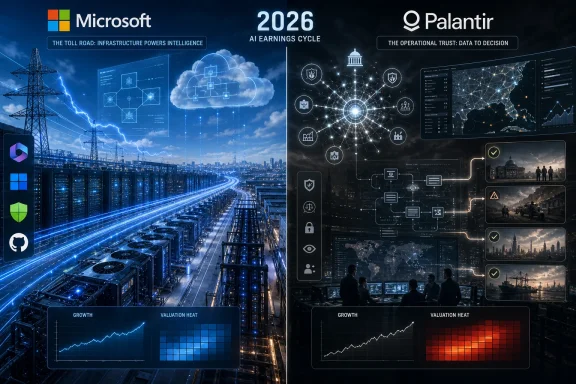 Microsoft Is Building the Toll Road, Not Just Driving on It
The Microsoft story is easy to misunderstand because the company’s AI narrative has been compressed into the word “Copilot.” Copilot matters, but it is not the whole argument. Microsoft’s current AI machine runs from data center power and GPUs through Azure, GitHub, Microsoft 365, Dynamics, security, and a growing portfolio of agentic tools that can be sold into nearly every corner of enterprise IT.That is why the most important Microsoft number was not merely Azure growth, though 40 percent growth in Azure and other cloud services is the kind of figure that would define an entire company if Microsoft were smaller. The more revealing figure was commercial remaining performance obligation, which rose to $627 billion. That is not revenue in the bank, but it is a huge contractual signal that large customers are committing to Microsoft’s cloud and software stack over time.
The annualized AI revenue run rate above $37 billion also changes the tone of the debate. For the last two years, skeptics have asked when generative AI would become a real business rather than an expensive demo layered over enterprise software. Microsoft’s answer is now numeric: the AI business is already larger than many standalone software giants.
But this is not a victory lap. Microsoft’s AI buildout is brutally capital intensive, and the company’s quarterly additions to property and equipment reached $30.876 billion. That is the price of trying to be the default infrastructure provider for the next computing platform. The payoff could be enormous, but the bill arrives before the capacity is fully monetized.
The Capex Question Is the Whole Microsoft Question
The strongest bear case against Microsoft is not that AI demand is fake. It is that AI demand may be real and still not profitable enough, quickly enough, to justify the scale of the buildout. Data centers, accelerators, networking, cooling, and power agreements do not behave like ordinary software expenses. They are long-lived commitments made under uncertain assumptions about model efficiency, pricing pressure, utilization, and customer adoption curves.That is why Microsoft’s earnings are both reassuring and unsettling. Revenue, cloud growth, backlog, and net income all point to a company executing from a position of extraordinary strength. Yet the same report shows a business that must keep feeding the infrastructure machine to remain in front of demand.
This is where Microsoft differs from the cloud growth stories of the 2010s. The earlier cloud migration thesis was about shifting enterprise workloads from owned hardware to hyperscale platforms. The AI thesis is more physically demanding. It requires specialized chips, more electricity, denser clusters, and a willingness to invest ahead of revenue in a way that makes even old cloud capex cycles look modest.
For WindowsForum readers, this is not just an investor abstraction. Microsoft’s AI infrastructure spending will shape the pace and packaging of Windows, Microsoft 365, Azure, GitHub, Defender, and developer tooling. If the company needs to drive utilization across a massive AI estate, expect AI features to move from premium experiments into default workflows wherever Microsoft can plausibly justify them.
The risk is that customers may not want AI everywhere at the speed Microsoft wants to deploy it. Administrators already live with the tension between vendor roadmaps and enterprise change control. Microsoft’s infrastructure economics give the company a powerful incentive to make AI consumption feel inevitable.
Palantir Sells the Scarcer Thing: Operational Trust
Palantir’s quarter tells a different story. Its revenue base is much smaller, but its growth rate is much hotter. Q4 FY25 revenue grew 70 percent year over year to $1.41 billion, U.S. commercial revenue surged 137 percent, and its Rule of 40 score reached 127 percent. Those are not normal enterprise software numbers.The reason investors care is not just growth. It is where the growth is occurring. Palantir has spent years trying to escape the perception that it was primarily a government contractor with bespoke deployment habits and controversial politics. The AIP era has given the company a cleaner commercial narrative: Palantir can move quickly inside large organizations because it does not ask them to rebuild their entire data estate before seeing operational outcomes.
That is a powerful pitch in the current AI market. Many enterprises have bought cloud capacity, experimented with copilots, and run internal pilots without reaching the harder stage: embedding AI into actual decisions, approvals, supply chains, defense workflows, fraud systems, factories, hospitals, and customer operations. Palantir’s promise is that it can bridge the gap between raw data, model output, and accountable institutional action.
This is why Palantir’s rhetoric often sounds more intense than conventional SaaS marketing. Alex Karp is not selling another dashboard. He is selling decision advantage. Whether one finds that compelling or theatrical, the market is rewarding the possibility that Palantir has found a repeatable way to turn AI from a productivity layer into an operating layer.
The Software Layer Looks Magical Until the Multiple Arrives
Palantir’s business model has the beauty Microsoft’s does not: it does not need to finance the physical substrate of AI at hyperscaler scale. It can run on top of cloud infrastructure, plug into customer data, and capture high-value software margins without building the world’s most expensive compute grid. In a market worried about AI capex, that is an attractive contrast.But the valuation contains its own hazard. A price-to-earnings multiple near 192 is not a compliment; it is a demand letter from the market. It says Palantir must keep delivering exceptional growth, exceptional margins, and exceptional customer expansion for long enough that today’s price eventually looks rational.
That is possible, but it leaves little room for ordinary software gravity. U.S. commercial growth above 100 percent is thrilling when the base is still expanding from a comparatively small level. The question is how long that rate can persist as the base grows, procurement cycles lengthen, and customers move from urgent AI experimentation to budget discipline.
Stock-based compensation is another part of the argument investors cannot hand-wave away. Palantir has improved its profitability profile, but dilution remains a live issue when evaluating shareholder returns. A capital-light software business can be a wonderful machine, but only if growth and per-share economics move together.
This is the paradox of Palantir. The company may be executing brilliantly and still be priced for a version of brilliance that is hard to sustain. Microsoft can be slower and still cheaper. Palantir can be faster and still more dangerous.
These Companies Are Not Fighting the Same War
The lazy comparison is to say Microsoft and Palantir are both AI companies. They are, but that phrase now covers too much ground to be useful. Microsoft is a platform conglomerate using AI to reinforce its cloud, productivity, security, developer, and enterprise software franchises. Palantir is an application and ontology company trying to become the trusted decision layer for institutions that cannot afford hallucinated process theater.Their customer conversations are different. Microsoft usually enters through CIOs, cloud architects, security leaders, procurement departments, and enterprise licensing machinery. It benefits from being everywhere already. Palantir often wins when an organization has a specific operational problem and a senior leader wants visible results quickly.
Their economic exposures are also different. Microsoft must manage infrastructure utilization, gross margin pressure, supply chains, and competitive pricing against Amazon Web Services, Google Cloud, and increasingly specialized AI infrastructure providers. Palantir must prove that its deployment model scales commercially without becoming too dependent on a narrow set of large customers, government priorities, or charismatic executive storytelling.
They can also coexist. A large enterprise could run on Azure, use Microsoft 365 Copilot, secure endpoints with Defender, manage code through GitHub, and still deploy Palantir for operational intelligence in specific domains. That coexistence is important because the AI economy is not a single budget line. It is becoming a stack of overlapping claims on infrastructure, data, workflow, governance, and automation.
Still, budgets are finite. Every dollar spent on a premium AI workflow platform is a dollar that may not be spent on another vendor’s analytics, automation, or cloud-native tooling. The fight is not always direct, but it is real.
Azure’s Moat Is Scale, but Scale Is Not Immunity
Microsoft’s strongest advantage is distribution. It already owns the enterprise desktop relationship through Windows and Microsoft 365, the identity layer through Entra, the collaboration layer through Teams, the developer workflow through GitHub and Visual Studio, and a massive cloud footprint through Azure. AI can be inserted into all of those surfaces.That kind of distribution is difficult to beat because it lowers friction. A new AI vendor must often justify security, compliance, procurement, integration, identity, and support from scratch. Microsoft can frequently present AI as an extension of an existing contract, an existing admin console, or an existing enterprise architecture.
But scale can make companies less sensitive to user frustration. Windows users have already seen how aggressively Microsoft can push cloud accounts, Edge, OneDrive, Copilot, and telemetry-linked experiences into the operating system. The same distribution that makes Microsoft powerful can also make it heavy-handed.
For sysadmins, the practical question is not whether Microsoft can ship AI features. It plainly can. The question is whether those features will be governable, auditable, licensable, and removable in ways that match enterprise reality. AI that appears uninvited in a regulated workflow is not innovation; it is a ticket queue.
This is where Microsoft’s moat must become more than bundling. If the company wants AI to be trusted at the enterprise layer, it must provide controls that are as mature as the features are ambitious. Otherwise, rivals do not need to beat Microsoft everywhere. They only need to look safer in the workflows where control matters most.
Palantir’s Moat Is Focus, but Focus Can Become Concentration
Palantir’s advantage is that it has spent years working in environments where data is fragmented, decisions are consequential, and trust cannot be faked. Defense, intelligence, logistics, manufacturing, and large-scale operations are not friendly playgrounds for shallow AI demos. They reward systems that can connect messy reality to usable action.That history gives Palantir credibility in a market suddenly crowded with vendors claiming to make enterprise AI “operational.” The company’s ontology-centered approach is not new, but the arrival of modern AI models makes it easier to explain why that architecture matters. Models need context, permissions, workflows, and guardrails. Palantir has been selling versions of that connective tissue for years.
The risk is that Palantir’s focus also creates concentration. U.S. government revenue remains a major piece of the business, and U.S. commercial momentum is doing much of the work in the growth story. That can be a strength when U.S. institutions are spending aggressively, but it can become a vulnerability if procurement slows, politics shift, or commercial adoption broadens less quickly than the valuation assumes.
There is also the question of cultural fit. Palantir’s intensity is part of its brand, but not every enterprise wants to reorganize around a vendor’s operating philosophy. Some customers want a platform that transforms how they work. Others want modular tools that fit inside existing architectures without creating a new center of gravity.
Palantir’s upside depends on enough customers choosing the first path. That is a bigger prize, but also a narrower one.
Wall Street Is Pricing Certainty and Optionality Differently
Microsoft’s valuation reflects a mature giant that still grows like a much younger company in its cloud and AI segments. A P/E ratio around 30 is not cheap in an absolute sense, but for a company with Microsoft’s margins, cash generation, customer base, and backlog, it reads as a bet on durable execution rather than speculative transformation. Investors are paying for scale with evidence.Palantir’s valuation reflects something more combustible. A P/E ratio around 192 implies that the company is not being valued on the present so much as on the possibility that it becomes a dominant enterprise AI operating layer. That is the sort of valuation that can produce spectacular returns if the thesis is right and painful compression if growth merely becomes excellent instead of extraordinary.
This is why the stock reactions matter less than the underlying expectations. Both Microsoft and Palantir can beat earnings and still trade lower if investors decide that the bar has moved faster than the business. In AI, the market is not just asking whether companies are growing. It is asking whether they are growing fast enough to justify a future already embedded in the price.
Microsoft’s burden is to prove that its infrastructure spending will generate attractive returns over time. Palantir’s burden is to prove that its commercial explosion is not a short-cycle rush of AI urgency, but the beginning of a durable software category. Those are different burdens, and investors should not pretend otherwise.
For WindowsForum’s audience, the difference has a practical edge. Microsoft’s AI economics will show up in the products most readers administer every day. Palantir’s success will show up in the kinds of institutional workflows where AI moves from assistant to actor. One affects the default enterprise computing environment. The other affects how organizations make decisions inside it.
The Real AI Market Is Splitting Into Physics and Workflow
The most useful way to read these results is to divide the AI market into physics and workflow. Physics is compute, power, data centers, networking, model training, inference capacity, and the cloud platforms that make all of it rentable. Workflow is where AI touches the organization: approvals, investigations, forecasts, coding, procurement, logistics, customer service, compliance, and command decisions.Microsoft is one of the few companies trying to own both sides. It has the balance sheet to build the physics layer and the software estate to push AI into workflow. That is why its opportunity is so large, and why its capex is so alarming.
Palantir is more deliberately placed on the workflow side. It does not need to win the cloud war to win customers. It needs to convince institutions that the value of AI is not in having access to a model, but in having a system that knows the organization well enough to make model output useful.
This distinction explains why both companies can claim to be central to enterprise AI without making identical claims. Microsoft says, in effect, “build and run your AI future on our platform.” Palantir says, “make your institution operationally intelligent now.” The first is broader. The second is sharper.
The market may ultimately reward both, but not in the same way. Infrastructure tends toward scale, utilization, and platform economics. Workflow tends toward domain expertise, trust, switching costs, and executive sponsorship. The best AI companies will not merely have models attached. They will know where in that split they actually make money.
Windows Users Should Watch the Licensing, Not the Demos
The AI arms race will be sold through demos, but it will be felt through licensing. Microsoft has already shown a willingness to attach AI value to premium SKUs, add-ons, and cloud consumption. If its infrastructure bill keeps rising, the company will keep searching for ways to convert AI engagement into recurring revenue across the stack.That means IT departments should expect more packaging complexity, not less. Copilot-branded features will continue spreading across Microsoft 365, Windows, GitHub, security products, Power Platform, Dynamics, and Azure services. Some will be transformative. Some will be incremental. Some will be difficult to justify outside narrow use cases.
The administrative challenge is to separate capability from compulsion. A feature can be useful and still not belong in every tenant. A model can be powerful and still require data boundaries, retention policies, role-based access controls, legal review, and user training before deployment. AI governance is becoming ordinary IT governance, only with faster blast radius.
Palantir raises a different governance question. Its value proposition depends on deep integration with institutional data and decision workflows. That can produce impressive outcomes, but it also means customers must think carefully about vendor dependency, auditability, and who controls the operational logic once the platform becomes embedded.
The near future of enterprise AI will be less about whether the technology works in a demo and more about whether organizations can operate it responsibly at scale. That is not as exciting as a keynote. It is much closer to where the money will be made.
The Earnings Print Leaves Investors With a Cleaner Choice
The comparison between Microsoft and Palantir is useful precisely because it is imperfect. One is a diversified hyperscaler with an AI business already at massive run-rate scale. The other is a high-growth software company trying to define the operating layer for AI-driven institutions. Both are plausible winners, but they suit different investor temperaments.Microsoft looks like ballast with upside. It offers cloud growth, AI leverage, a gigantic backlog, and mature profitability, offset by the risk that infrastructure spending outruns near-term returns. Palantir looks like asymmetry with altitude sickness. It offers explosive growth and a capital-light model, offset by valuation risk, dilution concerns, and the need to keep compounding from a higher base.
The cleanest reading is not that one company is “the better AI stock” in all contexts. It is that Microsoft is the safer expression of AI as infrastructure and platform, while Palantir is the more volatile expression of AI as institutional transformation. Investors who blur those categories are likely to misread both.
The Numbers Say AI Is No Longer a Side Bet
Microsoft and Palantir’s latest results make the AI trade less theoretical and more demanding. The market now has enough evidence to stop asking whether enterprises will spend money on AI. The harder question is which layer captures the margin and which companies can keep that margin once the first wave of enthusiasm matures.- Microsoft’s strongest evidence is not just Azure growth, but the combination of cloud revenue, AI run-rate disclosure, commercial backlog, and net income at enormous scale.
- Microsoft’s biggest risk is that AI infrastructure spending requires years of high utilization and pricing discipline before the return profile becomes obvious.
- Palantir’s strongest evidence is the acceleration of U.S. commercial revenue, record contract activity, and unusually high Rule of 40 performance.
- Palantir’s biggest risk is that its valuation assumes exceptional execution for a long time, leaving little room for growth normalization or dilution concerns.
- The two companies are not interchangeable AI bets, because Microsoft monetizes infrastructure and platform gravity while Palantir monetizes operational decision workflows.
- Enterprise buyers should watch governance, licensing, and integration depth more closely than product demos, because those are the places where AI costs and risks become real.
Source: vocal.media Microsoft and Palantir Offer Two Different AI Bets as Investors Weigh Infrastructure Scale Against Software Growth
