

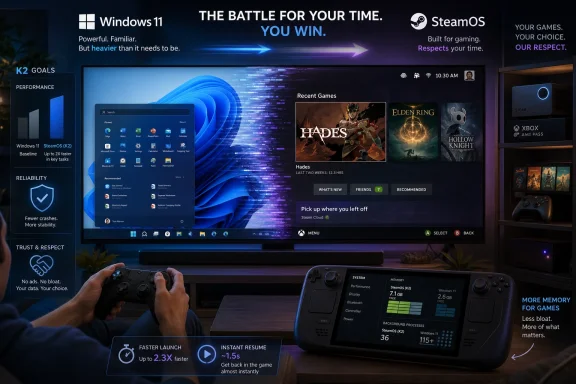
Microsoft’s reported Windows K2 initiative is an internal effort, begun in the second half of 2025, to improve Windows 11 performance, reliability, and user trust as Valve’s SteamOS-powered Steam Machine prepares to challenge Windows gaming PCs in 2026. That makes it more than another polish sprint. It is Microsoft’s belated admission that gamers are no longer comparing Windows only with older Windows. They are comparing it with an operating system that often feels as if it was built for play first and everything else second.
The uncomfortable part for Microsoft is that the Steam Machine does not need to beat Windows everywhere. It only needs to make Windows feel unnecessary in the living room, inconvenient on handhelds, and bloated on the kind of low-power gaming hardware where every watt and gigabyte matters. If K2 is real in the form reported by Windows Central and amplified by PCGamesN, it is the right argument at the right time. But performance parity with SteamOS will not be enough if Windows still greets players with account coercion, update anxiety, AI upsells, Edge nagging, and a Start menu that feels like rented billboard space.
The PC gaming establishment has spent decades treating Windows as gravity. Developers targeted it, GPU vendors optimized for it, anti-cheat vendors trusted it, modders expected it, and users tolerated it because the alternative usually meant compromise. SteamOS changes the emotional contract, because it does not ask the player to admire the general-purpose computer hiding underneath.
That is why the Steam Deck was so dangerous to Microsoft even before Valve revived the Steam Machine. It was not the fastest machine, the most open PC, or the most compatible device. It was proof that a PC game could feel like a console session: suspend, resume, update, launch, play, sleep.
Windows 11, by contrast, often feels like a productivity operating system reluctantly allowing a game to take over the screen. The desktop shell is still there. The notifications are still there. The update stack is still there. The system services, background widgets, account prompts, cloud sync nudges, and browser preference nags are still waiting just outside the frame.
Microsoft appears to understand this now. The reported K2 pillars—performance, reliability, and craft—are not glamorous, but they are exactly the words a Windows team should be using after years of feature churn. The issue is whether Microsoft can make those words override the company’s other instincts: telemetry, cloud attachment, subscription conversion, AI placement, and default-service protection.
SteamOS is narrow by design. It assumes the primary job is to run games from Steam, with enough Linux flexibility beneath the surface for tinkerers to escape the garden when they want. That narrowness is a product advantage on gaming hardware, because scope is the enemy of responsiveness.
Windows has the opposite inheritance. It must be the operating system for accountants, CAD engineers, school laptops, medical devices, streamers, modders, enterprise fleets, kiosk systems, and someone’s uncle who still opens every download from the desktop. That breadth is why Windows remains indispensable. It is also why Windows feels so heavy on a device whose immediate job is to wake up and launch Hades II.
This is Microsoft’s central dilemma. It cannot simply become SteamOS without giving up the universal compatibility that makes Windows Windows. But it can stop forcing every gaming session to carry the whole psychic weight of the Windows desktop.
The Xbox full-screen experience on the ROG Xbox Ally family points toward that answer. Microsoft and Asus did not create a true Xbox handheld OS; they created a Windows device that tries to avoid loading the entire familiar Windows shell by default. Reports and early testing have suggested meaningful memory savings, with Microsoft discussing roughly 2GB of memory reclaimed by turning off components unnecessary for the handheld gaming path.
That matters because handheld and small-form-factor gaming PCs are not RTX 5090 towers with RAM to waste. They are machines where integrated graphics borrow system memory, where background power draw cuts battery life, and where a half-second of UI lag can make a premium device feel cheap. The lesson is obvious: Windows gaming needs fewer layers between power button and game.
What makes this moment different is the competitive pressure. Vista’s reputation problem still left Microsoft competing mostly with itself. Windows 8’s Start screen rebellion ended with Windows 10 restoring enough familiarity to calm the room. Windows 11’s problem is subtler: it is not universally hated, but it is widely distrusted by the very people who used to defend Windows as the default home of PC gaming.
That erosion matters. Enthusiasts are the unpaid support layer for the Windows ecosystem. They build the family PCs, recommend laptops, troubleshoot game crashes, explain driver updates, and decide whether a living-room box should run Windows, SteamOS, Bazzite, or something else. When those users start saying “just install Linux” without irony, Microsoft has lost more than a benchmark.
The reported K2 shift away from pure shipping velocity is the most encouraging part of the story. Windows has too often felt like a product trying to satisfy a calendar instead of a user. If K2 means features spend longer on real hardware, regressions get blocked more aggressively, and teams are rewarded for removing friction rather than adding engagement surfaces, then Microsoft has the beginnings of an answer.
But “beginnings” is doing a lot of work. A trust rebuild is not a sprint, and it cannot be measured only by internal reliability dashboards. It has to be visible in the everyday texture of the OS: File Explorer opening faster, search returning what users actually asked for, the Start menu respecting intent, settings staying where users put them, updates completing without drama, and gaming sessions surviving sleep, resume, controller handoff, and display changes.
This is a more dangerous fight for Microsoft than it first appears. Windows has always been strongest on the desk, where keyboards, mice, multiple monitors, browsers, Discord, launchers, capture tools, mod managers, and productivity apps justify the complexity. The couch is less forgiving. Ten feet away from the screen, with a controller in hand, every dialog box is an indictment.
Valve understands that the living room is about continuity. Buy a game on Steam, play it on the desktop, suspend it on the handheld, resume it on the TV, use the same controller layer, and keep the UI consistent. Microsoft has the assets to compete with that—Xbox, Game Pass, Play Anywhere, cloud saves, DirectX, Windows compatibility—but the Windows experience often makes those assets feel like departments rather than one product.
A Steam Machine does not have to run every anti-cheat title or every Windows-only utility to become a problem. It can define the premium console-like PC gaming experience for users whose libraries are already concentrated on Steam. If that happens, Windows becomes the compatibility fallback rather than the aspirational default.
That reversal should worry Redmond. Once users see Windows as the thing they boot only when they must, Microsoft’s strategic position weakens. The company still owns enormous parts of the PC stack, but it loses the emotional center of enthusiast gaming.
For Microsoft, parity is necessary because performance is the simplest story. If a player installs Bazzite on the same device and gets better frame pacing, longer battery life, or fewer background interruptions, the explanation does not need to be technically complete to be persuasive. The user sees the result.
Still, Microsoft should resist treating this as a scoreboard problem alone. A narrow benchmark win in five games will not fix a system that feels pushy. A slightly faster Start menu will not redeem an installation process that treats local accounts as a loophole to be closed. A reclaimed gigabyte of memory will not matter if Windows Update chooses the wrong moment to remind users who is really in charge.
The prize is not merely higher FPS. It is confidence. Players need to believe that when they pick up a handheld or turn on a living-room PC, Windows will behave like part of the gaming appliance rather than the office computer that wandered into the den.
That confidence has to include latency, suspend-resume behavior, Bluetooth controller reliability, external display handling, HDR consistency, shader compilation experience, overlay sanity, and launcher coexistence. Microsoft cannot optimize only the Xbox path and call the job done. PC gaming is multi-store by nature, and Windows’ advantage is precisely that it can host Steam, Epic, GOG, Battle.net, itch.io, EA, Ubisoft, emulators, mods, and local executables without asking permission.
Gamers understand accounts. Steam is an account. Xbox is an account. Epic, GOG, Battle.net, Discord, Twitch, and every live-service game are accounts. The issue is not that Microsoft wants users to sign in; it is that Windows increasingly behaves as though a local-first PC is an abnormal request.
That posture clashes with PC gaming culture. Enthusiasts reinstall operating systems. They test hardware offline. They build machines for children, spouses, labs, LAN parties, benchmarking, emulation cabinets, and living-room use. They create local admin accounts because they want a clean baseline before layering services on top.
A Windows setup screen that makes a Microsoft account feel mandatory tells these users something they do not want to hear: this PC is not fully yours until it is attached to Microsoft’s cloud identity system. Whether or not that is the intended message, it is the received one.
If K2 is truly about winning back trust, Microsoft should restore an explicit local-account path during setup. It can recommend a Microsoft account. It can explain the benefits of cloud sync, BitLocker recovery, Store purchases, Xbox services, and device backup. But the choice should be visible, supported, and boring.
The irony is that Microsoft would probably gain more goodwill, and perhaps more voluntary account sign-ins, by ending the cat-and-mouse game. Users who feel respected are more likely to opt in. Users who feel cornered become experts in bypasses, debloat scripts, and alternative operating systems.
Together, they change the moral atmosphere of the OS. Users paid for the PC. Many paid for the Windows license, directly or through the OEM. They did not buy an operating system expecting its prime surfaces to become growth channels for adjacent Microsoft products.
This is where the SteamOS comparison becomes lethal. SteamOS is obviously a front end for Steam, and Valve is not a charity. But on a Steam Machine, that commercial intent is aligned with the device’s reason to exist: show the library, sell games, launch games, manage games. Windows advertising often feels misaligned because it appears in places users associate with system control.
The Start menu should be sacred. So should default app choices. So should the out-of-box experience. So should update completion screens. These are not just pixels; they are trust boundaries.
Microsoft’s reported plan to remove ads from the Start menu, if it materializes, would be more than cosmetic. It would be a signal that Windows is willing to give back some of the space it has steadily colonized for promotion. The company should go further and create a gaming-focused clean mode where promotional surfaces, AI suggestions, consumer subscription nags, and browser preference prompts are disabled by design.
That mode should not require Enterprise licensing, registry spelunking, or third-party debloat tools. It should be a supported Windows personality: this machine is for games; behave accordingly.
For gamers, the suspicion is sharper. If a system is already accused of wasting memory, interrupting sessions, and inserting unwanted services, AI becomes an easy symbol for bloat. It does not matter that every AI feature has different technical characteristics. The category gets flattened into one complaint: why is this on my gaming PC?
K2 reportedly includes awareness of Windows 11’s overuse of AI as a user complaint. That is important. Microsoft does not need to abandon AI in Windows, but it does need to stop treating AI visibility as a virtue.
The better path is restraint. AI features should be opt-in where they touch personal data, removable where they are not core system functions, and subordinate to performance budgets on gaming hardware. If an AI feature costs memory, CPU wakeups, storage churn, or user attention, it must justify itself like any other feature.
There is a powerful version of AI in Windows gaming. Imagine crash diagnostics that translate faulting modules into actionable fixes, shader-cache management that understands game libraries, power profiles that learn per-title behavior, or accessibility tools that help more players enjoy more games. But those wins will be buried if Microsoft keeps making Copilot feel like an unavoidable houseguest.
But these are exactly the areas where Windows 11’s reputation has been bruised. File Explorer has too often felt slower than it should on modern hardware. Windows search remains inconsistent enough that many power users immediately install alternatives. Updates have improved from the worst days of Windows 10, but the anxiety around restarts, driver changes, and surprise behavior has not disappeared.
For IT pros, reliability has a broader meaning. A good Windows release is not merely stable on one gaming handheld. It is predictable across fleets, documented clearly, controllable through policy, and reversible when something breaks. Microsoft’s consumer gaming ambitions cannot come at the expense of enterprise discipline, because the same Windows servicing culture affects both.
That is where K2’s reported emphasis on robustness over velocity could matter most. Windows needs fewer “look what’s new” moments and more “this no longer breaks” moments. It needs changelogs that map to user pain, Insider testing that catches regressions on ordinary hardware, and telemetry that informs quality without becoming a substitute for listening.
Microsoft also has to remember that reliability is experienced as a pattern. One bad update can be forgiven. A recurring sense that Windows changes things without permission becomes identity. That is how users end up saying “Windows being Windows,” and not as a compliment.
Windows 11’s simplified taskbar arrived with cleaner visuals but fewer affordances. For some users, that trade was fine. For others, it felt like Microsoft removed muscle memory in service of a design system. The inability, at launch, to move the taskbar or use older workflows became a proxy for a larger complaint: Windows had become less interested in how its most loyal users actually work.
Gaming PCs are still PCs. The same machine that launches Cyberpunk 2077 may also run OBS, Discord, MSI Afterburner, Blender, Visual Studio Code, a browser with 60 tabs, and a mod manager. A player may dock a handheld and expect it to become a desktop. A living-room PC may still need maintenance with a keyboard and mouse.
That is why restoring taskbar flexibility is not nostalgia. It is respect for the PC as a configurable object. SteamOS can be opinionated because its main interface is intentionally narrow. Windows must be configurable because its promise is breadth.
The Start menu has a similar burden. It must be fast, quiet, and useful. If Microsoft wants to recommend something, it should earn that placement by being relevant to the user’s library, device state, or explicit intent—not because a growth team found a surface.
Valve has narrowed the gap impressively through Proton and SteamOS, but compatibility remains Windows’ moat. The danger is that Microsoft has sometimes behaved as though the moat is enough. It is not.
Compatibility feels like freedom only when the system respects the user. If Windows runs everything but constantly steers the user toward Microsoft services, resets preferences, pushes cloud backup, or buries local choices, then compatibility starts to feel like a ransom note. Users stay because they must, not because they want to.
That is not a stable place for a platform to be. Proton does not need to solve every game tomorrow; it only needs to keep reducing the number of reasons users must return to Windows. Every time that list shrinks, Windows’ tolerance budget shrinks with it.
Microsoft’s response should be to make Windows the best multi-store gaming OS without resentment. That means celebrating Steam rather than treating Xbox as the only first-class path. It means making handheld controls, overlays, performance profiles, and suspend behavior work across launchers. It means allowing OEMs and users to choose Playnite, Steam Big Picture, Xbox full-screen experience, or another shell without hacks.
The Windows gaming PC should feel like the place where everything works and the user chooses the front end. If Microsoft can deliver that, Valve’s advantage becomes style and integration rather than liberation.
The harder problem is humility. Windows has to stop assuming that every Microsoft service deserves privileged access to the user’s attention. It has to stop treating defaults as strategic territory to be defended at all costs. It has to stop acting surprised when enthusiasts resent a system that feels less personal than the machines they built themselves.
K2’s reported community angle could help if it is more than optics. Reviving Insider meetups, encouraging engineering leaders to speak publicly, and listening to feedback can rebuild some of the old Windows culture. But community engagement becomes counterproductive if users identify the same pain points for years and Microsoft responds with another Copilot placement.
The company also needs to be honest about segmentation. A corporate laptop, a school device, a creator workstation, a gaming handheld, and a living-room Steam competitor do not need the same first-run experience. Windows can remain one platform while offering different supported modes.
This is where Apple, Valve, and console makers have an advantage: they are willing to say no on behalf of an experience. Microsoft historically says yes to everything, then asks the shell to reconcile the mess. K2 should be the moment Windows learns to say no to itself.
The Steam Machine will not be perfect. SteamOS still has compatibility gaps. Linux troubleshooting can become arcane quickly once users leave the happy path. Some multiplayer titles remain problematic because of anti-cheat decisions. Non-Steam launchers can still be awkward. A Windows PC will remain the safer recommendation for many users who want the largest possible library with the least research.
But perfection is not required to shift perception. The Steam Deck already proved that a device can win affection while being technically limited, because the experience coheres. If the Steam Machine brings that coherence to the TV with enough performance and a sane price, Microsoft will face a new kind of Windows defection: not ideological Linux migration, but casual preference.
That should terrify Microsoft more than a few angry Reddit threads. Casual preference is how defaults change. A user who buys a Steam Machine and enjoys it may still own a Windows desktop, but the center of gravity for gaming moves. The next purchase, the next recommendation, and the next living-room setup follow the experience that felt better.
Microsoft’s two-year performance horizon, if accurately reported, is therefore both sensible and risky. Sensible because deep OS work takes time. Risky because Valve is not waiting two years to shape expectations.
Near-term changes would reveal whether Microsoft understands the assignment. A faster File Explorer would be welcome, but a faster File Explorer alongside a clean Start menu would say more. Better gaming performance would matter, but better gaming performance alongside an explicit local-account option would matter differently. Taskbar flexibility would please power users, but taskbar flexibility alongside fewer default-app nags would suggest a cultural shift.
Microsoft does not need to turn Windows into SteamOS. It needs to make Windows feel like a trustworthy host for SteamOS-style experiences, Xbox experiences, desktop experiences, and everything in between. That is a subtler challenge, but it is also Microsoft’s natural strength when the company gets out of its own way.
The Windows brand has survived worse than this. It survived Vista. It survived Windows 8. It survived the forced-update fury of early Windows 10. But survival is not the standard in a market where Valve is offering delight.
Source: PCGamesN Microsoft is reportedly fixing Windows 11 to take on the Steam Machine, but here's what else it needs to do
The uncomfortable part for Microsoft is that the Steam Machine does not need to beat Windows everywhere. It only needs to make Windows feel unnecessary in the living room, inconvenient on handhelds, and bloated on the kind of low-power gaming hardware where every watt and gigabyte matters. If K2 is real in the form reported by Windows Central and amplified by PCGamesN, it is the right argument at the right time. But performance parity with SteamOS will not be enough if Windows still greets players with account coercion, update anxiety, AI upsells, Edge nagging, and a Start menu that feels like rented billboard space.
 Microsoft Has Finally Found the Enemy, and It Is Friction
The PC gaming establishment has spent decades treating Windows as gravity. Developers targeted it, GPU vendors optimized for it, anti-cheat vendors trusted it, modders expected it, and users tolerated it because the alternative usually meant compromise. SteamOS changes the emotional contract, because it does not ask the player to admire the general-purpose computer hiding underneath.That is why the Steam Deck was so dangerous to Microsoft even before Valve revived the Steam Machine. It was not the fastest machine, the most open PC, or the most compatible device. It was proof that a PC game could feel like a console session: suspend, resume, update, launch, play, sleep.
Windows 11, by contrast, often feels like a productivity operating system reluctantly allowing a game to take over the screen. The desktop shell is still there. The notifications are still there. The update stack is still there. The system services, background widgets, account prompts, cloud sync nudges, and browser preference nags are still waiting just outside the frame.
Microsoft appears to understand this now. The reported K2 pillars—performance, reliability, and craft—are not glamorous, but they are exactly the words a Windows team should be using after years of feature churn. The issue is whether Microsoft can make those words override the company’s other instincts: telemetry, cloud attachment, subscription conversion, AI placement, and default-service protection.
SteamOS Wins by Having Fewer Opinions About Your Life
The reason SteamOS feels refreshing is not merely that it is Linux. Most players do not care what kernel is underneath their frame pacing. They care that the system gets out of the way.SteamOS is narrow by design. It assumes the primary job is to run games from Steam, with enough Linux flexibility beneath the surface for tinkerers to escape the garden when they want. That narrowness is a product advantage on gaming hardware, because scope is the enemy of responsiveness.
Windows has the opposite inheritance. It must be the operating system for accountants, CAD engineers, school laptops, medical devices, streamers, modders, enterprise fleets, kiosk systems, and someone’s uncle who still opens every download from the desktop. That breadth is why Windows remains indispensable. It is also why Windows feels so heavy on a device whose immediate job is to wake up and launch Hades II.
This is Microsoft’s central dilemma. It cannot simply become SteamOS without giving up the universal compatibility that makes Windows Windows. But it can stop forcing every gaming session to carry the whole psychic weight of the Windows desktop.
The Xbox full-screen experience on the ROG Xbox Ally family points toward that answer. Microsoft and Asus did not create a true Xbox handheld OS; they created a Windows device that tries to avoid loading the entire familiar Windows shell by default. Reports and early testing have suggested meaningful memory savings, with Microsoft discussing roughly 2GB of memory reclaimed by turning off components unnecessary for the handheld gaming path.
That matters because handheld and small-form-factor gaming PCs are not RTX 5090 towers with RAM to waste. They are machines where integrated graphics borrow system memory, where background power draw cuts battery life, and where a half-second of UI lag can make a premium device feel cheap. The lesson is obvious: Windows gaming needs fewer layers between power button and game.
K2 Cannot Be Another Rebrand for “We’ll Try Harder”
Windows has had quality campaigns before. Every few years, Microsoft rediscovers the fundamentals, tells users it is listening, and then ships another wave of features that look suspiciously like product-management OKRs rather than user needs. The cynicism around K2 is therefore earned.What makes this moment different is the competitive pressure. Vista’s reputation problem still left Microsoft competing mostly with itself. Windows 8’s Start screen rebellion ended with Windows 10 restoring enough familiarity to calm the room. Windows 11’s problem is subtler: it is not universally hated, but it is widely distrusted by the very people who used to defend Windows as the default home of PC gaming.
That erosion matters. Enthusiasts are the unpaid support layer for the Windows ecosystem. They build the family PCs, recommend laptops, troubleshoot game crashes, explain driver updates, and decide whether a living-room box should run Windows, SteamOS, Bazzite, or something else. When those users start saying “just install Linux” without irony, Microsoft has lost more than a benchmark.
The reported K2 shift away from pure shipping velocity is the most encouraging part of the story. Windows has too often felt like a product trying to satisfy a calendar instead of a user. If K2 means features spend longer on real hardware, regressions get blocked more aggressively, and teams are rewarded for removing friction rather than adding engagement surfaces, then Microsoft has the beginnings of an answer.
But “beginnings” is doing a lot of work. A trust rebuild is not a sprint, and it cannot be measured only by internal reliability dashboards. It has to be visible in the everyday texture of the OS: File Explorer opening faster, search returning what users actually asked for, the Start menu respecting intent, settings staying where users put them, updates completing without drama, and gaming sessions surviving sleep, resume, controller handoff, and display changes.
The Steam Machine Changes the Battlefield From Handhelds to the Couch
The Steam Deck embarrassed Windows in a category Microsoft had not fully taken seriously. The revived Steam Machine, expected as part of Valve’s 2026 hardware push, is more direct. It aims at the living room, the console-adjacent PC, and the user who wants Steam library access without building a tower or maintaining a Windows install.This is a more dangerous fight for Microsoft than it first appears. Windows has always been strongest on the desk, where keyboards, mice, multiple monitors, browsers, Discord, launchers, capture tools, mod managers, and productivity apps justify the complexity. The couch is less forgiving. Ten feet away from the screen, with a controller in hand, every dialog box is an indictment.
Valve understands that the living room is about continuity. Buy a game on Steam, play it on the desktop, suspend it on the handheld, resume it on the TV, use the same controller layer, and keep the UI consistent. Microsoft has the assets to compete with that—Xbox, Game Pass, Play Anywhere, cloud saves, DirectX, Windows compatibility—but the Windows experience often makes those assets feel like departments rather than one product.
A Steam Machine does not have to run every anti-cheat title or every Windows-only utility to become a problem. It can define the premium console-like PC gaming experience for users whose libraries are already concentrated on Steam. If that happens, Windows becomes the compatibility fallback rather than the aspirational default.
That reversal should worry Redmond. Once users see Windows as the thing they boot only when they must, Microsoft’s strategic position weakens. The company still owns enormous parts of the PC stack, but it loses the emotional center of enthusiast gaming.
Performance Parity Is the Entry Fee, Not the Prize
PCGamesN’s framing is right to emphasize that Microsoft reportedly wants Windows to close the performance gap with SteamOS on comparable hardware. Benchmarks on handheld-class systems have repeatedly fed the perception that SteamOS or SteamOS-like Linux distributions can deliver smoother results than Windows 11, especially at constrained power levels. On higher-end desktop hardware with discrete GPUs, Windows remains highly competitive and sometimes faster, but that nuance does not erase the handheld narrative.For Microsoft, parity is necessary because performance is the simplest story. If a player installs Bazzite on the same device and gets better frame pacing, longer battery life, or fewer background interruptions, the explanation does not need to be technically complete to be persuasive. The user sees the result.
Still, Microsoft should resist treating this as a scoreboard problem alone. A narrow benchmark win in five games will not fix a system that feels pushy. A slightly faster Start menu will not redeem an installation process that treats local accounts as a loophole to be closed. A reclaimed gigabyte of memory will not matter if Windows Update chooses the wrong moment to remind users who is really in charge.
The prize is not merely higher FPS. It is confidence. Players need to believe that when they pick up a handheld or turn on a living-room PC, Windows will behave like part of the gaming appliance rather than the office computer that wandered into the den.
That confidence has to include latency, suspend-resume behavior, Bluetooth controller reliability, external display handling, HDR consistency, shader compilation experience, overlay sanity, and launcher coexistence. Microsoft cannot optimize only the Xbox path and call the job done. PC gaming is multi-store by nature, and Windows’ advantage is precisely that it can host Steam, Epic, GOG, Battle.net, itch.io, EA, Ubisoft, emulators, mods, and local executables without asking permission.
The Account Mandate Is a Self-Inflicted Wound
The Microsoft account requirement during Windows 11 setup remains one of the clearest examples of Microsoft confusing business alignment with user experience. Microsoft’s own support material says Windows 11 Home and Windows 11 Pro for personal use require internet connectivity and a Microsoft account during initial setup. From a services strategy perspective, the logic is obvious. From a user trust perspective, it is corrosive.Gamers understand accounts. Steam is an account. Xbox is an account. Epic, GOG, Battle.net, Discord, Twitch, and every live-service game are accounts. The issue is not that Microsoft wants users to sign in; it is that Windows increasingly behaves as though a local-first PC is an abnormal request.
That posture clashes with PC gaming culture. Enthusiasts reinstall operating systems. They test hardware offline. They build machines for children, spouses, labs, LAN parties, benchmarking, emulation cabinets, and living-room use. They create local admin accounts because they want a clean baseline before layering services on top.
A Windows setup screen that makes a Microsoft account feel mandatory tells these users something they do not want to hear: this PC is not fully yours until it is attached to Microsoft’s cloud identity system. Whether or not that is the intended message, it is the received one.
If K2 is truly about winning back trust, Microsoft should restore an explicit local-account path during setup. It can recommend a Microsoft account. It can explain the benefits of cloud sync, BitLocker recovery, Store purchases, Xbox services, and device backup. But the choice should be visible, supported, and boring.
The irony is that Microsoft would probably gain more goodwill, and perhaps more voluntary account sign-ins, by ending the cat-and-mouse game. Users who feel respected are more likely to opt in. Users who feel cornered become experts in bypasses, debloat scripts, and alternative operating systems.
Ads in Windows Are Not Small; They Are Symbolic
The Start menu ad debate is often dismissed as overblown because any one individual placement can seem minor. A recommendation here, a Microsoft 365 prompt there, a OneDrive nudge after setup, an Edge banner after an update. None of these alone destroys Windows.Together, they change the moral atmosphere of the OS. Users paid for the PC. Many paid for the Windows license, directly or through the OEM. They did not buy an operating system expecting its prime surfaces to become growth channels for adjacent Microsoft products.
This is where the SteamOS comparison becomes lethal. SteamOS is obviously a front end for Steam, and Valve is not a charity. But on a Steam Machine, that commercial intent is aligned with the device’s reason to exist: show the library, sell games, launch games, manage games. Windows advertising often feels misaligned because it appears in places users associate with system control.
The Start menu should be sacred. So should default app choices. So should the out-of-box experience. So should update completion screens. These are not just pixels; they are trust boundaries.
Microsoft’s reported plan to remove ads from the Start menu, if it materializes, would be more than cosmetic. It would be a signal that Windows is willing to give back some of the space it has steadily colonized for promotion. The company should go further and create a gaming-focused clean mode where promotional surfaces, AI suggestions, consumer subscription nags, and browser preference prompts are disabled by design.
That mode should not require Enterprise licensing, registry spelunking, or third-party debloat tools. It should be a supported Windows personality: this machine is for games; behave accordingly.
AI Is Not the Villain, but Windows Has Made It Feel Like One
Microsoft’s AI push has suffered from a classic platform-owner mistake: assuming strategic importance automatically creates user desire. Copilot may become useful in many contexts, and local AI features may eventually help users search files, summarize settings, troubleshoot crashes, or tune performance. But Windows 11’s AI branding has often arrived before the everyday value was clear.For gamers, the suspicion is sharper. If a system is already accused of wasting memory, interrupting sessions, and inserting unwanted services, AI becomes an easy symbol for bloat. It does not matter that every AI feature has different technical characteristics. The category gets flattened into one complaint: why is this on my gaming PC?
K2 reportedly includes awareness of Windows 11’s overuse of AI as a user complaint. That is important. Microsoft does not need to abandon AI in Windows, but it does need to stop treating AI visibility as a virtue.
The better path is restraint. AI features should be opt-in where they touch personal data, removable where they are not core system functions, and subordinate to performance budgets on gaming hardware. If an AI feature costs memory, CPU wakeups, storage churn, or user attention, it must justify itself like any other feature.
There is a powerful version of AI in Windows gaming. Imagine crash diagnostics that translate faulting modules into actionable fixes, shader-cache management that understands game libraries, power profiles that learn per-title behavior, or accessibility tools that help more players enjoy more games. But those wins will be buried if Microsoft keeps making Copilot feel like an unavoidable houseguest.
Reliability Is the Feature Windows Forgot How to Market
Reliability is not exciting until it is absent. Nobody praises an operating system because File Explorer did not hang today. Nobody posts a benchmark showing that Bluetooth audio survived suspend and resume. Nobody cheers when search indexes files correctly without pegging the CPU.But these are exactly the areas where Windows 11’s reputation has been bruised. File Explorer has too often felt slower than it should on modern hardware. Windows search remains inconsistent enough that many power users immediately install alternatives. Updates have improved from the worst days of Windows 10, but the anxiety around restarts, driver changes, and surprise behavior has not disappeared.
For IT pros, reliability has a broader meaning. A good Windows release is not merely stable on one gaming handheld. It is predictable across fleets, documented clearly, controllable through policy, and reversible when something breaks. Microsoft’s consumer gaming ambitions cannot come at the expense of enterprise discipline, because the same Windows servicing culture affects both.
That is where K2’s reported emphasis on robustness over velocity could matter most. Windows needs fewer “look what’s new” moments and more “this no longer breaks” moments. It needs changelogs that map to user pain, Insider testing that catches regressions on ordinary hardware, and telemetry that informs quality without becoming a substitute for listening.
Microsoft also has to remember that reliability is experienced as a pattern. One bad update can be forgiven. A recurring sense that Windows changes things without permission becomes identity. That is how users end up saying “Windows being Windows,” and not as a compliment.
The Taskbar and Start Menu Are Still the Political Center of Windows
It may seem strange that taskbar resizing, taskbar movement, and Start menu performance can matter in a fight with SteamOS. They matter because they are where Windows users feel ownership. Microsoft learned this during the Windows 8 era and then seemed to partially forget it with Windows 11.Windows 11’s simplified taskbar arrived with cleaner visuals but fewer affordances. For some users, that trade was fine. For others, it felt like Microsoft removed muscle memory in service of a design system. The inability, at launch, to move the taskbar or use older workflows became a proxy for a larger complaint: Windows had become less interested in how its most loyal users actually work.
Gaming PCs are still PCs. The same machine that launches Cyberpunk 2077 may also run OBS, Discord, MSI Afterburner, Blender, Visual Studio Code, a browser with 60 tabs, and a mod manager. A player may dock a handheld and expect it to become a desktop. A living-room PC may still need maintenance with a keyboard and mouse.
That is why restoring taskbar flexibility is not nostalgia. It is respect for the PC as a configurable object. SteamOS can be opinionated because its main interface is intentionally narrow. Windows must be configurable because its promise is breadth.
The Start menu has a similar burden. It must be fast, quiet, and useful. If Microsoft wants to recommend something, it should earn that placement by being relevant to the user’s library, device state, or explicit intent—not because a growth team found a surface.
Windows’ Real Advantage Is Compatibility, but It Has to Feel Like Freedom
The best argument for Windows gaming remains brutally practical: it runs the most stuff. Anti-cheat support is broader. Game Pass PC matters. Modding tools are mature. Peripheral utilities expect it. Capture workflows, RGB control panels, firmware updaters, VR runtimes, launchers, and obscure fan patches often assume Windows first.Valve has narrowed the gap impressively through Proton and SteamOS, but compatibility remains Windows’ moat. The danger is that Microsoft has sometimes behaved as though the moat is enough. It is not.
Compatibility feels like freedom only when the system respects the user. If Windows runs everything but constantly steers the user toward Microsoft services, resets preferences, pushes cloud backup, or buries local choices, then compatibility starts to feel like a ransom note. Users stay because they must, not because they want to.
That is not a stable place for a platform to be. Proton does not need to solve every game tomorrow; it only needs to keep reducing the number of reasons users must return to Windows. Every time that list shrinks, Windows’ tolerance budget shrinks with it.
Microsoft’s response should be to make Windows the best multi-store gaming OS without resentment. That means celebrating Steam rather than treating Xbox as the only first-class path. It means making handheld controls, overlays, performance profiles, and suspend behavior work across launchers. It means allowing OEMs and users to choose Playnite, Steam Big Picture, Xbox full-screen experience, or another shell without hacks.
The Windows gaming PC should feel like the place where everything works and the user chooses the front end. If Microsoft can deliver that, Valve’s advantage becomes style and integration rather than liberation.
The Fix Requires Product Humility, Not Just Engineering Muscle
Microsoft can absolutely make Windows faster. It can profile shell components, reduce background services, improve memory behavior, streamline File Explorer, and harden update validation. The company has world-class engineers, enormous telemetry, deep relationships with silicon vendors, and decades of compatibility knowledge.The harder problem is humility. Windows has to stop assuming that every Microsoft service deserves privileged access to the user’s attention. It has to stop treating defaults as strategic territory to be defended at all costs. It has to stop acting surprised when enthusiasts resent a system that feels less personal than the machines they built themselves.
K2’s reported community angle could help if it is more than optics. Reviving Insider meetups, encouraging engineering leaders to speak publicly, and listening to feedback can rebuild some of the old Windows culture. But community engagement becomes counterproductive if users identify the same pain points for years and Microsoft responds with another Copilot placement.
The company also needs to be honest about segmentation. A corporate laptop, a school device, a creator workstation, a gaming handheld, and a living-room Steam competitor do not need the same first-run experience. Windows can remain one platform while offering different supported modes.
This is where Apple, Valve, and console makers have an advantage: they are willing to say no on behalf of an experience. Microsoft historically says yes to everything, then asks the shell to reconcile the mess. K2 should be the moment Windows learns to say no to itself.
The Steam Machine Is a Deadline Microsoft Did Not Set
Valve’s 2026 hardware push gives Microsoft a useful enemy. Without that pressure, Windows quality work can disappear into the usual swamp of priorities. With it, every rough edge in Windows 11 becomes a comparison point.The Steam Machine will not be perfect. SteamOS still has compatibility gaps. Linux troubleshooting can become arcane quickly once users leave the happy path. Some multiplayer titles remain problematic because of anti-cheat decisions. Non-Steam launchers can still be awkward. A Windows PC will remain the safer recommendation for many users who want the largest possible library with the least research.
But perfection is not required to shift perception. The Steam Deck already proved that a device can win affection while being technically limited, because the experience coheres. If the Steam Machine brings that coherence to the TV with enough performance and a sane price, Microsoft will face a new kind of Windows defection: not ideological Linux migration, but casual preference.
That should terrify Microsoft more than a few angry Reddit threads. Casual preference is how defaults change. A user who buys a Steam Machine and enjoys it may still own a Windows desktop, but the center of gravity for gaming moves. The next purchase, the next recommendation, and the next living-room setup follow the experience that felt better.
Microsoft’s two-year performance horizon, if accurately reported, is therefore both sensible and risky. Sensible because deep OS work takes time. Risky because Valve is not waiting two years to shape expectations.
The K2 Test Is Whether Microsoft Gives Users Back Control
The most concrete way to judge K2 is not by a codename, a blog post, or a synthetic benchmark. It is by whether Windows 11 becomes less presumptuous. Faster is good. Quieter is better. Faster and quieter while giving users more control is the actual win.Near-term changes would reveal whether Microsoft understands the assignment. A faster File Explorer would be welcome, but a faster File Explorer alongside a clean Start menu would say more. Better gaming performance would matter, but better gaming performance alongside an explicit local-account option would matter differently. Taskbar flexibility would please power users, but taskbar flexibility alongside fewer default-app nags would suggest a cultural shift.
Microsoft does not need to turn Windows into SteamOS. It needs to make Windows feel like a trustworthy host for SteamOS-style experiences, Xbox experiences, desktop experiences, and everything in between. That is a subtler challenge, but it is also Microsoft’s natural strength when the company gets out of its own way.
The Windows brand has survived worse than this. It survived Vista. It survived Windows 8. It survived the forced-update fury of early Windows 10. But survival is not the standard in a market where Valve is offering delight.
The Fix List Microsoft Cannot Benchmark Away
If K2 is to become more than a codename passed around by Windows watchers, it needs to produce visible concessions as well as invisible optimizations. The most important changes are not mysterious; they are the things users have been asking for while Microsoft chased shinier priorities.- Microsoft should restore a clear local-account option during Windows 11 setup, even if it continues to recommend a Microsoft account for users who want cloud sync and Xbox integration.
- Microsoft should remove promotional surfaces from the Start menu, setup flow, update completion screens, and default system experiences on paid Windows PCs.
- Microsoft should make a supported gaming mode that reduces background services, AI surfaces, and desktop shell overhead without requiring OEM exclusivity or registry tricks.
- Microsoft should treat Steam, Epic, GOG, Battle.net, Xbox, and local executables as equal citizens in Windows gaming features.
- Microsoft should make taskbar flexibility, faster File Explorer performance, and reliable Windows search part of the core quality contract rather than optional nostalgia.
- Microsoft should publish fewer promises about engagement and more measurable improvements in update reliability, suspend-resume behavior, controller handling, and real-world gaming performance.
Source: PCGamesN Microsoft is reportedly fixing Windows 11 to take on the Steam Machine, but here's what else it needs to do
