

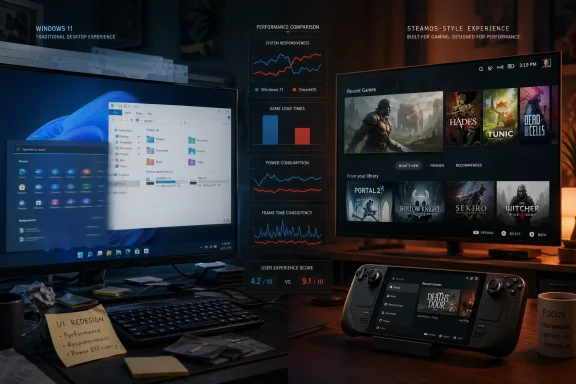
Microsoft’s rumored “Windows K2” effort is not really about shaving a few frames off a benchmark chart. It is about something more embarrassing for Redmond: Windows, the default home of PC gaming for three decades, is now being measured against a Linux-based console OS made by a company that once needed Microsoft’s platform to exist. If the reporting is right, Microsoft has decided that SteamOS is no longer a hobbyist curiosity or handheld convenience layer. It is a performance target — and that alone says more about Windows 11’s current reputation than any marketing deck could.
The most important phrase in the Windows K2 reporting is not “gaming performance,” “File Explorer,” or even “SteamOS.” It is the suggestion that Microsoft is benchmarking Windows against things users already prefer.
That sounds obvious, but Windows has spent years living under a different law of gravity. It did not need to be loved in order to be used. It came with the PC, ran the apps, supported the weird printer, launched the anti-cheat driver, and knew what to do when a 2009 accounting package demanded administrative privileges for no defensible reason. Windows won not because it was clean, but because it was compatible.
That bargain has frayed. Windows 11 has always been technically competent, often handsome, and sometimes genuinely forward-looking. But it has also felt like an operating system built by committees with competing incentives: one team trying to modernize the shell, another trying to surface Microsoft 365, another trying to push Copilot, another trying to preserve enterprise manageability, and another trying not to break thirty years of Win32 expectations.
SteamOS, by contrast, has the luxury of narrowness. It boots into a gaming-first environment, targets a curated hardware experience on Steam Deck, and treats the desktop as a secondary mode rather than the moral center of the machine. That narrowness is precisely why it has become dangerous. In the places where SteamOS is good, it feels intentional.
Windows often feels comprehensive. SteamOS often feels designed.
Valve changed the terms by not selling Linux as Linux. Steam Deck did not ask users to become converts. It asked them to press a power button, sign into Steam, and play. Proton did the ideological heavy lifting quietly, translating a vast swath of Windows gaming into something that felt console-simple enough for normal people and tweakable enough for the old guard.
That is the lesson Microsoft cannot ignore. SteamOS does not need to beat Windows everywhere. It only needs to beat Windows in the emotional moments that matter to gamers: wake quickly, launch reliably, avoid nagging, stay out of the way, and make the hardware feel faster than its spec sheet implies.
For decades, Windows could absorb irritation because alternatives were worse. Now the alternative is not “install Arch and pray.” It is a handheld with a sleep button. It is a living-room PC concept with Steam’s storefront, cloud saves, controller mapping, shader pre-caching, and a UI that understands the couch. Valve has wrapped Linux in a product shape Microsoft understands very well: an ecosystem.
The reported Steam Machine revival raises the stakes. A SteamOS box under the TV does not need to dominate Best Buy to matter. It only needs to give enthusiasts, small-form-factor builders, and console-curious PC gamers a credible non-Windows default. Once that default exists, Windows has to compete on experience rather than inertia.
Gaming exposes overhead brutally. A user may tolerate a slow settings page or a Start menu that hesitates. They are less forgiving when a game stutters, resumes awkwardly, drains battery, or loses performance to processes they never asked for. Enthusiasts can forgive complexity when it buys capability; they are less patient when complexity behaves like drag.
SteamOS has a structural advantage on devices like Steam Deck because Valve controls more of the stack. It can optimize update cadence, graphics behavior, shader delivery, sleep and resume, controller integration, and performance profiles around a smaller target. Microsoft, meanwhile, must support everything from a domain-joined workstation to a bargain-bin laptop to a liquid-cooled tower with three launchers and four RGB daemons.
But that explanation only goes so far. Users do not buy architectural excuses. They buy outcomes. If SteamOS makes the same silicon feel faster, quieter, or more appliance-like, then Windows’ breadth starts to look less like power and more like bloat.
That is why K2, if real, matters. It implies Microsoft understands that gaming is not a side quest for Windows. It is one of the few consumer categories where people still care deeply about the operating system beneath the app.
And for many Windows 11 users, it has become the place where the OS feels slower than it should. Context menus have been reworked and layered. Search has remained inconsistent. Folder navigation can feel oddly heavy on machines that have no business struggling with a file manager. The gap between “modern” and “fast” has been too visible.
The reported use of File Pilot as a reference point is interesting because it suggests Microsoft may be looking outside its own design culture for evidence of what users reward. Third-party Windows utilities have long acted as unofficial product research for Microsoft. When enough people install replacements for Start, Explorer, search, window management, or screenshots, they are not merely customizing. They are filing a collective bug report.
There is one awkward wrinkle in the Club386 write-up: Windows 11 already has File Explorer tabs, and has had them since the 22H2-era feature rollout in 2022. That does not invalidate the broader argument about File Explorer’s sluggishness, but it does show how perception can lag reality. If a major feature exists and people still talk as if Explorer is behind the times, Microsoft has not solved the experience problem. It has merely shipped a checkbox.
Tabs were never the finish line. Users want a file manager that feels instantaneous, predictable, and local even when cloud providers, network shares, indexing, previews, and shell extensions are all jostling for position. If K2 turns Explorer into something that feels less like a compatibility museum and more like a tool, that may matter more to everyday trust than another Copilot entry point.
Microsoft has never been fully able to decide whether Start is a personal command surface or a distribution channel. That tension predates Windows 11, but Windows 11 made it harder to ignore because the interface became simpler and more centered. There is less visual clutter to hide the business model.
A faster Start menu would be welcome. A quieter Start menu would be more important. Performance and trust are linked: when a UI surface pauses, users wonder what it is doing; when that same surface also promotes services, users assume the worst. Even if the delay has nothing to do with advertising or cloud calls, the suspicion is already planted.
This is where Microsoft’s consumer Windows strategy has been oddly self-defeating. The company owns Xbox, Game Pass, Microsoft 365, OneDrive, Edge, Bing, Copilot, and a sprawling account ecosystem. It is understandable that Windows would surface them. But when the OS becomes too eager a salesman, every hitch looks like a pitch loading in the background.
If K2 is partly a retreat from that posture, it could mark a meaningful shift. Not because Microsoft will stop monetizing Windows-adjacent services, but because it may finally understand that the operating system itself has to feel neutral before users will trust anything built on top of it.
This matters for enthusiasts more than Microsoft sometimes appears to realize. The people who build PCs, reinstall Windows, image machines, test preview builds, and advise relatives are also the people most exposed to setup friction. They are the unpaid sales force for the platform. Annoy them often enough and they become evangelists for alternatives.
SteamOS benefits from a simpler promise: sign into Steam and play. That promise hides plenty of complexity, including compatibility layers, shader caches, driver work, and the realities of Linux gaming. But the user-facing transaction is clear. Windows setup, by contrast, can feel like negotiating with a mall kiosk before receiving the keys to a house you already bought.
Enterprise IT has its own deployment tools and policies, but consumer perception bleeds upward. If Windows is seen as nagware on day one, the platform starts every relationship in debt.
The same background compatibility that frustrates gamers also enables businesses to run custom agents, VPNs, endpoint protection, accessibility tools, peripheral suites, legacy apps, and management frameworks. The same driver ecosystem that creates instability also supports the absurd variety of PC hardware. The same cloud integrations that irritate local-first users are genuinely useful for people who live across multiple devices.
Windows cannot become SteamOS without ceasing to be Windows. That is the central tension K2 would have to navigate. Microsoft does not need to turn Windows 11 into a console OS. It needs to make the general-purpose OS stop feeling like a penalty for people who want a focused gaming machine or a fast local desktop.
That likely means more ruthless control over defaults, background activity, and shell latency. It may mean clearer modes, not in the old “Game Mode” checkbox sense, but in a deeper scheduling and services posture where the OS understands when the user is playing, presenting, compiling, copying, searching, or simply trying to open a folder. It may also mean admitting that performance work cannot be a one-time initiative. It has to be a culture.
The danger is that Microsoft treats K2 as another named rescue project rather than a change in product discipline. Windows history is full of course corrections: security resets, design resets, update-model resets, Store resets, browser resets, AI resets. Some worked. Some became branding exercises. The difference is whether the work survives the next internal reorganization.
That gap is dangerous. Nothing makes a futuristic feature look sillier than a sluggish basic one. If Microsoft asks users to trust Windows with more context, more automation, and more ambient intelligence, the system must first prove that it can respect their time in ordinary tasks.
Performance is not anti-AI. In fact, it is a precondition for AI credibility. An assistant that opens instantly, indexes responsibly, stays private when told, and does not burden the machine might earn a place. An assistant bolted onto an already heavy shell will be judged as bloat, even if the underlying technology is impressive.
This is why K2’s rumored focus on speed and reliability is strategically smarter than another feature wave. Microsoft does not need more demos. It needs fewer eye-rolls.
It is not that everyone will switch. They will not. Anti-cheat support remains uneven. Modding workflows vary. Non-Steam launchers can be awkward. Creative tools, productivity apps, and hardware utilities still pull many users back to Windows. The Windows gaming ecosystem is vast, and most players will remain there by default.
But defaults are no longer destiny. The Steam Deck taught players that their Steam library could be portable without Windows. The next Steam Machine, if priced and positioned well, could teach them that a living-room PC does not need Windows either. Once users have one positive non-Windows gaming experience, the psychological monopoly breaks.
That is the actual competitive threat. Not immediate market-share collapse, but permission. Valve gives users permission to imagine PC gaming without Windows. Microsoft’s job is to make that thought less tempting.
Windows has often improved when Microsoft faced credible pressure. The web pushed the company toward standards it once resisted. Mobile exposed the cost of complacency, even if Microsoft never recovered there. Chromebooks forced some honesty about simplicity, management, and battery life in education. Now SteamOS is applying pressure from a direction Microsoft once considered safely contained: PC gaming.
That pressure is healthy. Windows does not need to win by locking users in or waiting for compatibility to do the work. It can win by being the best place to run the broadest library of software while feeling fast, quiet, and respectful. That is a harder product challenge than adding another panel to Settings, but it is also the one users actually care about.
If K2 is real, it should be judged not by whether Microsoft can produce a few favorable game benchmarks in 2026 or 2027, but by whether Windows stops making powerful PCs feel oddly encumbered. The company has the engineering talent, the telemetry, the ecosystem leverage, and the competitive motivation. What it has lacked is the willingness to treat everyday friction as an existential threat.
SteamOS has made that threat visible. Now Microsoft has to prove that Windows can still be more than the platform everyone has to tolerate. It has to become the platform people would choose again, even if they finally had a credible way out.
Source: Club386 Microsoft reportedly has a secret project to make Windows 11 as fast as SteamOS in games | Club386
 Windows Is Finally Being Judged Like a Product, Not an Entitlement
The most important phrase in the Windows K2 reporting is not “gaming performance,” “File Explorer,” or even “SteamOS.” It is the suggestion that Microsoft is benchmarking Windows against things users already prefer.That sounds obvious, but Windows has spent years living under a different law of gravity. It did not need to be loved in order to be used. It came with the PC, ran the apps, supported the weird printer, launched the anti-cheat driver, and knew what to do when a 2009 accounting package demanded administrative privileges for no defensible reason. Windows won not because it was clean, but because it was compatible.
That bargain has frayed. Windows 11 has always been technically competent, often handsome, and sometimes genuinely forward-looking. But it has also felt like an operating system built by committees with competing incentives: one team trying to modernize the shell, another trying to surface Microsoft 365, another trying to push Copilot, another trying to preserve enterprise manageability, and another trying not to break thirty years of Win32 expectations.
SteamOS, by contrast, has the luxury of narrowness. It boots into a gaming-first environment, targets a curated hardware experience on Steam Deck, and treats the desktop as a secondary mode rather than the moral center of the machine. That narrowness is precisely why it has become dangerous. In the places where SteamOS is good, it feels intentional.
Windows often feels comprehensive. SteamOS often feels designed.
Valve Turned Linux Into a Consumer Threat by Refusing to Sell Linux
The old Linux-on-the-desktop argument was always abstract. Advocates talked about freedom, package managers, kernel quality, and escaping Microsoft’s ecosystem. Most consumers heard: drivers, terminal commands, forum archaeology, and one weird Wi-Fi chip away from regret.Valve changed the terms by not selling Linux as Linux. Steam Deck did not ask users to become converts. It asked them to press a power button, sign into Steam, and play. Proton did the ideological heavy lifting quietly, translating a vast swath of Windows gaming into something that felt console-simple enough for normal people and tweakable enough for the old guard.
That is the lesson Microsoft cannot ignore. SteamOS does not need to beat Windows everywhere. It only needs to beat Windows in the emotional moments that matter to gamers: wake quickly, launch reliably, avoid nagging, stay out of the way, and make the hardware feel faster than its spec sheet implies.
For decades, Windows could absorb irritation because alternatives were worse. Now the alternative is not “install Arch and pray.” It is a handheld with a sleep button. It is a living-room PC concept with Steam’s storefront, cloud saves, controller mapping, shader pre-caching, and a UI that understands the couch. Valve has wrapped Linux in a product shape Microsoft understands very well: an ecosystem.
The reported Steam Machine revival raises the stakes. A SteamOS box under the TV does not need to dominate Best Buy to matter. It only needs to give enthusiasts, small-form-factor builders, and console-curious PC gamers a credible non-Windows default. Once that default exists, Windows has to compete on experience rather than inertia.
The Gaming Gap Is About Overhead, But Also About Humiliation
The claim that Microsoft wants Windows 11 gaming performance to be comparable to SteamOS on identical hardware is technically plausible and politically explosive. Windows carries more services, more legacy, more background behavior, more security layers, and a broader driver universe. Some of that weight is the price of being Windows. Some of it is the price of years of product sprawl.Gaming exposes overhead brutally. A user may tolerate a slow settings page or a Start menu that hesitates. They are less forgiving when a game stutters, resumes awkwardly, drains battery, or loses performance to processes they never asked for. Enthusiasts can forgive complexity when it buys capability; they are less patient when complexity behaves like drag.
SteamOS has a structural advantage on devices like Steam Deck because Valve controls more of the stack. It can optimize update cadence, graphics behavior, shader delivery, sleep and resume, controller integration, and performance profiles around a smaller target. Microsoft, meanwhile, must support everything from a domain-joined workstation to a bargain-bin laptop to a liquid-cooled tower with three launchers and four RGB daemons.
But that explanation only goes so far. Users do not buy architectural excuses. They buy outcomes. If SteamOS makes the same silicon feel faster, quieter, or more appliance-like, then Windows’ breadth starts to look less like power and more like bloat.
That is why K2, if real, matters. It implies Microsoft understands that gaming is not a side quest for Windows. It is one of the few consumer categories where people still care deeply about the operating system beneath the app.
File Explorer Is the Symbolic Crime Scene
The File Explorer portion of the report may sound mundane next to SteamOS comparisons, but it is arguably more revealing. File Explorer is not a prestige app. It is not where Microsoft demonstrates AI ambition or cloud strategy. It is where users touch the operating system a hundred times a week.And for many Windows 11 users, it has become the place where the OS feels slower than it should. Context menus have been reworked and layered. Search has remained inconsistent. Folder navigation can feel oddly heavy on machines that have no business struggling with a file manager. The gap between “modern” and “fast” has been too visible.
The reported use of File Pilot as a reference point is interesting because it suggests Microsoft may be looking outside its own design culture for evidence of what users reward. Third-party Windows utilities have long acted as unofficial product research for Microsoft. When enough people install replacements for Start, Explorer, search, window management, or screenshots, they are not merely customizing. They are filing a collective bug report.
There is one awkward wrinkle in the Club386 write-up: Windows 11 already has File Explorer tabs, and has had them since the 22H2-era feature rollout in 2022. That does not invalidate the broader argument about File Explorer’s sluggishness, but it does show how perception can lag reality. If a major feature exists and people still talk as if Explorer is behind the times, Microsoft has not solved the experience problem. It has merely shipped a checkbox.
Tabs were never the finish line. Users want a file manager that feels instantaneous, predictable, and local even when cloud providers, network shares, indexing, previews, and shell extensions are all jostling for position. If K2 turns Explorer into something that feels less like a compatibility museum and more like a tool, that may matter more to everyday trust than another Copilot entry point.
The Start Menu Has Become a Trust Test
The reported goal of a much faster Start menu, possibly stripped of ad-like behavior, cuts to the heart of Windows 11’s public-relations problem. The Start menu is not just a launcher. It is the front door of the operating system. When the front door contains recommendations, promotions, web results, account nudges, or latency, users interpret that as disrespect.Microsoft has never been fully able to decide whether Start is a personal command surface or a distribution channel. That tension predates Windows 11, but Windows 11 made it harder to ignore because the interface became simpler and more centered. There is less visual clutter to hide the business model.
A faster Start menu would be welcome. A quieter Start menu would be more important. Performance and trust are linked: when a UI surface pauses, users wonder what it is doing; when that same surface also promotes services, users assume the worst. Even if the delay has nothing to do with advertising or cloud calls, the suspicion is already planted.
This is where Microsoft’s consumer Windows strategy has been oddly self-defeating. The company owns Xbox, Game Pass, Microsoft 365, OneDrive, Edge, Bing, Copilot, and a sprawling account ecosystem. It is understandable that Windows would surface them. But when the OS becomes too eager a salesman, every hitch looks like a pitch loading in the background.
If K2 is partly a retreat from that posture, it could mark a meaningful shift. Not because Microsoft will stop monetizing Windows-adjacent services, but because it may finally understand that the operating system itself has to feel neutral before users will trust anything built on top of it.
The Setup Experience Still Says the Quiet Part Out Loud
Club386’s complaint about installation prompts lands because everyone knows the ritual. You install Windows, and before the desktop becomes yours, the operating system would like to discuss accounts, subscriptions, cloud backup, browser defaults, device services, privacy toggles, and sometimes gaming offers. Each screen may be defensible in isolation. Together, they create the impression that Windows is less an OS than an onboarding funnel.This matters for enthusiasts more than Microsoft sometimes appears to realize. The people who build PCs, reinstall Windows, image machines, test preview builds, and advise relatives are also the people most exposed to setup friction. They are the unpaid sales force for the platform. Annoy them often enough and they become evangelists for alternatives.
SteamOS benefits from a simpler promise: sign into Steam and play. That promise hides plenty of complexity, including compatibility layers, shader caches, driver work, and the realities of Linux gaming. But the user-facing transaction is clear. Windows setup, by contrast, can feel like negotiating with a mall kiosk before receiving the keys to a house you already bought.
Enterprise IT has its own deployment tools and policies, but consumer perception bleeds upward. If Windows is seen as nagware on day one, the platform starts every relationship in debt.
Microsoft’s Hardest Problem Is That Windows Must Be Everything
It is easy to say Microsoft should make Windows leaner. It is harder to define what gets cut.The same background compatibility that frustrates gamers also enables businesses to run custom agents, VPNs, endpoint protection, accessibility tools, peripheral suites, legacy apps, and management frameworks. The same driver ecosystem that creates instability also supports the absurd variety of PC hardware. The same cloud integrations that irritate local-first users are genuinely useful for people who live across multiple devices.
Windows cannot become SteamOS without ceasing to be Windows. That is the central tension K2 would have to navigate. Microsoft does not need to turn Windows 11 into a console OS. It needs to make the general-purpose OS stop feeling like a penalty for people who want a focused gaming machine or a fast local desktop.
That likely means more ruthless control over defaults, background activity, and shell latency. It may mean clearer modes, not in the old “Game Mode” checkbox sense, but in a deeper scheduling and services posture where the OS understands when the user is playing, presenting, compiling, copying, searching, or simply trying to open a folder. It may also mean admitting that performance work cannot be a one-time initiative. It has to be a culture.
The danger is that Microsoft treats K2 as another named rescue project rather than a change in product discipline. Windows history is full of course corrections: security resets, design resets, update-model resets, Store resets, browser resets, AI resets. Some worked. Some became branding exercises. The difference is whether the work survives the next internal reorganization.
The AI Era Makes the Performance Backlash Sharper
K2 is reportedly arriving in a Windows era dominated by AI. That creates a delicate optics problem. Microsoft wants Windows to be the client platform for Copilot, local inference, Recall-like experiences, agentic workflows, and whatever comes after the current chatbot wave. Users, meanwhile, are still asking why Explorer search can feel slow and why Start sometimes behaves like a web portal wearing an OS costume.That gap is dangerous. Nothing makes a futuristic feature look sillier than a sluggish basic one. If Microsoft asks users to trust Windows with more context, more automation, and more ambient intelligence, the system must first prove that it can respect their time in ordinary tasks.
Performance is not anti-AI. In fact, it is a precondition for AI credibility. An assistant that opens instantly, indexes responsibly, stays private when told, and does not burden the machine might earn a place. An assistant bolted onto an already heavy shell will be judged as bloat, even if the underlying technology is impressive.
This is why K2’s rumored focus on speed and reliability is strategically smarter than another feature wave. Microsoft does not need more demos. It needs fewer eye-rolls.
SteamOS Is Forcing Windows to Remember the Enthusiast
The enthusiast PC market is small compared with the global Windows installed base, but it has disproportionate influence. Enthusiasts build the rigs, post the benchmarks, write the guides, recommend the laptops, complain loudly, and discover the workarounds that later become mainstream grievances. When that audience starts saying SteamOS feels better for gaming, Microsoft has a narrative problem.It is not that everyone will switch. They will not. Anti-cheat support remains uneven. Modding workflows vary. Non-Steam launchers can be awkward. Creative tools, productivity apps, and hardware utilities still pull many users back to Windows. The Windows gaming ecosystem is vast, and most players will remain there by default.
But defaults are no longer destiny. The Steam Deck taught players that their Steam library could be portable without Windows. The next Steam Machine, if priced and positioned well, could teach them that a living-room PC does not need Windows either. Once users have one positive non-Windows gaming experience, the psychological monopoly breaks.
That is the actual competitive threat. Not immediate market-share collapse, but permission. Valve gives users permission to imagine PC gaming without Windows. Microsoft’s job is to make that thought less tempting.
A Better Windows Would Help More Than Gamers
The irony is that a gaming-driven performance push could benefit everyone. The same work needed to reduce latency, background overhead, shell sluggishness, and update irritation would help office workers, developers, students, creators, and admins. A faster Explorer is not a gaming feature. A more reliable Start menu is not a gaming feature. A less intrusive setup flow is not a gaming feature. They are signs of an operating system that has rediscovered restraint.Windows has often improved when Microsoft faced credible pressure. The web pushed the company toward standards it once resisted. Mobile exposed the cost of complacency, even if Microsoft never recovered there. Chromebooks forced some honesty about simplicity, management, and battery life in education. Now SteamOS is applying pressure from a direction Microsoft once considered safely contained: PC gaming.
That pressure is healthy. Windows does not need to win by locking users in or waiting for compatibility to do the work. It can win by being the best place to run the broadest library of software while feeling fast, quiet, and respectful. That is a harder product challenge than adding another panel to Settings, but it is also the one users actually care about.
If K2 is real, it should be judged not by whether Microsoft can produce a few favorable game benchmarks in 2026 or 2027, but by whether Windows stops making powerful PCs feel oddly encumbered. The company has the engineering talent, the telemetry, the ecosystem leverage, and the competitive motivation. What it has lacked is the willingness to treat everyday friction as an existential threat.
SteamOS has made that threat visible. Now Microsoft has to prove that Windows can still be more than the platform everyone has to tolerate. It has to become the platform people would choose again, even if they finally had a credible way out.
Source: Club386 Microsoft reportedly has a secret project to make Windows 11 as fast as SteamOS in games | Club386
