

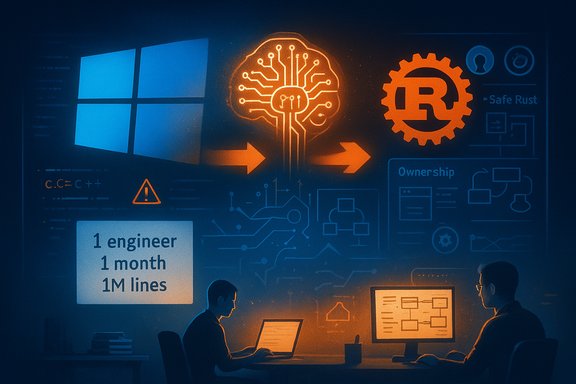
Microsoft’s latest public dust-up over an apparent plan to “rewrite Windows in Rust” began as a LinkedIn hiring post from Distinguished Engineer Galen Hunt and quickly became a global conversation about AI-assisted code migration, memory safety, and how platform vendors modernize decades‑old systems. The headline claims — a 2030 target to eliminate “every line of C and C++,” and a provocative north‑star of “1 engineer, 1 month, 1 million lines of code” — were amplified across tech media before Hunt and Microsoft clarified the reality: this is a research and tooling effort to enable migration, not an immediate, unsupervised AI rewrite of Windows.
Microsoft’s public engineering discourse around Rust and memory‑safe languages has been building for several years. The company has invested in Rust tooling, encouraged Rust usage in new system components, and piloted Rust implementations in selected, security‑sensitive subsystems. Galen Hunt’s LinkedIn post crystallized that trajectory into a vocal research charter — and the subsequent media storm forced rapid clarification that the post described an internal research team and hiring call rather than a product roadmap to hand Windows to AI for a wholesale rewrite. The clarification is notable for two reasons. First, it separates aspirational tooling targets from operational change; second, it exposes how quickly simple, vivid phrasing can be conflated with corporate strategy in the public sphere. Those optics matter because Windows is ABI‑sensitive, supports a massive third‑party driver and application ecosystem, and powers enterprise environments where stability and compatibility are everything.
For IT professionals, the right posture is cautious optimism: follow Microsoft’s published artifacts, validate translated components in controlled environments, and insist on transparent verification and ABI guarantees before moving translated components into production. The debate is not whether Rust is useful — it demonstrably is — but how to modernize responsibly when your platform is the backbone of enterprise and consumer computing.
In the months ahead, the most important deliverables to watch for are concrete, auditable engineering artifacts: open‑source transformation tools, peer‑reviewed validation strategies, and staged telemetry from Insider and Canary deployments. Those signals — not memetic one‑liners — will tell whether Microsoft’s research charter becomes a practical, safe path to modernizing Windows or a cautionary case about the limits of automation applied to decades‑old system software.
Source: thestack.technology Microsoft is rewriting Windows in Rust in small bites
 Background and overview
Microsoft’s public engineering discourse around Rust and memory‑safe languages has been building for several years. The company has invested in Rust tooling, encouraged Rust usage in new system components, and piloted Rust implementations in selected, security‑sensitive subsystems. Galen Hunt’s LinkedIn post crystallized that trajectory into a vocal research charter — and the subsequent media storm forced rapid clarification that the post described an internal research team and hiring call rather than a product roadmap to hand Windows to AI for a wholesale rewrite. The clarification is notable for two reasons. First, it separates aspirational tooling targets from operational change; second, it exposes how quickly simple, vivid phrasing can be conflated with corporate strategy in the public sphere. Those optics matter because Windows is ABI‑sensitive, supports a massive third‑party driver and application ecosystem, and powers enterprise environments where stability and compatibility are everything.What Galen Hunt actually posted — and what he later corrected
Galen Hunt’s original LinkedIn message described a CoreAI/EngHorizons team building a “powerful code processing infrastructure” that combines deterministic program analysis with AI agents to perform large‑scale program transformations. The message included the memorable lines about removing C/C++ by 2030 and the one‑engineer productivity north‑star. Within days, Hunt edited the post to explicitly state: “Windows is NOT being rewritten in Rust with AI — my team’s project is a research project” and that the post sought like‑minded engineers to build migration tooling. Two verification points:- Multiple independent outlets documented both the original language and Hunt’s correction, making the timeline and the correction verifiable.
- Microsoft spokespeople reiterated the distinction between a research charter and an operational rewrite in responses to press inquiries.
What Redmond is already doing with Rust (small bites, not a flip‑the‑switch rewrite)
Microsoft’s Rust work predates this LinkedIn flashpoint, and there are concrete, verifiable projects that show a pragmatic, iterative approach to language migration:- Patina — an open device/firmware initiative that expands UEFI/firmware components written in Rust rather than wrappers around C implementations. The Patina project and documentation are publicly available as a Rust‑first firmware effort.
- Hyperlight — an open‑source Rust library and micro‑VM framework for executing isolated functions with hypervisor protection; Microsoft’s engineering blog announced Hyperlight and its WASM guest work.
- Kernel experiments — Microsoft has rolled small, kernel‑adjacent Rust components into Windows Insider builds (for example, an early Rust implementation of GDI region shipped in an Insider Canary build). These are deliberately staged trials, limited in scope and rollout.
What the research charter actually proposes: AI + algorithmic program analysis
Hunt’s post and the job description outline a hybrid stack:- Deterministic, algorithmic program analysis that builds whole‑program graphs, call graphs, and dataflow/ABI models.
- A scaleable code processing infrastructure that can operate across large repositories.
- An AI processing infrastructure that orchestrates LLM‑based agents guided by the algorithmic layer to propose, transform, and validate code changes at scale.
Key technical constraints that make wholesale automated rewrites hard
- ABI and binary compatibility: Windows supports drivers and kernel extensions compiled as native binaries — preserving calling conventions, structure layouts, and undocumented behavior is essential. Automated transformations must maintain ABI compatibility or provide robust, backwards‑compatible shims.
- Undefined behavior (UB) and semantics: C/C++ programs frequently rely on UB or low‑level behavior that’s tolerated in practice. A naive transpile to Rust can either illicitly insert unsafe blocks (eroding Rust’s safety guarantees) or change behavior in subtle, dangerous ways.
- Ownership and architecture: Rust’s ownership model often necessitates redesigning data layouts and algorithms rather than literal line‑by‑line translation. Experienced systems developers note that a correct Rust port usually begins with architectural rethinking around ownership, borrowing, and lifetimes. This is why prior attempts at large, literal transpilation have produced inefficient or unsafe Rust code.
- Performance and timing: Low‑latency kernel code and device drivers have strict timing and memory semantics. Any migration must match or beat C/C++ performance without introducing GC pauses or altered cache behavior. Microsoft’s pilots show Rust can meet performance goals, but only after careful engineering and benchmarking.
Where Microsoft’s public experiments line up with the research claims
Evidence that Microsoft is moving deliberately and incrementally:- Insider previews shipped a Rust‑based GDI region in win32kbase_rs.sys, demonstrating kernel‑adjacent experiments with controlled rollouts in Canary builds. This is consistent with a staged approach: small, high‑risk surface areas first, behind Insider rings.
- Hyperlight and Hyperlight‑Wasm show a push to standardize protected execution and micro‑VM tooling with Rust, which aligns with the company’s security rationale for Rust adoption in cloud and edge scenarios.
- Patina demonstrates Rust‑first firmware efforts — an area where memory safety and determinism matter and where an incremental rewrite is more tractable than wholesale OS conversion.
Claims that are verifiable — and those that are not
Verifiable:- Hunt made the LinkedIn post with the language quoted and subsequently edited it to clarify the research intent. Multiple outlets captured the original text and the correction.
- Microsoft has public Rust projects and announcements (Hyperlight, Patina, Rust in Windows Insider builds), consistent with incremental adoption.
- The literal interpretation of “1 engineer, 1 month, 1 million lines of code” as a reliably achieved throughput is aspirational; there is no public audit or technical paper showing this metric has been met in production across large, ABI‑sensitive codebases. Treat that phrase as a guiding engineering north‑star rather than a published throughput measurement.
- Specific, granular claims about the scale or speed of individual ports (for example, a widely circulated line stating “Two developers ported TrueType with 154,000 lines of Rust in six months”) appear in social and secondary reporting but lack confirmatory primary artifacts or engineering repo histories that independently substantiate the exact numbers. Such claims should be flagged and treated with caution until direct repository evidence, Microsoft engineering posts, or peer‑reviewed writeups are published.
Strengths of Microsoft’s approach (what’s promising)
- Security-first rationale: Replacing memory‑unsafe code in critical paths with Rust can materially reduce whole categories of vulnerabilities (buffer overflows, use‑after‑free). This is a well‑argued, evidence‑backed motivation embraced across industry and agencies.
- Incremental, staged pilots: Shipping small Rust components in Insider previews and open‑sourcing tooling (Patina, Hyperlight) shows a conservative, auditable path that avoids monolithic risk.
- Investment in tooling and verification: The research charter’s emphasis on deterministic program analysis, whole‑program graphs, and verification layers is the right engineering posture for safe migration — deterministic algorithms plus AI assistance and human review.
- Open‑source contributions: Projects hosted in the open (Hyperlight, Patina documentation, related GitHub repos) enable the ecosystem to inspect, audit, and iterate with Microsoft, building external confidence and shared tooling.
Risks and unknowns (what keeps enterprise operators up at night)
- Regression and compatibility risk: Automated code modifications risk subtle behavior changes that can break drivers, third‑party integrations, or internal synchronization expectations. The Windows platform, with billions of devices, is intolerant of high‑impact regressions.
- False safety via unsafe proliferation: If AI‑assisted translations rely on wrapping existing unsafe behavior into frequent unsafe Rust blocks, the migration gains can be illusory. Rigorous verification is essential to ensure the resulting Rust code leverages safety guarantees rather than bypasses them.
- Operational rollout complexity: Rolling translated components into production requires staged Canary/Insider testing, driver/ABI agreements with OEMs, and coordinated servicing. Abrupt or poorly coordinated pushes would damage trust.
- Over‑reliance on unpublished metrics: Treat the 2030 date and the north‑star metric skeptically until Microsoft publishes engineering milestones, tools, and transparent validation pipelines. Ambitious timelines can create pressure to shortcut verification.
Practical guidance for IT teams and Windows administrators
- Maintain current baselines: Keep stable servicing, block untested Insider builds in production, and require proof of compatibility before adopting translated components. Insider trials are exactly that — trials — and should not be treated as production readiness indicators.
- Watch for staged signals: Look for published repositories, whitepapers, or Microsoft engineering posts that describe verification approaches, test harnesses, and rollback mechanics. Those are the clearest signals that research tooling is maturing into safe migration workflows.
- Demand ABI guarantees: If/when Microsoft translates kernel or driver‑adjacent code, expect explicit ABI contracts, driver signing and compatibility guidance, and OEM coordination. These operational artifacts will determine whether a migration is safe for enterprise fleets.
- Treat AI‑generated code as a draft: Use generated code in controlled experiments, require peer review by systems engineers with ownership model expertise, and validate performance and timing under real workloads. AI is helpful for suggestions and boilerplate, not gold‑plated autopilot for mission‑critical code.
How to evaluate progress objectively (concrete signals to watch)
- Published toolchains and proof artifacts (open‑source repos, transformation pipelines, reproducible demos).
- Engineering papers or blog posts documenting verification strategies, ABI preservation techniques, and test harnesses.
- Canary/Insider telemetry that isolates translated components behind feature flags with measured stability and security metrics.
- OEM and driver‑vendor communications confirming compatibility tests and signed driver assurances.
Conclusion — realistic expectations for Windows Rust migration and AI
Microsoft’s hiring post crystallized an audacious research ambition: building tooling that could enable large‑scale C/C++ → Rust migrations with algorithmic analysis plus AI assistance. The company’s clarification and the existing small, verifiable Rust projects (Patina firmware, Hyperlight, Rust slices in Insider builds) point to a careful, incremental adoption path rather than a sudden, AI‑driven rewrite. The upside is significant: fewer memory‑safety bugs, cleaner long‑term maintainability, and modern tooling for systems software. The hazards are equally real: ABI fragility, the temptation to shortcut verification, and the operational complexities of migrating a living platform used by billions. The prudent view is to treat Microsoft’s effort as research and tooling investment that could, with time and rigorous verification, yield meaningful security improvements — but not as a guarantee that Windows will be instantaneously or universally rewritten in Rust by any fixed date.For IT professionals, the right posture is cautious optimism: follow Microsoft’s published artifacts, validate translated components in controlled environments, and insist on transparent verification and ABI guarantees before moving translated components into production. The debate is not whether Rust is useful — it demonstrably is — but how to modernize responsibly when your platform is the backbone of enterprise and consumer computing.
In the months ahead, the most important deliverables to watch for are concrete, auditable engineering artifacts: open‑source transformation tools, peer‑reviewed validation strategies, and staged telemetry from Insider and Canary deployments. Those signals — not memetic one‑liners — will tell whether Microsoft’s research charter becomes a practical, safe path to modernizing Windows or a cautionary case about the limits of automation applied to decades‑old system software.
Source: thestack.technology Microsoft is rewriting Windows in Rust in small bites
