

Microsoft’s WorkLab report “Breaking down the infinite workday,” published June 17, 2025, found that the most heavily pinged fifth of Microsoft 365 users received 275 meetings, emails, or chat notifications across 24 hours, while their core eight-hour workday averaged one interruption every two minutes. The number is alarming, but its methodology is narrower—and more revealing—than the viral shorthand suggests. Microsoft has not proved that every knowledge worker is interrupted 275 times during office hours; it has documented how collaboration software can turn work into a continuous stream for its busiest users. The report’s real warning is not that everyone gets too many notifications, but that organizations have allowed coordination to consume the time once reserved for concentration and recovery.
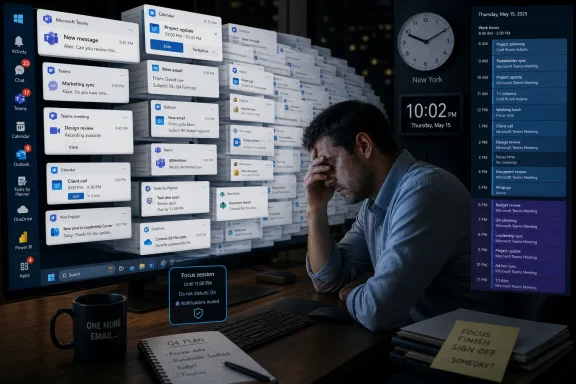
The figure that traveled furthest from Microsoft’s report was 275. It is precise, memorable, and easy to visualize as a relentless sequence of Outlook messages, Teams chats, meeting reminders, and calendar invitations marching across a Windows desktop.
It is also easy to misstate. Some early coverage compressed Microsoft’s two measurements into a single claim that workers were interrupted 275 times within an eight-hour workday. Microsoft’s methodology says something more qualified: the two-minute interval refers to an eight-hour workday, while the 275 total is accumulated across the full 24 hours.
Both measures apply to the top 20 percent of Microsoft 365 users ranked by the volume of pings received. They do not describe the median employee, every Microsoft 365 subscriber, or the workforce as a whole.
That distinction is not a technicality. It changes the article from a universal claim about modern employment into a warning about the people occupying the most communication-intensive positions inside Microsoft’s dataset.
Microsoft’s count also measures incoming events, not necessarily successful diversions of human attention. A message arriving is observable in Microsoft 365 telemetry; whether its recipient reads it immediately, ignores it, has notifications muted, or notices it only hours later is not.
That limits what can responsibly be concluded from the total. A calendar invitation, an email routed to a low-priority folder, and an urgent message from a manager all enter the count, but they do not impose the same cognitive cost.
Still, the methodological caveat should not become an excuse to dismiss the result. Being in the top fifth by ping volume may make the group atypical, but it also makes the group strategically important: managers, project leads, technical specialists, support staff, and cross-functional coordinators are likely to be among the people most exposed to communication overload.
The report therefore identifies a failure mode rather than a population average. It shows what happens when a worker becomes the junction through which too many decisions, requests, status updates, and approvals must pass.
Usage data is unusually powerful because it captures behavior at a scale that diaries and workplace interviews cannot. It can detect when meetings occur, when chats are sent, and when users return to their inboxes without relying entirely on memory or self-reporting.
The trade-off is interpretive. Telemetry can reveal that a message arrived, but not whether it mattered; that a meeting began, but not whether it was useful; or that someone opened an inbox at 10 p.m., but not whether the action felt voluntary, stressful, routine, or necessary.
The survey adds that missing human layer. Nearly half of employees and more than half of leaders described their work as chaotic and fragmented, suggesting that the digital activity is not merely harmless background traffic.
Even so, correlation remains the boundary. Microsoft’s evidence does not establish whether messaging volume causes workers to feel chaotic, whether chaotic organizations generate more messaging, or whether both are products of a third problem such as unclear authority, understaffing, distributed teams, or constantly shifting priorities.
This is where the report is strongest as organizational diagnosis and weaker as causal science. It provides a remarkably detailed picture of symptoms while leaving the underlying disease open to interpretation.
That distinction matters because the remedy depends on the cause. If the problem is badly configured notification systems, changing software defaults may help. If it is an organization in which nobody knows who can make a decision, quieter notifications may merely hide the dysfunction.
A ping is not automatically an interruption, but a workplace designed around instant response can quickly turn it into one. The social expectation attached to the message may be more disruptive than the sound, banner, or unread badge itself.
Workers learn which channels are treated as urgent. If managers use chat for immediate requests, employees monitor chat. If important decisions disappear inside sprawling email threads, employees repeatedly scan their inboxes. If meeting invitations arrive without agendas but declining them carries political risk, calendars fill regardless of whether attendance is productive.
The software records the result. The organization creates the incentive.
By 10 p.m., 29 percent of active workers were back in their inboxes. These are not measurements of a single late deadline or an occasional international call; taken together, they describe a workday whose boundaries have become porous.
Microsoft attributes some of the increase in late meetings to collaboration across time zones. That is plausible and, for global organizations, sometimes unavoidable. A team distributed across continents cannot always find a time that falls comfortably within everyone’s working day.
But time zones explain only part of the management question. They do not decide whose evening will be sacrificed, how frequently the burden will recur, whether attendance is genuinely necessary, or whether an asynchronous update could replace the call.
An 8 p.m. meeting may be a rational compromise once a month. The same meeting every week can become an unofficial extension of the employee’s contracted day.
The rise in after-hours chat is more difficult to dismiss as calendaring arithmetic. Chat carries the appearance of informality, yet its immediacy can create a stronger demand for attention than email. A message may take seconds to send while imposing minutes—or far longer—of cognitive disruption on the recipient.
This is how an infinite workday emerges without anyone explicitly announcing one. No manager needs to issue a memo abolishing the end of the workday; the boundary can disappear through accumulated exceptions, each framed as a small request.
One late meeting is necessary because of a customer. One evening message is sent before the sender forgets. One inbox check is needed to prepare for the morning. Each action is defensible in isolation, while the resulting culture is exhausting in aggregate.
The 275 figure dramatizes volume. The after-hours findings expose power.
Employees who are uncertain whether they may ignore a late message do not experience it as optional simply because the sender writes “no need to respond tonight.” If promotions, assignments, and perceptions of commitment reward visible availability, nominal permission to disconnect may carry little weight.
For IT departments, this creates an uncomfortable limit. Administrators can configure platforms, control notification behavior, and provide focus tools, but they cannot resolve the implicit expectation that the most responsive worker is the most valuable worker.
That makes the problem harder than simply telling employees to be more disciplined. A person cannot mute the organization indefinitely and still remain part of it.
The deeper issue is that coordination has become an expanding layer placed on top of production rather than a limited activity supporting it. Employees spend the day discussing, scheduling, clarifying, and updating, then use evenings to complete the individual work that those conversations generated.
The distinction is particularly important for Windows users whose desktops are the convergence point for the modern office. The operating system may simultaneously surface email alerts, Teams activity, calendar reminders, browser notifications, task-management prompts, security notices, and updates from line-of-business applications.
Each product has a defensible reason to request attention. The combined environment has no natural mechanism for deciding which request deserves it.
This is an architectural problem as much as a behavioral one. Enterprise software is usually procured and administered by application, while human attention is consumed across the entire stack.
The Teams administrator sees Teams. The messaging team sees email. The project office sees task updates. The security team sees alerts. Department heads see calendars and deadlines. The employee sees all of them arriving on one screen.
Local optimization then produces global overload. Every team tunes its own system to increase visibility and engagement, but few organizations assign anyone responsibility for the cumulative interruption burden.
That burden is easy to overlook because communication generates observable evidence of activity. Messages are sent, meetings are held, responses are logged, and documents are revised. Focused analysis, careful writing, debugging, design, and planning are less visible while they are happening.
Motion can therefore be mistaken for output. An employee who answers rapidly appears engaged, while one who disconnects from communication long enough to solve a difficult problem can appear unavailable.
Microsoft’s report challenges that equation, even as Microsoft benefits from selling the products through which much of the visible activity occurs. The company is effectively acknowledging that adoption and engagement are incomplete measures of workplace value.
That formulation moves the argument beyond total hours. A ten-hour day containing long stretches of uninterrupted concentration may be demanding, but a shorter day shattered into tiny intervals can leave a worker feeling equally depleted and with less to show for it.
Sophie Leroy, dean of the University of Washington Bothell School of Business, coined the term “attention residue” to describe what happens “when part of our attention is focused on another task instead of being fully devoted to the current task that needs to be performed.”
The mechanism explains why the cost of an interruption cannot be measured solely by the time spent answering it. A worker may close the chat window and return to a spreadsheet, document, or development environment, yet continue thinking about the message, the unfinished task it displaced, or the new obligation it introduced.
According to Leroy, “attention residue easily occurs when we leave tasks unfinished, when we get interrupted.” Her research indicates that switching tasks does not guarantee a clean transfer of cognitive resources from one activity to the next.
The residue can point in both directions. Part of the mind remains attached to the original task while the worker handles the interruption, then part remains occupied by the interruption after the original task resumes.
Gloria Mark’s field research at the University of California, Irvine, adds scale to that cost. Recovering from a single interruption can take almost half an hour, while observed attention on one screen has fallen from about two and a half minutes in the early 2000s to roughly 47 seconds in more recent data.
Those numbers should not be multiplied mechanically by 275. Interruptions overlap, many signals are ignored, and recovery time varies with the task, the person, and the interruption’s complexity.
The figures instead demonstrate why a worker’s calendar can appear to contain open time while the worker experiences no usable focus. Thirty empty minutes divided by reminders, banners, quick replies, and anticipation of the next meeting may never become a coherent thirty-minute block.
The scarce resource is not time on the calendar; it is uncontested attention.
This is especially relevant to technical work. A developer returning to code must reconstruct assumptions, state, dependencies, and the intended next step. An administrator diagnosing a failure must retain a chain of observations. An analyst must remember why a pattern in the data appeared significant.
A small interruption can evict that working context. The employee may still complete the task, but only after paying the reconstruction cost repeatedly.
The resulting loss is rarely visible in an incident report or financial ledger. It appears as slower delivery, avoidable mistakes, shallow analysis, duplicated investigation, and workers who end the day exhausted despite feeling that they accomplished little.
But WorkLab is not an independent labor institute. Its analysis is embedded in Microsoft’s broader argument that artificial intelligence and agents can help organizations redesign work.
Marc Holitscher, national technology officer at Microsoft Switzerland, said the answer “isn’t working hard but fundamentally reimagining how we work.” The first half is persuasive. The second demands scrutiny over who performs the reimagining and what interests shape it.
Microsoft’s commercial path runs through Copilot and other AI-assisted workflows. Its proposed future involves software summarizing information, preparing materials, analyzing data, and reducing some of the manual effort surrounding knowledge work.
Those tools may save time. They may also increase the volume and speed of communication unless organizations place limits on what the newly available capacity is used to produce.
If AI makes it effortless to draft five status reports instead of one, employees may receive five status reports. If it lowers the cost of preparing a meeting, organizations may schedule more meetings. If agents make it easier to generate messages, the recipient still has to decide which messages deserve attention.
Efficiency at the sending end can create overload at the receiving end. Email already demonstrated this dynamic: reducing the cost of communication did not necessarily reduce the time spent communicating.
The same risk applies to AI-generated summaries. A summary can help someone avoid a meeting, but it can also become another artifact that must be reviewed alongside the recording, transcript, chat, shared document, and follow-up thread.
Microsoft’s own thesis contains the correct qualification: AI must be paired with a reimagined rhythm of work. Without that organizational redesign, automation may accelerate the system that produced the infinite workday.
This is not an argument against Copilot or workplace AI. It is an argument against confusing faster production of information with better allocation of attention.
The decisive question for an AI deployment should therefore not be how many messages, documents, or summaries it creates. It should be whether the deployment removes decisions, eliminates meetings, shortens response chains, or protects meaningful periods of concentration.
If the answer is merely that employees can process a larger torrent, the organization has not solved overload. It has upgraded the pumps while leaving the leak open.
These measures are useful. Windows and Microsoft 365 users should not treat every application’s default request for attention as an obligation.
But personal configuration is the weakest layer of intervention because it places the cost of organizational disorder on the employee. It asks individuals to decide which incoming requests can safely be ignored while preserving the same expectations, dependencies, and power relationships that created the traffic.
A worker can block two hours for focus, but the block is fragile if colleagues schedule over it. An employee can mute chat, but not if the team treats delayed responses as poor performance. A manager can avoid evening email, but scheduled delivery does little if everyone knows the work was still being performed at night.
Even successful personal boundaries can produce inequality. Senior employees with authority and institutional knowledge may be able to decline meetings that junior staff feel compelled to attend.
The organization must therefore set defaults that make focused work legitimate rather than exceptional. That includes clarifying which channels are urgent, establishing expected response windows, defining who needs to attend meetings, and preventing routine work from becoming an evening cleanup operation.
Managers have disproportionate influence because their behavior becomes policy whether or not it is written down. A leader who sends frequent late-night messages communicates an availability expectation even when each message is framed as optional.
Conversely, a manager who protects focus periods, documents decisions clearly, and tolerates asynchronous responses gives employees practical permission to disconnect. Culture is formed through repeated consequences, not wellness slogans.
This is why Microsoft’s report should be read by operations leaders and department heads, not delegated to a productivity seminar. The infinite workday is a workflow-design problem with consequences for retention, quality, security, and delivery.
IT can supply the measurements and controls. Management has to change the demand.
Yet the top-fifth qualification does not make the evidence irrelevant. In operational systems, extremes often identify constraints before averages do.
If the busiest 20 percent consists of people through whom projects, approvals, incidents, and customer decisions flow, their interruption burden can slow everyone connected to them. A bottleneck does not need to include the majority of employees to affect the majority of work.
These users may also reveal how communication patterns spread. An overloaded manager sends rushed clarifications, schedules catch-up meetings, and delegates without sufficient context. Recipients then generate more questions, messages, and meetings, creating a feedback loop.
The most interrupted employees can become interruption multipliers—not because they are careless, but because fragmentation reduces their ability to communicate decisively.
This is one reason organization-wide averages can conceal risk. A department with relatively quiet individual contributors may still depend on a project lead whose day is sliced into two-minute intervals.
Microsoft’s report does not provide enough evidence to identify the roles inside its top 20 percent, and it would be irresponsible to assume a precise occupational profile. The practical response is to examine local data rather than generalize from the global finding.
Administrators should look for concentration: people receiving disproportionate message volume, teams carrying persistent evening meetings, and business processes that require repeated manual approval from the same individual.
The goal should not be to punish high communication activity. High volume may indicate that a person is indispensable, poorly supported, or trapped inside an inefficient workflow.
Treating the metric as an employee-performance score would reproduce the report’s central error in another form. The number is most useful as evidence of system design, not individual failure.
Tired employees working late are still making access decisions, reviewing documents, handling sensitive messages, and responding to prompts. The erosion of focus can increase the chance that a suspicious request is processed automatically rather than examined carefully.
A crowded notification environment also gives malicious or mistaken activity camouflage. When employees are conditioned to clear prompts rapidly, another approval request or urgent message can blend into the stream.
The issue is not that Microsoft’s report documents a specific security incident; it does not. The connection is a practical inference from the working conditions it describes.
Security programs routinely ask users to pause, verify, and report anomalies. Collaboration cultures simultaneously reward immediate response. Those expectations collide when a worker is handling constant pings and returning to the inbox at 10 p.m.
Change management and incident response can suffer in the same way. An administrator interrupted midway through a complex procedure may lose track of completed steps or assumptions. A support engineer moving rapidly among chats can apply context from one user’s problem to another case.
Checklists, peer review, automation, and controlled maintenance windows exist partly to reduce these human risks. Their value rises as the surrounding environment becomes more fragmented.
This gives IT leaders another reason to resist treating notification overload as a personal wellness issue. Attention is part of operational resilience.
Phone calls outside the platform, conversations with colleagues, consumer messaging services, specialist applications, and physical disruptions may fall outside the picture. Conversely, Microsoft 365 events counted as pings may never command meaningful attention.
The user cohort is also selective. Both headline interruption figures concern the top 20 percent by ping volume, and the report should not be paraphrased as if it measured every worker equally.
The survey broadens the evidence, but perception data has its own limits. Employees and leaders may agree that work is chaotic without agreeing on why, who is responsible, or what should change.
Microsoft also arrives at the analysis with a commercial position. The company sells the communication environment that generates the signals and the AI tools offered as part of the solution.
None of those caveats invalidates the report. They define what it can support.
It can support the conclusion that a heavily messaged segment of Microsoft 365 users faces near-continuous incoming activity during core hours. It can support the finding that meetings and chats are increasingly crossing conventional work boundaries. It can support the observation that many surveyed employees and leaders experience work as fragmented.
It cannot prove that each ping breaks concentration, that Microsoft software alone caused the pattern, or that AI will reverse it.
The strongest reading is therefore neither alarmist nor dismissive. The report is a vendor-produced measurement of a real organizational failure, presented through a commercial theory of how that failure might be fixed.
Readers should accept the measurement carefully and evaluate the proposed cure separately.
Microsoft has given employers a vivid measurement of the workplace they built: not universally interrupted every two minutes, but capable of pushing its most connected people toward a day with no reliable edge. The next stage will show whether organizations use AI and administration to remove unnecessary work—or merely help exhausted employees survive a faster version of the same system.
 The Viral Number Combines Two Different Clocks
The figure that traveled furthest from Microsoft’s report was 275. It is precise, memorable, and easy to visualize as a relentless sequence of Outlook messages, Teams chats, meeting reminders, and calendar invitations marching across a Windows desktop.It is also easy to misstate. Some early coverage compressed Microsoft’s two measurements into a single claim that workers were interrupted 275 times within an eight-hour workday. Microsoft’s methodology says something more qualified: the two-minute interval refers to an eight-hour workday, while the 275 total is accumulated across the full 24 hours.
Both measures apply to the top 20 percent of Microsoft 365 users ranked by the volume of pings received. They do not describe the median employee, every Microsoft 365 subscriber, or the workforce as a whole.
That distinction is not a technicality. It changes the article from a universal claim about modern employment into a warning about the people occupying the most communication-intensive positions inside Microsoft’s dataset.
| Microsoft finding | Measurement window | User cohort | What was counted | Proper interpretation |
|---|---|---|---|---|
| One interruption every two minutes | Eight-hour workday | Top 20 percent by ping volume | Meetings, emails, and chats | The busiest users face almost continuous incoming activity during core hours |
| 275 interruptions per day | Full 24 hours | Top 20 percent by ping volume | Meetings, emails, and chats | Work-related signals continue beyond the conventional workday |
| Chaotic and fragmented work | Survey response | 31,000 workers across 31 markets | Employees’ and leaders’ perceptions | The telemetry pattern is reflected in how many respondents describe their work |
That limits what can responsibly be concluded from the total. A calendar invitation, an email routed to a low-priority folder, and an urgent message from a manager all enter the count, but they do not impose the same cognitive cost.
Still, the methodological caveat should not become an excuse to dismiss the result. Being in the top fifth by ping volume may make the group atypical, but it also makes the group strategically important: managers, project leads, technical specialists, support staff, and cross-functional coordinators are likely to be among the people most exposed to communication overload.
The report therefore identifies a failure mode rather than a population average. It shows what happens when a worker becomes the junction through which too many decisions, requests, status updates, and approvals must pass.
Microsoft 365 Can Count Activity but Not Attention
Microsoft based its analysis on Microsoft 365 usage signals and paired that telemetry with a survey of 31,000 workers across 31 markets. Those sources complement one another, but neither turns the report into a controlled experiment.Usage data is unusually powerful because it captures behavior at a scale that diaries and workplace interviews cannot. It can detect when meetings occur, when chats are sent, and when users return to their inboxes without relying entirely on memory or self-reporting.
The trade-off is interpretive. Telemetry can reveal that a message arrived, but not whether it mattered; that a meeting began, but not whether it was useful; or that someone opened an inbox at 10 p.m., but not whether the action felt voluntary, stressful, routine, or necessary.
The survey adds that missing human layer. Nearly half of employees and more than half of leaders described their work as chaotic and fragmented, suggesting that the digital activity is not merely harmless background traffic.
Even so, correlation remains the boundary. Microsoft’s evidence does not establish whether messaging volume causes workers to feel chaotic, whether chaotic organizations generate more messaging, or whether both are products of a third problem such as unclear authority, understaffing, distributed teams, or constantly shifting priorities.
This is where the report is strongest as organizational diagnosis and weaker as causal science. It provides a remarkably detailed picture of symptoms while leaving the underlying disease open to interpretation.
That distinction matters because the remedy depends on the cause. If the problem is badly configured notification systems, changing software defaults may help. If it is an organization in which nobody knows who can make a decision, quieter notifications may merely hide the dysfunction.
A ping is not automatically an interruption, but a workplace designed around instant response can quickly turn it into one. The social expectation attached to the message may be more disruptive than the sound, banner, or unread badge itself.
Workers learn which channels are treated as urgent. If managers use chat for immediate requests, employees monitor chat. If important decisions disappear inside sprawling email threads, employees repeatedly scan their inboxes. If meeting invitations arrive without agendas but declining them carries political risk, calendars fill regardless of whether attendance is productive.
The software records the result. The organization creates the incentive.
The Clock Reveals More Than the Counter
The report’s most consequential findings concern when work happens. Meetings beginning after 8 p.m. increased 16 percent year over year, while chats sent outside the nine-to-five rose 15 percent.By 10 p.m., 29 percent of active workers were back in their inboxes. These are not measurements of a single late deadline or an occasional international call; taken together, they describe a workday whose boundaries have become porous.
Microsoft attributes some of the increase in late meetings to collaboration across time zones. That is plausible and, for global organizations, sometimes unavoidable. A team distributed across continents cannot always find a time that falls comfortably within everyone’s working day.
But time zones explain only part of the management question. They do not decide whose evening will be sacrificed, how frequently the burden will recur, whether attendance is genuinely necessary, or whether an asynchronous update could replace the call.
An 8 p.m. meeting may be a rational compromise once a month. The same meeting every week can become an unofficial extension of the employee’s contracted day.
The rise in after-hours chat is more difficult to dismiss as calendaring arithmetic. Chat carries the appearance of informality, yet its immediacy can create a stronger demand for attention than email. A message may take seconds to send while imposing minutes—or far longer—of cognitive disruption on the recipient.
This is how an infinite workday emerges without anyone explicitly announcing one. No manager needs to issue a memo abolishing the end of the workday; the boundary can disappear through accumulated exceptions, each framed as a small request.
One late meeting is necessary because of a customer. One evening message is sent before the sender forgets. One inbox check is needed to prepare for the morning. Each action is defensible in isolation, while the resulting culture is exhausting in aggregate.
The 275 figure dramatizes volume. The after-hours findings expose power.
Employees who are uncertain whether they may ignore a late message do not experience it as optional simply because the sender writes “no need to respond tonight.” If promotions, assignments, and perceptions of commitment reward visible availability, nominal permission to disconnect may carry little weight.
For IT departments, this creates an uncomfortable limit. Administrators can configure platforms, control notification behavior, and provide focus tools, but they cannot resolve the implicit expectation that the most responsive worker is the most valuable worker.
Coordination Has Occupied the Space Where Work Was Supposed to Happen
Meetings, email, and chat are not distractions in the same sense as entertainment or irrelevant browsing. They are work—or at least mechanisms through which work is assigned, discussed, approved, and reported.That makes the problem harder than simply telling employees to be more disciplined. A person cannot mute the organization indefinitely and still remain part of it.
The deeper issue is that coordination has become an expanding layer placed on top of production rather than a limited activity supporting it. Employees spend the day discussing, scheduling, clarifying, and updating, then use evenings to complete the individual work that those conversations generated.
The distinction is particularly important for Windows users whose desktops are the convergence point for the modern office. The operating system may simultaneously surface email alerts, Teams activity, calendar reminders, browser notifications, task-management prompts, security notices, and updates from line-of-business applications.
Each product has a defensible reason to request attention. The combined environment has no natural mechanism for deciding which request deserves it.
This is an architectural problem as much as a behavioral one. Enterprise software is usually procured and administered by application, while human attention is consumed across the entire stack.
The Teams administrator sees Teams. The messaging team sees email. The project office sees task updates. The security team sees alerts. Department heads see calendars and deadlines. The employee sees all of them arriving on one screen.
Local optimization then produces global overload. Every team tunes its own system to increase visibility and engagement, but few organizations assign anyone responsibility for the cumulative interruption burden.
That burden is easy to overlook because communication generates observable evidence of activity. Messages are sent, meetings are held, responses are logged, and documents are revised. Focused analysis, careful writing, debugging, design, and planning are less visible while they are happening.
Motion can therefore be mistaken for output. An employee who answers rapidly appears engaged, while one who disconnects from communication long enough to solve a difficult problem can appear unavailable.
Microsoft’s report challenges that equation, even as Microsoft benefits from selling the products through which much of the visible activity occurs. The company is effectively acknowledging that adoption and engagement are incomplete measures of workplace value.
Attention Residue Turns Small Requests Into Large Costs
Alexia Cambon, senior research director on Microsoft’s Copilot and Future of Work team, captured the distinction in the report: “It’s not just that the work never ends—it’s that work is increasingly disruptive, leaving little time for moments of mental rest or focus.”That formulation moves the argument beyond total hours. A ten-hour day containing long stretches of uninterrupted concentration may be demanding, but a shorter day shattered into tiny intervals can leave a worker feeling equally depleted and with less to show for it.
Sophie Leroy, dean of the University of Washington Bothell School of Business, coined the term “attention residue” to describe what happens “when part of our attention is focused on another task instead of being fully devoted to the current task that needs to be performed.”
The mechanism explains why the cost of an interruption cannot be measured solely by the time spent answering it. A worker may close the chat window and return to a spreadsheet, document, or development environment, yet continue thinking about the message, the unfinished task it displaced, or the new obligation it introduced.
According to Leroy, “attention residue easily occurs when we leave tasks unfinished, when we get interrupted.” Her research indicates that switching tasks does not guarantee a clean transfer of cognitive resources from one activity to the next.
The residue can point in both directions. Part of the mind remains attached to the original task while the worker handles the interruption, then part remains occupied by the interruption after the original task resumes.
Gloria Mark’s field research at the University of California, Irvine, adds scale to that cost. Recovering from a single interruption can take almost half an hour, while observed attention on one screen has fallen from about two and a half minutes in the early 2000s to roughly 47 seconds in more recent data.
Those numbers should not be multiplied mechanically by 275. Interruptions overlap, many signals are ignored, and recovery time varies with the task, the person, and the interruption’s complexity.
The figures instead demonstrate why a worker’s calendar can appear to contain open time while the worker experiences no usable focus. Thirty empty minutes divided by reminders, banners, quick replies, and anticipation of the next meeting may never become a coherent thirty-minute block.
The scarce resource is not time on the calendar; it is uncontested attention.
This is especially relevant to technical work. A developer returning to code must reconstruct assumptions, state, dependencies, and the intended next step. An administrator diagnosing a failure must retain a chain of observations. An analyst must remember why a pattern in the data appeared significant.
A small interruption can evict that working context. The employee may still complete the task, but only after paying the reconstruction cost repeatedly.
The resulting loss is rarely visible in an incident report or financial ledger. It appears as slower delivery, avoidable mistakes, shallow analysis, duplicated investigation, and workers who end the day exhausted despite feeling that they accomplished little.
The Vendor Diagnosing the Fire Also Sells the Extinguisher
Microsoft deserves credit for publishing a report that casts its own productivity ecosystem in an uncomfortable light. The company’s platforms are not presented solely as efficiency engines; their telemetry becomes evidence of a workplace struggling under communication volume.But WorkLab is not an independent labor institute. Its analysis is embedded in Microsoft’s broader argument that artificial intelligence and agents can help organizations redesign work.
Marc Holitscher, national technology officer at Microsoft Switzerland, said the answer “isn’t working hard but fundamentally reimagining how we work.” The first half is persuasive. The second demands scrutiny over who performs the reimagining and what interests shape it.
Microsoft’s commercial path runs through Copilot and other AI-assisted workflows. Its proposed future involves software summarizing information, preparing materials, analyzing data, and reducing some of the manual effort surrounding knowledge work.
Those tools may save time. They may also increase the volume and speed of communication unless organizations place limits on what the newly available capacity is used to produce.
If AI makes it effortless to draft five status reports instead of one, employees may receive five status reports. If it lowers the cost of preparing a meeting, organizations may schedule more meetings. If agents make it easier to generate messages, the recipient still has to decide which messages deserve attention.
Efficiency at the sending end can create overload at the receiving end. Email already demonstrated this dynamic: reducing the cost of communication did not necessarily reduce the time spent communicating.
The same risk applies to AI-generated summaries. A summary can help someone avoid a meeting, but it can also become another artifact that must be reviewed alongside the recording, transcript, chat, shared document, and follow-up thread.
Microsoft’s own thesis contains the correct qualification: AI must be paired with a reimagined rhythm of work. Without that organizational redesign, automation may accelerate the system that produced the infinite workday.
This is not an argument against Copilot or workplace AI. It is an argument against confusing faster production of information with better allocation of attention.
The decisive question for an AI deployment should therefore not be how many messages, documents, or summaries it creates. It should be whether the deployment removes decisions, eliminates meetings, shortens response chains, or protects meaningful periods of concentration.
If the answer is merely that employees can process a larger torrent, the organization has not solved overload. It has upgraded the pumps while leaving the leak open.
Personal Focus Settings Cannot Repair Organizational Incentives
The standard response to notification overload is to recommend individual controls: mute channels, disable banners, schedule focus time, close email, decline unnecessary meetings, and establish working hours.These measures are useful. Windows and Microsoft 365 users should not treat every application’s default request for attention as an obligation.
But personal configuration is the weakest layer of intervention because it places the cost of organizational disorder on the employee. It asks individuals to decide which incoming requests can safely be ignored while preserving the same expectations, dependencies, and power relationships that created the traffic.
A worker can block two hours for focus, but the block is fragile if colleagues schedule over it. An employee can mute chat, but not if the team treats delayed responses as poor performance. A manager can avoid evening email, but scheduled delivery does little if everyone knows the work was still being performed at night.
Even successful personal boundaries can produce inequality. Senior employees with authority and institutional knowledge may be able to decline meetings that junior staff feel compelled to attend.
The organization must therefore set defaults that make focused work legitimate rather than exceptional. That includes clarifying which channels are urgent, establishing expected response windows, defining who needs to attend meetings, and preventing routine work from becoming an evening cleanup operation.
Managers have disproportionate influence because their behavior becomes policy whether or not it is written down. A leader who sends frequent late-night messages communicates an availability expectation even when each message is framed as optional.
Conversely, a manager who protects focus periods, documents decisions clearly, and tolerates asynchronous responses gives employees practical permission to disconnect. Culture is formed through repeated consequences, not wellness slogans.
This is why Microsoft’s report should be read by operations leaders and department heads, not delegated to a productivity seminar. The infinite workday is a workflow-design problem with consequences for retention, quality, security, and delivery.
IT can supply the measurements and controls. Management has to change the demand.
Action checklist for admins
- Audit meeting, email, and chat patterns by team, paying particular attention to recurring after-hours activity rather than relying only on organization-wide averages.
- Separate urgent channels from routine channels and publish clear response-time expectations for each.
- Review notification defaults on managed Windows devices and Microsoft 365 applications, disabling nonessential banners where business requirements allow.
- Protect agreed focus blocks from routine meeting bookings and give employees a documented escalation route when those blocks are repeatedly overridden.
- Ask meeting owners to define the required audience, expected decision, and whether an asynchronous update could replace the call.
- Measure AI pilots by meetings removed, handoffs shortened, and focus time restored—not merely by content generated or messages processed.
- Revisit staffing, approval chains, and ownership when high ping volume is concentrated around a small number of people.
The Top 20 Percent Should Be Treated as a System Alarm
Critics can reasonably object that Microsoft’s headline figures describe only the top fifth of users by ping volume. That limitation should be prominent wherever the 275 total is repeated.Yet the top-fifth qualification does not make the evidence irrelevant. In operational systems, extremes often identify constraints before averages do.
If the busiest 20 percent consists of people through whom projects, approvals, incidents, and customer decisions flow, their interruption burden can slow everyone connected to them. A bottleneck does not need to include the majority of employees to affect the majority of work.
These users may also reveal how communication patterns spread. An overloaded manager sends rushed clarifications, schedules catch-up meetings, and delegates without sufficient context. Recipients then generate more questions, messages, and meetings, creating a feedback loop.
The most interrupted employees can become interruption multipliers—not because they are careless, but because fragmentation reduces their ability to communicate decisively.
This is one reason organization-wide averages can conceal risk. A department with relatively quiet individual contributors may still depend on a project lead whose day is sliced into two-minute intervals.
Microsoft’s report does not provide enough evidence to identify the roles inside its top 20 percent, and it would be irresponsible to assume a precise occupational profile. The practical response is to examine local data rather than generalize from the global finding.
Administrators should look for concentration: people receiving disproportionate message volume, teams carrying persistent evening meetings, and business processes that require repeated manual approval from the same individual.
The goal should not be to punish high communication activity. High volume may indicate that a person is indispensable, poorly supported, or trapped inside an inefficient workflow.
Treating the metric as an employee-performance score would reproduce the report’s central error in another form. The number is most useful as evidence of system design, not individual failure.
An Infinite Workday Is Also a Security Problem
Fragmented work is usually discussed in terms of productivity and well-being, but there is an operational-security dimension that deserves more attention.Tired employees working late are still making access decisions, reviewing documents, handling sensitive messages, and responding to prompts. The erosion of focus can increase the chance that a suspicious request is processed automatically rather than examined carefully.
A crowded notification environment also gives malicious or mistaken activity camouflage. When employees are conditioned to clear prompts rapidly, another approval request or urgent message can blend into the stream.
The issue is not that Microsoft’s report documents a specific security incident; it does not. The connection is a practical inference from the working conditions it describes.
Security programs routinely ask users to pause, verify, and report anomalies. Collaboration cultures simultaneously reward immediate response. Those expectations collide when a worker is handling constant pings and returning to the inbox at 10 p.m.
Change management and incident response can suffer in the same way. An administrator interrupted midway through a complex procedure may lose track of completed steps or assumptions. A support engineer moving rapidly among chats can apply context from one user’s problem to another case.
Checklists, peer review, automation, and controlled maintenance windows exist partly to reduce these human risks. Their value rises as the surrounding environment becomes more fragmented.
This gives IT leaders another reason to resist treating notification overload as a personal wellness issue. Attention is part of operational resilience.
The Report’s Blind Spots Matter, but They Do Not Erase Its Warning
Microsoft’s data comes from its own productivity environment. It counts activity visible to Microsoft 365, not every workplace interaction or interruption.Phone calls outside the platform, conversations with colleagues, consumer messaging services, specialist applications, and physical disruptions may fall outside the picture. Conversely, Microsoft 365 events counted as pings may never command meaningful attention.
The user cohort is also selective. Both headline interruption figures concern the top 20 percent by ping volume, and the report should not be paraphrased as if it measured every worker equally.
The survey broadens the evidence, but perception data has its own limits. Employees and leaders may agree that work is chaotic without agreeing on why, who is responsible, or what should change.
Microsoft also arrives at the analysis with a commercial position. The company sells the communication environment that generates the signals and the AI tools offered as part of the solution.
None of those caveats invalidates the report. They define what it can support.
It can support the conclusion that a heavily messaged segment of Microsoft 365 users faces near-continuous incoming activity during core hours. It can support the finding that meetings and chats are increasingly crossing conventional work boundaries. It can support the observation that many surveyed employees and leaders experience work as fragmented.
It cannot prove that each ping breaks concentration, that Microsoft software alone caused the pattern, or that AI will reverse it.
The strongest reading is therefore neither alarmist nor dismissive. The report is a vendor-produced measurement of a real organizational failure, presented through a commercial theory of how that failure might be fixed.
Readers should accept the measurement carefully and evaluate the proposed cure separately.
What IT Leaders Should Carry Into the Next Workday
The practical lesson is not that every employee endures exactly 275 disruptive events, nor that a single notification policy will restore concentration. Microsoft has identified a narrower but still serious pattern in which the busiest users are surrounded by communication throughout the day and increasingly pulled back into work at night.- The 275 total covers 24 hours, while the two-minute interval covers an eight-hour workday.
- Both headline figures apply to the top 20 percent of users by ping volume.
- Microsoft counts meetings, emails, and chats, but cannot determine the cognitive impact of each event.
- Meetings after 8 p.m. rose 16 percent year over year, and chats outside nine-to-five increased 15 percent.
- By 10 p.m., 29 percent of active workers were back in their inboxes.
- AI is useful only if it reduces coordination overhead rather than producing more material for employees to process.
Microsoft has given employers a vivid measurement of the workplace they built: not universally interrupted every two minutes, but capable of pushing its most connected people toward a day with no reliable edge. The next stage will show whether organizations use AI and administration to remove unnecessary work—or merely help exhausted employees survive a faster version of the same system.
References
- Primary source: Silicon Canals
Published: 2026-07-09T22:50:14.890637
Loading…
siliconcanals.com - Official source: microsoft.com
Loading…
www.microsoft.com - Related coverage: axios.com
Loading…
www.axios.com - Related coverage: forbes.com
Loading…
www.forbes.com - Related coverage: fortune.com
Loading…
fortune.com