

Microsoft said on June 18, 2026, that it consolidated data from more than 70 internal sales systems into a governed Microsoft Fabric model, layered Power BI and Copilot experiences on top, and saved 100,000 seller hours annually. The more interesting claim is not that AI made sellers faster. It is that Microsoft’s AI gains appeared only after the company did the unfashionable work of simplifying dashboards, retiring reports, standardizing definitions, and rebuilding trust in the data underneath them.
That matters because enterprise AI is still too often sold as a magic interface for messy organizations. Microsoft’s internal sales transformation argues the opposite: Copilot is useful when it sits on a disciplined semantic layer, not when it is asked to hallucinate order out of departmental chaos. For WindowsForum readers running Microsoft-heavy estates, this is less a feel-good productivity story than a blueprint—and a warning.
The old enterprise assumption is that more data creates better decisions. Microsoft’s sales organization seems to have tested that assumption at industrial scale and found its weak point: sellers were not starving for information, they were drowning in it.
Over time, Microsoft’s internal sales teams gained access to more systems, more reports, more dashboards, and more ways to slice the business. Each addition was probably rational in isolation. A finance team needed a metric, a regional leader wanted a pipeline view, a product group needed adoption signals, and a customer-facing seller wanted a sharper read on risk.
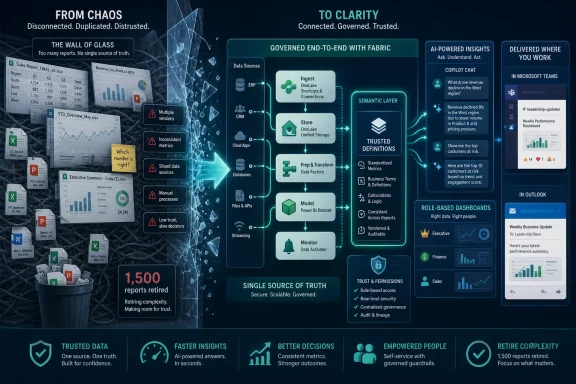
The accumulation produced the familiar enterprise result: a “single pane of glass” became a wall of glass shards. Sellers were navigating hundreds of reports and dashboards, exporting data into spreadsheets, building their own analyses, and manually assembling presentations before customer meetings and internal business reviews. The work was nominally analytical, but much of it was really clerical.
That is the paradox Microsoft is now trying to turn into a product lesson. The problem was not that sellers lacked dashboards. It was that dashboards had become another workload.
Michael Toomey, a revenue insights lead in Microsoft’s Finance Data and Experience team, put the complaint in plain language: sellers had been given a “gigantic well of data,” but the path from that data to doing the job was fragmented. That distinction is the whole story. A seller does not need data access as an end in itself; a seller needs the next best action, the account risk, the customer context, the meeting prep, and the confidence that the number in one tool means the same thing as the number in another.
This is where the story becomes relevant beyond sales. Many IT departments have lived through the same arc with endpoint telemetry, identity logs, cost management dashboards, vulnerability scanners, ticketing systems, and compliance portals. The modern Microsoft estate can produce astonishing amounts of signal. It can also turn every administrator into a part-time reconciler of conflicting truths.
That sounds like implementation plumbing, but it is the actual product lesson. AI systems that answer business questions need more than access to tables. They need agreed meanings. If one system defines revenue, customer segment, risk, forecast stage, or account ownership differently from another, a natural-language interface may simply make the confusion faster and more convincing.
Microsoft’s emphasis on a semantic layer is therefore more than a data architecture footnote. The semantic layer is where business definitions, metrics, and data quality rules become reusable infrastructure. It is what lets an agent reason over “pipeline,” “customer opportunity,” or “risk” without each prompt becoming a negotiation over terminology.
For years, organizations have treated semantic models as the province of BI teams and data architects. Microsoft’s internal example reframes them as AI infrastructure. The company is effectively saying that governed business meaning is now a prerequisite for useful agents.
That will be a hard message for some customers to hear. Fabric, OneLake, Power BI semantic models, Purview-style governance, and Copilot integrations are all attractive on a slide. But the work of rationalizing definitions across finance, sales, operations, and product groups is political as much as technical. Somebody has to decide which metric wins, which legacy report dies, and which team no longer gets to maintain its own private version of the truth.
That is also why this story deserves more scrutiny than a generic “AI saved time” case study. Microsoft did not claim that a prompt box alone produced the transformation. It credits the combination of a trusted data foundation, a redesigned user experience, and AI embedded into daily tools. The ordering matters.
This is another quiet but important admission. The enterprise portal has long been the compromise nobody loves. It centralizes access, checks the governance box, and gives leaders confidence that “the information is available.” But availability is not the same as usability, especially when employees are under pressure to prepare for a customer conversation or respond to a business review.
Microsoft’s newer model pushes insights toward the seller. Power BI surfaces intelligent insights into dashboards each morning. Relevant reports are routed based on job description and client base. Sellers can subscribe to continuously updated reports that appear in their inbox. Information can surface in Microsoft Teams or email rather than requiring a jump into a separate reporting environment.
That is the “flow of work” strategy Microsoft has been pushing across Microsoft 365 Copilot, Teams, Outlook, Power BI, and Fabric. The company’s bet is that productivity gains come when AI and analytics meet users where they already spend their day, not when users are asked to adopt yet another destination.
For Windows and Microsoft 365 administrators, the strategic direction is obvious. Teams is no longer just a collaboration client. Outlook is no longer just mail. Power BI is no longer just a reporting surface. These products are becoming delivery channels for governed organizational intelligence.
That creates benefits and risks. The benefit is lower friction: users do not need to know which report, workspace, model, or dashboard contains the answer. The risk is that the productivity surface becomes opaque. If an answer appears in Teams, administrators and data owners must still understand where it came from, which permissions were applied, how fresh the data was, and whether the underlying model was approved for that use.
The obvious sales pitch is speed. Microsoft says processes that once took hours can now be completed in minutes, and that insight generation became 10 times faster. It also says the program saved 100,000 seller hours annually, reduced data ingestion costs by 30 percent, and retired or consolidated 1,500 reports.
Those are strong internal metrics, though they should be read with the usual caution applied to vendor-published transformation stories. Microsoft is describing its own deployment of its own stack, in an organization with enormous engineering resources and executive pressure to make AI real. That does not invalidate the results, but it does mean customers should treat the case study as a pattern, not a plug-and-play promise.
The pattern is still valuable. Microsoft is not presenting Copilot as a generic chatbot sitting beside a pile of reports. It is presenting Copilot as a business interface over curated, permissioned, role-aware data products. In that model, the user asks a question in plain English, but the answer is constrained by governance, grounded in approved models, and delivered inside familiar productivity tools.
That is the version of enterprise AI that has a chance to survive contact with compliance teams. It does not ask organizations to choose between self-service and control. It tries to make control the condition that enables self-service.
The weakness is also clear. If the governed layer is incomplete, stale, politically contested, or poorly modeled, the AI experience inherits those flaws. Worse, it may hide them behind fluent prose. A bad dashboard at least looks like a dashboard; a bad AI answer can look like a confident analyst.
Every large organization has reporting sediment. Dashboards accumulate because creating a new one is often easier than decommissioning an old one. Reports survive because a senior leader once asked for them, because a team is afraid to delete them, or because nobody knows whether they are still being used.
AI makes this problem more urgent. A sprawling report estate is not just a user-experience issue when agents begin reasoning over enterprise data. It becomes an accuracy, governance, and trust issue. Redundant or contradictory reports give AI systems more places to retrieve partial context and more ways to generate plausible but disputed answers.
By reducing the reporting footprint, Microsoft was not merely cleaning house. It was reducing the surface area of confusion.
This is where IT and data teams should resist the temptation to skip ahead to agent demos. The demoable moment is a seller asking, “What risks should I focus on today?” and receiving a concise, contextual answer. The hard prerequisite is deciding which risk signals are authoritative, which reports should be retired, which data refresh cycles are acceptable, and which roles get access to which customer context.
That is not glamorous work. It is also the difference between an AI assistant and an AI-shaped search box over organizational clutter.
It also creates a higher standard. If Microsoft is telling customers that Fabric, Power BI, Copilot, and AI Foundry can reshape data work, then its internal deployments become evidence of both possibility and complexity. The company’s own story says success required executive sponsorship, active change management, governance alignment, user-experience redesign, and semantic standardization.
That is a lot more than buying licenses.
The “Customer Zero” framing is most useful when it exposes the hidden cost of transformation. Microsoft’s sales organization did not simply adopt AI; it reorganized the data environment around AI. It aligned definitions. It curated dashboards. It routed reports by role. It embedded insights into daily tools. It changed workflows that sellers had built around spreadsheets and presentations.
That should sound familiar to anyone who has managed a Microsoft 365 rollout. Technology adoption rarely fails because the button is hard to find. It fails because existing habits, incentives, permissions, data quality issues, and leadership expectations are not aligned with the new system.
The uncomfortable implication is that Copilot projects may resemble ERP projects more than productivity app deployments. They touch business definitions, operational processes, governance models, and executive reporting expectations. They are less about “turning on AI” than about deciding what the organization knows and how it should act on that knowledge.
For admins, that means the old boundaries between desktop management, collaboration administration, BI governance, and security operations continue to blur. A seller receiving AI-generated customer insights in Teams is relying on permissions, data labels, identity controls, device posture, retention policies, and model governance all at once.
The Windows client still matters, but the action is increasingly in the management plane around the worker. Conditional access, endpoint compliance, information protection, data loss prevention, audit logging, and app governance become part of the AI user experience, even if the user never thinks about them.
This is where Microsoft’s internal story is both promising and demanding. If insights can be surfaced in email and Teams, users may spend less time switching contexts and more time acting. But the same convenience raises the stakes for governance mistakes. The wrong data routed to the wrong role is no longer buried in a dashboard portal; it may arrive proactively in a user’s daily workflow.
Security-minded readers should also note the direction of travel. As agents take on meeting preparation, pipeline reviews, and customer insight generation, they become operational participants rather than passive assistants. That makes access control, auditability, prompt governance, and data lineage more important, not less.
The distinction is important. A chatbot answers a question. An agent may monitor signals, assemble context, draft materials, recommend priorities, and eventually trigger workflows. Once that happens, the quality of the semantic layer becomes operationally consequential.
If an agent prepares a meeting brief from trusted customer data, it can save time and improve consistency. If it misunderstands account ownership, uses stale pipeline data, or merges conflicting definitions, it can mislead a seller at the exact moment the organization is trying to look more informed.
This is why Microsoft’s emphasis on governed data products is not mere architecture theater. Agentic systems need boundaries. They need authoritative sources, role-aware access, business definitions, and human oversight. Without those, the agent becomes an accelerant for existing dysfunction.
There is also a strategic platform play here. Fabric becomes the place where data is unified and semantically grounded. Power BI becomes both the analytics layer and a Copilot consumption surface. Microsoft 365 becomes the productivity shell where insights appear. AI Foundry becomes part of the agent-building and orchestration story. Teams and Outlook become the places where work is nudged forward.
Customers may like the integration. They may also worry about lock-in. The more Microsoft makes its AI experiences depend on the connective tissue between Fabric, Power BI, Microsoft 365 Copilot, and Teams, the harder it becomes to treat any one product as optional.
Reconciliation is the hidden tax on enterprise work. It is the meeting before the meeting, the spreadsheet beside the dashboard, the Slack or Teams message asking which number is “real,” the exported CSV that becomes someone’s local truth. It rarely appears in productivity metrics, but it consumes hours and erodes trust.
Microsoft’s seller transformation attacked reconciliation at multiple levels. It standardized definitions. It consolidated data. It curated role-based dashboards. It surfaced daily insights. It retired reports. It embedded AI into familiar tools. Each step reduces the number of moments where a seller has to stop and ask, “Where is the right answer?”
That is a more credible vision of AI productivity than the fantasy of replacing workers with autonomous agents. In complex organizations, the first major gain may simply be reducing the friction that keeps skilled employees from using their judgment.
For IT pros, this suggests a practical test for AI projects: does the deployment remove reconciliation work, or does it merely add another interface to reconcile? If users still have to verify every answer against three dashboards and a spreadsheet, the AI layer has not solved the problem. It has become part of it.
The 30 percent ingestion cost reduction suggests that rationalization was not only about user experience. Consolidating pipelines, reducing duplication, and retiring unnecessary reporting assets can have direct infrastructure and operational cost benefits. In the Fabric era, data sprawl is not just cognitive overhead; it is a bill.
The 10 times faster insight generation number is equally interesting because it implies a change in the path from question to answer. A seller no longer needs to know which dashboard contains the answer, export data, manipulate it, and package it for a meeting. The system is designed to surface relevant context more directly.
But customers should be wary of treating these numbers as universal benchmarks. Microsoft has a unique internal environment, deep product expertise, strong incentives to showcase its AI stack, and the ability to coordinate across teams in ways many enterprises will struggle to match. The lesson is not “you will save 100,000 hours.” The lesson is “you will not get meaningful savings unless you simplify the data estate first.”
That is the part some AI buyers still resist. They want the productivity outcome without the governance project. Microsoft’s own example says the two are inseparable.
That playbook is more honest than the usual AI theater because it admits that employees do not suffer from a shortage of portals. They suffer from fragmented systems, inconsistent definitions, manual preparation, and the constant burden of turning raw information into action.
The risk for customers is that Microsoft’s integrated answer can look deceptively simple from the outside. Fabric, Power BI, Copilot, AI Foundry, Teams, and Outlook form a compelling stack, but the stack does not automatically create organizational agreement. It provides the machinery through which agreement can be expressed.
That distinction should guide deployments. A company that has not resolved data ownership will not become aligned because Copilot can summarize a report. A sales team that does not trust pipeline definitions will not suddenly trust them because they appear in natural language. A finance team that maintains shadow metrics will not abandon them unless leadership forces convergence.
Microsoft’s internal case study is therefore a useful corrective to AI magical thinking. It shows that the interface can become simpler only when the system behind it becomes more disciplined.
Here is the condensed version worth carrying into the next Copilot, Fabric, or Power BI planning meeting:
That matters because enterprise AI is still too often sold as a magic interface for messy organizations. Microsoft’s internal sales transformation argues the opposite: Copilot is useful when it sits on a disciplined semantic layer, not when it is asked to hallucinate order out of departmental chaos. For WindowsForum readers running Microsoft-heavy estates, this is less a feel-good productivity story than a blueprint—and a warning.
 Microsoft’s Sellers Had a Data Problem Disguised as Abundance
The old enterprise assumption is that more data creates better decisions. Microsoft’s sales organization seems to have tested that assumption at industrial scale and found its weak point: sellers were not starving for information, they were drowning in it.Over time, Microsoft’s internal sales teams gained access to more systems, more reports, more dashboards, and more ways to slice the business. Each addition was probably rational in isolation. A finance team needed a metric, a regional leader wanted a pipeline view, a product group needed adoption signals, and a customer-facing seller wanted a sharper read on risk.
The accumulation produced the familiar enterprise result: a “single pane of glass” became a wall of glass shards. Sellers were navigating hundreds of reports and dashboards, exporting data into spreadsheets, building their own analyses, and manually assembling presentations before customer meetings and internal business reviews. The work was nominally analytical, but much of it was really clerical.
That is the paradox Microsoft is now trying to turn into a product lesson. The problem was not that sellers lacked dashboards. It was that dashboards had become another workload.
Michael Toomey, a revenue insights lead in Microsoft’s Finance Data and Experience team, put the complaint in plain language: sellers had been given a “gigantic well of data,” but the path from that data to doing the job was fragmented. That distinction is the whole story. A seller does not need data access as an end in itself; a seller needs the next best action, the account risk, the customer context, the meeting prep, and the confidence that the number in one tool means the same thing as the number in another.
This is where the story becomes relevant beyond sales. Many IT departments have lived through the same arc with endpoint telemetry, identity logs, cost management dashboards, vulnerability scanners, ticketing systems, and compliance portals. The modern Microsoft estate can produce astonishing amounts of signal. It can also turn every administrator into a part-time reconciler of conflicting truths.
Fabric Was the Boring Part That Made the AI Part Possible
Microsoft’s first move was not to bolt a chatbot onto the existing reporting estate. It consolidated data from more than 70 systems into a unified model on Microsoft Fabric, with standardized definitions, consistent metrics, and common hierarchies.That sounds like implementation plumbing, but it is the actual product lesson. AI systems that answer business questions need more than access to tables. They need agreed meanings. If one system defines revenue, customer segment, risk, forecast stage, or account ownership differently from another, a natural-language interface may simply make the confusion faster and more convincing.
Microsoft’s emphasis on a semantic layer is therefore more than a data architecture footnote. The semantic layer is where business definitions, metrics, and data quality rules become reusable infrastructure. It is what lets an agent reason over “pipeline,” “customer opportunity,” or “risk” without each prompt becoming a negotiation over terminology.
For years, organizations have treated semantic models as the province of BI teams and data architects. Microsoft’s internal example reframes them as AI infrastructure. The company is effectively saying that governed business meaning is now a prerequisite for useful agents.
That will be a hard message for some customers to hear. Fabric, OneLake, Power BI semantic models, Purview-style governance, and Copilot integrations are all attractive on a slide. But the work of rationalizing definitions across finance, sales, operations, and product groups is political as much as technical. Somebody has to decide which metric wins, which legacy report dies, and which team no longer gets to maintain its own private version of the truth.
That is also why this story deserves more scrutiny than a generic “AI saved time” case study. Microsoft did not claim that a prompt box alone produced the transformation. It credits the combination of a trusted data foundation, a redesigned user experience, and AI embedded into daily tools. The ordering matters.
The Dashboard Portal Lost to the Flow of Work
After consolidating the data foundation, Microsoft redesigned how sellers accessed information. Instead of asking them to hunt through a portal of reports, it created role-based dashboards aligned to responsibilities, workflows, and client bases.This is another quiet but important admission. The enterprise portal has long been the compromise nobody loves. It centralizes access, checks the governance box, and gives leaders confidence that “the information is available.” But availability is not the same as usability, especially when employees are under pressure to prepare for a customer conversation or respond to a business review.
Microsoft’s newer model pushes insights toward the seller. Power BI surfaces intelligent insights into dashboards each morning. Relevant reports are routed based on job description and client base. Sellers can subscribe to continuously updated reports that appear in their inbox. Information can surface in Microsoft Teams or email rather than requiring a jump into a separate reporting environment.
That is the “flow of work” strategy Microsoft has been pushing across Microsoft 365 Copilot, Teams, Outlook, Power BI, and Fabric. The company’s bet is that productivity gains come when AI and analytics meet users where they already spend their day, not when users are asked to adopt yet another destination.
For Windows and Microsoft 365 administrators, the strategic direction is obvious. Teams is no longer just a collaboration client. Outlook is no longer just mail. Power BI is no longer just a reporting surface. These products are becoming delivery channels for governed organizational intelligence.
That creates benefits and risks. The benefit is lower friction: users do not need to know which report, workspace, model, or dashboard contains the answer. The risk is that the productivity surface becomes opaque. If an answer appears in Teams, administrators and data owners must still understand where it came from, which permissions were applied, how fresh the data was, and whether the underlying model was approved for that use.
Copilot Is Being Used as a Business Interface, Not a Party Trick
The AI layer in Microsoft’s internal story includes Power BI Copilot, Microsoft Fabric, and AI Foundry. Sellers can ask questions in natural language and receive answers in tools they already use. Copilot-driven experiences can generate summaries, help assemble meeting materials, prioritize the day, and surface insights that previously required manual digging.The obvious sales pitch is speed. Microsoft says processes that once took hours can now be completed in minutes, and that insight generation became 10 times faster. It also says the program saved 100,000 seller hours annually, reduced data ingestion costs by 30 percent, and retired or consolidated 1,500 reports.
Those are strong internal metrics, though they should be read with the usual caution applied to vendor-published transformation stories. Microsoft is describing its own deployment of its own stack, in an organization with enormous engineering resources and executive pressure to make AI real. That does not invalidate the results, but it does mean customers should treat the case study as a pattern, not a plug-and-play promise.
The pattern is still valuable. Microsoft is not presenting Copilot as a generic chatbot sitting beside a pile of reports. It is presenting Copilot as a business interface over curated, permissioned, role-aware data products. In that model, the user asks a question in plain English, but the answer is constrained by governance, grounded in approved models, and delivered inside familiar productivity tools.
That is the version of enterprise AI that has a chance to survive contact with compliance teams. It does not ask organizations to choose between self-service and control. It tries to make control the condition that enables self-service.
The weakness is also clear. If the governed layer is incomplete, stale, politically contested, or poorly modeled, the AI experience inherits those flaws. Worse, it may hide them behind fluent prose. A bad dashboard at least looks like a dashboard; a bad AI answer can look like a confident analyst.
Report Retirement May Be the Most Underrated Metric
Among Microsoft’s reported outcomes, the retirement and consolidation of 1,500 reports may be the most revealing. Saving hours is the headline. Killing reports is the cultural change.Every large organization has reporting sediment. Dashboards accumulate because creating a new one is often easier than decommissioning an old one. Reports survive because a senior leader once asked for them, because a team is afraid to delete them, or because nobody knows whether they are still being used.
AI makes this problem more urgent. A sprawling report estate is not just a user-experience issue when agents begin reasoning over enterprise data. It becomes an accuracy, governance, and trust issue. Redundant or contradictory reports give AI systems more places to retrieve partial context and more ways to generate plausible but disputed answers.
By reducing the reporting footprint, Microsoft was not merely cleaning house. It was reducing the surface area of confusion.
This is where IT and data teams should resist the temptation to skip ahead to agent demos. The demoable moment is a seller asking, “What risks should I focus on today?” and receiving a concise, contextual answer. The hard prerequisite is deciding which risk signals are authoritative, which reports should be retired, which data refresh cycles are acceptable, and which roles get access to which customer context.
That is not glamorous work. It is also the difference between an AI assistant and an AI-shaped search box over organizational clutter.
The Customer Zero Story Cuts Both Ways
Microsoft frames the project as part of its “Customer Zero” approach: use Microsoft technologies internally, learn what works at scale, and pass that knowledge to customers. This is a powerful marketing device because it gives Microsoft a lived example rather than a hypothetical architecture.It also creates a higher standard. If Microsoft is telling customers that Fabric, Power BI, Copilot, and AI Foundry can reshape data work, then its internal deployments become evidence of both possibility and complexity. The company’s own story says success required executive sponsorship, active change management, governance alignment, user-experience redesign, and semantic standardization.
That is a lot more than buying licenses.
The “Customer Zero” framing is most useful when it exposes the hidden cost of transformation. Microsoft’s sales organization did not simply adopt AI; it reorganized the data environment around AI. It aligned definitions. It curated dashboards. It routed reports by role. It embedded insights into daily tools. It changed workflows that sellers had built around spreadsheets and presentations.
That should sound familiar to anyone who has managed a Microsoft 365 rollout. Technology adoption rarely fails because the button is hard to find. It fails because existing habits, incentives, permissions, data quality issues, and leadership expectations are not aligned with the new system.
The uncomfortable implication is that Copilot projects may resemble ERP projects more than productivity app deployments. They touch business definitions, operational processes, governance models, and executive reporting expectations. They are less about “turning on AI” than about deciding what the organization knows and how it should act on that knowledge.
The Windows Angle Is the Management Plane Around the Worker
This story is not directly about Windows, but it is very much about the Microsoft workplace stack that Windows users inhabit. The seller’s endpoint is just one node in a chain that includes identity, Teams, Outlook, Power BI, Fabric, SharePoint, Purview, and Copilot. The value of the AI experience depends on the integrity of that chain.For admins, that means the old boundaries between desktop management, collaboration administration, BI governance, and security operations continue to blur. A seller receiving AI-generated customer insights in Teams is relying on permissions, data labels, identity controls, device posture, retention policies, and model governance all at once.
The Windows client still matters, but the action is increasingly in the management plane around the worker. Conditional access, endpoint compliance, information protection, data loss prevention, audit logging, and app governance become part of the AI user experience, even if the user never thinks about them.
This is where Microsoft’s internal story is both promising and demanding. If insights can be surfaced in email and Teams, users may spend less time switching contexts and more time acting. But the same convenience raises the stakes for governance mistakes. The wrong data routed to the wrong role is no longer buried in a dashboard portal; it may arrive proactively in a user’s daily workflow.
Security-minded readers should also note the direction of travel. As agents take on meeting preparation, pipeline reviews, and customer insight generation, they become operational participants rather than passive assistants. That makes access control, auditability, prompt governance, and data lineage more important, not less.
AI Agents Move the Fight From Search to Action
Microsoft’s article ends by pointing toward personal and role-based agents that take on workflows such as meeting preparation, pipeline reviews, and customer insight generation. That is the frontier the company wants customers to see: not just better search, but delegated work.The distinction is important. A chatbot answers a question. An agent may monitor signals, assemble context, draft materials, recommend priorities, and eventually trigger workflows. Once that happens, the quality of the semantic layer becomes operationally consequential.
If an agent prepares a meeting brief from trusted customer data, it can save time and improve consistency. If it misunderstands account ownership, uses stale pipeline data, or merges conflicting definitions, it can mislead a seller at the exact moment the organization is trying to look more informed.
This is why Microsoft’s emphasis on governed data products is not mere architecture theater. Agentic systems need boundaries. They need authoritative sources, role-aware access, business definitions, and human oversight. Without those, the agent becomes an accelerant for existing dysfunction.
There is also a strategic platform play here. Fabric becomes the place where data is unified and semantically grounded. Power BI becomes both the analytics layer and a Copilot consumption surface. Microsoft 365 becomes the productivity shell where insights appear. AI Foundry becomes part of the agent-building and orchestration story. Teams and Outlook become the places where work is nudged forward.
Customers may like the integration. They may also worry about lock-in. The more Microsoft makes its AI experiences depend on the connective tissue between Fabric, Power BI, Microsoft 365 Copilot, and Teams, the harder it becomes to treat any one product as optional.
The Real Productivity Gain Is Less Reconciliation
The most persuasive part of Microsoft’s account is not the promise that sellers can ask natural-language questions. Natural-language analytics has been around in various forms for years, often with mixed results. The stronger claim is that sellers spend less time reconciling information before they can make a decision.Reconciliation is the hidden tax on enterprise work. It is the meeting before the meeting, the spreadsheet beside the dashboard, the Slack or Teams message asking which number is “real,” the exported CSV that becomes someone’s local truth. It rarely appears in productivity metrics, but it consumes hours and erodes trust.
Microsoft’s seller transformation attacked reconciliation at multiple levels. It standardized definitions. It consolidated data. It curated role-based dashboards. It surfaced daily insights. It retired reports. It embedded AI into familiar tools. Each step reduces the number of moments where a seller has to stop and ask, “Where is the right answer?”
That is a more credible vision of AI productivity than the fantasy of replacing workers with autonomous agents. In complex organizations, the first major gain may simply be reducing the friction that keeps skilled employees from using their judgment.
For IT pros, this suggests a practical test for AI projects: does the deployment remove reconciliation work, or does it merely add another interface to reconcile? If users still have to verify every answer against three dashboards and a spreadsheet, the AI layer has not solved the problem. It has become part of it.
The Numbers Are Impressive, but the Prerequisites Are the Story
Microsoft’s published results are tidy: 100,000 seller hours saved annually, 30 percent lower data ingestion costs, 10 times faster insight generation, and 1,500 reports retired or consolidated. In a less careful reading, those numbers become the story. In a better reading, they are the receipt for the work that preceded them.The 30 percent ingestion cost reduction suggests that rationalization was not only about user experience. Consolidating pipelines, reducing duplication, and retiring unnecessary reporting assets can have direct infrastructure and operational cost benefits. In the Fabric era, data sprawl is not just cognitive overhead; it is a bill.
The 10 times faster insight generation number is equally interesting because it implies a change in the path from question to answer. A seller no longer needs to know which dashboard contains the answer, export data, manipulate it, and package it for a meeting. The system is designed to surface relevant context more directly.
But customers should be wary of treating these numbers as universal benchmarks. Microsoft has a unique internal environment, deep product expertise, strong incentives to showcase its AI stack, and the ability to coordinate across teams in ways many enterprises will struggle to match. The lesson is not “you will save 100,000 hours.” The lesson is “you will not get meaningful savings unless you simplify the data estate first.”
That is the part some AI buyers still resist. They want the productivity outcome without the governance project. Microsoft’s own example says the two are inseparable.
Microsoft’s Seller Stack Offers a More Honest AI Playbook
The most useful version of this story is not the glossy one. The useful version says enterprise AI starts with the unglamorous work of deciding which data is trusted, which reports deserve to exist, which workflows matter, and which tools employees actually use.That playbook is more honest than the usual AI theater because it admits that employees do not suffer from a shortage of portals. They suffer from fragmented systems, inconsistent definitions, manual preparation, and the constant burden of turning raw information into action.
The risk for customers is that Microsoft’s integrated answer can look deceptively simple from the outside. Fabric, Power BI, Copilot, AI Foundry, Teams, and Outlook form a compelling stack, but the stack does not automatically create organizational agreement. It provides the machinery through which agreement can be expressed.
That distinction should guide deployments. A company that has not resolved data ownership will not become aligned because Copilot can summarize a report. A sales team that does not trust pipeline definitions will not suddenly trust them because they appear in natural language. A finance team that maintains shadow metrics will not abandon them unless leadership forces convergence.
Microsoft’s internal case study is therefore a useful corrective to AI magical thinking. It shows that the interface can become simpler only when the system behind it becomes more disciplined.
The Lesson Microsoft Probably Wants Customers to Miss Least
The practical reading for IT leaders is narrower and more actionable than the marketing language around “Frontier Firms.” Microsoft’s seller transformation worked because it treated AI as the final mile of a data modernization effort, not the first mile.Here is the condensed version worth carrying into the next Copilot, Fabric, or Power BI planning meeting:
- Microsoft’s reported gains came after it consolidated data from more than 70 systems into a governed Fabric foundation.
- The semantic layer was central because agents and Copilot experiences need standardized business definitions to produce trustworthy answers.
- Role-based dashboards and proactive delivery mattered because sellers did not want another reporting portal to babysit.
- Retiring and consolidating 1,500 reports was not cleanup trivia; it reduced confusion, cost, and the risk of contradictory answers.
- The strongest productivity claim is not that AI found data faster, but that sellers spent less time reconciling data before acting.
- Customers should treat Microsoft’s numbers as proof of possibility, not as guaranteed returns from simply enabling Copilot licenses.
References
- Primary source: Microsoft
Published: 2026-06-18T15:42:07.869837
From data sprawl to AI-driven seller insights at Microsoft - Inside Track Blog
Learn how we unified our sales data using Power BI and Fabric to help our sellers find insights faster and to prepare for customer conversations.www.microsoft.com
