

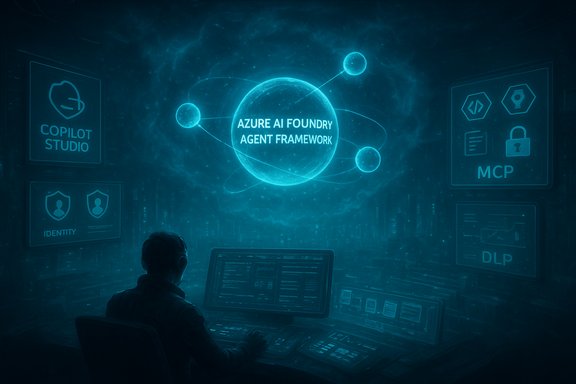
Microsoft’s vision for an “agentic web” — sketched in a TechSparks 2025 masterclass by Salim Naim, Director of AI at Microsoft Asia — frames the current AI moment as a platform transition from static pages and app-centric workflows to autonomous, intent-driven agents that act, negotiate and collaborate on users’ behalf. Naim argued that this shift requires an entirely new toolchain — runtimes, protocols, identity and evaluator systems — and that Microsoft is building those foundations so startups and enterprises can safely scale fleets of agents inside governed environments.
Background: why “agentic” is more than just a buzzword
In the last two years the industry moved from proof-of-concept chat interfaces to agents that plan multi-step strategies, call tools, and carry out real-world actions. Researchers and vendors now describe an “Agentic Web” where agents represent user intent across apps and on the open internet, coordinating with other agents via shared protocols and marketplaces. That broader academic framing is emerging in parallel with vendor roadmaps and standards work that aim to make agents portable, auditable and interoperable. This is not incremental UI change. It reframes:- Interaction models from discrete “task-based” app flows to persistent, intent-oriented sessions.
- Economic incentives from attention-driven metrics to outcome/value-based transactions between agents and services.
- Operational risk from individual model errors to systemic governance needs across agent fleets.
Overview: what Salim Naim said — the essentials
Salim Naim’s TechSparks masterclass distilled Microsoft’s thesis into three connected claims:- The evolution is a platform shift comparable to Web 1.0 → Web 2.0; agentic AI is about autonomy. Enterprises must think in terms of agents and evaluators, not merely models and prompts.
- Microsoft is building the toolchain — runtimes, identity primitives, developer SDKs and evaluation toolkits — so that startups and customers can create secure, reliable agents that scale.
- The future user experience will be intent-centric: a single intelligent interface (for example, Copilot) can retrieve emails, summarise content, draft replies and produce deliverables without forcing users to hop between discrete apps.
The Microsoft stack: foundations, protocols and runtimes
Azure AI Foundry, Copilot Studio and the Agent Framework
Microsoft’s platform strategy couples developer ergonomics with enterprise-grade governance. Core components include:- Azure AI Foundry / Agent Service: production runtimes and orchestration for agent lifecycle, scaling and observability.
- Copilot Studio and Copilot APIs: low-code and API surfaces to author agents that connect to Microsoft 365, Graph data and external services. The Retrieval API and agent templates are explicitly positioned for enterprise grounding and compliance.
- Agent Framework / AutoGen: open-source and research frameworks to define multi-agent behaviors and orchestrations, intended to bridge prototypes to production.
Standards and the plumbing: MCP, NLWeb, A2A
Interoperability hinges on protocol work. The Model Context Protocol (MCP) — originally put forth to let LLMs discover and invoke tools in a structured, machine-readable way — has been adopted across multiple platforms, and Microsoft has integrated MCP support into parts of Windows, Copilot and Azure toolchains. Complementary standards and proposals (NLWeb as a site-level natural language interface) aim to make web content programmatically accessible to agents. These protocols are central to the vision of an “open agentic web.”What the demo scenarios mean in practice: intent-first UIs and Copilot
Naim demonstrated a Copilot prototype that collapses several common productivity steps into one conversational flow: retrieve emails, summarize content, draft replies, and create presentations without context switching. This is the practical expression of Microsoft’s intent-based UX thesis: the interface is no longer a portal to apps but the agent that accomplishes outcomes. Microsoft’s product releases illustrate the same trajectory:- Copilot in Word and Outlook already ground responses in tenant data and enforce data loss prevention (DLP) checks before accessing sensitive files. This shows a deliberate move to tie generative outputs to enterprise guardrails.
- Copilot Actions in Windows 11 demonstrates how an agent can act inside the desktop — open apps, edit files and perform multi-step workflows inside a visible “agent workspace” where users can observe and interrupt execution. Microsoft calls this experimental and emphasizes permissioned, sandboxed operation.
Multi-agent coordination: harder than it looks
A central point Naim made — and one Microsoft research teams and external academics emphasize — is that agents often fail to coordinate reliably. When multiple agents collaborate, they can disagree, pursue conflicting sub-goals, or drift from the user’s intent. Benchmarks and new agent-evaluation frameworks are beginning to show systemic weaknesses in grounding, negotiation and task adherence. Research initiatives and toolkits being developed aim to shift evaluation from static benchmarks to outcome-focused metrics:- AgentEval-style frameworks automate task-specific criteria and use critic/evaluator agents or human-in-the-loop workflows to judge real-world utility and fidelity. These frameworks are increasingly open-source and form part of Microsoft-affiliated academic projects.
- Microsoft Research and partners are funding projects to measure multi-turn task completion, uncertainty estimation, and RAG (retrieval augmented generation) fidelity — moving evaluation toward what matters for enterprise operations.
Governance, security and trust: where the rubber meets the road
Enterprises are the natural early customers for agentic systems — but they demand security, compliance and predictable controls before broad adoption. Naim’s remarks reflect that reality: scaling from a handful of copilots to thousands of autonomous agents dramatically increases the attack surface and governance burden. Key trust-building building blocks Microsoft and others emphasize:- Identity-first agent accounts: register agents as directory objects with scoped permissions and lifecycle controls.
- Data protection and DLP: before an agent accesses files, the system must enforce classification and DLP policies. Microsoft’s Copilot already implements such checks in preview.
- Rule-based guardrails and content filters: many failure modes (prompt injection, policy evasion, action misuse) cannot be safely handled by another LLM alone. Enterprises need deterministic, rule-based controls (prompt shields, action cooldowns, approval gates) and independent safety layers like Azure AI Content Safety.
- Observability & immutable audit trails: agent actions, tool calls and data usage must be logged and tamper-resistant to meet regulatory and audit requirements.
A caution on specific operational claims
At TechSparks, Naim referenced enterprises already running large numbers of agents; one notable line in media coverage said a Microsoft customer “already runs more than 10,000” autonomous agents. That specific figure could not be independently corroborated from public company filings or Microsoft press materials at the time of writing, though multiple vendors have reported customers with large Copilot seat counts and other providers (e.g., Salesforce’s Agentforce) have publicly said customers created 10,000+ agents in short periods. Where precise numerical claims are stated anecdotally, they should be treated as illustrative of scale rather than an independently verified metric.For founders and developers: build for an enterprise-first world
Naim closed with pragmatic advice: startups must design for compliance, interoperability and reliability from day one. Translating that into a concrete checklist:- Instrument evaluation and observability from the start:
- Implement outcome-based tests, A/B experiments, and human-in-the-loop evaluators.
- Adopt identity and least-privilege patterns:
- Treat each agent as an auditable identity; use ephemeral tokens, just-in-time access and conditional access policies.
- Ground outputs purposefully:
- Use tenant-specific retrieval pipelines (RAG) with validated sources and provenance labels.
- Layer deterministic guardrails:
- Combine rule-based filters, approval gates and content-safety services; do not rely solely on another LLM for enforcement.
- Design for interoperability:
- Expose tools via standard MCP/A2A interfaces; allow customers to swap models and runtimes without full rewrites.
- Plan for cost and licensing:
- Budget for runtime credits, operational telemetry and the human oversight that scales with agent count.
Strengths of Microsoft’s approach — and where it could fall short
Strengths
- End-to-end platform play: coupling low-code authoring (Copilot Studio), runtimes (Azure AI Foundry) and identity/governance (Entra, Purview) gives enterprises a predictable integration path.
- Standards-first posture: embracing MCP and A2A helps portability and reduces vendor lock-in risk if the protocols gain adoption.
- Operational focus: making evaluators, observability, and auditability first-class reduces the common “pilot-to-production” friction that stalled many earlier AI projects.
Risks and open questions
- Emergent failure modes at scale: multi-agent negotiation, cascading errors and adversarial prompts create failure classes that are still poorly understood; automated evaluators may not yet model long-tail enterprise scenarios.
- Standards adoption friction: MCP and similar protocols require broad ecosystem support; until they reach critical mass, integrations may still be brittle.
- Vendor consolidation and lock-in tradeoffs: platform convenience can centralize controls and telemetry in a single vendor’s cloud; customers must weigh that against interoperability benefits.
- Regulatory and legal uncertainty: agentic automation raises new questions about liability, cross-border data flows and auditing burden in regulated industries; operating models will need to adapt.
The economics: from attention to a value economy
One of the more provocative ideas in Naim’s talk is economic: agents can shift the web away from attention-first monetization toward transactional value models where agents negotiate outcomes, fees and services. That marketplace idea is plausible but requires:- Identity, reputation and escrow systems for agents.
- Standardized semantic descriptions for services (so agents can discover and compare offers).
- Regulatory guardrails for consumer protections and dispute resolution.
Verdict: realistic optimism with heavy operational demands
Microsoft’s investment in runtimes, standards and governance tools is a practical response to the operational gaps that have stalled many enterprise AI projects. The company’s approach — integrate identity, guardrails and evaluator tooling into the developer workflow — addresses the chief enterprise blockers: trust, compliance and maintainability. For startups and IT teams, this lowers the bar to ship agentic features that meet corporate risk thresholds. However, the architecture is not a magic bullet. Multi-agent coherence, secure cross-agent protocols, and robust evaluation at production scale remain active research and engineering problems that will determine whether agents become reliable digital coworkers or brittle, risky experimentations. Enterprises should adopt an incremental, safety-first posture: pilot focused agent workloads with tight scope, instrument outcomes rigorously, and invest in governance automation before scaling widely.Practical next steps for IT leaders and founders
- Prioritize identity and least-privilege design for agents before building tool integrations.
- Bake evaluators and human approval gates into the release pipeline; measure outcomes, not just accuracy.
- Use open protocols (MCP/A2A) where possible to future-proof integrations and reduce rewrite risk.
- Treat agent actions as auditable events; retain tamper-resistant logs for compliance reviews.
- Invest in operator training: humans will move from doing tasks to evaluating agent outcomes and handling exceptions.
Conclusion
Salim Naim’s masterclass at TechSparks captured a central truth about this phase of AI: agents are less a single product than a platform shift — a change that requires new runtimes, identity systems, evaluators and operational playbooks. Microsoft’s strategy to build that stack — from Copilot Studio to Azure AI Foundry and standards work like MCP — reflects a deliberate, enterprise-oriented approach that pairs developer productivity with governance primitives. The opportunity for startups and enterprises is real: agents can reduce context switching, automate complex workflows and create new value channels. The obligations are equally real: robust guardrails, deterministic controls and outcome-driven evaluators must be built in, not bolted on. The companies that master trust, control and measurable outcomes early are the most likely to scale successfully in an agentic web — but widespread success will hinge on solving hard multi-agent coordination problems and building an interoperable, auditable infrastructure across vendors and geographies.Source: YourStory.com https://yourstory.com/2025/11/techsparks-microsoft-salim-naim-building-foundations-agentic-web/
