

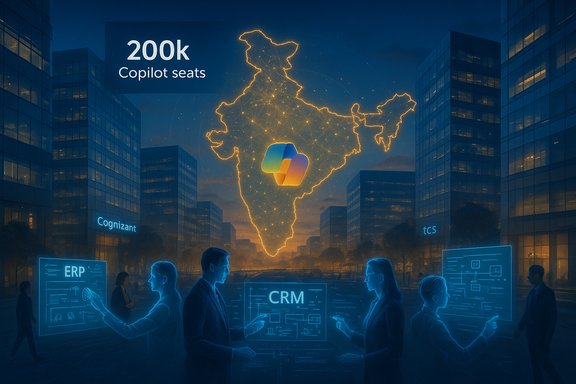
Microsoft’s India visit has produced a coordinated, high-stakes push to industrialize “agentic AI”: Satya Nadella announced that Microsoft will partner with Cognizant, Infosys, TCS and Wipro to deploy more than 50,000 Microsoft Copilot licences at each firm — a combined program Microsoft says will exceed 200,000 seats — and paired that commercial pact with a separate US$17.5 billion investment to expand cloud, AI infrastructure, sovereign-ready offerings and skilling in India.
The announcement stitches together three simultaneous strategic plays: (1) platform scale — pushing Microsoft 365 Copilot, Copilot Studio and Azure AI Foundry into enterprise operations; (2) partner-led activation — using the delivery muscle of the four large systems integrators to accelerate seat adoption and client rollouts; and (3) sovereign infrastructure and skilling — a multibillion-dollar investment to host, govern and train for AI at national scale. Microsoft framed the four IT services firms as “Frontier Firms” that will embed Copilot and agentic AI into internal workflows and client solutions, positioning India as a global hub for production-grade AI deployments. Microsoft’s $17.5 billion investment for India (calendar years 2026–2029) is presented as the infrastructural backbone for this plan: new hyperscale regions, expanded data centre capacity, in-country processing for Copilot, and a widening of skilling programs targeting millions of workers. Independent outlets confirmed the size and timing of the investment.
That path carries tangible upside — scalable productivity gains, new managed services, and faster enterprise adoption — but also significant operational and strategic risks. Enterprises should welcome the tooling but insist on disciplined pilots, transparent activation metrics, auditable governance, and contractual guardrails that make economics and control explicit. The next 6–18 months will determine whether this is the moment agentic AI moves from headline commitments to measurable, repeatable business outcomes — or whether the scale of the announcement outpaces the readiness of governance, cost controls and activation to deliver on the promise.
Source: Free Press Journal Microsoft, Cognizant, Infosys, TCS And Wipro Sign Mega AI Pact To Deploy Over 2 Lakh Copilot Licenses Across India
 Background
The announcement stitches together three simultaneous strategic plays: (1) platform scale — pushing Microsoft 365 Copilot, Copilot Studio and Azure AI Foundry into enterprise operations; (2) partner-led activation — using the delivery muscle of the four large systems integrators to accelerate seat adoption and client rollouts; and (3) sovereign infrastructure and skilling — a multibillion-dollar investment to host, govern and train for AI at national scale. Microsoft framed the four IT services firms as “Frontier Firms” that will embed Copilot and agentic AI into internal workflows and client solutions, positioning India as a global hub for production-grade AI deployments. Microsoft’s $17.5 billion investment for India (calendar years 2026–2029) is presented as the infrastructural backbone for this plan: new hyperscale regions, expanded data centre capacity, in-country processing for Copilot, and a widening of skilling programs targeting millions of workers. Independent outlets confirmed the size and timing of the investment. What Microsoft and the partners actually announced
The headline numbers
- Each of Cognizant, Infosys, TCS and Wipro will deploy over 50,000 Microsoft Copilot licences, with the four partners collectively exceeding 200,000 seats as a coordinated initiative.
- Microsoft simultaneously announced a US$17.5 billion commitment for cloud and AI infrastructure, skilling, and operations across India for calendar years 2026–2029.
- Microsoft has stated intentions to provide in-country processing for Microsoft 365 Copilot in India (processing prompts and responses locally under normal operations), a capability that matters for regulated sectors.
Product and platform pieces called out
- Microsoft 365 Copilot — the knowledge-worker layer embedded in Microsoft 365 apps for drafting, summarization and workflow automation.
- Copilot Studio — the orchestration and authoring surface for building multi-step agents and workflows.
- Azure AI Foundry / model routing — model catalogue, routing, governance and observability to manage agent chains and enterprise policies.
- GitHub Copilot — developer productivity tooling integrated into the overall developer + agent story.
Company-by-company snapshot
Cognizant
Cognizant has been framed by Microsoft as a “client zero” and builder of enterprise Copilot solutions. The company previously purchased 25,000 Microsoft 365 Copilot seats in an earlier tie-up, a verifiable procurement that anchors its role in this larger initiative. Cognizant’s messaging emphasizes converting infrastructure investments into measurable client outcomes and scaling Copilot to both internal users and customer environments.Infosys
Infosys positions its Topaz Fabric™ and Infosys Cobalt® cloud offerings as the platform for operationalizing multi-agent workflows. The company describes this Copilot deployment as part of a strategic evolution toward an AI-first operating model — human+agent workflows embedded across delivery, sales, HR and client engagement. Infosys leadership framed the move as enabling measurable transformation at scale.TCS
TCS emphasizes democratization: the company states it has equipped tens of thousands of professionals with Microsoft AI tools, and presented initiatives such as a personalized AI Coach for employees and large-scale internal hackathons to accelerate internal adoption. TCS’ emphasis is on workforce enablement and turning developer productivity and knowledge-worker augmentation into routine practice.Wipro
Wipro announced a three-year strategic partnership and launched a Microsoft Innovation Hub at its Partner Labs in Bengaluru. Wipro reports deployment of more than 50,000 Copilot licences as part of client-zero programs and says it has upskilled 25,000+ employees on Microsoft Cloud and GitHub technologies. Wipro frames this program as industry-specific: financial services, retail, manufacturing, healthcare and more will receive tailored copilots built on Wipro Intelligence™ and Microsoft’s stack. Wipro published an explicit press release confirming elements of this pact.Why this matters: strategic implications
- Acceleration from pilot to production: The scale of the announced licences and the partner-led play convert Copilot from a productivity experiment into an operational standard across major enterprise service firms. This materially shortens the time from proof-of-concept to standardized enterprise deployment.
- Sovereignty and procurement: Localising Copilot processing and expanding hyperscale regions addresses procurement barriers for regulated customers in finance, healthcare and government, making enterprise adoption more plausible for sensitive workloads.
- Commercial gravity and vendor lock-in: Large internal seat counts and integrated managed services create recurring revenue and deepen commercial ties between Microsoft, its cloud infrastructure, and the partners’ client accounts; this raises the commercial bar for rivals and increases switching costs for customers.
- Workforce transformation: The partners’ plans for mass upskilling and internal AI coaching programs are central to converting licences into active, productive users; supply-side skilling will be a major determinant of measured ROI.
Technical and operational analysis: what “agentic AI” brings — and what it demands
Capabilities enabled
- Multi-step, stateful workflows that can plan, call APIs, synthesize data across systems and persist changes or recommendations.
- Vertical copilots that connect to ERP, CRM, HR and domain data, enabling significant automation of knowledge work.
- Developer acceleration through GitHub Copilot and code-generation agents that are integrated with deployment pipelines.
New operational requirements
- Governance and observability: Agentic workflows will require model routing, telemetry, policy enforcement, lineage and auditable decision trails. Azure AI Foundry and Microsoft’s governance primitives are intended to provide those capabilities, but their integration with customer systems will be non-trivial.
- Access controls and DLP: Protecting sensitive data when agents interact with multiple systems is essential. Enterprises will need fine-grained access control, prompt filtering, and robust data loss prevention integrated with Copilot connectors.
- Testing and validation pipelines: Agents that take actions need pre-deployment simulation, synthetic test data, safety checks and rollback plans.
- Cost and capacity planning: Large-scale Copilot usage imposes inference costs (GPU/accelerator capacity) and operational expenses; licensing is only the visible part of the bill.
Risks, trade-offs and cautionary signals
- Activation vs. Commitment: A headline commitment of 50k+ licences does not equate to 50k active monthly users. Verification of seat activation rates, monthly active user metrics, and value delivery will be crucial to validate the program’s efficacy. Treat the headline as a commercial commitment and roadmap rather than a fully provisioned snapshot.
- Governance failure at scale: Agentic AI increases the blast radius for errors — automated multi-step actions tied to business systems can make mistakes faster and at higher scale. Without rigorous guardrails, audit trails and human-in-the-loop policies, the operational risk multiplies.
- Regulatory and compliance ambiguity: In-country processing addresses one dimension of regulatory concern, but compliance also requires contractual clarity on data flows, model training data usage, explainability, retention and third-party risk. Sovereign processing is necessary but not sufficient.
- Economic opacity: The total cost of ownership will include licences, Azure inference/meters, partner professional services and long-term managed services. Enterprises must model these costs carefully and demand predictable unit economics tied to measurable outcomes.
- Vendor concentration and vendor lock-in: Large-scale platform and partner adoption increases dependency on one cloud-provider stack and one delivery ecosystem, which may limit future strategic flexibility.
Practical guidance for CIOs and procurement teams
- Demand clear activation metrics and a staged roll-out plan.
- Require timelines, monthly active user (MAU) targets, and migration calendars tied to contractual milestones.
- Insist on auditable governance and safety SLAs.
- Include requirements for model lineage, explainability, incident response, and third-party audits where necessary.
- Quantify total cost of ownership.
- Build cost models that combine licence fees, expected inference spend, partner implementation fees and ongoing managed services.
- Pilot business-critical workflows with escalation controls.
- Start with bounded agentic workflows where rollback is trivial and the outcomes are easily measured.
- Negotiate portability and exit clauses.
- Ensure contractual rights for data extraction, model artefacts, and re-deployment options to reduce lock-in risk.
Market consequences and competitive context
- The coordinated partner strategy consolidates Microsoft’s position as the preferred platform for enterprise agentic AI while simultaneously elevating Indian systems integrators as global channels to operationalize AI at enterprise scale. This creates a new playbook: platform owner supplies models, infrastructure and governance; systems integrators supply vertical IP, connectors and skilling programs. Independent reporting and Microsoft materials indicate that the market play is explicit and deliberate.
- For cloud rivals, the combined infrastructure investment and partner engagements raise the bar: competing ecosystems will need matching sovereign offers, partner ecosystems and demonstrable governance to remain competitive for regulated enterprise customers.
Verification notes and cautionary flags
- The core numerical claims — 50,000+ licences per partner and US$17.5 billion investment — were announced by Microsoft and have been corroborated by multiple independent news outlets and partner press statements. Nevertheless, the per-partner activation timelines, the split between internal vs. client-facing licences, and the specific cadence of seat provisioning were not uniformly itemised at announcement time; readers should treat the licence numbers as committed programs rather than immediate, fully activated seat inventories.
- Several partner-specific claims (for example, prior verified purchases such as Cognizant’s earlier 25,000-seat purchase) are publicly documented in prior announcements and provide credible anchors for the larger programme; those prior purchases make the larger aggregate credible but do not strictly verify immediate activation across the new 50k-per-partner claims.
The longer view: what success looks like
Success in this program will be measurable in a few concrete ways:- Significant, sustained increases in monthly active users and task automation rates across partner workforces and client deployments.
- Demonstrable, auditable governance that prevents high-severity incidents while allowing agents to take productive actions.
- Clear ROI tied to measurable outcomes: time saved on knowledge work, reduction in cycle times, measurable uplift in client delivery velocity and developer productivity.
- Evidence of portability and modular governance that lets customers retain control over data, models and metadata even as they consume managed services.
Conclusion
Microsoft’s coordinated pact with Cognizant, Infosys, TCS and Wipro — combined with a US$17.5 billion investment pledge for India — signals a deliberate push to industrialize agentic AI at enterprise scale. The program is strategically coherent: platform pieces (Copilot, Copilot Studio, Azure AI Foundry) plus partner IP and skilling, anchored on sovereign infrastructure and local processing, create a plausible path from experimentation to production.That path carries tangible upside — scalable productivity gains, new managed services, and faster enterprise adoption — but also significant operational and strategic risks. Enterprises should welcome the tooling but insist on disciplined pilots, transparent activation metrics, auditable governance, and contractual guardrails that make economics and control explicit. The next 6–18 months will determine whether this is the moment agentic AI moves from headline commitments to measurable, repeatable business outcomes — or whether the scale of the announcement outpaces the readiness of governance, cost controls and activation to deliver on the promise.
Source: Free Press Journal Microsoft, Cognizant, Infosys, TCS And Wipro Sign Mega AI Pact To Deploy Over 2 Lakh Copilot Licenses Across India
