

Microsoft’s “big pause” on AI datacenter expansion is not a stumble so much as a strategic reset — one that exposes the tension between raw compute-scale ambitions and the practical realities of energy, cost, product economics, and the new monetization mechanics Microsoft is building around Copilot and on-device intelligence. The headlines — lease cancellations, paused projects, and the rise of internal models and tokenized AI usage — are connected threads of a single, coherent strategic pivot that aims to trade unbounded scale for efficiency, orchestration, and product fit.
Microsoft spent 2024–2025 acting like a hyperscaler in expansion mode: aggressive datacenter commitments, deep commercial ties to OpenAI, and a product push to embed AI everywhere from Microsoft 365 to Windows and GitHub. Those bets demanded vast new capacity — land purchases, power contracts, and multi-hundred‑megawatt leases — all intended to support training and inference for large generative models. Recent reporting and industry channel checks, however, show a notable course correction: Microsoft has canceled or allowed to lapse a meaningful swath of planned capacity and paused work on large projects while pivoting investments toward efficiency and product-centric model development.
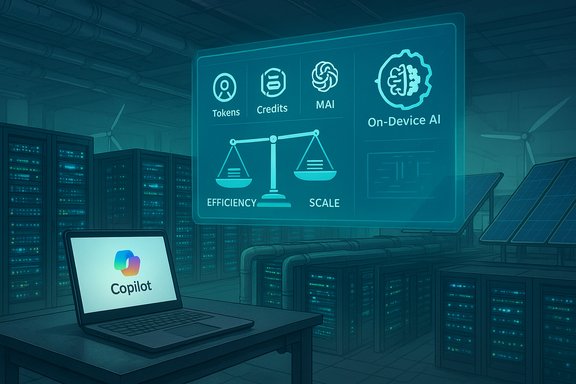
That course correction sits alongside a parallel product shift: Microsoft is shipping first‑party foundation models (the MAI family), pushing on-device and local-first AI (Copilot+ and DeepSeek concepts), and introducing consumption mechanics — monthly AI credits or tokens — that change how users pay for and interact with AI features. These policy, product, and infrastructure moves combine into a new operating model for Microsoft’s AI strategy: fewer blind bets on raw scale; more emphasis on orchestration across models, tighter integration with OS and apps, and direct monetization through usage tokens and credits.
Key facts firms should note:
Why this is significant:
The next chapters will be technical: whether MAI models and on-device runtimes truly reduce cost-per-inference at scale; whether Microsoft can operationalize seamless orchestration without latency or governance trade-offs; and whether the market rewards prudence over raw scale. For enterprises and Windows users, the priority is clear — demand measurable performance, insist on model cards and SLAs, and design for multi-layer AI deployment to capture the benefits while containing the risks.
Source: Thurrott.com "The Big Pause" - Microsoft's AI Strategy Deconstructed - From Energy to Tokens
 Background / Overview
Microsoft spent 2024–2025 acting like a hyperscaler in expansion mode: aggressive datacenter commitments, deep commercial ties to OpenAI, and a product push to embed AI everywhere from Microsoft 365 to Windows and GitHub. Those bets demanded vast new capacity — land purchases, power contracts, and multi-hundred‑megawatt leases — all intended to support training and inference for large generative models. Recent reporting and industry channel checks, however, show a notable course correction: Microsoft has canceled or allowed to lapse a meaningful swath of planned capacity and paused work on large projects while pivoting investments toward efficiency and product-centric model development.That course correction sits alongside a parallel product shift: Microsoft is shipping first‑party foundation models (the MAI family), pushing on-device and local-first AI (Copilot+ and DeepSeek concepts), and introducing consumption mechanics — monthly AI credits or tokens — that change how users pay for and interact with AI features. These policy, product, and infrastructure moves combine into a new operating model for Microsoft’s AI strategy: fewer blind bets on raw scale; more emphasis on orchestration across models, tighter integration with OS and apps, and direct monetization through usage tokens and credits.
The Big Pause: What Microsoft actually did
Lease cancellations and paused construction
Multiple reports indicate Microsoft canceled or allowed to lapse data center agreements covering “a couple of hundred megawatts” of capacity, and let over 1 gigawatt (GW) of letters of intent expire. The company also temporarily paused early work on a $3.3 billion Wisconsin project while it evaluates scope and technological shifts. These actions are not a company-wide retreat but a targeted slowdown that restores agility and reduces the financial risk of underutilized assets.Key facts firms should note:
- Scale: cancellations are in the range of hundreds of megawatts — material, but not existential to Azure’s already-large footprint.
- Pauses: at least one multi-billion dollar project was temporarily halted while the company reassessed design and demand assumptions.
- Reallocation: Microsoft appears to be concentrating some investments domestically while slowing international commitments.
Why now? Oversupply, efficiency gains, and power constraints
Three practical forces drove the pause:- Forecast mismatch: early demand models projected near-explosive growth in AI compute; more recent channel checks suggest those forecasts were optimistic, especially after model and infrastructure efficiency improved.
- Energy and site friction: securing sufficient power, permitting, and water/cooling capacity for hyperscale sites is increasingly complex; Microsoft’s public sustainability targets (including a push to eliminate water-based cooling by 2026) complicate site selection and timing.
- Product economics: Microsoft’s product teams are moving to model orchestration and edge/offline inference strategies that reduce dependence on continuous, massive cloud throughput. That reduces the immediate need for raw additional capacity.
Energy and data-center implications: “Green” constraints, waterless cooling, and hardware choices
From raw megawatts to kilowatt-efficiency
The pause reframes data center strategy from adding megawatts to increasing useful work per watt. Microsoft is reportedly pivoting to:- Hardware efficiency: investing in liquid cooling or other acceleration techniques to get more throughput from existing racks.
- Renewable integration: favoring regions where clean energy is available or can be contracted to lower Scope 2 emissions that matter to enterprise customers.
- Waterless cooling ambition: committing to eliminate water-based cooling by 2026 — a laudable sustainability goal that adds real engineering constraints to site selection. Implementing this at scale is non-trivial and likely a cause of slowed ground-up expansion.
Risk: the supply chain and regional energy markets
Scaling AI at hyperscale is more than racks and chips; it’s about grid capacity, local permitting, and long-term power contracts. Microsoft’s slowed expansion exposes a real trade-off: cooling and sustainability requirements push deployments to fewer, better-suited locations but may increase dependence on transmission upgrades and long-term renewable PPAs. That concentrates operational risk even as it reduces capital risk.From “compute is king” to “orchestration is king”: MAI, OpenAI, and the multi-model play
Microsoft diversifies from OpenAI dependence
Microsoft’s long, complex relationship with OpenAI remains strategic and financially significant, but Microsoft is actively building first-party models (MAI‑1‑preview and MAI‑Voice‑1) and packaging them for product use rather than benchmark supremacy. The goal is orchestration: route a request to the model (OpenAI, MAI, an open-weight model, or an on-device runtime) that best balances cost, latency, governance, and capability. Early public materials and community benchmarks show MAI models in the wild, but vendor-provided training-scale claims and throughput numbers should be treated as provisional pending independent benchmarks.What Microsoft claims and what we can independently confirm
- Product tack: MAI models are presented as product-first — optimized for latency and integration with Copilot features rather than chasing leaderboard metrics. That framing is consistent across Microsoft disclosures and third‑party coverage.
- Vendor claims: public claims such as training on ~15,000 H100 GPUs or single‑GPU audio throughput numbers for MAI‑Voice‑1 are plausible given Microsoft’s resources but are vendor assertions until reproduced by independent tests. Treat them as promising signals, not established facts.
Tokens, credits, and the new Copilot economics
The tokenization of AI usage
Microsoft has begun to shift Microsoft 365 and Copilot pricing toward consumption-based mechanics: seat subscriptions plus monthly AI credits or tokens that gate heavy usage. For consumers, Microsoft announced subscription adjustments tied to Copilot availability; for power users and enterprises, per‑call or per‑token economics are increasingly the norm. This is a deliberate move to align revenue with GPU-powered inference costs and to price features that consume disproportionate inference resources.Why this is significant:
- Alignment of costs and revenue: heavy generative workloads are expensive. Tokens let Microsoft charge heavy users more while keeping base subscriptions accessible.
- Predictable throttles and UX: tokens create natural throttles for product design (a user runs out of credits and either waits, purchases more, or uses a lower-cost path). This enables tiered experiences without a full paywall.
- Data and governance: usage tokens also produce telemetry that can be used to tune routing (on-device vs cloud, MAI vs OpenAI) and to manage workload placement for cost and compliance reasons.
Practical consumer impact
For individuals, the net effect is twofold: new AI features add clear value, and they often bring higher subscription prices or consume monthly credits. Microsoft has published options that let users opt into classic (non‑Copilot) plans or buy additional AI credits. For enterprises, token-based consumption gives finer cost control but increases the need for governance, tagging, and quota management to prevent runaway bills.On-device AI, DeepSeek, and privacy trade-offs
Local models: speed, privacy, and the promise of offline Copilot
Microsoft’s on-device ambitions — illustrated by Copilot+ PCs and local models such as the DeepSeek concept — are aimed at lowering latency, saving cloud compute costs, and addressing privacy concerns by keeping data on-device. Technical tricks such as aggressive quantization (reported 4‑bit QuaRot styles) and sliding-window decoding strategies aim to reduce memory and speed up token generation on client NPUs. These techniques make locally hosted models plausible on modern silicon.Privacy: helpful but imperfect guarantees
Running inference locally does reduce data exfiltration risk from cloud calls, but it introduces other concerns:- Local attack surface: on-device models are subject to OS-level vulnerabilities and could be targeted by malicious software to extract prompts or model state. Local equals private only if the OS and hardware attestation are robust.
- Provenance and model updates: ensuring models are patched, updated, and aligned with enterprise governance is more complex when models live on millions of endpoints. That increases management overhead for IT teams.
Business and competitive dynamics
Microsoft’s bet: orchestration over exclusivity
Microsoft’s new posture is to be an AI orchestrator: owning distribution (Windows, Office, GitHub), offering multiple model sources (OpenAI, MAI, third-party), and placing workloads where they make sense. This reduces the strategic risk of single-vendor dependence and gives Microsoft leverage in controlling cost-per-inference. It also allows the company to prioritize product fit — shipping efficient, tuned models for Copilot scenarios rather than chasing raw benchmark supremacy.Competitors are choosing different paths
Other major players remain committed to different trade-offs:- Amazon and Google are continuing to pursue raw compute and custom silicon strategies to retain a scale advantage. AWS’s Ultracluster and Google’s TPU investments reflect that emphasis.
- New entrants (xAI, custom supercomputing projects) are pursuing extreme hardware scaling that could undercut public cloud economics for certain workloads. Microsoft’s measured approach is therefore a deliberate differentiation, not capitulation.
Investor and operational implications
For investors, Microsoft’s pause reduces near-term capital intensity and mitigates downside risk from idle build-outs. Operationally, it increases emphasis on software and model engineering returns versus physical expansion. But the move also raises questions:- Will Microsoft’s internal models materially lower cost-per-call and sustain Copilot margins? Early claims are promising but require independent validation.
- Can Microsoft execute the orchestration layer — routing requests seamlessly across on-device, MAI, and external models — without adding latency or complexity for customers? The engineering work is significant.
Risks, unknowns, and claims that need verification
Vendor claims require independent benchmarking
Microsoft and its partners have made ambitious performance claims — single‑GPU voice throughput, multi‑thousand‑GPU training runs, and rapid on-device latencies. These numbers are plausible but remain vendor assertions until reproduced by independent benchmarks. Prudence demands that customers and procurement teams insist on measurable SLAs, model cards, and reproducible tests before making large buying decisions.Strategic risks Microsoft must manage
- Over‑correction risk: pausing too long could cede scale advantage to competitors who continue to invest in raw hardware. Microsoft signals flexibility, but timing matters.
- Governance complexity: multi-model orchestration introduces more surface area for provenance, hallucination, and data‑use governance failures. Enterprises will need clearer contracts and model-level guarantees.
- Product-friction risk: tokenization and credit mechanics change UX expectations. If not managed well, heavy-handed throttles could alienate users or fragment experiences across tiers.
Speculative long-range claims
High-level proclamations — such as AI reducing the cost of energy by orders of magnitude — are visionary but speculative. These types of macroeconomic transformations are technically imaginable in the long term but rest on breakthroughs (in energy production, storage, and conversion) that are not yet validated. Statements of this kind should be flagged as aspirational rather than imminent.What this means for Windows users, IT leaders, and developers
For Windows users and consumers
- Expect richer Copilot integrations and the option to run useful models locally on Copilot+ hardware. That delivers lower-latency experiences for everyday tasks and better privacy for sensitive workflows.
- Prepare for subscription shifts: Copilot features bring new tiers and monthly AI credits. Evaluate whether new AI features justify higher recurring costs or extra token purchases.
For IT leaders and procurement
- Build governance: tag and monitor AI usage to manage token consumption, cost, and data provenance. Contracts must include clear cost-per-call, model‑card disclosures, and rollback mechanisms.
- Plan for lifecycle management: on-device models require secure update pipelines and attestation. Factor device management into AI rollouts.
For developers and platform partners
- Design for orchestration: build apps that can degrade gracefully from high‑fidelity cloud models to efficient local models to balance cost and latency.
- Embrace multi-model testing: validate app behavior across MAI, OpenAI, and on-device models to avoid surprises in behavior, latency, or cost.
Conclusion: a tactical pause, not a strategic retreat
Microsoft’s “big pause” is best read as a pragmatic pivot: the company is shifting from scale-for-scale’s-sake to a layered strategy that prizes efficiency, product fit, and orchestration. That shift reduces near‑term capital exposure while amplifying the importance of software, model engineering, and smart monetization — tokens, credits, and consumption metrics that align customer charges with actual GPU-cost realities. The approach carries real promise: better energy economics, more private on-device experiences, and flexible routing across models that could lower long-term costs. But the model rests on execution: independent verification of vendor performance claims, robust governance across a proliferating model ecosystem, and careful UX design for tokenized access.The next chapters will be technical: whether MAI models and on-device runtimes truly reduce cost-per-inference at scale; whether Microsoft can operationalize seamless orchestration without latency or governance trade-offs; and whether the market rewards prudence over raw scale. For enterprises and Windows users, the priority is clear — demand measurable performance, insist on model cards and SLAs, and design for multi-layer AI deployment to capture the benefits while containing the risks.
Source: Thurrott.com "The Big Pause" - Microsoft's AI Strategy Deconstructed - From Energy to Tokens
