

Microsoft’s AI strategy is under fresh scrutiny after former Microsoft executive Mat Velloso argued in April 2026 that the company had “missed the AI wave,” citing weak Bing share gains, low Copilot usage, underused NPUs in Windows PCs, and heavy infrastructure spending. The accusation lands because Microsoft is not an AI bystander. It is one of the companies paying for the boom, packaging it into Windows and Office, and asking customers to believe that Copilot is the next interface for work. The uncomfortable question is whether Microsoft is leading the AI era — or merely renting the most expensive seat in the arena.
The easy rebuttal to Velloso is that Microsoft could hardly have “missed” AI while being OpenAI’s most important strategic partner, wiring generative models into Azure, GitHub, Windows, Edge, Bing, Teams, Outlook, and Microsoft 365. Few companies have moved faster to make AI unavoidable in their product lineup. Fewer still have spent more aggressively to secure the data centers, GPUs, model access, and enterprise distribution needed to make that ambition plausible.
But “missing a wave” in technology rarely means failing to notice it. Microsoft noticed the internet. Microsoft noticed mobile. In both cases, it had products, engineers, and strategies; what it lacked was the decisive product-market fit that defined the next computing platform. The company’s danger in AI is not absence. It is that AI may become another era where Microsoft supplies the plumbing while someone else owns the behavior.
That is why Velloso’s broadside is more than an ex-employee’s dunk. His résumé gives the criticism a particular sting: more than a decade at Microsoft, time advising Satya Nadella, leadership roles around AI developer products at Google DeepMind, and a later role at Meta’s AI organization. He is not an outside analyst squinting at quarterly disclosures. He is describing, from experience, how the major AI contenders operate.
Microsoft’s defense is equally obvious. It has paying Copilot customers, cloud demand, GitHub Copilot momentum, a vast enterprise channel, and an unmatched ability to turn software defaults into corporate standards. Yet that is exactly what makes this moment so revealing. If Microsoft cannot convert preinstalled AI, bundled AI, licensed AI, and enterprise-contracted AI into habitual usage, then the problem is not distribution. It is usefulness.
Then the window narrowed. Bing became more interesting, but it did not become the default verb of the internet. The broader search market did not visibly reorganize around Microsoft’s product, and the public quickly learned that a chatbot strapped to a search engine is not automatically a better search engine. It can be more verbose, more persuasive, and more theatrical without being more reliable.
Velloso’s complaint that Microsoft made Bing its biggest AI bet and failed to move share is therefore not just about search percentage points. It is about Microsoft’s instinct to route a platform shift through an old battlefield. The company saw AI as a way to reopen the search war, but users experienced AI as something broader, messier, and less tied to a blue links business model.
That matters for Windows users because Bing’s AI push also foreshadowed the Copilot pattern. Microsoft’s first move was not to let AI emerge where it was most naturally useful, but to place it where Microsoft most wanted leverage. In Edge, in Bing, in the Windows taskbar, in Office sidebars, the strategy often felt like distribution chasing destiny.
This is where Microsoft’s internet history becomes relevant, but not in the cartoonish “Microsoft missed everything” sense. The company did not miss the internet as a technical phenomenon; it missed the way the web would shift power away from Windows APIs and toward services, browsers, and eventually ad-funded platforms. The risk now is similar. Microsoft may understand large language models perfectly well while misreading where control over the AI user experience will settle.
But enterprise seat counts are not the same thing as product dependence. The central question is whether workers open Copilot because it is indispensable, or whether organizations buy licenses because Microsoft account teams, E5 renewals, AI urgency, and executive pressure make a trial politically easy. In corporate software, procurement often arrives long before affection.
Velloso’s claim that fewer than 3 percent of paying users actually use Copilot should be treated carefully because Microsoft does not disclose the usage denominator in the way critics would like. Still, the direction of the criticism matches a growing anxiety among IT leaders: Copilot is easy to deploy, expensive to justify, and uneven in daily value. It can summarize meetings, draft documents, search across work data, and help with Excel or Outlook, but those features do not automatically become muscle memory.
Microsoft’s problem is that Copilot is both too broad and too vague. It is a brand, an assistant, a sidebar, a chat window, a coding tool, a Windows feature, a security product, and an enterprise upsell. The name promises a universal helper, but users encounter a scattered family of experiences with different capabilities, permissions, and costs.
That fragmentation undercuts the magic. ChatGPT became a habit because it was simple: type into the box and get something useful. GitHub Copilot became a habit because it met developers at the exact point of work and reduced friction in a visible way. Microsoft 365 Copilot has to understand corporate permissions, document context, Teams meetings, tenant configuration, compliance boundaries, and user expectations that vary by department. That is a much harder product problem than putting a sparkle icon in the ribbon.
The trouble is that the pitch ran ahead of the use cases. Recall became the headline feature and then the cautionary tale, delayed and reworked after privacy and security concerns overwhelmed the original launch. Other local AI features, including image tools, live captions, and studio effects, are useful in pockets but have not yet made the NPU feel like a must-have component for most buyers.
That leaves OEMs in an awkward position. They invested in hardware differentiation around NPUs, but the software story remains thin. A better webcam blur does not sell a new PC refresh cycle on its own. Nor does an operating system assistant that often behaves more like a web-connected chatbot than a native Windows intelligence layer.
Microsoft seems to have recognized at least part of the backlash. Its Windows messaging in 2026 has shifted toward improving user sentiment, reducing unwanted Copilot surfaces, and making the operating system feel less cluttered. That is a tacit admission that ubiquity can backfire. When users perceive AI as an intrusion rather than a capability, every new entry point becomes another reminder that the product is serving the vendor’s strategy before the user’s task.
Windows has a unique opportunity in AI precisely because it sits beneath the work. It knows files, windows, devices, input methods, installed applications, and local context in a way no browser tab can. But that opportunity also raises the bar. The AI that belongs in Windows should feel like the OS getting smarter, not like a cloud service stapled to the Start menu.
That is why any reported reliability or service-level concern around GitHub lands differently from generic Copilot criticism. GitHub should be Microsoft’s clearest AI success story, not a platform dragged into the same skepticism as Bing or Windows Copilot. If developer trust slips, Microsoft risks damaging the one Copilot brand that has already earned daily usage through utility rather than bundling.
The broader lesson is that AI adoption is strongest when the product has a narrow job and a clear feedback loop. A developer accepts or rejects a code suggestion. A security analyst triages an alert. A support agent drafts a response. A finance worker reconciles data. These are grounded workflows where AI can be measured against time saved, errors reduced, or output improved.
By contrast, “your AI companion for everything” is a marketing line in search of a retention curve. Microsoft has too often treated Copilot as a universal layer instead of a set of sharp tools. That may help the company tell a platform story to investors, but it does not help a user decide what to do at 9:17 on a Tuesday morning.
But the partnership is not the same thing as ownership of the wave. If OpenAI becomes the primary consumer and developer interface for AI, Microsoft risks being the infrastructure partner behind someone else’s platform. Azure revenue would still be valuable, but the strategic prize would move elsewhere.
This is the tension behind Microsoft’s recent organizational shifts. Mustafa Suleyman’s Microsoft AI group has been tasked with building more of the company’s own model and consumer AI capability, while Copilot product leadership has been adjusted to sharpen execution. The message is clear enough: Microsoft cannot rely forever on privileged access to another company’s frontier models while also hoping to define the user experience.
That does not mean the partnership has failed. It means the partnership solved Microsoft’s speed problem before it solved Microsoft’s identity problem. Is Microsoft an AI lab, an AI infrastructure company, an enterprise AI packager, a productivity software vendor with AI features, or the owner of a new agentic platform? The answer can be “all of the above” for a while, but not indefinitely.
The risk for Redmond is that the AI market splits in ways that make its bundle less powerful. Developers may live in model-native tools. Consumers may choose independent assistants. Enterprises may buy vertical agents from startups. Cloud buyers may optimize across multiple model providers. In that world, Microsoft’s distribution still matters, but it no longer guarantees control.
That creates a subtle but important trust issue. Users and administrators can sense when a feature exists because it solves a problem, and when it exists because the company needs to justify a strategic bet. Copilot’s most awkward moments come when it feels less like a breakthrough than a utilization strategy for expensive compute.
To be fair, the infrastructure race is not irrational on its face. AI demand is real, model training and inference are compute-hungry, and cloud capacity has become a strategic asset. If AI agents, multimodal models, and enterprise automation mature as promised, the companies with data center capacity will have enormous leverage.
But there is a difference between capacity and adoption. Microsoft can build the roads, lease the land, wire the substations, buy the accelerators, and still discover that customers are taking shorter trips than expected. The economics of AI improve only if usage becomes frequent, valuable, and priced in a way that covers the cost of serving it.
That is why Copilot’s usage question matters so much. A lightly used AI license is not just a product disappointment; it is a warning signal about the return on the infrastructure behind it. The more Microsoft spends, the less patience investors and customers will have for vague claims about transformation.
That gives Microsoft a durable advantage. CIOs may experiment with independent AI tools, but they still have to manage data leakage, access control, legal discovery, and vendor risk. Microsoft can sell AI into organizations where it already owns the directory, the productivity suite, the endpoint management layer, and the security stack. No startup has that footprint.
Yet governance cannot compensate forever for mediocre experience. If workers do not use a tool, IT departments eventually stop expanding it. If employees use outside tools instead, Microsoft’s compliance advantage becomes a defensive talking point rather than a growth engine. The enterprise buyer can mandate availability, but not enthusiasm.
This is where Microsoft’s old strengths become double-edged. Bundling can win procurement. Defaults can create exposure. Admin portals can reduce friction. But the AI era rewards products that learn from usage, improve quickly, and delight individuals before committees finish standardizing them. Microsoft has to move at consumer-software speed inside enterprise-software constraints.
That is hard, but not impossible. Teams became a workplace default because Microsoft combined bundling with a real behavioral shift. Azure grew because Microsoft learned cloud infrastructure was not just Windows Server in someone else’s building. The company can adapt. The question is whether Copilot is adapting fast enough.
Saying Microsoft missed mobile is more accurate, but still incomplete. Windows Mobile and Windows Phone had ideas, loyal users, and moments of genuine design leadership. What Microsoft lacked was the ecosystem gravity to compete with iOS and Android once developers, carriers, consumers, and hardware partners aligned elsewhere.
AI may rhyme with both stories. Like the internet, it threatens to reduce the importance of the operating system as users move to service-based interfaces. Like mobile, it may consolidate around ecosystems where developers and users congregate before Microsoft’s platform machinery fully catches up.
The crucial difference is that Microsoft is entering this wave from a stronger position than it had in mobile. Azure is central to the AI buildout. Microsoft 365 remains entrenched. GitHub gives the company developer relevance. Windows still matters in business and gaming. Security, identity, and management give Redmond leverage that most AI-native companies would envy.
That is why “missed” may be the wrong verb. Microsoft has not missed AI in the sense of failing to participate. It may be at risk of misplacing AI — pushing it into legacy surfaces, measuring it by licenses rather than habits, and assuming that enterprise distribution will substitute for product clarity.
Microsoft understands this, which is why Copilot is everywhere. But being everywhere is not the same as being the place where users begin. The browser, the search box, the phone home screen, the IDE, and the chat app have all been starting points in different eras. AI’s starting point is still unsettled.
For Microsoft, Windows should be a natural candidate. The PC remains the place where serious work happens, especially in organizations. A truly native Windows agent could manage files, configure settings, automate repetitive desktop tasks, explain system problems, coordinate across applications, and operate within clear user-controlled permissions.
But Microsoft has to earn that level of trust. Recall showed how quickly the promise of contextual intelligence can collide with privacy fears. Admins do not want a black box watching endpoints without predictable controls. Users do not want a permanent sense that the OS is narrating their lives back to a cloud service.
The winning AI interface will not merely be powerful. It will be legible. Users will need to know what it can see, what it can do, where data goes, and how to stop it. Microsoft’s enterprise DNA should help here, but only if the company treats trust as product architecture rather than damage control.
The weakness is execution across surfaces. Bing AI did not reset search. Windows Copilot has not yet become the operating system’s missing brain. Microsoft 365 Copilot is growing in paid seats but still fighting for daily indispensability. Copilot branding has spread faster than user understanding.
That creates a perception problem that feeds on itself. If every Microsoft product gets an AI layer, users start to assume AI is a corporate mandate rather than a considered feature. If pricing is high and usage is uneven, administrators become skeptical. If hardware requirements are marketed before killer apps arrive, OEMs and buyers feel like they are funding a roadmap instead of receiving a benefit.
The cure is not less AI. It is more specific AI. Microsoft needs fewer generic Copilot moments and more workflows where the before-and-after is undeniable. It needs Windows AI features that justify local silicon. It needs Office AI that makes a finance analyst, lawyer, salesperson, teacher, or project manager unwilling to go back. It needs admin tools that show usage and ROI without forcing customers to become amateur data scientists.
In other words, Microsoft must stop proving that it can put AI in everything and start proving that AI makes particular things meaningfully better.
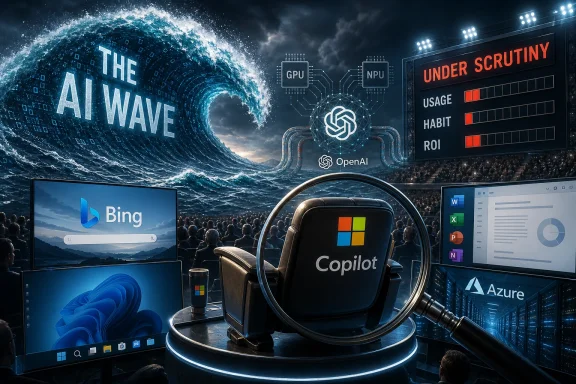 Microsoft Bought the Front Row, but It Still Has to Win the Show
The easy rebuttal to Velloso is that Microsoft could hardly have “missed” AI while being OpenAI’s most important strategic partner, wiring generative models into Azure, GitHub, Windows, Edge, Bing, Teams, Outlook, and Microsoft 365. Few companies have moved faster to make AI unavoidable in their product lineup. Fewer still have spent more aggressively to secure the data centers, GPUs, model access, and enterprise distribution needed to make that ambition plausible.But “missing a wave” in technology rarely means failing to notice it. Microsoft noticed the internet. Microsoft noticed mobile. In both cases, it had products, engineers, and strategies; what it lacked was the decisive product-market fit that defined the next computing platform. The company’s danger in AI is not absence. It is that AI may become another era where Microsoft supplies the plumbing while someone else owns the behavior.
That is why Velloso’s broadside is more than an ex-employee’s dunk. His résumé gives the criticism a particular sting: more than a decade at Microsoft, time advising Satya Nadella, leadership roles around AI developer products at Google DeepMind, and a later role at Meta’s AI organization. He is not an outside analyst squinting at quarterly disclosures. He is describing, from experience, how the major AI contenders operate.
Microsoft’s defense is equally obvious. It has paying Copilot customers, cloud demand, GitHub Copilot momentum, a vast enterprise channel, and an unmatched ability to turn software defaults into corporate standards. Yet that is exactly what makes this moment so revealing. If Microsoft cannot convert preinstalled AI, bundled AI, licensed AI, and enterprise-contracted AI into habitual usage, then the problem is not distribution. It is usefulness.
Bing Was the First Warning Shot
The most damaging part of Microsoft’s AI push may still be Bing. In early 2023, Microsoft had a rare opening: Google looked vulnerable, search felt stale, and conversational AI seemed like the first credible chance in years to change how people found information online. Microsoft moved quickly, wrapped OpenAI technology into Bing, and made search feel briefly contested again.Then the window narrowed. Bing became more interesting, but it did not become the default verb of the internet. The broader search market did not visibly reorganize around Microsoft’s product, and the public quickly learned that a chatbot strapped to a search engine is not automatically a better search engine. It can be more verbose, more persuasive, and more theatrical without being more reliable.
Velloso’s complaint that Microsoft made Bing its biggest AI bet and failed to move share is therefore not just about search percentage points. It is about Microsoft’s instinct to route a platform shift through an old battlefield. The company saw AI as a way to reopen the search war, but users experienced AI as something broader, messier, and less tied to a blue links business model.
That matters for Windows users because Bing’s AI push also foreshadowed the Copilot pattern. Microsoft’s first move was not to let AI emerge where it was most naturally useful, but to place it where Microsoft most wanted leverage. In Edge, in Bing, in the Windows taskbar, in Office sidebars, the strategy often felt like distribution chasing destiny.
This is where Microsoft’s internet history becomes relevant, but not in the cartoonish “Microsoft missed everything” sense. The company did not miss the internet as a technical phenomenon; it missed the way the web would shift power away from Windows APIs and toward services, browsers, and eventually ad-funded platforms. The risk now is similar. Microsoft may understand large language models perfectly well while misreading where control over the AI user experience will settle.
Copilot Has a Seat Count Problem and a Habit Problem
Microsoft’s strongest counterargument is that Copilot is already a business. Satya Nadella told investors during Microsoft’s fiscal third-quarter 2026 earnings cycle that Microsoft had more than 20 million enterprise customers paying for Microsoft Copilot, up from 15 million in January. That is not nothing. Most software vendors would kill for that ramp.But enterprise seat counts are not the same thing as product dependence. The central question is whether workers open Copilot because it is indispensable, or whether organizations buy licenses because Microsoft account teams, E5 renewals, AI urgency, and executive pressure make a trial politically easy. In corporate software, procurement often arrives long before affection.
Velloso’s claim that fewer than 3 percent of paying users actually use Copilot should be treated carefully because Microsoft does not disclose the usage denominator in the way critics would like. Still, the direction of the criticism matches a growing anxiety among IT leaders: Copilot is easy to deploy, expensive to justify, and uneven in daily value. It can summarize meetings, draft documents, search across work data, and help with Excel or Outlook, but those features do not automatically become muscle memory.
Microsoft’s problem is that Copilot is both too broad and too vague. It is a brand, an assistant, a sidebar, a chat window, a coding tool, a Windows feature, a security product, and an enterprise upsell. The name promises a universal helper, but users encounter a scattered family of experiences with different capabilities, permissions, and costs.
That fragmentation undercuts the magic. ChatGPT became a habit because it was simple: type into the box and get something useful. GitHub Copilot became a habit because it met developers at the exact point of work and reduced friction in a visible way. Microsoft 365 Copilot has to understand corporate permissions, document context, Teams meetings, tenant configuration, compliance boundaries, and user expectations that vary by department. That is a much harder product problem than putting a sparkle icon in the ribbon.
Windows Became an AI Billboard Before It Became an AI Platform
For Windows enthusiasts, the most pointed criticism is not about Bing or Office. It is about the operating system itself. Microsoft and its PC partners spent the past two years selling the idea of the AI PC, with neural processing units positioned as the next essential hardware block after the CPU and GPU. Copilot+ PCs promised local AI features, better efficiency, and a new class of Windows experiences.The trouble is that the pitch ran ahead of the use cases. Recall became the headline feature and then the cautionary tale, delayed and reworked after privacy and security concerns overwhelmed the original launch. Other local AI features, including image tools, live captions, and studio effects, are useful in pockets but have not yet made the NPU feel like a must-have component for most buyers.
That leaves OEMs in an awkward position. They invested in hardware differentiation around NPUs, but the software story remains thin. A better webcam blur does not sell a new PC refresh cycle on its own. Nor does an operating system assistant that often behaves more like a web-connected chatbot than a native Windows intelligence layer.
Microsoft seems to have recognized at least part of the backlash. Its Windows messaging in 2026 has shifted toward improving user sentiment, reducing unwanted Copilot surfaces, and making the operating system feel less cluttered. That is a tacit admission that ubiquity can backfire. When users perceive AI as an intrusion rather than a capability, every new entry point becomes another reminder that the product is serving the vendor’s strategy before the user’s task.
Windows has a unique opportunity in AI precisely because it sits beneath the work. It knows files, windows, devices, input methods, installed applications, and local context in a way no browser tab can. But that opportunity also raises the bar. The AI that belongs in Windows should feel like the OS getting smarter, not like a cloud service stapled to the Start menu.
GitHub Shows the Difference Between AI That Fits and AI That Floats
The exception that proves the rule is GitHub Copilot. Developers were among the first mainstream professional users to adopt generative AI because the workflow was obvious. Code completion, boilerplate generation, test scaffolding, refactoring, and documentation assistance all fit naturally inside the development loop. The value was immediate enough that users tolerated errors, learned the tool’s limits, and kept coming back.That is why any reported reliability or service-level concern around GitHub lands differently from generic Copilot criticism. GitHub should be Microsoft’s clearest AI success story, not a platform dragged into the same skepticism as Bing or Windows Copilot. If developer trust slips, Microsoft risks damaging the one Copilot brand that has already earned daily usage through utility rather than bundling.
The broader lesson is that AI adoption is strongest when the product has a narrow job and a clear feedback loop. A developer accepts or rejects a code suggestion. A security analyst triages an alert. A support agent drafts a response. A finance worker reconciles data. These are grounded workflows where AI can be measured against time saved, errors reduced, or output improved.
By contrast, “your AI companion for everything” is a marketing line in search of a retention curve. Microsoft has too often treated Copilot as a universal layer instead of a set of sharp tools. That may help the company tell a platform story to investors, but it does not help a user decide what to do at 9:17 on a Tuesday morning.
The OpenAI Partnership Is a Moat and a Dependency
Microsoft’s OpenAI deal remains one of the most consequential technology partnerships of the decade. It gave Microsoft early access to frontier models, credibility in the generative AI race, and a powerful Azure demand engine. It also allowed Microsoft to move faster than rivals whose internal AI products were either not ready or not yet packaged for mass deployment.But the partnership is not the same thing as ownership of the wave. If OpenAI becomes the primary consumer and developer interface for AI, Microsoft risks being the infrastructure partner behind someone else’s platform. Azure revenue would still be valuable, but the strategic prize would move elsewhere.
This is the tension behind Microsoft’s recent organizational shifts. Mustafa Suleyman’s Microsoft AI group has been tasked with building more of the company’s own model and consumer AI capability, while Copilot product leadership has been adjusted to sharpen execution. The message is clear enough: Microsoft cannot rely forever on privileged access to another company’s frontier models while also hoping to define the user experience.
That does not mean the partnership has failed. It means the partnership solved Microsoft’s speed problem before it solved Microsoft’s identity problem. Is Microsoft an AI lab, an AI infrastructure company, an enterprise AI packager, a productivity software vendor with AI features, or the owner of a new agentic platform? The answer can be “all of the above” for a while, but not indefinitely.
The risk for Redmond is that the AI market splits in ways that make its bundle less powerful. Developers may live in model-native tools. Consumers may choose independent assistants. Enterprises may buy vertical agents from startups. Cloud buyers may optimize across multiple model providers. In that world, Microsoft’s distribution still matters, but it no longer guarantees control.
The Capital Spending Story Is Becoming the Product Story
Microsoft’s AI push is also a financial story now, and not just because investors enjoy panicking about capex. The company is spending at a scale that changes the way every product decision is interpreted. When Microsoft tells customers that AI is the future, it is also trying to fill a massive infrastructure pipeline that has to generate returns.That creates a subtle but important trust issue. Users and administrators can sense when a feature exists because it solves a problem, and when it exists because the company needs to justify a strategic bet. Copilot’s most awkward moments come when it feels less like a breakthrough than a utilization strategy for expensive compute.
To be fair, the infrastructure race is not irrational on its face. AI demand is real, model training and inference are compute-hungry, and cloud capacity has become a strategic asset. If AI agents, multimodal models, and enterprise automation mature as promised, the companies with data center capacity will have enormous leverage.
But there is a difference between capacity and adoption. Microsoft can build the roads, lease the land, wire the substations, buy the accelerators, and still discover that customers are taking shorter trips than expected. The economics of AI improve only if usage becomes frequent, valuable, and priced in a way that covers the cost of serving it.
That is why Copilot’s usage question matters so much. A lightly used AI license is not just a product disappointment; it is a warning signal about the return on the infrastructure behind it. The more Microsoft spends, the less patience investors and customers will have for vague claims about transformation.
Enterprise IT Is Not Buying Magic; It Is Buying Governance
The irony is that Microsoft’s best AI argument may not be that Copilot is dazzling. It may be that Copilot is governable. In the enterprise, boring matters. Identity, compliance, data residency, audit logs, retention policies, security boundaries, and admin controls are not side dishes. They are the meal.That gives Microsoft a durable advantage. CIOs may experiment with independent AI tools, but they still have to manage data leakage, access control, legal discovery, and vendor risk. Microsoft can sell AI into organizations where it already owns the directory, the productivity suite, the endpoint management layer, and the security stack. No startup has that footprint.
Yet governance cannot compensate forever for mediocre experience. If workers do not use a tool, IT departments eventually stop expanding it. If employees use outside tools instead, Microsoft’s compliance advantage becomes a defensive talking point rather than a growth engine. The enterprise buyer can mandate availability, but not enthusiasm.
This is where Microsoft’s old strengths become double-edged. Bundling can win procurement. Defaults can create exposure. Admin portals can reduce friction. But the AI era rewards products that learn from usage, improve quickly, and delight individuals before committees finish standardizing them. Microsoft has to move at consumer-software speed inside enterprise-software constraints.
That is hard, but not impossible. Teams became a workplace default because Microsoft combined bundling with a real behavioral shift. Azure grew because Microsoft learned cloud infrastructure was not just Windows Server in someone else’s building. The company can adapt. The question is whether Copilot is adapting fast enough.
The Internet and Mobile Comparisons Are Crude, but Not Useless
Saying Microsoft missed the internet is too simple. Internet Explorer won browser share for years, Windows servers powered plenty of web infrastructure, and Microsoft eventually built a major cloud business. But the company failed to define the web’s economic and cultural center. Google did.Saying Microsoft missed mobile is more accurate, but still incomplete. Windows Mobile and Windows Phone had ideas, loyal users, and moments of genuine design leadership. What Microsoft lacked was the ecosystem gravity to compete with iOS and Android once developers, carriers, consumers, and hardware partners aligned elsewhere.
AI may rhyme with both stories. Like the internet, it threatens to reduce the importance of the operating system as users move to service-based interfaces. Like mobile, it may consolidate around ecosystems where developers and users congregate before Microsoft’s platform machinery fully catches up.
The crucial difference is that Microsoft is entering this wave from a stronger position than it had in mobile. Azure is central to the AI buildout. Microsoft 365 remains entrenched. GitHub gives the company developer relevance. Windows still matters in business and gaming. Security, identity, and management give Redmond leverage that most AI-native companies would envy.
That is why “missed” may be the wrong verb. Microsoft has not missed AI in the sense of failing to participate. It may be at risk of misplacing AI — pushing it into legacy surfaces, measuring it by licenses rather than habits, and assuming that enterprise distribution will substitute for product clarity.
The Real Contest Is the Interface After the App
The most important AI question is not which company has the cleverest chatbot this quarter. It is whether AI becomes a new interface layer that sits above apps, files, websites, and workflows. If that happens, the owner of the interface gains enormous power. It can route user intent, select services, summarize information, execute actions, and mediate commerce.Microsoft understands this, which is why Copilot is everywhere. But being everywhere is not the same as being the place where users begin. The browser, the search box, the phone home screen, the IDE, and the chat app have all been starting points in different eras. AI’s starting point is still unsettled.
For Microsoft, Windows should be a natural candidate. The PC remains the place where serious work happens, especially in organizations. A truly native Windows agent could manage files, configure settings, automate repetitive desktop tasks, explain system problems, coordinate across applications, and operate within clear user-controlled permissions.
But Microsoft has to earn that level of trust. Recall showed how quickly the promise of contextual intelligence can collide with privacy fears. Admins do not want a black box watching endpoints without predictable controls. Users do not want a permanent sense that the OS is narrating their lives back to a cloud service.
The winning AI interface will not merely be powerful. It will be legible. Users will need to know what it can see, what it can do, where data goes, and how to stop it. Microsoft’s enterprise DNA should help here, but only if the company treats trust as product architecture rather than damage control.
Microsoft’s AI Problem Is Execution, Not Imagination
There is no shortage of imagination in Microsoft’s AI story. The company sees agents reshaping work, AI PCs making local compute relevant again, developer tools becoming collaborative, and cloud infrastructure becoming the factory floor of the next economy. This is not a timid strategy.The weakness is execution across surfaces. Bing AI did not reset search. Windows Copilot has not yet become the operating system’s missing brain. Microsoft 365 Copilot is growing in paid seats but still fighting for daily indispensability. Copilot branding has spread faster than user understanding.
That creates a perception problem that feeds on itself. If every Microsoft product gets an AI layer, users start to assume AI is a corporate mandate rather than a considered feature. If pricing is high and usage is uneven, administrators become skeptical. If hardware requirements are marketed before killer apps arrive, OEMs and buyers feel like they are funding a roadmap instead of receiving a benefit.
The cure is not less AI. It is more specific AI. Microsoft needs fewer generic Copilot moments and more workflows where the before-and-after is undeniable. It needs Windows AI features that justify local silicon. It needs Office AI that makes a finance analyst, lawyer, salesperson, teacher, or project manager unwilling to go back. It needs admin tools that show usage and ROI without forcing customers to become amateur data scientists.
In other words, Microsoft must stop proving that it can put AI in everything and start proving that AI makes particular things meaningfully better.
Redmond’s AI Report Card Is Being Written in Daily Active Use
The fairest reading of the moment is that Microsoft is neither doomed nor triumphant. It is in the dangerous middle: heavily invested, deeply positioned, visibly ambitious, but still searching for the kind of user behavior that turns a technology wave into a Microsoft-controlled platform. The next year will be judged less by demos than by retention curves, renewal expansions, and whether Copilot becomes boringly necessary.- Microsoft has not missed AI as an investment category, but it may still miss AI as a user-interface shift if Copilot does not become a daily habit.
- Bing’s AI relaunch showed that model access and aggressive distribution do not automatically change entrenched consumer behavior.
- Microsoft 365 Copilot’s paid-seat growth is meaningful, but administrators will increasingly demand evidence of usage, productivity gains, and defensible ROI.
- Copilot+ PCs need native Windows use cases that make NPUs feel essential rather than merely compliant with a marketing checklist.
- GitHub Copilot remains Microsoft’s clearest proof that AI works best when it is embedded in a precise workflow with immediate feedback.
- Microsoft’s OpenAI partnership gives it enormous leverage, but it also exposes the company to the risk of becoming infrastructure for someone else’s interface.
References
- Primary source: Windows Central
Published: Tue, 19 May 2026 11:07:03 GMT
Ex-Microsoft exec says the company blew it with AI, as it did with mobile — "Not even 3% of paying Copilot users use it even when it's pre-deployed right in their faces." | Windows Central
Microsoft might have missed the AI wave, with Copilot adoption stuck at just 3%.www.windowscentral.com - Related coverage: computerworld.com
Microsoft now has more than 20M paying Copilot users – Computerworld
According to CEO Satya Nadella, the AI assistant is used just as much as Outlook. www.computerworld.com
- Official source: microsoft.com
Microsoft Fiscal Year 2026 Third Quarter Earnings Conference Call
www.microsoft.com
- Related coverage: windowsreport.com
Ex-Microsoft Executive Says Copilot Adoption Is Far Lower Than Expected
Former Microsoft executive Mat Velloso says Microsoft “missed the AI wave” despite Copilot, Bing AI, and AI PC investments. windowsreport.com
- Related coverage: fool.com
The Real Reason Microsoft Just Went All-In on AI Infrastructure. It's Not What You Might Think. | The Motley Fool
Microsoft is transforming from a software giant into an AI infrastructure powerhouse.www.fool.com - Related coverage: techradar.com
Microsoft spent billions on Copilot, but only 3.3% of users are actually paying for the AI tools | TechRadar
Microsoft spent $37.5 billion on AI tools, with limited returns so farwww.techradar.com
- Related coverage: tomshardware.com
Mark Zuckerberg says Meta is cutting 8,000 jobs to pay for AI infrastructure — insatiable compute demand means the company can't rule out further headcount reductions | Tom's Hardware
Compute costs are crowding out headcount at the company that just raised its 2026 capex forecast to $145 billion.www.tomshardware.com - Related coverage: datacenterdynamics.com
Microsoft spent $11.1bn on data center leases alone in Q1 2026 - DCD
Total capex for the quarter reached $34.9bn, above predicted $30bnwww.datacenterdynamics.com - Related coverage: ai.cc
Big Tech AI Infrastructure Spending Proves Effective Despite Rising Costs in 2026 - AICC - AI.cc
Discover how Big Tech's AI infrastructure investments in 2026 are proving effective, overcoming rising costs while enhancing operational efficiency www.ai.cc
- Related coverage: techcrunch.com
The billion-dollar infrastructure deals powering the AI boom | TechCrunch
Here's everything we know about the biggest AI infrastructure projects, including major spending from Meta, Oracle, Microsoft, Google, and OpenAI.techcrunch.com - Related coverage: techfastforward.com
Amazon, Google, Meta, Microsoft Bet $725B on AI in 2026 | TechFastForward
Amazon, Google, Meta, and Microsoft will spend a combined $725 billion on AI infrastructure in 2026, up 77% from 2025, straining the global power grid.www.techfastforward.com
