

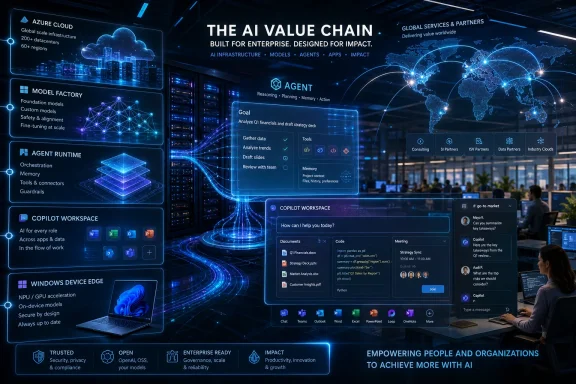
Microsoft used Build 2026 in San Francisco and partner events around its FY27 planning cycle to sharpen an AI strategy that now spans Azure data centers, Microsoft-built models, agent platforms, Copilot distribution, Windows devices, and a global services ecosystem. The message to investors is not subtle: Microsoft wants to own more of the AI value chain before somebody else turns its software empire into mere plumbing. That ambition is expensive, risky, and increasingly unavoidable. The company is no longer just selling AI features; it is trying to define the operating system of enterprise intelligence.
The easiest way to misunderstand Microsoft’s AI push is to treat it as a spending story. Capital expenditure is the visible part because data centers, GPUs, power contracts, and networking gear are tangible enough for investors to model and worry about. But Microsoft’s real wager is about control: control of compute supply, control of the developer surface, control of business data, and control of the interface through which workers ask software to do things.
That is why the company’s recent events matter. Build 2026 was not simply another developer conference with a Copilot button attached to every product demo. It presented a theory of computing in which agents become the layer above applications, and Microsoft becomes the place where those agents are built, governed, hosted, discovered, and billed.
The financial context is what gives that theory force. Microsoft entered the period with enormous cash resources and continued free-cash-flow generation, even as AI infrastructure spending began to weigh on investor sentiment. The company can afford a long campaign, but the market is asking a narrower question: how long must shareholders fund the buildout before AI behaves like a software-margin business rather than a construction project?
That question is fair. It is also incomplete. If agentic AI becomes a durable enterprise computing model, the companies that hesitate on infrastructure may find themselves renting the future from those that did not.
This is not merely a user-interface story. It changes where value accrues. If the agent becomes the primary interface, the operating system, browser, office suite, CRM, code editor, and cloud platform all become ingredients in a larger orchestration layer. Microsoft’s advantage is that it already owns or influences many of those layers.
The company’s Build announcements leaned into that stack logic. Microsoft Foundry, Agent 365, GitHub, Azure, Microsoft 365, Teams, Windows, and Copilot are being arranged as parts of one agent factory. The goal is to let developers build agents with enterprise context, deploy them into familiar work surfaces, and manage them with the security and compliance controls that corporate buyers demand.
This is why Microsoft keeps using frontier language. The company is trying to persuade the market that AI will not be a feature category bolted onto Office and Azure. It will be an ecosystem shift, and Microsoft wants to be the ecosystem’s default institution.
Microsoft has learned the hard way that cloud demand is not theoretical. Azure capacity has been a limiting factor at various points during the AI boom, and customers will not wait politely if model inference, training clusters, or Copilot services lag behind demand. In enterprise technology, reliability is part of the product. If Microsoft cannot provide the compute, some portion of the AI value chain moves elsewhere.
That is the logic behind building aggressively now. Microsoft is trying to shorten the distance between AI demand and monetizable AI supply. Every Copilot seat, every agent runtime, every developer workflow, and every enterprise AI deployment ultimately needs compute. If the company underbuilds, it risks ceding growth to rivals. If it overbuilds, it faces depreciation, margin pressure, and investor backlash.
The tension is not going away. AI infrastructure has the economics of both cloud computing and industrial expansion. Microsoft is building digital services, but it is doing so with warehouses full of advanced chips and power-hungry equipment. That makes the business less elegant than the old software model, even if the eventual revenue opportunity is larger.
This is not a betrayal of partnership. It is normal platform behavior. A platform company wants optionality at the model layer, especially when model costs, latency, data governance, and workload specificity matter to enterprise customers. The most expensive model is not always the best model for a given task. Sometimes a smaller, cheaper, better-governed model is exactly what a business process needs.
Microsoft’s pitch is increasingly multi-model. Developers and enterprises should be able to build with frontier reasoning models, task-specific models, local models, and partner models while staying inside Microsoft’s control plane. That is important because the model itself may become less differentiated over time than the system around it: identity, permissions, data grounding, observability, compliance, billing, and distribution.
For investors, this matters because it could reduce the risk that Microsoft becomes a reseller of someone else’s intelligence. The company wants Azure to host the compute, Foundry to manage the model lifecycle, GitHub to shape development, Microsoft 365 to provide business context, and Copilot to become the workplace interface. In that structure, the model is vital, but it is not the whole business.
That is a subtle but important change. A chatbot answers questions. An agentic workplace layer initiates tasks, coordinates systems, retrieves context, and takes action subject to policy. If Microsoft can make Copilot the default place where office workers interact with agents, it gets a powerful position in the next enterprise software cycle.
The challenge is that many customers are still moving from experimentation to proof. AI demos can be dazzling, but CIOs care about measurable productivity, security boundaries, data leakage, hallucination risk, and workflow redesign. Microsoft’s opportunity is enormous because it already sits inside the tenant, the identity system, the document store, and the collaboration graph. Its risk is equally obvious: if Copilot feels expensive, inconsistent, or intrusive, customers will slow-roll deployment.
That is why the company is emphasizing context and governance. Enterprise agents are only useful if they understand the work without violating the rules of the work. Microsoft has an advantage here because Entra, Purview, Defender, SharePoint, Teams, and Microsoft Graph are already embedded in corporate life. The company is trying to convert that administrative sprawl into an AI moat.
Build 2026 positioned Windows 11 less as a passive endpoint and more as a development and execution environment for AI. Local agents, sandboxing, terminal improvements, Windows Subsystem for Linux enhancements, and device-level AI capabilities all fit the same pattern. Microsoft wants developers to build AI systems on Windows, test them locally, connect them to cloud-scale models, and deploy them into enterprise workflows.
That matters for Windows enthusiasts because the operating system may become more opinionated about AI whether users asked for it or not. Microsoft has already learned that Copilot branding can provoke backlash when it feels forced into the shell. The company’s better argument is not that every user needs a floating assistant. It is that Windows must be a credible workstation for the agentic software era.
The distinction is important. AI as a nagging consumer feature is easy to dislike. AI as a secure local development substrate is more compelling. Microsoft needs to prove it understands the difference.
That is the purpose of the Frontier Partner and Frontier Transformation language. It gives Microsoft’s services ecosystem a new badge, a new sales motion, and a new way to frame AI projects around operational capability rather than experimentation. In plain English, Microsoft needs partners to turn AI from impressive demos into boringly useful systems that save labor, accelerate decisions, or create new revenue.
MCAPS Start for Partners fits that pattern. These partner events are not as glamorous as Build, but they matter commercially because they align the channel around Microsoft’s priorities for the coming fiscal year. If Microsoft wants FY27 to be the year AI agents move from pilot to production, the partner ecosystem has to know what to sell, how to implement it, and how success will be measured.
This is where companies like Sonata Software enter the story. The claimed value is not that a partner attended a Microsoft event or received a badge. The real test is whether partners can take Microsoft’s infrastructure, models, cloud modernization tools, and automation frameworks and produce measurable business outcomes. Investors should be careful with promotional claims, but the underlying market need is real.
Their collaboration is therefore both obvious and delicate. Microsoft wants Azure to be the place enterprises run demanding AI workloads. Nvidia wants its chips, networking, and software to remain the default substrate for those workloads. Customers want capacity, performance, and simpler deployment. Everyone’s incentives align until supply scarcity, pricing power, or platform control becomes the issue.
The bigger point is that Microsoft’s AI strategy creates winners beyond Microsoft. Nvidia is the most visible, but networking suppliers, memory vendors, data center operators, power providers, cooling specialists, and systems integrators all participate in the buildout. Broadcom’s relevance, for example, reflects the importance of networking and custom silicon in hyperscale AI infrastructure.
Still, investors should avoid turning every Microsoft-adjacent name into an AI winner by association. The ecosystem is large, but margins and bargaining power will vary widely. Some suppliers will capture durable value. Others will experience a boom that looks better in revenue than in profit.
But investors should separate market expansion from market conversion. Building infrastructure in or for emerging markets does not automatically create high-margin AI revenue. Local regulation, energy constraints, currency risk, skills gaps, procurement cycles, and price sensitivity all shape adoption. The opportunity is large because many organizations can leapfrog older technology patterns, but the path is uneven.
Microsoft’s advantage is that it can combine cloud, productivity software, security, developer tooling, and partner delivery into one enterprise package. That breadth is especially useful where customers do not want to assemble an AI stack from scratch. The company can show up with Azure, Microsoft 365, Copilot, industry partners, and a migration plan.
The risk is that AI infrastructure becomes geopolitically and locally contested. Data sovereignty rules, national cloud preferences, local power politics, and concerns about foreign platform dependency will influence where Microsoft can build and how it can sell. The global AI economy will not be one uniform market. It will be a patchwork of commercial opportunity and political negotiation.
The most important near-term metric may not be whether Microsoft can make AI popular. It already has attention. The question is whether Microsoft can make AI routine inside businesses. Routine usage is what turns a technology wave into recurring revenue, renewal leverage, and platform lock-in.
That means the market should watch usage depth more than announcement volume. Are enterprises expanding Copilot seats after initial deployments? Are agents being used in production workflows rather than sandbox demos? Is Azure AI demand converting into profitable consumption, or merely absorbing capital? Are partners building repeatable practices, or are they selling bespoke consulting under a frontier label?
Microsoft has enough balance-sheet strength to absorb a long investment cycle. But even Microsoft cannot escape the discipline of returns forever. If AI revenue growth fails to keep pace with infrastructure commitments, the same spending that looks visionary today will be reinterpreted as excess.
Microsoft’s installed base gives it a head start. Outlook, Teams, Word, Excel, PowerPoint, SharePoint, Dynamics, GitHub, Windows, and Azure already mediate daily work for millions of people and organizations. AI agents that live inside those systems can see more context, trigger more actions, and encounter less friction than tools that sit outside them.
That does not guarantee success. Incumbency can become complacency, and Microsoft has a long history of turning good ideas into confusing product sprawl. The naming alone — Copilot, Foundry, Agent 365, Frontier, Work IQ, model catalogs, studios, runtimes — risks burying the strategy under brand sediment. Customers do not buy taxonomy. They buy outcomes.
But the architecture is coherent. Microsoft is building a vertically integrated enterprise AI platform disguised as a series of product announcements. The more those pieces interlock, the more difficult it becomes for competitors to displace Microsoft without replacing the customer’s work environment itself.
That does not mean every Windows machine becomes an AI appliance overnight. The installed base is too broad, and Microsoft still has to support ordinary productivity, gaming, compatibility, accessibility, and legacy workflows. But the gravitational pull is clear. New Windows experiences will increasingly be designed around local inference where possible, cloud agents where necessary, and Copilot-mediated workflows where Microsoft sees monetization.
This will sharpen old debates. Enthusiasts will ask whether AI features can be removed, disabled, audited, or run locally. Admins will ask how agents are governed, logged, patched, and contained. Developers will ask whether Microsoft’s AI tooling improves productivity or locks them into yet another abstraction layer. Privacy-minded users will ask what context is being collected, transmitted, stored, and used for grounding.
Those questions are not anti-AI. They are the questions that determine whether AI becomes trusted infrastructure or another layer of platform anxiety.
The most durable beneficiaries are likely to be those tied to hard constraints or repeatable enterprise adoption. Compute accelerators, advanced networking, memory, power infrastructure, data center engineering, security governance, migration services, and industry-specific AI workflows all map to problems Microsoft cannot solve alone. The weaker opportunities are those that rely mostly on association, branding, or vague claims of AI transformation.
This is especially true in verticals such as healthcare, education, finance, and public sector work. AI adoption there requires domain expertise, compliance knowledge, data integration, and change management. Microsoft can provide the platform, but sector specialists often provide the last mile.
Investors should also remember that platform ecosystems can be unforgiving. Microsoft’s partners benefit from its distribution, but they also live under its roadmap. A service or product that fills a gap today can become a native Microsoft feature tomorrow. The best-positioned partners will be those whose value comes from expertise, implementation depth, and customer trust rather than from a thin wrapper around Microsoft APIs.
Microsoft is trying to industrialize that transition. Its stack is built to move from experimentation to deployment: developers build agents, IT governs them, users access them through familiar tools, partners customize them, and Azure meters the underlying consumption. If that loop works, Microsoft gets a recurring AI business with multiple revenue streams.
If it fails, the company is left with a more fragmented outcome. Copilot becomes useful but not transformative. Azure grows but at lower incremental returns. Partners sell consulting projects without repeatable scale. Windows gains AI features that many users ignore. The infrastructure still gets built, but the software leverage is less impressive.
That is why the coming year matters. Microsoft does not need every AI promise to arrive immediately, but it does need evidence that customers are moving from novelty to dependency. Dependency is the threshold that turns spending into strategy.
Microsoft is accelerating because it believes the next computing platform is being formed now, and waiting would be more dangerous than overspending. That does not make the strategy safe; it makes it consequential. If agents become the new enterprise interface, Microsoft’s current spending could look like the foundation of another decade of platform power. If adoption stalls, the same buildout will become a case study in how even the strongest software company in the world can be forced to relearn the brutal economics of infrastructure.
 Microsoft Is Turning AI Spending Into a Control Strategy
The easiest way to misunderstand Microsoft’s AI push is to treat it as a spending story. Capital expenditure is the visible part because data centers, GPUs, power contracts, and networking gear are tangible enough for investors to model and worry about. But Microsoft’s real wager is about control: control of compute supply, control of the developer surface, control of business data, and control of the interface through which workers ask software to do things.That is why the company’s recent events matter. Build 2026 was not simply another developer conference with a Copilot button attached to every product demo. It presented a theory of computing in which agents become the layer above applications, and Microsoft becomes the place where those agents are built, governed, hosted, discovered, and billed.
The financial context is what gives that theory force. Microsoft entered the period with enormous cash resources and continued free-cash-flow generation, even as AI infrastructure spending began to weigh on investor sentiment. The company can afford a long campaign, but the market is asking a narrower question: how long must shareholders fund the buildout before AI behaves like a software-margin business rather than a construction project?
That question is fair. It is also incomplete. If agentic AI becomes a durable enterprise computing model, the companies that hesitate on infrastructure may find themselves renting the future from those that did not.
Build 2026 Recast the App Economy as an Agent Economy
Satya Nadella’s Build message was that computing is moving from an app-centric world to an agent-centric one. That phrase can sound like conference-stage abstraction, but it marks a real shift in how Microsoft wants customers and developers to think about software. In the app era, users opened tools, navigated menus, and moved data between systems. In the agent era, users express intent, and software plans, reasons, calls tools, and executes across boundaries.This is not merely a user-interface story. It changes where value accrues. If the agent becomes the primary interface, the operating system, browser, office suite, CRM, code editor, and cloud platform all become ingredients in a larger orchestration layer. Microsoft’s advantage is that it already owns or influences many of those layers.
The company’s Build announcements leaned into that stack logic. Microsoft Foundry, Agent 365, GitHub, Azure, Microsoft 365, Teams, Windows, and Copilot are being arranged as parts of one agent factory. The goal is to let developers build agents with enterprise context, deploy them into familiar work surfaces, and manage them with the security and compliance controls that corporate buyers demand.
This is why Microsoft keeps using frontier language. The company is trying to persuade the market that AI will not be a feature category bolted onto Office and Azure. It will be an ecosystem shift, and Microsoft wants to be the ecosystem’s default institution.
The Infrastructure Bill Is the Price of Avoiding Dependency
The reported $190 billion capital expenditure figure for calendar 2026 is the number that will haunt every Microsoft AI conversation this year. It is so large that even a company of Microsoft’s scale has to justify it not as routine expansion, but as a strategic necessity. AI workloads are not ordinary cloud workloads. They require scarce accelerators, dense networking, specialized cooling, massive power planning, and fast deployment cycles that collide with physical-world constraints.Microsoft has learned the hard way that cloud demand is not theoretical. Azure capacity has been a limiting factor at various points during the AI boom, and customers will not wait politely if model inference, training clusters, or Copilot services lag behind demand. In enterprise technology, reliability is part of the product. If Microsoft cannot provide the compute, some portion of the AI value chain moves elsewhere.
That is the logic behind building aggressively now. Microsoft is trying to shorten the distance between AI demand and monetizable AI supply. Every Copilot seat, every agent runtime, every developer workflow, and every enterprise AI deployment ultimately needs compute. If the company underbuilds, it risks ceding growth to rivals. If it overbuilds, it faces depreciation, margin pressure, and investor backlash.
The tension is not going away. AI infrastructure has the economics of both cloud computing and industrial expansion. Microsoft is building digital services, but it is doing so with warehouses full of advanced chips and power-hungry equipment. That makes the business less elegant than the old software model, even if the eventual revenue opportunity is larger.
Frontier Models Are Microsoft’s Insurance Policy
For the past several years, Microsoft’s AI story has been inseparable from OpenAI. That partnership remains central, but Build 2026 made clearer that Microsoft does not want its frontier ambitions to depend entirely on any single outside model provider. The company is investing in its own model work, smaller specialized models, model routing, and tooling that can select the right model for a job.This is not a betrayal of partnership. It is normal platform behavior. A platform company wants optionality at the model layer, especially when model costs, latency, data governance, and workload specificity matter to enterprise customers. The most expensive model is not always the best model for a given task. Sometimes a smaller, cheaper, better-governed model is exactly what a business process needs.
Microsoft’s pitch is increasingly multi-model. Developers and enterprises should be able to build with frontier reasoning models, task-specific models, local models, and partner models while staying inside Microsoft’s control plane. That is important because the model itself may become less differentiated over time than the system around it: identity, permissions, data grounding, observability, compliance, billing, and distribution.
For investors, this matters because it could reduce the risk that Microsoft becomes a reseller of someone else’s intelligence. The company wants Azure to host the compute, Foundry to manage the model lifecycle, GitHub to shape development, Microsoft 365 to provide business context, and Copilot to become the workplace interface. In that structure, the model is vital, but it is not the whole business.
Copilot Is Becoming a Distribution Channel, Not Just a Product
Copilot began as a branded AI assistant attached to Microsoft’s biggest products. That was a logical first move because Microsoft 365 has one of the most valuable enterprise distribution channels in software. But the agentic strategy makes Copilot more ambitious. It becomes a place where agents are invoked, routed, monitored, and embedded into work.That is a subtle but important change. A chatbot answers questions. An agentic workplace layer initiates tasks, coordinates systems, retrieves context, and takes action subject to policy. If Microsoft can make Copilot the default place where office workers interact with agents, it gets a powerful position in the next enterprise software cycle.
The challenge is that many customers are still moving from experimentation to proof. AI demos can be dazzling, but CIOs care about measurable productivity, security boundaries, data leakage, hallucination risk, and workflow redesign. Microsoft’s opportunity is enormous because it already sits inside the tenant, the identity system, the document store, and the collaboration graph. Its risk is equally obvious: if Copilot feels expensive, inconsistent, or intrusive, customers will slow-roll deployment.
That is why the company is emphasizing context and governance. Enterprise agents are only useful if they understand the work without violating the rules of the work. Microsoft has an advantage here because Entra, Purview, Defender, SharePoint, Teams, and Microsoft Graph are already embedded in corporate life. The company is trying to convert that administrative sprawl into an AI moat.
Windows Is Being Pulled Back Into the Developer Story
For years, Windows has been a complicated asset in Microsoft’s cloud-first era. It remains massively important, but Azure, Microsoft 365, and GitHub have carried more of the growth narrative. AI gives Windows a new strategic role: the local edge of Microsoft’s agent platform.Build 2026 positioned Windows 11 less as a passive endpoint and more as a development and execution environment for AI. Local agents, sandboxing, terminal improvements, Windows Subsystem for Linux enhancements, and device-level AI capabilities all fit the same pattern. Microsoft wants developers to build AI systems on Windows, test them locally, connect them to cloud-scale models, and deploy them into enterprise workflows.
That matters for Windows enthusiasts because the operating system may become more opinionated about AI whether users asked for it or not. Microsoft has already learned that Copilot branding can provoke backlash when it feels forced into the shell. The company’s better argument is not that every user needs a floating assistant. It is that Windows must be a credible workstation for the agentic software era.
The distinction is important. AI as a nagging consumer feature is easy to dislike. AI as a secure local development substrate is more compelling. Microsoft needs to prove it understands the difference.
Partners Are the Multipliers Microsoft Cannot Replace
The investor-focused version of Microsoft’s AI story often centers on Azure revenue and Copilot subscriptions. That misses the partner layer, which may determine whether enterprise AI becomes a repeatable business or remains a pile of pilots. Microsoft can build the platform, but customers still need process redesign, data cleanup, integration work, security review, and industry-specific implementation.That is the purpose of the Frontier Partner and Frontier Transformation language. It gives Microsoft’s services ecosystem a new badge, a new sales motion, and a new way to frame AI projects around operational capability rather than experimentation. In plain English, Microsoft needs partners to turn AI from impressive demos into boringly useful systems that save labor, accelerate decisions, or create new revenue.
MCAPS Start for Partners fits that pattern. These partner events are not as glamorous as Build, but they matter commercially because they align the channel around Microsoft’s priorities for the coming fiscal year. If Microsoft wants FY27 to be the year AI agents move from pilot to production, the partner ecosystem has to know what to sell, how to implement it, and how success will be measured.
This is where companies like Sonata Software enter the story. The claimed value is not that a partner attended a Microsoft event or received a badge. The real test is whether partners can take Microsoft’s infrastructure, models, cloud modernization tools, and automation frameworks and produce measurable business outcomes. Investors should be careful with promotional claims, but the underlying market need is real.
Nvidia Is Both Supplier and Strategic Constraint
Microsoft’s AI infrastructure strategy cannot be understood without Nvidia. The GPU leader supplies much of the raw acceleration that makes large-scale AI possible, while its software stack remains deeply embedded in how AI workloads are built and optimized. Microsoft needs Nvidia, and Nvidia benefits from Microsoft’s cloud reach.Their collaboration is therefore both obvious and delicate. Microsoft wants Azure to be the place enterprises run demanding AI workloads. Nvidia wants its chips, networking, and software to remain the default substrate for those workloads. Customers want capacity, performance, and simpler deployment. Everyone’s incentives align until supply scarcity, pricing power, or platform control becomes the issue.
The bigger point is that Microsoft’s AI strategy creates winners beyond Microsoft. Nvidia is the most visible, but networking suppliers, memory vendors, data center operators, power providers, cooling specialists, and systems integrators all participate in the buildout. Broadcom’s relevance, for example, reflects the importance of networking and custom silicon in hyperscale AI infrastructure.
Still, investors should avoid turning every Microsoft-adjacent name into an AI winner by association. The ecosystem is large, but margins and bargaining power will vary widely. Some suppliers will capture durable value. Others will experience a boom that looks better in revenue than in profit.
The Emerging-Market Angle Is Real but Easy to Overstate
Microsoft’s AI-first strategy has a global dimension. Data center commitments, cloud regions, skills programs, partner networks, and AI adoption campaigns all extend beyond the United States and Western Europe. Emerging markets matter because they represent both future demand and a strategic contest over who supplies the digital infrastructure for the next decade.But investors should separate market expansion from market conversion. Building infrastructure in or for emerging markets does not automatically create high-margin AI revenue. Local regulation, energy constraints, currency risk, skills gaps, procurement cycles, and price sensitivity all shape adoption. The opportunity is large because many organizations can leapfrog older technology patterns, but the path is uneven.
Microsoft’s advantage is that it can combine cloud, productivity software, security, developer tooling, and partner delivery into one enterprise package. That breadth is especially useful where customers do not want to assemble an AI stack from scratch. The company can show up with Azure, Microsoft 365, Copilot, industry partners, and a migration plan.
The risk is that AI infrastructure becomes geopolitically and locally contested. Data sovereignty rules, national cloud preferences, local power politics, and concerns about foreign platform dependency will influence where Microsoft can build and how it can sell. The global AI economy will not be one uniform market. It will be a patchwork of commercial opportunity and political negotiation.
The Market Is Right to Worry About the Payback Window
Microsoft bulls can point to cloud growth, Copilot adoption potential, GitHub’s developer leverage, and the company’s unmatched enterprise distribution. Bears can point to capex intensity, uncertain AI monetization, possible margin compression, and the chance that productivity gains do not translate neatly into software revenue. Both sides have a case.The most important near-term metric may not be whether Microsoft can make AI popular. It already has attention. The question is whether Microsoft can make AI routine inside businesses. Routine usage is what turns a technology wave into recurring revenue, renewal leverage, and platform lock-in.
That means the market should watch usage depth more than announcement volume. Are enterprises expanding Copilot seats after initial deployments? Are agents being used in production workflows rather than sandbox demos? Is Azure AI demand converting into profitable consumption, or merely absorbing capital? Are partners building repeatable practices, or are they selling bespoke consulting under a frontier label?
Microsoft has enough balance-sheet strength to absorb a long investment cycle. But even Microsoft cannot escape the discipline of returns forever. If AI revenue growth fails to keep pace with infrastructure commitments, the same spending that looks visionary today will be reinterpreted as excess.
The Real Contest Is Over the New Work Interface
The strategic prize is not simply cloud share. It is the interface through which work gets done. If agents become the new layer of enterprise computing, then whoever controls identity, context, permissions, workflow, and distribution will sit in an extraordinarily powerful position.Microsoft’s installed base gives it a head start. Outlook, Teams, Word, Excel, PowerPoint, SharePoint, Dynamics, GitHub, Windows, and Azure already mediate daily work for millions of people and organizations. AI agents that live inside those systems can see more context, trigger more actions, and encounter less friction than tools that sit outside them.
That does not guarantee success. Incumbency can become complacency, and Microsoft has a long history of turning good ideas into confusing product sprawl. The naming alone — Copilot, Foundry, Agent 365, Frontier, Work IQ, model catalogs, studios, runtimes — risks burying the strategy under brand sediment. Customers do not buy taxonomy. They buy outcomes.
But the architecture is coherent. Microsoft is building a vertically integrated enterprise AI platform disguised as a series of product announcements. The more those pieces interlock, the more difficult it becomes for competitors to displace Microsoft without replacing the customer’s work environment itself.
Windows Users Should Expect More AI, but Not Always the AI They Want
For the WindowsForum audience, the practical impact is closer to home. Microsoft’s AI strategy will shape Windows feature priorities, hardware requirements, developer tooling, security models, and the way Microsoft talks about the PC. The company’s bet on agents will not remain confined to Azure data centers and enterprise licensing decks.That does not mean every Windows machine becomes an AI appliance overnight. The installed base is too broad, and Microsoft still has to support ordinary productivity, gaming, compatibility, accessibility, and legacy workflows. But the gravitational pull is clear. New Windows experiences will increasingly be designed around local inference where possible, cloud agents where necessary, and Copilot-mediated workflows where Microsoft sees monetization.
This will sharpen old debates. Enthusiasts will ask whether AI features can be removed, disabled, audited, or run locally. Admins will ask how agents are governed, logged, patched, and contained. Developers will ask whether Microsoft’s AI tooling improves productivity or locks them into yet another abstraction layer. Privacy-minded users will ask what context is being collected, transmitted, stored, and used for grounding.
Those questions are not anti-AI. They are the questions that determine whether AI becomes trusted infrastructure or another layer of platform anxiety.
The Investor Story Is Broader Than Microsoft Stock
The Barchart framing treats Microsoft’s strategy as a signal for investors looking across the AI ecosystem, and that is reasonable as long as the analysis stays disciplined. Microsoft’s capital spending and platform direction create demand for suppliers, partners, and adjacent software companies. But not every company orbiting Microsoft will benefit equally.The most durable beneficiaries are likely to be those tied to hard constraints or repeatable enterprise adoption. Compute accelerators, advanced networking, memory, power infrastructure, data center engineering, security governance, migration services, and industry-specific AI workflows all map to problems Microsoft cannot solve alone. The weaker opportunities are those that rely mostly on association, branding, or vague claims of AI transformation.
This is especially true in verticals such as healthcare, education, finance, and public sector work. AI adoption there requires domain expertise, compliance knowledge, data integration, and change management. Microsoft can provide the platform, but sector specialists often provide the last mile.
Investors should also remember that platform ecosystems can be unforgiving. Microsoft’s partners benefit from its distribution, but they also live under its roadmap. A service or product that fills a gap today can become a native Microsoft feature tomorrow. The best-positioned partners will be those whose value comes from expertise, implementation depth, and customer trust rather than from a thin wrapper around Microsoft APIs.
The Numbers Only Work If AI Moves From Pilots to Operating Models
The phrase “frontier transformation” may sound like marketing, but it points to the central economic problem. AI pilots are easy to announce and hard to scale. An enterprise can run a chatbot proof of concept in a department and claim momentum. Turning that into a governed operating model across legal, finance, sales, engineering, HR, and customer support is much harder.Microsoft is trying to industrialize that transition. Its stack is built to move from experimentation to deployment: developers build agents, IT governs them, users access them through familiar tools, partners customize them, and Azure meters the underlying consumption. If that loop works, Microsoft gets a recurring AI business with multiple revenue streams.
If it fails, the company is left with a more fragmented outcome. Copilot becomes useful but not transformative. Azure grows but at lower incremental returns. Partners sell consulting projects without repeatable scale. Windows gains AI features that many users ignore. The infrastructure still gets built, but the software leverage is less impressive.
That is why the coming year matters. Microsoft does not need every AI promise to arrive immediately, but it does need evidence that customers are moving from novelty to dependency. Dependency is the threshold that turns spending into strategy.
The Bet Microsoft Is Asking Wall Street to Underwrite
Microsoft’s AI-first strategy now has enough moving parts that investors should reduce it to a few concrete tests. The company is not simply buying GPUs or adding Copilot branding. It is attempting to make agentic computing the next enterprise platform and to place Azure, Microsoft 365, GitHub, Windows, and its partner ecosystem at the center of that transition.- Microsoft’s AI strategy is best understood as a bid for platform control, not as a collection of disconnected product launches.
- The enormous infrastructure spend is a defensive and offensive move designed to secure capacity before AI demand hardens into long-term cloud commitments.
- Build 2026 made clear that Microsoft sees agents as the next major software interface, with Copilot evolving into a distribution layer for work automation.
- The partner ecosystem will determine whether frontier AI becomes repeatable enterprise transformation or remains a consulting-heavy pilot market.
- Windows users and administrators should expect AI to become more deeply embedded in the operating system, development workflow, and device strategy.
- The investment case depends less on AI hype than on measurable adoption, profitable Azure consumption, and evidence that customers renew and expand AI deployments.
Microsoft is accelerating because it believes the next computing platform is being formed now, and waiting would be more dangerous than overspending. That does not make the strategy safe; it makes it consequential. If agents become the new enterprise interface, Microsoft’s current spending could look like the foundation of another decade of platform power. If adoption stalls, the same buildout will become a case study in how even the strongest software company in the world can be forced to relearn the brutal economics of infrastructure.
References
- Primary source: Barchart
Published: 2026-06-20T23:54:15.222963
Microsoft is Accelerating its AI-First Strategy. From Infrastructure to Frontier Models, Here’s What Investors Need to Know
As the AI ecosystem matures, companies associated with Microsoft could benefit, growing at a faster rate than peers due to the funding and resources being allocated here.www.barchart.com
- Related coverage: techradar.com
'The last thing any of us want': Microsoft CEO Satya Nadella warns AI dominance could 'hollow out entire industries' | TechRadar
Satya Nadella says current AI transition is like early years of globalizationwww.techradar.com - Official source: blogs.microsoft.com
Microsoft Build 2026: Be yourself at work - The Official Microsoft Blog
Platforms shift when developers build. We explore, choose tools, dream, create. This platform shift comes with more information than ever, ready at your fingertips. This shift, it’s about building fast AND THEN: it’s about building, operating, optimizing and observing. Securing your...blogs.microsoft.com - Official source: microsoft.com
FY26 Q3 - Press Releases - Investor Relations - Microsoft
FY26 Q3 - Press Releases - Investor Relations - Microsoftwww.microsoft.com
- Official source: partner.microsoft.com
Build Frontier Transformation capability with new engineer skilling and June events
Explore new Microsoft partner skilling, certifications, and events to build AI delivery capability and accelerate your Frontier Transformation practice.partner.microsoft.com
- Related coverage: tomshardware.com
Microsoft CEO says new AI data centers use as little water annually as a restaurant — closed-loop cooling system aims to slash consumption from millions of gallons as AI infrastructure faces mounting environmental scrutiny | Tom's Hardware
Critics say the plan does not solve the consumption issue of Microsoft's over 500 existing data centerswww.tomshardware.com
- Related coverage: windowscentral.com
Microsoft outlines its vision for “the next computer” with Project Solara, an agentic platform that exists liminally in your pocket and on your desk | Windows Central
After Windows Phone, Microsoft is eager to get ahead of the next paradigm shift in computing, and it's betting big on an agentic hardware and software future.www.windowscentral.com - Related coverage: techcrunch.com
Microsoft announces glut of new data centers but says it won't let your electricity bill go up | TechCrunch
The tech giant has pledged to be a "good neighbor" as it continues to invest in AI infrastructure throughout the country.techcrunch.com - Related coverage: tomsguide.com
Biggest Microsoft Build 2026 announcements — agentic AI, RTX Spark Dev Box, GitHub Copilot app, new MAI models, and more | Tom's Guide
All the big news from Microsoft's AI-focused eventwww.tomsguide.com - Official source: news.microsoft.com
Microsoft Build 2026
 news.microsoft.com
- Related coverage: portal.alifconsulting.com
MCAPS Start for Partners 2026 | FY27 Priorities for Microsoft Partners | Alif Partner Portal
Microsoft has announced MCAPS Start for Partners 2026. Learn the event date, FY27 priorities, key focus areas, and what Microsoft partners should watch. portal.alifconsulting.com
- Related coverage: windowslatest.com
Microsoft pledges to make Windows 11 the OS for building AI, after years of Copilot backlash
Microsoft is turning Windows 11 into agent-native at Build 2026, adding local AI models and OS-level security to fix its developer platform. www.windowslatest.com
