

Microsoft’s latest “Customer Zero” dispatch on agentic AI marks a clear turning point: the company is no longer talking about copilots as optional helpers but is actively provisioning identity-bearing, auditable agents across Microsoft 365—built with Copilot Studio, run on Azure AI Foundry, and governed through new observability and identity primitives as Microsoft’s internal IT organization (Microsoft Digital) becomes the earliest, largest production customer for the stack.
Microsoft has threaded a consistent narrative through 2024–2025: embed generative AI across Office, Teams, Dynamics and Azure; give organizations low-code and pro-code ways to build multi-step, stateful agents; and bake governance, tracing and lifecycle controls into the platform so enterprises can operate at scale. The recent “Powering agentic AI adoption” piece—and companion posts on Agent Framework, Employee Self-Service Agent (ESS), and Copilot Studio—pull those threads together and describe how Microsoft itself is running the playbook at scale as Customer Zero. The practical upshot is twofold:
Those are compelling ingredients for enterprise adoption. But the Customer Zero lessons also carry clear caveats: vendor-sourced productivity claims need independent validation; action-capable agents demand rigorous human-in-the-loop and rollback strategies; model routing and data-residency choices require careful compliance mapping; and identity-backed agents require intentional lifecycle management.
For IT leaders, the tactical path forward is clear: pilot small and measurable scenarios, instrument outcomes rigorously, codify governance and identity lifecycles from day one, and treat agents as production services with owners and runbooks. Microsoft’s Customer Zero experience offers a fast track—but it is not a turnkey guarantee. Organizations that combine measured pilots with strong governance, the right telemetry and clear ownership will be best positioned to capture agentic AI’s productivity upside while controlling the real risks of delegating work to autonomous, language-driven systems.
Source: Microsoft Powering agentic AI adoption at Microsoft: Our ‘Customer Zero’ story - Inside Track Blog
 Background / Overview
Microsoft has threaded a consistent narrative through 2024–2025: embed generative AI across Office, Teams, Dynamics and Azure; give organizations low-code and pro-code ways to build multi-step, stateful agents; and bake governance, tracing and lifecycle controls into the platform so enterprises can operate at scale. The recent “Powering agentic AI adoption” piece—and companion posts on Agent Framework, Employee Self-Service Agent (ESS), and Copilot Studio—pull those threads together and describe how Microsoft itself is running the playbook at scale as Customer Zero. The practical upshot is twofold:- Microsoft is shipping the tools enterprises need to create, publish and manage agents—Copilot Studio, Agent Store, Azure AI Foundry, and the Microsoft Agent Framework—and is demonstrating the model by rolling these into daily internal operations.
- Microsoft Digital is acting as an intensive feedback loop: piloting templates like the Employee Self-Service Agent and facility-focused agents to accelerate adoption, measure impact, and harden governance patterns before those templates are broadly offered to customers.
What Microsoft says it has built and why it matters
Agentic building blocks: Copilot Studio, Agent Store, and Agent Framework
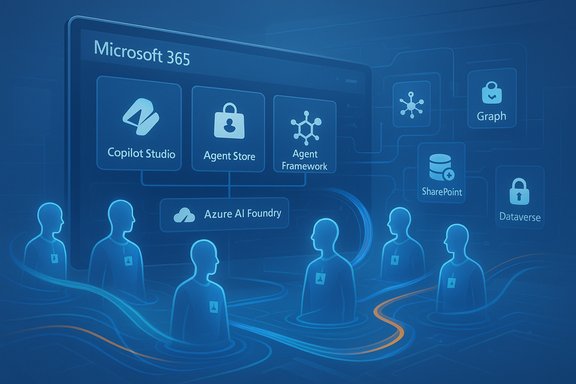
Microsoft’s agent platform rests on distinct but integrated pieces:- Copilot Studio — a low-code, in-product authoring environment that lets tenant teams and citizen developers assemble agents, connect them to knowledge sources (Microsoft Graph, SharePoint, Dataverse) and to enterprise systems (Workday, ServiceNow, SAP) using pre-built connectors and templates. Microsoft positions Copilot Studio as the primary place to author, tune and publish agents into the tenant catalog.
- Agent Store (Microsoft 365 Agent Store) — an in-product marketplace surfaced inside Copilot and Teams for discovery, approval and deployment of agents across the organization. Agents published to the Agent Store can be scoped and approved by tenant admins, making them discoverable and reusable across teams.
- Microsoft Agent Framework & Azure AI Foundry — a developer-grade, open-source orchestration runtime and SDK that unifies research-driven orchestration patterns (AutoGen-style) with enterprise-grade durability, observability and governance (Semantic Kernel lineage). Azure AI Foundry supplies the hosting, telemetry, Model Context Protocol (MCP) integrations and security plumbing to run agents at scale. The Agent Framework provides composability (multi-agent choreography), protocol-level interoperability (Agent-to-Agent, MCP), and observability hooks required for auditing and compliance.
Agent identities, lifecycle and billing: Entra Agent ID and the Agentic User concept
Microsoft’s roadmap and product notes point to agents being represented as directory objects—“Agentic Users” or managed identities—so that agents can have mailboxes, Teams presence, and inclusion in lifecycle processes like access reviews and conditional access. This identity-first model is a significant design choice: agents become first-class members of the tenant directory and thus subject to the same IAM controls IT already uses. Admins can approve agent templates and assign a potential agent license (reported internally in some notes as “A365” or Agent 365).Customer Zero: the Employee Self-Service Agent and real-world shaping of product decisions
Microsoft Digital’s Employee Self-Service Agent (ESS) is the canonical Customer Zero example: it centralizes HR, IT, facilities and campus services into a single, actionable conversational flow (visitor registration, dining, facilities tickets, shuttle booking, payroll inquiries). Microsoft reports early operational metrics—reduction in ticket volumes, faster resolutions, and large interaction targets—that have driven product features such as photo-based ticket creation, preconfigured connectors, and action-first flows. These Customer Zero lessons then inform defaults, governance patterns and templates available to customers.Verifying the claims: what’s confirmed and what should be treated cautiously
Microsoft’s public materials and developer docs confirm several platform-level claims:- Copilot Studio supports low-code agent authoring and integration with Graph, SharePoint and Dataverse, and provides templates for agent publishing.
- Azure AI Foundry and the Microsoft Agent Framework provide a hosted runtime with MCP support, OpenTelemetry-based tracing, approval workflows for tool invocations, and support for multi-model choices. The Agent Framework is publicly documented as open source and positioned as the unifying SDK for agentic development.
- Microsoft has piloted and published the Employee Self-Service Agent as a template and has provided internal rollout details about what it does and how it integrates with third-party systems (Workday, ServiceNow, SAP). Those product and community posts are explicit.
- Several headline impact metrics cited in Customer Zero write-ups—hours saved, projected ticket reductions, or projected annual interaction volumes—are internal telemetry or projections and should be treated as vendor-provided claims until independently audited. Microsoft documentation itself and community posts flag these numbers as internal performance indicators rather than universally guaranteed outcomes. IT leaders should validate these in their own controlled pilots.
- Multi-model routing and third-party model hosting choices introduce compliance and data-residency complexity. Microsoft documents that Copilot Studio and Foundry can route some workloads to models hosted outside Azure (for instance, Anthropic-hosted models remain on AWS in some integrations), which necessitates tenant-level mapping of model choices to regulatory requirements. Independent coverage has flagged these model-hosting nuances. Validate routing and residency in your tenant configuration.
Strengths: why Microsoft’s Customer Zero path is compelling for enterprise IT
1) End-to-end platform and integration surface
Microsoft is delivering a full-stack vision—authoring, runtime, identity, discovery, and lifecycle tooling—so enterprises can avoid stitching point solutions and instead run agents within a single governance boundary (Azure + Microsoft 365). That reduces integration friction and makes security and compliance patterns more uniformly enforceable.2) Low-code + pro-code paths accelerate time-to-value
Copilot Studio’s low-code authoring, combined with the Microsoft Agent Framework and the Microsoft 365 Agents SDK, covers both citizen developers and engineering teams. Organizations can start with accelerators like the ESS template and iterate toward pro-code, scalable agents as trust and maturity grow. This dual-path strategy maps well to hybrid enterprise development models.3) Observability and lifecycle controls are built-in
Azure AI Foundry and the Agent Framework emphasize OpenTelemetry tracing, tool approval workflows, and human-in-the-loop gates. For regulated industries that require auditability—finance, healthcare, utilities—these primitives are essential to moving agentic AI into production. Microsoft’s investments in telemetry and standards (MCP, A2A) make it feasible to reconstruct agent actions and produce audit trails.4) Internal Customer Zero feedback reduces product risk
Microsoft Digital’s extensive internal deployments surface real-world friction: what connectors are most needed, which flows require human approval, and how to prioritize everyday use cases. Those learnings have already fed back into templates, admin controls and product documentation—shortening the enterprise learning curve.Risks and blind spots: pragmatic governance, security, and operational concerns
No platform is risk-free. The Microsoft Customer Zero story underscores benefits, but it also raises repeatable concerns every IT leader must plan for.1) Vendor-provided ROI and measurement risk
Internal metrics (hours saved, ticket reductions, interaction volumes) are useful but not a substitute for independent, repeatable measurement. Organizations must instrument their own KPIs, capture baseline process metrics and run controlled pilots before extrapolating vendor figures to their environment. Microsoft’s Customer Zero numbers are credible signals, but they are vendor-sourced and shaped by Microsoft’s unique scale and data estate.2) Action safety and hallucination risk
Agents that “act” (create tickets, send emails, alter records) must be treated as systems of record when they have write access. The platform provides human approval hooks and conservative defaults, but practical deployments require:- Clear classification of what actions agents may take autonomously versus actions that require approval.
- Robust testing and canary rollouts for actioning agents (especially when they touch finance, HR, security or customer-facing systems).
- Comprehensive monitoring of agent outputs, with explainability and rollback mechanisms.
3) Data residency, model routing and third-party hosting
Some model options (third-party or partner-hosted) may process data outside the tenant’s primary cloud region. That is a compliance and data governance surface risk for regulated customers. IT and legal teams must map model-hosting choices to regulatory obligations and tenant policies. Microsoft documentation and independent reporting confirm these options and recommend explicit configuration.4) Identity and lifecycle complexity
Treating agents as “users” means they must be included in identity lifecycle management and access reviews. This is operationally sensible—but it also introduces new governance work: agents need owners, cost centers, rotation/retirement processes, and audit responsibilities. Don’t let agent objects proliferate without ownership and lifecycle policies.5) Citizen developer sprawl and shadow agents
Low-code authoring democratizes innovation, but it can also lead to uncontrolled agent sprawl. Guardrails—approval flows, pre-approved templates, centralized visibility and training—are essential to maintaining security posture and reducing redundant, conflicting automations. Microsoft Digital’s governance playbook explicitly prioritizes staged rollout, training and admin oversight.Practical guidance: a six-point playbook for IT leaders
Organizations that want to adopt agentic AI responsibly can reuse many of Microsoft Digital’s lessons while tailoring them to local risk and scale.- Start with high-frequency, low-risk scenarios.
- Pilot with employee self-service, facilities, meeting facilitation and knowledge retrieval before enabling agents that change finance or HR records. Microsoft’s ESS example shows how facilities and HR use-cases create daily value and drive adoption.
- Define an agent risk taxonomy and action matrix.
- Classify agents by impact (inform, suggest, act) and require approvals for any action-level flows with non-reversible consequences. Use the platform’s human-in-the-loop hooks for high-risk actions.
- Centralize governance while enabling local innovation.
- Maintain a tenant catalog and an approval workflow, but allow business units to customize pre-approved templates. The Agent Store and Copilot Studio are designed to balance discovery with admin gating.
- Instrument and measure from day one.
- Capture baseline KPIs (ticket volume, time-to-resolution, handoff rates) and instrument agent telemetry to measure impact. Treat vendor-reported hours-saved claims as hypotheses to validate.
- Test model routing and data residency.
- Map each agent’s model choices and hosting locations. Block or restrict models that route data outside acceptable jurisdictions. Use Purview and tenant-level controls where applicable.
- Build a team for agent operations (AgentOps).
- Create a cross-functional team (product, security, legal, compliance, support) to manage lifecycle, incident response, approvals and training. Treat agents as production services with SLAs and runbooks.
Technical deep-dive: what developers and architects need to know
Model Context Protocol (MCP) and agent tooling
MCP enables agents to discover and invoke external tools and services via a standardized protocol. Azure AI Foundry provides hosted MCP tool support and approval workflows so agents can call external REST services or specialized tool servers securely. This makes it practical to integrate documentation servers, search indexes, or proprietary APIs into agent flows while keeping approvals auditable.Observability and OpenTelemetry
Microsoft has extended OpenTelemetry conventions to multi-agent contexts, enabling tracing across agent orchestration, tool calls and model invocations. That means incident investigations can follow a trace from user request through agent choreography to tool execution, and back—an essential capability for audit and RCA (root-cause analysis). Azure AI Foundry and the Agent Framework both emphasize telemetry as a first-class concern.Multi-agent choreography, durability and long-running workflows
The Agent Framework supports durable workflows—agents can pause/resume, checkpoint state, and coordinate handoffs. This durability is necessary for long-running processes like multi-step approvals or complex analytics that require sequential sub-tasks. The framework combines orchestration patterns (sequential, concurrent, group-chat) with checkpointing semantics for reliability.Human-in-the-loop patterns
For actions with compliance or safety implications, the product surfaces approval requests for operators. This pattern allows agents to present a proposed plan and then queue the action for human review before execution—crucial for preventing incorrect or risky automated actions. The platform’s approval workflow integrates with UI surfaces and admin workflows.Independent perspective and industry context
Media coverage and analyst reporting confirm that Microsoft’s agent push is significant and industry-shaping. Independent outlets reported on Microsoft’s Agent Framework, the idea of agents as directory objects and the broader strategy to commercialize agents through an Agent Store and Agent 365 licensing concepts. Coverage also highlights industry debate—optimism about productivity gains and concern about costs, safety and model accuracy—so organizations should balance enthusiasm with disciplined evaluation. Notably, model choice and hosting arrangements (for example, Anthropic model integrations) are real-world complications: model performance and hosting location decisions matter for compliance, cost and quality. The platform’s multi-model approach is an advantage for flexibility, but it increases configuration complexity for secure enterprise deployments.Conclusion
Microsoft’s Customer Zero story is both an operational playbook and a product road map. By deploying the Employee Self-Service Agent and building out Copilot Studio, Agent Store, Azure AI Foundry and the Microsoft Agent Framework, Microsoft demonstrates a cohesive approach to agentic AI: democratize creation, enable powerful orchestration, and enforce enterprise-grade governance.Those are compelling ingredients for enterprise adoption. But the Customer Zero lessons also carry clear caveats: vendor-sourced productivity claims need independent validation; action-capable agents demand rigorous human-in-the-loop and rollback strategies; model routing and data-residency choices require careful compliance mapping; and identity-backed agents require intentional lifecycle management.
For IT leaders, the tactical path forward is clear: pilot small and measurable scenarios, instrument outcomes rigorously, codify governance and identity lifecycles from day one, and treat agents as production services with owners and runbooks. Microsoft’s Customer Zero experience offers a fast track—but it is not a turnkey guarantee. Organizations that combine measured pilots with strong governance, the right telemetry and clear ownership will be best positioned to capture agentic AI’s productivity upside while controlling the real risks of delegating work to autonomous, language-driven systems.
Source: Microsoft Powering agentic AI adoption at Microsoft: Our ‘Customer Zero’ story - Inside Track Blog
