

Microsoft’s AI pivot is now as much about building an in‑house, full‑stack platform as it is about preserving the benefits of its longtime OpenAI partnership — a dual strategy Wall Street increasingly values and that reshapes how investors, IT leaders, and developers should think about Azure, Copilot, and enterprise AI deployments.
Microsoft’s relationship with OpenAI began as a high‑profile strategic bet: a $1 billion anchor investment in 2019 that expanded into multibillion‑dollar commitments over subsequent years. That partnership gave Microsoft priority access to frontier models, exclusive commercial pathways for some time, and a prominent role in the cloud compute supply chain supporting ChatGPT and related offerings. Public reporting now places Microsoft’s cumulative OpenAI commitments in the neighborhood of $13 billion, a figure regularly cited by both company executives and market reporters. At the same time, Microsoft has been quietly and deliberately assembling its own AI stack: internal model work (codenames such as Phi‑4 and other internal families), expanded Azure AI infrastructure, and tighter integration of AI across Microsoft 365, Windows, GitHub, LinkedIn and Xbox. This approach positions Microsoft to monetize AI through both product bundling (Copilot inside Office and Windows) and cloud consumption (Azure AI training and inference). Analysts and journalists now frame Microsoft’s AI posture as platform diversification plus distribution leverage — meaning Microsoft can both host others’ models and run compelling first‑party models at scale.
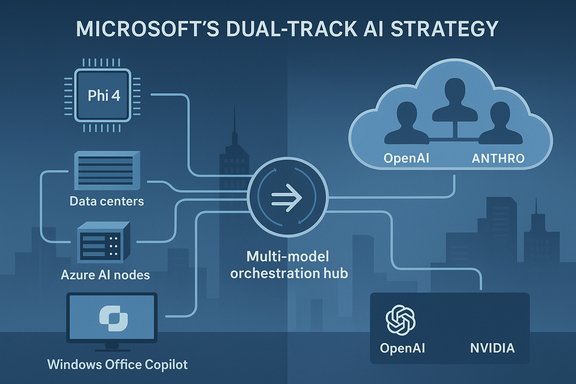
To reduce inference costs and improve responsiveness for those very high‑frequency tasks, Microsoft is deploying and experimenting with smaller, task‑specialized in‑house models alongside access to frontier models. Files and reporting captured in recent company and industry analysis show Microsoft increasingly routing workload types to the most efficient model for the task — a hybrid orchestration model that mixes in‑house models, third‑party models (Anthropic, Google models, etc., and OpenAI models as appropriate.
That said, the economics of compute, execution complexity, regulatory scrutiny, and the competitive field make Microsoft’s path forward a conditional one. The company’s dual‑track strategy — preserve privileged OpenAI ties while building first‑party models and forging new model partnerships — is sensible from a risk management standpoint. It reduces single‑vendor exposure while keeping Microsoft’s distribution and cloud advantages firmly in play.
Enterprises and investors should therefore value Microsoft’s progress, but also demand evidence of durable monetization and careful capex discipline. The AI era rewards both technological leadership and disciplined economics; Microsoft has the assets for both, yet must prove it can convert them into consistent, profitable growth over the coming years.
Conclusion
Microsoft’s AI story is no longer just a tale of a strategic bet on OpenAI; it is a broader narrative about building a full‑stack, multi‑model platform that leverages Microsoft’s distribution and cloud muscle. The company’s investments, partnerships and productization efforts give it a credible path to lead in enterprise AI — provided it manages capital intensity, competition, and regulatory complexity effectively. Policymakers, IT leaders and investors should track adoption metrics (Copilot seat growth, Azure AI consumption), margin trends on AI workloads, and contractual disclosures tied to compute commitments to evaluate whether Microsoft’s AI upside materializes into predictable, long‑term value.
Source: 富途牛牛 Microsoft's AI advantage is by no means solely reliant on OpenAI — Wall Street highly values this.
 Background / Overview
Microsoft’s relationship with OpenAI began as a high‑profile strategic bet: a $1 billion anchor investment in 2019 that expanded into multibillion‑dollar commitments over subsequent years. That partnership gave Microsoft priority access to frontier models, exclusive commercial pathways for some time, and a prominent role in the cloud compute supply chain supporting ChatGPT and related offerings. Public reporting now places Microsoft’s cumulative OpenAI commitments in the neighborhood of $13 billion, a figure regularly cited by both company executives and market reporters. At the same time, Microsoft has been quietly and deliberately assembling its own AI stack: internal model work (codenames such as Phi‑4 and other internal families), expanded Azure AI infrastructure, and tighter integration of AI across Microsoft 365, Windows, GitHub, LinkedIn and Xbox. This approach positions Microsoft to monetize AI through both product bundling (Copilot inside Office and Windows) and cloud consumption (Azure AI training and inference). Analysts and journalists now frame Microsoft’s AI posture as platform diversification plus distribution leverage — meaning Microsoft can both host others’ models and run compelling first‑party models at scale.Microsoft’s AI position today: evidence that it’s not a one‑trick pony
Significant capital and capacity investments
Microsoft has signaled a willingness to spend at scale on AI infrastructure. The company disclosed guidance that implied massive AI‑related capital expenses for fiscal 2025, with public reporting putting Microsoft’s FY‑2025 AI data‑center and infrastructure investment plans in the tens of billions — a figure that analysts have summarized as an approximate $80 billion spending expectation on AI data centers for the fiscal year. That capex commitment is consistent with the company’s need to secure GPU capacity, networking and power at hyperscale. More recently Microsoft announced a sweeping $17.5 billion investment plan specifically for India — to build hyperscale datacenters, expand Azure and localize Copilot and M365 processing inside the country — demonstrating the company’s global capital commitments to making Azure the backbone for AI workloads. This India pledge builds on an earlier $3 billion plan made in January 2025.In‑house model development and the Copilot strategy
Microsoft’s product strategy centers on embedding AI deeply into existing distribution channels. The Copilot family — Microsoft 365 Copilot, GitHub Copilot, and Windows‑level AI — is the salient example: by making AI a core, seat‑based feature of productivity suites, Microsoft has translated model access into recurring revenue opportunities and high customer lock‑in.To reduce inference costs and improve responsiveness for those very high‑frequency tasks, Microsoft is deploying and experimenting with smaller, task‑specialized in‑house models alongside access to frontier models. Files and reporting captured in recent company and industry analysis show Microsoft increasingly routing workload types to the most efficient model for the task — a hybrid orchestration model that mixes in‑house models, third‑party models (Anthropic, Google models, etc., and OpenAI models as appropriate.
Strategic diversification: Anthropic, multicloud, and compute deals
Microsoft’s strategy is also visible in its partner deals. In November, Microsoft announced a strategic partnership with Anthropic and NVIDIA that includes significant capital commitments and compute purchasing expectations: Microsoft committed to invest up to $5 billion in Anthropic while Anthropic committed to purchase large volumes of Azure compute capacity under the arrangement — a deal widely reported and framed as part of Microsoft’s effort to offer customers model choice and to lock in future Azure demand. These types of deals underscore Microsoft’s approach of creating a multi‑model ecosystem on top of Azure.Wall Street’s perspective: why investors like a “dual‑track” Microsoft
Distribution is the moat
Investors prize Microsoft’s combination of unrivaled distribution and enterprise relationships. Embedding Copilot across Microsoft 365 and Windows gives Microsoft an unusually wide funnel to monetize AI via subscriptions, seat licenses, and cloud consumption. Analysts argue this creates multiple monetization levers — a subscription revenue stream (Copilot seats), cloud consumption (Azure inference and training), and enterprise services (consulting, skilling and sovereign cloud offerings). That mix is one of the principal reasons many analysts remain bullish on Microsoft’s long‑term AI upside.The OpenAI relationship remains strategically important — but more flexible
Microsoft’s OpenAI stake and commercial relationship continue to deliver strategic value: preferential API terms (as negotiated), deep technical collaboration, and integrated product pathways. Recent restructuring and recapitalization reporting indicate Microsoft now has meaningful equity exposure (reported in late‑2025 announcements as a roughly 27% stake following a reconstitution of OpenAI) alongside long‑term IP and commercial arrangements that could extend into the early 2030s. Those developments reduce a prior potential single‑point dependency while preserving privileged access. That combination — privileged access without sole reliance — is what Wall Street tends to reward.Financial signals and market capitalization
Microsoft remains one of the largest public companies by market cap; real‑time market data as of the current trading session placed Microsoft’s market capitalization in the neighborhood of $3.85 trillion. Analysts routinely debate multi‑trillion dollar upside scenarios for Microsoft as Copilot adoption scales and Azure AI consumption grows, but those forecasts depend on execution and profitable monetization of AI workloads.Critical analysis: strengths, execution realities and the downside risks
Strengths that matter
- Distribution and product integration: Microsoft can surface AI features at massive scale by integrating Copilot into Office, Windows, GitHub and Teams. That reach translates into a distribution moat that model-only companies cannot easily replicate.
- Balance sheet and capital optionality: Microsoft’s cash flow allows large‑scale capex and strategic investments (including stakes in model providers) that smaller competitors cannot match. This makes it feasible to underwrite long‑term bets on training farms and edge infrastructure.
- Multi‑model orchestration: Offering customers choice between in‑house models, Anthropic/Claude, OpenAI, and other weights reduces vendor lock‑in risk and positions Azure as a neutral marketplace for enterprises that require both compliance and model flexibility.
Key execution realities and limitations
- Compute economics remain brutal: Training and running frontier models consumes extraordinary GPU, networking and power resources. Even for a company at Microsoft’s scale, proving consistent margins on large‑scale inference workloads is non‑trivial. The company’s elevated capex plans for data centers and GPUs underscore the challenge: if cloud demand growth or pricing deteriorates, these investments can compress near‑term margins.
- Productization and monetization hurdles: Embedding AI features is one thing; turning those features into durable, high‑margin revenue is another. Seat‑based pricing and cloud consumption need to be carefully calibrated so that usage growth yields predictable ARPU expansion rather than coat‑tacked consumption volatility. Analysts note conversion of Copilot adoption into stable revenue is still an ongoing process.
- Regulatory and antitrust scrutiny: As Microsoft extends AI into platform layers with distribution advantages, regulators and competitors are paying closer attention to exclusivity terms, cloud advantages, and potential bundling effects. This scrutiny could shape future deal terms and constrain some business practices.
Risks that investors and IT buyers should weigh
- Over‑investment risk: Microsoft’s multiyear capital push to secure GPU and datacenter capacity could be costly if the pace of enterprise AI adoption decelerates or if other technical breakthroughs drastically change compute economics. Public reporting of large projects (for example, multi‑party infrastructure efforts announced under names such as Stargate) contain ambitious funding targets that, if underutilized, would amplify overhang risk.
- Competitive model performance: If competing model families (from Google, Anthropic, or future entrants) materially outperform Microsoft’s in‑house offerings on either accuracy, latency, or cost, Microsoft may need to lean more heavily on external providers — weakness that could both raise costs and diminish perceived differentiation.
- Market sentiment and valuation swings: AI is a narrative‑driven market. If promised AI productivity gains prove slower to materialize or if a major safety/regulatory incident occurs, even fundamentally strong firms like Microsoft can experience sharp sentiment reversals. Investors must separate near‑term hype from measurable revenue growth tied to AI features.
Separating verifiable claims from reportage and rumor
When assessing public claims it is vital to distinguish what is verifiable from what remains speculative:- Verifiable, multi‑sourced items:
- Microsoft’s cumulative capital commitments to OpenAI in the low‑to‑mid‑double‑digit billions have been widely reported and acknowledged by company executives and reputable outlets.
- Microsoft’s FY‑2025 level AI‑related data‑center spending expectations and high capex commitment were reported by major financial outlets.
- The Anthropic‑Microsoft‑NVIDIA strategic partnership and the headline investment/compute commitments were announced publicly and covered by multiple independent outlets.
- Microsoft’s India investment of $17.5 billion over four years was formally announced by Microsoft and covered by multiple news organizations.
- Items that require caution or further verification:
- Precise internal revenue breakdowns (for example, specific percentages of Azure revenue attributable to “AI” vs. “core cloud”) are often estimates from analysts and not always consistent across reports. Where a single analyst’s percentage is cited, that number should be treated as an estimate rather than an exact accounting fact. If a detailed breakdown is essential for decision‑making, consult Microsoft’s investor filings and analyst models directly.
- Large‑scale project funding totals and timelines for multi‑party infrastructure ventures (like so‑called Project Stargate) have been reported widely, but they are multiyear and contingent on partner financing, procurement and regulatory approvals. Such figures change frequently; treat headline totals as directional and check for updated disclosures.
Practical guidance for IT leaders, CIOs and Windows administrators
1. Architect for multi‑model routing and cost control
Design AI pipelines to route queries to cheaper, task‑appropriate models when possible, reserving frontier models for high‑value or high‑safety tasks. This tiered inference approach materially controls cloud spend and reduces latency.2. Insist on sovereignty and auditability for sensitive workloads
When deploying Copilot‑style features in regulated industries, ensure data residency, audit trails, and the ability to localize inference. Microsoft’s sovereign cloud options and regional datacenter expansion (notably in India) are relevant here; evaluate contractual commitments for in‑country processing.3. Treat AI features as software artifacts
Version, test, red‑team and monitor copilots as you would production software. Implement governance workflows that allow controlled rollouts and human oversight for high‑risk outputs.4. Model‑agnostic procurement
Negotiate Azure consumption terms that allow model flexibility, and insist on options to access alternative model providers (Claude, OpenAI, in‑house Microsoft models) to avoid technological lock‑in and to preserve negotiation leverage.The bottom line: Microsoft’s AI advantage is durable — but not risk‑free
Microsoft’s combination of deep pockets, unrivaled distribution (Microsoft 365, Windows, GitHub), and an increasingly sophisticated in‑house AI stack gives it a substantial advantage in the enterprise AI race. Wall Street’s interest in Microsoft’s autonomous AI capabilities reflects a belief that the company can convert distribution into monetization at scale — and that it can do so without being wholly dependent on any single external model provider.That said, the economics of compute, execution complexity, regulatory scrutiny, and the competitive field make Microsoft’s path forward a conditional one. The company’s dual‑track strategy — preserve privileged OpenAI ties while building first‑party models and forging new model partnerships — is sensible from a risk management standpoint. It reduces single‑vendor exposure while keeping Microsoft’s distribution and cloud advantages firmly in play.
Enterprises and investors should therefore value Microsoft’s progress, but also demand evidence of durable monetization and careful capex discipline. The AI era rewards both technological leadership and disciplined economics; Microsoft has the assets for both, yet must prove it can convert them into consistent, profitable growth over the coming years.
Conclusion
Microsoft’s AI story is no longer just a tale of a strategic bet on OpenAI; it is a broader narrative about building a full‑stack, multi‑model platform that leverages Microsoft’s distribution and cloud muscle. The company’s investments, partnerships and productization efforts give it a credible path to lead in enterprise AI — provided it manages capital intensity, competition, and regulatory complexity effectively. Policymakers, IT leaders and investors should track adoption metrics (Copilot seat growth, Azure AI consumption), margin trends on AI workloads, and contractual disclosures tied to compute commitments to evaluate whether Microsoft’s AI upside materializes into predictable, long‑term value.
Source: 富途牛牛 Microsoft's AI advantage is by no means solely reliant on OpenAI — Wall Street highly values this.
