

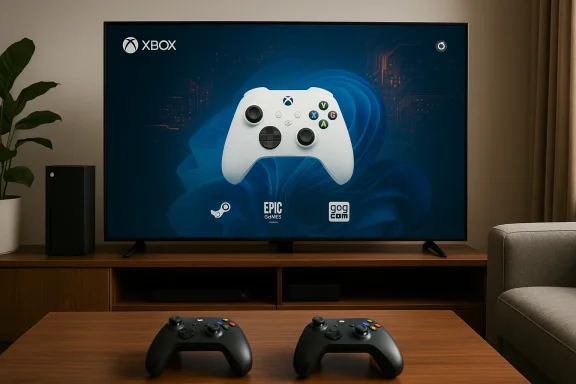
Microsoft’s next living‑room gamble is no longer just a whisper: evidence from supplier comments, Microsoft’s own Full Screen Experience trials, and sustained reporting points to a plausible — if ambitious — plan to ship a hybrid console in the 2027 window that boots to a console‑grade, TV‑first shell while running a full Windows 11 runtime underneath. This approach would let the device act like a traditional Xbox for mainstream players while exposing a true Windows PC layer for power users and allowing native PC storefronts such as Steam, Epic Games Store, GOG and Battle.net to run alongside Microsoft’s own ecosystem. The case rests on three converging signals: AMD’s public timeline for a semi‑custom SoC, Microsoft shipping and expanding the Xbox Full Screen Experience (FSE) on Windows handhelds, and investigative reporting that describes a layered “console shell over Windows” architecture — each of which is verifiable and consequential for players, developers, and the wider industry.
Background / Overview
For years Microsoft has quietly blurred the lines between PC and console: Play Anywhere, Game Pass on PC, and first‑party titles supporting cross‑device entitlements set the cultural and technical groundwork. More recently the company shipped Windows 11 handhelds (the ASUS ROG Xbox Ally and Ally X) that boot into a controller‑first Xbox Full Screen Experience — a live experiment in the precise layering Microsoft is reportedly considering foe. That engineering path, combined with Microsoft’s announced multi‑year silicon partnership with AMD and a supplier comment indicating the chip effort “supports a launch in 2027,” has pushed the hybrid‑console thesis from speculation into credible planning.Why does this matter? Because it reframes a console not as a closed, single‑purposcurated Windows appliance — one that can be both a simple, turn‑on‑and‑play box and a fully capable Windows machine running arbitrary Windows apps and third‑party storefronts. That promise addresses long‑standing developer friction and consumer fragmentation — but it also multiplies technical, legal, and business complexity in ways Microsoft has not faced at console scale before.
What the reportssentials
- Microsoft is experimenting with a layered model where a console‑grade UI (Xbox Full Screen Experience) sits on top of a full Windows 11 runtime; users boot to the console shell by default and can exit to Windows to run desktop apps or other storefronts. This behavior is already shipping in preview and on retail handhelds.
- AMD publicly confirmed that development of a semi‑custom SoC for Microsoft is “progressing well to support a launch in 2027,” a supplier‑side timing marker that many outlets treat as the earliest viable retail window. That comment does not equal a Microsoft retail commitment, but it makes 2027 a plausible target.
- The Xbox ecosystem is being reworkedscovery model*: Microsoft’s Xbox PC app is gaining an Aggregated Gaming Library that discovers installed titles from Steam, Epic, Battle.net and others and surfaces them inside the Xbox UI — a practical building block for multi‑store support.
- Hardware repors point to a high‑ambition semi‑custom AMD APU (leaked under the internal codename “Magnus”) that would prioritize larger memory budgets and on‑device AI accelerators to support both Windows multitasking and high‑fidelity gaming. These hardware reports are plausible but remain unverified and should be treated cautiously.
The engineering model: a console shell layered on Windows
How Full Screen Experience (FSE) makes this feasible
FSE is not a new kernel or a rearchitecting of Windows; it’s a session posture that hides Explorer, defers non‑essential services, mutes notifications, and launches a single “home app” (typically the Xboen at sign‑in. On handhelds FSE has demonstrated measurable gains — freeing roughly 1–2 GB of memory and reducing background CPU wakeups — which translates to steadier frame delivery and longer battery life in thermally constrained devices. Those same mechanics can be scaled, in theory, to a TV‑first device that prioritizes controller navigation and fast boot‑to‑game flows.This is an important technical nuance: because Windows remains the kernel and driver model, kernel‑mode anti‑cheat and DRM subsystems stay intact. That makes running PC storefronts and many native Windows games feasible without reinventing the platform security stack — but it also means third‑party anti‑cheat vendors and DRM systems must be negotiated into the launch story to ensure seamless “turn‑on‑and‑play” behavior for titles that depend on kernel‑level protections.
Aggregation, orchestratiostorefront support
The practical model the Xbox team appears to be shipping is aggregation and orchestration, not wholesale substitution. The Xbox PC app’s Aggregated Gaming Library discovers installed games from multiple clients and can launch them from a unified list; when native DRM or kernel anti‑cheat requires the original client, the front end hands off to that client. In short:- Aggregated discovery brings titles into a single library and UI.
- Direct launch works when the executable and DRM permit it.
- Hand‑off behavior occurs when native client or kernel protections are required.
Hardware: the AMD partnership, “Magnus,” and the premium trade‑offs
What AMD actually told investors
On an earnings call, AMD CEO Dr. Lnt of Microsoft’s semi‑custom SoC is “progressing well to support a launch in 2027.” That phrasing is supplier readiness language: meaningful, but not equivalent to a Microsoft retail release date. It does, however, remove a major technical unknown — silicon readiness — and strengthens the timeline plausibility. Multiple outlets reported the comment and contextualized it with Microsoft and AMD’s 2025 co‑engineering announcement.The “Magnus” rumor set: high ambition, unverified specifics
Enthusiast leaks and analyst pieces have circulated a codename and ambitious spec targets — high CU counts, large unified GDDR7 pools, substantial on‑die NPUs — intended to support both Windows multitasking and next‑generation game workloads. These leak numbers make sense in design goals (more RAM for Windows, NPUs for OS‑level upscaling) but e not been confirmed by AMD or Microsoft and should be treated as indicative, not definitive. Rely on official spec sheets or validated silicon benchmarks before using leaked figures as fact.The cost equation: why Microsoft said “premium”
Microsoft executives have described the next device as “very premium, very high‑end, curated.” That language aligns with higher BOM due to bigger memory budgets and possible NPUs, and it suggests Microsoft understands the device may land at higher retail prices than prior generations. If Microsoft chooses to subsidize hardware with Game Pass or services, it could shift the economics; otherwise a premium price point is a real risk for mainstream adoption.Developer and ecosystem impacts
Simplifying cross‑platform development — with caveats
A Windows‑rooted Xbox would reduce porting friction: studios targeting Windows already use PC tooling and middleware; a shared OS simplifies QA and toolchains. That could speed ports, reduce QA surface, and broaden the range of titles that run well on console hardware. For indies, the ability to reach a console‑style audience without bespoke console certification is appealing.But there are important caveats:
- Certification and UX requirements for TV‑first titles will still matter. Developers may need to produce controller‑first polish to appear in the default Xbox shell.
- Anti‑cheat and DRM integration remains a technical and legal negotiation. Some PC anti‑cheat solutions require privileged drivers or kernel hooks that must be handled carefully for console‑grade stability.
- Supporting two modes — a console UI path and a full Windows path — adds complexity. Studios may need to maintain dual build targets or conditional code paths to accommodate both experiences.
Store economics and the new bargaining table
If Microsoft permits third‑party storefronts on day‑one, the revenue dynamics change. Microsoft can continue to incentivize developers through preferential store fees (public reporting suggests Micro a lower cut than some competitors) and Game Pass placement, but the rise of multiple stores on the same hardware will require new cross‑entitlement and DLC portability agreements. Publishers and storefronts will negotiate access, pricing, and entitlement handoffs; this is where policy, commercial incentives, and platform fees will shape real consumer outcomes more than the technical architecture alone.Consumer experience: benefits and realistic limits
Tangible consumer benefits
dentities**: Default console simplicity for most users and an optional Windows desktop for power users.- Access to broader PC libraries: Potential to run Steam, Epic, GOG titles without buying a separate PC.
- Backwards compatibility continuity: If implemented, Xbox console titles remain first‑class citizens while desktop titles augment the catalog.
- Multitasking and productivity: A single living‑room device capable of light creative work, streaming, or web browsing.
Realistic constraints and UX trade‑offs
- Anti‑cheat friction: Some competitive games use kernel drivers for anti‑cheat; ensuring those work without undermining co‑trivial.
- Store launch friction: Users may be confused by hybrid launch behavior (direct launch vs. hand‑off to client), reducing the “turn‑on‑and‑play” promise if not smoothed by UI/UX work.
- Price sensitivity: Premium hardware with big memory and NPUs can push MSRP above what many console buyers expect.
- Fragmentation risk: OEM variants at different price points can produce inconsistent experiences unless Microsoft tightly controls key certifications and UX guidelines.
Policy, competition, and antitrust considerations
A console that openly runs multiple storefronts will draw regulatory and commercial attention. On one hand, greater openness can be a positive counter to platform lock‑in debates; on the other hand, Microsoft’s control over the default front door, Game Pass placement, and potential preferential treatments could invite scrutiny about competitive fairness. The device’s business model — what is front‑loaded in the dlements are free or paid, and whether multiplayer paywalls remain — will shape regulatory narratives and competitive responses from Valve, Epic, and Sony. Any promised openness needs to be backed by transparent policies or it risks being criticized as nominal openness with a proTimeline and credibility — what to believe (and what to treat as provisional)
- AMD’s remark that their semi‑custom SoC development is “progressing well to support a launch in 2027” is real, public, and the clearest external timing signal we have. Treat it as supplier readiness, not a Microsoft retail commitment.
- Microsoft’s software evidence is tangible: FSE is shipping and the Aggregated Gaming Library is rolling out in thare shipped artifacts that prove the layered software model is being actively developed and tested in the market.
- High‑detail hardware leaks and internanus” are valuable lead indicators but remain unverified. Use them to understand design intent and risk (larger memory budgets, NPUs, PC‑class performance) — but do not treat leaked CU counts, TOPS numbers, or die‑size estimates as final until AMD or Microsoft publishes specs.
How Microsoft could make (or bress hinges on executing across three difficult vectors simultaneously:
- Software polish: deliver a default console shell that is fast, reliable, and indistinguishable from the best console experiences — while also enabling a frictionless exit to full WindoE must feel native on a TV at launch.
- Ecosystem diplomacy: negotiate anti‑cheat and DRM behavior, storefront cooperation, and cross‑entitlement deals so that Steam, Epic, and other clients work without undermining the default experience or exposing security surface.
- Price and positioning: choose SKUs and pricing that align with consumer expectations. A premium, high‑BOM flagship and accessible OEM variants can work — but only if Microsoft’s messaging makes clear who each SKU is for and what functionality (full Windows access, creator features) is included.
Practical advice for players, developers, and observers
- Gamers: treat 2027 as an informed earliest‑case retail window. If you value a pure, predictable console UX, wait for post‑launch reviews that test default behavior for typical console scenarios. If you value PC flexibility, look for SKUs explicitly marketed with full Windows access.
- Developers: plan for a multi‑mode target. Optimize for controller polish if you want exposure in the default Xbox shell; use Windows‑native toolchains to support broader PC features. Watch Microsoft’s GDK and any updated certification guidelines closely.
- Industry watchers: follow AMD’s silicon updates for the clearest external timing signals, but expect Microsoft to retain control over the launch cadence. Monitor anti‑cheat vendor statements, OEM policy documents, and Microsoft’s Xbox/Windows developer guidance for the contours of real openness vs. default funneling.
Final assessment — bold promise, real complexity
Microsoft’s hybrid console thesis is one of the most consequential platform bets in recent console history: it promises real user choice, easier cross‑platform development, and a potential expansion of the Xbox ecosystem into a family of Windows appliances. The company has shipped credible software building blocks (the Full Screen Experience and Aggregated Library) and has supplier confirmation that AMD’s SoC program is aligned with a 2027 cadence. Those are not small wins.Yet the devil is in the details. Anti‑cheat integration, clear storefront and entitlement policies, OEM fragmentation, and premium BOM pressure are tangible risks that could convert a compelling vision into a muddled user experience or an overpriced niche. Microsoft’s ability to execute cross‑team — Windows OS reliability, Xbox UI polish, AMD silicon delivery, and multi‑party commercial agreements — will determine whether the next Xbox becomes a category‑defining hybrid or a cautionary example of overreach.
For now, treat the core thesis — a Windows‑backed, console‑skinned Xbox that supports PC storefronts — as credible and actively being built. Treat specific launch dates, leaked hardware numbers, and final SKU policies as provisional. Watch for formal announcements from Microsoft and validated silicon data from AMD; until then, the outline is visible but the fine print still matters.
Microsoft’s gamble is elegant in theory: give mainstream players a simple, curated living‑room experience while granting power users the full flexibility of Windows. Pulling that off at scale — at the right price and with the right ecosystem agreements — would reshape not just Xbox, but expectations for what a “console” can be in a Windows‑centric era. The next year of rollouts, partner talks, and official reveals will tell us whether this is a pragmatic evolution or a high‑risk pivot.
Source: Mix Vale Microsoft prepares hybrid console for 2027 with support for PC stores and open Windows architecture
