

Microsoft’s new customer feature post makes a clear, bold claim: the era of AI is moving from single, conversational assistants toward coordinated, multi-agentic teams that can plan, act, and operate across systems as a new form of digital labor. That shift is not just conceptual — Microsoft is wiring it into product surfaces (Copilot Studio, Agent Store), runtime services (Azure AI Foundry / Agent Service), and identity and governance primitives (Entra Agent ID / Agent 365). The company pairs those platform moves with customer vignettes — Contraforce in security, Stemtology in regenerative medicine, and SolidCommerce in retail — to show how multi-agentic systems can compress timelines, slash unit costs, and scale operations. The underlying macro argument is also backed by big-dollar momentum: corporate AI investment reached roughly $252.3 billion in 2024, providing the economic backdrop for enterprises to pursue ambitious, agentic automation programs.
Source: Microsoft Single agents to AI teams: The rise of multi-agentic systems | The Microsoft Cloud Blog
 Background / Overview
What Microsoft means by “agentic” and “multi-agentic”
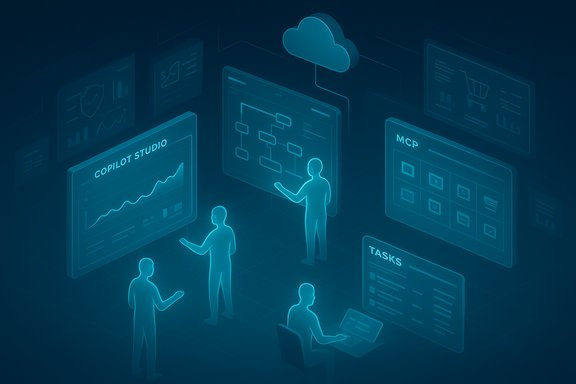
Microsoft frames agentic AI as the union of traditional software strengths — stateful workflows, tool access, and operational controls — with the adaptive reasoning of large language models (LLMs). In practice that means agents are expected to understand intent, decompose goals into stepwise actions, call external tools or APIs, maintain memory, and escalate to humans when required. When a coordinating agent delegates to specialist subagents (for triage, retrieval, decisioning, or execution), you have a multi-agentic system: an AI “team” rather than a single assistant. That conceptual shift is central to Microsoft’s product narrative. Two important platform elements underpin Microsoft’s vision:- Copilot Studio: a low-code/no-code authoring surface for building, tuning and publishing agents.
- Azure AI Foundry / Agent Service: a production runtime that hosts agents, provides observability and model routing, and enforces enterprise controls.
Why the shift matters now
Three converging forces make multi-agent systems practical:- Model capability and cost improvements — LLMs and multimodal models are stronger and inference is far cheaper than prior years, enabling background/autonomous workloads at scale.
- Enterprise demand for automation and outcomes — organizations are moving beyond pilots to production deployments where agents must act, not just advise.
- Tooling and governance maturity — runtimes, identity controls, observability, and integration protocols are becoming available, lowering the barrier for ops teams to run agent fleets safely.
Microsoft’s platform map: what’s being stitched together
The core components (short)
- Copilot Studio — authoring, templates, low-code agent creation.
- Agent Store / Agent 365 — catalog, discovery, tenancy and license surfaces for agents.
- Azure AI Foundry / Agent Service — runtime orchestration, model routing, and production execution.
- Entra Agent ID — directory-backed identities and lifecycle controls for agents.
- Model Context Protocol (MCP) — integration fabric for agent-to-tool and agent-to-agent communication.
What this enables for enterprises
- Agents that can be discovered and reused across teams.
- Identity, access, and lifecycle controls that make agents auditable.
- Multi-model routing for cost, performance, and compliance tradeoffs.
- Built-in telemetry and tracing to support human review and forensics.
Three customer vignettes: claims, validation, and caveats
1) Contraforce — autonomous security delivery at MSP scale
Microsoft’s writeup highlights Contraforce, an MSSP partner that built a multi-tenant, multi-agent security delivery platform on Microsoft Foundry. The headline results are dramatic: 90% automation of investigation/response tasks, incident response times reduced from about 30 minutes to ~30 seconds, and cost per incident reduced from roughly $15 to under $1. Microsoft cites the customer story; ContraForce’s own announcements echo the same figures and claim even lower per-incident compute costs in some pilots. Independent corroboration: third-party coverage and partner writeups discuss ContraForce’s product and the rise of agentic autonomous MDR (managed detection and response) offerings, but publicly verifiable audits or peer-reviewed validations of the specific numeric claims are limited at this stage. Industry reporting supports the premise that automation can materially reduce mean time to response (MTTR) for triage and enrichment tasks, but exact multipliers vary widely by environment and the underlying telemetry quality. That means:- The directional claim — significant reductions in MTTR and unit cost — is plausible and consistent with other MSSP automation reports.
- The specifics (60× faster → 30 sec, <$1 per incident, <$0.25 in some trials) currently rest primarily on vendor and customer statements and are not yet broadly validated in independent audits. Treat these as promising but not universally proven.
2) Stemtology — shortening biomedical discovery cycles
Stemtology’s engagement with Microsoft AI Co‑Innovation Labs centers on using multi-agent workflows to parse literature, generate hypotheses, and design experiments. Microsoft’s lab pages claim research timelines cut by up to 50%, with prototypes delivered in weeks rather than months, and an expectation of ≥90% predictive accuracy for some therapy predictions. Independent context: industry analyses from life‑sciences consultancies and McKinsey show that AI and generative tools have already compressed many document- and protocol-driven workflows (for example, drafting study documents, protocol generation, and literature triage), often reporting 30–50% time savings in operational sprints. These broader studies corroborate the feasibility of large timeline reductions when AI augments search, extraction, and drafting tasks — but complex wet-lab experiments, clinical proofs, and regulatory validation still impose hard minimums that limit end-to-end acceleration. In other words, the Stemtology claim is credible for preclinical literature review and experimental design phases, while downstream translational and regulatory milestones remain governed by domain realities. Cautionary note: the asserted ≥90% predictive accuracy and the ability to scale to 100 diseases are aspirational and appear to be target performance metrics in Microsoft’s case materials and the partner’s projections; independent validation of those numbers is not publicly available. These should be treated as vendor-provided milestones rather than independently verified outcomes.3) SolidCommerce — retail personalization and support orchestration
SolidCommerce’s case frames multi-agent orchestration as a remedy for inconsistent customer communications and heavy support loads. The Microsoft narrative shows a stack of triage agents, FAQ handlers, account managers, recommendation agents, and compliance checks delivering richer multimodal customer experiences and real-time personalization. That outcome is aligned with broader market experience where modular agents handle intent classification, retrieval-augmented replies, and rule-driven escalation to human agents. Independent signals: the retail sector has been an early adopter of automated messaging and recommendation systems; numerous partner case studies from different clouds show measurable gains in response time, automation rate, and conversion uplift after introducing document retrieval + LLM-based responders. The SolidCommerce story aligns with that precedent but again relies on vendor and partner reporting rather than academic evaluation.What’s actually new — and what’s not
New
- Treating agents as identity-bound, auditable workforce members with lifecycle, licensing, and catalog surfaces.
- Product-level runtimes and governance surfaced to productionize agent fleets rather than ad-hoc prototypes.
- Emphasis on agent-to-agent protocols (orchestrator + specialists) for reliable multi-step workflows.
Not new (but now scaled)
- Retrieval-augmented generation (RAG), semantic search, and tool invocation — these pattern elements have been in use for some time, but now they’re being packaged with production controls.
- Human-in-the-loop escalation and approval workflows — still central, and made visible in governance UIs.
Strengths and practical benefits
- Speed and scale: Automating repetitive triage and synthesis tasks reduces human touch time and allows small teams to operate like larger ones. Concrete business effects include faster incident handling and shorter R&D sprints in the presented cases.
- Outcome-focused automation: Multi-agent systems are designed to close loops (act on tickets, create deliverables) rather than only surface candidates for human attention.
- Reusability and governance: Agent stores, identity plumbing, and runtime telemetry create enterprise-grade traces and reuse patterns for consistent behavior across tenants.
- Specialization: Decomposing flows into specialist agents improves reliability and allows different models/skills to be chosen for particular sub-tasks (e.g., vision models for images, domain-specific LLMs for medical text).
Risks, limits, and operational pitfalls
- Overtrust and hallucination risk: Agents that act (not just suggest) can cause business, legal, and safety harms when outputs are taken at face value. Systems must be designed with fail-safe approvals and explainability.
- Identity and accountability gaps: Giving agents an Entra identity and mailbox simplifies operations but raises questions about audit trails, ownership, and who is legally responsible for agent actions. Proper governance and change control are mandatory.
- Data leakage and scope creep: Agents that access multiple systems increase attack surface and exfiltration risk; least-privilege connectors, sensitive-data redaction, and Purview-like controls must be enforced.
- Model and tool heterogeneity: Multi-agent systems that route across models and tools must manage compatibility, latency, and versioning. Observability and testing frameworks become more complex.
- Economic modeling is immature: Vendor case study numbers (MTTR, per-incident cost, predictive accuracy) are often optimistic pilot results. Independent audits are rare; organizations must baseline and measure their own ROI.
Practical guidance for Windows and enterprise IT teams
- Start with tightly scoped pilots:
- Pick a single, repetitive process (ticket triage, meeting capture, literature review) and measure baseline metrics.
- Define action-level guardrails:
- Which actions can agents perform autonomously? Which require approval? Map these explicitly.
- Treat agents as first-class directory objects:
- Assign owners, cost centers, SLAs and auditing responsibilities before deployment.
- Enforce least privilege on connectors:
- Use scoped, tokenized connectors and session-limited credentials; rotate keys and log all tool calls.
- Implement robust observability and rollback:
- Capture model inputs/outputs, tool calls, and decision rationale so incidents can be reconstructed.
- Run red-team tests and model-evaluation pipelines:
- Test prompt-injection, data-poisoning, and adversarial inputs; benchmark model drift over time.
- Measure outcomes and economic impact:
- Track MTTR, false positives, additional escalations, and true bottom-line financial impact.
A prioritized checklist for pilot success
- Define stakeholders and owners (security, legal, compliance, business).
- Limit agent permissions to a narrow scope for the pilot.
- Require human approval for any action with legal or financial consequences.
- Implement immutable audit logs for every agent-run action.
- Include a phased rollout plan with clear rollback procedures.
- Budget for model and tooling costs (tokens, hosted agents, runtime hours).
Flagging unverifiable or aspirational claims
Several of the most eye-catching numbers in vendor and partner materials are compelling but currently lack independent third‑party validation:- Contraforce’s <$1 / incident (and the even lower <$0.25 figure in some marketing pieces) is a vendor-reported pilot outcome. Independent, audited studies confirming that exact unit-economics across diverse customer sets are not publicly available yet.
- Stemtology’s ≥90% predictive accuracy and the ambition to scale to 100 diseases are targets or early results reported in co‑innovation materials; these should be treated as internal performance indicators rather than externally validated clinical claims.
The economics: money is flowing — but measurement matters
The macro data is clear: corporate AI investment topped roughly $252.3 billion in 2024, signaling broad willingness to fund automation and model-based projects. That funding environment is what enables vendors and integrators to build agentic stacks and incubate ambitious pilot results. But financing alone doesn’t guarantee operational success; disciplined measurement, realistic baselines, and careful cost modeling (including model inference costs, data hosting, and governance overhead) are required to convert investment into durable ROI.Looking ahead — what to watch in the next 12–24 months
- Standardization and protocols: Expect broader adoption of MCP-like protocols, agent-to-agent patterns, and connector standards that make multi-vendor compositions easier.
- Governance tooling maturation: Admin consoles, policy-as-code, and auditor-friendly trace visuals will become essential features rather than optional add-ons.
- Emergence of marketplaces: Agent Stores and internal catalogs will increase reuse and reduce duplication, but they will also raise procurement, licensing, and compliance questions.
- Regulatory focus: As agents take action on behalf of organizations, regulators may require clearer audit trails and human accountability for autonomous decisions.
- Operational practices: DevOps for agents (AgentOps) — including versioning agents, A/B testing strategies, and continuous evaluation — will become a mainstream discipline.
Conclusion
Microsoft’s framing of a shift from single agents to digital teams (multi-agentic systems) is an apt description of where enterprise AI is heading: from conversational helpers to operational colleagues that plan, coordinate and take action. The promise is powerful — compressed timelines in R&D, radical improvements in security response economics, and richer customer experiences. The platform tooling Microsoft is investing in (Copilot Studio, Azure AI Foundry, Agent Store, Entra Agent ID, MCP) removes many of the early infrastructure barriers and signals an industry move toward production-grade agent orchestration. Equally important are the risks and unknowns: many headline numbers are vendor- or partner-reported and need independent validation; agentic systems increase the surface area for security and governance failures; and organizations must adopt disciplined lifecycle and accountability practices to realize the promised value safely. For IT leaders and Windows ops teams, the sensible path is a staged approach: run tightly scoped pilots, bake governance into deployment workflows, measure outcomes rigorously, and only scale when controls and metrics prove reliable. When done right, multi-agentic AI isn’t a mere productivity upgrade — it’s a new operating model that remaps who (and what) performs work inside modern organizations.Source: Microsoft Single agents to AI teams: The rise of multi-agentic systems | The Microsoft Cloud Blog
