

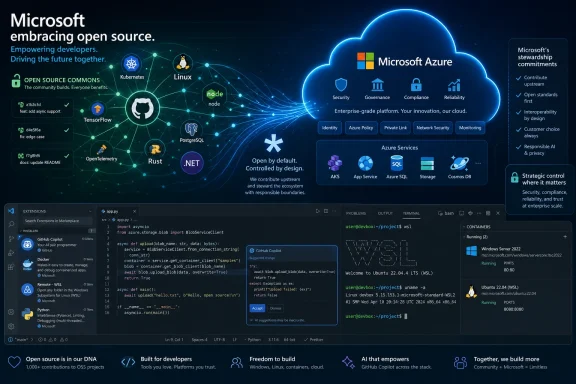
Microsoft’s open-source conversion is real, but it is not romantic: the company that once treated Linux as a legal and commercial threat now maintains major open-source projects, owns GitHub, ships Linux-based infrastructure, and uses open source as a central pillar of Azure, developer tooling, and AI strategy. That shift matters because it changed daily life for developers and administrators who no longer have to choose quite so sharply between Windows and Linux. But it also leaves a harder question hanging over Redmond’s redemption story. Microsoft did not simply discover freedom; it discovered that open source had become the road to the next monopoly-adjacent platform.
The company’s modern posture is easy to admire if you remember the bad old days. It is also easy to misunderstand if you mistake tactical generosity for ideological surrender. Microsoft no longer needs to crush open source at the operating-system layer because the money moved upward, into cloud platforms, developer subscriptions, AI services, identity, management, and hosted infrastructure.
That is the asterisk. Microsoft may love Linux, but it loves Linux most when Linux runs on Microsoft’s terms.
It is fashionable now to treat Steve Ballmer’s “Linux is a cancer” line as a relic from a less enlightened corporate age, like a bad haircut preserved in an annual report. The quote still shocks because it was unusually blunt, but it was not an isolated outburst. It captured a broader Microsoft strategy built around defending Windows, Office, and proprietary APIs from anything that looked like a shared commons.
The early Microsoft worldview was not difficult to understand. Software was property, copying was theft, and the company’s business depended on convincing customers and developers that the safest route was to buy into Microsoft’s stack from the operating system upward. Bill Gates’ 1976 “Open Letter to Hobbyists” predated the open-source movement as we now know it, but the instinct was already there: software had owners, and unpaid sharing threatened the market that Microsoft wanted to build.
By the 2000s, Linux had become more than a hobbyist irritant. It was a server operating system, an enterprise bargaining chip, a symbol of resistance to Windows lock-in, and eventually the base layer for Android. Microsoft’s legal, licensing, and public-relations campaigns reflected that escalation. The company warned of intellectual-property risks, suggested Linux infringed Microsoft patents without fully spelling out the claims, and profited from patent licensing deals with Android hardware makers.
This history matters because it prevents today’s story from becoming too neat. Microsoft was not a misunderstood participant in an open debate over software models. It was the dominant desktop software company treating open source as a threat to its margins, its platform control, and its ability to dictate the rules of commercial computing.
That was the context for the now-famous “Microsoft loves Linux” moment. It was not just a cultural reset. It was a survival memo delivered as a keynote slide.
Azure could not become a serious cloud platform if it treated Linux as an enemy. Enterprise customers wanted to run mixed environments. Startups were building on open-source stacks by default. Developers expected Git workflows, cross-platform tools, and languages that moved faster than traditional Windows release cycles. If Microsoft insisted that the future looked like Windows Server plus Visual Studio plus .NET Framework in the old closed sense, it would have ceded the most important infrastructure market of the next decade.
So Microsoft adapted. It brought Linux workloads into Azure. It made .NET cross-platform. It open-sourced PowerShell. It turned Visual Studio Code into one of the most important developer tools in the world. It embraced Git, joined the Linux Foundation at the top membership tier, acquired GitHub, and eventually open-sourced large parts of Windows Subsystem for Linux.
There is no need to sneer at those moves. They produced real benefits. Developers got better tools. Administrators got more flexible environments. Windows became less hostile to modern development. Microsoft became easier to work with because customers had forced it to become easier to work with.
But that is precisely the point. The company’s conversion was not a spontaneous moral awakening. It was a rational response to the fact that the center of gravity had moved away from the old Windows monopoly.
At the time, many developers feared the worst. Those fears were understandable. Microsoft’s old reputation made it easy to imagine GitHub becoming another proprietary funnel or slowly losing the trust of the communities that made it valuable. That did not happen in the crude way skeptics feared. GitHub did not become a Windows-only outpost, and Microsoft did not bulldoze the culture overnight.
Instead, the more interesting thing happened. GitHub became a commercial platform wrapped around open collaboration. The repositories remained accessible. The open-source workflows remained familiar. But the revenue opportunities expanded around hosting, enterprise management, security scanning, package infrastructure, Codespaces, and, most importantly, Copilot.
That is the modern Microsoft pattern in miniature. Preserve the open surface because the open surface is what attracts developers. Monetize the surrounding services because that is where the platform power accumulates.
Copilot sharpened that logic. Open-source code helped train the broader ecosystem of AI-assisted development, and GitHub’s position gave Microsoft a privileged distribution channel for AI coding tools. Whether one sees that as innovation, appropriation, or both, it demonstrates the new economics of open source. The value is not always in owning the code. The value is often in owning the interface through which developers interact with the code.
It also illustrates why Microsoft’s open-source story requires careful language. The underlying Code - OSS project is open source, but the official Microsoft-distributed VS Code build includes Microsoft branding, telemetry defaults, marketplace integration, and licensing terms that are not identical to a pure community build. For most users, this distinction is invisible. For open-source purists and enterprise compliance teams, it is the whole story.
Microsoft is hardly alone in this model. The industry is full of products that maintain an open core while reserving commercial integrations, hosted services, branding, or premium features. But Microsoft’s version carries more historical weight because the company spent decades mastering platform leverage. When it gives something away, the natural question is not whether the gift is useful. The question is what dependency the gift creates.
VS Code creates a gravitational field. Extensions target it. Tutorials assume it. AI coding tools integrate with it. New developers learn through it. Enterprises standardize on it. Once that happens, the editor becomes less a standalone application than a control point in the developer workflow.
That does not make VS Code bad. It makes it strategic.
The effect on Windows was profound. Instead of losing developers to macOS or Linux laptops, Microsoft could tell them to stay on Windows and bring Linux along. That was not just a convenience feature. It was a defensive move for Windows as a developer platform.
Open-sourcing much of WSL strengthened the message. It answered years of community pressure, gave developers more visibility into the stack, and made Microsoft’s cross-platform pitch feel less performative. For Windows enthusiasts, WSL is one of the clearest signs that modern Microsoft understands how people actually build software now.
Still, the architectural politics are complicated. WSL makes Linux more available, but it also makes Windows more attractive as the host. It reduces the need to choose between ecosystems, but in doing so it helps Windows remain the default workstation for people who might otherwise leave. It is interoperability in service of retention.
That is not a criticism so much as a reminder. WSL is good engineering and good business at the same time. Microsoft’s best open-source moves are usually both.
Azure Linux exists because Microsoft needs a controlled, optimized, supportable Linux base for cloud and container workloads. That is entirely reasonable. Hyperscale cloud providers care deeply about consistency, security patching, image size, boot performance, and integration with their orchestration layers. A Microsoft-maintained Linux distribution is not an ideological contradiction in 2026; it is a cloud operations decision.
But it also reveals how far the battlefield has moved. The question is no longer whether Linux beats Windows Server in some abstract contest. The question is whose cloud, whose management plane, whose identity system, whose observability stack, and whose billing relationship surrounds the Linux workload.
When Microsoft says a large share of Azure compute runs Linux, that is both a real openness story and a cloud capture story. Customers can run the operating system they want, but they are doing it inside Microsoft’s infrastructure. Linux becomes a workload. Azure becomes the business.
This is why “Microsoft loves Linux” can be true and incomplete. Microsoft loves Linux as a customer requirement, as an Azure workload, as a container host, as a developer expectation, and as a way to meet the market where it is. That is very different from saying Microsoft wants computing power to disperse away from large platforms.
That is progress. It is also worth asking why the posture changed.
In the 2000s, Microsoft’s money depended on protecting Windows and Office licensing from commoditization. In the 2020s, Microsoft’s growth depends on cloud consumption, enterprise subscriptions, AI services, security, and platform management. Open-source software no longer has to be defeated for Microsoft to win. In many cases, it has to be welcomed so that workloads, developers, and data flow into Microsoft-controlled commercial layers.
This is the strategic genius of the pivot. Microsoft can be friendlier because the terms of competition are friendlier to its new business. A Linux VM on Azure is not a lost Windows license in the old sense. It is cloud revenue, identity integration, monitoring spend, storage usage, support opportunity, and perhaps a future AI workload.
The company did not stop caring about control. It found more durable forms of control.
When Microsoft open-sources a client extension or improves transparency around a tool, that can be meaningful. But the core value of AI coding assistants often sits elsewhere: in the model, the service, the training pipeline, the ranking system, the telemetry, the integration with enterprise policy, and the subscription relationship. The visible component may be open while the decisive layer remains closed.
This is not unique to Microsoft. The AI industry in general has become adept at borrowing the language of openness while reserving the expensive and powerful parts of the system. Model weights, training data, inference infrastructure, safety layers, and product integrations are often governed by terms that are far removed from traditional open-source expectations.
For developers, the practical concern is not philosophical purity. It is dependency. If an AI coding workflow becomes central to an organization, switching costs rise quickly. Code review habits change. Junior developer training changes. IDE choices change. Security review changes. Procurement changes.
Microsoft understands this better than almost anyone. The company that once won by making Windows the default platform for software distribution now has a chance to make Copilot and GitHub the default platform for software creation.
Sysadmins benefit too. Hybrid environments are less awkward. Microsoft’s documentation and tooling are more likely to acknowledge reality instead of pretending every serious enterprise is a pure Windows shop. Azure’s Linux support is not a side quest. It is core infrastructure.
The security picture is more nuanced. Open development can improve scrutiny, but cloud and AI dependencies create new concentrations of risk. A vulnerability in an open component is one kind of problem. A policy change, outage, pricing shift, telemetry concern, or service dependency in a proprietary platform is another.
The modern Microsoft is easier to live with because it is less doctrinaire. It is also harder to avoid because its services now sit comfortably inside open-source workflows rather than outside them. The old Microsoft demanded allegiance. The new Microsoft offers convenience until allegiance becomes the path of least resistance.
The lesson is that corporate open source is always conditional. It survives when it aligns with business incentives. It expands when it builds markets, recruits developers, reduces friction, or weakens competitors. It contracts when it threatens revenue, control, or strategic leverage.
That does not make it fake. It makes it capitalism with a GitHub repository.
The right posture for developers and IT leaders is neither paranoia nor fan worship. Use the tools. Read the licenses. Understand the difference between open code and open governance. Watch where the hosted service begins. Ask what happens if the pricing changes, the API closes, the extension marketplace shifts, the telemetry policy evolves, or the product becomes inseparable from a paid cloud feature.
Microsoft has earned more trust than it had in 2001. It has not earned a blank check.
The company’s modern posture is easy to admire if you remember the bad old days. It is also easy to misunderstand if you mistake tactical generosity for ideological surrender. Microsoft no longer needs to crush open source at the operating-system layer because the money moved upward, into cloud platforms, developer subscriptions, AI services, identity, management, and hosted infrastructure.
That is the asterisk. Microsoft may love Linux, but it loves Linux most when Linux runs on Microsoft’s terms.
 The Old Microsoft Did Not Merely Dislike Open Source
It is fashionable now to treat Steve Ballmer’s “Linux is a cancer” line as a relic from a less enlightened corporate age, like a bad haircut preserved in an annual report. The quote still shocks because it was unusually blunt, but it was not an isolated outburst. It captured a broader Microsoft strategy built around defending Windows, Office, and proprietary APIs from anything that looked like a shared commons.The early Microsoft worldview was not difficult to understand. Software was property, copying was theft, and the company’s business depended on convincing customers and developers that the safest route was to buy into Microsoft’s stack from the operating system upward. Bill Gates’ 1976 “Open Letter to Hobbyists” predated the open-source movement as we now know it, but the instinct was already there: software had owners, and unpaid sharing threatened the market that Microsoft wanted to build.
By the 2000s, Linux had become more than a hobbyist irritant. It was a server operating system, an enterprise bargaining chip, a symbol of resistance to Windows lock-in, and eventually the base layer for Android. Microsoft’s legal, licensing, and public-relations campaigns reflected that escalation. The company warned of intellectual-property risks, suggested Linux infringed Microsoft patents without fully spelling out the claims, and profited from patent licensing deals with Android hardware makers.
This history matters because it prevents today’s story from becoming too neat. Microsoft was not a misunderstood participant in an open debate over software models. It was the dominant desktop software company treating open source as a threat to its margins, its platform control, and its ability to dictate the rules of commercial computing.
Nadella Changed the Tone Because the Market Changed the Math
Satya Nadella’s arrival as CEO in 2014 gave Microsoft a new vocabulary, but the deeper shift was already being forced by the market. Windows had missed the smartphone era. AWS had defined the cloud era before Azure became a credible challenger. Developers were increasingly building with Linux, containers, JavaScript, Python, Git, and cloud-native tooling that did not revolve around Windows.That was the context for the now-famous “Microsoft loves Linux” moment. It was not just a cultural reset. It was a survival memo delivered as a keynote slide.
Azure could not become a serious cloud platform if it treated Linux as an enemy. Enterprise customers wanted to run mixed environments. Startups were building on open-source stacks by default. Developers expected Git workflows, cross-platform tools, and languages that moved faster than traditional Windows release cycles. If Microsoft insisted that the future looked like Windows Server plus Visual Studio plus .NET Framework in the old closed sense, it would have ceded the most important infrastructure market of the next decade.
So Microsoft adapted. It brought Linux workloads into Azure. It made .NET cross-platform. It open-sourced PowerShell. It turned Visual Studio Code into one of the most important developer tools in the world. It embraced Git, joined the Linux Foundation at the top membership tier, acquired GitHub, and eventually open-sourced large parts of Windows Subsystem for Linux.
There is no need to sneer at those moves. They produced real benefits. Developers got better tools. Administrators got more flexible environments. Windows became less hostile to modern development. Microsoft became easier to work with because customers had forced it to become easier to work with.
But that is precisely the point. The company’s conversion was not a spontaneous moral awakening. It was a rational response to the fact that the center of gravity had moved away from the old Windows monopoly.
GitHub Turned the Commons Into Strategic Terrain
The GitHub acquisition remains the defining symbol of Microsoft’s open-source era because it showed exactly how sophisticated the new strategy had become. Microsoft did not buy a code-hosting company for $7.5 billion merely because it liked pull requests. It bought the social graph, workflow layer, and default collaboration hub of global software development.At the time, many developers feared the worst. Those fears were understandable. Microsoft’s old reputation made it easy to imagine GitHub becoming another proprietary funnel or slowly losing the trust of the communities that made it valuable. That did not happen in the crude way skeptics feared. GitHub did not become a Windows-only outpost, and Microsoft did not bulldoze the culture overnight.
Instead, the more interesting thing happened. GitHub became a commercial platform wrapped around open collaboration. The repositories remained accessible. The open-source workflows remained familiar. But the revenue opportunities expanded around hosting, enterprise management, security scanning, package infrastructure, Codespaces, and, most importantly, Copilot.
That is the modern Microsoft pattern in miniature. Preserve the open surface because the open surface is what attracts developers. Monetize the surrounding services because that is where the platform power accumulates.
Copilot sharpened that logic. Open-source code helped train the broader ecosystem of AI-assisted development, and GitHub’s position gave Microsoft a privileged distribution channel for AI coding tools. Whether one sees that as innovation, appropriation, or both, it demonstrates the new economics of open source. The value is not always in owning the code. The value is often in owning the interface through which developers interact with the code.
Visual Studio Code Shows the Difference Between Open Source and Open Product
Visual Studio Code is one of Microsoft’s greatest developer-relations victories. It is fast, extensible, cross-platform, familiar to beginners, powerful enough for professionals, and popular in communities that would have once reflexively rejected a Microsoft editor. It deserves much of its praise.It also illustrates why Microsoft’s open-source story requires careful language. The underlying Code - OSS project is open source, but the official Microsoft-distributed VS Code build includes Microsoft branding, telemetry defaults, marketplace integration, and licensing terms that are not identical to a pure community build. For most users, this distinction is invisible. For open-source purists and enterprise compliance teams, it is the whole story.
Microsoft is hardly alone in this model. The industry is full of products that maintain an open core while reserving commercial integrations, hosted services, branding, or premium features. But Microsoft’s version carries more historical weight because the company spent decades mastering platform leverage. When it gives something away, the natural question is not whether the gift is useful. The question is what dependency the gift creates.
VS Code creates a gravitational field. Extensions target it. Tutorials assume it. AI coding tools integrate with it. New developers learn through it. Enterprises standardize on it. Once that happens, the editor becomes less a standalone application than a control point in the developer workflow.
That does not make VS Code bad. It makes it strategic.
WSL Is a Bridge, but Bridges Have Tollbooths Nearby
Windows Subsystem for Linux may be the most elegant example of Microsoft turning a former weakness into a strength. For years, developers who needed Linux tools on a Windows machine had to juggle virtual machines, dual-boot setups, remote servers, Cygwin-style compromises, or unofficial workflows. WSL changed that calculation by making Linux environments feel native enough for everyday development.The effect on Windows was profound. Instead of losing developers to macOS or Linux laptops, Microsoft could tell them to stay on Windows and bring Linux along. That was not just a convenience feature. It was a defensive move for Windows as a developer platform.
Open-sourcing much of WSL strengthened the message. It answered years of community pressure, gave developers more visibility into the stack, and made Microsoft’s cross-platform pitch feel less performative. For Windows enthusiasts, WSL is one of the clearest signs that modern Microsoft understands how people actually build software now.
Still, the architectural politics are complicated. WSL makes Linux more available, but it also makes Windows more attractive as the host. It reduces the need to choose between ecosystems, but in doing so it helps Windows remain the default workstation for people who might otherwise leave. It is interoperability in service of retention.
That is not a criticism so much as a reminder. WSL is good engineering and good business at the same time. Microsoft’s best open-source moves are usually both.
Azure Linux Makes the Subtext Official
Nothing punctures the old caricature more cleanly than Microsoft maintaining its own Linux distribution. CBL-Mariner, now branded as Azure Linux in key contexts, would have sounded like satire in the Ballmer era. Today it is simply infrastructure.Azure Linux exists because Microsoft needs a controlled, optimized, supportable Linux base for cloud and container workloads. That is entirely reasonable. Hyperscale cloud providers care deeply about consistency, security patching, image size, boot performance, and integration with their orchestration layers. A Microsoft-maintained Linux distribution is not an ideological contradiction in 2026; it is a cloud operations decision.
But it also reveals how far the battlefield has moved. The question is no longer whether Linux beats Windows Server in some abstract contest. The question is whose cloud, whose management plane, whose identity system, whose observability stack, and whose billing relationship surrounds the Linux workload.
When Microsoft says a large share of Azure compute runs Linux, that is both a real openness story and a cloud capture story. Customers can run the operating system they want, but they are doing it inside Microsoft’s infrastructure. Linux becomes a workload. Azure becomes the business.
This is why “Microsoft loves Linux” can be true and incomplete. Microsoft loves Linux as a customer requirement, as an Azure workload, as a container host, as a developer expectation, and as a way to meet the market where it is. That is very different from saying Microsoft wants computing power to disperse away from large platforms.
The Patent Wars Ended Because the Revenue Model Moved
One reason the new Microsoft feels less threatening is that the old patent saber-rattling has faded from the center of the story. The company is no longer publicly campaigning against Linux in the same way. It has joined open-source defensive efforts, contributed to major projects, and learned that overt hostility would be commercially self-defeating.That is progress. It is also worth asking why the posture changed.
In the 2000s, Microsoft’s money depended on protecting Windows and Office licensing from commoditization. In the 2020s, Microsoft’s growth depends on cloud consumption, enterprise subscriptions, AI services, security, and platform management. Open-source software no longer has to be defeated for Microsoft to win. In many cases, it has to be welcomed so that workloads, developers, and data flow into Microsoft-controlled commercial layers.
This is the strategic genius of the pivot. Microsoft can be friendlier because the terms of competition are friendlier to its new business. A Linux VM on Azure is not a lost Windows license in the old sense. It is cloud revenue, identity integration, monitoring spend, storage usage, support opportunity, and perhaps a future AI workload.
The company did not stop caring about control. It found more durable forms of control.
The AI Layer Reopens Old Questions in New Clothes
GitHub Copilot has made Microsoft’s open-source asterisk harder to ignore because it sits at the intersection of community code, proprietary models, paid services, and developer dependence. It is useful. It is popular. It is also a reminder that the next platform shift may be less about who owns the repository and more about who mediates the act of writing software.When Microsoft open-sources a client extension or improves transparency around a tool, that can be meaningful. But the core value of AI coding assistants often sits elsewhere: in the model, the service, the training pipeline, the ranking system, the telemetry, the integration with enterprise policy, and the subscription relationship. The visible component may be open while the decisive layer remains closed.
This is not unique to Microsoft. The AI industry in general has become adept at borrowing the language of openness while reserving the expensive and powerful parts of the system. Model weights, training data, inference infrastructure, safety layers, and product integrations are often governed by terms that are far removed from traditional open-source expectations.
For developers, the practical concern is not philosophical purity. It is dependency. If an AI coding workflow becomes central to an organization, switching costs rise quickly. Code review habits change. Junior developer training changes. IDE choices change. Security review changes. Procurement changes.
Microsoft understands this better than almost anyone. The company that once won by making Windows the default platform for software distribution now has a chance to make Copilot and GitHub the default platform for software creation.
Windows Users Got a Better Microsoft, Not a Smaller One
For WindowsForum readers, the practical effects of Microsoft’s open-source turn are mostly positive. Windows is a better development environment than it was a decade ago. PowerShell is more useful across platforms. Windows Terminal, WSL, VS Code, GitHub integration, and cloud-native tooling have made Windows machines viable for workflows that once belonged almost exclusively to Linux desktops or Macs.Sysadmins benefit too. Hybrid environments are less awkward. Microsoft’s documentation and tooling are more likely to acknowledge reality instead of pretending every serious enterprise is a pure Windows shop. Azure’s Linux support is not a side quest. It is core infrastructure.
The security picture is more nuanced. Open development can improve scrutiny, but cloud and AI dependencies create new concentrations of risk. A vulnerability in an open component is one kind of problem. A policy change, outage, pricing shift, telemetry concern, or service dependency in a proprietary platform is another.
The modern Microsoft is easier to live with because it is less doctrinaire. It is also harder to avoid because its services now sit comfortably inside open-source workflows rather than outside them. The old Microsoft demanded allegiance. The new Microsoft offers convenience until allegiance becomes the path of least resistance.
Developers Should Trust the Code, Not the Slogan
The lesson is not that Microsoft is secretly unchanged. That argument is too lazy. Companies do evolve, and Microsoft has plainly changed in ways that matter. Many of its engineers are sincere open-source participants. Many of its projects are valuable. Many communities are better off because Microsoft stopped treating Linux as a disease and started treating it as infrastructure.The lesson is that corporate open source is always conditional. It survives when it aligns with business incentives. It expands when it builds markets, recruits developers, reduces friction, or weakens competitors. It contracts when it threatens revenue, control, or strategic leverage.
That does not make it fake. It makes it capitalism with a GitHub repository.
The right posture for developers and IT leaders is neither paranoia nor fan worship. Use the tools. Read the licenses. Understand the difference between open code and open governance. Watch where the hosted service begins. Ask what happens if the pricing changes, the API closes, the extension marketplace shifts, the telemetry policy evolves, or the product becomes inseparable from a paid cloud feature.
Microsoft has earned more trust than it had in 2001. It has not earned a blank check.
The Asterisk Is Where the Strategy Lives
Microsoft’s open-source era is best understood through the concrete trade-offs it creates, not through the emotional whiplash of comparing Ballmer’s rhetoric with Nadella’s.- Microsoft’s embrace of Linux is genuine, but it became inevitable once Azure needed to host the workloads customers were already running.
- GitHub remains indispensable to open source, but it is also one of Microsoft’s most important commercial control points for developer workflow and AI distribution.
- Visual Studio Code and WSL have made Windows dramatically better for developers, while also making it easier for Microsoft to keep those developers inside the Windows ecosystem.
- Azure Linux shows that Microsoft is not merely tolerating Linux; it is productizing Linux for its own cloud operations and customer platform strategy.
- The biggest open-source risk in the Microsoft ecosystem is no longer old-fashioned hostility, but quiet dependency on proprietary services wrapped around open tools.
References
- Primary source: MakeUseOf
Published: Sat, 30 May 2026 19:30:19 GMT
Microsoft’s open-source era still comes with an asterisk
Open source and Microsoft finally became friends with a slightly awkward handshake. www.makeuseof.com
- Related coverage: phoronix.com
Microsoft Rebranding CBL-Mariner Linux Distribution To "Azure Linux" - Phoronix
Microsoft's in-house Linux distribution used for a variety of purposes had been known as CBL-Mariner for 'Common Base Linux' while now it appears to be in the process of transitioning to Azure Linux.www.phoronix.com
- Related coverage: linux.com

Microsoft's Ballmer: Linux is a cancer - Linux.com
Author: JT Smith The Chicago Sun-Times has an interview with Microsoft CEO Steve Ballmer. Here’s what he has to say about Linux: “It’s good competition. It will force us to be innovative. It will force us to justify the prices and value that we deliver. And that’s only...
www.linux.com
- Related coverage: arstechnica.com
Microsoft “loves Linux” as it makes Azure bigger, better - Ars Technica
11 million servers, new giant VMs, and more third-party app support.arstechnica.com - Official source: learn.microsoft.com
Azure Linux Frequently Asked Questions (FAQ) - AKS | Microsoft Learn
Frequently asked questions about Azure Linux on Azure Kubernetes Service (AKS), including pricing, GPU support, certifications, and upgrade processes.learn.microsoft.com - Related coverage: wired.com
Why Microsoft CEO Satya Nadella Loves What Steve Ballmer Once Despised | WIRED
“I don’t want to fight old battles,” says Microsoft CEO Satya Nadella. “I want to fight new ones.” It’s Sunday evening, and Nadella is sitting in a glass-enclosed room at the back of a Japanese restaurant in San Francisco’s North Beach neighborhood, eating sushi with a few reporters. As the meal...www.wired.com
- Related coverage: toppopular.com
Microsoft CBL-Mariner Linux Distribution Rebranded as Azure Linux
In early March 2024, Microsoft decided to rename the Azure Linux repository of its Linux distribution project, previously known as CBL-Mariner (Common Base Linux), which serves as a Linux distribution for Microsoft’s internal infrastructure.toppopular.com - Related coverage: linuxtoday.com

Why Microsoft loves Linux | Linux Today
Bill Gates and Steve Ballmer may have hated Linux, but new Microsoft CEO Satya Nadella says Microsoft loves Linux. What changed Microsoft’s mind?
www.linuxtoday.com
- Related coverage: xataka.com
Desde que Ballmer dijo que Linux era un cáncer, a Nadella y su amor por el Open Source: así ha sido la relación de Microsoft con el SO
'Linux es un cáncer' es una de las frases más recordadas de Steve Ballmer. Hubo más, desde luego pero aquella viene ahora a la mente de muchos usuarios cuando...www.xataka.com - Related coverage: phys.org
- Official source: microsoft.com
Microsoft Fiscal Year 2024 Fourth Quarter Earnings Conference Call
www.microsoft.com
- Related coverage: latestly.com
Microsoft CEO Satya Nadella Says AI Assistant Copilot Accounted for 40% of GitHub Revenue Growth at USD 2 Billion in 2024 | 📲 LatestLY
Artificial intelligence (AI) assistant Copilot accounted for over 40 per cent of GitHub's revenue growth this year as the annual revenue run rate of the open-sourced developer platform has reached $2 billion, according to Satya Nadella, Microsoft Chairman and CEO. 📲 Microsoft CEO Satya...www.latestly.com - Official source: azure.microsoft.com
Developer innovation at the center at GitHub Universe 2025
Discover how GitHub Universe 2025 spotlighted agentic development, AI-powered tools, and developer innovation. Learn more. azure.microsoft.com
- Related coverage: windowscentral.com
Only 3.3% of Microsoft 365 users pay for Copilot | Windows Central
A new report suggests that only a fraction of the Microsoft 365 and Office 365 users who interact with Copilot Chat actually pay for it.www.windowscentral.com - Related coverage: crn.com
Microsoft Q4 2024: CEO Nadella Calls Copilot Growth Rate Fastest For Any M365 Suite
Microsoft CEO Satya Nadella and CFO Amy Hood talk AI, GenAI, Office 365, security, Copilot, GitHub, CapEx and more on Q4 and FY 2024 earnings call.www.crn.com - Related coverage: barchart.com
Microsoft (MSFT) Q4 2024 Earnings Call Transcript
MSFT earnings call for the period ending June 30, 2024.www.barchart.com
- Related coverage: annualreports.ai
- Official source: microsoft.gcs-web.com
- Related coverage: techradar.com
10 products that launched at Microsoft Build — and what happened to them | TechRadar
From Windows 8 to Copilot, here’s everything that was born at Buildwww.techradar.com - Official source: blogs.windows.com
The Windows Subsystem for Linux is now open source
Today we’re very excited to announce the open-source release of the Windows Subsystem for Linux. This is the result of a multiyear effort to prepare for this, and a great closure to the first ever issue raised on the Microsoft/WSL repo:blogs.windows.com - Official source: github.com
GitHub - microsoft/WSL: Windows Subsystem for Linux · GitHub
Windows Subsystem for Linux. Contribute to microsoft/WSL development by creating an account on GitHub. github.com
- Related coverage: alternativeto.net
Microsoft open sources Windows Subsystem for Linux (WSL) and releases code on GitHub | AlternativeTo
Microsoft has open sourced the Windows Subsystem for Linux, making WSL’s code available on GitHub and opening development to the community for contributions. This move closes the first issue ever raised on Microsoft’s WSL repository about open sourcing the project.alternativeto.net - Related coverage: gigazine.net
MicrosoftがWindows Subsystem for Linux(WSL)をオープンソース化してコードをGitHubに公開 - GIGAZINE
Microsoftが、Linuxカーネルを仮想マシン内で実行するためのシステムである「Windows Subsystem for Linux(WSL)」をオープンソース化し、ソースコードをGitHubに公開したことを、2025年5月20日に開催したイベント「Microsoft Build 2025」で発表しました。gigazine.net - Related coverage: bleepingcomputer.com
Microsoft open-sources Windows Subsystem for Linux at Build 2025
Microsoft has open-sourced the Windows Subsystem for Linux (WSL), making its source code available on GitHub, except for a few components that are part of Windows.www.bleepingcomputer.com
