

Microsoft’s quiet infiltration of mission-critical workflows — from Hawaiʻi’s developmental‑disability services to the data fabric that feeds enterprise AI — is more than a PR headline; it’s an incremental but measurable reshaping of the company’s core growth engine. Over the last two weeks two developments crystallized that trend: a public-sector deployment of an AI adverse‑event reporting solution built on Microsoft’s Azure stack, and Microsoft’s purchase of Osmos, a small but strategically positioned data‑engineering startup whose technology plugs directly into Microsoft Fabric. Together they spotlight a simple thesis: Microsoft is shifting from selling raw cloud capacity to selling AI‑ready workflows and data‑operations products that increase usage intensity — and therefore revenue per customer — while also increasing capital intensity on the infrastructure side.
Microsoft’s current strategic posture is “cloud plus AI.” Azure provides the compute and platform services; Microsoft’s growing AI product set — Copilot variants, Azure AI Foundry / Foundry (formerly Azure AI Studio), Fabric and OneLake — is designed to convert customers into ongoing, higher‑margin consumption flows. That strategic pivot is now visible in two directions simultaneously: first, Microsoft and its ecosystem partners are embedding Azure AI into frontline, mission‑critical business processes (healthcare case management being a recent example); second, Microsoft is buying or integrating technologies that reduce the friction of getting enterprise data into Azure and into the right shape for AI. Both trends, taken together, deepen platform stickiness but also accentuate the capital required to host and operate AI workloads at scale.
At the same time, the strategy raises meaningful questions about capital efficiency, competition and regulatory friction. Microsoft’s $80 billion infrastructure commitment underscores the magnitude of the upside it seeks — and the magnitude of the risk if consumption, price‑performance or regulatory acceptance diverges from plan. For investors and enterprise IT leaders, the right framing is not “AI will save or sink Microsoft” but rather: watch whether Microsoft can keep converting operational projects into sustained, higher‑consumption platform relationships while simultaneously bringing down the effective cost of serving those workloads. The Hawaii project and the Osmos deal are early, concrete signals that the company is executing on that two‑part objective — but the payoff will be measured over many quarters, not by a single announcement.
Source: simplywall.st Is Microsoft’s Expanding AI Cloud Footprint Quietly Reshaping Its Core Growth Story (MSFT)? - Simply Wall St News
 Background
Microsoft’s current strategic posture is “cloud plus AI.” Azure provides the compute and platform services; Microsoft’s growing AI product set — Copilot variants, Azure AI Foundry / Foundry (formerly Azure AI Studio), Fabric and OneLake — is designed to convert customers into ongoing, higher‑margin consumption flows. That strategic pivot is now visible in two directions simultaneously: first, Microsoft and its ecosystem partners are embedding Azure AI into frontline, mission‑critical business processes (healthcare case management being a recent example); second, Microsoft is buying or integrating technologies that reduce the friction of getting enterprise data into Azure and into the right shape for AI. Both trends, taken together, deepen platform stickiness but also accentuate the capital required to host and operate AI workloads at scale. What changed this week: the Hawaii deployment and the Osmos deal
RSM’s Azure‑backed adverse event reporting solution
RSM US LLP announced the deployment of an AI‑powered adverse‑event reporting and analytics platform for Hawaiʻi’s Developmental Disabilities Division. The platform uses a collection of Microsoft technologies — Azure, Azure SQL, Azure AI Foundry, Power BI and other Microsoft Data & AI tools — to analyze medical and service data, flag unreported incidents, and surface individuals at elevated risk, serving roughly 3,600 active participants in the program’s first phase. At scale, this type of solution aims to shorten the window between a risky signal and intervention, and it demonstrates how Azure’s AI services are being embedded into public‑sector casework where timeliness and reliability are operationally essential. Why it matters: this isn’t a lightweight POC. It’s a production system that touches vulnerable people and requires regulatory, privacy and reliability guardrails. When a Microsoft cloud configuration plays a direct role in health‑and‑safety workflows, customers confront procurement, compliance and SLA questions with the platform vendor, not only third‑party integrators. That raises the economic and political stickiness of Azure for public and regulated customers, while also exposing Microsoft to greater scrutiny if outages, data issues or algorithmic errors occur.Microsoft’s acquisition of Osmos and what it signals about data readiness
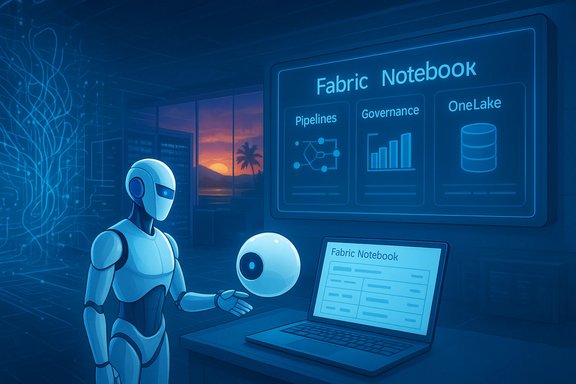
Microsoft announced a deal to acquire Osmos, a Seattle‑area startup focused on automating complex data‑ingestion and transformation workflows and integrating tightly with Microsoft Fabric and OneLake. Osmos’ agentic “AI Data Engineer” and autonomous data‑wrangler capabilities are designed to convert messy, external and semi‑structured sources into production‑grade, AI‑ready tables and Fabric notebooks — effectively shortening time to insight and lowering the human effort required to prepare data for models and analytics. Microsoft framed the deal as a way to “accelerate autonomous data engineering” inside Fabric; Osmos’ product and partner momentum already included Fabric integrations before the acquisition. Why it matters: enterprises consistently cite “data readiness” as the main bottleneck for AI projects. Buying a capability that automates ingestion, mapping, cleaning and validation directly into Fabric moves Microsoft from being a place you host models to being the place that makes your data usable for those models. That accelerates customer value, increases usage of Fabric and OneLake services, and creates a more defensible product flywheel — but it also means Microsoft must ensure the combined system is auditable, explainable and governed.How these moves reshape the investment narrative (and the calculus for returns)
Microsoft’s investment story for long investors has two central pillars today:- AI and cloud investments driving higher customer consumption and stickiness; and
- a willingness to invest heavily in data‑center and AI infrastructure to capture that long‑term consumption.
Technical and commercial implications: product detail and customer impact
Azure AI Foundry / Foundry (platform context)
Microsoft’s Foundry is positioned as an “AI app and agent factory” — a platform for designing, deploying and governing agents and AI apps at enterprise scale. Foundry provides model discovery, multi‑agent orchestration, observability and routing tools that let organizations choose between foundational models from many vendors and route requests to the most cost‑effective and capable model in real time. For customers building production AI — and for partners like RSM — Foundry reduces integration complexity and enables governance at scale.Osmos’ capabilities and Fabric integration
Osmos automates ingestion, schema matching, table merging, cleaning operations and can auto‑generate Fabric‑native notebooks (e.g., Spark/PySpark) with built‑in validation, metric logging and versioning. In practice, this reduces the run‑rate cost of data engineering and lowers the human review cycle. For Microsoft, integrating Osmos inside Fabric has three measurable benefits:- reduces enterprise friction to adopt Fabric and OneLake;
- increases the frequency and volume of data pipelines running inside Fabric; and
- creates lock‑in through embedded operational metadata, lineage and governance.
Real‑world: the Hawaii adverse‑event project
The RSM deployment underscores how these products are used in constrained, regulated environments: the platform ingests clinical and service data, applies detection models to flag anomalies or missed reports, and presents actionable dashboards and casework queues for human review. That combination — automated detection plus human triage — is typical of the safe adoption pattern regulators and risk teams prefer. For Microsoft and Azure, delivering that pattern repeatedly across agencies and regulated industries creates a durable commercial beachhead.The business trade‑offs and principal risks
No strategy is asymptotically positive without its trade‑offs. Microsoft’s drive to convert more enterprise workflows into cloud‑hosted AI consumption faces three major risk vectors:- Capital and margin pressure: Massive investments in GPUs, datacenters and custom networking mean Microsoft’s free cash flow profile will be cyclical and capex‑heavy for the next several years. The $80 billion data‑center plan is real and recent reporting shows material sequential capex increases; generating adequate returns requires both steady demand and continued price‑performance gains in AI hardware and software.
- Competition and substitution risk: Serverless and hybrid competitors — including AWS, Google Cloud and specialized AI providers — are aggressively productizing AI offerings. Separately, efficient new model architectures (and startups claiming dramatically lower training cost) can change consumption economics quickly. The rise of efficient models from Chinese firms like DeepSeek highlights a potential future where model architecture and pricing, not just raw capacity, determine where workloads run. If lower‑cost models move enterprise demand off hyperscale providers or reduce per‑query pricing materially, Microsoft’s revenue mix and margin assumptions could be pressured.
- Regulatory and social licence: When cloud AI is controlling or substantially influencing mission‑critical workflows in healthcare, social expectations for transparency, governance and energy usage increase. Local permitting, energy constraints and political scrutiny of hyperscalers’ data‑center footprints can slow expansions and raise effective operating costs. Microsoft has publicly committed to sustainability goals and to “multiple winners” in AI, but political friction remains a material risk for capital‑intensive growth models.
Financial context: current numbers, projections and modeling caveats
Microsoft’s most recent public financial summary shows a company of extraordinary scale: total revenue for fiscal 2024 was $245.12 billion, and fiscal 2025 reported results (public proxy and filings) show revenue north of $280 billion with net income in the low‑hundreds of billions range depending on accounting and timing. Those base figures matter when projecting the incremental impact of AI adoption: to move the needle materially on a company of Microsoft’s size, AI‑driven revenue must translate into sustained high multiples of incremental consumption over many years. The valuation and forecast cited in the Simply Wall St piece — a model projecting $425.0 billion revenue and $158.4 billion earnings by 2028 — is a plausible, model‑driven view that relies on specific growth assumptions (roughly ~14.7% CAGR in revenue across the intermediate years in that example). Such long‑range forecasts are useful as scenario exercises but depend sensitively on assumptions about:- enterprise AI adoption speed and the elasticity of cloud consumption to Copilot / Fabric usage;
- long‑run capex intensity and Microsoft’s ability to improve price‑performance on inference; and
- macro factors including FX, regulatory changes and competition.
Practical guardrails for judging Microsoft’s AI story
For investors and enterprise buyers seeking to move beyond the hype, here are analytical checkpoints to separate signal from noise:- Consumption tranches: track not just Azure top‑line growth but the split between new customer adds, increased consumption inside existing accounts, and revenue tied to Copilot / Fabric usage. Rising intensity inside existing customers is the most durable indicator of platform power.
- Capex intensity vs. utilization: watch the ratio of incremental capital deployed to incremental revenue from AI workloads. A falling ratio indicates improving capital efficiency; a rising ratio without demand growth is a red flag.
- Product integration outcomes: measure time‑to‑value in pilot deployments — e.g., how long from POC to production for data ingestion + model inference workflows. The shorter the cycle, the faster Microsoft’s Fabic + Osmos + Foundry stack will scale.
- Governance and auditability: for regulated sectors, demand for explainability, ModelOps and data lineage features is non‑negotiable. Microsoft’s ability to bundle those features into Fabric and Foundry will determine whether public entities and health systems scale their deployments.
- Competitive pricing pressure: as efficient models and alternative inference fabrics emerge, monitor both per‑query pricing and customer willingness to pay for vendor‑managed convenience. If customers trade down to cheaper models without sacrificing business outcomes, consumption dynamics could shift.
Conclusion — incremental but structural
The Hawaiʻi deployment and the Osmos acquisition are not game‑ending on their own. But they are representative of a broader trend: Microsoft is methodically converting AI interest into productized workflows (Copilot, Foundry, Fabric) and buying the low‑level data‑engineering plumbing that reduces customer friction. That combination increases the odds of successful monetization for Azure and Fabric, because it moves Microsoft closer to the data and processes that create recurring, mission‑critical demand.At the same time, the strategy raises meaningful questions about capital efficiency, competition and regulatory friction. Microsoft’s $80 billion infrastructure commitment underscores the magnitude of the upside it seeks — and the magnitude of the risk if consumption, price‑performance or regulatory acceptance diverges from plan. For investors and enterprise IT leaders, the right framing is not “AI will save or sink Microsoft” but rather: watch whether Microsoft can keep converting operational projects into sustained, higher‑consumption platform relationships while simultaneously bringing down the effective cost of serving those workloads. The Hawaii project and the Osmos deal are early, concrete signals that the company is executing on that two‑part objective — but the payoff will be measured over many quarters, not by a single announcement.
Source: simplywall.st Is Microsoft’s Expanding AI Cloud Footprint Quietly Reshaping Its Core Growth Story (MSFT)? - Simply Wall St News
