

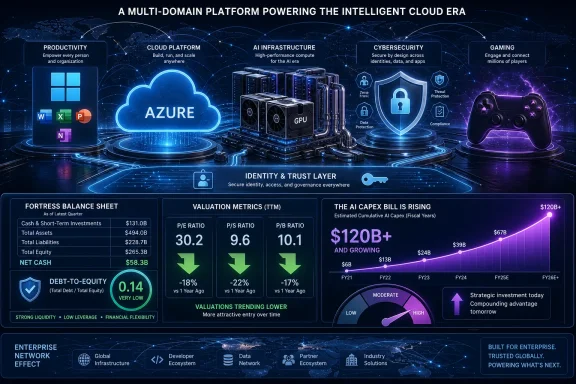
Microsoft’s latest peer-comparison snapshot, published July 2026 by Benzinga’s automated content engine and reviewed by an editor, argues that Microsoft looks financially stronger than four software-industry peers because its debt-to-equity ratio is just 0.14 and its operating profit metrics remain unusually large. The more interesting story is not that Microsoft has a tidy balance sheet. It is that the old software-industry comparison table is struggling to describe what Microsoft has become. A company once valued as a Windows-and-Office toll collector is now being judged while it is simultaneously a cloud utility, an AI infrastructure builder, a cybersecurity vendor, a gaming publisher, and the default identity layer for much of enterprise computing.
Benzinga’s core takeaway is straightforward: Microsoft’s price-to-earnings, price-to-book, and price-to-sales ratios appear low compared with its selected software peers, suggesting possible undervaluation. At the same time, the comparison flags lower return on equity and slower revenue growth as caution signs. That is the neat, automated version of the story.
But Microsoft is not neatly comparable to a narrow peer set. A low valuation multiple against smaller, faster-growing software names can mean opportunity, but it can also mean the market is pricing a company with different constraints. Microsoft’s size makes spectacular percentage growth harder, while its capital commitments make old software-margin assumptions less clean than they used to be.
The debt-to-equity figure is real enough as a signal. A ratio of 0.14 says Microsoft is not leaning heavily on borrowed money to fund its ambitions. In an industry where many companies used cheap capital to buy growth, that conservatism still matters.
Yet the balance-sheet comfort can obscure the operational shift underneath. Microsoft may not be borrowing recklessly, but it is spending aggressively. The company’s AI and cloud buildout has turned capital expenditure into one of the central questions around the stock, the platform, and the future of Windows-era enterprise computing.
That is why the debt-to-equity ratio matters, but not in the way a simple peer table implies. It does not merely say Microsoft is safer than competitors. It says Microsoft can attempt things that competitors cannot attempt without changing their risk profile.
This is the heart of Microsoft’s current advantage. It can pour money into data centers, GPUs, networking, and AI services while still presenting investors with the profile of a financially disciplined mega-cap. Smaller software firms may show better growth rates or cleaner software margins, but they do not have Microsoft’s cross-subsidizing machinery.
The tradeoff is that Microsoft’s strength also makes it harder to analyze. A traditional software company sells code. Microsoft sells code, infrastructure, compliance comfort, developer ecosystems, security posture, and procurement simplicity. Its financial ratios are not wrong; they are just increasingly blunt instruments.
The concern is incomplete because Microsoft’s growth is no longer evenly distributed across a single software business. Azure, AI services, Microsoft 365 commercial, security, and cloud infrastructure are pulling the company forward, while more mature segments naturally grow at a slower pace. A blended corporate revenue-growth figure can flatten that reality into something less informative than it appears.
The AI boom has also changed what investors should expect from Microsoft. For years, the ideal software company had high margins, low capital intensity, and recurring revenue. Microsoft still has recurring revenue, but AI infrastructure is capital-hungry in a way that classic software was not.
This is where the comparison with software peers becomes strained. Microsoft is being valued partly as a software company and partly as a cloud-and-AI utility. The first model rewards margin purity; the second rewards capacity, scale, and utilization. Those are not the same game.
Microsoft’s own executives have framed the spending as necessary to meet cloud and AI demand. That is credible. Azure capacity constraints have been a recurring theme in Microsoft commentary, and the company has repeatedly tied capital investment to customer demand rather than speculative empire-building.
Still, investors are right to ask when spending converts into durable returns. AI infrastructure is not a one-time upgrade cycle like replacing office PCs. It requires land, power, chips, cooling, networking, and continuous refreshes. The useful life of today’s AI hardware may be shorter than the depreciation schedules investors grew comfortable with during the classic cloud era.
That does not make Microsoft’s strategy reckless. It makes the company’s old valuation shorthand less useful. A low debt-to-equity ratio tells us Microsoft can afford the race; it does not tell us what the race will cost to win.
For a smaller software company, high ROE may signal a lean, efficient business. For Microsoft, lower relative ROE may simply reflect the scale of the machine. The denominator is huge because the company has spent decades accumulating capital, intellectual property, infrastructure, and retained profits.
That said, investors should not dismiss the metric entirely. If Microsoft is spending heavily on AI infrastructure, the question becomes whether those investments will lift returns or dilute them. A company can be profitable in absolute terms and still become less efficient at converting capital into earnings.
This is the emerging tension in Microsoft’s story. The company’s EBITDA and gross profit remain formidable, but the next phase depends on whether AI services become high-margin software-like revenue or lower-margin infrastructure throughput. Microsoft wants the former. The economics of the hardware race keep threatening to pull it toward the latter.
This is why Microsoft can monetize AI differently from a pure AI startup. It does not need every user to visit a new destination. It can place AI into workflows users already inhabit: the desktop, Office documents, Teams meetings, GitHub repositories, security consoles, and Azure management tools.
That distribution power is difficult to capture in a peer comparison. A software company with a great product still has to acquire users, fight churn, and win procurement cycles. Microsoft often begins inside the enterprise perimeter, already trusted by IT, already integrated with identity, and already present on the endpoint.
The risk is that this same ubiquity raises expectations. If Copilot becomes just another bundled feature rather than a must-have productivity layer, Microsoft may have spent infrastructure-scale money to produce software-suite-level upsell. That would still be a business many companies would envy, but it would not justify every bullish AI assumption.
The company also competes with open-source ecosystems and developer habits. GitHub gives Microsoft a privileged position, but developers are not a captive audience in the same way Office users once were. AI coding tools, model providers, and cloud platforms are changing fast enough that yesterday’s default can become tomorrow’s legacy burden.
Google has its own AI stack, from chips to models to cloud services. Amazon Web Services remains the infrastructure giant that Azure must keep chasing in many enterprise categories. Oracle has found new relevance by selling cloud capacity into the AI boom. The competitive field is not a peer group; it is a map of overlapping empires.
That matters because Microsoft’s advantage is breadth, not uncontested supremacy. Breadth lets the company bundle, integrate, and absorb shocks. It also creates management complexity and regulatory exposure, especially when the same company controls productivity software, operating systems, cloud infrastructure, identity, security, and AI assistants.
That is not a contradiction. It is the new shape of Big Tech finance. The winners of the software era are using their cash flows to buy position in the AI infrastructure era, and Microsoft is doing so from one of the strongest starting points in the industry.
The automated comparison becomes misleading only if readers treat it as the whole picture. A low debt-to-equity ratio is not a buy thesis by itself. Low multiples are not automatically bargains. High EBITDA does not answer whether the next dollar of AI revenue will be as profitable as the last dollar of Office revenue.
The better interpretation is that Microsoft has more room for error than almost anyone else. That is valuable. It is not the same thing as being risk-free.
This is where Microsoft’s enterprise base gives it an edge. CIOs do not adopt technology the way consumers do. They standardize, pilot, govern, audit, and negotiate. Microsoft knows how to sell into that world better than almost anyone.
But enterprise adoption can also be slow. The fact that AI is impressive does not mean every company immediately knows how to deploy it profitably. Security, compliance, data quality, licensing complexity, and change management all slow the conversion of AI hype into paid, sticky usage.
Microsoft’s bet is that patience favors the platform owner. If AI becomes a feature woven through enterprise software rather than a standalone destination, Microsoft is positioned beautifully. If AI remains fragmented among specialized tools, model providers, and custom workflows, the platform advantage becomes less absolute.
That restlessness is part of the company’s modern identity under Satya Nadella. Microsoft has spent the past decade escaping the caricature of the Windows monopoly. It embraced Linux in Azure, bought GitHub, expanded cross-platform Office, pushed Teams, and turned security into a major growth engine.
AI is the next chapter of that reinvention, but it is also the most expensive. Cloud was capital-intensive; AI cloud is more so. Software margins used to be Microsoft’s superpower. Now the company is trying to preserve that superpower while building the physical substrate for a new computing layer.
That is why the debt number matters, but only as the beginning of the analysis. Microsoft’s financial fortress gives it permission to be restless. It does not guarantee that every restless bet will pay off.
Both readings can be true at once. That is what makes Microsoft difficult to categorize and difficult to dismiss. The company is financially conservative in its capital structure and strategically aggressive in its spending plans.
For investors, admins, and Windows watchers, the practical conclusions are narrower than the hype cycle suggests:
 Microsoft Looks Cheap Only If You Squint at the Right Column
Benzinga’s core takeaway is straightforward: Microsoft’s price-to-earnings, price-to-book, and price-to-sales ratios appear low compared with its selected software peers, suggesting possible undervaluation. At the same time, the comparison flags lower return on equity and slower revenue growth as caution signs. That is the neat, automated version of the story.But Microsoft is not neatly comparable to a narrow peer set. A low valuation multiple against smaller, faster-growing software names can mean opportunity, but it can also mean the market is pricing a company with different constraints. Microsoft’s size makes spectacular percentage growth harder, while its capital commitments make old software-margin assumptions less clean than they used to be.
The debt-to-equity figure is real enough as a signal. A ratio of 0.14 says Microsoft is not leaning heavily on borrowed money to fund its ambitions. In an industry where many companies used cheap capital to buy growth, that conservatism still matters.
Yet the balance-sheet comfort can obscure the operational shift underneath. Microsoft may not be borrowing recklessly, but it is spending aggressively. The company’s AI and cloud buildout has turned capital expenditure into one of the central questions around the stock, the platform, and the future of Windows-era enterprise computing.
The Balance Sheet Is Strong Because the Franchise Is Stronger
Microsoft’s low debt burden is not an accident of financial hygiene. It is the result of decades of compounding enterprise lock-in: Windows licensing, Office subscriptions, Azure consumption, SQL Server, GitHub, LinkedIn, Dynamics, security tooling, and an increasingly unavoidable Microsoft 365 identity stack. Few companies can fund a generational infrastructure race largely from internal cash flow.That is why the debt-to-equity ratio matters, but not in the way a simple peer table implies. It does not merely say Microsoft is safer than competitors. It says Microsoft can attempt things that competitors cannot attempt without changing their risk profile.
This is the heart of Microsoft’s current advantage. It can pour money into data centers, GPUs, networking, and AI services while still presenting investors with the profile of a financially disciplined mega-cap. Smaller software firms may show better growth rates or cleaner software margins, but they do not have Microsoft’s cross-subsidizing machinery.
The tradeoff is that Microsoft’s strength also makes it harder to analyze. A traditional software company sells code. Microsoft sells code, infrastructure, compliance comfort, developer ecosystems, security posture, and procurement simplicity. Its financial ratios are not wrong; they are just increasingly blunt instruments.
AI Has Turned Microsoft From a Software Compounder Into an Infrastructure Landlord
Microsoft’s official fiscal third-quarter 2026 results, announced in April, showed revenue of $82.9 billion, up 18 percent year over year, with diluted earnings per share of $4.27. Microsoft also said Microsoft Cloud revenue reached $54.5 billion, up 29 percent. Those numbers make the “low revenue growth” concern in the Benzinga snapshot feel incomplete rather than false.The concern is incomplete because Microsoft’s growth is no longer evenly distributed across a single software business. Azure, AI services, Microsoft 365 commercial, security, and cloud infrastructure are pulling the company forward, while more mature segments naturally grow at a slower pace. A blended corporate revenue-growth figure can flatten that reality into something less informative than it appears.
The AI boom has also changed what investors should expect from Microsoft. For years, the ideal software company had high margins, low capital intensity, and recurring revenue. Microsoft still has recurring revenue, but AI infrastructure is capital-hungry in a way that classic software was not.
This is where the comparison with software peers becomes strained. Microsoft is being valued partly as a software company and partly as a cloud-and-AI utility. The first model rewards margin purity; the second rewards capacity, scale, and utilization. Those are not the same game.
The “Undervalued” Argument Runs Into the Cost of Staying Ahead
If Microsoft’s multiples look low compared with peers, there are two plausible explanations. One is that the market is underpricing a dominant company. The other is that investors are applying a discount for the cost of defending that dominance in the AI era.Microsoft’s own executives have framed the spending as necessary to meet cloud and AI demand. That is credible. Azure capacity constraints have been a recurring theme in Microsoft commentary, and the company has repeatedly tied capital investment to customer demand rather than speculative empire-building.
Still, investors are right to ask when spending converts into durable returns. AI infrastructure is not a one-time upgrade cycle like replacing office PCs. It requires land, power, chips, cooling, networking, and continuous refreshes. The useful life of today’s AI hardware may be shorter than the depreciation schedules investors grew comfortable with during the classic cloud era.
That does not make Microsoft’s strategy reckless. It makes the company’s old valuation shorthand less useful. A low debt-to-equity ratio tells us Microsoft can afford the race; it does not tell us what the race will cost to win.
Return on Equity Is a Warning Light, Not a Verdict
Benzinga’s automated analysis flags Microsoft’s low return on equity compared with peers as a sign of lower profitability. That deserves attention, but it also needs context. Return on equity can look less exciting for mature giants with enormous equity bases, diversified assets, and large retained earnings.For a smaller software company, high ROE may signal a lean, efficient business. For Microsoft, lower relative ROE may simply reflect the scale of the machine. The denominator is huge because the company has spent decades accumulating capital, intellectual property, infrastructure, and retained profits.
That said, investors should not dismiss the metric entirely. If Microsoft is spending heavily on AI infrastructure, the question becomes whether those investments will lift returns or dilute them. A company can be profitable in absolute terms and still become less efficient at converting capital into earnings.
This is the emerging tension in Microsoft’s story. The company’s EBITDA and gross profit remain formidable, but the next phase depends on whether AI services become high-margin software-like revenue or lower-margin infrastructure throughput. Microsoft wants the former. The economics of the hardware race keep threatening to pull it toward the latter.
Windows Still Matters Because It Is the Distribution Layer
For WindowsForum readers, the financial story is not abstract. Microsoft’s investor narrative increasingly runs through cloud and AI, but Windows remains one of the company’s most important distribution surfaces. Copilot, Microsoft 365, Edge, Defender, identity services, and developer tooling all touch Windows in ways that reinforce the broader platform.This is why Microsoft can monetize AI differently from a pure AI startup. It does not need every user to visit a new destination. It can place AI into workflows users already inhabit: the desktop, Office documents, Teams meetings, GitHub repositories, security consoles, and Azure management tools.
That distribution power is difficult to capture in a peer comparison. A software company with a great product still has to acquire users, fight churn, and win procurement cycles. Microsoft often begins inside the enterprise perimeter, already trusted by IT, already integrated with identity, and already present on the endpoint.
The risk is that this same ubiquity raises expectations. If Copilot becomes just another bundled feature rather than a must-have productivity layer, Microsoft may have spent infrastructure-scale money to produce software-suite-level upsell. That would still be a business many companies would envy, but it would not justify every bullish AI assumption.
Competitors Are Not Standing Still, But They Are Not Fighting the Same War
Comparing Microsoft to “software industry” peers can make sense for a screening table, but it misses the multidimensional nature of the competition. Microsoft competes with Google in productivity and cloud AI, Amazon in infrastructure, Salesforce in business applications, Oracle in databases and enterprise workloads, Apple at the edge of personal computing, and a long list of security vendors across the enterprise stack.The company also competes with open-source ecosystems and developer habits. GitHub gives Microsoft a privileged position, but developers are not a captive audience in the same way Office users once were. AI coding tools, model providers, and cloud platforms are changing fast enough that yesterday’s default can become tomorrow’s legacy burden.
Google has its own AI stack, from chips to models to cloud services. Amazon Web Services remains the infrastructure giant that Azure must keep chasing in many enterprise categories. Oracle has found new relevance by selling cloud capacity into the AI boom. The competitive field is not a peer group; it is a map of overlapping empires.
That matters because Microsoft’s advantage is breadth, not uncontested supremacy. Breadth lets the company bundle, integrate, and absorb shocks. It also creates management complexity and regulatory exposure, especially when the same company controls productivity software, operating systems, cloud infrastructure, identity, security, and AI assistants.
The Automated Table Gets the Facts Right and the Story Half Right
Benzinga’s article is useful because it captures the paradox. Microsoft can look undervalued on some ratios while also looking less exciting on growth and ROE. It can appear financially conservative while making one of the most aggressive infrastructure bets in corporate technology.That is not a contradiction. It is the new shape of Big Tech finance. The winners of the software era are using their cash flows to buy position in the AI infrastructure era, and Microsoft is doing so from one of the strongest starting points in the industry.
The automated comparison becomes misleading only if readers treat it as the whole picture. A low debt-to-equity ratio is not a buy thesis by itself. Low multiples are not automatically bargains. High EBITDA does not answer whether the next dollar of AI revenue will be as profitable as the last dollar of Office revenue.
The better interpretation is that Microsoft has more room for error than almost anyone else. That is valuable. It is not the same thing as being risk-free.
The Investor Debate Is Really About Time
Microsoft’s current valuation debate is less about whether the company is strong and more about how long investors are willing to wait for AI spending to mature. If demand keeps rising, Azure capacity fills, and Copilot becomes a standard enterprise line item, today’s spending will look like disciplined expansion. If adoption is slower, pricing weakens, or model costs remain stubbornly high, the same spending will look like margin compression dressed up as strategy.This is where Microsoft’s enterprise base gives it an edge. CIOs do not adopt technology the way consumers do. They standardize, pilot, govern, audit, and negotiate. Microsoft knows how to sell into that world better than almost anyone.
But enterprise adoption can also be slow. The fact that AI is impressive does not mean every company immediately knows how to deploy it profitably. Security, compliance, data quality, licensing complexity, and change management all slow the conversion of AI hype into paid, sticky usage.
Microsoft’s bet is that patience favors the platform owner. If AI becomes a feature woven through enterprise software rather than a standalone destination, Microsoft is positioned beautifully. If AI remains fragmented among specialized tools, model providers, and custom workflows, the platform advantage becomes less absolute.
The Numbers Say Microsoft Is Safe; the Strategy Says It Is Restless
The most striking thing about Microsoft in 2026 is how little it resembles a complacent incumbent. A company with Windows, Office, Azure, GitHub, Xbox, LinkedIn, and a massive security business could have chosen to harvest cash and defend margins. Instead, Microsoft is spending as though the next platform shift is already underway and as though missing it would be more dangerous than overinvesting.That restlessness is part of the company’s modern identity under Satya Nadella. Microsoft has spent the past decade escaping the caricature of the Windows monopoly. It embraced Linux in Azure, bought GitHub, expanded cross-platform Office, pushed Teams, and turned security into a major growth engine.
AI is the next chapter of that reinvention, but it is also the most expensive. Cloud was capital-intensive; AI cloud is more so. Software margins used to be Microsoft’s superpower. Now the company is trying to preserve that superpower while building the physical substrate for a new computing layer.
That is why the debt number matters, but only as the beginning of the analysis. Microsoft’s financial fortress gives it permission to be restless. It does not guarantee that every restless bet will pay off.
The Ratios Point to a Bargain, but the Capex Bill Writes the Fine Print
The cleanest reading of the Benzinga comparison is that Microsoft remains one of the strongest companies in software, with less leverage than major peers and enough operating muscle to make its valuation look reasonable. The messier reading is that the market is already looking past the old software model and asking what AI-scale infrastructure will do to future returns.Both readings can be true at once. That is what makes Microsoft difficult to categorize and difficult to dismiss. The company is financially conservative in its capital structure and strategically aggressive in its spending plans.
For investors, admins, and Windows watchers, the practical conclusions are narrower than the hype cycle suggests:
- Microsoft’s low debt-to-equity ratio shows that the company is funding its ambitions from a position of unusual financial strength.
- The “undervalued” signal from low valuation multiples should be weighed against the rising capital intensity of cloud and AI infrastructure.
- Microsoft’s slower percentage revenue growth is partly a function of scale, not necessarily a sign that the business is weakening.
- The company’s Windows, Microsoft 365, Azure, security, and identity footprint gives it distribution advantages that most software peers cannot match.
- The biggest risk is not debt but whether AI spending produces durable, high-margin enterprise revenue quickly enough to satisfy investors.
- Traditional software peer comparisons are useful as a snapshot, but they understate how much Microsoft now competes as an infrastructure platform.
References
- Primary source: Benzinga
Published: 2026-07-07T09:59:13.740773
Loading…
www.benzinga.com - Official source: microsoft.com
FY26 Q3 - Performance - Investor Relations - Microsoft
FY26 Q3 - Performance - Investor Relations - Microsoftwww.microsoft.com
- Related coverage: windowsforum.com
Loading…
windowsforum.com - Related coverage: finance.yahoo.com
Microsoft reports 23% increase in net income for Q3 FY26 to $31.8bn
Redmond’s revenue for the reported quarter soared to $82.9bn, an 18% rise from $70bn in Q3 FY25.finance.yahoo.com - Related coverage: tomshardware.com
Google, Microsoft, Meta, and Amazon capex spending to hit $725 billion in 2026, up 77% from last year — analyst says bear thesis is 'garbage' | Tom's Hardware
Microsoft's CFO attributed $25 billion of its record capex budget to rising memory chip prices.www.tomshardware.com - Related coverage: tikr.com
Microsoft Stock Hits $82.9B Revenue as Azure Grows 40% in Q3 FY2026 | TIKR.com
Microsoft’s AI business hit $37B in annualized revenue this quarter. The bigger question is whether $190B in CapEx converts fast enough. www.tikr.com
- Related coverage: windowscentral.com
CEO Satya Nadella insists Microsoft Copilot AI is widely used | Windows Central
Satya Nadella says Microsoft’s Copilot AI is seeing strong adoption, even as investors question the growth of Azure and Microsoft 365.www.windowscentral.com