

Microsoft’s framing of a single, unified security platform as the antidote to AI’s expanding attack surface is no longer rhetoric — it’s rapidly becoming product strategy, roadmap, and go‑to‑market reality for enterprise defenders. At a recent Microsoft AI‑focused event, senior product leaders laid out a defensive architecture that treats agents, generative models, and the data that feeds them as a single security problem to be discovered, assessed, protected, and governed from one pane of glass. The pitch is straightforward: if AI multiplies the ways sensitive information can leak or be manipulated, then only a purpose‑built, integrated security stack — combining data governance, posture management, threat protection, and compliance — can realistically keep pace.
Two clear signals mark this shift. First, Microsoft has introduced centralized surfaces that aggregate signals about AI usage and AI assets so security teams can see “where AI lives” in their environment. Second, the company has added AI‑specific controls — from adaptive DLP to classification that prevents sensitive data from being included in prompts — and folded them into governance and compliance workflows that address emerging regulatory requirements. Those moves reframed the problem from point solutions protecting individual apps to a horizontal security problem that needs orchestration and lifecycle controls.
That said, tooling alone won’t eliminate the problem. Organizations must couple unified technology with disciplined governance, continual testing, and realistic expectations about what automated controls can and cannot do. Vendors will continue to innovate, but so will attackers. The path forward for security teams is clear: build inventory, apply context‑aware controls, harden data hygiene, and treat regulatory accountability as a design constraint — not an afterthought. Only with that combination will enterprises be able to harness AI’s productivity gains while holding the expanding attack surface to an acceptable level.
Source: Cloud Wars Microsoft Positions Unified Security as Key to Managing AI’s Expanding Attack Surface
 Background
Why Microsoft is refocusing security around AI
Enterprises are adopting generative AI and autonomous agents in production faster than policy and tooling can keep up. As usage spreads from pilot projects into line‑of‑business workflows, so do new attack vectors: data pasted into chat prompts, credentialed agents that act on behalf of users, prompt injection and jailbreak techniques, and model vulnerabilities that let adversaries influence outcomes. Microsoft’s response has been to extend its existing security portfolio — Defender, Entra, Purview, Sentinel and Security Copilot — into features and dashboards explicitly designed to discover, score, and mitigate AI‑specific risk across an organization’s estate.Two clear signals mark this shift. First, Microsoft has introduced centralized surfaces that aggregate signals about AI usage and AI assets so security teams can see “where AI lives” in their environment. Second, the company has added AI‑specific controls — from adaptive DLP to classification that prevents sensitive data from being included in prompts — and folded them into governance and compliance workflows that address emerging regulatory requirements. Those moves reframed the problem from point solutions protecting individual apps to a horizontal security problem that needs orchestration and lifecycle controls.
The expanding attack surface in the AI era
Concrete threats to watch
AI doesn’t invent new classes of risk — it amplifies them and creates new operational patterns that change how those risks manifest. Security leaders must now address:- Data leakage through prompts and agents. Employees pasting proprietary documents into public chat, or autonomous agents unintentionally exfiltrating customer records, create avenues for sensitive data to escape traditional perimeter defenses.
- Prompt injection and jailbreaks. Malicious inputs that subvert model behavior can cause confidential outputs or privileged actions.
- Model vulnerabilities and poisoning. Both training data and runtime interactions can be manipulated to change model outputs or degrade reliability.
- Hallucinations and unreliable outputs. AI systems that fabricate facts introduce downstream risk in decision‑making and regulatory reporting.
- Shadow AI and unmanaged third‑party models. Unsanctioned apps and external model endpoints operating outside IT visibility increase blind spots.
Two core security questions enterprises must answer
Microsoft’s leadership has distilled the AI security problem into two fundamental verification questions that every program must address:- Do I trust the data? — Is the provenance, sensitivity, and access posture of the underlying data known and enforced?
- Is the AI system reliable, safe, and secure? — Are models, agents, and applications configured and monitored to resist misuse and adversary influence?
Microsoft’s unified approach: what it looks like in practice
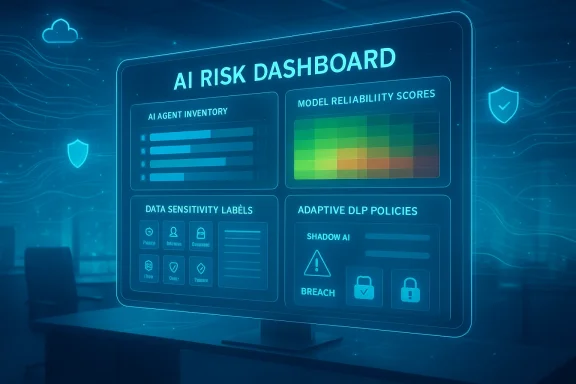
A single pane of glass for AI risk
Microsoft has been explicit about building a unified view that aggregates signals from identity, data, and threat protection systems. New dashboard and inventory capabilities are intended to give CISOs and AI risk leaders a consolidated picture of agents, models, and AI applications across the estate, with prioritization mechanisms to focus remediation. The integration pulls together:- Inventory and discovery from endpoint and cloud telemetry to locate AI usage and agents.
- Risk scoring from cloud app catalogs that evaluate third‑party AI services.
- Data posture and sensitivity signals from Purview to identify where sensitive content exists and how it’s labeled.
- Identity signals from Entra (conditional access, device posture).
- Threat signals and investigation assistance from Defender and Security Copilot.
Data protection and hygiene: Purview and adaptive DLP
Microsoft’s data governance stack — Microsoft Purview — is central to the approach. Key elements to note:- Discovery and classification at scale. Purview catalogs data, applies sensitivity labels, and allows teams to find data sets used by AI applications.
- Adaptive DLP and policies that follow context. DLP rules can be tuned based on user risk, data sensitivity and the application context (for example, preventing sensitive content from being pasted into Copilot or an external AI web app).
- Data Security Posture Management (DSPM). DSPM capabilities surface oversharing risks (e.g., SharePoint sites with wide access) and recommend remediation — helping to reduce the “flat” permission environments that make data easily searchable by an AI.
- Protection at prompt boundaries. Templates and policy engines are being extended to detect and block attempts to input sensitive data into generative AI endpoints from managed endpoints or browsers.
App discovery, risk scoring and Shadow AI controls
Defender for Cloud Apps (a CASB and cloud discovery tool) has been updated to treat generative AI as a first‑class category. Capabilities include:- Cloud discovery and category filters to surface usage of generative AI apps from network telemetry and endpoint signals.
- A catalog risk score for cloud apps that aggregates security, compliance, legal and general maturity signals; this score can be used to auto‑sanction or block applications.
- Session controls and blocking workflows that can feed endpoint protections and conditional access policies, enabling centralized mitigation for unsanctioned AI usage.
Governance and compliance: Compliance Manager and reporting
Regulatory pressure is real. The EU AI Act, national AI action plans, and evolving industry rules impose documentation, incident reporting and lifecycle obligations that demand traceability. Microsoft’s compliance tooling attempts to help by:- Offering assessment templates and self‑assessment workflows to evaluate posture against regulatory frameworks.
- Producing audit evidence and model configuration reports so organizations can show how a model was configured and what safety settings were applied.
- Providing recommended remediations and step‑by‑step implementation guidance for gaps identified in governance reviews.
Agent controls and portfolio management
Microsoft is positioning agent management — registries, control planes and lifecycle tooling — as a necessary control for environments where many autonomous agents will coexist. Capabilities aim to:- Maintain a registry of approved agents and their identities.
- Provide access control, policy inheritance and centralized audit logging for agent actions.
- Integrate agent telemetry into the broader security dashboard so agents become discoverable risk entities rather than invisible scripts.
What this unified approach gets right
Strengths and pragmatic benefits
- Visibility at scale. Consolidating identity, data and threat signals reduces the “you can’t secure what you can’t see” problem. An AI inventory and risk scorecard give teams a starting point for prioritization.
- Contextual controls. Adaptive DLP and label‑aware protection make it possible to prevent sensitive content from being included in prompts without broadly disabling AI productivity.
- Operational workflow alignment. Giving security teams the ability to triage, assign and document remediation tasks (including using AI to assist investigations) shortens mean time to respond.
- Regulatory focus. Built‑in posture assessments and evidence generation make the compliance conversation more tractable for organizations subject to EU, UK or other AI regulations.
- Leverage of existing telemetry. Organizations already using Defender, Entra and Purview get incremental value when these services are orchestrated together, reducing the need to bolt in a separate, bespoke AI governance stack.
Where the unified pitch falls short or raises risks
Integration is not a substitute for design
A single dashboard is valuable, but it can create a false sense of completeness. Aggregated signals help prioritize, but they do not magically fix the underlying engineering challenges that cause model unreliability, such as biased training data or insufficient adversarial testing.Coverage gaps and third‑party models
- External model governance remains hard. Many public or third‑party LLM providers expose APIs and models outside of corporate boundaries. Microsoft’s discovery and blocking can reduce accidental exfiltration, but controlling model training sets, external inference logs, and third‑party model drift lies partly outside the defender’s direct control.
- Not all apps or agents are equally visible. Shadow agents running from unmanaged devices or private cloud instances can still evade discovery if telemetry isn’t comprehensive.
Vendor concentration and lock‑in risks
A tightly integrated security stack simplifies operations, but it also increases dependency on a single vendor for telemetry, control and remediation. That has implications for negotiation leverage, diversity of detection approaches, and the potential for systemic blind spots if one vendor’s detection model has an unknown failure mode.Operational complexity and specialist skills
Configuring sensitivity labels, adaptive DLP, app risk scoring, conditional access, and host‑level controls across a large estate is a nontrivial engineering and change‑management effort. Smaller organizations risk misconfiguration. The tooling reduces effort, but practitioners still need to design labeling taxonomies, define acceptable AI workflows, and run continuous validation.Cost and licensing complexity
Many of the advanced controls (adaptive protection, endpoint DLP, integrated agent registries and advanced compliance features) are tied to specific licensing tiers. Budget and procurement complexity will influence how broadly these protections can be rolled out, especially for distributed or multi‑cloud enterprises.The marketing claim: “first comprehensive provider”
Microsoft’s positioning — that it is the first security provider to offer comprehensive coverage across data security, posture management, threat protection, safety systems and governance — is a marketing claim. It’s directionally accurate in that Microsoft’s portfolio touches every part of the stack, but organizations should evaluate technical fit, coverage gaps, and independent comparisons rather than treat that statement as a single proof point.Practical recommendations for security teams
Immediate steps every organization should take
- Perform an AI asset inventory. Discover where generative AI is being used (cloud, SaaS apps, endpoints) and classify those apps by purpose and sensitivity of data they touch.
- Harden data hygiene. Archive or delete stale data, tighten access controls on broad SharePoint/SharePoint‑like sites, and apply sensitivity labels where appropriate.
- Deploy DLP and endpoint protections for prompt boundaries. Configure policies that prevent or warn against copying/pasting sensitive data into known AI categories, and monitor for overrides.
- Enable cloud app discovery and tune risk thresholds. Use your CASB to categorize third‑party AI usage and define what constitutes an unsanctioned app for your environment.
- Create AI incident playbooks. Define how to investigate model misbehavior, trace provenance of an erroneous output, and report incidents in a way that satisfies regulatory timelines.
- Document for compliance. Maintain records of model configuration, safety settings, data inventories and mitigation actions for auditability.
Medium‑term program items
- Build a cross‑functional AI governance council that includes security, privacy, legal, data science and business stakeholders.
- Invest in telemetry coverage — ensure managed endpoints, cloud workloads, and network logs feed centralized detection tools.
- Run adversarial testing and red‑team exercises for models and agents to assess prompt injection and model poisoning risks.
What defenders should not assume
- DLP will catch everything. Advanced prompt techniques and token‑level manipulations can bypass naïve content checks.
- Discovery is complete by flipping a switch. Continuous monitoring and periodic scans are required to prevent blind spots.
- A vendor dashboard absolves the need for internal accountability. Security tooling helps, but governance, risk appetite, and documented processes are the controlling factors.
What to expect next: trajectory and timelines
- Expect regulators to keep increasing expectations for lifecycle security, monitoring and incident reporting. Enterprises operating in EU markets should already be mapping obligations from the AI Act to their inventories and governance practices.
- Tooling will continue to converge: identity, data and threat protection vendors will expand AI‑specific controls, and interoperability will become a competitive differentiator.
- Managed services and security partners will expand offerings that combine policy design, classification services and operational runbooks to help organizations jumpstart AI governance.
Conclusion
Microsoft’s argument that AI requires a unified security approach is persuasive — the combinatorial risks of agents, generative models and sprawling data estates make fragmentation a liability. The company’s practical work — cataloging AI assets, scoring app risk, surfacing data sensitivity, and providing adaptive DLP controls — aligns with security best practices for reducing the probability and impact of data leaks and model misuse.That said, tooling alone won’t eliminate the problem. Organizations must couple unified technology with disciplined governance, continual testing, and realistic expectations about what automated controls can and cannot do. Vendors will continue to innovate, but so will attackers. The path forward for security teams is clear: build inventory, apply context‑aware controls, harden data hygiene, and treat regulatory accountability as a design constraint — not an afterthought. Only with that combination will enterprises be able to harness AI’s productivity gains while holding the expanding attack surface to an acceptable level.
Source: Cloud Wars Microsoft Positions Unified Security as Key to Managing AI’s Expanding Attack Surface
