

Microsoft’s next Xbox push reads like a rewrite of the company’s original thesis: bring Windows into the living room, but this time make it a modern, premium, cross‑platform ecosystem rather than a single black box under the TV.
The public signals that arrived in 2025–early 2026 paint a bold, risky roadmap: Microsoft is pivoting from the traditional single‑device console model toward a family of Xbox experiences built on Windows 11, powered by a long‑term silicon partnership with AMD, and distributed across first‑party hardware and OEM devices. That strategy folds together three simultaneous bets — deep hardware advancement, Windows as the living‑room runtime, and a multi‑store, multi‑platform software posture — into one vision that, if executed, would change how gamers buy, play and think about Xbox.
At the center of the technical story is an AMD semi‑custom APU reportedly codenamed “Magnus,” described by multiple leaks and repeated in industry reporting as the silicon foundation for Microsoft’s next‑generation console family. AMD’s CEO publicly said development of a Microsoft semi‑custom SoC is “progressing well to support a launch in 2027,” which industry outlets interpreted as a best‑case timeframe for a retail release. Microsoft, for its part, has been explicit about a multi‑year AMD partnership and about maintaining backward compatibility — but the company has also been careful to stress software polish and Windows refinements as gating factors before a mass launch.
The ramifications are enormous: if the new Xbox is essentially a Windows 11 gaming PC with a TV‑first, console‑style shell, it changes the perimeter of competition (bringing Steam, Epic and other storefronts into the conversation), complicates exclusivity economics (more first‑party ports to rival consoles are already happening), and raises difficult engineering trade‑offs around compatibility, store ecosystems, and user expectations.
That announcement shifted the narrative from “one console per generation” to “a platform spanning multiple form factors.” AMD’s subsequent earnings commentary in late 2025—where the company acknowledged it was developing a semi‑custom SoC for Microsoft that was on track to support a 2027 launch—was the clearest numerical hint yet that the hardware path is real, not vaporware.
Those handhelds are already shipping and include dedicated hardware and software integrations that demonstrate the core flows Microsoft is pitching — controller‑first navigation, Game Bar enhancements, and NPU‑enabled AI features such as Auto Super Resolution and auto‑generated highlight reels. The Ally devices show both the promise and the problems: the concept works, but real‑world polish and store/library fragmentation quickly surface.
Why this matters:
Two caveats are critical:
This “store pluralism” benefits consumers: it reduces friction to play purchases made on other platforms and makes the Xbox experience more inclusive. But it also raises major questions:
That approach has benefits:
Potential consumer value:
However, there are practical limits:
Microsoft’s likely approach:
If Microsoft pulls it off, the company will have built an ecosystem that feels like a platform rather than a single box: Xbox on the TV, Xbox in your hand, Xbox on your OEM living‑room PC — with Game Pass and Xbox services as the connective tissue. If the pieces don’t align, the effort risks delivering confusion rather than clarity: a premium device few buy, a fragmented library, and a diluted brand that no longer convinces players to choose Xbox hardware.
This is a high‑stakes bet on silicon, software and services. It’s also the clearest signal yet that Microsoft intends to make Xbox a platform first and a console second — a gamble with enormous upside and equally large execution risk.
Source: EGW.News Microsoft’s Next Xbox Console Will Be the Most Ambitious and Could Be Released Next Year
 Overview
The public signals that arrived in 2025–early 2026 paint a bold, risky roadmap: Microsoft is pivoting from the traditional single‑device console model toward a family of Xbox experiences built on Windows 11, powered by a long‑term silicon partnership with AMD, and distributed across first‑party hardware and OEM devices. That strategy folds together three simultaneous bets — deep hardware advancement, Windows as the living‑room runtime, and a multi‑store, multi‑platform software posture — into one vision that, if executed, would change how gamers buy, play and think about Xbox.At the center of the technical story is an AMD semi‑custom APU reportedly codenamed “Magnus,” described by multiple leaks and repeated in industry reporting as the silicon foundation for Microsoft’s next‑generation console family. AMD’s CEO publicly said development of a Microsoft semi‑custom SoC is “progressing well to support a launch in 2027,” which industry outlets interpreted as a best‑case timeframe for a retail release. Microsoft, for its part, has been explicit about a multi‑year AMD partnership and about maintaining backward compatibility — but the company has also been careful to stress software polish and Windows refinements as gating factors before a mass launch.
The ramifications are enormous: if the new Xbox is essentially a Windows 11 gaming PC with a TV‑first, console‑style shell, it changes the perimeter of competition (bringing Steam, Epic and other storefronts into the conversation), complicates exclusivity economics (more first‑party ports to rival consoles are already happening), and raises difficult engineering trade‑offs around compatibility, store ecosystems, and user expectations.
Background: how we got here
The AMD–Xbox partnership
Microsoft and AMD’s relationship dates back decades; AMD silicon powered earlier Xbox generations and remains central to console architecture industry‑wide. In mid‑2025 Xbox announced a strategic, multi‑year collaboration with AMD to co‑engineer silicon across a portfolio of devices: living‑room consoles, handhelds, cloud servers and OEM Windows devices carrying an Xbox experience.That announcement shifted the narrative from “one console per generation” to “a platform spanning multiple form factors.” AMD’s subsequent earnings commentary in late 2025—where the company acknowledged it was developing a semi‑custom SoC for Microsoft that was on track to support a 2027 launch—was the clearest numerical hint yet that the hardware path is real, not vaporware.
From Project Kennan to Xbox Ally
Microsoft’s immediate iteration of the Windows‑rooted idea has been visible in the Xbox Ally program with ASUS. The ROG Xbox Ally and ROG Xbox Ally X are Windows 11 handhelds with an “Xbox full‑screen experience” that aggregates libraries, exposes an Xbox‑first UI, and lets users drop to full Windows when they need desktop apps. The Ally devices provide a working proof of concept: a TV‑focused Xbox shell can sit atop Windows and present a console‑like UX while retaining the breadth of PC software.Those handhelds are already shipping and include dedicated hardware and software integrations that demonstrate the core flows Microsoft is pitching — controller‑first navigation, Game Bar enhancements, and NPU‑enabled AI features such as Auto Super Resolution and auto‑generated highlight reels. The Ally devices show both the promise and the problems: the concept works, but real‑world polish and store/library fragmentation quickly surface.
What the new Xbox architecture would look like
A Windows 11 base with a console shell
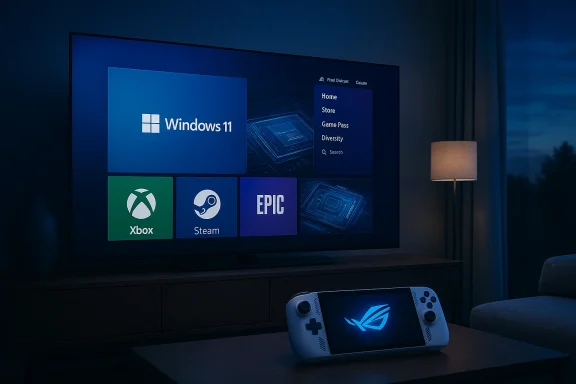
The defining architecture shift is straightforward in concept: the next Xbox family runs Windows 11 as the underlying operating system but boots by default into a TV‑optimized, console‑like interface. That interface behaves like an Xbox shell — full‑screen guide, controller navigation, curated dashboard — while Windows remains accessible for productivity, streaming, or sideloading other storefronts.Why this matters:
- Users get the familiarity of Xbox navigation while gaining access to the enormous PC game library.
- Developers gain the option to target a single, unified Windows runtime for console‑style features and for PC distribution.
- Microsoft can push Xbox experiences to OEM hardware (handhelds, small form‑factor PCs, living‑room PCs) without rewriting the OS stack.
The silicon: “Magnus” and the move to high‑end APUs
Leaked reporting and analyst coverage point to a very large AMD semi‑custom APU—codenamed “Magnus” in industry leaks—combining Zen‑6 CPU cores, RDNA‑5 GPU architecture, GDDR7 memory, and an on‑die NPU for AI acceleration. Technical claims circulating in public reporting include ambitious figures: dozens of RDNA‑5 compute units, a wide GDDR7 memory bus, and an NPU capable of tens to hundreds of TOPS depending on operating mode.Two caveats are critical:
- The specific numbers primarily originate from leaks and secondary reporting; AMD has publicly confirmed only that semi‑custom work is ongoing and progressing to support Microsoft’s timeline.
- Final silicon choices are always subject to yield, heat, power, and price trade‑offs; a 400+ mm² APU with high TDP would drive cooling and cost design decisions that influence retail positioning.
Software, stores, and game libraries: openness vs. curation
Multi‑store aggregation and the Xbox shell
One of the boldest implications of a Windows‑based Xbox is that the device could run multiple storefronts: Microsoft’s own Xbox Store, Valve’s Steam client, Epic Games Store and other PC platforms. The Ally handhelds already demonstrate an aggregated library view in the Xbox full‑screen experience, surfacing titles from Game Pass, Steam and other installers.This “store pluralism” benefits consumers: it reduces friction to play purchases made on other platforms and makes the Xbox experience more inclusive. But it also raises major questions:
- How are achievements, social systems, and save compatibility reconciled across storefronts?
- Will Microsoft require certification for storefront apps or impose UI restrictions for the console shell? If so, how open will the platform be in practice?
- Revenue and policy tension: how will Microsoft negotiate platform fees, cross‑purchases, or subscription entitlements when the same game appears on multiple stores?
Cross‑platform publishing and first‑party ports
Microsoft’s recent decisions show a meaningful shift: major Xbox franchises are reaching non‑Xbox consoles and PC storefronts more often than prior generations. Releasing first‑party games on PlayStation and Nintendo platforms (and on Steam) is no longer unthinkable and has already begun for select titles. That directly supports the idea of Xbox as a platform brand — one that earns revenue through software and services beyond hardware attachment.That approach has benefits:
- Expanded revenue streams for expensive AAA projects.
- Greater reach and cultural visibility for Xbox franchises.
- Reduced reliance on hardware sales to recoup studio investments.
- Potential brand dilution if exclusives (the traditional hardware incentive) disappear.
- Risk of eroding console loyalty — if big Xbox games are available on competitor hardware, why buy an Xbox at all?
- Contractual and technical complexity when ports require engine adjustments, platform certifications, or platform‑specific features.
AI, NPU features and the evolution of gameplay capture
AI is being baked into hardware and UX in two ways: silicon NPUs that accelerate inference on device, and cloud AI for heavyweight model workloads. On the handheld side, the Ally devices already ship with NPUs and promise features like Auto Super Resolution and automated highlight reels — short clips generated by on‑device analysis of gameplay moments.Potential consumer value:
- Instant highlight generation reduces friction for sharing and social engagement.
- AI upscaling improves perceived performance on a per‑title basis without developer work.
- System‑level AI assists could aid testing, QA, accessibility, and in‑game tutoring.
- Who owns the highlights and derived clips? Are they stored locally or sent to cloud services?
- How will NPUs handle model updates, security, and adversarial content?
- Will on‑device AI be standardized so developers can rely on certain primitives, or will it fragment by OEM?
Backward compatibility: marketing promise vs. engineering reality
Microsoft’s commitment to backward compatibility is a recurring theme in its public messaging: the company explicitly stated it intends to “maintain compatibility with your existing library of Xbox games.” That commitment is plausible on a Windows‑based device because Windows can host multiple execution layers and emulation environments. The Ally handheld experience already shows a pathway to aggregate various libraries.However, there are practical limits:
- Not every legacy title is packaged in a way that runs natively on modern Windows builds; some rely on custom firmware, legacy APIs, or hardware quirks that require engineering work to repackage and certify.
- Licensing, middleware, and third‑party code may prevent some older titles from being re‑released or sold outside their original ecosystem.
- Backward compatibility at the binary level often incurs performance and visual fidelity trade‑offs that must be tested extensively.
Price, positioning and OEM strategy
One of the trickiest pieces of the puzzle is price. A high‑end, Windows‑equipped Magnus‑class device with a large APU, high‑bandwidth GDDR7 memory and a premium chassis will not be cheap to manufacture. Multiple industry reports speculate that a flagship device could skew premium — approaching $800–$1,000 or higher — with OEM partners offering lower‑cost alternatives.Microsoft’s likely approach:
- First‑party flagship (premium, curated) to showcase the full vision and justify higher margins.
- OEM variants (ASUS, and rumors of Lenovo/Razer) across price and form factors to capture broader market segments.
- Handheld and living‑room PCs filling different niches: handhelds for portability, living‑room PCs for performance.
- High initial price reduces the installed base, making it harder to sell Game Pass subscriptions and justify first‑party investments.
- Competitors and PC OEMs can undercut pricing with commodity hardware optimized for Steam.
- Tariffs, memory price fluctuations (GDDR7 costs), and global supply constraints could push retail prices even higher.
Developer experience and tooling
A Windows‑rooted Xbox collapses some complexity for developers — a single runtime that targets both console‑style and PC experiences. But it also introduces new fragmentation:- Developers still must consider multiple storefronts, input methods (touch, mouse, controller), and performance envelopes across hardware SKUs.
- Certification and platform APIs may be split between the Xbox shell and native Windows, complicating QA.
- Cross‑purchase, cross‑save, and cross‑play features will need stronger tooling and clearer best practices for save formats and entitlement checks.
Strengths of the strategy
- Consumer freedom and choice. Letting players access multiple stores and a combined library is highly consumer‑friendly and reduces platform lock‑in resentment.
- Leverage Windows’ ecosystem. Microsoft can reuse decades of Windows investment — drivers, app distribution, update mechanisms — rather than reinventing an OS for every device.
- Silicon co‑design with AMD. Co‑engineering with AMD can yield powerful, efficient APUs tuned for gaming and AI workloads, potentially delivering a hardware leap.
- Service monetization. A broader installed base across devices and stores multiplies opportunities for Game Pass subscriptions, in‑game transactions, and cloud services.
Risks and unanswered questions
- Brand dilution. If Xbox first‑party games proliferate on competitor consoles and PC storefronts, the hardware incentive to buy an Xbox could shrink.
- Library fragmentation. Not all Xbox titles will immediately run on Windows‑based Xbox devices; key titles may be left behind due to packaging, DRM, or technical debt.
- Store economics. Embracing other storefronts invites complex negotiations on fees, entitlements, and cross‑purchase incentives.
- Software polish for TV. Windows 11 must be refined for a living‑room controller‑first experience; any roughness will undermine the console UX promise.
- Hardware cost and supply. Premium silicon and cutting‑edge memory will push pricing higher and introduces risk during downturns in the console buying cycle.
- Regulatory and antitrust optics. As Microsoft pushes Xbox titles more widely, regulators and platform holders may scrutinize partnerships, acquisition strategies, and competition impacts.
What to watch next
- Microsoft messaging and developer tooling at major events (GDC and Microsoft dev events) — these will reveal how the company intends to simplify cross‑platform development and whether concrete APIs for NPUs and the Xbox shell are available.
- AMD earnings and public materials — any references to clients and semi‑custom timelines will clarify the 2027 launch window.
- OEM announcements beyond ASUS — confirmation from Lenovo, Razer, or others will validate the hardware strategy beyond a single partner.
- Pricing signals — official price points for flagship devices and OEM variants will determine whether the strategy appeals to mass consumers or a premium niche.
- Title releases and porting patterns — if major first‑party launches continue to appear on PlayStation and Switch candidates, Microsoft’s software strategy is clearly multi‑platform and revenue‑driven.
Conclusion
Microsoft’s next Xbox plan is the company’s most audacious gaming pivot in years: a Windows‑based console family designed to blur the line between PC and console, powered by high‑end AMD silicon and distributed across a mixture of first‑party and OEM hardware. The vision is compelling — more games in more places, richer on‑device AI features, and a flexible hardware portfolio for customers — but success depends on three things aligning: polished TV‑first software on Windows, airtight developer tools and economics, and a hardware pricing strategy that doesn’t strangle the installed base.If Microsoft pulls it off, the company will have built an ecosystem that feels like a platform rather than a single box: Xbox on the TV, Xbox in your hand, Xbox on your OEM living‑room PC — with Game Pass and Xbox services as the connective tissue. If the pieces don’t align, the effort risks delivering confusion rather than clarity: a premium device few buy, a fragmented library, and a diluted brand that no longer convinces players to choose Xbox hardware.
This is a high‑stakes bet on silicon, software and services. It’s also the clearest signal yet that Microsoft intends to make Xbox a platform first and a console second — a gamble with enormous upside and equally large execution risk.
Source: EGW.News Microsoft’s Next Xbox Console Will Be the Most Ambitious and Could Be Released Next Year
