AMD Led Next Xbox SoC Aims for 2027 Launch Tied to Windows 11

  • Thread Author
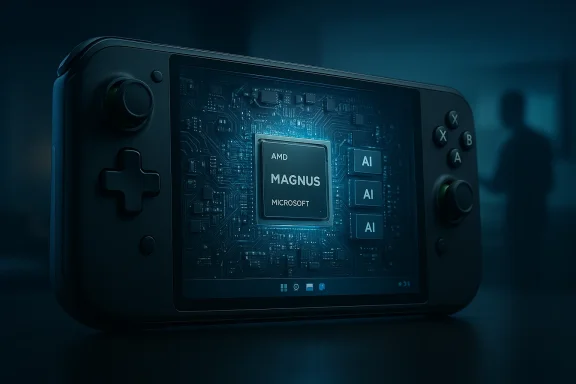
Close-up of a handheld console showing a glowing AI chip labeled MAGNUS amid circuitry.
Microsoft’s chip partner just gave us a hard timing marker: AMD CEO Lisa Su told investors that development of “Microsoft’s next‑gen Xbox featuring an AMD semi‑custom SoC is progressing well to support a launch in 2027,” a cautious but unmistakable signal that the company’s engineering timeline is targeting that year if everything goes to plan.

Background / Overview​

Microsoft and AMD announced a strategic, multi‑year partnership to co‑engineer silicon across a family of devices last year. That pact framed Microsoft’s next‑generation console not as a single closed box but as part of a broader, Windows‑centric ecosystem that includes living‑room consoles and handheld hardware developed in partnership with OEMs like ASUS. The partnership was explicitly positioned around shared silicon work and AI‑enabled features, which helps explain why AMD’s production and timeline statements carry extra weight for Xbox fans and industry watchers.
Inside Microsoft, the next Xbox is reportedly moving toward a PC‑console hybrid model—essentially a Windows 11 gaming PC that boots to a console‑like experience by default. That pivot is visible in Microsoft’s recent OEM collaborations (notably the ROG Xbox Ally family) and in public comments from Xbox leadership. In that light, AMD’s comment about being ready to “support a launch in 2027” is best read as a supplier readiness marker rather than a retail date the company is definitively committing to. (windowscentral.com)

What changed this week: the Lisa Su moment and why it matters​

AMD’s Q4 earnings call included one line that rippled across every gaming outlet: that the AMD semi‑custom SoC for Microsoft is “progressing well to support a launch in 2027.” On its face this is supply‑chain speak—AMD can meet the engineering and manufacturing milestones necessary for a 2027 ramp—but it is also the clearest confirmation so far that the partners’ timelines are aligned toward that window. For an industry used to leaks and thin teasers, supplier confirmation of this kind is significant because chip development timelines are one of the single largest gating factors for console programs.
Why this matters now:
  • Chip development and tape‑out schedules determine when development kits reach studios and when final silicon can be produced at scale.
  • The console ecosystem is moving toward tighter integration with Windows, which raises OS‑level dependencies (more on that below).
  • Global component markets—especially memory and storage—are volatile, and the industry is watching whether supply can meet demand without pushing retail price points higher.
In short: AMD’s line doesn’t mandate Microsoft’s launch date, but it materially narrows the range of credible windows and forces stakeholders (retailers, developers, OEM partners) to plan for a potential 2027 ramp.

The codename: “Magnus” — what we actually know​

Windows Central’s Jez Corden reports that AMD’s internal designation for the next‑gen Xbox SoC is “Magnus.” The article clarifies that “Magnus” appears to be AMD’s internal chip codename and not necessarily Microsoft’s marketing or platform codename for the end product. That distinction matters: vendors routinely use different internal names (AMD, Microsoft, OEMs) during development, and codenames rarely survive intact into consumer branding. (windowscentral.com)
Why the chip codename matters to technical observers:
  • Codenames let analysts trace architecture roadmaps, infer possible CPU/GPU microarchitectures (e.g., generational jumps in Zen/RDNA families), and estimate performance envelopes.
  • A single SoC codename tied to a portfolio strategy suggests Microsoft may plan variants—multiple SKUs built from shared silicon blocks—rather than a single monolithic box. That aligns with current signals that Microsoft considers base, premium, and handheld form factors within the same platform family.
At this stage, “Magnus” is a useful handle for insiders and supply chain watchers, but it is not a specification sheet. Treat the name as confirmation of an AMD‑led custom SoC program, not as proof of particular core counts, cache sizes, or clock targets. (windowscentral.com)

Windows 11 integration: the software gating factor​

One of the most consequential revelations from reporting is that Microsoft’s release timing will be tightly coupled to Windows 11 improvements. Insiders tell Windows Central that the launch “hinges on improvements to Windows 11 and other factors” and that the Windows and Xbox teams are collaborating “harder than ever” to produce a polished, console‑like experience. That is a crucial operational detail: if the next Xbox is effectively a Windows 11 device that boots into a console shell, the OS must meet a very specific set of requirements around latency, input handling, power management, and app‑store behavior.
This has multiple implications:
  • Microsoft cannot simply lift a PC build of Windows 11 onto consumer devices and call it a day; it needs a curated, low‑latency, controlled experience that feels like a console to most users while retaining Windows’ openness for advanced use cases.
  • The OS timeline becomes a gating item for certification, performance tuning, and QA across a vastly larger compatibility matrix (PC software, Steam, Epic, Game Pass, cloud gaming clients).
  • The “best case scenario” phrasing used internally suggests Microsoft would rather delay to get the software right than ship hardware with a compromised experience. (windowscentral.com)
This is the first major console generation in which a platform shift toward an existing PC OS is a deliberate strategy rather than an accidental similarity—and that elevates software risk to the same level as silicon and supply risk.

RAM and storage: a supply‑chain problem that changed the calendar​

A complicating factor that has already influenced industry timing is the dramatic volatility in memory and storage markets. Valve recently acknowledged that spiking prices and constrained availability for RAM and SSD parts forced it to “revisit” pricing and shipping schedules for its Steam Machine and Steam Frame hardware—language that is blunt and consequential. The memory landscape has been reshaped by unprecedented AI data‑center demand, which is diverting high‑bandwidth memory and premium DDR/HBM contracts away from consumer markets and pushing prices up. That market stress is precisely the sort of variable that can convert a “best case” launch into a delayed program or a higher retail price.
Why this matters for Xbox:
  • Memory is one of the most expensive line items in a high‑performance console SoC and associated system memory. If DDR5/LPDDR5 prices remain elevated, Microsoft must either accept a higher retail price, reduce memory configurations, or absorb the cost—each choice has business consequences.
  • For a platform that promises to be more premium and potentially PC‑like, shaving memory to reduce costs could be technically visible (load times, cache hit rates, texture streaming).
  • Microsoft’s supplier agreements and forward buys will mitigate some exposure, but the market is fluid; suppliers reallocating inventory to AI servers can create real shortages for consumer programs even with pre‑booked contracts.
This is why industry observers treat RAM price trends as a near‑term lead indicator for console launch economics and marketing positioning.

Pricing and SKU strategy: premium positioning, multiple partners​

Xbox President Sarah Bond has publicly described the next Xbox as “a very premium, very high‑end curated experience,” language that telegraphs strategic positioning but raises immediate questions about MSRP and subsidy models. Historically, home consoles have been loss‑leader devices subsidized by first‑party software and services; calling the device “premium” implies a smaller or absent hardware subsidy and a higher street price. Bond’s phrasing coincided with Microsoft’s partnership with OEMs like ASUS for handheld hardware—an architecture that enables multi‑tier SKUs and OEM variants at different price points.
Key strategic options Microsoft faces:
  • Single flagship SKU priced at a premium to preserve margins and avoid subsidization.
  • Multi‑SKU strategy: base and premium consoles plus OEM handhelds and partner variants (ASUS, possibly other PC OEMs) to cover different price bands.
  • A “modular” approach where Microsoft sells a platform (OS/service) and leaves more of the hardware variance to partners—this reduces Microsoft’s direct inventory risk while enabling varied price points.
Windows Central’s reporting suggests Microsoft may be explicitly exploring OEM partner models with different price tiers, and that the company itself had not settled on a final retail price at the time of reporting. That uncertainty is understandable given RAM volatility and the broader hardware revenue squeeze Microsoft has been experiencing. (windowscentral.com)

Technical expectations and the limits of speculation​

Public reporting and leaks around the next generational cycle have sketched a plausible technical picture: a semi‑custom AMD SoC potentially using next‑generation Zen family CPU cores and an RDNA‑family GPU, paired with system memory and AI accelerators that target richer visuals, hardware‑accelerated upscaling, and on‑device AI features. But there’s a critical distinction to keep in mind: supplier codenames, leaked roadmaps, and earnings‑call soundbites are not hardware specifications. They indicate architecture direction, not retail performance numbers.
Responsible, cautious technical takeaways:
  • Expect an SoC designed for mixed workloads: gaming rasterization, AI inference for game features, and efficient media/encode pipelines suited to console and handheld profiles.
  • Expect variants or binning: more powerful premium SKU(s) and possibly an OEM‑tuned handheld silicon (lower power, different thermal envelope).
  • Avoid treating leaked core counts or teraflop estimates as final until vendors publish final specs; those numbers change frequently during the last 12–18 months of productization.
Where reporting gets speculative—especially on performance comparisons to PC GPUs or on exact core microarchitectures—treat those claims as unverified until AMD or Microsoft publish formal specs or until independent benchmarks appear.

Strategic risks for Microsoft​

Microsoft’s Gen‑10 Xbox program carries a mix of opportunity and risk. The top risks to watch:
  1. Software dependency and polish risk
    • Tying the next Xbox to Windows 11 creates a complex QA surface. If Windows updates or platform features lag, the device experience could be compromised or delayed. Microsoft’s emphasis on not locking to a hard 2027 date indicates they understand this risk. (windowscentral.com)
  2. Component market volatility
    • RAM and SSD price spikes driven by AI demand are an immediate risk to final pricing and launch economics. Valve’s public delay is proof that even well‑funded hardware programs can be pinned back by memory markets.
  3. Channel and subsidy economics
    • Historically, consoles rely on hardware subsidies funded by first‑party titles and ongoing platform revenue. A premium price reduces the capacity for subsidy and raises the bar for consumer adoption unless Microsoft leans harder into subscription value (Game Pass, cloud features, cross‑platform content).
  4. Competitive timing
    • Competing launches from Sony, Valve, and SteamOS‑friendly devices mean the market could be crowded by 2027. Microsoft must balance speed to market with the imperative to ship a convincing experience.
  5. Developer and ecosystem complexity
    • A Windows‑based console changes the developer equation—studios must be confident that the console will be promoted, supported, and uniquely valuable relative to a Windows PC. If perception tilts toward “just another PC,” exclusivity leverage and first‑party differentiation will be harder to sustain.

Strategic opportunities​

Despite the risks, Microsoft’s strategy also opens compelling opportunities:
  • Platform convergence: A console that is a Windows device could seamlessly deliver traditional console exclusives, PC storefronts, and Game Pass across form factors—handheld to living‑room—unlocking new player retention mechanics and platform stickiness.
  • OEM scale and diversified SKUs: Working with ASUS and other OEMs reduces Microsoft’s manufacturing risk and enables product tiers that reach both premium buyers and more price‑sensitive segments.
  • AI and software differentiation: Integrated AI features in hardware—if executed well—could offer unique gameplay and assistive experiences that differentiate beyond raw frame rates or ray‑tracing numbers.
  • Faster content discovery: Tighter integration with Windows stores and multi‑store support might drive new forms of cross‑promotion and monetization, benefiting both Microsoft and partner storefronts.
These opportunities hinge on execution—especially around the Windows experience and developer buy‑in—but they represent a distinct strategy that could reshape console economics if Microsoft pulls it off.

What gamers and developers should watch next​

If you’re tracking this story—whether as a potential buyer, a retailer, or a developer—here are practical next steps and signals to monitor:
  1. Microsoft announcements on Windows 11 console features:
    • Look for dev previews or insider builds that show the “console” experience and stability improvements. This is the single most important software signal.
  2. AMD and Microsoft roadmaps:
    • Any official AMD product briefings or Microsoft platform updates that move from “support” language to formal product release dates will be decisive.
  3. Memory and storage market indicators:
    • Watch DDR5 and NAND price indices and public statements from Valve, OEMs, or memory manufacturers. Rapid price stabilization or continued scarcity will directly affect retail strategies.
  4. OEM commitments:
    • More OEM partners (beyond ASUS) stepping forward to announce consoles or Windows‑first devices will indicate Microsoft is moving to a multi‑partner strategy.
  5. Developer kit availability:
    • When hardware dev kits reach studios (or when Microsoft provides cloud dev environments), the practical ramp for first‑party and third‑party content begins in earnest.

Conclusion — tempered optimism and clear watchpoints​

AMD’s confirmation that its semi‑custom SoC development is “progressing well to support a launch in 2027” is a major calibration event for the console calendar: it signals supplier readiness, tightens credible launch windows, and adds momentum to Microsoft’s plan for a Windows‑infused, premium next‑gen Xbox family. But the phrase “support a launch” is deliberately cautious, and Microsoft’s own internal public posture—calling 2027 the “best case scenario” and tying the program to Windows 11 readiness—underscores that this is still a contingent path.
The program’s biggest near‑term threat is market economics: memory and storage shortages driven by AI demand are already causing concrete changes in shipment plans (as Valve’s recent updates make clear), and until those markets stabilize, hardware pricing and SKU decisions remain in flux. Meanwhile, the strategic bet on Windows as the OS layer opens enormous opportunity but increases the software polish and developer coordination burden.
For gamers: plan your expectations accordingly. If Microsoft hits 2027 with a polished, premium device family it could redefine what a console is in the 2020s—but if component markets remain volatile, don’t be surprised if the firm delays to preserve the experience or arrives with higher MSRPs than prior generations.
For developers and partners: the clear action is to watch Microsoft’s Windows‑for‑console builds, evaluate the SDKs, and prepare to target a platform that blurs PC and console boundaries. If the goal is true cross‑ecosystem parity—cloud, native Windows, and console modes—then early engagement on performance and UX priorities will matter more than ever.
We’re watching “Magnus” closely—not just as a codename or a rumor, but as the linchpin of a strategic pivot for Xbox: a silicon program that could power a new family of premium devices if Microsoft and its partners execute across chips, software, supply chains, and developer relations. The 2027 target is plausible; whether it becomes reality will come down to the intersection of engineering readiness, OS quality, and a volatile component market that has already begun to reorder expectations.

Source: GamingBolt Next Xbox’s SoC Codenamed “Magnus,” 2027 Launch is the “Best Case Scenario” – Rumor
 

Microsoft’s next-generation Xbox PC — the rumored Windows‑rooted, TV‑first console powered by an AMD semi‑custom SoC — remains very much a live project, but the calendar for when it reaches store shelves is not set in stone; AMD’s public remark that development is “progressing well to support a launch in 2027” gave the industry a timing marker, yet multiple reporting threads make clear that Microsoft has not locked in 2027 as a hard ship date and is treating that year as a best‑case scenario rather than a commitment.

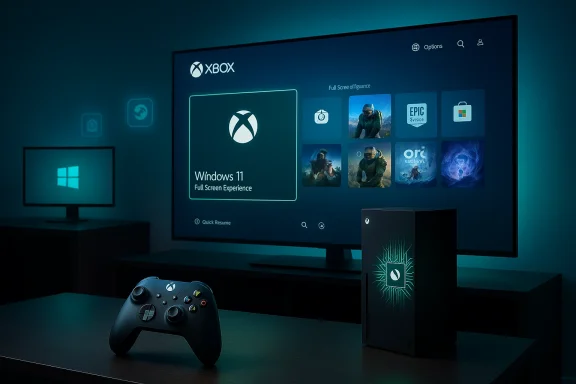
Xbox gaming setup with Windows 11 on a large screen, a console, and a controller under teal ambient lighting.Background / Overview​

Microsoft and AMD announced a strategic, multi‑year collaboration to co‑engineer silicon across a portfolio of devices — from home consoles and handhelds to cloud servers and OEM machines — with the explicit aim of bringing a more unified, AI‑enabled gaming and PC experience to market. AMD’s CEO, Dr. Lisa Su, used a recent earnings call to state that the company’s semi‑custom SoC work for Microsoft is “progressing well to support a launch in 2027,” a supplier‑side timeline that immediately catalyzed speculation about a 2027 retail debut.
Equally important, however, are Microsoft’s internal constraints and product priorities. Reporting from Microsoft‑adjacent sources indicates the company is treating Windows 11 readiness — specifically the “Full Screen Experience” (FSE) that would present a conimized interface over a full Windows runtime — as a gating factor. That means the hardware could be ready while the software still requires more polish, certification, and ecosystem work before Microsoft will commit to a final launch window.
The upshot: supplier readiness (AMD) and platform readiness (Microsoft’s Windows and Xbox teams) are converging, but they are separate dependencies. The industry should therefore expect multiple timeline scenarios over the next 18–30 months rather than a single, fixed release date.

What exactly did AMD say — and what does that phrase mean?​

When corporate leaders speak on earnings calls, every carefully chosen phrase gets parsed by investors and reporters. Dr. Lisa Su’s line — that development of Microsoft’s next‑gen Xbox “is progressing well to support a launch in 2027” — is literal; it signals that AMD’s silicon program is on schedule to enable a potential 2027 launch, not that Microsoft has publicly committed to shipping consoles that year.
Two important distinctions follow:
  • Supplier readiness vs. manufacturer timing. AMD can be ready to fabricate and deliver silicon on a schedule while Microsoft still refines system software, certification, ecosystem agreements, and the commercial plan (pricing, SKUs, distribution). The semiconductor partner’s timeline narrows one key unknown, but it does not, by itself, guarantee a retail launch date.
  • Marketing and product cadence matter. Console generations traditionally follow marketing and product cycles that involve large coordinated announcements, developer support windows, and retail channels. Microsoft’s own public filings and trial documents have previously suggested a later earliest‑possible generation cycle, a factor that still shapes internal planning.
In short: AMD gave the market a credible “ready” date for silicon. Microsoft — which must own the overall customer experience — is still aligning the rest of the stack and the business case.

Windows 11 as the runtime: technical and product implications​

The Windows‑under‑a‑TV‑skin thesis​

Multiple re same architectural thesis: the next full‑sized Xbox could run Windows 11 as the underlying operating system while defaulting to an Xbox‑branded, controller‑first Full Screen Experience (FSE) as the living‑room UI. That FSE would behave like a conventional console dashboard for most users while offering a button or menu option for power users to “exit to Windows” and access a full desktop environment, third‑party PC storefronts, and a broader set of Windows apps.
This model promises big benefits: unified development tools for studios, a single platform for app/service continuity across handheld and living‑room devices, and a path to open PC ecosystems without fragmenting the mainstream console experience.

But integrating desktop Windows into the living room is non‑trivial​

Making Windows behave like a low‑maintenance, TV‑first console presents several engineering and product challenges:
  • UX simplicity and stability. Windows was designed for mouse/keyboard and multi‑window productivity. A TV‑first FSE must mask that complexity without creating support headaches or frequent update regressions for living‑room users.
  • Fast boot and lifecycle management. Console users expect instant‑on simplicity, long‑term stability, and firmware‑grade update behavior. Windows update cadence and rollback behavior will likely need adaptation to meet console customer expectations.
  • Anti‑cheat and online integrity. Console platforms historically enforce a tightly controlled runtime for anti‑cheat and multiplayer fairness. Allowing exit into full Windows opens new attack surfaces that anti‑cheat venservices must certify and accept.
  • Third‑party storefronts and revenue models. If a device can run Steam, Epic, and other PC stores, Microsoft will need clear policies for certification, DRM, background services, and whether Game Pass or Microsoft Store offerings will have differentiated controls.
Reports indicate Microsoft is deliberately slowing its public timing until these integration questions — particularly FSE stability and partner acceptance — are addressed. That is one of the reasons insiders say 2027 should be considered optimistic rather than locked in.

Technical profile: what we can reasonably expect from the AMD semi‑custom SoC​

AMD’s multi‑year partnership with Microsoft is described publicly as a co‑engineering effort spanning CPU, GPU, and AI accelerators. While Microsoft and AMD have not released full chip specs, industry analysis and leaked materials suggest the SoC will be a high‑end design combining:
  • Zen‑family CPU cores tuned for console thermals and power budgets;
  • RDNA family graphics blocks optimized for TV resolutions, ray tracing, and AI‑assisted rendering;
  • AI accelerators dedicated to on‑device inference for features such as generative upscaling, latency‑reducing prediction, and dynamic content adaptation;
  • Memory and bandwidth profiles designed to support both native Windows workloads and sustained gaming performance.
AMD’s readiness to “support a 2027 launch” impeouts and vendor roadmaps are aligned with that window, but again, silicon readiness does not eliminate software or supply‑chain hurdles.

Supply chain realities and the memory shortage​

Hardware timing in 2026–2027 remains subject to macro supply constraints that directly affect product costs and attainable SKU mix. The industry has been wrestling with constrained DRAM and NAND supply, which has already influenced OEM pricing, SKU segmentation, and launch cadence. Multiple market briefings and analyst notes suggest Microsoft will be cautious about committing to a global launch if component pricing forces either higher retail prices or poor margins for key SKUs.
A staggered approach — regional launches, a limited first run for early adopters, or premium‑only SKUs followed by broader availability as supply improves — is feasible and has precedent. But each option changes the political and commercial implications for Microsoft and its partners.

Market timing: 2027 as “best case” vs. 2028 as “earliest” in legal filings​

Industry reporting must be read alongside Microsoft’s own courtroom and regulatory documents. In filings used during regulatory proceedings, Microsoft stated that the next generation of consoles was not expected to arrive before the fall of 2028 “at the very earliest.” That language has been widely cited and reflects Microsoft’s prior, conservative estimate in a legal context. Analysts read those words as Microsoft hedging expectations during litigation, not as an immutable product plan — but the phrasing nonetheless underscores that Microsoft has previously communicated a later earliest‑possible timeframe.
Taken together, the public timeline signals are:
  • AMD: silicon is on track to enable a 2027 launch if Microsoft chooses to ship then.
  • Microsoft (public/regulatory): has previously told regulators a 2028‑earliest timeframe, and internal teams reportedly treat 2027 as a best case dependent on software readiness.
That combination means the market should plan for a range of outcomes — an optimistic 2027 debut, a pragmatic 2028 earliest mass‑market generation, or a split strategy where premium units and developer kits appear earlier while broader retail availability follows later.

Competition and ecosystem context​

Sony and the PlayStation timeline​

Sony’s public and regulatory statements mirrored Microsoft’s conservative stance, with both parties telling regulators that the next generation of consoles was unlikely before 2028. Those synchronized timelines reduce the pressure for Microsoft to accelerate purely for competitive timing, since the console cycle is often an industry‑wide phenomenon rather than a single‑player sprint.

Valve and the Steam Machine family​

Meanwhile, Valve’s renewed hardware push and third‑party OEM efforts — many of which will use AMD silicon — add a new competitor dynamic: smaller, PC‑centric devices that emphasize PC storefrand modularity. Microsoft’s rumored Windows‑rooted console sits between traditional closed consoles and open PC hardware, which could be a strategic advantage if executed cleanly.

Opportunities for Microsoft and developers​

If Microsoft successfully ships a Windows‑based console that defaults to a polished Xbox FSE, the potential benefits are material:
  • Unified development and distribution. Studios could ship one binary that scales across handheld, console, and OEM Windows devices; developers would benefit from a single toolchain and certification model.
  • Service continuity. Game Pass, cloud saves, and cross‑device features would gain a natural home on devices that can run native Windows apps.
  • A more open ecosystem for players. Power users could access Steam, Epic, and other PC storefronts without buying a separate PC, broadening consumer choice and reducing platform lock‑in concerns.
  • AI‑driven enhancements. On‑device AI could accelerate features like upscaling, AI NPC behavior, voice/asset generation, and input prediction, pushing a new generation of gameplay experiences.
These upsides explain why Microsoft appears willing to absorb greater integration complexity — the product payoff could be a durable platform advantage that ties Xbox services and Game Pass more tightly into the broader Windows ecosystem.

Risks and open questions​

No engineering or business plan survives contact with the market without trade‑offs. For a Windows‑rooted Xbox PC, the key latform fragmentation and support costs.** If the device permits multiple storefronts and Windows apps, customer support complexity and fragmentation risk rise. Microsoft must decide whether it certifies a narrow “console Windows” profile or accepts the complexity of a truly full Windows experience.
  • Anti‑cheat and multiplayer integrity. Many PC anti‑cheat vendors have historically been reticent about open environments; Microsoft will need to secure vendor commitments and test plans to preserve competitive integrity.
  • Regulatory optics. As regulators scrutinize platform control and exclusives, shipping a hybrid device that can run third‑party stores both complicates and potentially improves Microsoft’s regulatory narrative — but challenges remain if Microsoft also holds preferential distribution for Game Pass content.
  • Price and SKU segmentation. Premium silicon and memory constraints could pusr than the mainstream console market tolerates, constraining adoption and harming content ecosystems reliant on scale.
  • Developer economics. If Microsoft allows third‑party store access with different fees and DLC rules, platform revenue flows and first‑party incentives will need careful rebalancing.
Several reporting threads flag these concerns as precisely why Microsoft is unwilling to rush a calendar commitment and is prioritizing the stability and partner acceptance of the Windows‑as‑console concept.

What to watch next — signals that will matter​

Over the coming months, several concrete signals will clarify whether 2027 is realistic or aspirational:
  • Windows 11 FSE milestones. Public or developer previews of the TV‑first Full Screen Experience and documented partner acceptance will be critical.
  • AMD silicon milestones. Public confirmation of tapeout, silicon validation, and mass‑production readiness from AMD will reduce the hardware timing uncertainty.
  • OEM announcements. If Microsoft’s partners (or Microsoft itself) announce developer kits, reference hardware, or premium OEM SKUs targeting the living room, the launch window narrows.
  • Supply‑chain datapoints. DRAM and NAND pricing and lead times will influence SKU strategy and retail pricing; sustained memory shortages would likely push Microsoft to favor later launch windows or premium‑first strategies.
  • Regulatory and legal context. Any fresh regulatory filings or courtroom disclosures that reference console timing could be a conservative floor for Microsoft’s consumer statements.

Scenario planning: three plausible launch paths​

  • Best‑case 2027 wide launch. AMD delivers silicon on schedule, Windows 11 FSE is validated with partners, supply constraints ease, and Microsoft ships mass retail units in late 2027. This would give Microsoft a potential lead over Sony and a dramatic market narrative if executed well.
  • Staggered 2027 developer/premium launch followed by 2028 mass. Microsoft ships developer kits and a premium limited‑run SKU in 2027 to satisfy early customers and partners while delaying broad availability until 2028 to ensure supply and software polish.
  • Conservative 2028 mass launch. Microsoft keeps to the previously disclosed conservative timing, aligning a global mass‑market launch with regulatory filings that previously suggested 2028 as the earliest practical window. This minimizes supply and UX risk but leaves the field clear for competitors to position alternative products earlier.
All three; choosing among them balances short‑term market agility against the long‑term goal of delivering a stable, profitable platform that preserves the Xbox experience.

Final analysis — why Microsoft is right to be cautious​

Microsoft’s ambition — to deliver a hybrid that feels like a console to most users but acts like a Windows PC for power users — is strategically bold. If it works, it could redefine the console model and reposition Microsoft as the bridge between PC and living‑room gaming.
That ambition, however, compounds execution risk. The company must satisfy hardware partners (AMD), anti‑cheat and multiplayer stakeholders, retail partners, and — most importantly — consumers who expect console‑grade simplicity. Rushing this integration risks a repeat of living‑room Windows regressions, messy updates, or a bifurcated UX that pleases neither mainstream console buyers nor PC veterans.
The cautious posture signaled by Microsoft’s internal teams and reported by industry outlets is therefore prudent. It preserves the options to:
  • prioritize polish over hitting a calendar target,
  • stagger SKUs to match supply realities, and
  • ensure third‑party partner commitments for anti‑cheat, storefronts, and content.
Those choices may frustrate consumers who want a clear calendar, but they increase the chances that when Microsoft does ship a Windows‑based Xbox PC at scale, the product will deliver the cohesive experience the company promises rather than a rushed compromise.

Microsoft’s next‑gen Xbox PC sits at the intersection of hardware readiness, software integration, and market strategy. AMD’s public readiness statement provided the industry its first concrete date anchor for silicon, but Microsoft’s own platform priorities — particularly the work required to shape Windows 11 into a reliable, TV‑first runtime — remain the decisive factor for timing. For now, 2027 is a possible year; a polished, global consumer launch may still sensibly arrive later.

Source: TweakTown Report: Next-gen Xbox PC is not locked in for 2027 launch
 

Back
Top