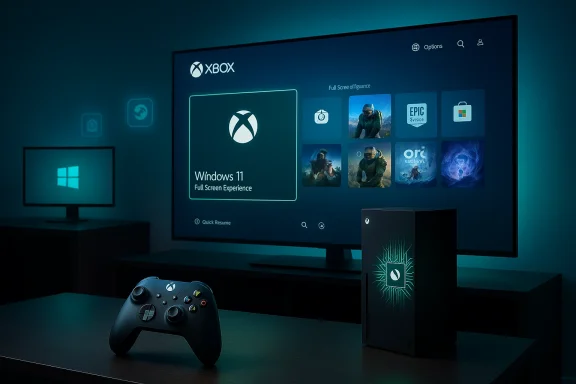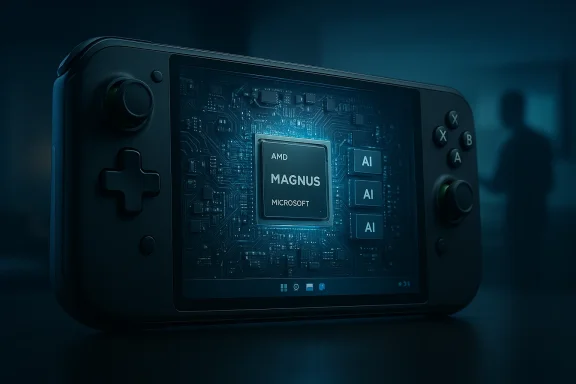
Microsoft’s chip partner just gave us a hard timing marker: AMD CEO Lisa Su told investors that development of “Microsoft’s next‑gen Xbox featuring an AMD semi‑custom SoC is progressing well to support a launch in 2027,” a cautious but unmistakable signal that the company’s engineering timeline is targeting that year if everything goes to plan.
Background / Overview
Microsoft and AMD announced a strategic, multi‑year partnership to co‑engineer silicon across a family of devices last year. That pact framed Microsoft’s next‑generation console not as a single closed box but as part of a broader, Windows‑centric ecosystem that includes living‑room consoles and handheld hardware developed in partnership with OEMs like ASUS. The partnership was explicitly positioned around shared silicon work and AI‑enabled features, which helps explain why AMD’s production and timeline statements carry extra weight for Xbox fans and industry watchers.Inside Microsoft, the next Xbox is reportedly moving toward a PC‑console hybrid model—essentially a Windows 11 gaming PC that boots to a console‑like experience by default. That pivot is visible in Microsoft’s recent OEM collaborations (notably the ROG Xbox Ally family) and in public comments from Xbox leadership. In that light, AMD’s comment about being ready to “support a launch in 2027” is best read as a supplier readiness marker rather than a retail date the company is definitively committing to. (windowscentral.com)
What changed this week: the Lisa Su moment and why it matters
AMD’s Q4 earnings call included one line that rippled across every gaming outlet: that the AMD semi‑custom SoC for Microsoft is “progressing well to support a launch in 2027.” On its face this is supply‑chain speak—AMD can meet the engineering and manufacturing milestones necessary for a 2027 ramp—but it is also the clearest confirmation so far that the partners’ timelines are aligned toward that window. For an industry used to leaks and thin teasers, supplier confirmation of this kind is significant because chip development timelines are one of the single largest gating factors for console programs.Why this matters now:
- Chip development and tape‑out schedules determine when development kits reach studios and when final silicon can be produced at scale.
- The console ecosystem is moving toward tighter integration with Windows, which raises OS‑level dependencies (more on that below).
- Global component markets—especially memory and storage—are volatile, and the industry is watching whether supply can meet demand without pushing retail price points higher.
The codename: “Magnus” — what we actually know
Windows Central’s Jez Corden reports that AMD’s internal designation for the next‑gen Xbox SoC is “Magnus.” The article clarifies that “Magnus” appears to be AMD’s internal chip codename and not necessarily Microsoft’s marketing or platform codename for the end product. That distinction matters: vendors routinely use different internal names (AMD, Microsoft, OEMs) during development, and codenames rarely survive intact into consumer branding. (windowscentral.com)Why the chip codename matters to technical observers:
- Codenames let analysts trace architecture roadmaps, infer possible CPU/GPU microarchitectures (e.g., generational jumps in Zen/RDNA families), and estimate performance envelopes.
- A single SoC codename tied to a portfolio strategy suggests Microsoft may plan variants—multiple SKUs built from shared silicon blocks—rather than a single monolithic box. That aligns with current signals that Microsoft considers base, premium, and handheld form factors within the same platform family.
Windows 11 integration: the software gating factor
One of the most consequential revelations from reporting is that Microsoft’s release timing will be tightly coupled to Windows 11 improvements. Insiders tell Windows Central that the launch “hinges on improvements to Windows 11 and other factors” and that the Windows and Xbox teams are collaborating “harder than ever” to produce a polished, console‑like experience. That is a crucial operational detail: if the next Xbox is effectively a Windows 11 device that boots into a console shell, the OS must meet a very specific set of requirements around latency, input handling, power management, and app‑store behavior.This has multiple implications:
- Microsoft cannot simply lift a PC build of Windows 11 onto consumer devices and call it a day; it needs a curated, low‑latency, controlled experience that feels like a console to most users while retaining Windows’ openness for advanced use cases.
- The OS timeline becomes a gating item for certification, performance tuning, and QA across a vastly larger compatibility matrix (PC software, Steam, Epic, Game Pass, cloud gaming clients).
- The “best case scenario” phrasing used internally suggests Microsoft would rather delay to get the software right than ship hardware with a compromised experience. (windowscentral.com)
RAM and storage: a supply‑chain problem that changed the calendar
A complicating factor that has already influenced industry timing is the dramatic volatility in memory and storage markets. Valve recently acknowledged that spiking prices and constrained availability for RAM and SSD parts forced it to “revisit” pricing and shipping schedules for its Steam Machine and Steam Frame hardware—language that is blunt and consequential. The memory landscape has been reshaped by unprecedented AI data‑center demand, which is diverting high‑bandwidth memory and premium DDR/HBM contracts away from consumer markets and pushing prices up. That market stress is precisely the sort of variable that can convert a “best case” launch into a delayed program or a higher retail price.Why this matters for Xbox:
- Memory is one of the most expensive line items in a high‑performance console SoC and associated system memory. If DDR5/LPDDR5 prices remain elevated, Microsoft must either accept a higher retail price, reduce memory configurations, or absorb the cost—each choice has business consequences.
- For a platform that promises to be more premium and potentially PC‑like, shaving memory to reduce costs could be technically visible (load times, cache hit rates, texture streaming).
- Microsoft’s supplier agreements and forward buys will mitigate some exposure, but the market is fluid; suppliers reallocating inventory to AI servers can create real shortages for consumer programs even with pre‑booked contracts.
Pricing and SKU strategy: premium positioning, multiple partners
Xbox President Sarah Bond has publicly described the next Xbox as “a very premium, very high‑end curated experience,” language that telegraphs strategic positioning but raises immediate questions about MSRP and subsidy models. Historically, home consoles have been loss‑leader devices subsidized by first‑party software and services; calling the device “premium” implies a smaller or absent hardware subsidy and a higher street price. Bond’s phrasing coincided with Microsoft’s partnership with OEMs like ASUS for handheld hardware—an architecture that enables multi‑tier SKUs and OEM variants at different price points.Key strategic options Microsoft faces:
- Single flagship SKU priced at a premium to preserve margins and avoid subsidization.
- Multi‑SKU strategy: base and premium consoles plus OEM handhelds and partner variants (ASUS, possibly other PC OEMs) to cover different price bands.
- A “modular” approach where Microsoft sells a platform (OS/service) and leaves more of the hardware variance to partners—this reduces Microsoft’s direct inventory risk while enabling varied price points.
Technical expectations and the limits of speculation
Public reporting and leaks around the next generational cycle have sketched a plausible technical picture: a semi‑custom AMD SoC potentially using next‑generation Zen family CPU cores and an RDNA‑family GPU, paired with system memory and AI accelerators that target richer visuals, hardware‑accelerated upscaling, and on‑device AI features. But there’s a critical distinction to keep in mind: supplier codenames, leaked roadmaps, and earnings‑call soundbites are not hardware specifications. They indicate architecture direction, not retail performance numbers.Responsible, cautious technical takeaways:
- Expect an SoC designed for mixed workloads: gaming rasterization, AI inference for game features, and efficient media/encode pipelines suited to console and handheld profiles.
- Expect variants or binning: more powerful premium SKU(s) and possibly an OEM‑tuned handheld silicon (lower power, different thermal envelope).
- Avoid treating leaked core counts or teraflop estimates as final until vendors publish final specs; those numbers change frequently during the last 12–18 months of productization.
Strategic risks for Microsoft
Microsoft’s Gen‑10 Xbox program carries a mix of opportunity and risk. The top risks to watch:- Software dependency and polish risk
- Tying the next Xbox to Windows 11 creates a complex QA surface. If Windows updates or platform features lag, the device experience could be compromised or delayed. Microsoft’s emphasis on not locking to a hard 2027 date indicates they understand this risk. (windowscentral.com)
- Component market volatility
- RAM and SSD price spikes driven by AI demand are an immediate risk to final pricing and launch economics. Valve’s public delay is proof that even well‑funded hardware programs can be pinned back by memory markets.
- Channel and subsidy economics
- Historically, consoles rely on hardware subsidies funded by first‑party titles and ongoing platform revenue. A premium price reduces the capacity for subsidy and raises the bar for consumer adoption unless Microsoft leans harder into subscription value (Game Pass, cloud features, cross‑platform content).
- Competitive timing
- Competing launches from Sony, Valve, and SteamOS‑friendly devices mean the market could be crowded by 2027. Microsoft must balance speed to market with the imperative to ship a convincing experience.
- Developer and ecosystem complexity
- A Windows‑based console changes the developer equation—studios must be confident that the console will be promoted, supported, and uniquely valuable relative to a Windows PC. If perception tilts toward “just another PC,” exclusivity leverage and first‑party differentiation will be harder to sustain.
Strategic opportunities
Despite the risks, Microsoft’s strategy also opens compelling opportunities:- Platform convergence: A console that is a Windows device could seamlessly deliver traditional console exclusives, PC storefronts, and Game Pass across form factors—handheld to living‑room—unlocking new player retention mechanics and platform stickiness.
- OEM scale and diversified SKUs: Working with ASUS and other OEMs reduces Microsoft’s manufacturing risk and enables product tiers that reach both premium buyers and more price‑sensitive segments.
- AI and software differentiation: Integrated AI features in hardware—if executed well—could offer unique gameplay and assistive experiences that differentiate beyond raw frame rates or ray‑tracing numbers.
- Faster content discovery: Tighter integration with Windows stores and multi‑store support might drive new forms of cross‑promotion and monetization, benefiting both Microsoft and partner storefronts.
What gamers and developers should watch next
If you’re tracking this story—whether as a potential buyer, a retailer, or a developer—here are practical next steps and signals to monitor:- Microsoft announcements on Windows 11 console features:
- Look for dev previews or insider builds that show the “console” experience and stability improvements. This is the single most important software signal.
- AMD and Microsoft roadmaps:
- Any official AMD product briefings or Microsoft platform updates that move from “support” language to formal product release dates will be decisive.
- Memory and storage market indicators:
- Watch DDR5 and NAND price indices and public statements from Valve, OEMs, or memory manufacturers. Rapid price stabilization or continued scarcity will directly affect retail strategies.
- OEM commitments:
- More OEM partners (beyond ASUS) stepping forward to announce consoles or Windows‑first devices will indicate Microsoft is moving to a multi‑partner strategy.
- Developer kit availability:
- When hardware dev kits reach studios (or when Microsoft provides cloud dev environments), the practical ramp for first‑party and third‑party content begins in earnest.
Conclusion — tempered optimism and clear watchpoints
AMD’s confirmation that its semi‑custom SoC development is “progressing well to support a launch in 2027” is a major calibration event for the console calendar: it signals supplier readiness, tightens credible launch windows, and adds momentum to Microsoft’s plan for a Windows‑infused, premium next‑gen Xbox family. But the phrase “support a launch” is deliberately cautious, and Microsoft’s own internal public posture—calling 2027 the “best case scenario” and tying the program to Windows 11 readiness—underscores that this is still a contingent path.The program’s biggest near‑term threat is market economics: memory and storage shortages driven by AI demand are already causing concrete changes in shipment plans (as Valve’s recent updates make clear), and until those markets stabilize, hardware pricing and SKU decisions remain in flux. Meanwhile, the strategic bet on Windows as the OS layer opens enormous opportunity but increases the software polish and developer coordination burden.
For gamers: plan your expectations accordingly. If Microsoft hits 2027 with a polished, premium device family it could redefine what a console is in the 2020s—but if component markets remain volatile, don’t be surprised if the firm delays to preserve the experience or arrives with higher MSRPs than prior generations.
For developers and partners: the clear action is to watch Microsoft’s Windows‑for‑console builds, evaluate the SDKs, and prepare to target a platform that blurs PC and console boundaries. If the goal is true cross‑ecosystem parity—cloud, native Windows, and console modes—then early engagement on performance and UX priorities will matter more than ever.
We’re watching “Magnus” closely—not just as a codename or a rumor, but as the linchpin of a strategic pivot for Xbox: a silicon program that could power a new family of premium devices if Microsoft and its partners execute across chips, software, supply chains, and developer relations. The 2027 target is plausible; whether it becomes reality will come down to the intersection of engineering readiness, OS quality, and a volatile component market that has already begun to reorder expectations.
Source: GamingBolt Next Xbox’s SoC Codenamed “Magnus,” 2027 Launch is the “Best Case Scenario” – Rumor