

Microsoft is developing the Learning Cubed Update for Minecraft Education. According to Microsoft 365 Roadmap ID 567317, the update plans to add cross-tenant multiplayer for dedicated servers and unspecified key features from recent Bedrock updates. Preview availability is planned for July 2026, followed by general availability planned for August 2026 across Android, Desktop, iOS, and Mac in the Worldwide Standard Multi-Tenant environment.
The important news is the planned expansion of multiplayer beyond a single Microsoft 365 tenant. If implemented as described, the change could create new options for approved collaboration between schools and other participating organizations. However, the roadmap entry is an early planning notice, not a complete technical specification. It does not explain how cross-tenant access will be authorized, how dedicated servers must be deployed, or which Bedrock features will be included.
That distinction should shape every deployment conversation. Learning Cubed may become a significant collaboration update, but administrators should not treat its planned release months as firm deployment dates or assume capabilities that Microsoft has not yet documented.
Roadmap ID 567317 identifies two headline elements for the Learning Cubed Update: cross-tenant multiplayer for dedicated servers and key features from recent Bedrock updates.
Of the two, cross-tenant multiplayer is the more consequential administrative change. A tenant is an organizational identity and management boundary in Microsoft’s cloud environment. Allowing users associated with different tenants to participate on a dedicated server could support activities involving more than one school, district, institution, or approved partner.
Possible educational uses could include interschool projects, shared simulations, collaborative builds, clubs, exchanges, and organized competitions. Those are potential applications rather than capabilities promised by the roadmap. Whether they are practical will depend on implementation details that Microsoft has not yet published.
The roadmap does not establish that dedicated servers are persistent, provide a particular player capacity, offer specific administrative portals or scripts, or support passcodes, allow lists, broadcasting, or other named controls. It also does not describe current dedicated-server availability or explain whether Learning Cubed depends on an existing server product, a new service, or a revised deployment model.
Administrators should therefore avoid reading “dedicated servers” as shorthand for a known configuration. Until Microsoft publishes detailed requirements, the term confirms only that the planned cross-tenant multiplayer feature is associated with dedicated servers.
The roadmap also should not be interpreted as proof that cross-tenant controls are already visible, partially active, or documented elsewhere. Roadmap ID 567317 lists the functionality as in development. Organizations should wait for official Preview documentation before deciding what controls are available or how they operate.
Roadmap ID 567317 does not answer those questions. It does not identify the authorization model or say whether approval will occur at the tenant, server, group, account, or session level. It does not specify whether both organizations must approve a relationship, whether access can be delegated, or how quickly an authorization change would take effect.
The roadmap also does not define server discovery. It is unknown whether users will locate servers through a directory, receive an invitation, enter a server address, follow an administrator-assigned configuration, or use some other process.
Similarly, the entry provides no details about moderation, event records, audit logs, account attribution, access reviews, or incident investigation. Schools should not assume that existing Microsoft 365 audit or identity-management tools will automatically provide complete visibility into Minecraft Education activity. That might eventually be the case, but the roadmap does not establish it.
This uncertainty does not diminish the news. It places it in the correct category: Microsoft has publicly identified a planned capability and broad release targets, while the operational design remains undisclosed.
Even so, a dedicated-server project involving multiple organizations would require planning beyond a normal classroom software deployment. Someone would need to coordinate the participating organizations and determine whether the implementation meets local technical, privacy, instructional, and safeguarding policies.
The roadmap does not assign responsibility to the organization hosting the server, the users’ home institutions, Microsoft, or a service provider. It also does not say who will be able to change server settings, remove participants, preserve a world, or respond to an incident. Those responsibilities may become clearer during Preview, but they should not be assumed in advance.
If organizations eventually have a choice of hosting models, each option could carry different costs and responsibilities. However, the roadmap does not confirm local hosting, cloud hosting, Microsoft-hosted infrastructure, third-party hosting, or any hybrid arrangement. Budget discussions should therefore treat server infrastructure and operating costs as unknown rather than as established requirements.
The same caution applies to data handling. A shared environment may contain student-created work, account identifiers, chat or interaction records, and other information, depending on the final implementation. The roadmap does not explain what is stored, where it is stored, how long it is retained, or what administrative export and deletion tools will be available.
For now, Learning Cubed should be viewed as a planned expansion of Minecraft Education’s collaboration scope—not as a fully specified infrastructure product.
The platforms named in Roadmap ID 567317 are Android, Desktop, iOS, and Mac. The roadmap does not define “Desktop” more narrowly in the supplied information, so administrators should not infer exact operating-system editions, hardware requirements, or device-management behavior from that label alone.
Preview should be treated as an opportunity to learn how the feature actually works. It should not be approached as an early-access reward for a large student event. A controlled evaluation would give IT and instructional teams time to compare Microsoft’s eventual documentation with local requirements before committing to a wider program.
Any pilot plan should remain conditional. For example, administrators may want to test whether approved users from two organizations can participate and whether access can be removed, but the roadmap does not promise a particular removal mechanism or immediate revocation behavior. Likewise, teams may want to review available logs, but they should not assume that detailed event or moderation logs will exist.
The roadmap’s month-level sequence leaves only a planned one-month interval between Preview and general availability. That makes preparation before Preview useful, but it does not justify configuring infrastructure around undocumented requirements. The safest work before July 2026 is organizational: identify potential participants, define the questions that must be answered, and establish criteria for proceeding or stopping.
That wording leaves considerable room for selection, modification, delay, or omission. Administrators, educators, and students should not be promised particular blocks, mobs, mechanics, visual changes, commands, creator tools, or other Bedrock additions based only on the roadmap entry.
“Key features” is a category, not a manifest. Microsoft may provide a detailed list closer to Preview, in release notes, or in updated product documentation. Until then, curriculum owners should avoid redesigning lessons around a consumer Bedrock capability that has not been confirmed for Minecraft Education.
The unspecified Bedrock content also creates a change-management question. Any meaningful gameplay update could affect lesson instructions, templates, worlds, assessments, or demonstrations. The roadmap does not say whether existing content will require conversion, whether behavior will change, or whether any compatibility limits will apply.
A pre-release review should therefore separate two testing tracks:
The necessary test cases can be written only after Microsoft identifies the included features and publishes technical requirements. Before then, the most useful preparation is an inventory of important worlds, templates, lesson plans, and device groups that might eventually need validation.
Preview is planned for July 2026. General availability is planned for August 2026. The named platforms are Android, Desktop, iOS, and Mac, and the targeted cloud environment is Worldwide Standard Multi-Tenant.
These are planning statements. They establish Microsoft’s current direction, but they do not provide a complete product specification or a guaranteed deployment timetable.
The dedicated-server requirements are also unknown. No supported infrastructure, hosting provider, hardware profile, operating system, network pattern, storage design, backup process, or recovery procedure is established by the supplied fact set.
Licensing is another open issue. The roadmap does not say whether existing Minecraft Education entitlements will cover cross-tenant dedicated-server use, whether server licensing will be separate, or whether additional services will be required.
Operational visibility is equally unclear. Microsoft has not specified what logs, moderation controls, reports, alerts, or audit information will accompany the feature. Organizations cannot yet determine whether those capabilities will satisfy local incident-response and student-safety requirements.
Finally, the rollout schedule remains broad. July and August 2026 are planned months, not exact dates. The roadmap does not say when Preview will begin within July, when general availability will begin within August, how long deployment could take, or whether distribution will differ by platform or tenant.
July 2026 — Preview is planned for Android, Desktop, iOS, and Mac. The roadmap provides a month-level target rather than a specific release date.
August 2026 — General availability is planned for the Worldwide Standard Multi-Tenant environment. This is also a month-level target, not a guarantee that the feature will appear for every tenant and platform on the first day of the month.
The schedule should be monitored rather than treated as fixed. Roadmap entries communicate current plans, and those plans may change as development, testing, and deployment progress.
A useful pilot plan would start with a written list of unknowns. Teams could then compare that list with Microsoft’s Preview documentation and test only the behaviors that Microsoft says are supported.
The pilot should use a noncritical world or equivalent test environment if the final product supports that approach. It should include only approved test participants and should avoid sensitive student information. These are risk-reduction recommendations, not claims about specific Minecraft Education controls.
Administrators should document what happens during each supported step: how the server is established, how another organization is approved, how users are selected, what participants see, and what administrators can observe. If Microsoft provides a revocation mechanism, the pilot should verify it. If it provides logs or moderation tools, the pilot should evaluate whether they contain enough information for local needs.
Testing should also include failure conditions documented by Microsoft. Organizations should not invent unsupported tests that could jeopardize production accounts or infrastructure, but they should examine normal administrative scenarios such as an expired collaboration, a removed participant, an unavailable service, or a client that has not yet received the required update—provided the Preview guidance explains how those scenarios are meant to work.
A cross-platform pilot should avoid assuming that identical behavior is guaranteed across Android, Desktop, iOS, and Mac. Each participating organization may have different update practices and device-management constraints. The fact that the roadmap names all four platform categories confirms intended availability, not identical deployment timing or management behavior.
Support ownership should be clear before students participate. Teachers should know whom to contact when a connection fails, an account is rejected, a world behaves unexpectedly, or another organization needs assistance. The final support process will depend on Microsoft’s implementation, but the need for named local decision-makers can be addressed before Preview.
If the implementation provides appropriate controls and participating organizations can satisfy their own policies, the feature could support collaborative programs that extend beyond a single tenant. The roadmap alone cannot establish which programs will be practical, how much administration they will require, or whether every district will consider the available controls sufficient.
Android, Desktop, iOS, and Mac support addresses the planned platform scope. Cross-tenant multiplayer addresses organizational scope. Combining the two could broaden participation, but only if authorization, licensing, hosting, moderation, support, and accountability are clear enough for real-world use.
For now, the strongest response is neither immediate enthusiasm nor blanket rejection. It is disciplined preparation. Schools can identify worthwhile use cases, assemble a short list of nonnegotiable requirements, and prepare a controlled Preview evaluation without assuming undocumented capabilities.
Preview is planned for July 2026, and general availability is planned for August 2026, but both remain month-level roadmap targets. The decisive information will come from the implementation details Microsoft provides closer to release.
If those details are clear and the controls meet local requirements, Learning Cubed could create a practical path to approved collaboration across organizational boundaries. If the controls, responsibilities, or prerequisites remain unclear, cautious institutions can defer deployment until the product and its documentation are mature enough to evaluate confidently.
The important news is the planned expansion of multiplayer beyond a single Microsoft 365 tenant. If implemented as described, the change could create new options for approved collaboration between schools and other participating organizations. However, the roadmap entry is an early planning notice, not a complete technical specification. It does not explain how cross-tenant access will be authorized, how dedicated servers must be deployed, or which Bedrock features will be included.
That distinction should shape every deployment conversation. Learning Cubed may become a significant collaboration update, but administrators should not treat its planned release months as firm deployment dates or assume capabilities that Microsoft has not yet documented.
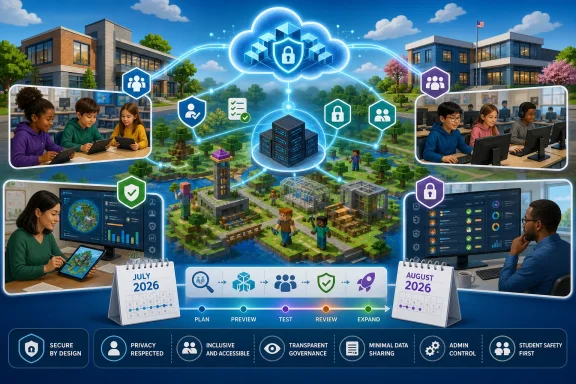 Learning Cubed Puts Cross-Tenant Multiplayer at the Center
Roadmap ID 567317 identifies two headline elements for the Learning Cubed Update: cross-tenant multiplayer for dedicated servers and key features from recent Bedrock updates.Of the two, cross-tenant multiplayer is the more consequential administrative change. A tenant is an organizational identity and management boundary in Microsoft’s cloud environment. Allowing users associated with different tenants to participate on a dedicated server could support activities involving more than one school, district, institution, or approved partner.
Possible educational uses could include interschool projects, shared simulations, collaborative builds, clubs, exchanges, and organized competitions. Those are potential applications rather than capabilities promised by the roadmap. Whether they are practical will depend on implementation details that Microsoft has not yet published.
The roadmap does not establish that dedicated servers are persistent, provide a particular player capacity, offer specific administrative portals or scripts, or support passcodes, allow lists, broadcasting, or other named controls. It also does not describe current dedicated-server availability or explain whether Learning Cubed depends on an existing server product, a new service, or a revised deployment model.
Administrators should therefore avoid reading “dedicated servers” as shorthand for a known configuration. Until Microsoft publishes detailed requirements, the term confirms only that the planned cross-tenant multiplayer feature is associated with dedicated servers.
The roadmap also should not be interpreted as proof that cross-tenant controls are already visible, partially active, or documented elsewhere. Roadmap ID 567317 lists the functionality as in development. Organizations should wait for official Preview documentation before deciding what controls are available or how they operate.
The Roadmap Confirms Direction, Not Architecture
Cross-tenant multiplayer introduces questions that do not arise from the roadmap’s short description alone. If users from separate organizations are to enter the same environment, administrators will need to understand how participation is approved, limited, monitored, and ended.Roadmap ID 567317 does not answer those questions. It does not identify the authorization model or say whether approval will occur at the tenant, server, group, account, or session level. It does not specify whether both organizations must approve a relationship, whether access can be delegated, or how quickly an authorization change would take effect.
The roadmap also does not define server discovery. It is unknown whether users will locate servers through a directory, receive an invitation, enter a server address, follow an administrator-assigned configuration, or use some other process.
Similarly, the entry provides no details about moderation, event records, audit logs, account attribution, access reviews, or incident investigation. Schools should not assume that existing Microsoft 365 audit or identity-management tools will automatically provide complete visibility into Minecraft Education activity. That might eventually be the case, but the roadmap does not establish it.
This uncertainty does not diminish the news. It places it in the correct category: Microsoft has publicly identified a planned capability and broad release targets, while the operational design remains undisclosed.
What is not yet confirmed
Roadmap ID 567317 does not specify:
These items should remain open questions until Microsoft publishes supporting documentation, Preview guidance, release notes, or administrative instructions.
- The exact features that will be selected from recent Bedrock updates.
- The cross-tenant authorization and approval model.
- The prerequisites for deploying or joining a dedicated server.
- The supported hosting topology, infrastructure model, or network design.
- Any licensing changes, additional entitlements, or hosting costs.
- The available logging, auditing, moderation, reporting, or incident-review controls.
- Backup, restoration, retention, or world-recovery mechanisms.
- Server discovery, invitation, allow-listing, passcode, or access-revocation behavior.
- Administrator roles, delegated permissions, or partner-management options.
- Client-version compatibility rules beyond the platforms named in the roadmap.
- Date-specific rollout details within July or August 2026.
Dedicated Servers Could Change the Operating Model
The phrase “dedicated servers” suggests an environment intended to be separate from an ordinary participant’s game session, but Roadmap ID 567317 does not define the resulting operating model. It would be premature to state that worlds will persist between sessions, that a teacher’s device will no longer be involved, or that the server will provide particular availability, capacity, management, or recovery features.Even so, a dedicated-server project involving multiple organizations would require planning beyond a normal classroom software deployment. Someone would need to coordinate the participating organizations and determine whether the implementation meets local technical, privacy, instructional, and safeguarding policies.
The roadmap does not assign responsibility to the organization hosting the server, the users’ home institutions, Microsoft, or a service provider. It also does not say who will be able to change server settings, remove participants, preserve a world, or respond to an incident. Those responsibilities may become clearer during Preview, but they should not be assumed in advance.
If organizations eventually have a choice of hosting models, each option could carry different costs and responsibilities. However, the roadmap does not confirm local hosting, cloud hosting, Microsoft-hosted infrastructure, third-party hosting, or any hybrid arrangement. Budget discussions should therefore treat server infrastructure and operating costs as unknown rather than as established requirements.
The same caution applies to data handling. A shared environment may contain student-created work, account identifiers, chat or interaction records, and other information, depending on the final implementation. The roadmap does not explain what is stored, where it is stored, how long it is retained, or what administrative export and deletion tools will be available.
For now, Learning Cubed should be viewed as a planned expansion of Minecraft Education’s collaboration scope—not as a fully specified infrastructure product.
Preview Is a Planning Milestone, Not a Deployment Promise
Microsoft’s roadmap lists Preview for July 2026 and general availability for August 2026. Both are planned month-level targets. The entry does not provide a specific release day, deployment sequence, tenant-by-tenant schedule, or guarantee that every platform will receive the feature simultaneously.| Release stage | Planned availability | What the roadmap indicates | Recommended admin posture |
|---|---|---|---|
| Preview | July 2026 | Planned early availability for Learning Cubed | Prepare a small, controlled evaluation only after Microsoft publishes requirements |
| General Availability | August 2026 | Planned broader availability in Worldwide Standard Multi-Tenant | Reassess documentation, licensing, controls, and platform readiness before production use |
Preview should be treated as an opportunity to learn how the feature actually works. It should not be approached as an early-access reward for a large student event. A controlled evaluation would give IT and instructional teams time to compare Microsoft’s eventual documentation with local requirements before committing to a wider program.
Any pilot plan should remain conditional. For example, administrators may want to test whether approved users from two organizations can participate and whether access can be removed, but the roadmap does not promise a particular removal mechanism or immediate revocation behavior. Likewise, teams may want to review available logs, but they should not assume that detailed event or moderation logs will exist.
The roadmap’s month-level sequence leaves only a planned one-month interval between Preview and general availability. That makes preparation before Preview useful, but it does not justify configuring infrastructure around undocumented requirements. The safest work before July 2026 is organizational: identify potential participants, define the questions that must be answered, and establish criteria for proceeding or stopping.
Bedrock Features Remain Unspecified
The second component of Learning Cubed is the planned addition of key features from recent Bedrock updates. Roadmap ID 567317 does not name those features.That wording leaves considerable room for selection, modification, delay, or omission. Administrators, educators, and students should not be promised particular blocks, mobs, mechanics, visual changes, commands, creator tools, or other Bedrock additions based only on the roadmap entry.
“Key features” is a category, not a manifest. Microsoft may provide a detailed list closer to Preview, in release notes, or in updated product documentation. Until then, curriculum owners should avoid redesigning lessons around a consumer Bedrock capability that has not been confirmed for Minecraft Education.
The unspecified Bedrock content also creates a change-management question. Any meaningful gameplay update could affect lesson instructions, templates, worlds, assessments, or demonstrations. The roadmap does not say whether existing content will require conversion, whether behavior will change, or whether any compatibility limits will apply.
A pre-release review should therefore separate two testing tracks:
- Cross-tenant multiplayer testing, focused on participation, authorization, administration, and support.
- Content and world testing, focused on the Bedrock features Microsoft ultimately includes and their effect on existing instructional materials.
The necessary test cases can be written only after Microsoft identifies the included features and publishes technical requirements. Before then, the most useful preparation is an inventory of important worlds, templates, lesson plans, and device groups that might eventually need validation.
What Is Confirmed, What Remains Unknown, and How to Prepare
The practical interpretation of Learning Cubed can be consolidated into three parts.What is confirmed
Microsoft lists the Learning Cubed Update under Roadmap ID 567317 and marks it as in development. The roadmap says the update plans to introduce cross-tenant multiplayer for dedicated servers and key features from recent Bedrock updates.Preview is planned for July 2026. General availability is planned for August 2026. The named platforms are Android, Desktop, iOS, and Mac, and the targeted cloud environment is Worldwide Standard Multi-Tenant.
These are planning statements. They establish Microsoft’s current direction, but they do not provide a complete product specification or a guaranteed deployment timetable.
What remains unknown
The central unknown is how separate organizations will establish and govern access to the same server. The roadmap does not describe administrative consent, user selection, server ownership, external-organization approval, access expiration, or revocation.The dedicated-server requirements are also unknown. No supported infrastructure, hosting provider, hardware profile, operating system, network pattern, storage design, backup process, or recovery procedure is established by the supplied fact set.
Licensing is another open issue. The roadmap does not say whether existing Minecraft Education entitlements will cover cross-tenant dedicated-server use, whether server licensing will be separate, or whether additional services will be required.
Operational visibility is equally unclear. Microsoft has not specified what logs, moderation controls, reports, alerts, or audit information will accompany the feature. Organizations cannot yet determine whether those capabilities will satisfy local incident-response and student-safety requirements.
Finally, the rollout schedule remains broad. July and August 2026 are planned months, not exact dates. The roadmap does not say when Preview will begin within July, when general availability will begin within August, how long deployment could take, or whether distribution will differ by platform or tenant.
Recommended pre-preview planning checklist
The following actions are recommendations for organizational readiness. They are not descriptions of Microsoft-supported configuration behavior, and they should not be mistaken for documented product requirements.- Identify one limited educational scenario that could justify a cross-tenant pilot.
- Select no more than a small number of participating organizations for the first evaluation.
- Name an instructional owner and a technical owner in each participating organization.
- Decide what documentation must be available before testing can begin.
- Record open questions about authorization, user approval, revocation, discovery, licensing, logging, moderation, hosting, networking, backups, and support.
- Define what evidence would be required to approve a pilot under local policy.
- Choose noncritical test content and avoid irreplaceable or sensitive student work.
- Inventory the Android, Desktop, iOS, and Mac device groups that could be included.
- Document how each organization normally evaluates and distributes application updates.
- Establish a simple incident-escalation path before involving students.
- Decide who has authority to pause the pilot if controls or documentation are insufficient.
- Set a review point after Preview testing and before any proposed production use.
- Recheck Roadmap ID 567317 and Microsoft’s official release materials for schedule changes.
- Do not purchase hosting, alter firewall rules, or assign administrative permissions solely on the basis of the roadmap description.
- Do not assume the general-availability release will resolve every issue identified during Preview.
Timeline
In development — Microsoft lists Learning Cubed under Roadmap ID 567317, describing planned cross-tenant multiplayer for dedicated servers and key features from recent Bedrock updates.July 2026 — Preview is planned for Android, Desktop, iOS, and Mac. The roadmap provides a month-level target rather than a specific release date.
August 2026 — General availability is planned for the Worldwide Standard Multi-Tenant environment. This is also a month-level target, not a guarantee that the feature will appear for every tenant and platform on the first day of the month.
The schedule should be monitored rather than treated as fixed. Roadmap entries communicate current plans, and those plans may change as development, testing, and deployment progress.
A Controlled Pilot Should Answer Questions, Not Prove a Narrative
If Preview arrives as planned in July 2026, the first pilot should be designed to discover limitations. It should not begin with the assumption that Learning Cubed is ready for a district-wide project or that every expected administrative feature is present.A useful pilot plan would start with a written list of unknowns. Teams could then compare that list with Microsoft’s Preview documentation and test only the behaviors that Microsoft says are supported.
The pilot should use a noncritical world or equivalent test environment if the final product supports that approach. It should include only approved test participants and should avoid sensitive student information. These are risk-reduction recommendations, not claims about specific Minecraft Education controls.
Administrators should document what happens during each supported step: how the server is established, how another organization is approved, how users are selected, what participants see, and what administrators can observe. If Microsoft provides a revocation mechanism, the pilot should verify it. If it provides logs or moderation tools, the pilot should evaluate whether they contain enough information for local needs.
Testing should also include failure conditions documented by Microsoft. Organizations should not invent unsupported tests that could jeopardize production accounts or infrastructure, but they should examine normal administrative scenarios such as an expired collaboration, a removed participant, an unavailable service, or a client that has not yet received the required update—provided the Preview guidance explains how those scenarios are meant to work.
A cross-platform pilot should avoid assuming that identical behavior is guaranteed across Android, Desktop, iOS, and Mac. Each participating organization may have different update practices and device-management constraints. The fact that the roadmap names all four platform categories confirms intended availability, not identical deployment timing or management behavior.
Support ownership should be clear before students participate. Teachers should know whom to contact when a connection fails, an account is rejected, a world behaves unexpectedly, or another organization needs assistance. The final support process will depend on Microsoft’s implementation, but the need for named local decision-makers can be addressed before Preview.
Pilot-readiness checklist
- Microsoft has published documentation sufficient to identify supported prerequisites.
- The planned Preview is available to the intended tenants and platforms.
- Every participating organization has approved the limited test purpose.
- Technical and instructional owners are named.
- The pilot uses noncritical content and a limited participant group.
- The team understands the documented authorization process.
- The team knows how to end participation using supported controls.
- Any available logging and moderation tools have been reviewed.
- Licensing and hosting implications have been checked against official terms.
- Device and application-update processes have been compared across organizations.
- A stop condition has been defined for unclear, missing, or unreliable controls.
- Results will be reviewed before any expansion or general-availability deployment.
Learning Cubed Could Make Collaboration an Administrative Product
Learning Cubed’s visible appeal may come from the unspecified Bedrock features that eventually reach Minecraft Education. The more important institutional development, however, is Microsoft’s plan for cross-tenant multiplayer on dedicated servers.If the implementation provides appropriate controls and participating organizations can satisfy their own policies, the feature could support collaborative programs that extend beyond a single tenant. The roadmap alone cannot establish which programs will be practical, how much administration they will require, or whether every district will consider the available controls sufficient.
Android, Desktop, iOS, and Mac support addresses the planned platform scope. Cross-tenant multiplayer addresses organizational scope. Combining the two could broaden participation, but only if authorization, licensing, hosting, moderation, support, and accountability are clear enough for real-world use.
For now, the strongest response is neither immediate enthusiasm nor blanket rejection. It is disciplined preparation. Schools can identify worthwhile use cases, assemble a short list of nonnegotiable requirements, and prepare a controlled Preview evaluation without assuming undocumented capabilities.
Preview is planned for July 2026, and general availability is planned for August 2026, but both remain month-level roadmap targets. The decisive information will come from the implementation details Microsoft provides closer to release.
If those details are clear and the controls meet local requirements, Learning Cubed could create a practical path to approved collaboration across organizational boundaries. If the controls, responsibilities, or prerequisites remain unclear, cautious institutions can defer deployment until the product and its documentation are mature enough to evaluate confidently.
References
- Primary source: Microsoft 365 Roadmap
Published: 2026-07-09T23:00:39.7653153Z
Loading…
www.microsoft.com - Related coverage: edusupport.minecraft.net
Loading…
edusupport.minecraft.net - Related coverage: education.minecraft.net
Loading…
education.minecraft.net - Official source: techcommunity.microsoft.com
What’s New in Microsoft EDU, Bett Edition January 2026 | Microsoft Community Hub
Welcome to our update for Microsoft Education and our special Bett 2026 edition! The Bett conference takes place in London during the week of January 21st -... techcommunity.microsoft.com
- Related coverage: minecraft.net
Loading…
www.minecraft.net - Related coverage: gamespot.com
Loading…
www.gamespot.com