

Players who want a stable Minecraft experience should update to Tiny Takeover now for the baby-mob features, but Java Edition players on Windows should treat Vulkan in 26.2 Snapshot 1 as a test-lab switch rather than a main-world upgrade path. The verdict is simple: install the cosmetic drop if you play normally, test Vulkan only in a separate snapshot profile, and do not move production worlds, modded setups, classrooms, servers, or family shared worlds onto unstable builds yet. Tiny Takeover is the visible update; Vulkan is the strategic one.
Minecraft Live Spring 2026 was held virtually on March 21, 2026 at 1 PM ET, with Tiny Takeover set to play on March 24. On the surface, this is exactly the kind of drop Mojang knows how to sell: small, understandable, instantly memeable, and easy to explain to players who do not read patch notes.
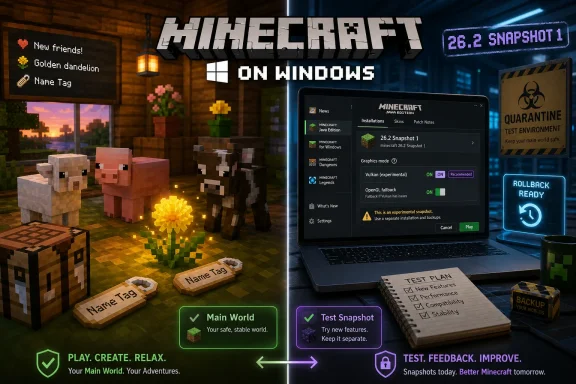
Tiny Takeover adds craftable name tags and a golden dandelion that can keep baby mobs from growing up. That is not a minor thing for builders, collectors, survival-roleplay players, or anyone who has ever tried to preserve the exact mob variant that made a base feel alive. It gives players a more direct way to shape the world’s emotional texture without relying as heavily on loot-table luck.
But for Windows and PC players, the longer story is not the golden dandelion. It is Minecraft Java Edition 26.2 Snapshot 1 adding support for rendering through Vulkan, alongside a Graphics API toggle and an OpenGL fallback. Mojang itself describes Vulkan as experimental and warns that it may be less performant or stable than OpenGL for some players, which is the polite way of saying: this is not yet the new default reality.
That split defines the decision. Tiny Takeover is an update you can enjoy. Vulkan is an architecture shift you should evaluate.
If you play Minecraft Java Edition on Windows and are curious about Vulkan, the smarter path is to test it only through the snapshot flow. Create a separate installation profile in the Minecraft Launcher, use a copied world or a disposable test world, and leave your long-running saves out of it. Snapshots are for discovering the future, not entrusting your future to them.
The toggle matters because Mojang is not ripping out OpenGL in one swing. Java Edition 26.2 Snapshot 1 includes a Graphics API option in Video Settings, and OpenGL remains available as a fallback. That fallback is not just a convenience; it is the safety valve that keeps experimentation from becoming a compatibility crisis.
So the decision tree looks like this in plain English. Update your regular Minecraft installation for Tiny Takeover if you want the baby-mob additions. Test Vulkan only if you are comfortable diagnosing graphics problems, performance regressions, or launch instability. Wait if your Minecraft setup depends on mods, older hardware, strict stability, or a server/client environment you do not want to troubleshoot.
Craftable name tags are the sleeper feature. Name tags have always sat in that strange Minecraft category where they are not technically essential but feel essential once a world becomes personal. Making them craftable lowers friction for players who treat mobs as part of their world-building rather than disposable entities.
The golden dandelion is even more direct. It lets players keep baby mobs from growing up, which turns a short-lived visual state into a permanent design choice. That is cosmetic in the strict mechanical sense, but Minecraft has never been a game where cosmetics are trivial. The difference between a base that functions and a base that feels inhabited often comes from these tiny persistent details.
For Bedrock players, especially those on Windows who treat Minecraft as a cross-device household game, Tiny Takeover is likely the update that matters today. It gives younger players a reason to engage, gives builders another aesthetic tool, and does not require anyone to understand graphics APIs, drivers, or render backends.
OpenGL has been the familiar foundation for Java Edition rendering, but familiar does not mean future-proof. Vulkan is a lower-level graphics API designed to give software more explicit control over GPU work. In theory, that can help modern rendering pipelines scale better and reduce some of the overhead associated with older approaches.
The phrase “in theory” is doing important work. Mojang’s own warning that Vulkan may be less performant or stable than OpenGL for some players is not boilerplate; it is the central caveat. A new graphics backend can improve some machines, regress others, and expose driver bugs that were invisible under the old path.
That is why the Graphics API toggle is the feature enthusiasts should care about as much as Vulkan itself. A forced migration would turn every edge case into a support problem. A toggle lets Mojang gather feedback, lets users compare behavior, and gives Windows players a way back when a GPU-driver combination does not behave.
The first rule is to avoid testing Vulkan on the only copy of a world that matters. Minecraft snapshots are explicitly unstable development builds, and graphics backend changes add a different class of risk than a new mob or block. A rendering bug might not corrupt a save, but troubleshooting a launch failure or visual issue becomes much easier when the world itself is disposable.
The second rule is to separate vanilla testing from modded testing. If a snapshot misbehaves under a modded stack, you may not immediately know whether Vulkan, the snapshot, the mod loader, a shader path, or a driver interaction is responsible. Start with vanilla. Then add complexity deliberately.
The third rule is to write down what you changed. That sounds excessively sysadmin-ish for a block game until you have three launcher profiles, two driver versions, a shader pack, and a world that only fails when one particular backend is active. Minecraft has a casual surface, but troubleshooting it on Windows can look a lot like troubleshooting any other client-side application.
For ordinary players, the advice is simpler. If you do not know why you would enable Vulkan, you probably do not need to enable Vulkan yet.
Fallback also gives Mojang room to learn. Experimental rendering is not a single yes-or-no feature; it is an exercise in discovering which hardware behaves, which drivers misbehave, and which assumptions in the engine break when the API changes. The more varied the test population, the more valuable the data — but only if players can recover from failures.
This is also where the snapshot label should be taken literally. “Experimental” does not mean “secretly better if you are brave.” It means the implementation is still being validated. Some players may see gains, some may see no meaningful difference, and some may find OpenGL remains the better option for now.
That reality should temper the usual PC-upgrade reflex. A high-end GPU does not guarantee a better Vulkan experience in an unfinished implementation. Conversely, a modest system that supports the necessary path may behave surprisingly well. Until Mojang says the Vulkan path is stable, individual results are evidence, not universal truth.
That distinction matters for households, schools, community servers, and anyone running a predictable Minecraft environment. A baby mob that stays young is unlikely to become an IT incident. A graphics backend that fails on a subset of machines absolutely can become one, especially when users do not understand why Minecraft suddenly behaves differently on similar-looking PCs.
For administrators supporting shared machines, the conservative posture is clear. Keep general users on stable releases. Allow snapshots only where experimentation is intended. If users test Vulkan, keep OpenGL available and document the way back.
For enthusiasts, the more interesting move is controlled benchmarking. Use the same world, the same render distance, the same driver, and the same settings when comparing OpenGL and Vulkan. Do not treat one impressive moment as a verdict. Minecraft performance is situational, and a backend that looks faster in one biome, view distance, or workload may not win everywhere.
But PC Minecraft has always lived in the space between toy and platform. The same game is used by children, speedrunners, modders, educators, server operators, redstone engineers, YouTubers, and people with absurdly tuned workstations. A rendering change in Java Edition lands differently across that audience.
That is why Windows players should avoid reading this as “cute update versus serious update.” Both matter, but on different clocks. Tiny Takeover matters the moment you load a world and start naming or preserving mobs. Vulkan matters if it becomes the foundation for future Java Edition rendering work.
The open question is not whether Vulkan is good technology. The question is whether Mojang’s implementation becomes stable and compatible enough for Minecraft’s unusually broad PC base. That answer will emerge from snapshots, driver behavior, user reports, and Mojang’s willingness to keep the fallback path healthy during the transition.
The same pattern has shown up in other Minecraft update cycles. A snapshot can look like a content preview while quietly testing how far Mojang can stretch the engine, the client, or the game’s assumptions about player hardware. For readers who followed the Mounts of Mayhem snapshot cycle, the lesson is familiar: the visible feature gets the attention, but the implementation details decide how painful the transition becomes.
That is why Minecraft coverage increasingly has to read like PC platform coverage. The game is not just adding things; it is changing the assumptions beneath them. A new mob behavior is gameplay. A new rendering path is infrastructure.
If you are a Bedrock player on Windows, Tiny Takeover is the easy part of the story. Update when the drop is available through the normal channel and enjoy the new mob-preservation and naming tools. The risk calculus is mostly ordinary update caution, not experimental-renderer caution.
If you are a Java Edition player, especially on Windows, you have two separate decisions. The content decision is whether you want Tiny Takeover’s new features. The graphics decision is whether you want to help test Vulkan before Mojang considers it stable.
Those decisions should not be merged. Wanting craftable name tags does not obligate you to test Vulkan. Wanting to test Vulkan does not mean your main world should become the test case.
 Mojang Ships the Cute Update While Hiding the Bigger PC Story in Plain Sight
Minecraft Live Spring 2026 was held virtually on March 21, 2026 at 1 PM ET, with Tiny Takeover set to play on March 24. On the surface, this is exactly the kind of drop Mojang knows how to sell: small, understandable, instantly memeable, and easy to explain to players who do not read patch notes.Tiny Takeover adds craftable name tags and a golden dandelion that can keep baby mobs from growing up. That is not a minor thing for builders, collectors, survival-roleplay players, or anyone who has ever tried to preserve the exact mob variant that made a base feel alive. It gives players a more direct way to shape the world’s emotional texture without relying as heavily on loot-table luck.
But for Windows and PC players, the longer story is not the golden dandelion. It is Minecraft Java Edition 26.2 Snapshot 1 adding support for rendering through Vulkan, alongside a Graphics API toggle and an OpenGL fallback. Mojang itself describes Vulkan as experimental and warns that it may be less performant or stable than OpenGL for some players, which is the polite way of saying: this is not yet the new default reality.
That split defines the decision. Tiny Takeover is an update you can enjoy. Vulkan is an architecture shift you should evaluate.
The Sensible Move Is to Update for Tiny Takeover and Quarantine Vulkan
For most players, the practical answer is not complicated. If you are on the normal release track and want the new baby-mob behavior, craftable name tags, and golden dandelion, updating for Tiny Takeover is reasonable. The feature set is immediate, understandable, and aimed at ordinary play rather than deep system behavior.If you play Minecraft Java Edition on Windows and are curious about Vulkan, the smarter path is to test it only through the snapshot flow. Create a separate installation profile in the Minecraft Launcher, use a copied world or a disposable test world, and leave your long-running saves out of it. Snapshots are for discovering the future, not entrusting your future to them.
The toggle matters because Mojang is not ripping out OpenGL in one swing. Java Edition 26.2 Snapshot 1 includes a Graphics API option in Video Settings, and OpenGL remains available as a fallback. That fallback is not just a convenience; it is the safety valve that keeps experimentation from becoming a compatibility crisis.
So the decision tree looks like this in plain English. Update your regular Minecraft installation for Tiny Takeover if you want the baby-mob additions. Test Vulkan only if you are comfortable diagnosing graphics problems, performance regressions, or launch instability. Wait if your Minecraft setup depends on mods, older hardware, strict stability, or a server/client environment you do not want to troubleshoot.
Tiny Takeover Is Small by Design, and That Is Why It Works
The modern Minecraft update cadence has moved away from giant monolithic releases that force every player to care about every subsystem at once. Tiny Takeover fits that newer model. It is deliberately approachable: baby mobs, name tags, a flower with a special behavior, and a reason for players to revisit the small rituals of animal breeding, pet keeping, and base decoration.Craftable name tags are the sleeper feature. Name tags have always sat in that strange Minecraft category where they are not technically essential but feel essential once a world becomes personal. Making them craftable lowers friction for players who treat mobs as part of their world-building rather than disposable entities.
The golden dandelion is even more direct. It lets players keep baby mobs from growing up, which turns a short-lived visual state into a permanent design choice. That is cosmetic in the strict mechanical sense, but Minecraft has never been a game where cosmetics are trivial. The difference between a base that functions and a base that feels inhabited often comes from these tiny persistent details.
For Bedrock players, especially those on Windows who treat Minecraft as a cross-device household game, Tiny Takeover is likely the update that matters today. It gives younger players a reason to engage, gives builders another aesthetic tool, and does not require anyone to understand graphics APIs, drivers, or render backends.
The Baby-Mob Drop Is the Headline, but Vulkan Is the Platform Bet
The Vulkan experiment in Java Edition deserves more attention because Java Minecraft’s relationship with PC hardware has always been odd. Minecraft can run on modest machines, but it can also expose bottlenecks in ways that surprise users with otherwise powerful Windows rigs. Render distance, chunk behavior, shaders, mods, drivers, and CPU load all turn “it runs Minecraft” into a more complicated claim than it sounds.OpenGL has been the familiar foundation for Java Edition rendering, but familiar does not mean future-proof. Vulkan is a lower-level graphics API designed to give software more explicit control over GPU work. In theory, that can help modern rendering pipelines scale better and reduce some of the overhead associated with older approaches.
The phrase “in theory” is doing important work. Mojang’s own warning that Vulkan may be less performant or stable than OpenGL for some players is not boilerplate; it is the central caveat. A new graphics backend can improve some machines, regress others, and expose driver bugs that were invisible under the old path.
That is why the Graphics API toggle is the feature enthusiasts should care about as much as Vulkan itself. A forced migration would turn every edge case into a support problem. A toggle lets Mojang gather feedback, lets users compare behavior, and gives Windows players a way back when a GPU-driver combination does not behave.
Windows Players Should Think Like Testers, Not Tourists
For WindowsForum readers, the Vulkan snapshot is interesting less because it is shiny and more because it touches the stack: GPU driver, operating system, Java runtime behavior, launcher profile, game version, mod loader, and world state. That is where enthusiasts and IT-minded players should slow down.The first rule is to avoid testing Vulkan on the only copy of a world that matters. Minecraft snapshots are explicitly unstable development builds, and graphics backend changes add a different class of risk than a new mob or block. A rendering bug might not corrupt a save, but troubleshooting a launch failure or visual issue becomes much easier when the world itself is disposable.
The second rule is to separate vanilla testing from modded testing. If a snapshot misbehaves under a modded stack, you may not immediately know whether Vulkan, the snapshot, the mod loader, a shader path, or a driver interaction is responsible. Start with vanilla. Then add complexity deliberately.
The third rule is to write down what you changed. That sounds excessively sysadmin-ish for a block game until you have three launcher profiles, two driver versions, a shader pack, and a world that only fails when one particular backend is active. Minecraft has a casual surface, but troubleshooting it on Windows can look a lot like troubleshooting any other client-side application.
For ordinary players, the advice is simpler. If you do not know why you would enable Vulkan, you probably do not need to enable Vulkan yet.
The OpenGL Fallback Is Not a Footnote
Mojang’s inclusion of OpenGL fallback is the difference between a responsible graphics transition and a messy one. It acknowledges the enormous diversity of Minecraft Java Edition machines. Windows players are not all on current GPUs, current drivers, or clean vanilla installations.Fallback also gives Mojang room to learn. Experimental rendering is not a single yes-or-no feature; it is an exercise in discovering which hardware behaves, which drivers misbehave, and which assumptions in the engine break when the API changes. The more varied the test population, the more valuable the data — but only if players can recover from failures.
This is also where the snapshot label should be taken literally. “Experimental” does not mean “secretly better if you are brave.” It means the implementation is still being validated. Some players may see gains, some may see no meaningful difference, and some may find OpenGL remains the better option for now.
That reality should temper the usual PC-upgrade reflex. A high-end GPU does not guarantee a better Vulkan experience in an unfinished implementation. Conversely, a modest system that supports the necessary path may behave surprisingly well. Until Mojang says the Vulkan path is stable, individual results are evidence, not universal truth.
Tiny Takeover Is Safe Fun; Vulkan Is a Compatibility Audit
The difference between the two updates is not merely content versus technology. It is risk profile. Tiny Takeover changes what players do in the world. Vulkan changes how the client draws that world.That distinction matters for households, schools, community servers, and anyone running a predictable Minecraft environment. A baby mob that stays young is unlikely to become an IT incident. A graphics backend that fails on a subset of machines absolutely can become one, especially when users do not understand why Minecraft suddenly behaves differently on similar-looking PCs.
For administrators supporting shared machines, the conservative posture is clear. Keep general users on stable releases. Allow snapshots only where experimentation is intended. If users test Vulkan, keep OpenGL available and document the way back.
For enthusiasts, the more interesting move is controlled benchmarking. Use the same world, the same render distance, the same driver, and the same settings when comparing OpenGL and Vulkan. Do not treat one impressive moment as a verdict. Minecraft performance is situational, and a backend that looks faster in one biome, view distance, or workload may not win everywhere.
Mojang’s Smaller Drops Make the Big Risks Easier to Miss
Tiny Takeover is a good example of Mojang’s current communications challenge. The approachable feature is what gets the trailer moment. The technical transition is what may matter more over time. That is not deception; it is product reality. Most players care about what they can see immediately.But PC Minecraft has always lived in the space between toy and platform. The same game is used by children, speedrunners, modders, educators, server operators, redstone engineers, YouTubers, and people with absurdly tuned workstations. A rendering change in Java Edition lands differently across that audience.
That is why Windows players should avoid reading this as “cute update versus serious update.” Both matter, but on different clocks. Tiny Takeover matters the moment you load a world and start naming or preserving mobs. Vulkan matters if it becomes the foundation for future Java Edition rendering work.
The open question is not whether Vulkan is good technology. The question is whether Mojang’s implementation becomes stable and compatible enough for Minecraft’s unusually broad PC base. That answer will emerge from snapshots, driver behavior, user reports, and Mojang’s willingness to keep the fallback path healthy during the transition.
Related Minecraft Coverage Shows the Pattern
WindowsForum has already been tracking Minecraft Live 2026 and the way Tiny Takeover packages baby mobs with bigger visual ambitions. That earlier discussion caught the shape of the announcement: cute on the surface, more technically suggestive underneath. The sharper point now is that the Vulkan snapshot gives that suspicion a concrete place to land.The same pattern has shown up in other Minecraft update cycles. A snapshot can look like a content preview while quietly testing how far Mojang can stretch the engine, the client, or the game’s assumptions about player hardware. For readers who followed the Mounts of Mayhem snapshot cycle, the lesson is familiar: the visible feature gets the attention, but the implementation details decide how painful the transition becomes.
That is why Minecraft coverage increasingly has to read like PC platform coverage. The game is not just adding things; it is changing the assumptions beneath them. A new mob behavior is gameplay. A new rendering path is infrastructure.
The Sensible Player’s Plan for March 2026 and Beyond
The practical plan is to split your Minecraft life into three lanes. Stable play gets Tiny Takeover. Curiosity gets a snapshot profile. Important worlds get backups and patience.If you are a Bedrock player on Windows, Tiny Takeover is the easy part of the story. Update when the drop is available through the normal channel and enjoy the new mob-preservation and naming tools. The risk calculus is mostly ordinary update caution, not experimental-renderer caution.
If you are a Java Edition player, especially on Windows, you have two separate decisions. The content decision is whether you want Tiny Takeover’s new features. The graphics decision is whether you want to help test Vulkan before Mojang considers it stable.
Those decisions should not be merged. Wanting craftable name tags does not obligate you to test Vulkan. Wanting to test Vulkan does not mean your main world should become the test case.
The Tiny Takeover Verdict Fits on One Workbench
Tiny Takeover is the drop to install; Vulkan is the experiment to isolate. That is the useful split for players who do not want the announcement cycle to blur ordinary updates with architectural testing.- Players who want the new baby-mob features should update through the normal release path rather than wait for the Vulkan work to mature.
- Java Edition players should test Vulkan only in 26.2 Snapshot 1 or later snapshot builds that expose the Graphics API toggle.
- Main worlds, modded installations, classrooms, family PCs, and community setups should stay on stable builds unless there is a deliberate testing reason to move.
- OpenGL fallback is the safety net, and players should treat it as the default escape route if Vulkan causes instability or poor performance.
- The long-term story is not the golden dandelion itself but whether Mojang can make Vulkan reliable enough to reshape Java Edition performance and compatibility on Windows PCs.
References
- Primary source: minecraft.fandom.com
Minecraft Live - March 2026 – Minecraft Wiki
Minecraft Live - March 2026 was an event that took place on March 21, 2026. It featured more information, including the release date about Tiny Takeover, special guests, and some upcoming contents. Note: Contents for this event appear in order. Parties Tiny Takeover Minecraft World Chaos Cubed...minecraft.fandom.com
- Independent coverage: boxtoplay.com
Tiny Takeover: baby mobs conquer your Minecraft worlds - BoxToPlay
Tiny Takeover has landed Minecraft’s first 2026 drop, Tiny Takeover, is now live on Java (26.1) and Bedrock. This update focuses on baby mobs, new…www.boxtoplay.com - Independent coverage: minecraft.how
Aggiornamenti Minecraft 2026: Guida Completa
Scopri il ciclo di aggiornamenti di Minecraft 2026 con Tiny Takeover e Minecraft Live. Quali novità, feature e rilasci per PS5 ti aspettano quest'anno. minecraft.how
- Independent coverage: pcgamer.com
How to watch Minecraft Live 2026 | PC Gamer
Secret stuff, guests, and new content will be revealed.www.pcgamer.com - Independent coverage: games.gg
Minecraft Live March 2026: Every Major Announcement from Mojang | GAMES.GG
Mojang Studios dropped a packed Minecraft Live showcase featuring Minecraft Dungeons 2, the Tiny Takeover release date, Chaos Cubed, and a real-world theme park reveal.games.gg - Independent coverage: gameversify.com
Minecraft LIVE 2026 - Cute Babies, Sulfur Caves & Big Surprises The Full Recap
Minecraft LIVE 2026 showed Mojang is mixing cute stuff, creative chaos, easy playing with friends, and real-world fun. Tiny Takeover is already here (or dropsgameversify.com
- Independent coverage: gamespot.com
As Minecraft's New Update Arrives, Mojang Says "Nothing Is Off The Table" For Future Drops - GameSpot
With the arrival of the cutest baby mobs in the game's existence, Minecraft's product manager tells GameSpot not to rule anything out for future drops.www.gamespot.com - Independent coverage: shacknews.com
Minecraft Tiny Takeover update arrives this week, Chaos Cubed coming later | Shacknews
Minecraft detailed its next two updates, the first of which is really gosh-darned cute.www.shacknews.com - Independent coverage: minecraft.net
Tune in to Minecraft Live | Minecraft
Learn more about Minecraft LIVE, the annual celebration of all things Minecraft. Hear from Mojang Studios and content creators during the livestream and find out where to watch it.www.minecraft.net - Independent coverage: olagg.io
- Independent coverage: gigamaus.de
Minecraft LIVE 2026: Alle Ankündigungen vom 21. März 2026 zusammengefasst - gigamaus.de
Am 21. März 2026 fand Minecraft LIVE statt – die halbjährliche Liveübertragung von Mojang Studios, bei der das Studio neue Inhalte, Entwicklereinblicke und große Ankündigungen für die weltweite Minecraft-Gemeinschaft präsentiert. Die Sendung dauerte rund 56 Minuten und lieferte gleich mehrere...www.gigamaus.de - Primary source: WindowsForum
Minecraft Live 2026: Tiny Takeover Baby Mobs and Vulkan Visuals | Windows Forum
Minecraft’s first big showcase of 2026 is locked in and the trailer gives a clear signal: the spring Minecraft Live is coming for cute, technical, and...windowsforum.com
