

Eczacıbaşı Holding has launched Mission AI, a group-wide program built on Microsoft Copilot Studio, Microsoft Foundry, Azure AI Services, Azure OpenAI in Foundry Models, and Microsoft productivity platforms to standardize AI adoption and turn employee ideas into production-oriented business agents. The important part is not that another large organization is “doing AI,” because nearly every boardroom now says that. It is that Eczacıbaşı tried to turn AI from a patchwork of experiments into an internal operating model, with a funnel, tooling choices, coaching, prototypes, and a path toward enterprise systems. For IT leaders, Mission AI is a useful case study in what happens when generative AI stops being a demo culture and starts becoming portfolio management.
Microsoft’s customer story frames Mission AI as a group-wide transformation initiative designed to standardize and scale AI adoption across Eczacıbaşı Holding’s diversified business portfolio. That phrase matters. “Standardize and scale” is the unglamorous work most organizations discover only after the first wave of AI enthusiasm: who is allowed to build, which tools are sanctioned, where data can go, how prototypes are judged, and how an idea survives long enough to become useful.
The program empowered employees across business units to develop custom AI solutions tailored to operational challenges and business needs. In other words, this was not simply a central IT team building bots for everyone else. Mission AI invited teams from across the affiliate network to participate, contribute insights, and work together on solutions, making the program explicitly collaborative rather than purely top-down.
That design choice is the story’s central tension. Enterprise AI cannot scale if it is treated as a laboratory reserved for specialists, but it also cannot survive if every department improvises its own agents, prompts, connectors, and governance rules. Mission AI’s bet was that a shared framework could give business users room to move without letting the organization fragment into dozens of incompatible experiments.
Fıçı, quoted in Microsoft’s account, describes the program in precisely those terms: “Mission AI bridged the gap between experimentation and sustained value creation, embedding AI into strategic decisions and daily business,” The line is corporate, but the problem it identifies is real. The gap between experimentation and value is where most AI pilots go to die.
The reason is simple: early AI work often rewards novelty, not repeatability. A chatbot that summarizes a document can impress a meeting room, but an agent that touches supply chain workflows, logistics decisions, corporate communications, or marketing operations has to be reliable enough to enter someone’s workday. Mission AI is interesting because it appears to have been built around that second threshold.
That selection ratio says two things at once. First, there was broad internal appetite for AI. Second, Eczacıbaşı did not treat every idea as equally ready, feasible, or valuable. In a mature enterprise AI program, saying no is as important as provisioning the tools.
Fıçı’s second quote underscores the cultural signal: “One defining moment for me was seeing 358 project ideas submitted from across the group in a short period. That showed real organizational readiness for AI,” Read narrowly, that is a statement about engagement. Read operationally, it is a warning to IT: once employees believe AI can solve local problems, demand will arrive faster than governance structures can handle unless the intake process is already there.
The structured pipeline selected 58 project ideas for development. From that group, 27 prototypes were completed, with 12 highlighted as high-impact solutions that could be applied organization-wide. The numbers describe a narrowing curve: broad participation, curated development, completed prototypes, then a smaller set judged potentially reusable beyond one business unit.
That is exactly how AI portfolios should behave. If every applicant becomes a production project, the organization has no prioritization discipline. If every prototype remains trapped in a local pilot, the organization has no scaling mechanism. Mission AI’s value is that it seems to have treated AI ideas as a managed pipeline rather than a suggestion box.
The graduation event hosted at the Microsoft office also matters, not because ceremonies make software better, but because enterprise transformation needs visible rituals. A showcase gives teams a deadline, executives a portfolio view, and participants a sense that their work is part of a broader organizational shift. In large groups with multiple affiliates, that visibility can be the difference between “one department made a clever bot” and “the group now has a repeatable AI delivery motion.”
Erhan Güleyüpoğlu, Senior IT Architecture and Infrastructure Manager, put the Copilot Studio half of that equation plainly: “Copilot Studio enabled rapid adoption, letting business users quickly get involved and create solutions without deep technical expertise,” That is the classic citizen-developer promise, but the AI version is more consequential than earlier low-code waves. A form app or dashboard usually automates a bounded process; an AI agent may interpret requests, retrieve information, call tools, and act across systems.
Microsoft’s own documentation describes Copilot Studio as a graphical, low-code tool for building agents and agent flows. Its official materials emphasize agent creation, knowledge grounding, actions, connectors, analytics, deployment channels, and the ability to start low-code while extending with APIs, custom connectors, and scripts. That aligns with the role Copilot Studio played in Mission AI: it lowered the barrier to participation while still fitting into a broader Microsoft enterprise stack.
But low-code is not magic, and it is not governance. The deeper implication of Mission AI’s two-track tooling model is that successful enterprise AI programs need a migration path from business-authored prototypes to more engineered systems. A department can sketch an agent in Copilot Studio, prove that the workflow matters, and then decide whether the use case requires deeper work in Microsoft Foundry, more formal integration, stronger lifecycle management, or additional technical controls.
That is where many organizations get stuck. They either force everything through central engineering, which kills local momentum, or they let business teams build freely, which creates maintenance and security risk. Mission AI’s design suggests a middle path: let employees propose and prototype, but place those efforts inside a shared framework that can distinguish a local helper from a candidate for organization-wide deployment.
For Microsoft, this is the strategic sweet spot. Copilot Studio is the approachable front door. Foundry is the more advanced build environment. Azure AI Services and Azure OpenAI in Foundry Models provide the AI infrastructure. Microsoft productivity platforms give the agents a place to live near the work people already do.
For customers, the appeal is equally obvious. Building generative AI agents from scratch means dealing with identity, data access, model selection, safety, logging, connectors, and deployment surfaces. Using Microsoft’s stack does not eliminate those problems, but it can concentrate them into a platform environment IT already understands.
The catch is that agent programs eventually collide with line-of-business systems. Microsoft’s account says further integration was planned into systems like SAP, CRM, and ERP for full deployment. That one sentence is where the story moves from AI enthusiasm to enterprise reality.
An agent that drafts marketing copy or summarizes internal documents can often remain at the edge of systems of record. An agent that interacts with SAP, CRM, or ERP enters a different risk class. It may see sensitive data, trigger workflows, influence inventory, shape customer interactions, or affect financial and operational processes. At that point, the question is no longer “can we build it?” but “can we govern it over time?”
That distinction should be familiar to Windows and Microsoft 365 admins. The first phase of adoption is often enablement: licenses, access, templates, pilots. The second phase is control: identity, permissions, data loss prevention, audit trails, connector review, lifecycle management, and rollback plans. Mission AI’s early success depends on the second phase being as deliberate as the first.
But an eight-week prototype window should be interpreted carefully. It is long enough to clarify the problem, identify data sources, build a first version, test assumptions, and show whether the user experience has promise. It is not long enough, by itself, to prove enterprise resilience, compliance readiness, long-term maintenance cost, or measurable return on investment across the organization.
Burak Zararsız, Senior Digital Technologies Manager, describes the adoption model this way: “Adoption was driven by a structured acceleration program and technical coaching,” That phrase is more important than the eight-week number. Acceleration without coaching tends to produce brittle demos. Coaching without a pipeline tends to produce workshops that never turn into systems. Mission AI combined both.
The presence of a partner also tells us something about the real skills gap. Low-code tools can let business users start building, but organizations still need architecture, data, security, and integration expertise to turn prototypes into durable software. The most successful internal AI programs are unlikely to be either purely democratized or purely centralized. They will look like guided ecosystems.
That is especially true when agents cross departmental boundaries. A supply chain agent may need data from planning systems. A logistics agent may need operational feeds. A corporate communications agent may need approved knowledge sources and tone controls. A marketing operations agent may need workflow integration and brand governance. Each prototype may begin with a local pain point, but production use pulls it into shared infrastructure.
Mission AI’s numbers show a program that has already passed the ideation phase. The next test is whether the 12 high-impact solutions can become repeatable, supportable, and measurable after the graduation event ends.
That language is appropriately cautious. “Initial performance improvements” is not the same as audited, enterprise-wide productivity gains. “MVP” is not the same as production-grade. “Planned for full deployment” is not the same as fully integrated.
This is not a criticism of Eczacıbaşı; it is a sign that the source material is describing a realistic phase of AI adoption. The danger in enterprise AI coverage is that prototypes are often written up as if they are finished transformations. Mission AI is more interesting if we resist that temptation. The program has demonstrated organizational appetite, built a pipeline, completed 27 prototypes, and identified 12 high-impact candidates. Now those candidates must survive integration.
The hardest step will likely be moving from task assistance to process ownership. An agent that helps a user find information can be useful even if imperfect. An agent that recommends or initiates operational actions needs stricter controls. It must know which data is authoritative, which user is allowed to do what, when human approval is required, and how exceptions are handled.
SAP, CRM, and ERP integration raises these stakes. Enterprise systems are full of business logic that is undocumented, locally customized, or understood only by experienced operators. If an agent simply adds a conversational layer on top, it may save time. If it begins to orchestrate actions across those systems, it becomes part of the control fabric of the business.
That is where Microsoft’s “integration-ready, secure” positioning will meet practical IT scrutiny. Secure platforms help, but security is an implementation discipline. Every connector, permission scope, knowledge source, and action path becomes part of the risk model.
Without a common framework, each affiliate or business unit can adopt different models, different data practices, different vendors, different prompt patterns, and different security assumptions. The result is not innovation at scale. It is an estate of disconnected experiments that central IT must later inventory, rationalize, and sometimes shut down.
A shared framework changes the conversation. It gives teams a sanctioned route to participate. It gives leaders a portfolio view. It gives IT a way to review and support projects before they become shadow systems. It gives successful ideas a path to spread more widely.
The inclusivity of Mission AI also matters here. If teams from across the affiliate network are invited to contribute insights and work together on solutions, the program can surface needs that central teams might not see. Supply chain staff know where delays happen. Logistics teams know which exceptions consume time. Communications teams know where approvals slow down. Marketing operations teams know which repetitive tasks create bottlenecks.
This is the strongest argument for business-led AI ideation: the people closest to the workflow often know which problems are worth solving. The strongest argument for central structure is that those same people should not have to become experts in model governance, identity, connectors, and compliance. Mission AI’s design appears to recognize both truths.
The speed advantage is clear. Business users can get involved quickly, as Güleyüpoğlu said, without deep technical expertise. That makes AI development less dependent on scarce engineering capacity and allows departments to test ideas before asking for full IT investment.
But every democratized tool creates a governance problem once it becomes successful. The easier it is to build agents, the more agents there will be. Some will duplicate one another. Some will be abandoned. Some will connect to stale documents. Some will encode departmental assumptions. Some will need access to systems they should not touch.
This is why the Mission AI framework matters more than the tooling alone. Copilot Studio can accelerate agent creation, but the organization still needs intake, review, ownership, documentation, testing, and retirement processes. An agent estate without lifecycle management becomes the AI equivalent of spreadsheet sprawl: useful, popular, and dangerously invisible.
Microsoft’s own Copilot Studio materials emphasize that agents can use knowledge sources, tools, connectors, and actions. Those are powerful capabilities, but they are also the points where administrators need discipline. The more an agent can do, the more important it becomes to define what it must not do.
This is where many enterprise AI roadmaps will split. Simple departmental agents may live comfortably in Copilot Studio. Higher-impact agents may need more technical architecture. The trick is not choosing one tool forever; it is choosing the right tool at the right maturity level.
For IT teams, that means defining escalation criteria. When does a prototype need architectural review? When does it require formal security testing? When does it need source control, environment separation, monitoring, or a production support owner? When does it stop being a “business-built agent” and become an enterprise application?
Mission AI’s model implies that such distinctions are inevitable. Out of 358 applicants, only 58 ideas moved into development. Out of the completed prototypes, 12 were highlighted as high-impact solutions that could be applied organization-wide. The more widely applicable a solution becomes, the less it can remain an informal experiment.
The Foundry path gives organizations a place to put that complexity. It does not remove the need for governance, but it acknowledges that some agents are closer to software engineering than business automation. That distinction will become more important as agents move from answering questions to executing work.
The metrics should vary by use case. A logistics agent might be judged on exception handling time, shipment visibility, or manual follow-up reduction. A supply chain agent might be judged on planning cycle time, forecast support, or faster retrieval of operational context. A corporate communications agent might be judged on drafting speed, approval consistency, or reduced duplication. A marketing operations agent might be judged on campaign workflow throughput or asset management efficiency.
But the common measurement discipline is the same: define a baseline, measure the change, track usage, and watch for quality failures. An agent that saves time but produces unreliable outputs may simply move work from creation to review. An agent that users try once and abandon has not changed the process. An agent that performs well in one business unit may fail elsewhere if the data, language, workflow, or permissions differ.
The fact that 12 prototypes were highlighted as high-impact and potentially organization-wide makes measurement even more important. A local pilot can survive on enthusiasm. A group-wide deployment needs evidence.
This is also where Microsoft and partners often have to move beyond platform enablement into operating discipline. Once agents are in daily business, the questions become less glamorous: who monitors them, who updates them, who validates knowledge sources, who responds when they fail, who approves new connectors, and who decides whether an agent should be retired?
That makes the governance model familiar. The same instincts admins developed for endpoint management, app deployment, conditional access, data protection, and SaaS sprawl now apply to agents. Inventory matters. Ownership matters. Least privilege matters. Change control matters. Monitoring matters.
The difference is that agents can blur the line between interface and automation. A user asks a question in natural language; the agent retrieves context, reasons over it, and may call a tool. That chain is harder to reason about than a traditional form submission or script. It requires both technical controls and business process clarity.
Mission AI’s planned integrations into SAP, CRM, and ERP are the point where admins should pay closest attention. Those systems often define the operational truth of the organization. If AI agents become a front end to them, administrators need to know exactly which transactions are read-only, which require approval, which can be automated, and which should remain human-only.
Graduation events can accidentally create the illusion that the hard part is over. In reality, the hard part begins when a promising prototype must operate in a messy environment with real users, incomplete data, changing business rules, and audit requirements. The prototype phase proves possibility; the production phase tests institutional seriousness.
Mission AI appears to have accomplished what many AI programs fail to do: generate broad participation, filter ideas, provide tool choices, deliver coaching, complete prototypes, and identify candidates for wider reuse. That is a strong foundation. But the next phase will determine whether the program becomes an engine for sustained value or a successful internal showcase.
The distinction will depend on integration and governance. Agents that remain disconnected from core systems may still be useful, but their impact will be limited. Agents that connect deeply into SAP, CRM, and ERP may create more value, but they will also require stronger controls. The highest-impact use cases are almost always the ones that demand the most operational maturity.
This is why Fıçı’s phrase about bridging experimentation and sustained value creation is the right lens for the story. The bridge has been built; now traffic has to cross it safely.
A few practical lessons stand out:
The next wave of enterprise AI will not be won by the organization with the most prototypes, the flashiest agent demos, or the broadest license deployment. It will be won by organizations that can absorb employee creativity without losing control, connect agents to real systems without weakening governance, and measure value after the excitement fades. Mission AI is still early in that journey, but it shows the shape of the model others will be pressured to build: inclusive at the edge, disciplined at the core, and increasingly tied to the systems where business actually happens.
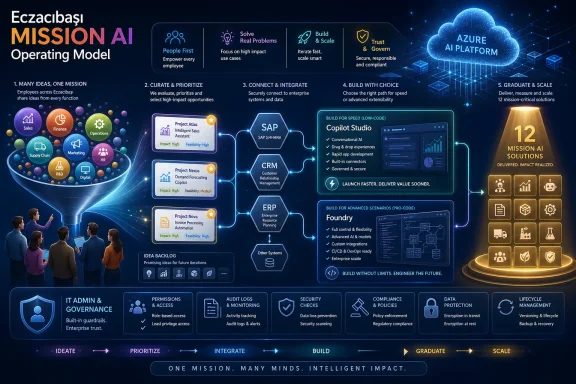 Mission AI Is Really an Operating Model, Not a Hackathon
Microsoft’s customer story frames Mission AI as a group-wide transformation initiative designed to standardize and scale AI adoption across Eczacıbaşı Holding’s diversified business portfolio. That phrase matters. “Standardize and scale” is the unglamorous work most organizations discover only after the first wave of AI enthusiasm: who is allowed to build, which tools are sanctioned, where data can go, how prototypes are judged, and how an idea survives long enough to become useful.The program empowered employees across business units to develop custom AI solutions tailored to operational challenges and business needs. In other words, this was not simply a central IT team building bots for everyone else. Mission AI invited teams from across the affiliate network to participate, contribute insights, and work together on solutions, making the program explicitly collaborative rather than purely top-down.
That design choice is the story’s central tension. Enterprise AI cannot scale if it is treated as a laboratory reserved for specialists, but it also cannot survive if every department improvises its own agents, prompts, connectors, and governance rules. Mission AI’s bet was that a shared framework could give business users room to move without letting the organization fragment into dozens of incompatible experiments.
Fıçı, quoted in Microsoft’s account, describes the program in precisely those terms: “Mission AI bridged the gap between experimentation and sustained value creation, embedding AI into strategic decisions and daily business,” The line is corporate, but the problem it identifies is real. The gap between experimentation and value is where most AI pilots go to die.
The reason is simple: early AI work often rewards novelty, not repeatability. A chatbot that summarizes a document can impress a meeting room, but an agent that touches supply chain workflows, logistics decisions, corporate communications, or marketing operations has to be reliable enough to enter someone’s workday. Mission AI is interesting because it appears to have been built around that second threshold.
The Funnel Shows Demand, but Also Discipline
The most revealing number in the Mission AI story is not the number of prototypes completed. It is the number of applicants at the top of the funnel. According to Microsoft’s customer story, Mission AI produced 358 applicants, from which 58 project ideas were selected for development.That selection ratio says two things at once. First, there was broad internal appetite for AI. Second, Eczacıbaşı did not treat every idea as equally ready, feasible, or valuable. In a mature enterprise AI program, saying no is as important as provisioning the tools.
Fıçı’s second quote underscores the cultural signal: “One defining moment for me was seeing 358 project ideas submitted from across the group in a short period. That showed real organizational readiness for AI,” Read narrowly, that is a statement about engagement. Read operationally, it is a warning to IT: once employees believe AI can solve local problems, demand will arrive faster than governance structures can handle unless the intake process is already there.
The structured pipeline selected 58 project ideas for development. From that group, 27 prototypes were completed, with 12 highlighted as high-impact solutions that could be applied organization-wide. The numbers describe a narrowing curve: broad participation, curated development, completed prototypes, then a smaller set judged potentially reusable beyond one business unit.
That is exactly how AI portfolios should behave. If every applicant becomes a production project, the organization has no prioritization discipline. If every prototype remains trapped in a local pilot, the organization has no scaling mechanism. Mission AI’s value is that it seems to have treated AI ideas as a managed pipeline rather than a suggestion box.
The graduation event hosted at the Microsoft office also matters, not because ceremonies make software better, but because enterprise transformation needs visible rituals. A showcase gives teams a deadline, executives a portfolio view, and participants a sense that their work is part of a broader organizational shift. In large groups with multiple affiliates, that visibility can be the difference between “one department made a clever bot” and “the group now has a repeatable AI delivery motion.”
Low-Code Got People Moving; Foundry Gave the Program a Ceiling
Mission AI participants could choose between Microsoft Copilot Studio and Microsoft Foundry. Microsoft’s source material describes Copilot Studio as offering low-code tools to help empower non-technical users, while Microsoft Foundry supported more advanced, customizable agent development. That division is important because it acknowledges a reality many AI programs try to ignore: not every useful agent should be built by a professional developer, and not every important agent can safely remain a low-code artifact.| Platform path | Primary role in Mission AI | User profile | Development style | Practical advantage |
|---|---|---|---|---|
| Microsoft Copilot Studio | Rapid agent creation for business-led use cases | Non-technical and business users | Low-code tools | Faster participation without deep technical expertise |
| Microsoft Foundry | Advanced, customizable agent development | More technical teams and complex projects | More customizable development | Greater depth for agents needing heavier integration or control |
Microsoft’s own documentation describes Copilot Studio as a graphical, low-code tool for building agents and agent flows. Its official materials emphasize agent creation, knowledge grounding, actions, connectors, analytics, deployment channels, and the ability to start low-code while extending with APIs, custom connectors, and scripts. That aligns with the role Copilot Studio played in Mission AI: it lowered the barrier to participation while still fitting into a broader Microsoft enterprise stack.
But low-code is not magic, and it is not governance. The deeper implication of Mission AI’s two-track tooling model is that successful enterprise AI programs need a migration path from business-authored prototypes to more engineered systems. A department can sketch an agent in Copilot Studio, prove that the workflow matters, and then decide whether the use case requires deeper work in Microsoft Foundry, more formal integration, stronger lifecycle management, or additional technical controls.
That is where many organizations get stuck. They either force everything through central engineering, which kills local momentum, or they let business teams build freely, which creates maintenance and security risk. Mission AI’s design suggests a middle path: let employees propose and prototype, but place those efforts inside a shared framework that can distinguish a local helper from a candidate for organization-wide deployment.
Microsoft’s Stack Is Being Used as the Control Surface
The Microsoft customer story says the program was underpinned by Azure AI Services, Azure OpenAI in Foundry Models, and integration-ready, secure Microsoft productivity platforms. That is not just a vendor list. It shows the architectural center of gravity: Eczacıbaşı’s Mission AI used Microsoft’s cloud AI services, model access, and productivity ecosystem as the substrate for moving ideas into production and deployment.For Microsoft, this is the strategic sweet spot. Copilot Studio is the approachable front door. Foundry is the more advanced build environment. Azure AI Services and Azure OpenAI in Foundry Models provide the AI infrastructure. Microsoft productivity platforms give the agents a place to live near the work people already do.
For customers, the appeal is equally obvious. Building generative AI agents from scratch means dealing with identity, data access, model selection, safety, logging, connectors, and deployment surfaces. Using Microsoft’s stack does not eliminate those problems, but it can concentrate them into a platform environment IT already understands.
The catch is that agent programs eventually collide with line-of-business systems. Microsoft’s account says further integration was planned into systems like SAP, CRM, and ERP for full deployment. That one sentence is where the story moves from AI enthusiasm to enterprise reality.
An agent that drafts marketing copy or summarizes internal documents can often remain at the edge of systems of record. An agent that interacts with SAP, CRM, or ERP enters a different risk class. It may see sensitive data, trigger workflows, influence inventory, shape customer interactions, or affect financial and operational processes. At that point, the question is no longer “can we build it?” but “can we govern it over time?”
That distinction should be familiar to Windows and Microsoft 365 admins. The first phase of adoption is often enablement: licenses, access, templates, pilots. The second phase is control: identity, permissions, data loss prevention, audit trails, connector review, lifecycle management, and rollback plans. Mission AI’s early success depends on the second phase being as deliberate as the first.
Eight Weeks Is Fast Enough to Prove Value, Not Long Enough to Prove Maturity
Mindworks, described in the source material as a Microsoft Solutions Partner specializing in AI-powered digital transformation, analytics, and software solutions, supported Mission AI’s rapid progress. Microsoft says Mindworks helped teams move from ideation to working prototypes in just eight weeks. That is fast, and it is exactly the kind of acceleration enterprises want from partner-led AI programs.But an eight-week prototype window should be interpreted carefully. It is long enough to clarify the problem, identify data sources, build a first version, test assumptions, and show whether the user experience has promise. It is not long enough, by itself, to prove enterprise resilience, compliance readiness, long-term maintenance cost, or measurable return on investment across the organization.
Burak Zararsız, Senior Digital Technologies Manager, describes the adoption model this way: “Adoption was driven by a structured acceleration program and technical coaching,” That phrase is more important than the eight-week number. Acceleration without coaching tends to produce brittle demos. Coaching without a pipeline tends to produce workshops that never turn into systems. Mission AI combined both.
The presence of a partner also tells us something about the real skills gap. Low-code tools can let business users start building, but organizations still need architecture, data, security, and integration expertise to turn prototypes into durable software. The most successful internal AI programs are unlikely to be either purely democratized or purely centralized. They will look like guided ecosystems.
That is especially true when agents cross departmental boundaries. A supply chain agent may need data from planning systems. A logistics agent may need operational feeds. A corporate communications agent may need approved knowledge sources and tone controls. A marketing operations agent may need workflow integration and brand governance. Each prototype may begin with a local pain point, but production use pulls it into shared infrastructure.
Mission AI’s numbers show a program that has already passed the ideation phase. The next test is whether the 12 high-impact solutions can become repeatable, supportable, and measurable after the graduation event ends.
The MVP Stage Is Where the Hard Work Begins
Microsoft says a diverse array of agent prototypes emerged from Mission AI, targeting supply chain, logistics, corporate communications, and marketing operations. Most were at the minimum viable product stage, with further integration into SAP, CRM, and ERP planned for full deployment. Initial performance improvements were observed during pilot deployments and early production use cases within individual business units.That language is appropriately cautious. “Initial performance improvements” is not the same as audited, enterprise-wide productivity gains. “MVP” is not the same as production-grade. “Planned for full deployment” is not the same as fully integrated.
This is not a criticism of Eczacıbaşı; it is a sign that the source material is describing a realistic phase of AI adoption. The danger in enterprise AI coverage is that prototypes are often written up as if they are finished transformations. Mission AI is more interesting if we resist that temptation. The program has demonstrated organizational appetite, built a pipeline, completed 27 prototypes, and identified 12 high-impact candidates. Now those candidates must survive integration.
The hardest step will likely be moving from task assistance to process ownership. An agent that helps a user find information can be useful even if imperfect. An agent that recommends or initiates operational actions needs stricter controls. It must know which data is authoritative, which user is allowed to do what, when human approval is required, and how exceptions are handled.
SAP, CRM, and ERP integration raises these stakes. Enterprise systems are full of business logic that is undocumented, locally customized, or understood only by experienced operators. If an agent simply adds a conversational layer on top, it may save time. If it begins to orchestrate actions across those systems, it becomes part of the control fabric of the business.
That is where Microsoft’s “integration-ready, secure” positioning will meet practical IT scrutiny. Secure platforms help, but security is an implementation discipline. Every connector, permission scope, knowledge source, and action path becomes part of the risk model.
The Real Win Is Organizational Alignment
Mission AI created a shared framework, bringing greater alignment to how solutions were developed and applied. That may sound like bland transformation language, but it is arguably the program’s most important output. In a diversified business portfolio, AI fragmentation is not a theoretical risk; it is the default.Without a common framework, each affiliate or business unit can adopt different models, different data practices, different vendors, different prompt patterns, and different security assumptions. The result is not innovation at scale. It is an estate of disconnected experiments that central IT must later inventory, rationalize, and sometimes shut down.
A shared framework changes the conversation. It gives teams a sanctioned route to participate. It gives leaders a portfolio view. It gives IT a way to review and support projects before they become shadow systems. It gives successful ideas a path to spread more widely.
The inclusivity of Mission AI also matters here. If teams from across the affiliate network are invited to contribute insights and work together on solutions, the program can surface needs that central teams might not see. Supply chain staff know where delays happen. Logistics teams know which exceptions consume time. Communications teams know where approvals slow down. Marketing operations teams know which repetitive tasks create bottlenecks.
This is the strongest argument for business-led AI ideation: the people closest to the workflow often know which problems are worth solving. The strongest argument for central structure is that those same people should not have to become experts in model governance, identity, connectors, and compliance. Mission AI’s design appears to recognize both truths.
Copilot Studio’s Promise Is Speed; Its Risk Is Sprawl
For WindowsForum.com readers, the most relevant part of Mission AI may be the role of Copilot Studio. Microsoft has been positioning Copilot Studio as a low-code way to build agents that can answer questions, automate workflows, connect to knowledge sources, and integrate with other systems. Mission AI provides a concrete example of how that positioning plays out inside a large organization.The speed advantage is clear. Business users can get involved quickly, as Güleyüpoğlu said, without deep technical expertise. That makes AI development less dependent on scarce engineering capacity and allows departments to test ideas before asking for full IT investment.
But every democratized tool creates a governance problem once it becomes successful. The easier it is to build agents, the more agents there will be. Some will duplicate one another. Some will be abandoned. Some will connect to stale documents. Some will encode departmental assumptions. Some will need access to systems they should not touch.
This is why the Mission AI framework matters more than the tooling alone. Copilot Studio can accelerate agent creation, but the organization still needs intake, review, ownership, documentation, testing, and retirement processes. An agent estate without lifecycle management becomes the AI equivalent of spreadsheet sprawl: useful, popular, and dangerously invisible.
Microsoft’s own Copilot Studio materials emphasize that agents can use knowledge sources, tools, connectors, and actions. Those are powerful capabilities, but they are also the points where administrators need discipline. The more an agent can do, the more important it becomes to define what it must not do.
Foundry Signals That Some Agents Need Engineering Gravity
The use of Microsoft Foundry alongside Copilot Studio is a sign that Eczacıbaşı did not treat low-code as the only path. The source material describes Foundry as supporting more advanced, customizable agent development. That matters because AI agents quickly outgrow simple patterns when they need custom orchestration, specialized integrations, model choice, or more rigorous development practices.This is where many enterprise AI roadmaps will split. Simple departmental agents may live comfortably in Copilot Studio. Higher-impact agents may need more technical architecture. The trick is not choosing one tool forever; it is choosing the right tool at the right maturity level.
For IT teams, that means defining escalation criteria. When does a prototype need architectural review? When does it require formal security testing? When does it need source control, environment separation, monitoring, or a production support owner? When does it stop being a “business-built agent” and become an enterprise application?
Mission AI’s model implies that such distinctions are inevitable. Out of 358 applicants, only 58 ideas moved into development. Out of the completed prototypes, 12 were highlighted as high-impact solutions that could be applied organization-wide. The more widely applicable a solution becomes, the less it can remain an informal experiment.
The Foundry path gives organizations a place to put that complexity. It does not remove the need for governance, but it acknowledges that some agents are closer to software engineering than business automation. That distinction will become more important as agents move from answering questions to executing work.
From Pilot Improvements to Business Value, Measurement Must Tighten
Microsoft says initial performance improvements were observed during pilot deployments and early production use cases within individual business units. That is encouraging, but the next phase requires more precise measurement. AI programs that cannot quantify value eventually become vulnerable to budget scrutiny, security objections, and user fatigue.The metrics should vary by use case. A logistics agent might be judged on exception handling time, shipment visibility, or manual follow-up reduction. A supply chain agent might be judged on planning cycle time, forecast support, or faster retrieval of operational context. A corporate communications agent might be judged on drafting speed, approval consistency, or reduced duplication. A marketing operations agent might be judged on campaign workflow throughput or asset management efficiency.
But the common measurement discipline is the same: define a baseline, measure the change, track usage, and watch for quality failures. An agent that saves time but produces unreliable outputs may simply move work from creation to review. An agent that users try once and abandon has not changed the process. An agent that performs well in one business unit may fail elsewhere if the data, language, workflow, or permissions differ.
The fact that 12 prototypes were highlighted as high-impact and potentially organization-wide makes measurement even more important. A local pilot can survive on enthusiasm. A group-wide deployment needs evidence.
This is also where Microsoft and partners often have to move beyond platform enablement into operating discipline. Once agents are in daily business, the questions become less glamorous: who monitors them, who updates them, who validates knowledge sources, who responds when they fail, who approves new connectors, and who decides whether an agent should be retired?
The Windows Admin Angle: Agents Are the New Endpoint Sprawl
Mission AI is not a Windows update story, but it is very much an IT operations story. For administrators living in Microsoft 365, Entra, Power Platform, Azure, SAP-connected environments, CRM systems, and ERP estates, AI agents are becoming another managed surface. They are not just chat windows; they are identities, permissions, connectors, prompts, knowledge sources, actions, logs, and user expectations.That makes the governance model familiar. The same instincts admins developed for endpoint management, app deployment, conditional access, data protection, and SaaS sprawl now apply to agents. Inventory matters. Ownership matters. Least privilege matters. Change control matters. Monitoring matters.
The difference is that agents can blur the line between interface and automation. A user asks a question in natural language; the agent retrieves context, reasons over it, and may call a tool. That chain is harder to reason about than a traditional form submission or script. It requires both technical controls and business process clarity.
Mission AI’s planned integrations into SAP, CRM, and ERP are the point where admins should pay closest attention. Those systems often define the operational truth of the organization. If AI agents become a front end to them, administrators need to know exactly which transactions are read-only, which require approval, which can be automated, and which should remain human-only.
Action checklist for admins
- Create an inventory of all Mission AI-style agents, including owner, business unit, platform path, connected systems, and deployment status.
- Separate MVP pilots from production agents, with different approval, monitoring, and support requirements for each stage.
- Review connectors and permissions before agents integrate with SAP, CRM, ERP, or other systems of record.
- Require documented knowledge sources, update cadence, and fallback paths for agents used in daily business.
- Define escalation criteria for moving a low-code Copilot Studio prototype into a more engineered Microsoft Foundry or IT-led implementation.
- Measure business outcomes against pre-pilot baselines before scaling any agent organization-wide.
The Graduation Event Was a Milestone, Not the Finish Line
The 27 completed prototypes and 12 high-impact solutions were showcased at a graduation event hosted at the Microsoft office. That is a useful endpoint for an acceleration phase. It is not an endpoint for transformation.Graduation events can accidentally create the illusion that the hard part is over. In reality, the hard part begins when a promising prototype must operate in a messy environment with real users, incomplete data, changing business rules, and audit requirements. The prototype phase proves possibility; the production phase tests institutional seriousness.
Mission AI appears to have accomplished what many AI programs fail to do: generate broad participation, filter ideas, provide tool choices, deliver coaching, complete prototypes, and identify candidates for wider reuse. That is a strong foundation. But the next phase will determine whether the program becomes an engine for sustained value or a successful internal showcase.
The distinction will depend on integration and governance. Agents that remain disconnected from core systems may still be useful, but their impact will be limited. Agents that connect deeply into SAP, CRM, and ERP may create more value, but they will also require stronger controls. The highest-impact use cases are almost always the ones that demand the most operational maturity.
This is why Fıçı’s phrase about bridging experimentation and sustained value creation is the right lens for the story. The bridge has been built; now traffic has to cross it safely.
What Other Enterprises Should Steal From Mission AI
Mission AI’s most transferable lesson is not “use Microsoft Copilot Studio.” It is that enterprise AI adoption needs a system for converting employee demand into governed delivery. The platform matters, but the program architecture matters more.A few practical lessons stand out:
- Broad participation works best when paired with a selective funnel, as shown by 358 applicants narrowing to 58 selected ideas.
- Low-code tools can accelerate adoption, but high-impact agents need a path toward deeper engineering and integration.
- Partner-led acceleration can compress ideation into working prototypes, but production maturity still requires internal ownership.
- MVP-stage agents should be treated as evidence-gathering instruments, not finished enterprise systems.
- Integration with SAP, CRM, and ERP is where AI pilots become operationally serious.
- The real asset is the shared framework that aligns how solutions are developed, applied, evaluated, and scaled.
The next wave of enterprise AI will not be won by the organization with the most prototypes, the flashiest agent demos, or the broadest license deployment. It will be won by organizations that can absorb employee creativity without losing control, connect agents to real systems without weakening governance, and measure value after the excitement fades. Mission AI is still early in that journey, but it shows the shape of the model others will be pressured to build: inclusive at the edge, disciplined at the core, and increasingly tied to the systems where business actually happens.
References
- Primary source: Microsoft
Published: 2026-07-09T08:12:07.584350
Loading…
www.microsoft.com - Related coverage: windowscentral.com
What is Project Aion? Inside Microsoft's secret agentic Copilot OS incubation project that runs on Windows and Android | Windows Central
Project Aion is a 2024 incubation effort designed to build out a functioning Copilot OS experience, capable of running on Windows, Android, and focused entirely on the web and agentic AI.www.windowscentral.com - Official source: learn.microsoft.com
Foundry Models sold by Azure - Microsoft Foundry | Microsoft Learn
Learn about Microsoft Foundry Models sold by Azure, their capabilities, deployment types, and regional availability for AI applications.learn.microsoft.com - Official source: developer.microsoft.com
Microsoft 365 Copilot | Extend and Customize Copilot
Extend, enrich, and customize Microsoft Microsoft 365 Copilot. Explore Copilot extensibility options such as agents, API plugins, and Copilot connectors to expand AI-powered productivity, skills, and creativity.developer.microsoft.com - Official source: azure.microsoft.com
Loading…
azure.microsoft.com - Official source: microsoft.github.io
Microsoft AI Technologies | Microsoft AI Decision Framework
Complete reference for Microsoft’s AI technology portfoliomicrosoft.github.io
- Official source: devblogs.microsoft.com
What's new in Microsoft Foundry | May 2026 | Microsoft Foundry Blog
Latest Microsoft Foundry updates for May 2026, including new models, agent skills and toolboxes, Foundry Local vision, evaluations, SDK releases, and platform improvementsdevblogs.microsoft.com - Official source: cdn-dynmedia-1.microsoft.com
- Official source: marketingassets.microsoft.com
Loading…
marketingassets.microsoft.com - Official source: techcommunity.microsoft.com
- Related coverage: techradar.com
From code-first to intent-first: Microsoft Build 2026 could be the end of programming as we know it | TechRadar
Redefining what it means to be a developer with agentic AIwww.techradar.com - Related coverage: tomsguide.com
Biggest Microsoft Build 2026 announcements — agentic AI, RTX Spark Dev Box, GitHub Copilot app, new MAI models, and more | Tom's Guide
All the big news from Microsoft's AI-focused eventwww.tomsguide.com - Related coverage: tomshardware.com
Microsoft adds Grok 4 to Azure AI Foundry following cautious trials — Elon Musk's latest AI model is now available to deploy for "frontier‑level reasoning" | Tom's Hardware
Comes with a 128K-token context window.www.tomshardware.com