
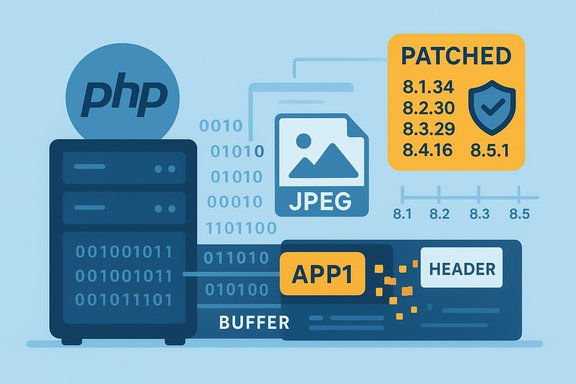
PHP’s core image helper has a subtle but consequential flaw: CVE‑2025‑14177 is an information‑disclosure bug in the getimagesize implementation that can cause uninitialized heap bytes to be copied into JPEG APPn metadata (for example APP1), leaking fragments of process memory when images are read in multi‑chunk mode (such as via php://filter). Upstream researchers published a minimal proof‑of‑concept and the PHP project issued patches in the 8.1.34 / 8.2.30 / 8.3.29 / 8.4.16 / 8.5.1 releases; operators should treat this as a medium‑severity confidentiality issue and prioritize updates for any hosts that parse or transform untrusted image content.
 Background
What was disclosed
CVE‑2025‑14177 was reported to the PHP project and publicly recorded on December 27, 2025. The vulnerability affects multiple maintained PHP branches: 8.1, 8.2, 8.3, 8.4 and 8.5 before the patched builds (8.1.34, 8.2.30, 8.3.29, 8.4.16 and 8.5.1). The bug causes the getimagesize call to return APPn metadata that may include uninitialized heap bytes when the underlying stream is read in multiple chunks.
Why this matters
getimagesize is commonly used by web applications and backend services to inspect uploaded images (dimensions, MIME, and embedded metadata). An attacker who can control the input stream or the conditions under which getimagesize runs can harvest small fragments of memory from the PHP process. Those fragments can contain pointers, heap metadata, session tokens, API keys, or other sensitive information — data that can materially lower the cost of follow‑on attacks. The issue is an information‑leak (confidentiality) problem rather than a direct code‑execution primitive, but leaks are valuable to attackers because they reduce entropy for exploit chains and can facilitate bypassing address space layout randomization (ASLR) or other defenses.
Technical overview
The root cause, in plain language
At its core the bug is an error in the stream read path used by PHP’s image handling code: the function that reads a stream in multiple chunks (php_read_stream_all_chunks writes each incoming chunk into the beginning of the destination buffer without advancing the write pointer between iterations. The function then reports that the buffer was filled, but the tail of the buffer may still contain leftover, uninitialized bytes. That buffer is later copied into the associative $info array returned by getimagesize, specifically into entries such as $info['APP1'], making uninitialized (and potentially sensitive) heap bytes visible to PHP code that inspects the APPn segments.
Multi‑chunk reads and php://filter
The issue is most reliably triggered when the source is read in multiple chunks. A commonly used way to force multi‑chunk reads is to route the file through a stream filter (for example, php://filter/read=string.rot13/resource=..., which intentionally changes how the stream is consumed so that multiple read operations occur. In practice the same bug can be triggered on "normal" images if the attacker or environment causes the reads to arrive in chunks; the upstream advisory explicitly notes that exploitability improves if an attacker knows or can influence the stream chunking behavior.
Proof‑of‑concept (PoC) summary
The upstream advisory includes a concise PoC (a small PHP script) that:
- Builds a minimal JPEG with a deliberately large APP1 section so it will be read across multiple chunks.
- Performs a small heap‑spray of a recognizable marker string and then frees those objects to increase the chance that the uninitialized buffer will contain the marker.
- Reads the JPEG through php://filter to enforce chunked reads and calls getimagesize($src, $info).
- Inspects $info['APP1'] for the marker and prints expected vs. returned APP1 lengths and a short snippet if the marker appears.
That PoC reliably demonstrates both corruption (when the returned head differs) and leakage (when the marker appears inside APP1), proving the presence of uninitialized memory in returned metadata.
Severity, scoring, and real‑world exploitability
CVSS and classification
The National Vulnerability Database and multiple vulnerability trackers list CVE‑2025‑14177 with a CVSS base score in the medium range (CVSS 4.0 = 6.3 per the NVD/CNA entry). Trackers classify the weakness as a heap out‑of‑bounds read (CWE‑125), with network attack vector in operational terms where an attacker can submit image content to a remote service that processes uploads, but with higher attack complexity compared to trivial remote parsing bugs because triggering the leak reliably typically depends on chunking behavior or filter usage.
When this becomes remotely exploitable
By itself this bug is a file‑based parsing/stream read issue. A remote attacker can leverage it if they can cause a vulnerable PHP process to call getimagesize on attacker‑controlled data — the canonical risk scenario is an unauthenticated upload endpoint that performs server‑side analysis (dimension check, thumbnailing, EXIF inspection) of user images. In that setting a carefully crafted image (or an image read via php://filter) can cause the process to leak fragments of heap memory back into PHP variables that the attacker can then exfiltrate through subsequent application behavior. The upstream advisory specifically calls out the ability to make this exploit practicable if the attacker knows or can control the stream’s chunking behavior.
What it does not mean
Published advisories and triage analyses emphasize that CVE‑2025‑14177 is not described as a standalone remote code‑execution (RCE) vulnerability. Read‑overflows are typically information disclosure issues; while they materially aid attackers and can be staged into full exploits when combined with other weaknesses, claims that this CVE directly yields unauthenticated RCE are unverified without additional chained primitives. Treat high‑impact exploit claims with caution until independent telemetry or reliable exploit code confirms them.
Affected products and patched versions
- PHP 8.1 before 8.1.34 — patched in 8.1.34.
- PHP 8.2 before 8.2.30 — patched in 8.2.30.
- PHP 8.3 before 8.3.29 — patched in 8.3.29.
- PHP 8.4 before 8.4.16 — patched in 8.4.16.
- PHP 8.5 before 8.5.1 — patched in 8.5.1.
Distributions and third‑party packagers are already packaging these fixes (for example Debian, Mageia and other Linux vendors listed security updates that include the upstream patch). If you rely on vendor packages (APT/YUM/zypper or container base images), consult your distribution’s security feed and apply the updated packages or rebuild images as required.
Detection and forensic indicators
What to look for in logs and telemetry
- Unexpected or repeated calls to getimagesize, image metadata reads, or parsing services immediately prior to application crashes or odd responses.
- Discrepancies between expected APPn lengths and returned metadata for JPEGs — the upstream PoC prints “APP1 length: expected=…, actual=…”, demonstrating a simple programmatic check you can adopt during testing.
- Process crash dumps or core files where the call stack includes ext/standard/image.c and php_read_stream_all_chunks — these point directly to the vulnerable code path.
- Unusual outbound traffic or application responses immediately after image upload events (possible exfiltration attempts).
Capture and preserve
If you suspect exploitation:
- Preserve the original uploaded file(s) and associated HTTP request metadata (headers, source IP, timestamps).
- Collect PHP error logs, web server logs, and any core dumps. Save the PHP build (binary) and exact version string reported by php -v.
- Isolate affected hosts and collect memory snapshots if your incident‑response processes support safe memory acquisition.
Mitigation and remediation (practical checklist)
Immediate (short term)
- Apply vendor or upstream patches immediately: upgrade to PHP versions 8.1.34, 8.2.30, 8.3.29, 8.4.16 or 8.5.1 depending on your branch. This is the definitive fix.
- If you cannot immediately upgrade, restrict or disable untrusted image processing where feasible: remove automated thumbnailing or previewing pipelines for public upload endpoints until patched.
- If your application uses php://filter or other stream wrappers on untrusted inputs, audit those call sites and avoid applying getimagesize to streams that you cannot control or verify.
Recommended (medium term)
- Inventory all hosts and containers that run PHP and all applications that call getimagesize or otherwise parse uploaded images. Pay special attention to:
- Public‑facing upload endpoints (CMS thumbnailers, webmail, image CDNs).
- Container base images and CI artifacts that may contain vulnerable PHP builds.
- Statically linked PHP builds or vendor bundles embedded in packaged appliances or desktop apps (these require rebuilds).
- Rebuild and redeploy container images and statically linked apps with patched PHP packages; for containers the fix often requires a simple image rebuild and rotation.
- Harden upload processing:
- Enforce strict magic‑byte checks (reject non‑image files).
- Limit processing to explicit, known‑good code paths and avoid passing arbitrary user content through php://filter unless strictly necessary.
- Run image‑processing workers in isolated sandboxes with minimal privileges and strong outbound egress controls.
Defensive coding and environment hardening
- Avoid using getimagesize on untrusted streams when possible; prefer safer libraries or perform image parsing with vetted, sandboxed microservices.
- Consider memory‑sanitizer or ASAN‑style builds in pre‑production to catch similar issues earlier in CI pipelines.
- Maintain fast, automated patching pipelines for language runtimes and shared libraries — this reduces the window between disclosure and remediation.
Notes on disabling stream wrappers: while it is technically possible to unregister or restore stream wrappers at runtime with the stream_wrapper_unregister/stream_wrapper_restore API, removing built‑in wrappers such as php:// can break legitimate functionality (for example php://input and other essential stream features). Use this approach only as a carefully tested, last‑resort mitigation and never in production without full compatibility testing.
Operational guidance for Windows administrators
Why Windows admins should care
Even though PHP is primarily associated with Linux web stacks, Windows servers and development environments run PHP for many CMS, intranet, and developer‑tools scenarios. Any Windows host that runs a vulnerable PHP build (IIS + PHP, XAMPP, WAMP, or packaged PHP runtimes inside applications) must be mapped and patched. Focus on:
- IIS servers hosting PHP apps and any services that perform image processing.
- Developer and CI machines that build container images or packages containing PHP (these seeds become downstream exposures).
Patch and verification workflow (Windows)
- Identify PHP instances: locate php.ini and run php -v on each host. Aggregate results.
- Back up current configuration and binaries.
- Apply the official PHP security update (download the appropriate Windows binaries / installers or use your vendor’s packages).
- Restart IIS / application pools and verify php -v reports the patched versions.
- Run a targeted functional test suite that exercises image upload and processing paths; ensure no regressions and that getimagesize returns expected metadata for benign samples.
Detection scripts and test ideas
- Reuse the upstream PoC concept (in a controlled lab) to verify whether your PHP builds are vulnerable: create a minimal JPEG with a large APP1 payload, heap‑spray a marker, read it via php://filter, and check $info['APP1'] for marker leakage. Do this only in isolated test environments — never on production or customer data.
- Add an automated health check that calls getimagesize on a prepared test stream and fails if the returned APPn segment length mismatches the expected length or if uninitialized bytes are detected.
- For broader fleet hunting, search logs for upload events followed by anomalous outbound activity or unusual application responses (these are proxy indicators of exfiltration attempts).
Risk assessment — who should act first
- Public‑facing upload processors (image CDNs, webmail, CMS instances) — highest priority. An unauthenticated attacker can reach these endpoints directly.
- Services that auto‑thumbnail or parse image metadata at scale (background workers) — second priority since they process many user files automatically.
- Desktop clients or document processors bundled with PHP or PHP extensions — medium priority; exploit requires local file processing or user interaction in many desktop scenarios.
- Embedded appliances and legacy vendors that ship static PHP builds — long‑tail risk; these may never receive timely updates and should be isolated.
Strengths of the upstream response — and remaining risks
Notable positives
- The PHP project published a clear advisory with a PoC and shipped patches across supported branches quickly. That makes detection and remediation practicable for administrators and packagers.
- Multiple downstream trackers (NVD, distro vendors, security vendors) indexed the CVE promptly and added package mappings, accelerating enterprise patch workflows.
Remaining risks and caveats
- Patch availability does not equal instant remediation; container images, embedded devices, and statically linked binaries require rebuilds and redeploys, which can create long tails of exposure.
- The exploitability depends on chunking and filter usage; attackers may find creative ways to force chunked reads in diverse environments. Assume exploitability is feasible in high‑throughput image‑processing services.
- Public PoCs reduce the bar for attackers. Even if no mass exploitation is observed today, the combination of PoC and ubiquitous image processing pipelines means defenders should update urgently.
Final recommendations — prioritized checklist
- Patch now: upgrade all PHP installations to the patched releases listed above. Confirm with php -v and restart services.
- Inventory: build an inventory of image processing endpoints (server and client) and static bundles that include PHP. Prioritize public upload processors and container images.
- If immediate patching is impossible: disable or throttle automated image processing, quarantine untrusted uploads, and increase logging and sandboxing for workers.
- Test: run the PoC in isolated labs to confirm patch effectiveness and to exercise detection signatures.
- Rebuild images and redistributables: for any software bundles or containers that statically include PHP, perform rebuilds with patched PHP and rotate images.
- Monitor for anomalous reads/exfil patterns and review crash telemetry for signatures of ext/standard/image.c in stacks.
Conclusion
CVE‑2025‑14177 is a practical reminder that even mature language runtimes can harbor subtle I/O and buffer‑management issues that only show up under specific streaming conditions. The bug is an information‑disclosure weakness in getimagesize that has been fixed upstream; the path to safety is straightforward — apply the security updates and validate your image‑processing pipelines. For organizations that process large volumes of untrusted images, the operational risk is real: patched systems close the window, but inventories, rebuilds and sandboxing policies are the durable defenses that prevent small runtime defects from becoming large incidents. Act quickly, patch comprehensively, and assume an attacker who finds any unpatched image pipeline will attempt to weaponize the leak.
Note: this article summarizes published advisories and technical PoCs from the PHP project and public vulnerability databases; any claims about full remote code execution based on CVE‑2025‑14177 alone remain unverified and should be treated with caution until independently corroborated.
