

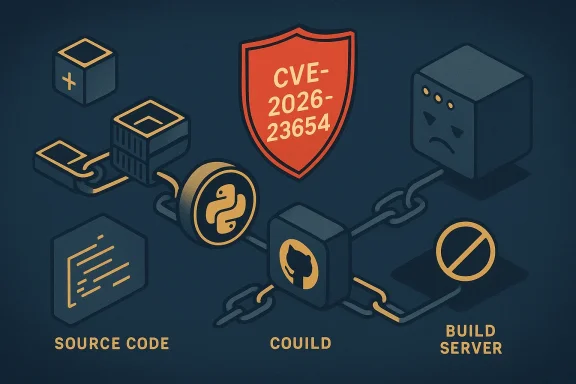
Microsoft's security catalog now lists CVE-2026-23654 — a high‑severity remote code execution (RCE) issue tied to the GitHub repository microsoft/zero-shot-scfoundation — and the vendor has issued an official remediation as part of the March 10, 2026 patch cycle. The flaw is not a classic buffer-overflow or web server bug; instead it stems from an improperly managed third‑party dependency in an open-source research repo used to evaluate single‑cell foundation models. When left unmitigated, the dependency chain can be abused to deliver and execute attacker-controlled code during installation or runtime, turning a code-of-record repository into an RCE vector for development, CI/CD, or research environments.
The microsoft/zero-shot-scfoundation repository hosts evaluation code that accompanies academic work on single‑cell foundation models. The project is primarily a research codebase — Jupyter notebooks, Docker configurations and dependency declarations — designed to reproduce benchmarks for models such as Geneformer and scGPT. The repository’s README and installation guide show the project depends on a collection of Python packages and external models, some of which are pulled directly from remote sources (GitHub or Hugging Face commits) or installed at runtime. (github.com)
What changed in this advisory is the classification of a supply‑chain / dependency risk as an RCE: a malicious actor who can substitute or introduce a package into the dependency chain (for example, by publishing a trojanized package to a public registry or exploiting an insufficiently pinned dependency) can achieve arbitrary code execution on hosts that install or run the vulnerable environment. Microsoft has cataloged this as CVE‑2026‑23654, assigned a high CVSS v3.1 score (reported publicly as 8.8), and marked the remediation level as OFFICIAL_FIX in the vendor bulletin distributed during the March 10, 2026 update cycle. Multiple industry trackers and reporting outlets summarized the vendor guidance as part of that release.
Caveat: some secondary reporting has appended speculative details around how the package might be substituted or whether specific CI systems have already been abused; those elements require forensic verification case‑by‑case. The vendor and early summaries do not identify confirmed in‑the‑wild exploitation, and you should treat speculative attack paths as possible but unproven until your telemetry suggests otherwise.
Source: MSRC Security Update Guide - Microsoft Security Response Center
 Background / Overview
The microsoft/zero-shot-scfoundation repository hosts evaluation code that accompanies academic work on single‑cell foundation models. The project is primarily a research codebase — Jupyter notebooks, Docker configurations and dependency declarations — designed to reproduce benchmarks for models such as Geneformer and scGPT. The repository’s README and installation guide show the project depends on a collection of Python packages and external models, some of which are pulled directly from remote sources (GitHub or Hugging Face commits) or installed at runtime. (github.com)What changed in this advisory is the classification of a supply‑chain / dependency risk as an RCE: a malicious actor who can substitute or introduce a package into the dependency chain (for example, by publishing a trojanized package to a public registry or exploiting an insufficiently pinned dependency) can achieve arbitrary code execution on hosts that install or run the vulnerable environment. Microsoft has cataloged this as CVE‑2026‑23654, assigned a high CVSS v3.1 score (reported publicly as 8.8), and marked the remediation level as OFFICIAL_FIX in the vendor bulletin distributed during the March 10, 2026 update cycle. Multiple industry trackers and reporting outlets summarized the vendor guidance as part of that release.
Why this matters: the modern attack surface of research repos
Open-source research repositories are a widespread, legitimate part of modern development and academic practice, but they have these characteristics that raise supply‑chain risk:- They often include automated installation instructions that pull code or models from third‑party registries or Git repositories.
- Many reproduction workflows run on shared infrastructure (developer laptops, CI systems, cloud instances) where a single compromised dependency can execute arbitrary code under the installer’s privileges.
- Researchers frequently use Docker or reproducible environment images that are treated as trusted — a trojanized package installed during image build becomes persistent and hard to detect.
- Notebooks and demo scripts increase the chance that code downloaded as part of an evaluation gets executed interactively or in automated test harnesses.
Technical anatomy of CVE‑2026‑23654
What the vendor classified
Microsoft’s public advisory treats the issue as a dependency‑related RCE: the project references or installs a third‑party component that, if substituted with a malicious package, can cause the installation or runtime process to execute attacker code. Public reporting clarifies that the vulnerable vector is the project's dependency chain rather than a memory corruption bug in native code. The CVE was included in Microsoft’s March security rollup and described in mainstream patch coverage as an Important / High risk requiring attention from developers and ops teams that use or deploy the repository.How the dependency attack works (high level)
- The repository lists or installs a package or model by name, commit, or URL. In some workflows that name could be resolved against multiple possible registries (public PyPI, private index, git+https, etc.).
- An attacker publishes a malicious package under the same name to a publicly available registry, or otherwise compromises the expected source.
- When a maintainer, researcher, or CI pipeline installs dependencies (pip install, Docker build, etc.), the package manager resolves and downloads the attacker's package.
- The malicious package contains installation hooks, post‑install scripts, or runtime code that triggers arbitrary actions on the host: spawning reverse shells, writing backdoors, or exfiltrating secrets present in the build/CI environment.
Evidence in the repository
The repository’s README and installation guide document the use of external models and git‑sourced installs (for example, references to pip installing from git+https URIs for Geneformer and scGPT, and Docker images that pull model artifacts). The requirements.txt included in the repo shows core Python dependencies but the INSTALLATION_GUIDE explicitly instructs how to fetch Hugging Face and GitHub model artifacts — actions that, if misconfigured, could resolve to attacker-controlled content in some environments. The presence of dynamic install steps and remote model pulls is the practical reason this codebase was flagged. (raw.githubusercontent.com)Scope and impact
- Attack vector: local/remote via installation and build pipelines that resolve dependencies automatically (CI systems, developer machines, Docker image builds). The vulnerability can lead to arbitrary code execution with the privileges of the installing user or build agent.
- CVSS and severity: public reporting shows a CVSS v3.1 base score reported as 8.8 and the issue was listed as part of Microsoft’s March 10, 2026 security publications. Microsoft’s remediation entry is marked OFFICIAL_FIX. There is currently no public evidence of active exploitation, according to public tracking summaries, but the high impact and accessible attack surface make timely mitigation prudent.
- Affected environments: anything that follows the repository’s default installation procedure without additional hardening — especially Docker image builds and CI runners that run pip installs or mount secrets. Research clusters and shared compute nodes are of particular concern because they may use cached credentials or shared tokens that an attacker can exploit for lateral movement or data exfiltration.
What Microsoft and others say (and where to trust the details)
Microsoft included CVE‑2026‑23654 in its March 2026 update guidance and marked the remediation level as an official fix; industry coverage from security outlets (BleepingComputer, Redmond Magazine, SANS, and several patch Tuesday roundups) picked up the advisory and summarized the risk as a dependency‑confusion style RCE in the zero‑shot repository. Independent technical writeups (Action1, patch‑management advisories) also described the root cause as a loosely controlled third‑party dependency that could be substituted via public registries, creating an installation‑time execution channel. These multiple independent sources — vendor bulletin entries and reporting from established tech security publications — together corroborate the core technical story.Caveat: some secondary reporting has appended speculative details around how the package might be substituted or whether specific CI systems have already been abused; those elements require forensic verification case‑by‑case. The vendor and early summaries do not identify confirmed in‑the‑wild exploitation, and you should treat speculative attack paths as possible but unproven until your telemetry suggests otherwise.
Detection: what to look for in your environment
If you or your organization pulled or built code from the zero‑shot repository, do the following immediate checks:- Verify recent builds and CI logs for unexpected pip install steps resolving to packages outside expected registries. Look for git+https installs that may have been redirected or rewritten.
- Inspect Docker image layers and build output for added binaries, suspicious postinstall scripts, or unexpected network activity during image creation.
- Search pip cache and site‑packages for newly installed modules that match the suspect names (e.g., poorly‑known dependency names) and check package metadata for unexpected authorship or upload timestamps.
- On build servers and developer machines, look for unexpected outbound connections from build agents or elevated subprocesses that began around the time of recent installs.
- Monitor endpoint and EDR telemetry for unknown processes, reverse shell indicators, or execution of Python packages from unusual locations.
- If you use artifact registries (internal package caches or Docker registries), validate package and image signatures and check whether recent pushes match known maintainers.
Remediation and mitigation — practical steps for developers and ops
Apply the following prioritized actions immediately:- Patch and update: Apply Microsoft’s official remediation or updates referenced in the March 10, 2026 advisory if you manage a curated set of images or if your organization has already integrated the zero‑shot project into internal tooling. The vendor’s fix was published during the March 2026 update cycle.
- Pin and lock dependencies:
- Use exact, immutable references for external artifacts: git commits (git+https@COMMIT), pinned Hugging Face model commits, or pinned package versions.
- Maintain dependency lockfiles (pip‑tools, poetry.lock) and check them into source control for reproducible installs.
- Use private registries and pull‑through caches:
- Configure pip and Docker to use internal, vetted package caches and registries that only accept artifacts from approved publishers.
- Block direct resolution from public registries in CI unless explicitly allowed and signed.
- Enforce package signing and verification:
- Where possible, validate package integrity using checksums, PGP signatures, or reproducible code builds. Reject packages that lack expected signatures or that show unusual provenance.
- Harden CI and build agents:
- Run builds in ephemeral, privilege‑limited containers with no access to production secrets.
- Avoid mounting host credential stores or tokens into build containers.
- Apply network egress controls: limit outbound access from build systems to required package sources only.
- Adopt software composition analysis (SCA):
- Use automated SCA tools to flag new transitive dependencies, particularly those without established maintainers or that were recently published.
- Integrate SCA alerts into PR workflows so risky dependency changes are reviewed before merging.
- Rotate secrets and short‑lived tokens:
- If you suspect any CI runner or build agent may have installed a malicious package, consider rotation of keys and tokens that may have been accessible to that environment.
Hardening recommendations for research codebases
Research repos should be treated differently from mature production projects:- Prefer Docker image artifacts hosted in controlled registries over recommending live installs from public registries in README instructions.
- Clearly document the exact provenance of large model artifacts: include checksums, signed releases, and immutable commit hashes.
- Limit default instructions to non‑privileged reproduction: avoid telling users to run setup scripts as root or to run flows that require host mounts of credentials.
- Encourage reproducible environments: provide a prebuilt, vetted container (with limited privileges) or a Binder/Colab artifact rather than a command sequence that performs live installs from the internet.
- Adopt lightweight SLSA provenance for critical research deliverables so downstream users can reason about the chain of custody for artifacts.
Incident response playbook (condensed)
If you find evidence of possible compromise or unexpected installs linked to zero‑shot‑scfoundation dependencies:- Immediately isolate the impacted build agents and revoke any CI tokens that were available to those agents.
- Capture forensic artifacts: full CI logs, container images, build caches, pip caches, and file system snapshots.
- Scan for persistence: unexpected scheduled tasks, cron entries, systemd units, or uploaded artifacts in public web directories.
- Rotate credentials that may have been present in the environment (short‑lived tokens, service principals, SSH keys).
- Restore affected machines from known‑good images; do not trust a post‑compromise cleanup unless validated by forensic evidence.
- Notify stakeholders and, if appropriate, file a security incident to your vendor or to law enforcement per your organization’s incident handling policy.
Strengths, weaknesses, and broader implications
Notable strengths in the vendor response and public coverage
- Microsoft cataloged the issue as a CVE and rolled it into the March 2026 update guidance, giving teams a canonical reference to act on.
- Public reporting from multiple independent outlets (security media and patch‑management vendors) reinforced that the issue is a supply‑chain dependency risk rather than an exploitable memory bug, which focuses mitigations on package management and CI hygiene.
Persistent weaknesses and risks
- Research repositories frequently rely on ad hoc instructions, which increases the chance of misconfiguration by downstream users. The zero‑shot repo’s Docker‑forward and remote model pulls are typical of projects that prioritize reproducibility over security.
- The attack surface is amplified by CI systems and shared research compute where credentials may be available to build environments.
- Public reporting has not (at the time of the advisory) documented active exploitation, but the lack of a public POC does not prevent attackers from weaponizing the path quickly once details are widely known. The window between vulnerability disclosure and weaponization has shrunk in recent years.
Broader lessons for the community
This CVE is a reminder that the software supply chain extends beyond classic runtime dependencies into the research and model‑serving ecosystems that power AI and data science work. As organizations rely more on community code and model artifacts, supply‑chain controls — private registries, pinned artifacts, signed releases, hardened CI — move from “best practice” to “essential.” The advisory should therefore be a wake‑up call to research teams, universities, and small labs that may be less prepared to apply enterprise-grade dependency controls.Quick checklist (for immediate action)
- If you cloned or used microsoft/zero-shot-scfoundation since early March 2026, assume risk and:
- Rebuild Docker images from vetted base images and verify layers.
- Re‑run CI builds with network egress blocked except to approved registries.
- Pin or vendor model artifacts and pip packages used by your experiments.
- Rotate any CI tokens or credentials that were available to build agents.
- Add detection heuristics:
- Alert on unexpected pip installs during CI runs.
- Alert on Docker image layers that add binaries outside expected build paths.
- Scan cached packages for unexpected publishers or upload timestamps.
Conclusion
CVE‑2026‑23654 illustrates a familiar but still underappreciated class of threats: supply‑chain RCE through loosely controlled research dependencies. The microsoft/zero-shot-scfoundation project is a legitimate academic artifact, but its default installation patterns — remote model pulls, dynamic installs, and Docker image builds — expose downstream users to the risk of package substitution and installation‑time code execution. Microsoft’s inclusion of the CVE in the March 10, 2026 update guidance and the subsequent coverage from multiple security outlets should prompt an immediate review of any usage of the repository in development, CI, or production pipelines. Patch where a vendor fix exists, pin and sign artifacts, harden your CI and build environments, and treat research code as a first‑class element of your supply‑chain security model. The technical details are straightforward and fixable — but prevention requires changes in developer habits and operational controls before the next commodity supply‑chain exploit appears.Source: MSRC Security Update Guide - Microsoft Security Response Center
